ABSTRACT
WAN, YANJUN. Simple Molecule Mercury Sensor. (Under the direction of Dr. Christopher B. Gorman.)
Several molecules previously produced from a nitrile-based cascade cyclization were
examined as potential mercury sensors. Various analytical parameters, including fluorescence
quantum yield, UV shift, fluorescence quenching, binding constant, binding ratio, and lowest
detection limit, were measured. The best mercury sensor molecule was found to be molecule
3c, which could be easily synthesized in gram quantities (3 steps, 55% overall yield). This molecule has a very high fluorescence quantum yield (Φ = 0.87), high sensitivity and
selectivity towards mercury ion in both organic and aqueous media. The overall performance
Simple Molecule Mercury Sensor
by
Yanjun Wan
A thesis submitted to the Graduate Faculty of
North Carolina State University
In partial fulfillment of the
Requirements for the degree of
Master of Science
Chemistry
Raleigh, North Carolina
2008
APPROVED BY:
______________________________
Christopher Gorman
Committee Chair
______________________________
Stefan Franzen
______________________________
Edmond Bowden
DEDICATION
Seek first his kingdom and his righteousness, and all these things will be given to you as
well.
BIOGRAPHY
Yanjun Wan was born in China in the year of 1983. She attended elementary school,
middle school, and high school in China, and graduated high school with straight As. After
high school, Yanjun attended Shanghai Jiao Tong University. In June 2005, Yanjun
graduated from Shanghai Jiao Tong University with a Bachelor of Science degree in
Chemistry, and a Bachelor of Arts degree in Finance as double-major. To further her
knowledge in Chemistry, Yanjun decided to go to graduate school at North Carolina State
University, where she pursued a Master of Science degree in Chemistry under the direction
ACKNOWLEDGMENTS
I would like to first thank my parents for their love and support, despite of the distance
between us. I would also like to thank Berk and Barbara Wilson, who are like my parents in
Raleigh, for bringing light to my life, and teaching me the righteous way of living through
life’s up-and-downs, and for their constant love, care, and encouragement.
I would like to thank Dr. Christopher B. Gorman for being the most wonderful advisor I
could ever imagine. He taught me not just Chemistry, but a whole series of life philosophy,
which is eventually even more important than Chemistry; when I look back, working for him
is one of my wisest decisions in life. I would also like to thank all members in my Advisory
Committee, Dr. Edmond Bowden, Dr. Stefan Franzen, and Dr. David Shultz, for always
being available and patient whenever I have any questions. I would like to thank the Gorman
Group. Every single one of them has always been helpful and encouraging to me. It was my
pleasure to be able to work with them. I would also like to thank Dr. Paul Boyle for X-ray
Structure Analysis, Dr. Matthew Lynton for Mass Spectroscopy Analysis, Dr. Lin He for
suggestions on fluorescence measurements. The Mercury Sensor Project was supported by
US Department of Energy (Grant DE-FG02-05ER46238). The Molecular Transistor Project
was supported by National Science Foundation (DMR-0303746).
I would like to thank my “brothers and sisters” in Raleigh, Sasha Movchan, Susan Pope,
and Alina Efremenko, for always being there when I cry or when I laugh, and for loving me
and always supporting me in front of others, yet never hesitating to point out my faults
TABLE OF CONTENTS
LIST OF TABLES ... vi
LIST OF FIGURES ... vii
LIST OF SCHEMES ... ix
INTRODUCTION ... 1
1.1 The Importance of Mercury Sensing ... 2
1.2 Four Major Categories of Mercury Sensors ... 2
1.3 Organic Dye Based Mercury Sensors –Advantages and Challenges ... 7
A SMALL MOLECULE MERCURY SENSOR ... 9
2.1 Introduction... 10
2.2 Results and Discussion ... 11
2.3 Conclusions ... 24
2.4 Experimental Section ... 27
MOLECULAR TRANSISTOR PROJECT ... 33
3.1 Introduction... 34
3.2 Results and Discussion ... 37
3.21 Synthesis and Characterization of Linker Molecules ... 37
3.22 Synthesis of Metal and Metal Oxide Nanoparticles ... 39
3.23 Ligand Exchange Experiments ... 39
3.3 Conclusion ... 43
3.4 Prospects for Synthesis of Nanoparticle Hetero-dimers and Hetero-trimers ... 43
3.5 Experimental Section ... 51
LIST OF TABLES
Table 1. A summary of recently reported mercury sensors. ... 3
Table 2. Photophysical data for 3b, 3c, 5b, and 5c. ... 14
Table 3. Different base systems for invariant concentration Job plot. ... 17
Table 4. Binding constant Ka of molecule 3c to different metal cations, calculated by
Benesi-Hildebrand plot. ... 21
Table 5. A quantitative comparison of molecule 3c to other promising organic dye based mercury sensors. ... 25
LIST OF FIGURES
Figure 1. X-ray crystal structures of 3b, 3c, 5b, and 5c. ... 12
Figure 2. Photograph of solutionsof0.1mM 3b, 3c, 5b, and 5c under UV light. ... 13
Figure 3. Electronic absorption spectra of 3b, 3c, 5b, and 5c in acetonitrile. ... 14
Figure 4. Fluorescence quantum yield calculation for 3b, 5b, 3c, and 5c in acetonitrile. ... 14
Figure 5. 0.5 mM molecule 3c mixed with 0.5 mM different metal cations, in 1% 0.2 M phosphate buffer and 99% acetonitrile. a) under day light; b) under UV lamp. ... 15
Figure 6. Invariant concentration Job plot of molecule 3c to mercury in acetonitrile. ... 16
Figure 7. Invariant concentration Job plot of molecule 3c to mercury in 1% aqueous buffer and 99% acetonitrile. ... 18
Figure 8. Suggested structure of the complex formed between molecule 3c and mercury nitrate. ... 18
Figure 9. A similar mercury complex characterized by X-ray diffraction by Ancker, et al.20 19 Figure 10. Binding of molecule 3c to mercury shows an obvious red shift upon increasing mercury concentration, in 0.5% 0.1 M phosphate buffer and 99.5% acetonitrile. ... 20
Figure 11. Addition of molecule 3c to mercury solution, where the concentration of mercury solution stays at 1 mM, while the concentration of molecule 3c solution varies from 0 to 50 µM. Solvent: 2% 0.25 M phosphate buffer and 98% acetonitrile. ... 20
Figure 12. Benesi-Hildebrand plot reveals the binding constant between molecule 3c and mercury: Ka = 4.94 104 M-1. ... 21
Figure 13. Structure comparison between molecule 3c and isoquinoline-3-amine. ... 22
Figure 14. Binding constant comparison between molecule 3c and isoquinoline-3-amine in 0.5% 0.1M phosphate buffer and 99.5% acetonitrile. Addition of molecule 3c incurred an obvious peak at 400 nm, but the same concentration of isoquinoline-3-amine did not incur any peak at 400 nm. ... 22
Figure 15. Oxygen dependent fluorescence quenching of molecule 3c. Flushing oxygen for 15 seconds reduced more than half of the fluorescence of molecule 3c, this quenching is reversible and the fluorescence of molecule 3c can be recovered upon flushing nitrogen. ... 23
Figure 16. Available thiophene molecules for future examination. ... 26
Figure 17. Proposed structures of water-soluble versions of molecule 3c. ... 27
Figure 18. A cartoon of the definition of (from left to right) homo-dimer, hetero-dimer, homo-trimer, and hetero-trimer. ... 35
Figure 19. a) TEM image of 7 nm iron oxide nanoparticles; b) Histogram of the size distribution of nanoparticles in a). ... 39
Figure 20. TEM images of iron oxide nanoparticle samples after ligand exchange with tartaric acid, showing (left) aggregated particles and (right) debris thought to result from aggregates of excess ligand that were not removed upon purification. ... 41
Figure 21. a) TEM image of 3nm gold nanoparticles capped by hexanethiol; b) Histogram of the size distribution of nanoparticles in a); c) TEM image of 3nm platinum nanoparticles capped by hexanethiol; d) Histogram of the size distribution of nanoparticles in c). ... 42
Figure 23. (a) The minimum linker length calculation for gold homo-trimer; (b) Structure and length of available three-arm homo-linker. ... 46
Figure 24. (a) The minimum linker length calculation for gold-iron oxide hetero-trimer; (b) Structure and lengths of the proposed three-arm hetero-linker. ... 47
LIST OF SCHEMES
Scheme 1. Synthesis of oligomer precursors. ... 11
Scheme 2. Cascade closure of multiple aromatic rings. ... 12
Chapter 1
1.1
The Importance of Mercury Sensing
There is an increasing concern over the severe risk of heavy metal pollution and
poisoning in environment, food, and products.1 Mercury ion is of particular interest because of its high toxicity and its ability to cause a wide variety of damage to the kidneys, digestive
system, and neurological system.2 Different forms of mercury can also be transformed between one another, under different environmental conditions.3 The most harmful form – methylated mercury, can become biomagnified up the food chain, reaching 106 – 107 times greater in some fish species, compared to the amount in surrounding water.4 Such high mercury levels can affect the health of animals at all stages in the food chain, including
humans.3 Thus, a simple yet highly-selective routine to detect mercury ions in both organic and aqueous media is of great interest.
1.2
Four Major Categories of Mercury Sensors
Most recently developed mercury sensors fall into one of four general categories:
nano-particle based sensors, DNA or other bio-molecule based sensors, polymer based
sensors, or organic dye based sensors. Table 1 summarizes several of these and indicates
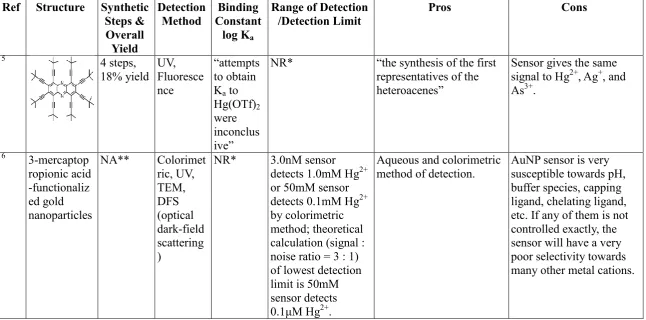
Table 1. A summary of recently reported mercury sensors.
Ref Structure Synthetic Steps & Overall Yield Detection Method Binding Constant
log Ka
Range of Detection /Detection Limit
Pros Cons
5 4 steps,
18% yield UV, Fluoresce nce “attempts to obtain Ka to
Hg(OTf)2
were inconclus ive”
NR* “the synthesis of the first representatives of the heteroacenes”
Sensor gives the same signal to Hg2+, Ag+, and As3+.
6 3-mercaptop
ropionic acid -functionaliz ed gold nanoparticles
NA** Colorimet ric, UV, TEM, DFS (optical dark-field scattering )
NR* 3.0nM sensor detects 1.0mM Hg2+ or 50mM sensor detects 0.1mM Hg2+ by colorimetric method; theoretical calculation (signal : noise ratio = 3 : 1) of lowest detection limit is 50mM sensor detects 0.1μM Hg2+.
Aqueous and colorimetric method of detection.
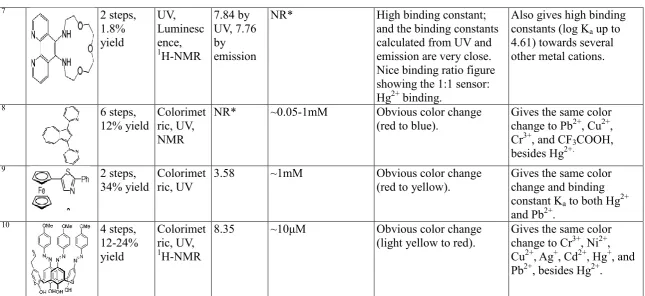
Table 1 continued…
7 2 steps,
1.8% yield UV, Luminesc ence, 1H-NMR 7.84 by UV, 7.76 by emission
NR* High binding constant; and the binding constants calculated from UV and emission are very close. Nice binding ratio figure showing the 1:1 sensor: Hg2+ binding.
Also gives high binding constants (log Ka up to
4.61) towards several other metal cations.
8 6 steps,
12% yield
Colorimet ric, UV, NMR
NR* ~0.05-1mM Obvious color change (red to blue).
Gives the same color change to Pb2+, Cu2+, Cr3+, and CF3COOH,
besides Hg2+.
9 2 steps,
34% yield
Colorimet ric, UV
3.58 ~1mM Obvious color change
(red to yellow).
Gives the same color change and binding constant Ka to both Hg2+
and Pb2+.
10 4 steps,
12-24% yield
Colorimet ric, UV,
1H-NMR
8.35 ~10μM Obvious color change
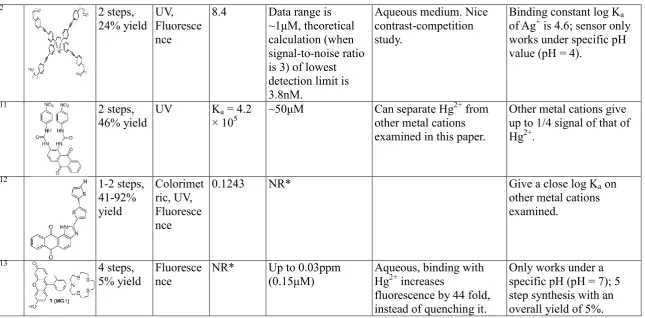
Table 1 continued…
2 2 steps,
24% yield UV, Fluoresce nce
8.4 Data range is ~1μM, theoretical calculation (when signal-to-noise ratio is 3) of lowest detection limit is 3.8nM.
Aqueous medium. Nice contrast-competition study.
Binding constant log Ka
of Ag+ is 4.6; sensor only works under specific pH value (pH = 4).
11 2 steps,
46% yield
UV Ka = 4.2
× 105
~50μM Can separate Hg2+ from other metal cations examined in this paper.
Other metal cations give up to 1/4 signal of that of Hg2+.
12 1-2 steps,
41-92% yield Colorimet ric, UV, Fluoresce nce
0.1243 NR* Give a close log Ka on
other metal cations examined.
13 4 steps,
5% yield
Fluoresce nce
NR* Up to 0.03ppm (0.15μM)
Aqueous, binding with Hg2+ increases
fluorescence by 44 fold, instead of quenching it.
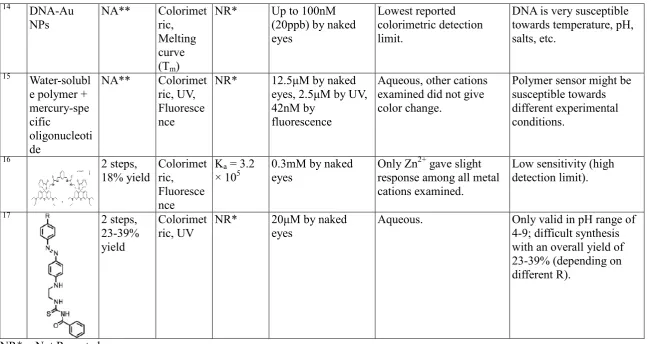
Table 1 continued…
14 DNA-Au
NPs
NA** Colorimet ric, Melting curve (Tm)
NR* Up to 100nM (20ppb) by naked eyes
Lowest reported colorimetric detection limit.
DNA is very susceptible towards temperature, pH, salts, etc.
15 Water-solubl
e polymer + mercury-spe cific
oligonucleoti de
NA** Colorimet ric, UV, Fluoresce nce
NR* 12.5μM by naked eyes, 2.5μM by UV, 42nM by
fluorescence
Aqueous, other cations examined did not give color change.
Polymer sensor might be susceptible towards different experimental conditions.
16 2 steps,
18% yield Colorimetric, Fluoresce nce
Ka = 3.2
× 105 0.3mM by naked eyes Only Zn
2+ gave slight
response among all metal cations examined.
Low sensitivity (high detection limit).
17 2 steps,
23-39% yield
Colorimet ric, UV
NR* 20μM by naked eyes
Aqueous. Only valid in pH range of 4-9; difficult synthesis with an overall yield of 23-39% (depending on different R).
NR* = Not Reported.
While sensors in the first three categories usually have the advantage of lower detection
limit, their applications are highly constrained by their susceptibility to a series of factors,
including temperature, pH, and other salts. For example, DNA-functionalized gold
nanoparticles described by Lee, et al., showed the lowest reported colorimetric detection
limit of 100 nM (20 ppb) in aqueous media.14 However, two important components of this sensor, DNA and gold nanoparticles, are both known to show a large variability in their
behavior as a function of temperature, pH, and the presence of other salts. In fact, the whole
detection process required a thermal controller to control temperature between 46 ºC to 50 ºC.
Another example is the mercury sensor reported by Liu, et al., which used a water-soluble
conjugated polymer and a label-free, mercury-specific oligonucleotide probe.15 This sensor can detect different concentration ranges of mercury by different means – it has an aqueous
detection limit of 12.5 µM by colorimetric detection, 2.5 µM by UV, and 42 nM by
fluorescence. However, due to the sensitive and fragile nature of the polymer and the probe,
this sensor can hardly serve as an inexpensive way of detecting different forms of mercury in
a variety of environments.
1.3
Organic Dye Based Mercury Sensors –Advantages and Challenges
Unlike sensors in the first three categories, organic dye based sensors are usually
synthesized organic molecules with high fluorescence and remarkable optical changes upon
binding to mercury ions, with the potential advantages of low cost, easy storage, and better
based mercury sensors usually suffer from one or several disadvantages, including multi-step
synthesis with low overall yield; poor sensitivity and/or selectivity; low binding constant;
and poor aqueous solubility.
Some of the most convincing and potentially useful organic dye based mercury sensors
are: Mercury Green 1 synthesized by Yoon, et al., with a quantum yield of 0.72, and a
detection limit up to 0.03 ppm (0.15 μM) in aqueous medium;13 and azo-component containing chemodosimeters synthesized by Lee, et al., with a colorimetric detection limit of
4 ppm (20 μM) by naked eyes in aqueous medium.17 Unfortunately, both sensors require considerable amount of effort in synthesis, and are limited to use only in specific pH ranges.
Other various organic dye based sensors cited in Table 1 all have different drawbacks as well.
Some sensor molecules require long synthetic routes, and the overall yields are less than
20%.5,7,9,16 Some sensor molecules are poor at differentiating mercury from other metal ions, most commonly, zinc, cadmium, lead, copper, silver, etc.5,7-10 On top of these drawbacks, most organic dye based sensors can only detect mercury ions in organic solution.5,7-12 For the few molecules that are claimed to be able to respond to aqueous mercury, experiments were
performed in mixed solvent systems (usually acetonitrile : water or dimethylsulfoxide :
water).2,17
Thus, although many mercury sensing molecules and assemblies have been reported,
none is universally applicable or ideal. This lack has prompted the study of other molecules
Chapter 2
2.1
Introduction
For an organic dye based mercury sensor to be applicable in industry, the common
challenges listed in Chapter 1 have to be addressed properly. First of all, an easy synthetic
route for large scale synthesis with a decent overall yield is a must for industrial application.
Second, high selectivity of the sensor, especially the ability to differentiate mercury from
other commonly present metal cations, is also crucial. Third, a sensor that could detect
mercury ions in both organic and aqueous media would be highly preferred. Besides these,
high binding constant and low detection limit are also key parameters of the overall
performance. A large detection range and variety in detection methods (e.g. colorimetric, UV,
fluorescence, etc) are also helpful.
Our group recently discovered a new methodology to close multiple aromatic rings in
nitrile-containing oligomers in a cascade cyclization. This methodology involves the
synthesis of a series of nitrile-containing precursor oligomers, the acid-catalyzed cyclization
that are widely reported in the synthesis of isoquinolines,18 followed by the spontaneous tautomerization of CH groups to NH groups. To our knowledge, this new methodology is the
first to report cascade closure of multiple aromatic rings. A series of products synthesized by
this methodology exhibit high quantum yield, which can potentially be used as organic dye
based sensors for different heavy metal ions.
Presented below are several potential organic dye based mercury sensors (3b, 3c, 5b, and 5c) synthesized by this cascade cyclization methodology, and their performance as colorimetric sensors. Their electronic absorption spectra and quantum yield were examined
revealed the high selectivity of molecule 3c towards mercury ion, and a series of quantitative measurements, including UV shift, fluorescence quenching, binding ratio, binding constant,
and lowest detection limit in both organic and aqueous media, were performed to examine
the overall performance of molecule 3c as a potential mercury sensor.
2.2
Results and Discussion
As shown in Scheme 1, oligomers 3a and 5a can be easily synthesized from commercially available starting materials. These oligomers could then be converted to
cyclized products (Scheme 2) in which the benzylic CH groups were found to tautomerize to
NH. This process results in entirely aromatic rings. To our knowledge, this is the first
example of cyclization/aromatization of this kind. Full details of every synthetic step are
provided in the experimental section.
Scheme 1. Synthesis of oligomer precursors. CN CN
CN CN CN NC
Cl CN
+
ii NC
Cl CN
+
CN
1 2 3a (97%)
1 4 5a (73%)
i
Scheme 2. Cascade closure of multiple aromatic rings. CN CN
CN CN CN 3a
5a
N NH2
Br
N N NH2 Br
i ii
N NH2
N N NH2
3b (72%) 3c (79%)
5b (59%) 5c (76%)
i ii
i) HBr/HOAc; ii) NaBH4, Pd on Carbon
Crystals of 3b, 3c, 5b, and 5c, suitable for X-ray diffraction, were obtained by group member Weijun Niu (Figure 1). These data showed that we were able to close multiple
aromatic rings in one step reaction, followed by debromination to reduce considerable steric
hindrance.
(3b) (3c) (5b) (5c)
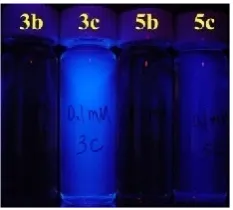
In Figure 2, solutions of 3b, 3c, 5b, and 5c at the same concentration (0.1 mM, in acetonitrile) showed considerable differences in fluorescence under UV lamp - the
debrominated 3c and 5c showed obviously higher fluorescence. For a sensor to operate via fluorescence quenching, a large quantum yield of fluorescence in the unbound form, and a
small quantum yield in the mercury bound form is desirable.
Figure 2. Photograph of solutionsof0.1mM 3b, 3c, 5b, and 5c under UV light.
The electronic absorption spectra of these 4 molecules are shown in Figure 3. One can
see that molecule 5c has a slightly higher extinction coefficient at virtually all wavelengths than other molecules. The quantum yields for fluorescence were determined in anhydrous
acetonitrile, between 375 nm and 600 nm. The results are shown in Figure 4 and Table 2.
Molecule 3c gave approximately 5 times higher quantum yield than molecule 5c. Based on quantum yield, molecule 3c was chosen as the most promising sensor for heavy metal ions among these molecules. Detailed procedures for obtaining electronic absorption spectra and
Figure 3. Electronic absorption spectra of
3b, 3c, 5b, and 5c in acetonitrile.
Figure 4. Fluorescence quantum yield calculation for 3b, 5b, 3c, and 5c in acetonitrile.
Table 2. Photophysical data for 3b, 3c, 5b, and 5c.
Compound Abs. Max Fl. Max (Quantum Yield)
3b 378nm 447nm 2%
3c 370nm 436nm 87%
5b 348nm 450nm 3%
5c 346nm 432nm 15%
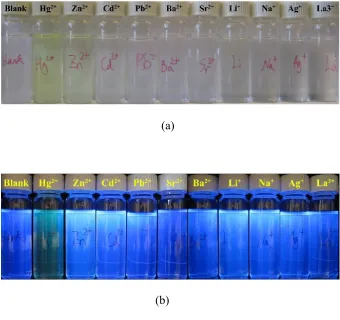
In qualitative tests, molecule 3c exhibited very high selectivity towards mercury ion. In Figure 5a, the vial with mercury nitrate showed an obvious color change from colorless to
dark yellow, while in Figure 5b, the vial with mercury nitrate showed almost completely
quenching of the fluorescence of molecule 3c. No other metal cations examined here exhibited the same color change or fluorescence quenching, qualitatively suggesting a high
(a)
(b)
Figure 5. 0.5 mM molecule 3c mixed with 0.5 mM different metal cations, in 1% 0.2 M phosphate buffer and 99% acetonitrile. a) under day light; b) under UV lamp.
To determine the stoichiometry of the molecule/mercury complex, an X-ray diffraction
showing the crystal structure of the molecule/mercury complex would be most desirable.
However, due to the low solubility and stability of the molecule/mercury complex in
common solvents, several attempts to obtain crystals suitable for X-ray diffraction were all
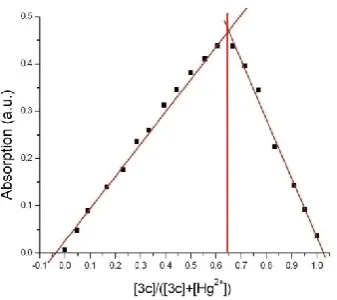
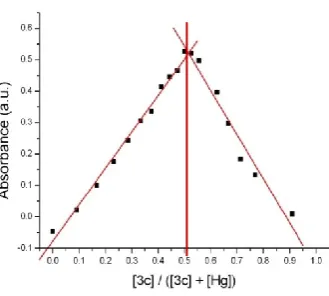
unsuccessful. Thus, an invariant concentration Job plot (Figure 6) was constructed. In this
plot, the absorbance of a series of acetonitrile solutions with the same total concentration, but
complete binding of all molecule 3c and all mercury ions available in solution. Solving
𝟑𝒄 ( 𝟑𝒄 + 𝐻𝑔2+ ) = 0.65 gives the ratio of [3c]:[Hg2+] = 2:1, indicating a 2:1
stoichiometry of the molecule/mercury complex.
Figure 6. Invariant concentration Job plot of molecule 3c to mercury in acetonitrile.
This 2:1 stoichiometry was unexpected and not desirable. The stoichiometry is different
than most mercury/molecule complexes and thus, relative binding affinity cannot be
compared between this complex and others in the literature. Moreover, as two molecules are
required for each mercury ion, this stoichiometry consequentially requires more molecules to
get a response than is ideal. It was wondered what the role of the second equivalent of the
molecule was in the overall binding. Cotton et al. suggested a possible role. Specifically, it
was noted that “This ligand (Ammonia) reacts in a unique way with mercury(II)
compounds”19. As shown in equation 1.1,19 one of the ammonia acted merely as a proton acceptor. Thus, despite of a seemly 2:1 ratio of reacted ammonia to mercury, the binding
HgCl
2+ 2NH
3HgNH
2Cl(s) + NH
4++ Cl
- (1.1)This suggests to us that the 2:1 ratio initially observed in the invariant concentration Job
plot could be “misleading” in terms of revealing the true binding ratio between mercury and
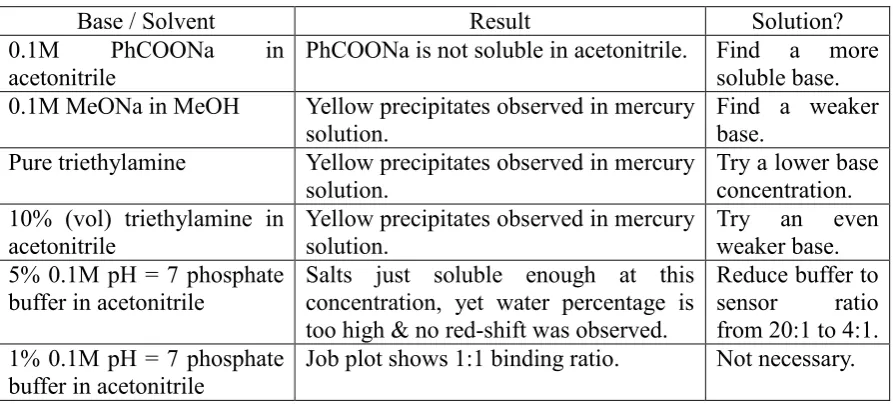
molecule 3c. To test this possibility, an invariant concentration Job plot in the presence of excess base was proposed, in the hope that such excess base would be more favorable as the
proton acceptors, thus molecule 3c would only be consumed as ligands to mercury complex. Table 3 shows the different base systems examined in sequence, and the reasoning for such
selections. As can be observed, selection of base and ionic strength were important in
obtaining a successful result.
Table 3. Different base systems for invariant concentration Job plot.
Base / Solvent Result Solution?
0.1M PhCOONa in
acetonitrile PhCOONa is not soluble in acetonitrile. Find a more soluble base. 0.1M MeONa in MeOH Yellow precipitates observed in mercury
solution. Find a weaker base.
Pure triethylamine Yellow precipitates observed in mercury solution.
Try a lower base concentration. 10% (vol) triethylamine in
acetonitrile
Yellow precipitates observed in mercury solution.
Try an even weaker base. 5% 0.1M pH = 7 phosphate
buffer in acetonitrile
Salts just soluble enough at this concentration, yet water percentage is too high & no red-shift was observed.
Reduce buffer to sensor ratio from 20:1 to 4:1. 1% 0.1M pH = 7 phosphate
buffer in acetonitrile
Finally, a Job plot in 1% aqueous buffer and 99% acetonitrile solution avoided the
consumption of molecule 3c as a sacrificial proton acceptor, and revealed a 1:1 binding ratio between molecule 3c and mercury complex, as shown in Figure 7. Under these conditions, a first order binding constant was then obtained. This result suggests a 4-member ring complex,
as shown in Figure 8. Such 4-member ring mercury complexes have been reported earlier by
Ancker, et al., and the structure of this mercury complex was characterized by X-ray
diffraction, as shown in Figure 9.20
Figure 7. Invariant concentration Job plot of molecule 3c to mercury in 1% aqueous buffer and 99% acetonitrile.
N NH
Hg NO3
Figure 9. A similar mercury complex characterized by X-ray diffraction by Ancker, et al.20
A qualitative test of binding revealed a ~40nm red-shift in the UV absorption peak when
molecule 3c was exposed to mercury ion (Figure 10). To calculate the binding constant Ka
from Benesi-Hildebrand plot, different concentrations of molecule 3c were added to mercury solutions of much greater concentration (Figure 11). Under these conditions, it is considered
that all molecule 3c added to the solution was bound to excess mercury, which has no absorption at 400 nm. Thus, the observed peak in corresponding UV spectra at 400 nm,
corresponds solely to the absorption of molecule/mercury complex. Figure 12 is the
Benesi-Hildebrand plot constructed from these data, and a Ka of 4.94 104 M-1 was
calculated. While zinc ion is the only cation that exhibited a small new peak around 410 nm,
corresponding to a Ka of 7.49 102 M-1, none of the other metal cations examined gave any
Figure 10. Binding of molecule 3c to mercury shows an obvious red shift upon increasing mercury concentration, in 0.5% 0.1 M phosphate buffer and 99.5% acetonitrile.
Figure 12. Benesi-Hildebrand plot reveals the binding constant between molecule 3c and mercury: Ka = 4.94 104 M-1.
Table 4. Binding constant Ka of molecule 3c to different metal cations, calculated by
Benesi-Hildebrand plot.
Metal Cation
Hg2+ Zn2+ Li+, Na+, K+, Ag+, Cd2+, Pb2+, Co2+, Ca2+, Sr2+, Ba2+, La3+, Tl3+
Ka( ) 4.94 104 7.49 102 Too small to measure by this method
However, the structure of molecule 3c resembles that of the commercially available
isoquinoline-3-amine. As shown in Figure 13, molecule 3c has one more substituent benzene ring, which provides extra electron density. Such an increase in electron density was later
proven to be crucial for the sensing of mercury ion: as shown in Figure 14,
isoquinoline-3-amine did not respond to the same concentration of mercury ion, but molecule
3c incurred an obvious peak at 400 nm, corresponding to a Ka of 7.49 102 M-1, as reported
N NH2 N NH2
molecule 3c isoquinoline-3-amine
Figure 13. Structure comparison between molecule 3c and isoquinoline-3-amine.
Figure 14. Binding constant comparison between molecule 3c and isoquinoline-3-amine in 0.5% 0.1M phosphate buffer and 99.5% acetonitrile. Addition of molecule 3c incurred an obvious peak at 400 nm, but the same concentration of isoquinoline-3-amine did not incur any peak at 400 nm.
The binding constant Ka ofmolecule 3c to mercury ion could also be measured by
Stern-Volmer plot. However, because oxygen is a much stronger fluorescence quencher than
(Figure 15) shows that flushing oxygen for 15 seconds reduced more than half of the
fluorescence from molecule 3c solution. Thus, the whole procedure of obtaining Stern-Volmer plot, which involves exposure of molecule 3c solution to air/oxygen for much longer than 15 seconds, would inevitably introduce a great error in the amount of quenched
fluorescence by oxygen, and thus produce a much greater error in calculated binding constant
Ka.
Figure 15. Oxygen dependent fluorescence quenching of molecule 3c. Flushing oxygen for 15 seconds reduced more than half of the fluorescence of molecule 3c, this quenching is reversible and the fluorescence of molecule 3c can be recovered upon flushing nitrogen.
The lowest detection limit of molecule 3c to mercury ion was found to be approximately 0.1 ppm (0.5 μM) in both organic (acetonitrile) and aqueous (dimethylsulfoxide:water = 4:1)
sensing studies, where molecule 3c and mercury ion were mixed with the same concentration of Li+, Na+, K+, Ag+, Cd2+, Pb2+, Co2+, Ca2+, Sr2+, Ba2+, La3+, and Tl3+, molecule 3c displayed the same lowest detection limit, which further illustrated its high selectivity towards mercury
ion.
2.3
Conclusions
To date, four different molecules have been successfully synthesized as possible
mercury sensors. The most promising mercury sensor among them was found to be molecule
3c, which can be easily synthesized in grams (3 steps, 55% overall yield), yet has a very high fluorescence quantum yield (Φ = 0.87), high sensitivity and selectivity towards mercury ion
in both organic and aqueous media. The binding constant of molecule 3c was found to be 4.94 104 M-1 to mercury, but only a maximum of 7.49 102 M-1 to all other metal cations examined.
Molecule 3c also showed considerable advantages over two of the most promising organic dye based sensors13,17 reported in recent literature, as shown by the comparison given in Table 5. Among these sensors, molecule 3c is much easier to synthesize with a much higher overall yield. Although binding constants of the other two molecules were not
reported, the binding constant of molecule 3c is comparable to or greater than any others reported. Molecule 3c is also highly selective towards mercury ion, demonstrated by the mixed ion sensing experiment above; and its selectivity towards mercury ion can be
suggest that molecule 3c is a very promising organic dye based mercury sensor.
Table 5. A quantitative comparison of molecule 3c to other promising organic dye based mercury sensors.
Sensor Molecule
CN CN
CN CN CN 3a
5a
N NH2
Br
N N NH2
Br
i ii
N NH2
N N NH2
3b (72%) 3c (79%)
5b (59%) 5c (76%)
i ii
Reference 13 17 This work (3c)
Synthesis overall yield 4 steps, 5% 2 steps, 23-39% overall yield 3 steps, 55% overall yield Binding Constant Ka NR* NR* 4.94 104
Detection Method & Limit
Colorimetric NR* 4 ppm (20 μM) 20 ppm (100 μM)
Fluorescence 0.03 ppm (0.15 μM)** NR* 0.1 ppm (0.5 μM)** NR* = Not reported
**: Both detection limits are measured at signal/noise = 3/1 ratio.
Some preliminary results suggest possible routes for the continuation of this project. A
series of molecules with fused aromatic rings were synthesized by this methodology, and
could be modified in different ways to make potential sensors for different metal cations. For
example, several thiophene molecules shown in Figure 16 were successfully synthesized and
characterized by group member Weijun Niu. Their photophysical and binding properties to
Figure 16. Available thiophene molecules for future examination.
Moreover, because the performance of molecule 3c as a mercury sensor did not decrease in the presence of water as a potential competing reagent, a water soluble version of
molecule 3c is proposed in
Figure 17. Such structures employed the hydrophilic -SO3Na group to increase the
solubility of the whole sensor in aqueous medium, yet retained the crucial structure to
mercury binding (the 2-aminopyridine function with high electron density). These proposed
molecules could be synthesized and examined as potential aqueous mercury sensors. The fact
that the mercury sensor itself is water soluble would allow a completely aqueous testing of
mercury waste in aqueous systems; and a lot of other solvents can be tested, as the extinction
Figure 17. Proposed structures of water-soluble versions of molecule 3c.
2.4
Experimental Section
General Considerations
All chemicals were purchased from Aldrich or Acros. Acetonitrile was dried by
distillation over CaH2. Anhydrous dichloroethane in a sure seal bottle was purchased from
Acros and used without further drying. Tetrabutylammonium hexafluorophosphate (TBAPF6)
was recrystallized three times from ethanol. Mercury nitrate monohydrate was used as
mercury source in all concerning measurements. All synthesis steps below were firstly
examined and characterized by group member Weijun, Niu. The buffer concentrations were
chosen at a minimum level (4:1 ratio) to both provide excess “proton acceptor” and minimize
a decrease in the solubility of molecule 3c in mixed solvent system.
Synthesis of 3a. To a flask containing 822.9 mg (7.4 mmol) of potassium tert-butoxide in 10 mL dimethylformamide (DMF), cooled in an ice bath, a mixture of 656.0 mg (4.8
mmol) 2-chlorobenzonitrile (1) and 430.4 mg (3. 7 mmol) 2-phenylacetonitrile (2) in 6 mL DMF was added drop wise. The reaction mixture was then stirred at room temperature (RT)
for 1 h, after which 20 mL saturated ammonium chloride (aq.) was added to quench excess
deionized water (DI), and dried over anhydrous sodium sulfate. Column purification with
dichloromethane (DCM) and gradient addition of methanol, followed by removal of solvent
and further drying under vacuum gave light yellow crystals (780.1 mg, 97% yield).
Alternatively, this reaction was carried out on a larger scale (6.6 g, 71% yield) and the
column purification step was replaced by recrystallization from hot ethanol.
Synthesis of 3b. To a flask containing 625.5 mg (2.9 mmol) of 3a, 7 mL of 45% HBr in acetic acid was added. The resulting solution turned yellow and was stirred at RT for an
additional 2 h. A 10 mL portion of ethyl acetate was added and, a yellow solid precipitated
out. This solid was filtered and then washed with ether. This solid was re-dissolved in 40
mL of ethyl acetate, neutralized by saturated sodium hydrogen carbonate (aq.), and dried
over anhydrous sodium sulfate. Column purification with DCM and gradient addition of
methanol, followed by removal of solvent and further drying under vacuum gave yellow
crystals (620.0 mg, 72% yield). Alternatively, this reaction was carried out on a larger scale
(4.0 g, 60% yield) and the column purification step was replaced by recrystallization from
hot ethanol. 1H-NMR (CDCl3): 4.33 (s, 2H), 7.17-7.52 (9H), 8.05 (d, 1H).
Synthesis of 3c. To a Schlenk flask containing a mixture of 2.0 mL of 4N potassium hydroxide and 2.0 mL of methanol, 107.0 mg (0.4 mmol) of 3b was added slowly under nitrogen protection. Then a mixture of 60.0 mg (0.03 mmol) of 5% Pd on activated carbon
and 60.0 mg (1.6 mmol) of sodium borohydride was added, and the mixture was stirred at RT
overnight. The resulting mixture was washed with tetrahydrofuran (THF) and dried over
anhydrous sodium sulfate. Column purification with DCM and gradient addition of methanol,
(741.0mg, 79% yield). 1H-NMR (DMSO): 3.25 (s, 1H), 5.19 (s, 1H), 7.01 (d, 1H), 7.12 (t, 1H), 7.24 (t, 1H), 7.27 (t, 1H), 7.33-7.52 (4H), 7.80 (d, 1H), 8.82 (s, 1H). MS: 221 (in acidic
solution).
Synthesis of 5a. To a Schlenk flask containing a mixture of 768.3 mg (5.6 mmol) of 2-chloro-benzonitrile (1), 1.2063 g (8.4 mmol) of 2-cyanophenyl acetonitrile (4), and 1.9391 g (17.3 mmol) of potassium tert-butoxide, 12 mL of anhydrous THF was added through a
syringe. The reaction mixture was stirred under reflux in an oil bath for 18 h, and then 30 mL
of saturated ammonium chloride (aq.) was added to quench excess potassium tert-butoxide.
The resulting solution was extracted with DCM and dried over anhydrous sodium sulfate.
Column purification with DCM and gradient addition of methanol, followed by removal of
solvent and further drying under vacuum gave a red solid (990.0 mg, 73% yield).
Synthesis of 5b. To a flask containing 434.7 mg (1.8 mmol) of 5a, a mixture of 10 mL of 45% HBr in acetic acid and 10 mL of DCM was added, and stirred at RT overnight. A
portion of 100 mL ether was added and, a yellow solid was precipitated and filtered. Then
this solid was re-dissolved in 50 mL of THF, neutralized by saturated sodium hydrogen
carbonate (aq.), and then dried over anhydrous sodium sulfate. Column purification with
DCM and gradient addition of methanol, followed by removal of solvent and further drying
under vacuum gave a light yellow solid (341.1 mg, 59% yield). 1H-NMR (DMSO): 4.60 (br, 2H), 7.89-8.93 (8H).
activated carbon and 90.0 mg (2.4 mmol) of sodium borohydride was added, and stirred at
RT for 3 days. The resulting mixture was washed with THF and dried over anhydrous sodium
sulfate. Column purification with DCM and gradient addition of methanol, followed by
removal of solvent and further drying under vacuum gave a light yellow solid (439.0mg, 76%
yield). 1H-NMR (CDCl3): 3.50 (br, 2H), 7.44-7.80 (6H), 8.04 (t, 1H), 8.82 (t, 1H), 9.28 (s,
1H). MS: 246 (in acidic solution).
Procedure for obtaining electronic absorption spectra. Solutions of 0.2 mM 3b, 3c,
5b, and 5c in acetonitrile were prepared. A UV cuvette of 1 cm path length, filled with acetonitrile, was measured as a blank. Then each of the prepared solutions were measured
using a HP 8452A UV/Vis spectrophotometer. Extinction coefficients were calculated by
Beer’s Law: ε = A/bc, where ε is the extinction coefficient, A is the measured absorbance, b
is the length of cuvette (1 cm), and c is the concentration of standard solutions (0.2 mM).
These data were plotted as extinction coefficient versus wave length in Microcal Origin 6.0.
Procedure for measuring quantum yield. Standard solutions of 25 μM 3b, 3c, 5b, 5c, and 2-Aminopyridine (standard) in acetonitrile were prepared in dry box. A fluorescence
cuvette of 1 cm path length, filled with acetonitrile, was measured as a blank. Then a series
of solutions containing 3.0 mL standard solution, 2.5 mL standard solution + 0.5 mL
acetonitrile, 2.0 mL standard solution + 1.0 mL acetonitrile, 1.5 mL standard solution + 1.5
mL acetonitrile, 1.0 mL standard solution + 2.0 mL acetonitrile, and 0.5 mL standard solution
+ 2.5 mL acetonitrile, respectively, were prepared individually, taken out of dry box in a
sealed fluorescence cuvette, and measured fluorescence signal from 375 to 600 nm (excited
under each curve was integrated, and the integrated area under the blank curve was
subtracted from all other sample curves. A plot of subtracted fluorescence area versus
absorbance was generated, and quantum yields of 3b, 3c, 5b, and 5c were calculated by comparing their slopes to the slope of the standard, 2-Aminopyridine (Φ = 0.87), as the
quantum yields are proportional to the slopes in a plot of integrated fluorescence area versus
absorbance.
Procedure for measuring binding constant Ka from UV spectra. Stock solutions of 2
mM mercury nitrate and 0.1 mM molecule 3c were prepared in mixed solvent of 98% acetonitrile and 2% 0.25 M aqueous phosphate buffer. A UV cuvette of 1 cm path length,
filled with the mixed solvent, was measured as a blank, then a series of solutions each
containing 1 mL stock solution of mercury nitrate, 0, 0.1, 0.2, …, 1.0 mL stock solution of
molecule 3c, and 1.0, 0.9, …, 0.1, 0 mL mixed solvent, were prepared and measured absorbance immediately. These data were plotted as absorption versus wave length in
Microcal Origin 6.0. At the peak wavelength, the differences in absorbance and the
differences in molecule 3c concentration were plotted as 1/ΔA ~ 1/Δ[3c], and the binding constant Ka was calculated by the equations below:
where Δε is the difference in extinction coefficient, b is the path length of the cuvette (1
cm), C0 is the concentration of mercury nitrate, and intercept and slope are calculated from
the linear fit of the plot.
Procedure for measuring binding ratio from Job plot. Standard solutions of 0.25 mM molecule 3c and 0.25 mM Hg2+ in acetonitrile were prepared in acetonitrile or a mixed solvent of 99% acetonitrile and 1% 0.2 M aqueous phosphate buffer. A series of solutions
with different ratios of 3c:Hg2+ (range from 1:20 to 20:1) were prepared and measured absorbance immediately. Then different absorbances were plotted versus the mole fraction of
molecule 3c: 3𝑐 ( 3𝑐 + 𝐻𝑔2+ ). This plot is called Invariant Concentration Job plot,
Chapter 3
3.1
Introduction
Since Richard Feynman proposed the trend of “getting smaller and smaller” in his talk
“There’s Plenty of Room at the Bottom” at the annual meeting of the American Physical
Society in 1959,21 there has been numerous attempts to build smaller and smaller electronics for the application in both research and industry, because smaller sized electronics allows
higher circuit density and faster processing speed. However, the traditional top-down,
lithographic approach is reaching its limit in smallest achievable feature size;22 and further reduction in feature size may benefit from a new method – the bottom-up approach of
molecular-based self-assembly. Despite of the cost advantage and convenience of synthesis
that the bottom-up molecular-based self-assembly approach offers, there are considerable
challenges as well. Two of the most obvious challenges are: how to bridge molecular scale
(~1 nm) and lithographic scale (~100 nm), and how to ensure the correct orientation of
inserted molecules.
In this project, orthogonal self-assembly of a molecule between two nanoparticles was
employed to attempt to solve these two problems. First of all, orthogonal self-assembly
ensures the correct orientation of inserted molecules because different ending groups bind
preferentially to different particles. Then, upon linking two particles of 10 - 20 nm in
diameter together, the resulting structure can plausibly be inserted into features defined on a
surface using lithography techniques. The general scheme behind this idea is shown in Figure
18 and is explained as follows.
A molecule is usually 1 - 2 nm in length, while the lower limit of defined lithographic
them together with a linker molecule will create a structure of approximately 20 - 40 nm in
size. Such structures are defined as shown in Figure 18: two identical nanoparticles linked
together by a two-end linker is defined as a homo-dimer, while two different nanoparticles
linked together by a two-end linker is defined as a hetero-dimer. In the same fashion, three
identical nanoparticles linked together by a three-end linker is defined as a homo-trimer,
while two identical and one different nanoparticles linked together by a three-end linker is
defined as a hetero-trimer.
Figure 18. A cartoon of the definition of (from left to right) homo-dimer, hetero-dimer, homo-trimer, and hetero-trimer.
Orthogonal Self-Assembly was firstly proposed by Wrighton and Whitesides in their
1989 Science paper as “In formation of Self-Assembly Monolayers (SAMs), (absorbant) Ai
adsorbs strongly on (surface) Si but weakly on Sj, while Aj adsorbs strongly on Sj but
weakly on Si”. This paper was also the first to demonstrate the preferential binding of
disulfide onto gold surface, and carboxylic acid onto alumina surface by the appearance of
new XPS peaks corresponding to sulfur on gold only and oxygen (from carboxylic acid) on
alumina only.23 Later on, Wrighton and Whitesides also demonstrated the preferential
binding of isocyanide onto platinum surface by the same method.24
necessarily apply to nanoparticles.25 This study was done primarily by monitoring the IR spectra of different incubated samples, as bound and unbound thiol and isocyanide display
peaks at different positions in IR spectra. The linker molecule synthesized in this paper has
two different ends – thiol and isocyanide, thus showing a peak around 1710 cm-1 for thiol, and a peak around 2120 cm-1 for isocyanide. When incubated with gold particles, the 1710 cm-1 peak shifted, while the 2120 cm-1 peak remained unchanged, suggesting that only the thiol end of the linker bound to gold particles. However, when incubated with platinum
particles, both 1710 cm-1 peak and 2120 cm-1 peak shifted, suggesting that both the thiol end and the isocyanide end of the linker bound to platinum particles. Furthermore, in a competing
experiment, when this linker molecule with both thiol and isocyanide ends were incubated
with platinum substrate, the IR spectrum showed a large 2120 cm-1 peak corresponding to unbounded isocyanide, versus a very small 2158 cm-1 peak corresponding to bounded isocyanide, further suggesting that the binding preference of isocyanide to platinum
previously concluded by Wrighton and Whitesides24 is only valid when the competition of thiol is excluded. These results indicated a new dimension when thinking about orthogonal
self-assembly in the case of nanoparticles, and binding preference of carboxylic acid to metal
oxide nanoparticles should also be examined, as a continuation of this project.
To complete this project, phenylethynyl oligomer (OPE) linker molecules with different
ending groups were synthesized. OPEs were chosen because they are rigid and thus of
well-defined end-to-end length. Moreover, they are precedented “molecular wire”
modifications. As will be discussed in detail below, some of these modifications were not
completely straightforward, and some fundamental questions about ideal conditions for
nanoparticle preparation still exist. It is then planned to synthesize a series of homo- and
hetero- dimers and trimers with the self-assembly technique, and to examine their properties
in different ways.
3.2
Results and Discussion
3.21 Synthesis and Characterization of Linker Molecules
Synthetic routes for all four target linker molecules are shown in Scheme 3. The OPE
linkage was chosen for reasons discussed above. The thiol, isocyanide and carboxylic ending
groups were chosen to bind preferentially to gold, platinum, and metal oxide nanoparticles
accordingly, as explained in the above mentioned literature reports. There were several
challenges in the actual synthesis, but they were all addressed properly by judicious
alteration of reactions reported in the literature. For example, the previously reported,
low-yield (~30%) method28 for the synthesis of molecule 4a used previously in the group, was replaced by a new, higher-yield method.29 The low solubility of 3-ring linkers was improved by adding side chains (-OC6H13) to the middle ring. And the hydrolysis of
3.22 Synthesis of Metal and Metal Oxide Nanoparticles
Water-soluble gold nanoparticles have been widely reported and are commercially
available.31 Moreover, synthesis of both water-soluble and organic-soluble platinum nanoparticles has been reported.32 On the other hand, metal oxide nanoparticles are much less studied. The most mono-dispersed metal oxide nanoparticles reported recently are oleic
acid capped, organic-soluble iron oxide nanoparticles synthesized by Hyeon, et al.33 The sizes of these nanoparticles could be controlled between 4 and 16 nm by controlling the ratio
of iron source to ligand. We were able to reproduce these reported results and made
mono-dispersed iron oxide nanoparticles of 7 nm diameter (Figure 19).
(a) (b)
Figure 19. a) TEM image of 7 nm iron oxide nanoparticles; b) Histogram of the size distribution of nanoparticles in a).
3.23 Ligand Exchange Experiments
different, immiscible solvents, it was necessary to alter the solubility of one of them so that
they could be combined in the same phase. This change could be accomplished by ligand
exchange of the oleic acid groups on the iron oxide nanoparticles for shorter, water
solubilizing ligands. A shorter ligand was preferred because the linker molecule must
protrude from this ligand shell and the shortest ligands minimize the length required for the
linker molecule. Longer linker molecules require more effort to synthesize and purify. It was
appreciated, however, that the ligands exchanged onto the iron oxide nanoparticles still had
to act to cap them and prevent their aggregation and subsequent agglomeration (e.g. fusing
together).
A number of possible ligands were surveyed. These included formic acid, benzoic acid,
citric acid, salicylic acid, succinic acid, tartaric acid, and glycerol. A mixture of oleic acid
capped iron oxide nanoparticles dissolved in toluene and the salt of a potential ligand
dissolved in deionized water were mixed and sonicated for 1 h, then allowed to stay at room
temperature for additional 24 h for the completion of any possible ligand exchange. The vials
with citric acid and tartaric acid showed a light brown color in the aqueous layer, while the
vials with succinic acid and glycerol showed a light yellow color in the aqueous layer after
ligand exchange. These layers were then individually removed using a pipette, and
centrifuged with membrane in the hope that particles would be caught in the membrane,
while excess ligands would filter through with solvent. The residues on the membrane were
then collected and re-dissolved into DI for TEM analysis. Despite these promising increases
in color in the aqueous layer, the ligand-exchanged products were not deemed to be suitable
Figure 20, an aggregate of nanoparticles is shown. Most of the roughly spherical particles
observed by TEM were aggregated after these ligand exchanges. In addition, other
non-spherical objects were observed in the right panel of Figure 20. This debris may be dirt
or impurities introduced by the ligand exchange process, or aggregation of excess ligand that
were not removed upon purification, but in any event is not the desired result: dispersed,
spherical nanoparticles.
Figure 20. TEM images of iron oxide nanoparticle samples after ligand exchange with tartaric acid, showing (left) aggregated particles and (right) debris thought to result from aggregates of excess ligand that were not removed upon purification.
To avoid this problem, it was decided to follow literature procedures32,34 on direct synthesis of hexanethiol capped, organic soluble gold and platinum nanoparticles. Toluene
dispersions of both gold and platinum nanoparticles were prepared as described fully in the
experimental section. TEM analysis of gold particles is shown in Figure 21a. A histogram of
the size distribution (Figure 21b) shows that most particles are between 2 and 3 nm in size,
particles is shown in Figure 21c. A histogram of the size distribution (Figure 21d) shows that
most particles are between 2 and 3 nm in size, which is also a reasonable size distribution for
subsequent experiments.
(a) (b)
(c) (d)
Thus, to date we have investigated and abandoned particle dimerization in aqueous
solutions. This decision was made because no suitable route was found to prepare the
iron-oxide particles in water, nor to apply ligand exchange on these particles to render them
water soluble yet still retain their original size and shape. All three types of nanoparticles
(iron oxide, gold and platinum) have, however, been prepared in organic solvents.
3.3
Conclusion
The primary focus of the work reported in this chapter was to identify routes to particles
with well defined, relatively mono-dispersed sizes and shapes. To date, we have successfully
synthesized organic soluble iron oxide nano-particles, and both water and organic soluble
gold and platinum particles of mono-dispersed sizes and shapes. Given that all particles have
been synthesized in organic phase, it is possible now to consider binding them together.
3.4
Prospects for Synthesis of Nanoparticle Hetero-dimers and
Hetero-trimers
The next logical step in this work would be to dimerize the two different kinds of
particles with the bifunctional ligands that were prepared. However, no specific attention
was yet given as to whether the relative lengths of the capping ligands on the particles and
the linker molecule were appropriate for dimerization (or trimerization with Y-shaped
molecules synthesized by other group members). If a linker molecule is too short relative to
bind them together. Thus, some simple geometry calculations were performed and presented
here to assess the suitability of the particles and linker molecules currently in hand.
In order to link two nanoparticles into a hetero-dimer, the length of the linker must
exceed the total length of both capping ligands on the particles so that the linker would be
able to “get through” both layers of ligands and bind to both nanoparticles. As shown in
Figure 22, we have gold nanoparticles with a 3 nm average diameter (1.5 nm average radius)
that are capped with hexanethiol groups. The thickness of the hexanethiol capping ligand
layer is estimated to be 0.9 nm from the minimum energy structure calculation in Chem 3D.
We also have iron oxide nanoparticles with a 7 nm average diameter (3.5 nm average radius)
that are capped with oleic acid groups. The thickness of the oleic acid capping ligand layer is
estimated to be 1.66 nm from the minimum energy structure calculation in Chem 3D. To “get
through” both hexanethiol ligand layer and oleic acid ligand layer, the theoretical minimum
linker length is calculated to be 0.9 nm + 1.66 nm = 2.56 nm. However, the two-end linker
molecules synthesized above are only 1.66 nm (molecule 7a and 7b) and 2.47 nm (molecule
15a and 15b) in length, respectively, calculated from the minimum energy structure
calculation in Chem 3D. These calculations suggest that we have to either replace the long
oleic acid capping ligand by some other shorter, organic-soluble capping ligand, or
synthesize new linker molecules of longer length. Given the time-consuming nature of linker
synthesis, and the general trend that longer linker molecules are less stable, the possibility of
replacing the long oleic acid capping ligand by a shorter ligand is more attractive and will be
Figure 22. Minimum linker length calculation for gold-iron oxide hetero-dimer.
In a similar fashion, a simple geometry calculation on the homo-trimer raises the
question as to whether the Y-shaped molecules available to us are long enough to prepare
homo-trimers. This calculation was done as shown in Figure 23a. We have the same gold
nanoparticles with a 1.5 nm average radius (“R” in Figure 23a) that are capped with a 0.9 nm
layer of hexanethiol groups (“ ” in Figure 23a. The minimum linker length (“Lmin” in Figure
23a) is determined when 3 nanoparticles (including their hexanethiol layers) are tangent to
each other. The angle between each 2 arms of the three-arm linker is a fixed value of 120º,
defined by the rigid planar structure of the central benzene ring. Equation 3.1 shows the
calculation of Lmin in the bold triangle in Figure 23a. The value of Lmin is calculated to be
1.27 nm. Group member Kusum Chandra has successfully synthesized the three-arm
homo-linker as shown in Figure 23b, and the length on each arm of this linker is calculated to
be 1.67 nm from the minimum energy structure calculation in Chem 3D, which could
theoretically get through both layers of ligands. Thus, no further ligand exchange or linker
(a) Minimum linker length calculation (b) Structure of 3-arm homo-linker
Figure 23. (a) The minimum linker length calculation for gold homo-trimer; (b) Structure and length of available three-arm homo-linker.
(3.1)
In a similar fashion, a simple geometry calculation was performed for the minimum
length of a molecule needed to bridge two gold nanoparticles with 1.5 nm radius and an iron
oxide nanoparticle with a 3.5 nm radius. This calculation was performed as shown in Figure
24a. We have the same gold nanoparticles with a 1.5 nm average radius (“r1” in Figure 24a)
that are capped with a 0.9 nm layer of hexanethiol groups (“ 1” in Figure 24a), and iron
oxide nanoparticles with a 3.5 nm average radius (“r2” in Figure 24a) that are capped with a
1.66 nm layer of oleic acid groups (“ 2” in Figure 24a). The minimum linker length (“Lmin”
in Figure 24a) occurs when 2 gold nanoparticles (including their hexanethiol layers) are
tangent to the iron oxide nanoparticle (including its oleic acid layer). The angle between each
the central benzene ring. Equations 4.1 – 4.3 shows the calculation of Lmin in bold triangles in
Figure 24a, and Lmin is calculated to be 1.95 nm. The synthesis of this three-arm hetero-linker
(Figure 24b) was still in process by other group members. The length on the hetero-arm with
carboxylic acid ending group is calculated to be 2.26 nm from the minimum energy structure
calculation in Chem 3D, which is considerably larger than the theoretical minimum length.
Thus, no further ligand exchange or linker synthesis is required for the self-assembly of the
hetero-trimer.
(a) Minimum linker length calculation (b) Structure of the three-arm hetero-linker
Figure 24. (a) The minimum linker length calculation for gold-iron oxide hetero-trimer; (b) Structure and lengths of the proposed three-arm hetero-linker.
(4.2)
(4.3)
A summary of minimum linker lengths versus available linker lengths are shown in
Table 6. As stated above, for both homo- and hetero-trimer, the linkers are longer than that
required geometrically and thus should be suitable for self-assembly experiments. However,
the available linkers for hetero-dimers are too short, because the oleic acid capping ligand on
iron-oxide nanoparticles is too long.
Table 6. Minimum linker lengths by calculation versus available linker lengths.
Hetero-dimer Homo-trimer Hetero-trimer Minimum
Linker Length
2.56 nm 1.27 nm 1.95 nm
Available Linker Length
1.66 nm
2.47 nm 1.67 nm 2.26 nm
Future Alternation
Ligand Exchange on
Iron Oxide
Nanoparticles Not Required Not Required
Thus, a continuation of this project would be ligand exchange on the oleic acid capped
iron-oxide nanoparticles for a smaller but still organic soluble ligand. The exchange kinetics
characterize the process of ligand exchange. Murray, et al. assessed the degree of ligand
exchange on small (1 - 2 nm) gold nanoparticles by oxidizing the gold, collecting the organic
ligands dissociated during this process and measuring the relative amounts of original and
exchanged ligand.35 This process is not convenient and, more importantly, it is not likely to be very accurate as the weight fraction of the particle to ligands increases. To be useful for
TEM analysis and molecular electronics measurements, we have chosen particles that are
much larger than the ones studied by Murray, et al.
Replacing the long oleic acid capping ligand by a shorter ligand appears to be most
promising. However, we have admitted that the exchange process on iron-oxide
nanoparticles is not yet characterized and thus there is no guarantee that it will work. Access
to other types of metal oxide particles as backup options for synthesis and ligand exchange is
thus desirable. Fortunately, Hyeon, et al. have reported the synthesis of zinc oxide and silica
oxide nanoparticles by a similar method to that used for the synthesis of the iron oxide
particles.36-38 So, if none of the ligand exchange experiments with oleic acid on iron oxide works, we also have the option of replacing iron oxide nanoparticles with some other metal
oxide nanoparticles that will allow ligand exchange with shorter ligands.
After the successful self-assembly of above designed homo- and hetero- dimers and
trimers, characterization becomes the next challenge, as those dimers and trimers are only
about the size of 20 nm. TEM is the primary characterization tool because it presents images
of the actual particles. Moreover, a series of accessorial characterization methods may also
be used to provide different information of such structures indirectly. For example, IR can be