The Molecular Evolution of
terminal ear1, a Regulatory Gene in the Genus Zea
Shawn E. White and John F. Doebley
Department of Plant Biology, University of Minnesota, Saint Paul, Minnesota 55108 Manuscript received January 2, 1999
Accepted for publication July 28, 1999
ABSTRACT
Nucleotide diversity in the terminal ear1 (te1) gene, a regulatory locus hypothesized to be involved in the morphological evolution of maize (Zea mays ssp. mays), was investigated for evidence of past selection. Nucleotide polymorphism in a 1.4-kb region of te1 was analyzed for a sample of 26 sequences isolated from 12 maize lines, five populations of the maize progenitor, Z. mays ssp. parviglumis, six other Zea populations, and two Tripsacum species. Although nucleotide diversity in te1 in maize is reduced relative to ssp. parviglumis, phylogenetic and statistical analyses of the pattern of polymorphism among these sequences provided no evidence of past selection, indicating that the region of the gene studied was probably not involved in maize evolution. The level of reduction in genetic diversity in te1 in maize relative to its progenitor is comparable to that found in previous reports for isozymes and other neutrally evolving maize genes and is consistent with a genome-wide reduction of genetic diversity resulting from a domestica-tion bottleneck. An estimate of the age (1.2–1.4 million yr) of the maize gene pool based on te1 is roughly consistent with previous estimates based on other neutral genes, but may be biased by the apparently slow synonymous substitution rate at te1.
T
HE crop plant maize (Zea mays ssp. mays) is thought acterized by elongated upper lateral branches tipped by tassels instead of ears, while mutant alleles of te1 to have been domesticated z5000–10,000 yr agofrom the wild annual plant, teosinte (Z. mays ssp. parvig- cause an increase in the frequency of leaf primordia initiation and the feminization of the terminal inflores-lumis;Iltis1983). Several traits distinguish the two
or-ganisms, most of which involve the morphology of lat- cence on the main stalk (Veitet al. 1993, 1998). te1 is a regulatory gene that encodes a protein with conserved eral branches and the inflorescences borne on them.
Teosinte plants have long lateral branches tipped with binding domains; it may function through RNA-binding activity (Veit et al. 1998). Both are attractive male inflorescences (tassels), and small ears bearing
candidates for the QTL on 3L since tru1 affects the kernels encased in hard stone-like fruitcases. Maize
fate of axillary meristems and te1 affects the pattern of plants have very short lateral branches tipped with large
internode initiation, as does the QTL. ears bearing exposed kernels. Quantitative trait locus
To begin to evaluate which of these two genes, if (QTL) mapping experiments have determined that
either, was involved in the origin of maize, the pattern these morphological differences between maize and
teo-of DNA sequence polymorphism in te1 in maize and sinte are primarily due to five chromosomal regions
teosinte was analyzed for evidence of past selection. (Doebley et al. 1990;Doebley and Stec1993), each
Although te1 nucleotide diversity is reduced in maize with major effects on one or more of these traits.
relative to its progenitor, no evidence for selection dur-One of the QTL identified in these mapping
experi-ing maize evolution was detected for the region ana-ments, found on the long arm of chromosome 3 (3L),
lyzed. The neutral pattern of evolution at te1 was ex-has an effect on several traits distinguishing maize and
ploited to investigate the age of the maize gene pool, teosinte. Teosinte plants into which the maize allele of
the time of the divergence of the Zea and Tripsacum the QTL on 3L has been introgressed via backcross
lineages, and the strength of the proposed domestica-breeding display a greater number of seeds per ear, a
tion bottleneck. larger number of shorter lateral branch internodes, and
feminized lateral inflorescences (Doebleyet al. 1995). Two maize genes mapping to 3L
[tassel-replaces-upper-MATERIALS AND METHODS ear1 (tru1) and terminal ear1 (te1)] have been identified
as candidates for this QTL (Doebleyet al. 1995). The PCR amplification, cloning, and sequencing: An z1.4-kb segment of the te1 gene was PCR amplified from 25 Zea and tru1 mutant allele of maize conditions a phenotype
char-Tripsacum individuals (Table 1). A single te1 sequence from 22 Zea and 2 Tripsacum plants, and both alleles from 1 Z. mays ssp. mexicana (IL769) plant, were amplified and sequenced to yield a total of 26 te1 sequences. The primers (TACAG
Corresponding author: John Doebley, Genetics Department,
Univer-CCGCTTCCGCAACAG and TGACGGTGGTCCTCGTATCC) sity of Wisconsin, 445 Henry Mall, Madison, WI 53706.
E-mail: [email protected] used in the amplifications were designed from the cDNA
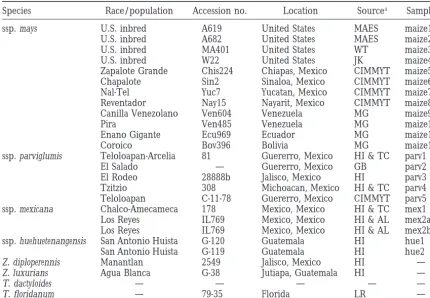
TABLE 1
Zea and Tripsacum lines used in this study
Species Race/population Accession no. Location Sourcea Sample
ssp. mays U.S. inbred A619 United States MAES maize1
U.S. inbred A682 United States MAES maize2
U.S. inbred MA401 United States WT maize3
U.S. inbred W22 United States JK maize4
Zapalote Grande Chis224 Chiapas, Mexico CIMMYT maize5
Chapalote Sin2 Sinaloa, Mexico CIMMYT maize6
Nal-Tel Yuc7 Yucatan, Mexico CIMMYT maize7
Reventador Nay15 Nayarit, Mexico CIMMYT maize8
Canilla Venezolano Ven604 Venezuela MG maize9
Pira Ven485 Venezuela MG maize10
Enano Gigante Ecu969 Ecuador MG maize11
Coroico Bov396 Bolivia MG maize12
ssp. parviglumis Teloloapan-Arcelia 81 Guererro, Mexico HI & TC parv1
El Salado — Guererro, Mexico GB parv2
El Rodeo 28888b Jalisco, Mexico HI parv3
Tzitzio 308 Michoacan, Mexico HI & TC parv4
Teloloapan C-11-78 Guererro, Mexico CIMMYT parv5
ssp. mexicana Chalco-Amecameca 178 Mexico, Mexico HI & TC mex1
Los Reyes IL769 Mexico, Mexico HI & AL mex2a
Los Reyes IL769 Mexico, Mexico HI & AL mex2b
ssp. huehuetenangensis San Antonio Huista G-120 Guatemala HI hue1
San Antonio Huista G-119 Guatemala HI hue2
Z. diploperennis Manantlan 2549 Jalisco, Mexico HI —
Z. luxurians Agua Blanca G-38 Jutiapa, Guatemala HI —
T. dactyloides — — — — —
T. floridanum — 79-35 Florida LR —
aAL, Alex Lasseigne; CIMMYT, Centro Internacional para Mejoramiento de Maiz y Trigo; GB, George Beadle; HI, Hugh Iltis; JK, Jerry Kermicle; LR, Lawrence Randolph; MAES, Minnesota Agricultural Experiment Station; MG, Major Goodman; TC, Ted Cochrane; WT, William Tracy.
quence of the te1 gene (Veitet al. 1998), and correspond to single PCR product. This method was employed for Tripsacum and Z. mays ssp. huehuetenangensis, which were not used in the 59half of the cDNA. PCR amplifications were performed
using PCR Supermix (BRL), 10% DMSO, and 10 pg of each assays of nucleotide polymorphism, and for maize inbred lines. In the case of the inbred lines, sequences obtained from single primer under the following conditions: 30 cycles of 958, 19;
578, 19; 758, 19 followed by a 109 final extension step at 758. clones were inspected for “singletons,” polymorphisms found only in that sequence relative to all other sequences. These The products of these amplifications were cloned into the TA
vector (Invitrogen, San Diego) and sequenced, either individ- differences can represent either errors introduced into the sequence by Taq polymerase or true sequence variation. Ream-ually or in pools (see below). Sequencing was performed by
an automated sequencer at the University of Minnesota Micro- plification and partial resequencing of these inbreds indicated that all singletons were due to Taq error and so the corrected Chemical Facility (Minneapolis) or the University of
Minne-sota Advanced Genetic Analysis Center (St. Paul). sequences were used in the analyses.
Data analysis: A phylogenetic tree based on the te1
se-Isolation of singlete1alleles:Many of the individuals used
in this study were members of noninbred strains, and therefore quences was constructed using the neighbor-joining method (PHYLIP version 3.5c,Felsenstein 1993) and Kimura two-likely to be heterozygous at te1. PCR products amplified from
heterozygous individuals would represent both alleles, and if parameter distances (Kimura1980). The level of support for branch points in the tree was assessed by determining the pooled prior to sequencing (to reduce the contribution of
errors introduced by Taq polymerase), would yield ambiguous consistency of the branch points among 200 bootstrap resam-plings of the original data. Two measures of nucleotide diver-sequencing results. Therefore, DNA restriction fragments with
single te1 alleles were isolated prior to PCR amplification. This sity were calculated using the SITES program (Hey and
Wakeley1997):p, the expected heterozygosity per nucleotide was done by identifying heterozygous individuals via Southern
blot analysis of DNA digested with restriction enzymes that site (Nei 1987), anduˆ, an estimate of 4Nem, where Neis the effective population size andmis the mutation rate per nucleo-do not cut te1, excising DNA fractions containing single alleles
from low-melting-point agarose gels, isolating the DNA from tide (Watterson1975). Evidence for past selection was inves-tigated using the Hudson, Kreitman, Aguade´ (HKA) test gel slices using Geneclean (Bio101), and using this DNA as
the substrate for PCR. Ten positive clones of PCR products (Hudsonet al. 1987), the Tajima test (Tajima1989), and the McDonald-Kreitman (M-K) test (McDonaldand Kreitman
of each te1 allele obtained by this method were pooled before
sequencing. Additional sequences from some samples were 1991). The HKA test was performed using the method of
Hiltonet al. (1994) with the alcohol dehydrogenase1 (adh1) and obtained using total cellular DNA from individual plants as
Goloubi-Figure 1.—A schematic diagram of the te1 region analyzed in this study and the nucleotide polymor-phisms found in that region among Zea sequences. Arrows indicate the position of PCR primers used, and open boxes represent exons 1 (EX1), 2 (EX2), and 3 (EX3). The sample designa-tions are given in Table 1. Position numbers refer to the genomic region of te1 between the primers used. Dots indicate sequence identity to the consensus se-quence, and dashes repre-sent indels. The synony-mous (S) and nonsyn-onymous changes (N) and the nature of the nonsynon-ymous changes are indi-cated.
noffet al. 1993) included as controls. The Tajima test and found within intron sequences, giving 2.1% polymor-the M-K test were performed using DnaSP (RozasandRozas phic nucleotide positions in introns, while 33 sites are
1997). Where required for these tests, we used Z. diploperennis
polymorphic within exons, giving 2.7% polymorphic as an outgroup. Recombination was assessed using the
algo-sites in the coding region. Of 309.67 synonymous algo-sites, rithm ofHudsonandKaplan(1985) in the SITES program.
24 (7.8%) were polymorphic, as were 9 of 901.33 non-The numbers of synonymous and nonsynonymous
substitu-tions per site were determined by the method of Nei and synonymous sites (1.0%). Thus, although the introns
Gojobori(1986). are more polymorphic than the nonsynonymous sites,
their level of polymorphism is closer to that of the non-synonymous sites than to the non-synonymous sites. Of the RESULTS
nine nonsynonymous substitutions, four result in
non-Nucleotide polymorphism atte1:To assay nucleotide conservative amino acid changes (Figure 1). There is polymorphism in te1, we determined the genomic se- one insertion/deletion (indel) of variable size that is quence of a 1399-bp region of the te1 gene, including due to the presence of different numbers of the short two small introns for 24 Zea samples (Figure 1). Over repeat “GCG.” This indel is fixed in size among the a total sequence length of 1399 bp, 1211 bp of which maize te1 sequences, but exhibits length variation are coding, there are 37 polymorphisms across all Zea among the other taxa of Zea.
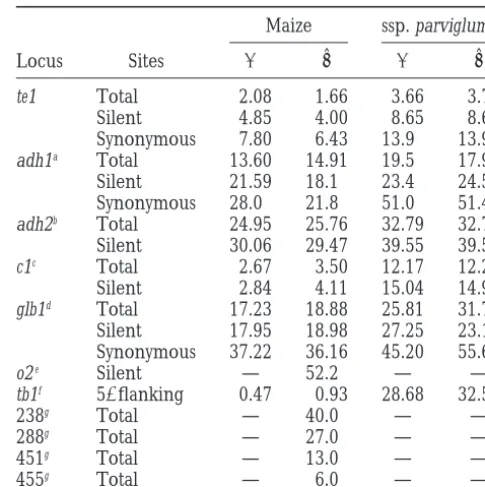
TABLE 2
Nucleotide diversity (panduˆ) at Zea loci
Maize ssp. parviglumis
Locus Sites p uˆ p uˆ
te1 Total 2.08 1.66 3.66 3.79
Silent 4.85 4.00 8.65 8.69
Synonymous 7.80 6.43 13.9 13.97
adh1a Total 13.60 14.91 19.5 17.91
Silent 21.59 18.1 23.4 24.5
Synonymous 28.0 21.8 51.0 51.4
adh2b Total 24.95 25.76 32.79 32.79
Silent 30.06 29.47 39.55 39.55
c1c Total 2.67 3.50 12.17 12.21
Silent 2.84 4.11 15.04 14.98
glb1d Total 17.23 18.88 25.81 31.72
Figure2.—A neighbor-joining tree of the te1 sequences.
Silent 17.95 18.98 27.25 23.15
Bootstrap values.50% are shown. Branch lengths are
propor-Synonymous 37.22 36.16 45.20 55.61 tional to the probable number of substitutions per site using
o2e Silent — 52.2 — —
Kimura 2-parameter distances.
tb1f 59flanking 0.47 0.93 28.68 32.57
238g Total — 40.0 — —
288g Total — 27.0 — —
(Figure 1). With the exception of 1 sequence (maize6), 451g Total — 13.0 — — all of the maize te1 sequences fall into 1 of 2 haplotypes. 455g Total — 6.0 — — There is no correlation between these 2 haplotypes and
Values per basepair31000. Silent sites were defined as 59 the geographical source of the maize lines sampled (Ta- leader, intron, and third position sites.
ble 1). One of these 2 haplotypes was found only among aEyre-Walkeret al. (1998).
bGoloubinoffet al. (1993). Synonymous sites not calcu-maize individuals, while the other was found in calcu-maize
lated because there are few sites. and 1 teosinte (Z. mays ssp. mexicana) individual (mex1).
cHanson et al. (1996). Synonymous sites not calculated In the remaining 11 Zea individuals, 11 haplotypes were
because there are few sites.
found. dHiltonandGaut(1998).
Haplotype diversity is influenced by the amount of eHenryandDamerval(1997). hWanget al. (1999).
recombination at a locus. We assessed the minimum
gRandom loci;Shattuck-Eidenset al. (1990). number of recombination events required to explain
the observed patterns of segregating sites within each subspecies included in the te1 data set using the method
huehuetenangensis sequences included in the analysis, ofHudsonandKaplan(1985). This test shows no
evi-however, group together in the tree. dence of recombination within either maize or ssp.
par-Comparison ofte1nucleotide diversity with other Zea
viglumis (Rm 5 0). However, when these two taxa are
loci:Values for nucleotide diversity at te1 in maize are considered together, there is evidence for at least one
among the lowest of the Zea loci for which p and uˆ recombination event (Rm51).
have been estimated (Table 2). The only genes with less
Phylogenetic analysis of te1 sequences: If te1 were
diversity [teosinte branched1 (tb1) and colorless aleurone involved in the evolution of maize, selection for a
spe-(c1)] are known or suspected to have been under selec-cific sequence motif at this locus could be expected to
tion in maize. Nucleotide diversity at te1 is also low in result in a te1 gene tree in which all maize sequences
ssp. parviglumis. Maize p and uˆ values for te1 at total form a single clade. To test this prediction, phylogenetic
sites arez57 and 44% of these values for ssp. parviglumis. analysis was performed on the te1 sequence data. The
At other loci, the percentage of variation found in maize resulting phylogenetic tree does not reveal a
monophy-compared to ssp. parviglumis ranges from 2.9% for tb1, letic maize clade (Figure 2). In fact, the tree shows little
to 60% for globulin1 (glb1) and 83% for adh1 when total resolution for any of the Zea species or subspecies. In
sites are considered (Table 2;HiltonandGaut1998). many cases a sequence from one subspecies is more
Tests for selection at te1: Low nucleotide diversity closely related to sequences from another subspecies
may indicate that selection has reduced polymorphism than it is to sequences from the same subspecies. A
at a locus. To test whether this is the case for te1 in similar lack of resolution is found in phylogenetic trees
maize, the HKA test was performed on the maize te1 made using other Zea nuclear genes (GautandClegg
sequence data using Z. diploperennis as the outgroup. 1993a; Goloubinoffet al 1993;Buckler and
Holts-This test assays whether there is a lack of consistency
ford 1996; Hanson et al. 1996; Hilton and Gaut
in the ratio of polymorphism to divergence between 1998), and is probably indicative of lineage sorting and/
sequences as controls, the HKA test did not reject the ence(s) would act as synapomorphies that could join all maize sequences in a single clade apart from other null hypothesis that te1 is evolving neutrally in maize
(X250.626, P50.73). Therefore, although nucleotide Zea. Phylogenetic analysis of the Zea and Tripsacum te1 sequences, however, reveals no evidence for a monophy-diversity at te1 is low compared to other maize loci,
similarly low te1 divergence values between species sug- letic maize clade. Rather, the maize sequences fall pri-marily into two groups, one of which includes a se-gest that this low level of polymorphism is not due to
positive selection within the maize lineage. quence from ssp. mexicana (mex1). This ssp. mexicana sequence is of the same haplotype as many of the maize Another common test for departure from neutrality,
the Tajima test, uses a comparison ofpanduto detect sequences, possibly due to introgression between ssp. mexicana and maize. Introgression between these two selection (Tajima 1989). Under neutral evolution, p
anduare expected to be equal, so the Tajima D statistic, subspecies has been reported previously (Doebley
1990b). Alternatively, both maize and ssp. mexicana may
p 2 uˆ/[V(p 2 uˆ)]21/2, will be zero when a locus is
evolving neutrally, and significantly different from zero have retained an ancient haplotype that was present in an ancestral population. Similarly, maize shares three when selection has affected the frequencies of the
poly-morphisms. There are only 3 maize haplotypes among polymorphisms with the ssp. parviglumis sequences, and two with other ssp. mexicana sequences. While these 12 maize sequences compared to 12 haplotypes among
12 teosinte sequences. So at least superficially, it appears shared polymorphisms could also reflect introgression between the three taxa, a more likely explanation is the that selection may have affected the pattern of
polymor-phism in maize. However, the D value for the maize te1 retention of ancient polymorphisms by each of these Z. mays subspecies as has been previously suggested for sequence data (D50.97) is not significantly different
from zero (P.0.1), and the null hypothesis that the adh1 and colored aleurone1 (c1;GautandClegg1993a;
Hansonet al. 1996). Since the topology of the te1 tree pattern of polymorphism is due to neutral processes
cannot be rejected. for Zea is similar in nature to that of neutral genes such as adh1, it offers no support for the hypothesis that te1 The relative numbers of synonymous and
nonsynony-mous nucleotide substitutions within and between spe- has been involved in maize morphological evolution.
No evidence for selection on te1: Three statistical cies can also be used to detect selection using the M-K
test. This test assumes that under neutral processes, the tests designed to determine whether a locus is evolving neutrally all failed to show evidence for past selection ratio of replacement to synonymous fixed differences
between species will be the same as the ratio of replace- acting on the maize te1 gene. One of the predictions made by these tests is that if te1 were involved in maize ment to synonymous polymorphisms within species.
When applied to the maize te1 data using Z. diploperennis evolution, the relative level of nucleotide diversity at te1 in maize should be reduced as compared to neutral for interspecies comparison, the M-K test revealed no
departure from neutrality (G value with William’s cor- genes such as adh1 and adh2. However, the HKA test, when applied to sequence data for te1 and the appro-rection50.588, P5 0.44).
Divergence dates: Since te1 appears to be evolving priate controls, shows no evidence for a reduction in nucleotide diversity in te1 relative to these other two neutrally, nucleotide divergences at te1 should be
appro-priate for determining the time of historical events such genes. Similarly, the McDonald-Kreitman test, which compares the ratio of replacement to synonymous fixed as the age of the maize gene pool and the divergence
time of the Zea-Tripsacum lineages. The two most diver- differences with the ratio of replacement to synonymous polymorphisms, failed to show any evidence of selection gent maize haplotypes (haplotypes 1 and 3) differ by
five synonymous substitutions over 309.67 synonymous at te1. The third test, the Tajima test, asks whether p andu are equivalent as expected under neutral evolu-sites (Figure 1). Assuming that the substitution rate in
maize is 5.9 to 6.531029substitutions per synonymous tion. When applied to the maize te1 data, the Tajima test did not reject the null hypothesis that te1 is evolving site per year for neutral genes (Gautet al. 1996; see
discussion), the maize gene pool is z1.2–1.4 million in a neutral manner.
Despite the fact that all of the statistical tests for selec-years (myr) old. The three maize te1 haplotypes
there-fore diverged well bethere-fore maize was domesticated tion failed to show any evidence for selection, a role for the te1 locus in maize evolution cannot be completely (z7500 yr ago;Iltis1983), and were inherited by the
maize lineage from an ancestral population. Similarly, discounted. These tests are designed to be conservative and so they reject the null hypothesis only in very obvi-using net divergence (Nei 1987) at synonymous sites
between the two Tripsacum species and Zea (9.33/308 ous cases of selection. Selection at te1 may therefore be too weak to be detected by these tests. Alternatively, if sites) and the above mutation rates, the Zea and
Tripsa-cum lineages divergedz2.3–2.6 mya. the region of te1 under selection in maize is upstream or downstream of the region analyzed, these tests would not detect selection if the recombination rate within DISCUSSION
the locus is high enough to allow closely linked regions to have different histories. Similar statistical analysis of
Phylogeny: If te1 were involved in the evolution of
shown that recombination can be sufficiently high that (expected heterozygosity) and 80% as many polymor-phic loci as its progenitor. Isozyme data, based on 21 neighboring sequences can have very different histories
(Wanget al. 1999). Specifically, comparison of the tb1 loci, indicated that maize possesses only 70% as much heterozygosity and only 73% as many polymorphic loci 59flanking region with the coding region of the gene
indicated that selection has impacted the pattern of as its progenitor. More recent studies of nucleotide di-versity at neutrally evolving loci are consistent with these polymorphism in one region but not the other. Thus,
if selection acted upon regions of the te1 gene other results, demonstrating that maize possesses z83% of the diversity found in its progenitor at adh1 andz60% than the one analyzed, it could have gone undetected.
Therefore, the results presented here suggesting that at glb1 (HiltonandGaut1998).
The percentage of diversity that maize has retained te1 was not involved in maize evolution should be
consid-ered preliminary. in te1 relative to ssp. parviglumis is consistent with these previous reports, although somewhat smaller. The
val-Nucleotide diversity inte1is low:The level of
nucleo-tide diversity in te1 is among the lowest of any maize ues ofpanduˆ for te1 in maize are 57 and 44% of these values for ssp. parviglumis. In addition, there are only locus and te1 has 10-fold less diversity than some other
maize loci (Table 2). The only genes with less diversity three maize haplotypes among 12 maize individuals compared to five haplotypes among 5 ssp. parviglumis (tb1 and c1) are known or suspected to have been under
selection in maize. Moreover, diversity for te1 is lower individuals, suggesting that haplotypic diversity is re-duced more severely than nucleotide diversity. Simula-than the reported values for most other genes whether
one considers total, silent, or synonymous sites (Table tions of the bottleneck process have shown that the reduction in maize genetic diversity can be explained 2). As suggested by the nonsignificant result of the HKA
test, the low diversity of te1 in maize is likely a characteris- by a short bottleneck involving only a few individuals (Eyre-Walkeret al. 1998). The low number of te1 hap-tic of this gene and not the result of a selective sweep.
Consistent with this interpretation, a low level of diver- lotypes in maize may therefore be due to a narrow bottle-neck from which only a few haplotypes emerged. sity for te1 appears to be maintained not only in maize
but also in ssp. parviglumis for which te1 has the lowest Time of historical events: Since te1 appears to be evolving in a neutral manner, te1 sequences should be value for uˆ observed in this subspecies. That selection
in maize is unlikely to explain the low diversity for te1 useful in estimating the time of historical events. To do this requires that the rate of sequence evolution at is made particularly clear if one compares te1 to tb1.
At tb1 where there is evidence for selection in maize, synonymous sites be known. Gaut and colleagues (Gaut
et al. 1996;Eyre-Walkeret al. 1998;HiltonandGaut
diversity is low in maize but high in ssp. parviglumis. If
one applies the HKA test to tb1 and te1, the result is 1998) have used a rate of 6.53 1029substitutions per synonymous site per year based on sequence divergence highly significant. This result is consistent with our
inter-pretation that tb1 has experienced a selective sweep at synonymous sites in adh1 and adh2 between maize and rice/barley and an estimated divergence date of 50 while te1 has not (data not shown).
There are at least three explanations for the low level myr for these grasses. To examine the generality of this rate, we calculated the synonymous rate between maize of nucleotide diversity in te1. First, the substitution rate
at te1 may be lower than it is for other maize genes. and rice for five genes (ant, c1, c2, cdc, and ohp; see
GautandDoebley1997) and obtained a rate of 5.93 Synonymous substitution rates have been found to vary
among plant nuclear genes (Wolfe et al. 1989) and 1029when these genes are averaged with adh1 and adh2. The rates among these genes vary from 4.731029for may indicate that different genes experience different
mutation rates. Second, background selection on te1, c2 to 7.031029for adh1. One potential source of error in these estimates is the presumed maize-rice divergence itself due to a high degree of functional constraint or
selection on neighboring genes coupled with a hitchhik- date of 50 myr. The fossil record does not provide an unambiguous estimate of the time of maize-rice diver-ing effect, could reduce variation at te1 (Maynard
Smith andHaigh 1974;Charlesworth et al. 1993). gence and various authors have placed the date in a range from 40–70 myr (Wolfeet al. 1989; Gautet al. If such selection were acting in the progenitor of extant
Zea species, there would have been less variation to 1996). Another potential source of error is rate variation among grass lineages. Gaut and Clegg (1993b) esti-partition into its descendants. Third, codon usage bias
can bring synonymous sites under selective constraint. mated that the rate of adh1 sequence evolution is 1.7 times higher in the maize lineage than in the penni-Codon usage bias appears to vary among mammalian
genes and causes a reduced synonymous substitution setum lineage. If this represents a recent acceleration of the rate in the maize lineage, applying a general grass rate in some genes relative to others (Li1997).
Previously, isozyme data were used to ask whether rate to maize would bias the estimates of the time of historical events to be older than they actually are. bottlenecks during domestication caused a reduction
in polymorphism in crops relative to their progenitors Gaut and Clegg (1993a) and Goloubinoff et al. (1993) first established that the age of the maize gene (Doebley 1989). The isozyme data indicate that an
as a species by calculating the divergence time for maize tion or historical parameters using te1 that are lower than those found with other neutral genes: smaller esti-alleles at adh1 and adh2, respectively.GautandClegg
(1993a) estimated that the most distinct adh1 alleles mates of u, a younger age for the maize gene pool, and a younger divergence time for the Zea-Tripsacum diverged 1.9 mya. More recently, SanMiguel et al.
(1998) estimated a divergence time of 3.6 myr for adh1, a lineages. As discussed above, a variety of explanations can be offered for these discrepancies; however, one value nearly twice the original estimate. (The difference
between these estimates partly reflects application of factor, a slower synonymous substitution rate for te1, can substantially explain all three discrepancies. If the the synonymous rate to intron sites in one of these
studies.)Hansonet al. (1996) estimated the age of the synonymous substitution rate for te1 is half of the aver-age for the seven nuclear genes we used to calculate a maize gene pool at 140,000 yr on the basis of the c1
gene and a substitution rate of 531029; however, this general rate, then the estimates for all three parameters would be much closer to estimates from the neutral estimate is likely biased downward since c1 was probably
under selection that eliminated some haplotypes during genes adh1, adh2, and glb1. For this reason, we suspect that te1 is evolving at a reduced rate. Better estimates maize domestication. We estimate that the divergence
time of the most distinct maize te1 alleles isz1.2–1.4 of the time of historical events will require a more com-plete fossil record, an investigation of rate variation myr. This estimate agrees roughly with prior estimates
in that it indicates that the age of the maize gene pool among different lineages, an understanding of rate vari-ation among genes, and reconsidervari-ation of applying greatly exceeds the age of maize as a species (5,000–
10,000 yr); however, it is only one-half to one-third as synonymous rates to intron sites. Until these matters are resolved, it should be recognized that estimates for large as some estimates. A potential explanation for this
discrepancy is a slower substitution rate for te1 relative the time of historical events surrounding maize evolu-tion, while interesting and fun, could easily be off by a to the adh genes as discussed above. Alternatively, if
during the domestication bottleneck, maize population factor of two or more.
From QTL to gene:The motivation for this study was sizes were very small (Eyre-Walkeret al. 1998), then
one would expect considerable variation in the extent to test whether te1 corresponds to a QTL involved in maize evolution (Doebley et al. 1995). The logic was to which different neutral genes retained the diversity
found in the progenitor of maize. simple: if te1 is this QTL, then it should show the signa-ture of a past selective sweep in maize. The signasigna-ture of Tripsacum has long been recognized as the sister
genus to Zea (Mangelsdorf andReeves 1939). Hil- selection was not observed. Unfortunately, this negative result is of limited value since selection on the te1
pro-tonandGaut(1998) have estimated the time of
diver-gence of the Zea and Tripsacum lineages at 4.5 to 4.8 moter may not have impacted nucleotide polymorphism in the coding region that we analyzed (seeWanget al. mya. Our estimate of 2.3–2.6 myr based on te1 is
consid-erably more recent and may be biased downward if te1 1999). Nevertheless, we feel that a population genetic is evolving at a slower rate than other maize genes as approach to testing gene:QTL correspondence remains discussed above. Although these dates do not provide of value, especially if the region analyzed includes both an estimate of the age of Zea since the taxonomic status coding and regulatory sequences. The value of a popula-of these lineages 4.7 mya is unknown, they can be viewed tion genetic approach is in part that alternative ap-as an upper bound, presuming that Zea is not paraphy- proaches to testing gene:QTL correspondence such as letic. A minimal estimate or lower bound for the age gene transformation are more costly, more time con-of Zea is provided by the divergence time con-of extant Zea suming, and fraught with their own sets of difficulties. species, presuming Zea is not polyphyletic. Zea mays and The authors thank Bruce Veit for sharing unpublished maize te1 Z. luxurians, two of the most distinct members of Zea cDNA sequence, Rong-Lin Wang for sharing unpublished tb1 data that potentially represent the earliest divergence among and for helpful discussion, Peter Crane, Brandon Gaut, and Jonathan Wendel for comments on the manuscript, and Brandon Gaut for extant members of the genus (Doebley 1990a), are
providing the glb1 data. This work was supported by a National Science estimated to have divergedz700,000 yr ago (Hilton
Foundation/Sloan postdoctoral fellowship to S.E.W. and a grant from andGaut1998), indicating that the genus should be the National Science Foundation to J.F.D.
at least this age. Among angiosperms, old genera can be traced back in the fossil record for 50–100 myr or more [P. Crane, personal communication (Oct. 27,
LITERATURE CITED 1998)]. For example, the extant genera Ceratophyllum
Buckler, E. S.,andT. P. Holtsford,1996 Zea systematics:
ribo-is known from the Paleocene (ca. 60 mya), while the
somal ITS evidence. Mol. Biol. Evol. 13: 612–622. extant genera Alnus and Betula are known
unequivo-Charlesworth, B., M. MorganandD. Charlesworth,1993 The cally from the Eocene (ca. 45 mya;Crane1989;Heren- effects of deleterious mutations on neutral molecular variation.
Genetics 134: 1289–1303.
deenet al. 1990). In this context, Zea, with its age
cur-Crane, P. R.,1989 Early fossil history and evolution of the Betula-rently estimated as between 0.7 and 4.7 myr, is a young
ceae, pp. 87–116 in Evolution, Systematics, and Fossil History of the
genus. Hamamelidae, Vol. 2, ‘Higher’ Hamamelidae, edited byP. R. Crane
popula-Doebley, J., 1989 Isozymic evidence and the evolution of crop Hilton, H., R. M. KlimanandJ. Hey,1994 Using hitchhiking genes to study adaptation and divergence during speciation within the plants, pp. 165–191 in Isozymes in Plant Biology, edited byD. E.
SoltisandP. S. Soltis.Dioscorides Press, Portland, OR. Drosophila melanogaster species complex. Evolution 48: 1900–1913.
Hudson, R. R.,andN. L. Kaplan,1985 Statistical properties of the
Doebley, J.,1990a Molecular evidence and the evolution of maize.
Econ. Bot. 44 (Suppl. 3): 6–27. number of recombination events in the history of a sample of DNA sequences. Genetics 111: 147–164.
Doebley, J.,1990b Molecular evidence for gene flow among Zea
species. Bioscience 40: 443–448. Hudson, R. R., M. KreitmanandM. Aguade´,1987 A test for neutral molecular evolution based on nucleotide data. Genetics 116:
Doebley, J.,andA. Stec,1993 Inheritance of morphological
differ-ences between maize and teosinte: comparison of results of two 153–159.
Iltis, H. H.,1983 From teosinte to maize: the catastrophic sexual F2populations. Genetics 134: 559–570.
Doebley, J., A. Stec, J. WendelandM. Edwards,1990 Genetic transmutation. Science 222: 886–894.
Kimura, M.,1980 A simple method for estimating evolutionary rates and morphological analysis of a maize-teosinte F2 population:
implications for the origin of maize. Proc. Natl. Acad. Sci. USA of base substitutions through comparative studies of nucleotide sequences. J. Mol. Evol. 16: 111–120.
87:9888–9892.
Doebley, J., A. StecandC. Gustus,1995 Teosinte branched1 and Li, W.-H.,1997 Molecular Evolution. Sinauer Associates, Sunderland,
MA. the origin of maize: evidence for epistasis and the evolution of
dominance. Genetics 141: 333–346. Mangelsdorf, P. C.,andR. G. Reeves,1939 The Origin of Indian Corn and Its Relatives. Texas Agric. Exp. Sta. Bull. No. 574, College
Eyre-Walker, A., R. L. Gaut, H. Hilton, D. L. Feldman andB.
S. Gaut,1998 Investigation of the bottleneck leading to the Station, TX.
Maynard Smith, J.,andJ. Haigh,1974 The hitchhiking effect of domestication of maize. Proc. Natl. Acad. Sci. USA 95: 4441–4446.
Felsenstein, J.,1993 PHYLIP (Phylogeny Inference Package) ver- a favorable gene. Genet. Res. 23: 23–35.
McDonald, J.,andM. Kreitman,1991 Adaptive protein evolution sion 3.5c. Distributed by the author. Department of Genetics,
University of Washington, Seattle. at the Adh locus in Drosophila. Nature 351: 652–654.
Nei, M.,1987 Molecular Evolutionary Genetics. Columbia University
Gaut, B. S.,andM. T. Clegg,1993a Molecular evolution of the
Adh1 locus in the genus Zea. Proc. Natl. Acad. Sci. USA 90: Press, New York.
Nei, M.,andT. Gojobori,1986 Simple methods for estimating the 5095–5099.
Gaut, B. S.,andM. T. Clegg,1993b Nucleotide polymorphism in number of synonymous and non-synonymous nucleotide substitu-tions. Mol. Biol. Evol. 3: 418–426.
the Adh1 locus of pearl millet (Pennisetum glaucum) (Poaceae).
Genetics 135: 1091–1097. Rozas, J.,andR. Rozas,1997 DnaSP version 2.0: a novel software package for extensive molecular population genetics analysis.
Gaut, B. S.,andJ. Doebley,1997 DNA sequence evidence for the
segmental allotetraploid origin of maize. Proc. Natl. Acad. Sci. Comput. Appli. Biosci. 13: 307–311.
SanMiguel, P., B. S. Gaut, A. Tikhonov, Y. Nakajima andJ. L.
USA 94: 6809–6814.
Gaut, B. S., B. R. Morton, B. M. McCaigandM. T. Clegg,1996 Bennetzen,1998 The paleontology of intergene retrotranspo-sons of maize. Nat. Genet. 20: 43–45.
Substitution rate comparisons between grasses and palms:
synony-mous rate differences at the nuclear gene Adh1 parallel rate Shattuck-Eidens, D. M., R. N. Bell, S. L. NeuhausenandT. Helen-tjaris,1990 DNA sequence variation within maize and melon: differences at the plastid gene rbcL. Proc. Natl. Acad. Sci. USA
93:10274–10279. observations from polymerase chain reaction amplification and direct sequencing. Genetics 126: 207–217.
Goloubinoff, P., S. Pa¨a¨boandA. C. Wilson,1993 Evolution of
maize inferred from sequence diversity of an Adh2 gene segment Tajima, F.,1989 Statistical methods for testing the neutral mutation hypothesis by DNA polymorphism. Genetics 123: 585–595. from archaeological specimens. Proc. Natl. Acad. Sci. USA 90:
1997–2001. Veit, B., R. J. Schmidt, S. HakeandM. F. Yanofsky,1993 Maize
floral development: new genes and old mutants. Plant Cell 5:
Hanson, M. A., B. S. Gaut, A. O. Stec, S. I. Fuerstenberg, M. M.
Goodmanet al., 1996 Evolution of anthocyanin biosynthesis in 1205–1215.
Veit, B., S. P. Briggs, R. J. Schmidt, M. F. YanofskyandS. Hake,
maize kernels: the role of regulatory and enzymatic loci. Genetics
143:1395–1407. 1998 Regulation of leaf initiation by the terminal ear1 gene of
Henry, A.-M.,andC. Damerval,1997 High rates of polymorphism maize. Nature 393: 166–168.
and recombination at the opaque-2 locus in cultivated maize. Mol. Wang, R.-L., A. Stec, J. Hey, L. LukensandJ. Doebley,1999 The Gen. Genet. 256: 147–157. limits of selection during maize domestication. Nature 398: 236–
Herendeen, P. S., D. H. LesandD. L. Dilcher,1990 Fossil Ceratophy- 239.
llum (Ceratophyllaceae) from the tertiary of North America. Watterson, G. A.,1975 On the number of segregating sites in Amer. J. Bot. 77: 7–16. genetical models without recombination. Theor. Popul. Biol. 7:
Hey, J.,andJ. Wakeley,1997 A coalescent estimator of the popula- 188–193.
tion recombination rate. Genetics 145: 833–846. Wolfe, K. H., P. M. SharpandW.-H. Li,1989 Rates of synonymous
Hilton, H.,andB. Gaut,1998 Speciation and domestication in substitution in plant genes. J. Mol. Evol. 29: 208–211. maize and its wild relatives: evidence from the globulin-1 gene.