Development of STNN& its application to
ECG Arrhythmia Classification &Diagnoses
Prabhjot Kaur
1, Daljeet Kaur
2P.G Student, Dept. of ECE, Panjab University, India1
Assistant Professor, Dept. of ECE, U.I.E.T, Panjab University, Chandigarh, India 2
ABSTRACT: Neural network have impressively demonstrated the capability of modeling spatial information. On the
other hand, the application of parallel distributed models to processing of temporal data has been restricted in several places . In space time neural network, the synaptic weights between two artificial neurons are replaced with an adaptable – adjustable filter. Instead of single synaptic weight, it provides a plurality of weights, which represents not only association but also temporal dependencies. Now the synaptic weights of the neural network are the coefficients of the adaptable digital filter, which gives a neural network that is defined both spatially and temporally. This network is a Time-Delayed neural network and also known as Elman network. In this paper, an attempt is made to design a Spatio-Temporal artificial neural network which is used to classify arrhythmias. In this Spatio Spatio-Temporal Neural Network the spatial information is the output from the 12 leads of ECG, which is obtained from an electrocardiograph, and temporal information from a particular lead output. The output of this model is that particular arrhythmia from which patient is suffering.Spatio temporal neural network differs from standard neural network in terms of memory. In STNN the networks memory is distributed over the connections rather than being implemented as a special layer of nodes. STNN can deal with spatial as well as temporal data.
KEYWORDS:ECG, Arrhythmiaclassification ,Spatio Temporal neural network
I. INTRODUCTION
Analysis of the electrocardiogram (ECG) for detecting different types of heartbeats is of major importance in the diagnosis of cardiac dysfunctions. Some arrhythmias appear infrequently, and very long ECG recordings are needed to capture them. Analysis of such large amount of data is very time consuming and, therefore, automatic processing systems can be of great assistance to the clinician. ECG data is the spatio temporal data, which varies with space as well as time. Spatio temporal neural network deals with the data which varies with space as well as time. As in this paper spatio temporal neural network is used cardiac arrhythmia classification. 12 lead ECG data has been taken. 5 branches of STNN are used and each branch is given 12 inputs. 12 inputs are given so the no. of delays given to the network are 12. Then the network is trained to classify different arrhythmias such as dextrocardia, posterior wall mi, tachycardia, bradycardia, ischemia, pericardial effusion, hyperkalemia etc.
II. PROBLEM FORMULATION
III. METHODOLOGY
In this paperSpatio temporal neural network has been used to identify 10 different Cardiac arrhythmias using ECG data. Thesis work has been divided into three steps.
Calculating ECG parameters from real ECG data: In the first step various ECG parameters are calculated and are normalized. These parameters are P, R, T, PR and HR.
STNN: In the next step these parameters are used to train the neural network. Inputs to the neural network are these ECG parameters. in this step the STNN is used for arrhythmia classification.
Feature extraction: In the third step Feature extraction is used for arrhythmia diagnosis.
In the first step ECG parameters P, R, T, PR and Heart Rate are calculated and normalized From the real ECG trace. Then in the second step Spatio temporal neural network is trained with parameters by considering following conditions.
For p>2 output is 20; for p ≤ 2 output is 10; for p ≤ 0 output is 0. Where p is the p wave amplitude.
For R ≤ 13 output is 1; for R > 13 output is 10
For 1<T ≤ 2 output is 10; for T > 2 output is 20, for T < 0 output is 0.
For PR ≤ .16 output is 10; for PR > .16 output is 15.
For 60 ≤ HR ≤ 100 output is 10; for HR< 60 output is 20.
After training STNN next step is Feature extraction. In feature extraction output of the neural network is used for arrhythmia diagnosis. MATLAB software is used to write the program.
Fig.2 Architectural view of one branch of STNN
Fig.2 shows the architectural view of a branch of STNN. Here STNN consists of 5 branches each for P, R, T , PR & HR. 11 delays are used as there are 12 lead data of ECG is used for input. P , R, T , PR & HR has 12 inputs at the same time. Linear activation function is used at the out put.
D
D
D
D D
D D D
D
D D
IV. RESULTS
As Spatio temporal neural network is trained to classify the arrhythmias. ECG data of a patient is used to train the network. In this work ECG data is taken & used to train the network for identifying particular arrhythmia.
Fig.3 ECG Trace for lead I,II,III,AVR,AVL,AVF.ECG of 52 years old patient
Fig.5 Error for P wave
Fig.5 shows error for the P wave for 1300 passes. This error is calculated by the program between the desired output and the network output Arrhythmia diagnosis for P wave is given in Table no1.
Fig.6 Error for T wave
Fig 6 shows the error for T wave for 7000 passes. Error for T wave is calculated by the program as a difference between desired out put and network output is given in Table no.2
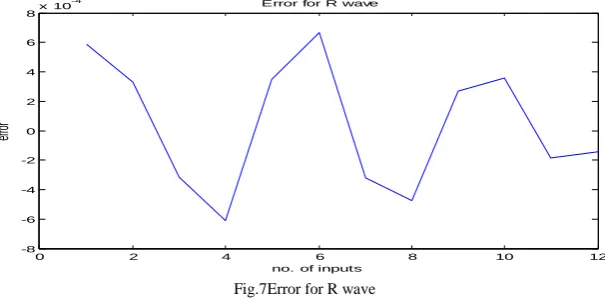
Fig.7Error for R wave
Fig. 7 shows the error for R wave with 300 passes.error for R wave is calculated by the program as a difference between desired output and network output is given in Table no 3
0 2 4 6 8 10 12
-2 -1 0 1 2 3 4 5
6x 10
-3
no. of inputs
er
ro
r
error for p wave
0 2 4 6 8 10 12
-6 -4 -2 0 2 4 6 8x 10
-3
no. of inputs
er
ro
r
error for T wave
0 2 4 6 8 10 12
-8 -6 -4 -2 0 2 4 6
8x 10
-4
no. of inputs
err
or
Fig.8 Error for PR interval
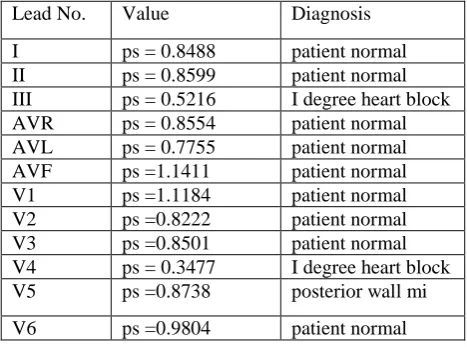
Fig.8 shows error for PR interval for 4500 passes. This error is between the network output and desired network output is given in Table no. 4
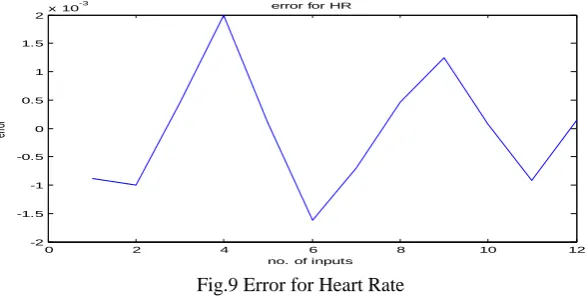
Fig.9 Error for Heart Rate Fig.9 shows the error for Heart Rate for 1200 passes. Given in Table no. 5
Table no.1 Arrythmia Diagnosis For P wave Table no.2 Arrhythmia Diagnosis for T wave
Lead No. Value Diagnosis
I p = 9.985 patient normal II p =20.0052 corpulmonale III p =10.0004 patient normal AVR p =19.9992 corpulmonale AVL p = 9.9989 patient normal AVF p =9.9999 patient normal V1 p =0.0012 dextrocardia V2 p =10.0002 patient normal V3 p = -1.8535e-004 dextrocardia V4 p =19.9996 corpulmonale V5 p =9.9999 patient normal V6 p =10.0005 patient normal
0 2 4 6 8 10 12
-0.6 -0.5 -0.4 -0.3 -0.2 -0.1 0 0.1 0.2 0.3
no. of inputs
err
or
error for PR interval
0 2 4 6 8 10 12
-2 -1.5 -1 -0.5 0 0.5 1 1.5
2x 10
-3
no. of inputs
err
or
error for HR
`Lead No. Value Diagnosis
I Tn=10.0056 patient normal II Tn =19.9922 hyperkalcemia III Tn =10.0052 patient normal AVR Tn = 9.9988 patient normal AVL Tn = 9.9979 patient normal AVF Tn = 20.0026 hyperkalcemia V1 Tn =
-4.8129e-004
ischemia
V2 Tn = -8.2908e-004
ischemia
Table no.3 Arrhythmia Diagnosis for Heart Rate Table no.4 Arrhythmia Diagnosis for R wave
Lead No. Value Diagnosis
I hr = 1.0009 patient normal II hr =1.0010 patient normal III hr =0.9996 patient normal AVR hr = 0.9980 patient normal AVL hr = -1.1544e-004 tachycardia AVF hr = 1.0016 hyperkalcemia V1 hr =1.0007 patient normal V2 hr =0.9995 patient normal V3 hr = 0.9998 patient normal V4 hr = 0.999 patient normal V5 hr = 1.0009 patient normal V6 hr = 0.9999 patient normal
Table no.5 Arrhythmia Dignosis For PR interval
Lead No. Value Diagnosis
I ps = 0.8488 patient normal II ps = 0.8599 patient normal III ps = 0.5216 I degree heart block AVR ps = 0.8554 patient normal AVL ps = 0.7755 patient normal AVF ps =1.1411 patient normal V1 ps =1.1184 patient normal V2 ps =0.8222 patient normal V3 ps =0.8501 patient normal V4 ps = 0.3477 I degree heart block V5 ps =0.8738 posterior wall mi
V6 ps =0.9804 patient normal
V. CONCLUSION AND FUTURE SCOPE
A spatio temporal neural network is used for the classification & diagnosis of different arrythmias such as dextrocardia, corpulmonale, atrial fibrillation, posterior wall mi, percardiac effusion, hyperkalemia, ischemia, posterior wall mi, first degree heart block, tachycardia and bradycardia. For this ECG parameters P, R, T, PR, and HR are calculated manually. These parameters are used to train the neural network to determine the cardiac arrhythmia. Spatio temporal neural network is used here which has 5 branches and each branch has 12 input variables. Delays used in this network are 11.and 5 neurons are used one neuron for each branch. This approach make the work simpler as it can deal with spatial as well as temporal data. STNN is better than normal back propagation neural network as lesser no. of neurons are required in STNN and it can deal with Spatio as well as temporal data at the same time. This approach has its scope in the field of medical i.e. where Doctors can use this program to classify the arrhythmia.This will improve the performance of heart treatment .EEG data can be applied to Spatio temporal neural network to detect abnormalities in the electrical activity of the brain which may help diagnose the presence and type of various brain disorders, to evaluate head injuries, tumors, infections, degenerative diseases, and other disturbances that affect the brain.
Lead No. Value Diagnosis
I r =1.0057 patient normal II r = 0.9975 patient normal III r = 9.9933 patient normal AVR r = 0.9939 patient normal AVL r =10.0141 patient normal AVF r =1.0076 patient normal V1 r = 9.9866 patient normal V2 r =0.9987 patient normal V3 r =1.0124 patient normal V4 r =1.0009 patient normal V5 r = 19.9911 posterior wall
mi
REFRENCES
[1 ] James .Villarreal , Friendswood , Robert O. Shelton , "Neural Network for processing both Spatial & temporal data wi th time based Back-propagation" United States Patent
[2 ] Christopher C. Pack , Bevil R. Conway , Richard T. Born ,Margaret S. Livingstone "Spatiotemporal Structure of Nonlinear Subunits in Macaque Visual Cortex" The Journal of Neuroscience, Volume: 26, page(s): 893-907, January 18, 2006
[3 ]Wu Shui-cai , BaiYiang-pin , “Study on dynamic electrocardiogram system with function of ECG tele-transmission”,Radio Science Conference,. Proceedings., 2010 Asia-Pacific
[4] B. Quenet and D. Horn "The Dynamic Neural Filter:A Binary Model of Spatiotemporal Coding" Massachusetts Institute of Technology , Neural Computation. , Volume: 15 , part 2 , page 309-329 , 2012
[5 ] M. Brito , J. Henriques , P. Gil , M. Antunes, "A Predictive Adaptive Approach to Generic ECG Data Compression" International Workshop on Intelligent Signal Processing , page(s): 32- 37 , 1-3 , Sept.2005
[ 6 ] Weng Chi Chan, Shuo Tang S, H. P, “ECG Parameter Extractor of Intelligent Home Healthcare Embedded System”,27th International
conference of Engineering in Medicine and Biology Society, 2010
[7] Herrero, G.G.;Gotchev, A.; Christov, I.; Egiazarian, K.,“Feature extraction for heartbeat classification using independent component analysis and matching pursuits”, Proceedings. (ICASSP apos;05). IEEE International Conference on Acoustics, Speech, and Signal Processing, Volume 4, Issue ,2012
[8] YukselOzbay and BekirKarlik,“ARecognition Of ECG ArrhythmiasUsingArtificial Neural Networks”,Proceedings – 23rd Annual Conference – IEEE/EMBS Oct.25-28, 2001, Istanbul, TURKEY
[9] Cosandier-Rimele, D., Badier, J.-M. , Chauvel, P., Wendling, F. "A Physiologically Plausible Spatio-Temporal Model for EEG Signals Recorded With Intracerebral Electrodes in Human Partial Epilepsy" , IEEE Transactions on Biomedical Engineering , Volume: 54 , Issue 3, page(s):380 – 388 , March 2007
[10] Hussain, M.; Khan, M.N. „„Online Urdu Ligature Recognition using Spatial Temporal Neural Processing‟‟ 9th International Multitopic Conference, IEEE INMIC 2009.