Copyright 0 1990 by the Genetics Society of America
Gene Conversion in the Evolution of Both the H-2 and
Qu
Class I Genes of
the Murine Major Histocompatibility Complex
Mary Kuhner,* Suzanne Watts: William Klitz,* Glenys Thornson* and Robert
S.Goodenow+
*Department of Integrative Biology and Department of Molecular and Cell Biology, University of Calijornia,Berkeley, Calvornia 94720, and ?Cell Biology Department, Baylor College of Medicine, One Baylor Plaza, Houston, Texas 77030 Manuscript received January 27, 1990
Accepted for publication September 4, 1990
ABSTRACT
In order to better understand the role of gene conversion in the evolution of the class I gene family of the major histocompatibility complex (MHC), we have used a computer algorithm to detect clustered sequence similarities among 24 class I DNA sequences from the H - 2 , Qa, and Tla regions
of the murine MHC. Thirty-four statistically significant clusters were detected; individual analysis of the clusters suggested at least 25 past gene conversion or recombination events. These clusters are comparable in size to the conversions observed in the spontaneously occurring H-2Kb” and H-2Kkm2 mutations, and are distributed throughout all exons of the class I gene. Thus, gene conversion does
not appear to be restricted to the regions of the class I gene encoding their antigen-presentation function. Moreover, both the highly polymorphic H-2 loci and the relatively monomorphic Qa and
Tla loci appear to have participated as donors and recipients in conversion events. If gene conversion
is not limited to the highly polymorphic loci of the MHC, then another factor, presumably natural selection, must be responsible for maintaining the observed differences in level of variation.
T
HE class I genes of the murine major histocom- patibility complex (MHC), located on chromo- some 17, can be divided into three distinct regions:H - 2 , Q a , and Tla (HOOD, STEINMETZ and MALISSEN
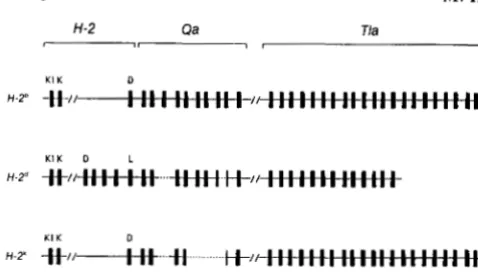
1983). Figure 1 shows the arrangement of these re- gions in several mouse strains. T h e H - 2 or “classical” loci K ,
D
and L encode the transplantation antigens, comparable to HLA-A and -B in humans. These loci are extraordinarily polymorphic, with amino acid var- iability concentrated primarily in the antigen recog- nition site (ARS), a cleft formed by two a-helices lying across a @-pleated sheet on the top of the molecule(BJORKMAN et al. 1987a,b). T h e T cell receptor inter-
acts specifically with residues on the a-helices, as well as with peptide bound in the cleft, in MHC-restricted cytotoxic T cell responses (BJORKMAN et al. 198713). T h e “nonclassical” loci of the Qa and Tla regions, which have the same general protein and gene struc- ture as the H-2 molecules (CHEN et al. 1987; ROBINSON
1987; WEISS 1987), display much less variability-few alleles can be distinguished serologically or biochem- ically-and do not appear to function as restriction elements (CHEN et al. 1987; ROBINSON 1987).
Elucidating the history of H-2 polymorphism is an intriguing evolutionary problem. Analysis of sponta- neous mutants including H-2Kkm2 and the H-2Kbm
series has revealed one diversification mechanism in which small sequence transfers between loci, termed gene conversion, introduce multiple amino acid
changes (NATHENSON et al. 1986; GELIEBTER and NA-
THENSON 1988; VOGEL et a / . 1988). T h e mutations
(;enetics 1 2 6 1 115-1 126 (December, 1990)
usually appeared in several littermates, reminiscent of mitotic recombination in the germ line (NATHENSON et al. 1986). It has been suggested, based on the structures of these mutants and the patchwork pattern of homology among naturally occurring H-2 and HLA
sequences (PEASE 1985), that gene conversion is a major mechanism for generating new class I alleles
(NATHENSON et al. 1986; PEASE 1985). However, since
other multigene families, such as hemoglobin, in which gene conversion also operates (COLLINS and
WEISSMAN 1984), d o not share the high class I poly-
morphism, forces other than conversion itself must be at work.
Natural selection for diversity and heterozygosity is also thought to promote the establishment and main- tenance of histocompatibility antigen variability
(KLITZ, THOMSON and BAUR 1986; KLEIN 1986). This
theory is consistent with the observation that most of the polymorphism among H-2 sequences consists of substitutions altering the amino acid sequence of the antigen recognition site (ARS) (HUGHES and NEI
1988). In contrast, the relative lack of polymorphism among Qa and Tla alleles suggests that they have evolved under different constraints than the H - 2
genes. Although their function remains unknown,
possible roles in development or immune regulation have been suggested for these molecules based on their ontogenic- and tissue-specific distribution
(FLAGHERTY et al. 1990; MORSE et al. 1990). Alter-
1116
H-2 Qa Tla
I , I
D H-2' /I"//-+
-KI K
K I K D L H-2' #-//-KHt)l---)Htt-"//-
KI K D
H-P
N-//"-fst
. ...-
FIGURE 1 .-Physical map of the class I loci. Schematic represen- tation of the physical map of the class I genes from three inbred mouse strains, C57BL/10 (H-26), BALB/C ( H - 2 d ) and C3H (H-2'). Genes (boxes) within the H-2 and Qa regions are positioned to show ;dlelic relationships based on DNA sequence similarity. Dashed lines indicate space added to facilitate this positioning. Note that the locus named L on haplotype H-2d (and H-2') is apparently allelic to locus D of other haplotypes, while D d (and D') represents a divergent duplication; the nomenclature predates the molecular map of this region. Boxes in the Tla region represent estimated numbers of genes only, not allelic relationships. Adapted from WATTS et al.
1989.
tional vestigial proteins (HUGHES and NEI 1989). Cor- respondingly, their near monomorphism may result from selection for a particular structure, or lack of the balancing selection which apparently promotes H - 2 variability. Since both Qa and Tla genes have been identified as potential donors for H-2Kbm mutations
(GELIEBTER and NATHENSON 1988), it has been pro-
posed that the nonclassical loci may be evolutionarily important in that they provide a reservoir of sequence information for generating novel H - 2 alleles by gene conversion (BREGEGERE 1983).
We have used a statistical algorithm (STEPHENS
1985) to detect evidence of clustering indicative of past gene conversion events among 24 murine class I sequences. For each putative conversion event we have analyzed the sequences and gene regions in- volved, the apparent length of the event, and its effect on protein sequence in order to gain a clearer picture of the nature, extent, and evolutionary significance of genetic exchange in the evolution of the mouse MHC.
MATERIALS AND METHODS
DNA sequences: An alignment with references for all the H - 2 and Qa sequences used can be found in KUHNER and GOODENOW (1989); for this study we have added the Tla
sequence T I 3 (FISHER, HUNT and HOOD 1985). Only exon sequences were compared due to the difficulty of aligning introns among the more distantly related sequences. Future reports may be able to confirm or reject some of the events reported here by using intron data. Because of the remark- able sequence conservation between the H-2Kq cDNA and genomic H-2KWz8 (MORITA et al. 1985), the latter was used to represent H2-Kq in regions not covered by the truncated cDNA. As a test of the method, we also used human se- quences HLA-AI (PARHAM et al. 1988), A 2 . I (HOLMES et al. 1987), B8 (PARHAM et al. 1989), B51 (ENNIS et al. 1990),
C w l (Gussow et al. 1987), and Cw? (SODOYER et al. 1984),
and bovine sequences BL?-6 and BL3-7 (ENNIS, JACKSON and
PARHAM 1988) for one comparison. Base pairs deleted or unknown in any sequence were omitted from all compari- sons involving that sequence.
Statistical algorithm: A modified form of the method of STEPHENS ( 1 985) was used. Briefly, each variable nucleotide site is treated as a division of the group of sequences under consideration into two subgroups. All sites which produce the same subgroups are analyzed together as a set, called a "partition." For example, the sites at which H2-Kd and QSk share one base pair, while all other sequences share a differ- ent base pair, constitute a partition. Non-random distribu- tion-clustering-of the sites in a partition is taken as evidence for genetic exchange. If two or more sequences share sub- stitutions because they have a common ancestor, the substi- tutions are expected to be randomly distributed across all variable sites in the molecule. If, on the other hand, substi- tutions are shared because of genetic exchange, they will be found predominantly in the region of exchange, forming a cluster.
Clustering was evaluated in two ways: comparison of the length spanned by the partition (do) to the length of the sequence, and comparison of the longest gap within the partition (go) to do. STEPHENS (1985) gives statistics for calculating the probabilities of do and go greater than or equal to those observed under the null hypothesis of random distribution of sites (Pd,, and Pgo, respectively).
Two changes were made to adapt STEPHENS' method to the analysis of the class I data: (1) The distribution of variability across the class I gene is not random; the antigen presenting sites are hypervariable, while the more 3' do- mains are highly conserved. T o partially correct for this, all sites found to be invariant in a given comparison were excluded from that comparison. (2) Sites with more than two alternative nucleotides present a problem for STEPHENS' method. We chose to replace each such site with the nearest 2-alternative site of compatible form. For example, a 3-way division of A/B/C would be replaced by A/BC or AB/C or AC/B, the choice being made by searching along the se- quence in both directions until a 2-way site of one of these types was found. If no similar 2-way site could be found, the 3-way site was omitted from analysis. This method allows comparison of large numbers of sequences simultaneously, and greatly increases the power of comparisons between divergent sequences (such as classical versus non-classical genes). However, it does introduce a bias toward identifi- cation of partitions as significant. T o compensate for this and for the multiple comparisons made, we have reported only partitions with Pdo or Pgo less than 0.01. Computer simulations (unpublished results) suggest that this corre- sponds to a true significance level of less than 0.05. Fur- thermore, the majority of the clusters detected with this modification were also detected when sites with three or more bases were simply omitted from the calculations (re- sults not shown).
In comparisons among large numbers of sequences, over- lapping events and point mutations can obscure the detec- tion of clusters. Therefore, in addition to the global com- parison of all 24 sequences, we also compared H-2 loci and
Gene Conversion in Mouse MHC
TABLE 1
Subsets of sequences analyzed
1117
Comparison Abbr. Seq. Sites (%) D G Sig All mouse sequences All 24 447 (74) 39 26 13
All except KI', TZ3 H2IQa 22 414 (78) 46 29 17
H-2 including KI' H2/K 1 13 262 (85) 36 22 7
H-2 except K l k H2 12 224 (84) 37 22 8
Qa and T 1 3 Qa/Tla 1 1 390 ( 7 5 ) 30 20 12
Qa Qa 10 350 (82) 31 27 15
Mouse, cow and human" Cross 32 491 (66) 50 35 10
Seq. indicates number of sequences in comparison; sites, number of variable sites present (parenthetical value indicates percent of variable sites at which exactly two nucleotides were observed: remaining sites were equivalenced to two-way sites as described in MATERIALS AND METHODS). D indicates how many partitions were tested using PdO (at least two sites required) and G how many were tested using Pg,, (at least three sites required). Sig indicates how many partitions were significant at the 0.01 level for either or both statistics.
a All mouse sequences, plus human sequences HLA-AI, A2. I , B8, B 5 1 , C w l and Cw3, and bovine sequences BL3-6 and BL3-7. Analysis was
of positions 1-888 only due to difficulty of aligning the most 3' exons. This comparison was included to test the possibility that use of distantly related sequences would result in spurious SCPs, and is not analyzed in detail.
Many of the clusters identified by this algorithm are visible to the eye when demarcated on an alignment of the DNA sequences. However, several significant clusters would probably be missed, either because the informative nucleo- tide positions are widely spread, or because intervening mismatches obscure the clustered sequence similarity.
As pointed out by C. STEPHENS (personal communication) each cluster must be examined individually to determine whether genetic exchange is a plausible explanation for it, and if so what type of exchange could be involved: sequences can share clustered substitutions either because of genetic exchange at the location of the cluster, or because of ex- change with an outside sequence which eliminates shared ancestral substitutions except in the region of the cluster.
Similarity trees: Trees of sequence similarity were con- structed using program NJTREE, kindly provided by Li Jin, using the neighbor-joining distance algorithm (SAITOU and NEI 1987). H-2 and Qa were considered separately; due to possible differences in evolutionary rate, we did not feel that constructing a tree for the entire data set would be meaningful. Trees were rooted on the midpoint between the two most divergent sequences.
RESULTS
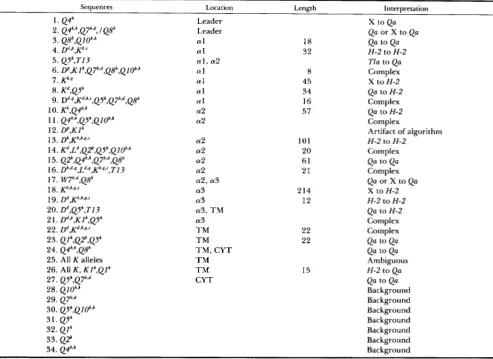
A total of 34 significantly clustered partitions (SCPs) were detected using our adaptation of STEPHENS' al- gorithm in the six comparisons made (see Table l for a list of the comparisons). Each is described individ- ually below; Table 2 presents an overview, and Figure 2 shows the distribution of the clusters on a map of the gene sequence.
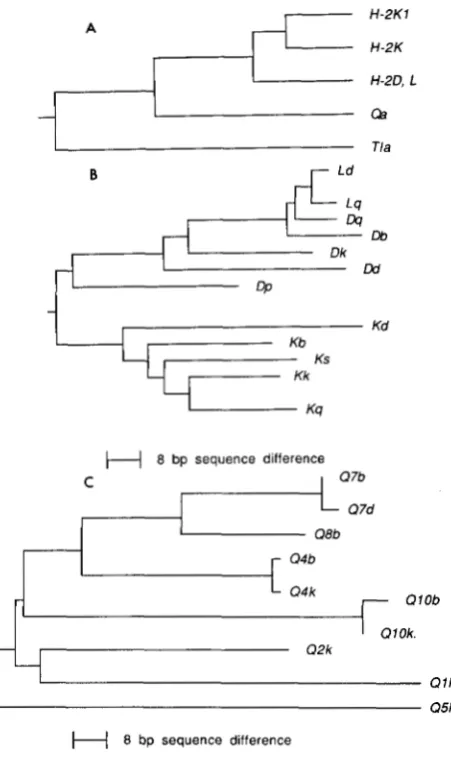
As an aid to interpreting the clusters observed, we also constructed neighbor-joining trees of the se- quences (Figure 3). We wish to emphasize that these trees probably do not represent the true tree of de- scent of the sequences due to unequal rates of evolu- tion, and cannot represent the true relationships
among sequences which have undergone genetic ex- change. Rather, they should be considered convenient organizing devices which represent the sequence sim- ilarity of the alleles analyzed, and can help in the interpretation of observed clusters.
For each cluster, we have listed the alleles showing
the apparently converted sequence, the base pairs involved (numbered as in the published alignment of these sequences (KUHNER and GOODENOW 1989),
which counts exon positions only), and the compari- sons in which this clustering was statistically signifi- cant. Level of significance (for the statistic Pd, unless
Pg,
is specified) is given by asterisks after the name of the comparison:*,
P<
0.01;**,
P<
0.001;***,
P<
0.0001;
****,
P 0.00001. For example, SCP #1 consists of clustering of ~ 4 ' unique sites at positions1 and 2; it was detected in comparisons of Qa se- quences with and without T l a ; and in both of these comparisons, P d , was significant at the 0.01 level. Some of the SCPs detected included sites remote from the actual cluster (for example, partition #2d includes bases spanning an intron and far removed from the rest of the cluster, which are clearly not part of the cluster in the leader sequence); such sites are under- lined. We also discuss possible conversion events which could have produced each cluster, the apparent length of the conversion, and its possible effect on the protein structure (unless specified otherwise, all clus- ters contained substitutions which changed the amino acid sequence).
When multiple lists of bases are given for a single SCP, there were substantial differences between the results from different subsets of sequences. For ex- ample, if the divergent T I 3 sequence shares four of five sites involved in a clustering, comparisons includ-
ing T I 3 will report a four-site SCP, while comparisons
excluding T I 3 will report a five-site SCP, with corre- spondingly different probability values. Clusters iden- tified as gaps in otherwise evenly distributed partitions were listed separately at the end, as in most cases it was difficult to assign these to events in a particular part of the gene.
Kuhner et al.
TABLE 2
Summary of significantly clustered partitions (scps)
Sequences Location Length Interpretation
1. 44'
2. Q4b,r,Q7b.d, / Q e b
3. QBb,QIOb"
5. Q5,",T13
6. D~,KI',,Q7b~d,Q8b,Q10b~'
7 . Kk,' 8 . Kd,Q5'
9. Dd.q,Kd.'.s,,45',Q7b~d,Q8b 10. Kb,Q4"
1 1. Q4b~',Q5',Q10b~'
Leader X to Qa
Leader
a1 18
a1 32 a l , a 2
a1 8
a1 45
a1 34
a 1 16
a2 57
a 2
a 2 101 a 2 20
a2 61
a 2 21
012, a 3
a 3 214
a 3 12 H-2 to H-2
a 3
T M 22
22
Qu or X to Qa Qa to Qa
Tla to Qa
Complex X to H-2 Qa to H-2
Complex
Qa to H-2
Complex
Artifact of algorithm
H-2 to H-2
Complex
Qa to Qa
Complex
Qa or X to Qa
X to H-2
Qa to H-2
Complex Complex Qa to Qa Qa to Qa
4. H-2 to H-2
12. D P , K P
13. D',Kbh44
14. Kd,Ld,Q2,Q5',Q!1Ob,'
15. Q2',Q4b.',Q7b~d,Q8b
16. Db.d,q,Ld,q,Kb~q.r,T13 17. W7b.d,Q8b
18, Kb,'W
19, Dd,Kb,'4.J
20. Dd,Q5',T13 a 3 , T M
21. Dd,P,KI',Q5'
23. Q1h,Q2',Q5k T M
24. Q4b.',Q8b T M , CYT
2 5 . All K alleles
26. All K , KI',QI' T M 15 H-2 to Qa
27. Q5h,Q7b,d CYT
28. QIOb.'
29.
30. Q5',Q10b.'
31. Q5k
32. Q I h
22. Dd,Kd.'.q.'
T M Ambiguous
Qa to Qa
Background Background Background Background Background Background Background 33. Q 2
34. Q4b.b
Length is maximum extent of identity between proposed donor and recipient, in base pairs. The abbreviation "X" refers to a hypothetical class I sequence not included in the present dataset. Clusters with the interpretation "Ambiguous" can be interpreted in more than one way, implicating different sets of sequences in the conversion; those with the interpretation "Complex" appear to require more than one conversion event for their explanation, while those with the interpretation "Background" appear to be the result of conversions elsewhere in the genes, rather than independent instances of conversion.
quence begins at position 1 1, and so H-2 comparisons cannot detect SCPs in positions 1-10.
Analysis of individual SCPs: Analyses are as fol-
lows.
Leader (Exon 1: 1-74):
1. Q4' 1, 2 (Qa/Tla*, Qa*)
This allele shows two unique substitutions at the very beginning of the leader (upstream of the standard translation start). These substitutions and two appar- ent point mutations scattered across the Q4' sequence are the only differences between the Q4 alleles, sug- gesting a possible conversion from an outside donor into ~ 4 ~ .
2a. Q4b9k,Q7b,d,Q8b
2b. 2c.
2d.
21,38,60,62 (All**)
20,21,38,60,62 (H2/Qa***)
6, 19,21,24,38,60,62,77
(Qa/Tla****)
6, 19,20,21,24,38,60,62, 77,561,937 (Qa:P,,**)
-
These alleles share a number of unique substitutions in the leader, while elsewhere
44
is more distinct fromQ7/Q8. T h e Qa tree indicates that Q4,Q7 and Q8 are high similar (Figure 3D), and continues to do so even when the leader is omitted (data not shown); this SCP can be interpreted as an exchange between 4 4 and
Q7/Q8, or as the result of exchanges elsewhere in the gene disrupting similarity between
44
and Q7/Q8 (i.e.,SCPs #10 and #11). T h e similarity does not continue into intron 1 (data not shown), suggesting that position 77 (in the a 1 domain) is not part of this event.
Alpha-I (Exon 2: 75-344):
T h e 4 8 locus clusters with (210 here rather than with its close relative Q7, suggesting a QlO to Q8
Gene Conversion in Mouse MHC 1119
bm5
-
bm6
-
b m l l b m 7
bm23 bm9 bml bm4
bm8 bm3 km2 bm16 b m l 0
- -
- - - _
L
- " - -
a1 a2 a3 TM CYr
a.
m.-1 .T@1.1- g..3.
u.
I0
..1
- 3 2 1 2 l o 1 1 1 4 17 2 1 22 2_5 -.zL
- 1 3 1 6 1 9 2 4 a 1 5
-
"
1 8
-
-
235 -" 20
-
2 4 2 6
FIGURE 2.-Distribution of SCPs across the gene. A general schematic of the class I gene is shown; the more 3' exons are not expressed in all loci. L, Translated leader sequence; T M , transmem- brane domain; CYT, cytoplasmic domains. Black indicates the beta sheets and hatching the alpha helices which make up the antigen recognition site. The locations of SCPs reported in this paper and of the H - 2 K b m (NATHENSON et al. 1986) and H-2K'" (VOGEL et al.
1988) mutants are shown. Note that introns are not drawn to scale (their length varies markedly between loci), and that the smaller SCPs have been enlarged to make them visible.
tions (SCP #2). SCPs #3 and #4 are illustrated in Figure 4.
4 . DdPp,Kb,' 142, 144, 145 ( H 2 / K 1 * * , H 2 * * )
Two related H-2D and two related H-2K alleles share a cluster of substitutions, suggesting a transfer from one locus to the other before divergence of these allele pairs. Amino acids in the ARS were affected.
5. Q5k, T13 189, 200,277, 321, 337, 3 4 0 , 3 4 2 , 4 0 9 , 4 1 9
(All* *)
Between positions 189 and 419 Q5k and T13 share many unique substitutions, in addition to showing substitutions (not listed) common to only one or two other alleles. QSk is otherwise a fairly typical Qa allele, suggesting transfer from Tla to Qa. However, there are also extensive mismatches between 45' and T 1 3
in this region, suggesting either that the event is very old or that a T L A sequence distinct from T13 served as donor to Q5k. T h e event extends across intron 2,
and affects ARS-homologous sequences in both a1
and a2.
6. DP,K1k,Q7b~dQ8b,Q10b9k 206, 207, 208 (Qa/
Tla***, Qu***)
This clustering is significant in the comparison among Qa sequences, suggesting a transfer between Qa loci in addition to transfers involving DP and K l k .
Q5' has a completely deviant sequence at these posi- tions for which no donor can be found. Thus, this region, which is not part of the ARS, may retain traces of several conversion events.
7 . KkPq 237, 240 ( H 2 / K l * )
Two substitutions are shared by the very similar K k
A
ri"
H-2K1 H-2KH-2D, L
oa
Tla
B Ld
Lq
Ds
Db
1
Dkw
QJ -
Kd Kb
Kk
Ks
Kq
H
8 bp sequence differenceC 0 7 b
0 7 d
0 8 b
Q4b
- Q4 k
0 l O b
7 Q 2 k
0 1 Ok.
-
Q l kI Q5k
H
8 bp sequence differenceFIGURE 3.--Similarity relationships among sequences. (A) Sche- matic (not to scale) of the accepted relationships among the class I
loci. (B) Neighbor-joining tree of H - 2 sequences. (C) Neighbor- joining tree of Qa sequences.
and Kq, suggesting a conversion from an outside do- nor-possibly a Q5k-like sequence, as QSk shares the substitution at 240 and an additional substitution at
244 which is present in K k , K q and K b . Mismatches between K k and K q suggest an exchange length of 45
bp or less, but if point mutations have overlaid the event it could be much longer. It affects a non-ARS structural region.
8. Kd,Q5k 257, 260, 278 ( H 2 / Q a * )
This region contains a cluster of similarities between
K d and Q5k, but also four mismatches suggesting that
the event is not recent. Sharing of bases between these sequences and T I 3 (see SCP #5) suggests that the direction of transfer was QSk to K d . The event affects the ARS.
ga Dd,qKd,k,s ,Q5k,Q7bpd,Q8b 314, 315
(All*, Q a / T l a * )
9b. 314, 315, 319
(H2IQa
*
*
, H 2 / K l * * , H 2 * * )9c. 314, 315, 319, 379
-
et
rn,k,S, Ld,q CtCt
Kk, 4 . . . .
0 1 k , Q 2 h , 0 4 b , k , 0 ~ , Q 7 4 d
Kd .g..
K l k . g . .
T 1 3 . g . .
. . . .
m , p q g a a (SCP #4)
Kb, s ggaa (SCP #4)
0 1 ob,h t a t . (SCP #3)
08b t a t c (SCP #3)
FIGURE 4.-Positions 142-148, illustrating SCPs #3 and #4.
Two disimilar H-2D alleles, three H-2K alleles, Q5,
47,
and48
share a distinctive sequence. Within this pattern, there is especially strong similarity betweenK d , Q7 and Q8. In the cross-species comparison, at
positions 3 14-3 15 the human allele HLA-B51 shows the pattern of D d , while other human and bovine al!eles ’analyzed show the mouse consensus pattern
(Pd;,
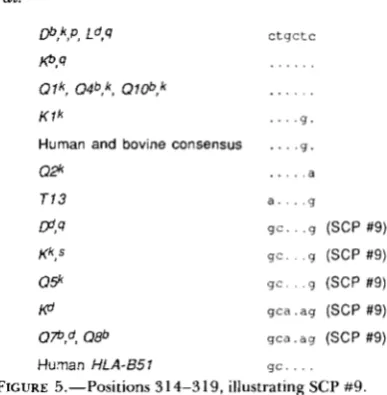
= 0.004 in the cross-species comparison), suggest- ing either conservation of polymorphism at this posi- tion for extremely long periods of time, or else re- peated mutation to the same two alternative forms. T h e large number of gene conversions which would be necessary to explain this SCP, and its presence in distantly-related species, suggest that convergent ev- olution may be contributing to its wide distribution, especially as this portion of the ARS is extremely immunogenic (the first class I sera developed recog- nized human variants in this region) and therefore a plausible target for strong selection. T h e complexity of this region is illustrated in Figure 5.If the interpretation of SCP #5 as a conversion from
T I 3 to Q5k is correct, events in this region have
evidently overlaid SCP #5 creating mismatches be- tween TI? and 4 5 k .
Alpha (Exon 3: 345-620):
loa. Kb,Q4b.k 355,358,363,367 ( H 2 / Q a * * * * )
lob. K b 3 5 5 , 3 5 8 , 3 6 3 , 3 6 7 , 3 7 9 , 3 8 8 , 3 9 7 ,
747,936,939 ( H 2 : P d , * ,
Pg,,*)
Allele K b shares a substantial run of sites with the
Q4 locus, suggesting a 4 4 to H-2K transfer; these sites contribute to the clustering of Kb-unique substitutions in comparisons involving only H - 2 sequences. This event affects the ARS.
1 1, Q4bsk,Q5k,Q10bsk 427, 430 (H2/Qa*, Qa/Tla*)
These Qa alleles resemble the H - 2 consensus, while one H-2 allele, D b , resembles Q1,
42,
Q7 and Q8.Although an exchange event appears to have occurred here, it is not entirely clear which sequences were involved. T h e SCP includes no amino acid changes.
12. DP,Klk 435, 436 ( H 2 / K l * >
Db,k,P, L 4 9 ctgctc
K? q . . . ,
Q l k , Q4b,k, Q1@,k . . . _
K l k . . . . g . Human and bovine consensus . . . .g.
Q2k . . . a
T I 3 a . . . . g
u?q g c . . . g (SCP #9)
Kk, s g c . . - 9 (SCP #9) 09 gc . - 9 (SCP #9)
Kd gca . a g (SCP #9)
0 7 b , d , Q8b gca . a g (SCP #9)
Human HLA-851 gc.. . .
FIGURE 5.-Positions 314-319, illustrating SCP #9.
This cluster is an example of a case in which our modification of STEPHENS’ algorithm produces poor results. D p is clustered with K l k because they share a substitution at 436 and because each has a unique substitution at 435, but this is not solid evidence for conversion.
13. Dk,Kb,k,qss 504, 507 ( H 2 * )
Allele D k shows a sequence typical of H-2K, sug- gesting conversion by that locus; however, the region has a pronounced “patchwork” pattern suggesting that multiple overlapping conversions have occurred here. If a Ks-like sequence acted as donor, the region of similarity is 10 1 bp. T h e event affects the ARS.
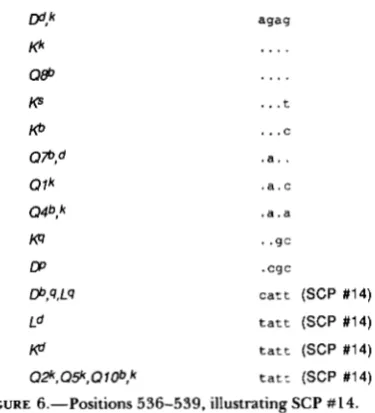
14. Kd,Ld,Q2k,Q5k,Q10bsk 536, 538, 539 @a**)
This clustering is significant in comparisons includ- ing only H - 2 sequences, suggesting some transfer among 42, Q5 and Q l O as well as a Qa/H-2 event. T h e complex pattern of similarities in this part of the
ARS (illustrated in Figure 6) obscures assignment of donor and recipient sequences, and also prevents de- tection of this SCP in comparisons involving H-2 as well as Qa sequences.
15. Q2k,Q4b2k,Q7b.d,Q8b 569, 573, 579 @a**)
This clustering suggests a transfer into Q2‘ from an allele of the Q 4 / Q 7 / Q 8 branch. It spans a maximum of 61 bp if Q 4 was the donor, and affects the ARS.
16a. Db,d,q,Ld,q.Kb,q,s,T13 593, 594 (All*)
16b. Dbd,q,Ld.q,Kb,q,S 590, 593, 594
( H 2 / Q a
* *
*,
H 2 /K l * * * , H2*** )
Two H-2K alleles and two H-2D alleles follow the
Gene Conversion in Mouse MHC 1121
od,k agag
Kk . . . .
Q8b . . . .
Ks
. .
.tKb
. .
. c0 7 4 6 . a . .
Q l k . a . c
Q46,k . a . a
Ks
.
.gc!3 . cgc
Db,q,Lq c a t t (SCP #14) Ld t a t t (SCP #14)
I@ t a t t (SCP #14)
Q@, 09, Q 1 Ob,k t a t t (SCP #14)
FIGURE 6.-Positions 536-539, illustrating SCP #14.
region, which is part of the non-ARS framework of the molecule.
17a. Q7b9d,Q86 32 , 655 , 659, 661, 666, 721
(All***)
17b.
-
3 2, 5 2 7,52 8,65 5,65 9,66 1,66 6,7 2 1 ( H 2 / Q a *)
A tight cluster of unique substitutions in the closely related Q7/Q8 loci suggests a conversion among these sequences, or from an unidentified donor into their common ancestor. If the bases at positions 527 and
528 are part of this conversion, it involves a region homologous to the ARS in a 2 and spans intron 2;
otherwise it affects only a3. Alpha-3 (Exon 4: 621-905):
18. Kbs'4J 6 5 0 , 6 6 3 , 8 3 9 , 8 6 3 ( H 2 / Q a * )
Across this region the most divergent H-2K allele,
K d , is quite different from all other K alleles; at some sites it follows the H - 2 and Qa consensus while the other K alleles differ, and at others it has unique or nearly unique substitutions. No known sequence can be identified as a donor, nor is it clear whether the exchange was into K d or into an ancestor of the other
H-2K alleles.
19. Dd,Kb*'4*S 6 5 1 , 6 5 6 ( H 2 * )
Allele D d shows a sequence typical of H-2K suggest- ing conversion by a K allele.
20a. Dd,Q5',T13 923, 925, 926 (All**)
20b. Dd,Q5'
-
413, 841, 914, 922, 923,925, 926, 934, 951,
977 ( H 2 / Q a : P d o * , Pgo***)
T h e D d allele shows extensive homology with Q5'
between positions 841 and 977, including both the unique substitutions listed here and other substitu- tions shared by Q5' and other Qa alleles or T 1 3 . This
is a large event, apparently spanning intron 4 (not analyzed).
21. Dd9PK1',Q5k 857, 859 (All*, H 2 / Q a * )
A pair of substitutions is shared by two related H -
2 0 sequences, the pseudogene K l ' , and Q5'. T h e
surrounding highly conserved sequences give no hints to the direction of the transfer or transfers, and do not allow a meaningful estimate of event length.
trans-Membrane (Exon 5: 906-1043):
22. Dd,Kd,k*Q*s 933, 937, 941 ( H 2 * )
This region shows similarities between D d , a group of related H-2K sequences, and Q5'. T h e Dd/Q5'
similarity may be part of SCP #20, but the H-2K
sequences also seem to have been involved in some type of transfer here.
23. Qlk,Q2',Q5' 936, 939, 972 @a*)
This SCP suggests a transfer among these se- quences, but direction is unclear, and as several events have apparently occurred in this region, it may rep- resent an effect of SCPs #21, #22 and #26 rather than an independent instance of exchange.
24a. Q4b*k,Q8b 1107, 1 1 14 (H2/Qa*)
24b. 941, 1037, 1107, 1114 ((la*)
Four substitutions and a one-bp insertion at position
968 are shared by 4 4 and Q8 in this region, a pattern suggesting either transfer from Q4 to Q8 or from another Qa sequence into
Q7.
If the former interpre- tation is correct, this appears to be a long event spanning introns 5 and 6 . It has a drastic effect on the protein, introducing a frameshift which generates a stop codon.25a. AllH-2Kalleles 969,970,978(All**)
25b. 969,970,978,1095,1103
25c. 20,38,924,969,970,978, W/Qa**)
1095,l 1O3(H2/K1:Pg,**)
Sites at which all H-2K alleles, but not the duplicated pseudogene K l ' , share unique substitutions cluster in the 3' region of the gene. This could be due to
exchanges among them, or to loss of similarity among them due to exchanges elsewhere. Alternatively, the presence of these substitutions in all K alleles suggests the possibility that natural selection is maintaining locus-specific characters in this region.
26a. All K,Kl',Ql' 973, 974 (All*, H2/Qa*)
26b. All K , K l ' 161, 928, 971, 973, 974
( H 2 / K l : Pgo*)
1122 M. Kuhner et al.
o r K l sequence is suggested, as Kl’.
into Ql’, apparently spanning 15 bp, is a possible exchange between K and
Cytoplasmic (Exons 6-8: 1044-1 157):
27a. Q5k,Q7b3d 1069, 1091, 1105 (H2/Qa*) 27b. 1091, 1105, 1119 @a**)
Positions grouping Q5‘ with Q7 cluster in the ex- treme 3’ region of the gene. This may be due to SCP #24, which disrupted the normal similarity of 4 7 and
48 in this region, and to SCP #5, which introduced novel variants into Q5; or it may represent an inde- pendent event, possibly a transfer from Q5 or Q7. It is 3’ of translation stop in these loci.
“Gap” partitions and unclassijiable SCPs:
28. QlObVR 22 sites, gap from 109-377, (All: Pgo*,
Qa/Tla:Pg,,*
Substitutions unique to QlO have apparently been eliminated from the region between positions 109 and
377
by SCPs #3 and #6, leading to this significant gap.29a. Q7b’d 78,90,91,883,950
29b. 7 8 , 9 0 , 9 1 , 1 3 4 , 1 9 0 , 8 8 3 , 9 5 0 , 1 0 3 4
(All: Pgo*, QalTEa: Pgo*)
(H2/Qa: Pgo*, Qa: Pgo*)
The leader and the region 3’ of position 883 show many Q7-unique substitutions, including an insertion; elsewhere Q8 shares most substitutions with 47. Sev- eral interpretations are possible; loss of Q7-like sites from Q8 by conversions (perhaps including SCP #24), or conversions of the
4 7
ancestor after it diverged from Q8 (perhaps including SCP #27).30a. Q5’,Q10b9” 10, 20, 924, 928 (QalTla: Pgo*) 30b. 10, 22, 924, 928, 1153, 1154
(Qa: Pg0*)
These loci cluster only in the leader and the ex- treme 3’ end of the gene suggesting either a disrup- tion of similarity in the remainder of the gene by recombination with other sequences (for example SCP #5) or two exchanges between the Q5 and QlO loci.
31a. (25’ 40 sites, gap from 284-396
31b. 52 sites, gap from 284-396
31c. 55 sites, gap from 785-1 153
3 Id. 79 sites spanning 4-977 (Qu***)
(All: Pdo****, P go
*
)(QalTla: Pg,*)
(H2IQa: Pd,*, Pgo***)
Two regions are lacking in Q5k-unique substitu- tions, which are abundant elsewhere. T h e first gap, between positions 284 and 396, may represent the traces of SCPs #5 and #9. T h e second gap, in the extreme 3’ region of the gene, may reflect the nu-
merous 3‘ SCPs involving Q5k: #20, #21, #23 and #27.
32a. Q l k 24 sites spanning 24-570 (All**) 32b. 34 sites, gap 643-1010 (H2IQa: Pgo*)
32c. 32 sites, gap 606-973 (QalTla: Pg,,*) 32d. 44 sites, gap 606-973 (Qa: Pg,*)
Sites specific to Ql are frequent in the 5
’
region of the gene but nearly absent from the 3’ region; it is unclear whether this represents introduction of 5‘ divergence by conversion or loss of 3’ divergence.33. Q2k 20 sites spanning 105-691 (Qa/Tlu*)
Sites unique to Q2k are absent in the 3‘ region of the gene, apparently due to SCPs #14, #15 and #23.
34. Q4b3k 22 sites spanning 17-714 (Qa*)
Sites unique to (24 are absent in the 3‘ region of the gene, perhaps due to SCP #24.
DISCUSSION
Thirty-four significantly clustered partitions (SCPs) representing potential instances of genetic exchange were identified in analysis of 24 murine class I major histocompatibility sequences. Some of these clusters appear to be due to other causes: SCP #12 may represent an artifact of the statistical algorithm, and SCPs #28-#34, which were identified as gaps in oth- erwise unclustered partitions, may be “background” to other identified events rather than representing gene conversions in their own right. SCP #25 (clus- tering of K-locus specific bases) may be due to selec- tion rather than to conversion. T h e following analysis will therefore concentrate on the remaining 25 SCPs, which we believe are most likely due to genetic ex- change in the form of gene conversion or recombi- nation.
Length of conversion tracts: For 16 of the 25 SCPs apparently representing conversions, it was possible to estimate the length of the putative conversion by examining the surrounding nucleotides and assuming that the conversion spanned the entire region in which the putative donor and recipient were identical. (In some of the remaining cases the putative conversion extended past one end of the gene or into an intron;
in others, the conversion was apparently from an unknown sequence, providing no way to estimate length.) These estimates should be regarded as ex- tremely tentative. Conversion length can readily be overestimated (due to misidentification of bases which are actually identical by descent as part of a conver- sion) or underestimated (due to subsequent point mu-
Gene Conversion in Mouse MHC 1123
length of the longest exon, 276 bp, represents the maximum-length event which could possibly be meas- ured.
Of the 16 events whose lengths could be directly estimated, 14 apparently spanned less than 70 bp; one spanned 10 1 bp; and one spanned 214 bp. These lengths are comparable to the K b m and K k m sponta- neous mutants, which spanned less than 200 bp (NA-
THENSON et al. 1986; VOGEL et al. 1988), and are also similar to the gene conversions observed when H - 2
genes were inserted into yeast chromosomes
(WHEELER et al. 1990).
Regions of the gene involved in conversions: SCPs
were detected throughout the coding sequence, af- fecting all exons except for the very short exon 8 (see Figure 2). Slightly more than half (14/25) of the detected SCPs were in the highly variable exons 2 and
3, which encode the antigen binding site. Further- more, not all of the events in these exons affected the antigen binding site: one SCP ( # 1 1 ) was completely silent and three (#6, #7, #16) affected framework portions of the molecule rather than the surfaces thought to be involved in antigen presentation and T cell recognition. This suggests that the mechanism of conversion in these genes is not limited to the antigen binding site, but produces conversions across the length of the gene. Lack of intron sequence for some alleles and difficulties in alignment prevented us from testing for conversion events in the introns, but in- spection of the sequences clearly indicates that con- version-like patterns exist in intron as well as exon sequences (data not shown).
Several SCPs (#3 1 4 3 4 ) involved the absence of sites specific to a particular Qa locus in the 3’ end of the gene (beyond the stop codon in most Qa alleles). T h e lack of such clusters in H - 2 , and their abundance in Qa, suggests that some mechanism other than the gene conversion observed across the gene may ac- count for them. One possibility is that selection is acting differently on the 5’ and 3‘ ends of Qa genes.
A priori, we would have expected the Qa loci, not all of which express the most 3’ exons, to be enriched for locus-specific substitutions in these exons (which are highly conserved in functional H-2 loci). T h e actual finding-absence of 3’ locus-specific substitu- tions-is surprising, and points to a possible high rate of between-locus conversion in the 3’ region of Qa
loci, tending to homogenize the sequences. Alterna- tively, there may be positive selection for locus-specific substitutions in the 5’ region of these genes, perhaps due to some functional specialization.
Directionality of conversions: Although STE-
PHENS’ algorithm (STEPHENS 1985) simply identifies clustering of similarities without giving a direction of
exchange, examination of the sequences and their similarity trees (Figure 3) can often be used to deduce
direction. For example, a sequence shared by several
Qa loci and by just one of the H-2D alleles was prob- ably transferred from Qa to H-2 rather than the reverse; this deduction is strengthened if the region of similarity includes substitutions which are typical of Qa rather than of H-2.
Thirteen clusters allow deduction of donor and recipient sequences. Of these, five involve only Qa
sequences and three only H-2 sequences. Three ap- parently involve transfer from Qa into H - 2 ; one from
H-2 into Qa; and one from Tla into Qa. These findings do not support the contention that information flows only from nonclassical to classical sequences (BREGE-
CERE 1983), especially as several of the clusters for which donor and recipient cannot be unambiguously determined appear to have involved H-2 to Qa trans- fers.
Two additional clusters appear to represent trans- fers into H - 2 , and one into Qa, from sequences outside the current dataset. As more sequences become avail- able, donors for these events may be found; however, it is likely that some of the donor sequences are no longer present in modern populations.
CONCLUSIONS
Twenty-five of the clusters detected using STE-
PHENS’ algorithm (STEPHENS 1985) appear to be bona
f i d e gene conversion events. They are similar in both
size and position to the H-2Kbm and H-2Kkm2 sponta- neous mutations (NATHENSON et al. 1986; GELIEBTER
and NATHENSON 1988; VOGEL et al. 1988) (see Figure
2)
and to conversion events detected when the mouse genes are carried in yeast chromosomes (WHEELER etal. 1990). However, unlike the spontaneous mutations
detected on the basis of allograft rejection, the events are distributed throughout the length of the class I gene, affecting the leader sequence, conserved frame- work regions within the antigen binding site, and the
3’ structural exons as well as the hypervariable antigen presentation site positions. Thus, the gene conversion mechanism does not appear to exhibit a preference for functional regions of the molecule. In addition, the events involved not only H-2, but also Qa and Tla
loci, confirming the occurrence of gene conversion in the evolution of nonclassical as well as classical genes.
We detected one SCP in which transfer was apparently from H - 2 to Qa and several more in which such transfer was probable. Since the 24 sequences com- pared contain only a proportion of the genetic infor- mation available among class I alleles, and the ability to detect events is diminished by overlapping recom- bination or mutation, the gene conversion events identified here are likely to represent only a fraction of the sequence exchanges which have shaped the evolutionary history of the class I gene family.
1124 M . Kuhner al.
should be considered. First, if STEPHENS’ algorithm is used to compare two groups of sequences with very different patterns of variability, it may produce spu- rious evidence for genetic exchange. However, this effect should produce locus-specific or region-specific clusters, since patterns of variability are presumably characteristic of the locus or region involved. Only one SCP (#25: clustering of substitutions specific to
H-2K in the transmembrane region) which could be explained in this way was observed. Furthermore, a large proportion of the SCPs were significantly clus- tered in comparisons involving only H-2 or only Qa
sequences, which should avoid this effect. Finally, a cross-species comparison indicated only one SCP sug- gesting conversion among distantly related species (human and mouse; SCP #9) while if variation in degree of relatedness were a major source of falsely significant SCPs, this comparison should have gener- ated many such SCPs.
A second source of clustering could be strong selec- tion for a particular variant, causing it to evolve in- dependently in several lineages. Although this mech- anism could account for a proportion of our SCPs (particularly SCP #9, in which the same polymorphism
is observed in species as distant from mouse as cow and human), it cannot explain the shared silent sub- stitutions that characterize many of them. Convergent evolution would not be expected to produce the same silent mutations in each lineage.
A third possible explanation for clustering is the persistence, perhaps due to natural selection, of an- cestral similarities in a region where other alleles have diverged. Although this mechanism could account for a few of the clusters observed, it will not explain SCPs such as #20, where a unique sequence is found in just one H-2 and one Qa allele. If the unique sequence is in fact ancestral, gene conversion must still be invoked to explain why all other sequences share the same, non-ancestral form.
Identification of evidence for gene conversion is not necessarily inconsistent with proposals that class I polymorphism is very old (FIGUEROA, GUNTHER and
KLEIN 1988; LAWLOR et al. 1988; MAYER et al. 1988).
Balancing selection could result in the persistence of polymorphic epitopes for extremely long periods; gene conversion, rather than eliminating such epi- topes, may actually contribute to their persistence by reassorting them with newly arisen, advantageous var- iants. This is consistent with the observation that several SCPs cannot be explained by single instances of gene conversion because they occur in too many groups of unrelated alleles (for example SCP #6,
where Z I P , K l k , and several Qa alleles share clustered
substitutions), although it is also possible that certain regions of the gene are preferentially converted. T h e gene conversions observed are short enough, com-
pared to the length of the gene, that they could occur fairly frequently without disrupting the overall simi- larity of related alleles, consistent with the observation that certain human and chimpanzee class I alleles have remained very similar since the two lineages diverged (LAWLOR et al. 1988).
Gene conversion has been invoked as a diversifying mechanism among H-2 loci. If gene conversion is occurring among Qa and Tla loci, how is the relative monomorphism of these loci maintained? Several ob- servations argue that Qa and Tla genes are not under the same selective constraints as the H-2 genes: (i) Qa
and Tla loci are relatively nonpolymorphic (CHEN et
al. 1987; WEISS 1987; WATTS et al. 1989), (ii) although some at least are expressed, Qa and Tla gene products do not appear to function as classical T cell restriction elements (CHEN et al. 1987; ROBINSON 1987), and (iii) significantly greater numbers of unique nucleotide substitutions are found in Qa compared to H-2 se- quences (HUGHES and NEI 1988). This suggests that the force which maintains H-2 polymorphism and Qa monomorphism in the face of gene conversion may be natural selection. Just as with point mutations, gene conversions which introduce variability into the H-2
genes may be selectively advantageous and preserved by natural selection, while similar conversions into Qa
or Tla loci may be neutral or detrimental and thus less likely to be propagated.
Gene conversion is usually thought of as a homog- enizing mechanism in multigene families. However, it can also generate new alleles if the length of the conversions is less than the length of the gene, as it apparently is in H-2; in this case, conversions can produce new alleles by reassorting variability present in existing alleles. In the H-2 antigen presenting site, selection for variability may favor conversions which produce novel combinations of epitopes. Elsewhere in the H-2 gene and in the Qa and Tla genes, the absence of this selection, combined in those loci which produce functional products with purifying selection to main- tain function, may favor conversions which reduce variability and preserve locus-specific residues. In this connection, it is interesting to note that the only locus- specific clustering in the H-2 genes (SCP #25) is in the conserved 3’ region of the gene.
T h e variety of evolutionary forces acting on the class I genes make them a useful model for many processes occurring elsewhere in the genome. As in
Qa and Tla, gene conversion could have an homoge- nizing effect in gene systems such as hemoglobin (COLLINS and WEISSMAN 1984), where apparently mi- nor perturbations of protein structure can result in drastic differences in function. On the other hand, gene conversion could contribute to the generation
Gene C o n v e r s i o n in Mouse MHC 1125
STEINMETZ and MALISSEN 1983; KLITZ, THOMSON
and BAUR 1986), immunoglobulin (REYNAUD et al.
1987), and T-cell receptor gene families. Considerable work remains to be done in describing both the phys- ical mechanisms and evolutionary consequences of gene conversion in complex multigene families.
We thank WARREN GISH and CHRIS MEACHAM for computing assistance, LI JIN for providing the phylogeny software, and PETER
PARHAM, MINNIE MCMILLAN, CLAY STEPHENS, and CHRIS WHEELER for comments on the manuscript. This work was sup- ported by National Institute of Health grants CA37099 (R.S.G.), GM35326 (G.T.) and Pregraduate Training Grant GM07232-10 (S.W.).
LITERATURE CITED
BJORKMAN, P. J., M. A. SAPER, B. SAMRAOUI, W. S. BENNETT, J. L. STROMINGER and D. C. WILEY, 1987a Structure of the human class I histocompatibility antigen, H L A - A 2 Nature 329: 506- 512.
STROMINGER and D. C. WILEY, 198713 T h e foreign antigen binding site and T cell recognition regions of class I histocom- patibility antigens. Nature 3 2 9 512-518.
BREGEGERE, F., 1983 A directional process of gene conversion is expected to yield dynamic polymorphism associated with sta- bility of alternative alleles in class I histocompatibility antigens gene family. Biochimie 65: 229-237.
CHEN, Y.-T., Y. OBATA, E. STOCKERT, T. TAKAHASHI and L. J. OLD, 1987 Tla-region genes and their products. Immunol. Res. 6: 30-45.
COLLINS, F. S., and S. M. WEISSMAN, 1984 T h e molecular genetics of human hemoglobin. Proc. Nucleic Acid. Res. Mol. Biol. 31:
3 15-462.
ENNIS, P. D,. A. P. JACKSON and P. PARHAM, 1990 Rapid cloning of HLA-A,B cDNA using the polymerase chain reaction. Proc. Natl. Acad. Sci. USA 87: 2833-2837.
FIGUEROA, F., E. GUNTHER and J. KLEIN. 1988 MHC polymor- phism pre-dating speciation. Nature 335: 265-267.
FISHER, D. A., S. W. HUNT I11 and L. HOOD, 1985 Structure of a gene encoding a murine thymus leukemia antigen, and orga- nization of Tla genes in the BALB/c mouse. J. Exp. Med. 162:
FLAGHERTY, L., E. ELLIOT, J. TINE, A. WALSH and J. WATERS, 1990 T h e genes and products of the Qa subregion of the murine major histocompatibility complex. CRC Crit. Rev. Im- munol. (in press).
GELIEBTER, J., and
s.
G . NATHENSON, 1988 Microrecombinations generate sequence diversity in the murine major histocompat- ibility complex: Analysis of the Kbm3, Kb"', Kb"" and K h f fmutants. Mol. Cell. Biol. 8 4342-4352.
GUSSOW, D., R. S. REIN, I. MEIHER, W. DEHOOG, G. H. A. SEEMAN, F. M. HOCKSTENBACK and H. L. PLOEGH, 1987 Isolation, expression, and the primary structure of HLA-Cwl and HLA- Cw2 genes-evolutionary aspects. Immunogenetics 25: 3 13- 322.
HOLMES, N., P. ENNIS, A. M. WAN, D. W. DENNEY and P. PARHAM, 1987 Multiple genetic mechanisms have contributed to the
generation of the HLA-A2/A28 family of class I MHC mole- cules. J. Immunol. 1 3 9 936-941.
HOOD, L., M. STEINMETZ and B. MALISSEN, I983 Genes of the major histocompatibility complex of the mouse. Ann. Rev. Immunol. 1: 529-568.
HUGHES, A. L., AND M. NEI, 1988 Pattern of nucleotide substi-
tution at major histocompatibility complex class I loci reveals overdominant selection. Nature 335: 167-170.
BJORKMAN, P. J., M. A. SAPER, B. SAMRAOUI, w .
s.
BENNETT,]. L.528-545.
HUGHES, A. L., and M. NEI, 1989 Evolution of the major histo- compatibility complex: independent origin of nonclassical class I genes in different groups of mammals. Mol. Biol. Evol. (in press).
KLEIN, J., I986 Natural History ofthe Major Histocompatibility Com-
plex. John Wiley & Sons, New York.
KLITZ, W., G. THOMSON and M. P. BAUR, 1986 Contrasting evolutionary histories among tightly linked HLA loci. Am. J. Hum. Genet. 3 9 340-349.
KUHNER, M. K., and R. GOODENOW, 1989 DNA sequences of mouse H - 2 and Qa genes. Immunogenetics 30: 458-464. LAWLOR, D. A,, F. E. WARD, P. D. ENNIS, A. P. JACKSON and P.
PARHAM, 1988 HLA-A and B polymorphism predates the divergence of humans and chimpanzees. Nature 335: 268-27 1. MAYER, W. E., M. JONKER, D. KLEIN, P. IVANYI, G. VAN SEVENTER
and J. KLEIN, 1988 Nucleotide sequences of chimpanzee MHC class 1 alleles: evidence for trans-species mode of evolu- tion. EMBO J. 7: 2765-2774.
MORITA, T . , C . DELARBRE, M. KRESS, P. KOURILSKY and G. GACH-
ELIN, 1985 An H-2K gene of the tW3' mutant at the T / t
complex is a close parent of an H-2Kq gene. Immunogenetics
21: 367-383.
MORSE, R., S. WATTS, C. GELBER and R. S . GOODENOW, 1990 T h e Qa region genes and antigens of the murine major histo- compatibility complex, in Immunology and Biotechnology in Biomedical Research, Series in Current Concepts in Immunogenetics,
Vol. 2, edited by P. TYLE et al. Verlag Chemie International Publications, Berlin (in press).
NATHENSON, S. G., J. GELIBTER, G. M. PFAFFENBACH and R. A. ZEFF, 1986 Murine major histocompatibility complex class I mutants: molecular analysis and structure-function implica- tions. Annu. Rev. Immunol. 4: 471-502.
PARHAM, P., C. E. LOMEN, D. A. LAWLOR, J. P. WAYS, N. HOLMES, H. L. COPPIN, R. D. SALTER, A. M. WAN and P. D. ENNIS, 1988 The nature of polymorphism in HLA-A, -B, and -C
molecules. Proc. Natl. Acad. Sci. USA 85: 4005-4009. PARHAM, P. D., A. LAWLOR, C. E. LOMEN and P. D. ENNIS,
1989 Diversity and diversification of HLA-A,B,C alleles. J. Immunol. 142: 3937-3950.
PEASE, L. R., 1985 Diversity in H-2 genes encoding antigen- presenting molecules is generated by interactions between members of the major histocompatibility complex gene family. Transplantation 39: 227-23 1 .
REYNAUD, C. A., V. ANQUEZ, H. GRIMAL and J. C. WEILL, 1987 A hyperconversion mechanism generates the chicken light chain preimmune repertoire. Cell 4 8 379-388.
ROBINSON, P. J., 1987 Structure and expression of polypeptides encoded in the mouse Qa region. Immunol. Res. 6: 46-56. SAITOU, N., and M. NEI, 1987 T h e neighbor-joining method: a
new method for reconstructing phylogenetic trees. Mol. Biol. Evol. 4: 406-425.
SODOYER, R., M. DAMOTTE, T. L. DELOVITSH, J. TRUCY, B. R.
JORDAN and T. STRACHAN, 1984 Complete nucleotide se- quence of a gene encoding a functional human class I histocom- patibility antigen (HLA-Cw3). EMBO J 3: 879-885.
STEPHENS, J. C. 1985 Statistical methods of DNA sequence analy- sis: Detection of intragenic recombination or gene conversion. Mol. Biol. Evol. 2: 539-556.
VOGEL, J. M., A. C. DAVIS, D. M. MCKINNEY, W. J. MARTIN and R. S. GOODENOW, 1988 Molecular characterization of the C3HfB/HeN H-2Kkm2 mutation: Implications for the molecular basis of alloreactivity. J. Exp. Med. 168: 1781-1800.
WEISS, E. H., 1987 Molecular biology of the mouse Q region. 2 genes integrated into yeast, in Transgenic Mice and Mutants Immunol. Res. 6 179-191. in MHC Research, edited by I. K. EGOROV and C. S. DAVID. WHEELER, C. J., D. MALONEY, S. WATTS, J. VOGEL, J. TOWNER, D.
BALDWIN, J. RUFER, M. ARBEITMAN, H. CHAN, S. FOGEL and
R. S . GOODENOW, 1990 Microconversion between murine H- Communicating editor: A. G. CLARK