Copyright 0 1995 by the Genetics Society of America
Methodology and Accuracy of Estimation of Quantitative Trait Loci Parameters
in a
Half-sib
Design
Using
Maximum Likelihood
M. J. Mackinnon"
and
J. I. Welled
*Institute of Cell, Animal and Population Biology, University of Edinburgh, Edinburgh EH9 3p, United Kingdom and +Institute of Animal Sciences, Agricultural Research Organization, The Volcani Centre, 50250, Israel
Manuscript received February 15, 1995
Accepted for publication June 27, 1995
ABSTRACT
Maximum likelihood methods were developed for estimation of the six parameters relating to a marker-linked quantitative trait locus (QTL) segregating in a half-sib design, namely the QTL additive effect, the QTL dominance effect, the population mean, recombination between the marker and the QTL, the population frequency of the QTL alleles, and the within-family residual variance. The method
was tested on simulated stochastic data with various family structures under two genetic models. A
method for predicting the expected value of the likelihood was also derived and used to predict the lower bound sampling errors of the parameter estimates and the correlations between them. It was
found that standard errors and confidence intervals were smallest for the population mean and variance,
intermediate for QTL effects and allele frequency, and highest for recombination rate. Correlations among standard errors of the parameter estimates were generally low except for a strong negative
correlation ( r = -0.9) between the QTL's dominance effect and the population mean, and medium
positive and negative correlations between the QTL's additive effect and, respectively, recombination
rate ( r = 0.5) and residual variance ( r = -0.6). The implications for experimental design and method
of analysis on power and accuracy of marker-QTL linkage experiments were discussed.
D
ETECTION of major genes influencing quantita-tive traits is now feasible with the explosion of
genetic marker technology in recent years. DNA-level
markers can be used to establish genetic maps and sys-
tematically screen genomes for quantitative trait loci
(QTL) in many agriculturally important species (ED-
WARDS et al. 1987; PATERSON et al. 1988; FRIES et al.
1989; HALEY et al. 1990; KEIM et al. 1990; SOLLER 1990; GEORGES et al. 1995). Detection of QTL can be achieved
by finding a difference in quantitative trait value of two
groups of offspring inheriting alternative marker alleles
from a common heterozygous parent. This procedure
can be used for both inbred species (e.g., experimental
species such as Drosophila and mice) using crosses be-
tween inbred lines (SAX 1923; SOLLER et al. 1976) and
for outbred species (e.g., farm animals and fruit trees)
where the analysis is carried out within large family
groups ( GELDERMANN 1975; NEIMANN-SBRENSEN a n d
ROBERTSON 1961; SOLLER a n d GENIZI 1978).
Having detected a QTL, it is of interest to find its
location in the genome by estimating its recombina-
tion distance from the marker and to determine the
effects of the QTL in the population by estimating the
magnitude of its effect, the degree of dominance, and
its frequency in the population. All of these parame-
ters are important for both assessing the potential use-
Corresponding author: Margaret Mackinnon, Institute of Cell, Animal
and Population Biology, University of Edinburgh, West Mains Rd., Edinburgh, EH9 3JT, UK. E-mail: eangZO@festival,ed.ac.uk
(knrtics 141: 755-770 (October, 1995)
fulness of the QTL in genetic improvement programs
and the way in which it will be used. Estimation of
these parameters can be carried out using maximum likelihood methods. While the power to detect QTL has been described well for both inbred line cross de-
signs (SOLLER et al. 1976; WELLER 1986, 1987; JENSEN
1989; LANDER a n d BOTSTEIN 1989; LUO and KEARSEY 1989; SIMPSON 1989; KNOTT a n d HALEY 1992a; DARVASI
et al. 1993) a n d within-family designs (SOLLER and
GENIZI 1978; WELLER et al. 1990; KNOTT a n d HALEY 199%; BOVENHUIS and WELLER 1994), only a few stud-
ies have explored the accuracy of the estimates (KNOTT
a n d HALEY 1992a,b; VAN OOIJEN 1992; DARVASI et al.
1993). All of the latter have relied on replicated sto- chastic simulations to measure accuracy empirically.
As this can be tedious, it would be useful to be able
to predict the accuracy of QTL parameters using theo-
retical methods, although the complex nature of the
likelihood models has so far prevented this being
done. In this study, a quasitheoretical numerical
method is used to predict both power and accuracy of QTL parameters from the shape of the multidimen-
sional expected likelihood surface. It is applied to the
half-sib design in which six parameters are estimated
simultaneously and is used to explore the effects of
data structure, statistical model and inaccurate marker
allele frequencies o n power, accuracy and sampling
correlations between parameter estimates. The proce-
dure described here can be used to determine the
to extract the best information marker-QTL linkage data.
THEORY
Experimental design: There
about the QTL from
are s sires each of
which produce Nprogeny when mated to an outbred population of dams. The phenotype for a quantitative trait is determined by many genes of small effect and
by random environmental factors, which together
cause the trait to be normally distributed with a mean
of p and variance of 0’. The trait is also affected by
a relatively major QTL with two alleles, Q and q, at
population frequencies of
p
and 1 -p,
respectively.Additive and dominance effects at the QTL are de-
noted a and d, respectively. Thus there are three possi-
ble genotypes, QQ
qq,
which have quantitativetrait values of pQQ = p
+
a, pQ(! = p+
d and pUeu = p- a. A marker locus is situated adjacent to the QTL
at a recombination distance of r. Only sires heterozy-
gous for the genetic marker are included in the analy- sis. The notation will assume only two alleles at the
genetic marker, M and m, although a situation of mul-
tiple marker alleles can be handled with only minor modifications. Thus sires have one of four possible
marker-QTL genotypes, viz: M W m Q M U mq, Mq/ mQ
or Mq/mq. Dams have one of 10 possible genotypes corresponding to all possible combinations of gametes
M Q Mq, mQ and mq. The frequency of allele M in the
dam population is denoted t and is assumed to be
known or estimated with a high degree of accuracy. The population is assumed to be at Hardy-Weinberg equilibrium with respect to the QTL and marker locus.
Progeny with records are assumed to be a random
sample of the sire’s progeny with respect to their value for the quantitative trait and marker loci.
Likelihood of the model: The likelihood for the half-
sib design, first given by WELLER (1990) and extended
here to account for dominance, QTL allele frequency and marker allele frequency, is
3 x , 3
L =
fi
[ d
n
n
c
C i l f ( X k - pl)b i = l k = l I
6 nz_J 3
+
p(1
-p )
n n
C , j f ( X k - pj) i=4 k = l 19 s
+
p(1
-p )
n n
c i f f ( x k - pj) 1=7 k = l 1+
(1 -n n
c t f f ( x k - pj) ( l )I2 n1-9 3
z = I O k = l j
1
where b = 1 to s and denotes the family number, i =
1-12 for progeny marker genotypes of M M , M m and
mm nested within sire marker-QTL genotypes M W m Q
M W m q , Mq/mQand Mq/rnq, respectively; nt = the num- ber of progeny in the ith marker genotypic group and
ni = nz+3;
j
= 1 , 2 and 3 for progeny QTL genotypesand column
j
from the matrix, C (Table 1) , of progenyQTL genotype probabilities conditional on sire QTL
genotype and progeny marker genotype; and f( xk - pJ
= the normal density function for the kth observation, xk, ( k = 1,
. . .
, n,) of the bth sire of the ith marker genotype group, conditional on the jth QTL genotype,and is abbreviated by and calculated as:
e-l/2cx,-y/oP
&0
.
A
= f ( x k - p,) =The four terms that are summed in the likelihood
equation for each sire represent the four possible
QTL genotypes of the sire, denoted h. That is, for
each possible genotype of the sire, the statistical den- sity of the sire’s progeny’s genotypes, conditional on
this sire’s genotype, is computed over all the observed
data. These terms, called sublikelihoods from here on, are multiplied by the probabilities of the sire’s
genotype Ph
[p2
for h = 1,p (
1 -p )
for h = 2 or 3 and(1 -
p)*
for h = 41 and summed to obtain the overalllikelihood.
C, the matrix of progeny QTL genotype probabilities,
conditional on sire QTL genotype and progeny marker genotypes and assuming linkage equilibrium is com-
puted as shown in Table 1. The rows of C represent the
progeny marker genotypes, MM, Mm, and mm, nested
within sire marker-QTL genotype, as shown to the right
of the matrix. The columns of C represent the progeny
QTL genotypes
qq.
Thus the probabilitiesfor each row sum to unity.
Each sire passes on average half of his breeding value
for the quantitative trait to his progeny. Equation 1
does not account for variance among sires due to genes
other than the QTL. The likelihood was therefore mod-
ified by subtracting half the sire’s polygenic breeding
value, g b , from each observation. Estimates of the sire’s
breeding value from genetic evaluations based on infor- mation from ancestors and descendants will include the
sire’s QTL genotype effect and are therefore biased
estimates of gb. Thus an alternative estimate of g b is
required. For the situation here, where each sire has
many offspring, an appropriate estimate is g b = x b - Gh
where
x,,
is the observed mean of the sire’s progenyand Gh is the expected QTL genotype mean of the sire’s
progeny, which is a function of a, d and
p
(BOICHARDet al. 1990). This is likely to be an effective way of parti-
tioning out the effects of polygenes from the QTL effect
in the sires because it uses two pieces of good and
almost independent information, namely the sire
mean, which estimates the total genetic effect, and the between-marker contrast within this sire mean, which
estimates the QTL effect. Because gb is conditional on
the sire’s QTL genotype, it is different for each of the
four summed terms of (1). The likelihood accounting
Estimation of QTL Parameters 757
TABLE 1
Progeny QTL genotype probabilities conditional on sire marker-QTL genotype and own marker genotype
C =
-
Progeny QTL genotype
Progeny marker Sire
Q4 44 genotype genotype
MM
M m M W m 4
MM mm
P
p
+
r - 2pr l - p - r + P mmP
p
+
r - 2pr l - p - r + p r M M[ t P ( l - [ t ( l -
p
- r+
2pr) [ t ( l - p ) r+ ( I - t , p l + ( 1 - t ) ( p
+
r - 2pr)l + ( I - t ) ( 1 -p
- r+
r p ) ] Mm M d m QP ( 1 -
4
l - p - r + 2 f w (1 - p ) r mm0
P
1 - P MM0
P
1 - P M d m 4 M m0
P
1 - P-
mmi=10 k = l f
The properties of this likelihood were explored both
by computation of its expectation as a function of pa-
rameter estimates (deterministic simulations) and by stochastic simulations. The situations for which simula-
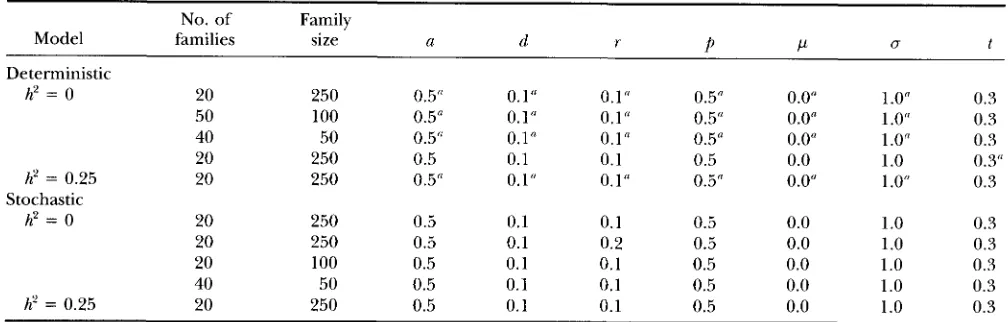
tions were performed are summarized in Table 2 and
described in more detail below.
Deterministic simulations: Expectation of the log likeli-
hood: A close approximation of the expected value of
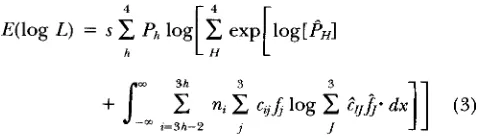
the natural log likelihood, E(1og L ) , for a given set of
parameter estimates is obtained by modifymg (1) to
give the following equation:
4
h
The derivation of this equation and the degree of approx-
imation is explained in the APPENDIX. Note that now the
lowercase subscripts h, iandjindicate that the parameters
are the true values and the uppercase superscripts and the indicate that these parameters are estimates or func- tions of estimates on which the value of the likelihood is
conditional. Thus the symbols in (3) take on the follow-
ing meanings: h denotes the sire's true QTL genotype,
and H the sire's hypothesized QTL genotype; Ph denotes
the expected frequency of sires with genotype h in the
data (depending on the real value of
p,
as describedabove), and P H denotes the probability that the sire has
genotype H, which is a function of the current estimate
of
p ,
denotedp?
ttris the conditional probability of falling into the@ QTL class and the fth marker-sire class giventhe current estimates of the parameters
p
and r, denotedp
and and the hypothesized sire genotype, H, whereZ
= i - 3 h
+
3H;J is an abbreviation of the density functiondefined previously used in (1) and (2) depending on
whether the model takes account of polygenic effects
(see below) and
f j
is the functionfi
given the estimatesof their component parameters e.g, t43 = (1 -
fl
and n,is the expected number of observations in the ith marker
genotypic group and is equal to '/?Nt, for i = 1, 4,
7,
and10; '/&for i = 2, 5, 8, and 11; and '/2N(l - t ) for i =
3, 6, 9, and 12, respectively. Without polygenic effects
(Equation
I),
=A x k
- p j ) and J?i = f ( x k - j l j ) . Withpolygenic effects (Equation
21,
J = f ( x k pl - &) andf j
= f i x k - j l J - g b ) where gb = gb - -
G.
TABLE 2
Models, family structures and parameter values used for simulations
No. of Family
Model families size a d r
P
PU t
Deterministic
h2 = 0 20 250 0.5'' 0.1" 0.1" 0.5" 0.0" 1 .Of'
50 100 0.5" 0.1" 0.1" 0.5" 0.0" 1 .Of'
0.3
40
0.3 50 0.5" 0.1" 0.1" 0.5" 0.0" 1 .0"
20 250 0.5 0.1 0.1 0.5 0.0 1 .0 0.3"
0.3
h' = 0.25 20 250 0.5" 0.1" 0.1" 0.5" 0.0" 1 .Of' 0.3
h2 = 0 20 250 0.5 0.1 0.1 0.5 0.0 1 .0 0.3
20 250 0.5 0.1 0.2 0.5 0.0 1.0 0.3
20 100 0.5 0.1 0.1 0.5 0.0 1.0 0.3
40 50 0.5 0.1 0.1 0.5 0.0 1.0 0.3
h' = 0.25 20 250 0.5 0.1 0.1 0.5 0.0 1 .0 0.3
h' = 0 indicates that the data were simulated without polygenes; hz = 0.25 indicates that the data were simulated with polygenes,
Stochastic
which accounted for 20% of the residual variation.
The likelihood was evaluated for a range of parameter estimates around these true values.
because it is based on infinite sample size theory, is
equivalent to the average of the log L evaluated in an
infinite number of replicates of stochastic data. It is
therefore useful for examining the shape of the log L
surface in infinite samples. Because it is the shape of
the surface around the maximum which determines the
accuracy of the parameter estimates, this method is thus a useful tool for exploring the properties of the likeli- hood surface without having to resort to many time- consuming replicates using stochastic data. The popula-
tions used in this study are large but not infinite, in
which case the expected log L is an approximation to
the true average likelihood. In the size of data sets used in this study, this approximation appears to be close enough to have no appreciable influence on the power
and accuracy (see APPENDIX).
Shape of the likelihood surface: Equation 3 was evaluated
for values of estimates f i , 6,
d,
?,j ,
and 8 , which rangedfrom +0.25 of the true values p = 0, a = 0.5, d = 0.1,
r = 0.1,
p
= 0.5 and n = 1 in increments of 0.025 forthree family structures ( N = 250, s = 20; N = 50, s =
100; N = 40, s = 50) without a polygenic effect in the
model and one structure ( N = 250, s = 20) with a
polygenic effect in the model (Table
2).
These datastructures and parameter values are considered to be typical of large-scale studies likely to be used for map- ping QTL in forest trees or animals. The marker allele
frequency, t, was 0.3 in all cases. For each parameter
varied, all other parameters were held at their true val-
ues. In these simulations gb was set to 0 because for
deterministic evaluations, this parameter is, in effect,
known. log L was then plotted against each parameter
to give "uniparameter profile likelihoods" assuming all other parameters are known. Three-dimensional plots
of log L as a function of two parameters were also pro-
duced for a few pairs of parameters ( 6 and
d,
d
and ?,fi
andd)
to examine the shape of the likelihood surfacewith respect to these parameters for the presence of
ridges or local maxima.
Accuracy of the estimates: From the uniparameter pro-
file likelihoods, the 95% confidence intervals were cal-
culated as the parameter value at which the log I,
equalled the maximum log L (log &) plus half the 95%
chi-squared value
(x2)
on one degree of freedom ( i . ~ . ,log I,,,, = log
4,
+
1.92). This test statistic is based on the fact that for large samples, the difference betweenlog L maximized for all but one parameter (log L , ) ,
and log L maximized for all parameters (log &,) is as-
ymptotically distributed as
-'/&
with one degree offreedom (WILE 1938). Assuming normality of the esti-
mate's sampling distribution, the standard error of the
estimate is expected to be half the 95% confidence
interval (KENDALL and STUART 1973). Approximate
standard errors and the correlations between them
were also calculated from the approximate variance-
covariance matrix of the estimates, which is obtained from the inverse of the matrix of all the second partial
derivatives of the log likelihood function ( i . e . , the ob-
served information matrix) (KENDALL. and STLJART
1973). These are lower bound standard errors ac-
cording to the Cramer-Rao inequality. For the simula- tion conditions used above, these second derivatives
were obtained by evaluating (3) at points on the surface
at small distances (?0.005) away from the true values
for all possible pairwise combinations of the parame- ters. This matrix was then inverted to give the approxi- mate variances and covariances of the parameter esti- mates and from these the standard errors of the
estimates and correlations between them were calcu- lated. When the matrix of numerically derived second
derivatives was not positive definite, the interval at
Estimation of QTL Parameters 759
in cases where the matrix was positive definite for both intervals, indicating that the choice of interval size did not have detectable effects on the results. The estimates of standard errors derived from the information matrix differ from those calculated from the confidence inter- vals by the fact that they are not based on the assump- tion that all other parameters are known. To test the effect on the accuracy of a single parameter of fixing
all other parameters us. simultaneously estimating all
parameters, standard errors were calculated from the reciprocal of only the diagonals of the information ma- trix instead of the inverse of the whole matrix. This effectively ignores any covariances between parameters. Standard errors derived in this way and those derived from the confidence intervals are called “uniparameter
standard errors” from here on, and those derived from
the full information matrix are called “multiparameter standard errors”.
Effect of marker allele frequency: The effect of using
wrong values of the marker allele frequency, t, was inves-
tigated by replacing t with
i
ranging from 0 to 1 inintervals of 0.1 in ( 3 ) . Maximum likelihood estimates
of each of the parameters were found while holding all other parameters constant. The bias in each parameter over the range of iwas calculated.
Stochastic simulations: Stochastic simulations were performed to illustrate that estimates of all parameters could be obtained by numerical maximization in sto- chastic data. Also the results from stochastic simulations were used to compare with those from the deterministic simulations. Data on progeny from multiple half-sib families of equal size were generated by first randomly assigning QTL genotypes to sires according to probabil-
ities
p’, p(
1 -p ) ,
p(l
-p )
and (1 -p)2,
and thengenerating progeny from each sire by random sampling from independent normal distributions with means of pj ( j = 1, 2 or 3 for QTL genotypes QQ
qq)
andvariance u2 in the expected proportions given the sire’s
genotype and frequency of the QTL alleles in the dam population. Marker genotypes were then assigned at
random according to expected frequencies given the
progeny’s QTL genotype. Three different family sizes
( N = 50, 100, and 250), two numbers of families (s =
20 and
40)
and two recombination rates ( r = 0.1 and0.2) were simulated (Table
2).
The other parameterswere set at p = 0, a = 0.5, d = 0.1,
p
= 0.5, u = 1 andt = 0.3. The above simulations assumed that, except for
the linked QTL, sires all had equal breeding values. A
further simulation with N = 250, s = 20, r = 0.1, p =
O , a = 0 . 5 , d = 0 . 1 , p = 0 . 5 , ~ = 1 a n d t = 0 . 3 , w a s performed accounting for polygenes by adding a half of a sire value randomly sampled from a normal distri-
bution with mean of 0 and variance 1/4uz = 0.0625 ( i e . ,
h2 = 0.25). Because random mating between sires and
dams was assumed, it was not necessary to account for genetic variation among dams for polygenes.
Fifteen replicate populations were generated for each
combination of values. For each replicate, maximum
likelihood estimates of ( p a ) , ( p
i-
d), ( p A a ) , f,j
and 6 were obtained by numerically maximizing the
logarithm of the likelihood described in (11, [or
(2)
for the simulations with a polygenic effect] using the iterative numerical maximization subroutine GEMINI
(LALOUEL 1979). This routine guarantees to find the global maximum and extensive testing using different starting values on same sets of data indicated that s t o p ping at local maxima was extremely unlikely. Thus for the replicates reported here, prior values were chosen at random from a range spanning the possible parame- ter space given the limits imposed by the overall mean and variance of the observed data. Convergence was considered to be reached when the normalized gradi-
ent of the likelihood was
<lop5.
Parameters were con-strained to wide boundaries, and in the case of r and
p,
were allowed to go out of the theoretical parameterspace during iterations to facilitate convergence. If con- vergence was reached at values outside the parameter space, iteration was restarted with a different set of pri- ors. Standard errors were estimated from the inverted matrix of the numerically derived second derivatives of
the function close to the maximum (LALOUEL 1979).
Predicted standard errors of combined parameters
were calculated from the predicted variances and co- variances of individual parameters. For example, the
standard error of ( p
I
a) was calculated as the squareroot of the sums of the squared standard errors of ci
and
b
plus twice the covariance between them.For all replicates the likelihood was also maximized
with rfixed at r = 0.5 to obtain a
x:
statistic with whichto test the null hypothesis of no linkage between the
marker and the QTL. As stated above, the four terms
which are summed in the likelihood equations (1) and
(2) represent the four possible QTL genotypes for each
sire. The most likely QTL sire genotype was designated as that corresponding to the maximum of the four sub- likelihoods.
RESULTS
Deterministic simulations: All of the deterministic
simulations performed in this study took <5 min to
run on a personal computer with a 80486 processor.
Thus the method was very rapid and not limited by
computer requirements.
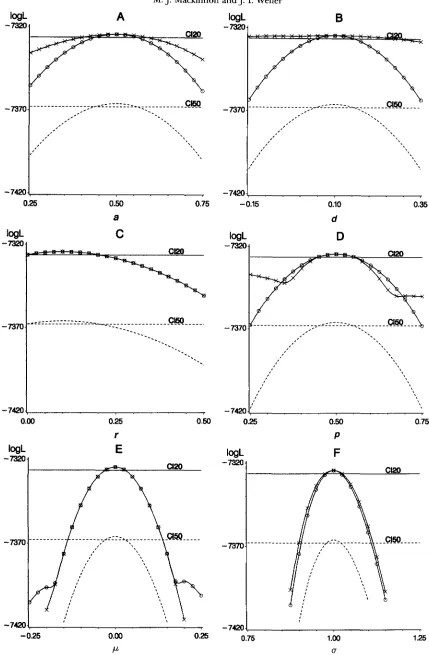
Standard errors from conJidence intervals: Figure 1 shows
the log L profiles as functions of each of the six parame-
ters
b,
ci,2,
f,fi
and 6 for two family structures (20 X250 and 50 X 100) with and without a polygenic effect.
The likelihood always maximized at the true value of the parameters indicating that the expected value of
the log likelihood as given in (3) calculated using deter-
ministic simulation yielded unbiased maximum likeli-
hood estimates, despite it being an approximation. Also
shown in Figure 1 are the confidence intervals ( a 2 0
M. J. Mackinnon and J. I. Weller
A
logLB
0.25 0.50 0.75 -0.15 0.10 0.35
a d
0.00 0.25 0.50
r
0.25 0.50 0.75
P
I /
-
V[''
''\\\\\,\,\\L
-
/!
.
7370 """""- """"-~"")c""""- "" """""
7370 """""""
""","'.""
"I \
-
7420 '\ J:-
7420-0.25 0.00 0.25 0.75 1.00 1.25
P u
FIGURE 1.-Uniparameter profiles of the expected log likelihood (log L ) with respect to parameter estimates assuming all other parameters known for data sets with 5000 records divided into either 20 families without (0-0) and with (X-X) a polygenic effect fitted in the model o r 50 families (-
-
- -) without a polygenic effect. True values of parameters were a = 0.5, d = 0.1, r = 0.1,p
= 0.5, t = 0.3, p = 0 and g = 1. Confidence intervals for estimates from data with 20 families (CI20) andEstimation of QTL Parameters 761
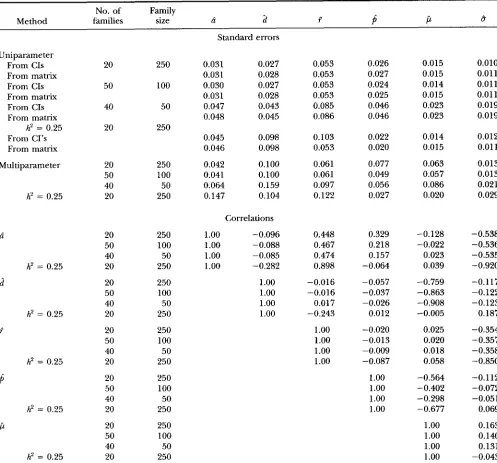
TABLE 3
Standard errors and correlations from deterministic simulations No. of Family
Method families size ci
2
i?P
P
BUniparameter
From CIS
From matrix
From CIS
From matrix
From CIS
From matrix
From CI's From matrix
Multiparameter
h2 = 0.25
h2 = 0.25
h' = 0.25
h2 = 0.25
h2 = 0.25
h2 = 0.25
h2 = 0.25
20 50 40 20 20 50 40 20 20 50 40 20 20 50 40 20 20 50 40 20 20 50 40 20 20 50 40 20 250 100 50 250 250 100 50 250 250 100 50 250 250 100 50 250 250 100 50 250 250 100 50 250 250 100 50 250
Standard errors
0.031 0.027
0.031 0.028
0.030 0.027
0.031 0.028
0.047 0.043
0.048 0.045
0.045 0.098
0.046 0.098
0.042 0.100
0.041 0.100
0.064 0.159
0.147 0.104
Correlations
1
.oo
-0.096 1.oo
-0.088 1.oo
-0.085 1.oo
-0.282 1.oo
1.oo
1.oo
1.oo
0.053 0.053 0.053 0.053 0.085 0.086 0.103 0.053 0.061 0.061 0.097 0.122 0.448 0.467 0.474 0.898 -0.016 -0.016 0.017 -0.243
1
.oo
1.oo
1.oo
1.oo
0.026 0.027 0.024 0.025 0.046 0.046 0.022 0.020 0.077 0.049 0.056 0.027 0.329 0.218 0.157 -0.064 -0.057 -0.037 -0.026 0.012 -0.020 -0.013 -0.009 -0.087
1
.oo
1.oo
1.oo
1.oo
0.015 0.015 0.014 0.015 0.023 0.023 0.014 0.015 0.063 0.057 0.086 0.020 -0.128 -0.022 0.023 0.039 -0.759 -0.863 -0.908 -0.005 0.025 0.020 0.018 0.058 -0.564 -0.402 -0.298 -0.677
1
.oo
1.oo
1.oo
1.oo
0.010 0.01 1 0.011 0.011 0.019 0.019 0.012 0.01 1 0.013 0.013 0.021 0.029 -0.538 -0.536 -0.535 -0.920 -0.117 -0.122 -0.123 0.187 -0.354 -0.357 -0.358 -0.850 -0.112 -0.072 -0.051 0.069 0.163 0.140 0.131 -0.043
Uniparameter and multiparameter lower bound standard errors of parameter estimates, and correlations between them,
derived from deterministic simulations for various models and family structures. True parameter values were p = 0.0, a = 0.5,
d = 0.1, r = 0.1,
p
= 0.5, o = 1 and h' = 0, unless otherwise indicated. around the maximum likelihood estimates. The stan-dard errors derived from these confidence intervals
(uniparameter standard errors), and those for the 40
sires X 50 progeny structure (not shown in Figure 1)
are given in Table 3. Clearly, r is the most difficult
parameter to estimate accurately because of the flatness of the likelihood surface across the range of values (Fig-
ure 1C) and largest standard error. The profile likeli-
hoods for 2,
d
andfi
were all similar in curvature (Figure1, A, B and D) and had similar confidence intervals, indicating that these parameters are estimated to ap- proximately the same degree of accuracy. The profiles
for /i and b were steepest reflecting the greater informa-
tion contributing to these parameters (Figure l , E and
F). The effect of decreasing total experimental size
from 5000 to 2000 was to increase the standard errors
by -50% for all parameters except forb. The effect of increasing the number of families on accuracy of all parameters was negligible. Allowing for a polygenic ef- fect in the model seemed to decrease the accuracy of
2 and
d,
increase the accuracy ofp
and do nothing tothe accuracy of ?, jl, and 8, although these effects could
not be tested for statistical significance. The reduction
M. J. J. I.
35
FIGURE 2.-Expected log likelihood surface with respect to estimates of two parameters at a time. (A-C): No polygenic effect was fitted whereas in D it was. Data sets comprised 5000 records divided into 20 families with true parameter values of a = 0.5,
d = 0 . 1 , r = 0 . 1 , p = O . 5 , t = 0 . 3 , p = O a n d a = l .
by estimating the polygenic effect, g b , as a function of
the sire’s major genotype mean, G b , this conditions out
some of the information on the component parameters
of this mean,
ci,
d,
and$.
While this explains the de-crease in accuracy of ci and
8,
it is not clear why theaccuracy of
$
increases when this polygenic effect isincluded. Accuracies of ?, ji, and 6 are not affected by
the incorporation of a polygenic effect because these
parameters are not components of the adjustment
term, g b .
Standard errors and correlations from the information ma-
trix: Approximate standard errors of the estimates un-
der the four sets of deterministically simulated condi-
tions (Table
2)
and the matrix of correlations betweenthem are given in Table 3. Uniparameter standard er-
rors derived from the diagonals of the information ma- trix were similar to those derived from the confidence intervals from the profile likelihoods. The multiparame- ter standard errors were considerably higher than the
uniparameter standard errors, indicating that confi-
dence intervals derived from profile likelihoods gener- ated by assuming all other parameters are known will
overestimate the accuracy of the estimates from a mul-
tiparameter model when the parameter estimates are
not independent, i.e., correlated. While in general
there were low correlations between parameter esti- mates across the range of conditions tested, there were some notable exceptions: a high correlation (-0.9) be-
tween jl and
d,
and medium correlations (50.4 to 0.6)between 6, ?and 6. This first correlation is presumably
because when
p
= 0.5, none of the between-markercontrasts are influenced by d so that the information
on d relies on the mean of the M m group of progeny
from heterozygous sires. This mean has an expectation of ( p
i
’/&)
so thatd
and jl are confounded. Thiscorrelation is expected to be lower when
p
is not equalto 0.5 because the between-marker contrasts then be-
Estimation of QTL Parameters 763
this correlation is reduced to -0 because the expecta-
tion of the mean becomes jl
+
1/2d
+
- ‘ / 2 d = jl+
&.
Thusd
andfi
are no longer confounded. Thecorrelations between 6, Pand 6 arise from the fact that
the contrast yielding most information on these param-
eters is MM vs. mm, which has an expected value of (1
- 2 r ) a / o . Thus high values of ci are consistent with
high values of P and low values of 6. These correlations
become higher ( a 20.9) when much of the informa-
tion on ci is conditioned out by accounting for the poly-
genic effect. Even though these correlations exist and influence the accuracy of the estimates, the fact that they are not perfect indicates that there is some inde-
pendent information contributing to each parameter
and thus each of the parameters is, in theory, estimable. These results show that the accuracy of individual pa-
rameter estimates is partly dependent on the data struc-
ture and partly on the statistical model fitted to the data.
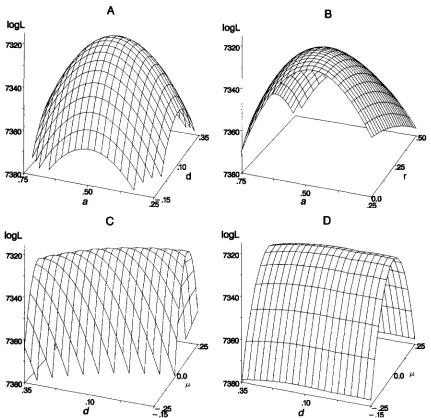
Figure
2
shows three-dimensional representations ofthe likelihood surface with respect to two parameters
at a time (ci and
d,
ci and P, jl and4.
The figuresillustrate that the surface is relatively uniform in curva- ture and has a single global maximum. This indicates that, in theory at least, the approach to the maximum during the estimation procedure should be relatively
unimpeded. Figure 2, C and D, shows the relationship
between
0
and2
with and without a polygenic effectfitted, respectively. It can be seen that while there is a
ridge along the axis of
d
in both figures, that the orien-tation of the ridge when the polygenic effect is not
fitted (Figure 1C) is on the diagonal of jl and dwhereas
it is almost parallel with
d
when a polygenic effect isfitted (Figure 1D). This reflects the dependence be-
tween jl and
d
in the first case and their independencein the second case. Similarly, the orientation of the
profiles for ci and
2
in the same plane as their corre-sponding axes in Figure lA, and the slightly diagonal
orientation of the profiles for P in Figure l B , respec-
tively, reflect the independence and moderate depen- dence between these pairs of parameters. Thus these three-dimensional figures are useful to illustrate the behavior of maximum likelihood estimators in multipa- rameter models.
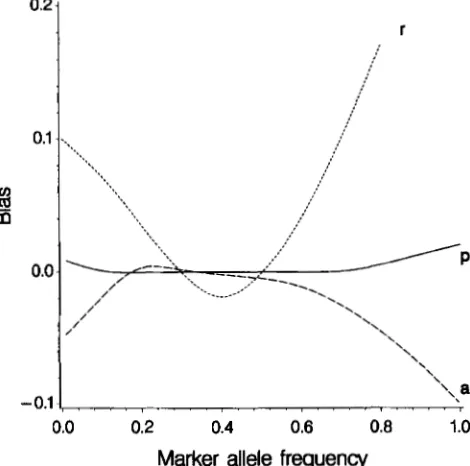
Effect of wrong marker allele frequency: Figure 3
shows the bias in estimates of ci, ? and
j
as functionsof assumed marker allele frequency,
f,
when the truefrequency was t = 0.3. It was found that P was very
sensitive to f, always being inflated by wrong allele fre-
quencies, 6 was moderately sensitive, and always de-
flated, and
fi
was relatively unaffected. There were noeffects on d,
0
and 6. Thus inaccuracies in estimatedmarker allele frequencies will cause the QTL to appear smaller and less tightly linked than it really is. The mag- nitude of the bias in recombination fraction was of the
order of one standard error in the case presented here.
Stochastic simulations: Stochastic simulations were
performed on a Sun SparcStation 2 computer. On this
O.*l r
,
-0.1 , , , , , , , , , , , , , , , , , , , , , , , , ,
‘\,a
0.0 0.2 0.4 0.6 0.8 1
.o
Marker allele frequency
FIGURE 3.-Bias in estimates of 2, i and as functions of
assumed marker allele frequency,
6
for data sets of 5000 rec-ords divided into 20 families and true parameter values of a = 0 . 5 , d = 0 . 1 , r = 0 . 1 , p = 0 . 5 , t = 0 . 3 , p = 0 0 n d u = l .
machine, which processes at 2.4 X
lo6
floating pointoperations per second, a typical run time per replicate
for 30 iterations or -350 evaluations of the likelihood
on 5000 records was -6 min of CPU. Generally only
one run was required for a replicate to reach conver-
gence, although -10% of runs had to be restarted with
different starting values because of parameters esti-
mates exiting the parameter space.
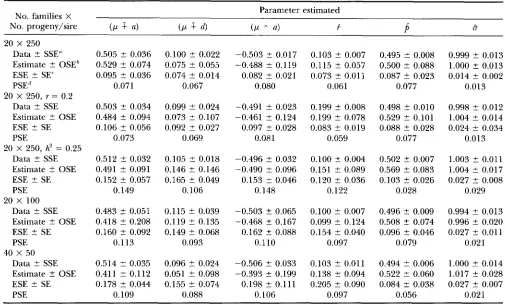
Estimates and standard mors: The estimates from the simulations, averaged over replicates, are given in Table 4. The success in obtaining estimates similar to simu- lated values shows that the half-sib likelihood model
presented in (1) and (2) can separate the effects of the
individual parameters and that estimation by numerical maximization is computationally feasible. Close agree- ment between the means over replicates of simulated and estimated parameter values indicates that the esti-
mates were unbiased or at least that any bias was negligi-
ble (Table 4). This applied equally in models with and without the polygenic effect, indicating that the method of approximating and adjusting for the polygenic ef- fects was successful in separating the major (QTL) ge- notype effect from polygenic effects.
Standard errors of the estimates are also given in
Table 4. These standard errors are derived from various
sources. The standard error on the simulated data repli-
cate mean (SSE) simply reflects the variation between
replicates in the true parameters due to sampling in
the simulated data and is based on only 15 observations.
The standard error on the estimated parameter (OSE)
is also based on 15 observations and is the observed
between-replicate variation in estimates of the parame-
J. Mackinnon and J. Weller
TABLE 4
Parameter estimates and standard errors from stochastic simulations
No. families X Parameter estimated
No. progeny/sire ( P
4
( P4
( P4
5P
B20 X 250 Data ? SSE"
Estimate t OSEh
ESE ? SE'
PSE"
20 X 250, r = 0.2 Data ? SSE
Estimate ? OSE
ESE ? SE
PSE
20 X 250, hz = 0.25 Data +- SSE
Estimate ? OSE
ESE ? SE
PSE 20 x 100
Data t SSE
Estimate ? OSE
ESE ? SE
PSE 40 X 50
Data t SSE Estimate -f. OSE
ESE ? SE PSE
0.505 ? 0.036 0.529 t 0.074 0.095 t 0.036
0.071
0.503 ? 0.034 0.484 ? 0.094 0.106 ? 0.056
0.073
0.512 ? 0.032 0.491 ? 0.091 0.152 t 0.057
0.149
0.483 2 0.051 0.418 ? 0.208 0.160 ? 0.092
0.113
0.514 2 0.035 0.411 t 0.112 0.178 ? 0.044
0.109
0.100 ? 0.022 0.075 t 0.055 0.074 2 0.014
0.067
0.099 t 0.024 0.073 2 0.107 0.092 ? 0.027
0.069
0.105 ? 0.018 0.146 ? 0.146 0.165 ? 0.049
0.106
0.115 ? 0.039 0.119 ? 0.135 0.149 ? 0.068
0.093
0.096 t 0.024 0.051 ? 0.098 0.155 2 0.074
0.088
-0.503 t 0.017 -0.488 ? 0.119 0.082 ? 0.021
0.080
-0.491 ? 0.023 -0.461 t 0.124 0.097 ? 0.028
0.081
-0.496 F- 0.032 -0.490 ? 0.096 0.153 t 0.046
0.148
-0.503 ? 0.065 -0.468 ? 0.167
0.110
-0.506 ? 0.033 -0.393 ? 0.199 0.198 ? 0.111 0.162 ? 0.088
0.106
0.103 ? 0.007 0.115 ? 0.057 0.073 +- 0.011
0.061
0.199 t 0.008 0.199 ? 0.078 0.083 ? 0.019
0.059
0.100 t 0.004 0.151 ? 0.089 0.120 ? 0.036
0.122
0.100 t 0.007 0.099 2 0.124 0.154 t 0.040
0.097
0.103 ? 0.011 0.138 f 0.094 0.205 ? 0.090
0.097
0.495 t 0.008 0.500 ? 0.088 0.087 ? 0.023
0.077
0.498 +- 0.010 0.529 ? 0.101 0.088 +- 0.028
0.077
0.502 t 0.007 0.569 ? 0.083 0.103 5 0.026
0.028
0.496 ? 0.009 0.508 t 0.074 0.096 ? 0.046
0.079
0.494 t 0.006 0.522 t 0.060 0.084 2 0.038
0.056
0.999 ? 0.013 1.000 t 0.013 0.014 ? 0.002
0.013
0.998 ? 0.012 1.004 ? 0.014 0.024 ? 0.034
0.013
1.003 5 0.011 1.004 t 0.017 0.027 ? 0.008
0.029
0.994 ? 0.013 0.996 ? 0.020 0.027 ? 0.011
0.021
1.000 rt 0.014 1.017 ? 0.028 0.027 ? 0.007
0.021
Replicate means (with replicate standard errors) of parameters in the data and their estimates from stochastic simulations,
their maximum likelihood estimates, and estimated and predicted standard errors for various family sizes and number of families
for true values of p = 0.0, a = 0.5, d = 0.1, r = 0.1,
p
= 0.5, ~7 = 1 and h2 = 0, unless otherwise indicated. "Mean and standard error (SSE) of the replicates of simulated data (see text).'Estimates and observed standard error of parameters, OSE.
'Estimated standard errors (ESE) of parameters from information matrix using GEMINI.
'I Multiparameter predicted standard errors (PSE) from deterministic simulations.
mated by GEMINI from the shape of the likelihood
surface around the maximum within each replicate of stochastic simulations, averaged over 15 replicates. The
predicted standard error (PSE) is the multiparameter
standard error derived from the deterministic simula-
tions, given previously in Table 3.
The standard errors for simulated data on 5000 ob-
servations were in general agreement with those pre-
dicted from the deterministic simulations, which are
also shown in Table 4. Where discrepancies occurred
between empirical (OSE and ESE) and predicted stan-
dard errors, the empirical standard errors (ie., from
the stochastic simulations) were usually higher. How-
ever, for the data sets with 2000 observations, the empir-
ical standard errors were always considerably higher
than the predicted standard errors. This difference was
even greater when smaller families were used. These
results confirm that the predicted standard errors from
the information matrix are lower bound standard er- rors. The underestimation is believed to be because, in the calculation of the expected log likelihood based on infinite sampling theory, sampling variation present in
stochastic data due to sampling among sire genotypes and among progeny QTL and marker genotypes is not
represented. Despite this underestimation, the pre-
dicted standard errors were not beyond the lower
bound 95% confidence limit of the empirical standard
errors and so are not likely to be misleading if they are correctly treated as lower bound estimates.
As rwas increased from 0.1 to 0.2, the standard errors
of all parameters changed very little. The effects of vary-
ing a, d and
p
were not investigated although this canreadily be done by using the theoretical method based
on the expected value of log L presented here. Since
it is possible to fix D at unity and measure a and d in
units of g , the effect of varying D need not be consid-
ered.
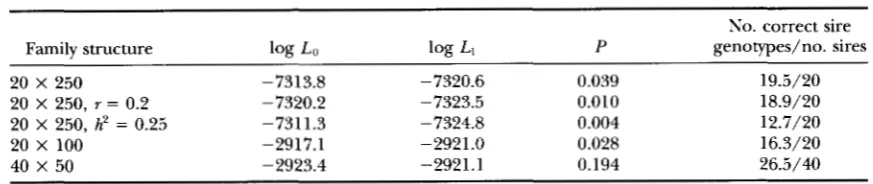
The log likelihoods, under the full and reduced mod-
els, and probabilities for the likelihood ratio chi-
squared tests, averaged over replicates, are given in Ta-
ble 5 for all parameter combinations and data set sizes
stochastically simulated. These figures give an average
test statistic for the different set of simulated conditions
Estimation of QTL Parameters
TABLE 5
Log likelihood ratio tests and proportion of correctly predicted genotypes
No. correct sire
Family structure log Lo log LI P genotypes/no. sires
20 X 250 -7313.8 -7320.6 0.039 19.5/20
20 X 250, r = 0.2 -7320.2 -7323.5 0.010 18.9/20
20 X 250, h2 = 0.25 -7311.3 -7324.8 0.004 12.7/20
20 x 100 -2917.1 -2921.0 0.028 16.3/20
40 X 50 -2923.4 -2921.1 0.194 26.5/40
Family structures are number of sires X number of progeny for sire. Replicate means of log likelihoods of
the full model (log Lo) and the reduced model with r = 0.5 (log L , ) , the probability, E‘, of the likelihood
ratio test for linkage being significant, and the proportion of sire genotypes ascertained correctly, for true
values of /I = 0.0, a = 0.5, d = 0.1, r = 0.1,
p
= 0.5, D = 1 and h‘ = 0, unless otherwise indicated.765
experiment under these conditions. The likelihood ra-
tio test was significant at the 5% level for all combina-
tions, except for the simulations of 40 sires with 50
progeny per sire when it was significant at the 20%
level, on average. The corresponding power of these data sets, calculated using the approximate method of
WELLER et al. (1990) was >90% for all sets except the
40 X 50 data set.
The number of sire genotypes ascertained correctly,
averaged over replicates, are also given in Table 5 for
all parameter combinations and data set sizes simulated.
Prediction of sire genotype was 95% correct for the
data sets with 20 sires and 250 progeny per sire. As
expected, the proportion of correct assignments de-
creased with a reduction in the number of records. For the same number of records, the proportion of correct predictions was higher with more progeny per sire. This corresponds to the results given above with respect to standard errors of parameter estimates and likelihood ratio test probabilities. When adjustment for a poly- genic effect was included in the model, the number of correctly ascertained sire genotypes was much lower. Presumably, this is because a major source of informa- tion on sire genotype, the sire genotype mean, is re- moved by the adjustment. Thus, for the purposes of
sire genotype determination, it may be better to fit a
model without a polygenic effect in order to determine which sires have high probabilities of being heterozy- gous.
DISCUSSION
This study has demonstrated that it is feasible, both computationally and theoretically, to obtain unbiased estimates of the six parameters which describe a QTL
in a segregating outbred population. Attention was fo-
cused on the accuracy of the estimates of these parame- ters because this is crucial to the interpretation of the QTL’s characteristics and also how effectively the QTL is used in subsequent exploitative breeding programs. The development of a deterministic method based on infinite population sampling theory for predicting the lower bound standard errors of estimates was used to
demonstrate the various factors influencing accuracy. These factors are summarized and discussed below. However, the value of the deterministic technique re- quires discussion first, because it forms part of the basis for the conclusions drawn about those factors affecting accuracy.
Deterministic simulation: The deterministic method was based on infinite sampling in that it predicted num-
bers of observations with a given value based on the
density of the normal distribution and then used these “perfect” samples to perform a weighted analysis of the whole population. This implies that all the sampling variation in the data was due to random normal devia- tions within QTL genotypes within families. However, in finite populations, there is also expected to be a sampling effect on the numbers of animals that fall into each of the progeny marker-QTL genotype groups and also on the numbers of sires falling into each sire QTL genotype group. These multinomial sampling effects
were not accounted for in the calculation of the ex-
pected log likelihood (3) because the proportions in
each group were considered to be fixed as dictated by
the frequency parameters,
p
and t. While in data setsof 5000 observations, this did not seem to be a problem,
in data sets of 2000, it is the most likely cause of the
clear underestimation of the predicted standard errors compared with the empirical standard errors, especially
when the families were smaller. The intermediate values
of
p
and t used in this study would have exacerbatedthis sampling variation problem. Modification of (3)
to take these sampling effects into account could be
performed: to do so would involve calculating the ex-
pected log likelihood for values of n,c9 and sPh taken
over the whole range of the appropriate discrete
multinomial distribution, weighting accordingly by the multinomial probabilities of observing each value, and then summing to obtain an overall weighted likelihood. This would be considerably more complex than the method used here but deserves further investigation to see whether it accounts for the underestimation of the standard errors found using deterministic simulation.
rors, these estimates are considered to be useful for
predicting the minimum size of experiment required
to obtain a given level of accuracy of estimation of QTL
parameters. Also, the fact that they are lower bound
standard errors does not devalue the results concerning their behavior with respect to data structure, statistical
model used, and their relationship with each other.
This seems to be true because of the similar (though not always parallel) behavior of the empirical standard errors with changes in these conditions. Thus the con- clusions drawn below on the factors influencing accu- racy are considered valid.
Factors influencing accuracy of parameter estimates: The study identified five separate (though not indepen- dent) influences on standard errors of the parameters.
The first was the nature and magnitude of the parame-
ter itself. Recombination rate, r, was by far the most
inaccurate parameter and, even with 5000 observations, could not be estimated to an accuracy that was able
to exclude 0 recombination from the 95% confidence
interval. In this study, only a single marker adjacent to the QTL was considered. However, most other studies where accuracy has been examined have also consid-
ered two markers which bracket the QTL (KNOTT and
HALEY 1992a; VAN OOIJEN 1992; DARVASI et al. 1993) in
which case standard errors are reduced, though are still
large (0.05 -0.15) relative to the recombination fraction
itself. For example, DARVASI et al. (1993) estimated stan-
dard errors of 0.11 and 0.05 for a gene with an effect
of 0.5 standard deviations located at a recombination
distance of -0.1 from a single marker and bracket
markers space 20 cM apart, respectively, in a backcross
population of 1000 informative individuals. The closest
situation in this study is that for a gene effect of 0.5
standard deviations at a recombination distance of 0.1 in a population of 40 sires, only 20 of which were infor- mative, with 50 progeny each, where the standard error was 0.10. Thus the results presented here concur with
those of DARVASI et al. (1993) and VAN OOIJEN (1992)
that for most feasible experimental sizes, even when two markers bracket the QTL, the resolution of mapping a QTL is near the limit of the marker map itself (10-20
cM) and therefore other techniques need to be em-
ployed for fine mapping of the gene.
In contrast, reasonably accurate estimates of the gene
effects, a and d, can be obtained. Using the examples
above, the standard errors on a were found to be 0.06
and 0.05 in this and the study of DARVASI et al. (1993),
respectively. This is -10% of the parameter itself, which
is typical of the accuracy of many of the parameters used
in routine genetic prediction analyses. Several authors (e.g., SMITH and SIMPSON 1986) have pointed out the importance of the accuracy of QTL parameters in pre- dicting breeding values based on marker-QTL linkages, but most of the loss in prediction accuracy is likely to arise from inaccurate estimates of recombination rate rather than gene effect, as the consequences of infer-
ring a recombinant individual us. a nonrecombinant
individual are far greater than overestimating or under-
estimating by a small fraction the value of an individual. The influence of the magnitude of the gene effect on accuracy was not investigated directly. However, as the gene effect decreases, the power of the analysis also decreases because the between-marker contrast, which is the main source of information, is reduced also. This
reduction in power is similar to that caused by a de-
crease in experimental size; this was investigated in this study and shown to cause a decrease in accuracy.
The population mean and residual standard devia- tion were estimated relatively accurately as expected from the fact that all individuals in the data contribute information to these parameters, not just those from heterozygous sires. Though not investigated, the accu-
racy of the QTL allele frequency,
p,
is expected to de-crease as the value of
p
tends towards extremes. Thisis because the frequency of informative families will
decrease. It is expected that the accuracy of a, d and r
will also decrease for the same reason. It is worth noting
that accurate estimation of
p
is very important in somesituations because it determines how much scope for
genetic improvement there is to bring the favorable
QTL to fixation and therefore the value of a marker- assisted within-breed improvement program.
The second factor affecting accuracy of individual
parameters is the correlation with other parameters.
This study is the first to demonstrate that strong sam- pling correlations exist between some parameters. This result means that the accuracy of parameters cannot be considered in isolation, because correlations with other parameters cause a decrease in accuracy of the other
parameters. The implications are that if one parameter
is poorly estimated or biased for some reason, then correlated parameters will also be affected. The rela- tionships between parameters must be considered in the prediction of response to breeding programs that attempt to incorporate information on several parame- ters simultaneously.
The third factor affecting accuracy is total experimen-
tal size, and this influence is large. When experimental
size was increased by a factor of 2.5, the accuracy of
all parameters improved. It was found that parameters slightly increased in accuracy with an increase in family size or decrease in number of families when the total number of progeny is held constant, reflecting the im- portance of within-family information to estimate most parameters. These results are concomitant with a de- crease in power as family size decreases as also shown
by SOLLER and GENIZI (1978) and WELLER et al. (1990).
It is expected that the influence of family size on accu- racy would be more noticeable when the total experi-
mental size is smaller than that used in the present
study.
The fourth influence found to affect accuracy was the
Estimation of QTL Parameters 767
this can lead to overestimation of the QTL effect
(KNOTT et al. 1990; KNOTT and HALEY 199213). Here the adjustment used was to subtract the sire’s mean, which is similar to the “modal method” for adjusting for sire
effects used by HOESCHELE (1988) and LE ROY et al.
(1989) for segregation analyses to detect major genes without the aid of markers. In this study, it was shown to be an effective way of accounting for between-family variation without prior knowledge of polygenic herita- bility or simultaneous estimation of the between-family variation from the likelihood analysis. The latter ap-
proach was found to be necessary in the KNOTI and
H A L E Y study (1992b), which examined a full-sib design
in which family sizes were relatively small and therefore
family means were inaccurate. The effect of fitting a
polygenic model on parameter accuracy was to decrease
the accuracy of the parameters ( a and
d);
this contrib-uted to the adjustment term because, in making the adjustment, much of the information on these parame-
ters is lost. Thus for the purposes of obtaining very
accurate estimates of the magnitude of gene effects, an alternative method for adjusting for between family
variation, such as that used by KNOTT and HALEY
(1992b) may be considered. Certainly, the effect of us- ing the polygenic model on the correlations between
parameters was to strengthen them, which is an undesir-
able consequence if several imperfectly estimated pa-
rameters are to be used simultaneosuly in breeding pro- grams.
The final influence on parameter accuracy examined in this study was that of assumed marker allele fre- quency. When wrong marker allele frequencies were used in the likelihood equation, the QTL was estimated to be larger and more distant from the marker than it really was. This problem is likely to be reduced as the heterozygosity of the marker increases because more progeny will have marker alleles that can be assigned to the sire and dam with certainty. Increased heterozy- gosity will certainly occur with the widespread transition
of use of diallelic markers such as RFLPs to polyallelic
markers such as microsatellites. The model presented here can be adjusted to account for multiple alleles by grouping the progeny into three marker genotype groups: one for those with the same genotype as the sire and two for those having either one of the sire’s alleles. In the current model, these groups would corre-
spond to the Mm, MM and m m groups and the frequen-
cies of the sire alleles in the dam population, t , and t . ~
would then replace t and (1 - t ) in the matrix C. One
problem that may arise is that with many alleles, marker frequencies estimated from the sample will be less accu- rate and wrongly assumed frequencies will influence the estimates, as shown in this study. One way to avoid this is to only use data from animals that have been
unambiguously assigned a paternal and maternal allele,
although this would result in loss of information and hence loss of accuracy of the estimates. Sensitivity to
assumptions about marker allele frequency is a well
known problem in linkage analysis of discrete traits.
So far, the information yielded by the likelihood on
the QTL parameters has been discussed. However, the likelihood also yielded information on the genotypes of the sires and was found to very accurately predict the sire’s genotype when the number of progeny was
>loo.
This information is of great practical impor-tance when the ultimate goal of the experiment is to select sires carrying favorable QTL alleles for commer- cial breeding via marker-assisted selection (WELLER
and FERNANDO 1991). This prediction method may
also be used to eliminate the uninformative QTL ho- mozygous sires at the early stage of a QTL mapping experiment, although where there are multiple QTL
to detect, there will be few sires that are homozygous
for all QTL and therefore able to be discarded. The confidence with which sires can be classified into QTL genotypes needs further investigation, especially when there are many possible QTL genotypes, in which case
the test of one genotype us. the rest requires some
knowledge of the properties of this multiple hypothe- sis test statistic.
The implications of violations of the assumptions of the model will be briefly considered. The model
assumed underlying normality and equal variance
among QTL genotypes and that the progeny with rec- ords were a random sample of the sire’s progeny. Skew- ness and kurtosis may lead to false conclusions about
major gene effects (GO et al. 1978). If there is skewness,
the analysis can be performed on transformed data,
as suggested by WELLER (1987), although overcorrec-
tion of the skewness can remove some of the informz- tion on the QTL from the mixture of distributions.
DARVASI (1990) found that estimation of QTL parame-
ters by ML under the assumption of equal genotype
variance resulted in accurate estimates for genotype means even if this assumption was incorrect, provided that the actual variances were not radically different. If recorded progeny are a selected sample, estimates
of QTL effects will be severely biased (MACKINNON and
GEORGES 1992). Incorporation of a truncation param-
eter in the likelihood model presented here may be
one way of accounting for the effects of selection. The
degree of selection would, however, have to be known from an independent analysis.
Conclusions: The study showed both theoretically and empirically that unbiased estimates of the six pa-
rameters that determine a QTL effect in the half-sib
design are able to be estimated by maximum likelihood
methodology via linkage to a genetic markers. All pa-
rameters except for recombination frequency and the QTL’s dominance effect are accurately estimated rela- tive to the size of the parameter itself when there are several thousand progeny records. Further improve- ments in accuracy may be obtained by including other
markers in the model that reduce the background varia-
tion ( JANSEN 1993; ZENC 1994). Parameter estimates