Copyright2000 by the Genetics Society of America
The Implications of Intergenic Polymorphism for Major
Histocompatibility Complex Evolution
Colm O’hUigin,* Yoko Satta,
†Anja Hausmann,* Roger L. Dawkins
‡and Jan Klein*
*Max-Planck-Institut fu¨r Biologie, Abteilung Immungenetik, D-72076 Tu¨bingen, Germany,†Department for Biosystems Science, Graduate University for Advanced Studies, Hayama, Kanagawa 240-0193, Japan and‡The Centre for Molecular Immunology
and Instrumentation, The University of Western Australia, Perth, Australia Manuscript received March 21, 2000
Accepted for publication May 30, 2000
ABSTRACT
A systematic survey of six intergenic regions flanking the humanHLA-Blocus in eight haplotypes reveals the regions to be up to 20 times more polymorphic than the reported average degree of human neutral polymorphism. Furthermore, the extent of polymorphism is directly related to the proximity to theHLA-B locus. Apparently linkage to HLA-B locus alleles, which are under balancing selection, maintains the neutral polymorphism of adjacent regions. For these linked polymorphisms to persist, recombination in the 200-kb interval fromHLA-BtoTNFmust occur at a low frequency. The high degree of polymorphism found distal toHLA-Bsuggests that recombination is uncommon on both sides of theHLA-Blocus. The least-squares estimate is 0.15% per megabase with an estimated range from 0.02 to 0.54%. These findings place strong restrictions on possible recombinational mechanisms for the generation of diversity at the HLA-B.
H
UMANS are among the species for which se- and balancing (HudsonandKaplan1988;Takahataquence polymorphisms have been best character- andSatta1998a) selection. Because the degree of in-ized. A compilation of genetic data byLi andSadler fluence depends on the strength of the linkage, a com-(1991) revealed that the genetic diversity in human pop- parison of polymorphism in the linked regions to that ulations averaged 0.08%, a value subsequently con- in regions under selection gives a measure of the recom-firmed byTakahataandSatta(1997). There is consid- bination frequency.
erable variation in the degree of polymorphism from A spectacular example of the effects of balancing selec-locus to selec-locus, however, presumably because of differ- tion is provided by the major histocompatibility com-ences in underlying mutational mechanisms and selec- plex (Mhc) loci, the most polymorphic loci in humans tive influences that may promote or reduce polymor- (Klein et al. 1993). [There are ⵑ200 allelic variants
phism. known at each of the HLA-B and HLA-DRB1 loci
Selection can directly affect the amount of polymor- (Bodmer et al.1999).] An unusual feature of theMhc phism at loci under its influence. Most commonly, nega- polymorphism is the sharing of sequence motifs by oth-tive selection reduces diversity by eliminating deleteri- erwise distinct alleles. Many mechanisms that involve ous variants (Kimura1983). Selective sweeps resulting genetic exchanges have been proposed for the diversi-from positive selection also reduce the degree of poly- fication of Mhc loci (Andersson et al. 1991; Kuhner morphism, due to the fixation of favored alleles. In and Peterson 1992; Andersson and Mikko 1995; contrast to these two mechanisms, balancing selection McDevitt 1995). A common theme of several of the promotes polymorphism through the maintenance of
proposed mechanisms is the implication of recombina-variant allelic forms. In each case, the influence of
selec-tion as a vehicle for promoting the dispersal of diversity tion on polymorphism should not be restricted to the
into various alleles (Sheet al.1991;McAdamet al.1994; locus under selection. Regions adjacent to such a locus
Sattaet al.1998). Putative recombinogenic sequences, should show a similar influence of selection, even if they
related to the bacteriophagechi sequence, have been themselves are selectively neutral (Felsenstein1974).
identified at class II loci (Gyllensten et al. 1991). It The effect is predicted and modeled for positive (
May-has been proposed that such chi-like elements promote
nard Smith and Haigh 1974; Kaplan et al. 1989;
recombination to higher than normal levels ( Gyllens-Begun and Aquadro 1992), negative or background
ten et al. 1991). As an alternative to recombinogenic (Charlesworth et al. 1993; Nordborg et al. 1996),
mechanisms, it has been proposed that the gradual ac-cumulation of mutations over long evolutionary peri-ods, coupled with convergence of certain key residues
Corresponding author:Colm O’hUigin, Max-Planck-Institut fu¨ r
Biolo-in the various alleles (Gustafssonet al.1991;
Gustaf-gie, Abt. Immungenetik, Corrensstr. 42, 72076 Tu¨ bingen, Germany.
E-mail: [email protected] ssonandAndersson1994;KleinandO’hUigin1995;
O’hUigin 1995;Kriener et al.2000), could generate estimate the degree of recombination in the proximity ofHLA-B.The recombination frequency thus estimated the observed diversity.
It is to be expected that high recombination rates will can be used to set limits on the amount of recombina-tion that can be involved in generatingHLA-Bdiversity. decouple the evolutionary history of loci under selection
from that of adjacent regions. Two lines of evidence We have therefore undertaken a survey of polymor-phisms in eight humanHLA-Bhaplotypes at five loci in have suggested that such decoupling does not occur.
The first of these involves conservation. Strong similari- theTNFtoHLA-Binterval, as well as one locus distal to HLA-B.
ties betweenDRBhaplotypes in humans and chimpan-zees extending over several hundred kilobases have been reported byKleinet al.(1991). Conserved human
MATERIALS AND METHODS
class I region haplotype blocks extending again over
several hundred kilobases have been described byDaw- Source of DNA: Human DNA was extracted from eight HLA-B homozygous EBV cell lines obtained from the tissue
kins et al.(1991). The results of both of these studies
typing service of the United Kingdom Transplantation Service,
have been interpreted as providing evidence for the
Bristol, England. The cell lines were Boleth (HLA-B*1501),
maintenance of ancient ancestral haplotypes under
re-Brip (HLA-B*1517), DBB (HLA-B*5701), DKB (HLA-B*4001),
combinationally frozen conditions. The second line of EA (HLA-B*0702), EHM (HLA-B*3501), Madura ( HLA-evidence was provided by the study of Mhc polymor- B*4001), and Renchr. In addition, DNA from the chimpanzee cell line Yvonne (provided by Dr. R. Bontrop, TNO Health
phism. Analysis of an intergenic region called CL1, at
Institute, Rijswijk, The Netherlands) and from the peripheral
least 100 kb proximal toHLA-B, showed a high degree
blood leukocytes of the gorilla, Jimmy (Miami Zoo, Miami)
of sequence variability in three haplotypes, apparently was used. All DNA was extracted by using the standard phenol-exceeding the expected neutral polymorphic levels chloroform procedure.
(Abrahamet al.1992). Neither of these lines of evidence Polymerase chain reaction (PCR):PCR amplification was used to obtain Mhc segments from genomic DNA. Table 1
appears easily compatible with enhanced
recombina-shows the primers used and the sizes and locations of the
tion in theMhcregion. In the first case, excessive
recom-amplified fragments. Unless otherwise indicated, all PCRs
binogenic mechanisms would be expected to scramble were carried out in a volume of 50l containing 100meach the haplotypes during the 5 million years since the diver- of dATP, dCTP, dGTP, and dTTP, 5l of 10⫻reaction buffer, gence of humans and chimpanzees. In the second case, and 2 units ofTaqpolymerase enzyme from Amersham Phar-macia Biotech, as well as 1mof each primer and 200 ng of
the adjacent regions should not hitchhike with HLA-B
genomic DNA. The PCR program consisted of 35 cycles of
and should therefore show no more polymorphism than
1 min denaturation followed by 30 sec primer annealing at
any unlinked region. Nevertheless, neither of these lines
55⬚and 1 min extension at 72⬚. Immediately preceding and
of evidence is conclusive. Common haplotypes found in following these 35 cycles, a 1-min denaturation step at 94⬚and chimpanzees and humans may be the result of selection a 10-min extension step at 72⬚ were included, respectively. The amplified fragments were separated from primers on 1%
favoring particular combinations that can, however,
re-low-melting-point agarose gels, cut out, purified by using the
combine freely. The high degree of polymorphism in
QIAEX II procedure, and cloned into pUC18 vectors by using
theCL1region may be caused, not byHLA-B, but by any
the Sureclone kit (Amersham Pharmacia Biotech). Following
nearby locus under balancing selection. Furthermore, it transformation into competentEscherichia colicells, DNA was is not clear whether the three selected haplotypes are isolated from resultant white colonies and sequenced on the A.L.F. sequencer (Amersham Pharmacia Biotech) using
uni-representative of polymorphisms in CL1 and
neigh-versal and reverse primers of the A.L.F. sequencing kit. At least
boring regions and whether different polymorphisms
two independent clones were used to verify each sequence.
are associated with different HLA-B alleles. Although Data analysis:Sequences were aligned by eye. Additional some studies have provided further evidence of poly- sequences for theTNFandHLA-Bregions (Mizukiet al.1997; morphism in noncoding regions of class I (Gaudieriet Guillaudeuxet al.1998; Shiinaet al.1998) and of HLA-B introns (Cerebet al.1996) were obtained from database en-al. 1997) and class II (Horton et al. 1998) loci, no
tries. Aligned sequences were used to construct phylogenetic
systematic survey relating polymorphism and linkage
trees by the neighbor-joining subroutine of the MEGA package
has been undertaken.
(Kumaret al.1993) following distance estimation by Kimura’s
To decide whether the high polymorphic levels in two-parameter method (Kimura 1980). Polymorphism was the CL1 locus are due to linkage to HLA-B, a closer analyzed and nucleotide diversities were estimated by using the DNASP package (version 2.2) ofRozasandRozas(1997).
examination of polymorphisms in theHLA-BandTNF interval is necessary in a wider variety of haplotypes. A higher degree of linkage to a locus under balancing
RESULTS
selection would be expected to be associated with a
higher polymorphic level, whereas lower linkage would General:To simplify the interpretation, we identified nonfunctional intergenic regions for amplification. Pre-lead to lower genetic diversity. By examining the degree
of polymorphism in this interval, it should therefore be sumably such regions evolve without the confounding influence of phenotypic selection. Our initial amplifica-possible to determine whether it is selection at theHLA-B
TABLE 1
Locations of amplified segments on large genomic sequences taken from the DNA database entries ofShiinaet al.(1998),Mizukiet al.(1997), andGuillaudeuxet al.(1998)
PCR fragment
Segment Location (accession no.) size (bp) Primersa
TNF 15439–16103 (Z15026) 665 CCCCTTTGAGGCACTTGTTT TAGGACTACAGGCGCATACC CL1 71612–73049 (AB000882) 1445 TTACAAAAGGGGTTGGCTGTAA
AAGGACACTCAGGGAATAAATGG CL2 17862–18311 (D83543) 449 CCTTTTGAGATGTCTTTTCAGGT TAGCGGAGGAAAGGCAAGGACACT FGF 26712–27620 (D83543) 888 TAACAGAAACAAGCTAAAGGTCAC
CCATGAGGGAATATCAAGAGTTT DHFR 46150–46733 (D83543) 583 CCCAGTTTTCCAACTCTATTTT
TTCTGCCAGTTCCAGTTGAATGG
HLA-B 58164–60850 (D83543) 805 TGTTGGTCCCAATTGTCTCCCCTC
GAACSGCCTCTGYGGGGAGAAGCA DIS 71670–72266 (D83543) 596 GGGGACGGTGCTAAAGGATT
GGGCTTCATTCAATTCACTGA
aForward primer sequence given first; primers given in 5⬘–3⬘orientation.
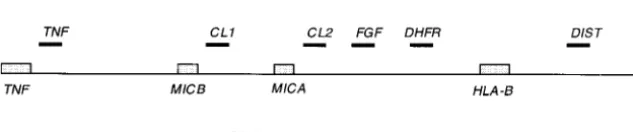
quence from known intergenic segments (Geraghty gion. Figure 1 shows the approximate positions of the segments we amplified, as well as the positions of genes et al.1992;Leelayuwatet al.1992) and by amplifying
it into adjacent DNA segments. The subsequent se- in theTNFto HLA-Binterval. The number of nucleo-tides compared excluding gaps was 5664 bp, of which quencing of the TNF to HLA-B region (Mizuki et al.
1997;Guillaudeuxet al.1998;Shiinaet al.1998) sim- 263 sites are segregating. Of the segregating sites, 132 are phylogenetically informative and the remaining 131 plified the task of identifying and choosing regions and
of evaluating those already chosen. are singletons. The description of the individual regions follows.
Several duplications in the HLA class I region have
been revealed by large-scale sequencing and they in- TNF: The amplified segment of 665 bp is ⵑ1.5 kb telomeric from the stop codon of the TNF gene and clude some of the initially chosen segments for
amplifi-cations (notably,CL1,FGF, andDIST). Two factors en- some 200 kb distant from HLA-B. It contains part of an Alu element but shows no evidence of divergent abled us to identify paralogous PCR amplification
products when they occurred. First, where two or more duplicate copies. Single substitutions were found in EHM (A to T at site 284 and T to C at 461), in Renchr different sequences were obtained from a putatively
ho-mozygous source, it is likely that paralogy is involved. (T to A at 436), in EA (C to T at 440), and in DKB (A to G at 672). There are two published sequences Second, phylogenetic analysis revealed the clustering of
paralogous segments into a clade separate from the encompassing this region. One of them (Guillaudeux
et al.1998) is identical with our Boleth, Brip, DBB, and targeted product. Since the genomic sequences are
known in the Boleth haplotype (Mizukiet al.1997), it Madura sequences. The other (Iriset al.1993, accession no. Z15026), reportedly from Boleth, shows several dif-was possible to assign definitive locations to the
frag-ments amplified. ferences from the Boleth sequence reported here and
the sequence of Guillaudeux et al. (1998). It differs Much of the intergenic region is nearly identical in
the fragments we sequenced and so the alignment is from all sequences presented here by deletion of C at site 330, insertion of G at 386, and single substitutions straightforward. There are many single substitutions,
however, leading to a moderate degree of polymor- at sites 373, 374, 375, 430, 433, 436, 448, and 453. None of the substitutions or indels were found in any of the phism. When an orthologous region was amplifiable,
we used the chimpanzee and gorilla sequences to deter- sequences we examined, including Boleth. It was there-fore excluded from our polymorphism estimates. In the mine the likely direction of substitutions for each
set used, there are a total of five singleton polymorphic Brip, DKB, and DBB, suggesting at least one recombina-tion breakpoint in the region.
sites (Figure 2), giving a nucleotide diversity of 0.18%
Despite the higher diversity atCL2compared toCL1, (SD 0.06%) at this locus.
no human sequence is more closely related to either
CL1: This region was originally identified as part of
the gorilla or the chimpanzee sequences than to other a duplicated segment on a restriction enzyme fragment
human sequences; in other words, we found no evidence of 6 kb by Leelayuwat et al. (1992). It lies ⵑ75 kb
for trans-species evolution of CL2. The high level of distal fromTNFand 130 kb proximal toHLA-B.Several
nucleotide diversity (1.5%) could indicate that the com-primers were designed to amplify a segment ofCL1of
parisons made are of a paralogous type. However, data-up to 1.46 kb encompassing a singleAluelement (sites
base searches could not identify any paralogs ofCL2. 696–1034). None of a variety of PCR primers could
FGF:TheFGFregion is adjacent to a fibroblast growth amplify theCL1segment from chimpanzee or gorilla,
factor-like pseudogene. We amplified a segment of 888 CL1being presumably deleted in these two species. An
bp that lies 175 kb distal fromTNFand 31 kb proximal Alu-lessCL2fragment could be obtained instead. Since
toHLA-B.The segment was obtained as follows: a primer CL1andCL2are related by duplication that occurred
based on the sequence ofLeelayuwatet al.(1996) was some 30 mya (Leelayuwat et al. 1992), the CL2
se-used in combination with a primer specific for a linker quences can be used as outgroups to determine the
added to a restriction fragment that contained the
Lee-substitutions that occurred in theCL1sequences. Both
layuwatet al.(1996) sequence. The amplification pro-CL2 and CL1 contain sequences related to the LTR8
duct was sequenced and primers were then designed repetitive element from chromosomes 7 and 14
(acces-for the amplification of theFGF segment on the basis sion nos. AC002508 and AC005857).
of this sequence. The primers were, however, not spe-Although only twice the size of theTNFsegment,CL1
cific for this region; they also amplified at least one contains 50 polymorphic sites (Figure 2) compared with
paralogous segment 50 kb proximal to the site described 5 found atTNF. The estimated nucleotide diversity of
byLeelayuwatet al.(1996). The paralogous segment, 1.24% (SD 0.19%) is more than six times greater than
labeled D83543-P in Figure 2, could be identified on the that estimated forTNF.Nineteen of the substitutions at
basis of sequences fromShiinaet al.(1998). A second the locus are informative. To determine the extent of
paralogous segment occurred at an unidentified posi-incompatibility among the informative nucleotide sites
tion and only this segment could be obtained from the in this region, an incompatibility matrix was produced
DBB cell line (Figure 2). The fixed sequence differences (TakahataandSatta1998b). Of the 1225 pairs of
infor-enabled us, however, to distinguish both paralogous mative sites, 103 pairs in two phylogenetically distinct
amplification products, which group in distinct clades blocks were incompatible. In the first 700 bp, substitutions
on phylogenetic trees. By these means we could identify were scattered and no pattern of relationships between
the sequences derived specifically from theFGFregion. sequences emerged. By contrast, at the 3⬘end of the CL1
After the exclusion of the DBB paralog, nine polymor-fragment, the Brip and Madura sequences shared six sites
phic sites were found in this segment, eight of which and most sites were compatible (Figure 2).
were singletons. There was no incompatibility among
CL2: The CL1 region and some 10 kb of its flanks
the substitutions. The nucleotide diversity of the seven were duplicated in an event estimated to have occurred orthologous sequences was 0.32% (SD 0.07%). some 30 mya (Leelayuwatet al.1992), giving rise to DHFR: The DHFR region lies adjacent to a DHFR a related segment called CL2. This segment lies 150 pseudogene identified byMizukiet al.(1997) and is 12 kb distal to TNFandⵑ50 kb proximal toHLA-B.The kb proximal toHLA-B.The amplified segment is 583 bp amplified fragment is 449 bp in length and is homolo- in length. In the sequences we analyzed, 15 polymorphic gous to part of the CL1 region. By positioning one sites were found, giving a nucleotide diversity of 1.02% primer across the site of the Aluinsertion in CL1, we (SD 0.15%) for the eight human DNAs. Nine sites were were able to preferentially amplifyCL2, which does not phylogenetically informative and all sites are mutually contain theAluelement. A total of 15 polymorphic sites compatible.
the nucleotide diversity reaches 2.10% (SD 0.40%) for not be critical. Rates of synonymous and nonsynony-mous substitution per site have been approximately the haplotypes surveyed here. The variation at
synony-mous sites is higher at 3.36% (SD 0.36%) in the same equal since the divergence ofMICAandMICB(ⵑ7.5% synonymous substitutions per sitevs.5.5% nonsynony-haplotypes.
DIST:This segment lies 11 kb distal fromHLA-Band mous substitutions). In contrast toHLA-B, MIC polymor-phisms are nottrans-specific between apes and humans 80 kb proximal to HLA-C. The primers we used were
not specific for this site and amplified at least one other (Cattley et al.1999). There is evidence of a linkage disequilibrium between theMICandHLA-Bgenes (Yao
segment that presumably arose with the duplication of
the ancestralHLA-BandHLA-Cloci. The amplified frag- et al.1999) and thus their polymorphism fits a picture of being generated, as in noncoding regions, by virtue ment was 596 bp long and contained 41 variant sites
(Figure 2). Only paralogous fragments could be ob- of their linkage toHLA-B. In this view theMIC genes may be functional and polymorphic, but selection at tained from the Renchr and DBB haplotypes. After the
exclusion of the paralogous segments, the estimated MICloci does not produce polymorphism in the manner found forHLA-B.
nucleotide diversity in the remaining six haplotypes was
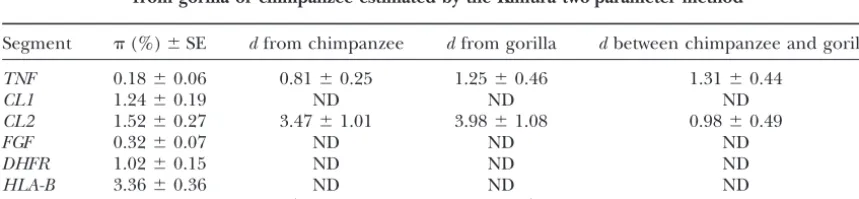
1.56% (SD 0.38%). Table 2 illustrates the extent of nucleotide diversity
found for the regions we sequenced. The lowest levels
Other loci:In addition to the data we have obtained
for these six loci from the eight human cell lines, other of diversity are found in segments most distant from HLA-B, close to theTNF locus. The diversity found at surveys have been conducted of coding sequences in the
HLA-BtoTNFinterval. Most prominent among these is TNF is nevertheless approximately double the average levels found by Li andSadler (1991) for unselected the search for polymorphism at the class I-related
MICAandMICB loci (Bahramet al. 1994;Fodilet al. sites of human gene sequences. The nucleotide diversity increases with increasing proximity toHLA-B, although 1996;Andoet al.1997;Pelletet al.1997;Visseret al.
1998;Yaoet al.1999). These surveys have concentrated the increase is not monotonic. It is unclear what effect any functional restrictions onMICAandMICBmay have on determining whether the sites of polymorphisms can
be related to molecular function. However, the patterns on the polymorphism in regions adjacent to those loci and whether these loci may be a cause of the nonmono-found are quite unlike those of class I genes in which
polymorphism is concentrated on sites specifying the tonic relationship. The absence of a simple relationship between diversity and distance from a locus under selec-peptide-binding region (PBR). In bothMICAandMICB,
little variation is found at putative PBR-specifying sites; tion is also seen in the analysis of two haplotypes in the class I region (SattaandTakahata2000). The highest it is instead concentrated in the fourth exon (Yaoet al.
1999), which is not variable in classical class I genes. nucleotide diversity is found at HLA-B itself, whether measured at the synonymous sites or in introns. The estimated nucleotide diversities of 20
near-com-pleteMICAand 13MICBcoding sequences are 1.02 and Recombination frequency:The most likely factor driv-ing the high levels of polymorphism in the six adjacent 0.23%, respectively, but comparison with other diversity
estimates is difficult since the haplotypes have not been regions reported here is their linkage toHLA-B.Since the degree of polymorphism can be related to recombi-systematically selected. The patterns of variability inMIC
genes are consistent with the hypothesis that these genes nation frequency, it is of some interest to determine what recombination frequency can account for the ob-represent nonclassical class I genes. There is evidence
that MICA may be involved in induction of antitumor served degree of polymorphism. By using the popula-tion genetics models ofTakahataandSatta(1998a) NK and T cell responses (Baueret al. 1999). On the
other hand, some MICA alleles contain in-frame stop and Sattaand Takahata(2000), we can attempt to fit a recombination rate to the observed data (Figure codons, suggesting that functionality of this locus may
TABLE 2
Nucleotide diversities ()⫾standard errors (SE) of orthologous segments and the divergences (d) from gorilla or chimpanzee estimated by the Kimura two-parameter method
Segment (%)⫾SE dfrom chimpanzee dfrom gorilla dbetween chimpanzee and gorilla
TNF 0.18⫾0.06 0.81⫾0.25 1.25⫾0.46 1.31⫾0.44
CL1 1.24⫾0.19 ND ND ND
CL2 1.52⫾0.27 3.47⫾1.01 3.98⫾1.08 0.98⫾0.49
FGF 0.32⫾0.07 ND ND ND
DHFR 1.02⫾0.15 ND ND ND
HLA-B 3.36⫾0.36 ND ND ND
DIS 1.56⫾0.38 1.76⫾0.24 2.25⫾0.72 0.68⫾0.34
Figure3.—The relationship between the per-centage of nucleotide diversity (ordinate) found for six amplified intergenic segments, as well as exons 1–7 ofHLA-Bin the same haplotype, plot-ted as a function of distance from HLA-B. The nucleotide diversity found in a range of MICA andMICBhaplotypes is also shown. The distances are given in kilobases with negative and positive numbers used for locations proximal to and distal from HLA-B, respectively. Lines show estimates of expected diversity at particular recombination frequencies following the model of Takahata andSatta(1998a). The solid lines show the least-squares estimate of recombination rate (0.15% per megabase per generation) and the dashed lines show the rates required to incorporate the maxima (0.02% per megabase) and minima (0.54% per megabase). The mutation rate is as-sumed to be 10⫺9per site per year and the
selec-tion intensity is 1%.
3). The least c-squares estimate gives a rate of 0.15% ber of branch switching by a modified method of Rob-inson andFoulds (1981) for all blocks to support a per megabase (Figure 3), which is one-sixth of the
aver-single phylogeny (not shown). The minimum number age rate found over the entire human genome (in
hu-was 18. Taking this number as a minimum number of mans estimated at 1% per megabase per generation: see
recombination events in the 200-kb region during the
Vogel and Motulsky 1997; Takahata and Satta
past 17 million years (this date is based on the average 1998a). The maximum and minimum diversity values
synonymous divergence of eight sampledHLA-Bexons, found can be encompassed by recombination
frequen-0.034/site, and the synonymous substitution rate of 10⫺9 cies of 0.02 and 0.54%, respectively. The curve of the
per site per year), the recombination frequency is calcu-estimate is monotonic and does not account for
varia-lated as 1.1/200 kb/million years. Assuming 20 years tions found in the vicinity of the MIC loci. However,
per generation in humans, the recombination rate per these variations affect primarily the shape of the
recom-megabase per generation is 0.01%. This possible mini-bination curve rather than its magnitude. The present
mum rate, although roughly estimated, is not much differ-estimate agrees with another differ-estimate for this region
ent from the lowest limit of the least-squares estimate. fromSattaand Takahata(2000) that is based on a
The polymorphisms at the HLA-Blocus are thought comparison of the sequences of Guillaudeux et al.
to betrans-specific between humans and chimpanzees, (1998) andShiinaet al.(1998) extending throughout
having arisen at least 5 million years before present theHLA-BandHLA-Cregions. It therefore appears that
(ⵑ250,000 generations ago, taking 20 years as genera-recombination frequency in proximity toHLA-Bis not
tion time). ForTNF, CL2, and DIST, orthologous seg-elevated compared to other genomic regions, but rather
ments from the chimpanzee and gorilla were obtained. reduced.
In every case the nucleotide diversities found in humans To examine the extent of incompatibility in this
re-were smaller than the nucleotide divergences between gion, an incompatibility matrix was constructed (Figure
humans and apes. This observation suggests that, unlike 4). Among all the pairs of informative sites (9870 pairs),
atHLA-B, the polymorphisms at the adjacent linked loci including those inHLA-B, 3769 pairs are incompatible.
have not evolvedtrans-specifically between humans and From the diagram, there appear to be at least five
phylo-apes. genetically distinct blocks (Figure 4). Block 1 is
com-posed of the 5⬘-most segment (5⬘ region of CL1, the entirety of CL2, and exon 2 of HLA-B). These three
DISCUSSION
regions are mutually compatible and support a single
phylogeny. Block 2 contains the only the 3⬘part ofCL1. For all the loci we examined we were able to find Block 3 is composed ofFGFandDHFR.Block 4 is formed sequence variation in pairwise comparisons of segments by exon 1 as well as exons 3–7 ofHLA-Band block 5 generally⬍1 kb in length. This is in contrast to findings byDIST.We reconstructed a phylogeny for each block. from surveys of genomic variation, in which fewer than Although the number of informative sites for each block one polymorphism per 1 kb is found in humans (Li
num-variation at theDISTorFGFloci. At the other extreme, tion size is too high or too large to be compatible with theTNFlocus shows variation that is only slightly above the nucleotide diversity at other neutral regions. It is, that expected from the Li and Sadler survey. These therefore, likely that this long persistence of the in-findings are in agreement with isolated observations of tergenic segments is due to their linkage to a locus high levels of polymorphism in the neighborhood of under balancing selection.
theHLA-Blocus (Leelayuwatet al.1992). The highest nucleotide diversities are observed at the The survey of polymorphisms proximate toHLA-Bis DISTlocus that is the closest toHLA-B(Figure 1, Table limited by the choice of sample. The eight human cell 2). In addition, the variation at the most polymorphic lines were chosen because of their ready availability, loci does not exceed that found at the HLA-B locus their serologically determinedHLAhomozygosity, and itself in the eight haplotypes; the locus has an intron 2 the variety ofHLA-Bhaplotypes they represent. There diversity of 2.1% (SD 0.4%) and a synonymous nucleo-is an indication that theHLA-Bgenes of the EHM and tide diversity of 3.4% (SD 0.4%). The balancing selec-Brip cell lines differ in a minor way only and that those tion driving polymorphism atHLA-Bis of sufficient mag-of the Madura and DKB cell lines are identical (Prasad nitude to explain the nucleotide diversity found at the
andYang1996). It may be relevant to ask how represen- adjacent neutral regions. Increasing levels of polymor-tative are the cell lines used. This question can reason- phism correlate with proximity toHLA-B, although the ably be answered only for theHLA-Blocus, at which a relationship is not simple. TheMICgenes fall into the large sample of variants is available. The nucleotide pattern of high polymorphism levels in proximity to diversity of 23 HLA-Bintron 2 sequences obtained by HLA-B, although selection at these loci may modify the
Cereb et al. (1996) is 1.68% (SD 0.28%). This value pattern. Our evidence suggests that linkage to HLA-B is slightly lower than that found in the eight chosen is the main factor that maintains polymorphisms in adja-haplotypes (2.1%, SD 0.4%), suggesting that the alleles cent regions. We find little or no evidence for any strong sampled here are more variable than those sequenced influence of another locus under balancing selection byCerebet al.(1996). Nevertheless, the diversity at the in the interval.
HLA-Bsynonymous sites of these eight haplotypes (3.4⫾ The extent of nucleotide diversity at these regions 0.4%) is not different from that (3.4 ⫾ 1.1%) of 82 does not appear to be compatible with a high level of availableHLA-Ballele sequences (TakahataandSatta recombination at
HLA-B. The long time (⬎5 million 1998a). It appears, therefore, that the present samples
years) available for the accumulation of diversity at are representative of a large number ofHLA-B alleles
HLA-Bshould be sufficient to allow linked neutral diver-and the sampling cannot account for the 20-fold
in-sity to be lost at moderate recombination rates (Figure crease in diversity of the present haplotypes compared
3). We have shown that the effects of selection can be to that in theLi andSadler (1991) survey.
seen near HLA-B and possibly extend as far as TNF, A high degree of nucleotide diversity may be caused
some 200 kb away from HLA-B, where the diversity is by high underlying mutation rates. However, studies by
double that found at other neutral loci. The
recombina-Sattaet al.(1993) on substitutions in theMhcindicate
tion frequency that gives a good fit to this diversity is that the mutation rate atHLA-Bmay be even lower than
0.15% per megabase per generation, one-sixth of the the human average. On the basis of the synonymous
human genomic average (1% per megabase). The high substitution rate of 10⫺9 (per site per year), the
diver-degree of linkage disequilibrium seen in neutral poly-gence time at the six intergenic segments adjacent to
morphisms appears to favor the view thatHLA-Bevolves HLA-Branges from 0.9 to 7.8 million years. Although
in a manner reflecting “frozen haplotypes” rather than chimpanzee or gorilla orthologs at TNF, DHFR, and
the recombination hotspot models (Kleinet al.1991). CL2 show no evidence of the trans-specific mode of
This mode of evolution may be common among Mhc evolution, the diversity of several pairs of alleles at these
loci. Preliminary data on class II polymorphisms indicate loci as well as other loci exceeds the average nucleotide
that at the HLA-DQB1 locus, as at the HLA-B locus, divergence between humans and chimpanzees (1.75%
adjacent neutral regions show a higher than expected averaged over 37 loci; Takahata and Satta 1997).
level of neutral polymorphism (Horton et al. 1998). Thus the polymorphisms observed in the intergenic
seg-According to this view, theMhcis evolving in a conserved ments adjacent toHLA-Bhave taken several millions of
fashion, without high levels of mutation or recombina-years to accumulate. When we explain this high extent
tion, but simply by the accumulation of polymorphism of nucleotide diversity by mutation and random genetic
drift, the required mutation rate or the effective popula- over long time periods under balancing selection.
of variation in the HLA-DQB1 locus in the class II region of the LITERATURE CITED
human MHC. J. Mol. Biol.282:71–97.
Abraham, L. J., C. Leelayuwat, G. Grimsley, M. A. Degli-Esposti, Hudson, R. R.,andN. L. Kaplan,1988 The coalescent process in
A. Mannet al., 1992 Sequence differences between HLA-B and models with selection and recombination. Genetics120:831–840. TNF distinguish different MHC ancestral haplotypes. Tissue Anti- Iris, F., L. Bougueleret, S. Prieur, D. Caterina, G. Primaset al., gens39:117–121. 1993 Dense Alu clustering and a potential new member of the
Andersson, L., andS. Mikko,1995 Generation of MHC class II NFkappaB family within a 90 kilobase HLA class III segment. diversity by intra- and intergenic recombination. Immunol. Rev. Nat. Genet.3:137–145.
143:5–12. Kaplan, N. L., R. R. HudsonandC. H. Langley,1989 The
“hitch-Andersson, L., K. Gustafsson, A.-K. Jonsson andL. Rask,1991 hiking effect” revisited. Genetics123:887–899.
Concerted evolution in a segment of the first domain exon of Kimura, M.,1980 A simple method for estimating evolutionary rates polymorphic MHC class II b loci. Immunogenetics33:235–242. of base substitutions through comparative studies of nucleotide
Ando, H., N. Mizuki, M. Ota, M. Yamazaki, S. Ohnoet al., 1997 sequences. J. Mol. Evol.16:111–120.
Allelic variants of the human MHC class I chain-related B gene Kimura, M.,1983 The Neutral Theory of Molecular Evolution. Cam-(MICB). Immunogenetics46:499–508. bridge University Press, Cambridge, UK.
Bahram, S., M. Bresnahan, D. E. Geraghtyand T. Spies,1994 Klein, J.,andC. O’hUigin,1995 Class II BMhcmotifs in an evolu-A second lineage of mammalian major histocompatibility com- tionary perspective. Immunol. Rev.143:89–111.
plex class I genes. Proc. Natl. Acad. Sci. USA91:6259–6263. Klein, J., C. O’hUigin, M. Kasahara, V. Vincek, D. Kleinet al., 1991
Bauer, S., V. Groh, J. Wu, A. Steinle, J. H. Phillipset al., 1999 Frozen haplotypes in Mhc evolution, pp. 261–286 inMolecular Activation of NK cells and T cells by NKG2D, a receptor for stress- Evolution of the Major Histocompatibility Complex, edited byJ. Klein
inducible MICA. Science285:727–729. andD. Klein.Springer-Verlag, Heidelberg, Germany.
Begun, D. J.,andC. F. Aquadro,1992 Levels of naturally occurring Klein, J., Y. Satta, C. O’hUiginandN. Takahata,1993 The molec-DNA polymorphism correlate with recombination rates in D. ular descent of the major histocompatibility complex. Annu. Rev. melanogaster.Nature356:519–520. Immunol.11:269–295.
Bodmer, J. G., S. G. E. Marsh, E. D. Albert, W. F. Bodmer, R. E. Kriener, K., C. O’hUigin, H. TichyandJ. Klein,2000 Convergent
Bontropet al., 1999 Nomenclature for factors of the HLA sys- evolution of major histocompatibility complex molecules in hu-tem, 1998. Eur. J. Immunogenet.26:81–116. mans and New World monkeys. Immunogenetics51:169–178.
Cattley, S. K., N. Longman, R. L. Dawkins, S. Gaudieri, J. K. Kulski Kuhner, M. K.,andM. J. Peterson,1992 Genetic exchange in the et al., 1999 Phylogenetic analysis of primate MIC (PERB11) evolution of the human MHC class II loci. Tissue Antigens39:
sequences suggests that the representation of the gene family 209–215.
differs in different primates: comparison of MIC (PERB11) and Kumar, S., K. TamuraandM. Nei,1993 MEGA: Molecular Evolu-C4. Eur. J. Immunogenet.26:233–238. tionary Genetic Analysis, Version 1.01. The Pennsylvania State
Cereb, N., Y. Kong, S. Lee, P. MayeandS. Yang,1996 Nucleotide University, University Park, PA.
sequences of MHC class I introns 1, 2, and 3 in humans and Leelayuwat, C., L. J. Abraham, H. Tabarias, F. T. Christiansen
intron 2 in nonhuman primates. Tissue Antigens47:498–511. andR. L. Dawkins,1992 Genomic organization of a
polymor-Charlesworth, B., M. T. MorganandD. Charlesworth,1993 phic duplicated region centromeric of HLA-B. Immunogenetics The effect of deleterious mutations on neutral molecular varia- 36:208–212.
tion. Genetics134:1289–1303. Leelayuwat, C., L. J. Abraham, M. Pinelli, D. C. Townend, A. F. Dawkins, R. L., M. P. Degli-Esposti, J. Abraham, W. Zhangand Wilkset al., 1996 The primate MHC contains sequences related
F. T. Christiansen,1991 Conservation versus polymorphism to the fibroblast growth factor receptor gene family. Tissue Anti-of the MHC in relation to transplantation, immune responses gens48:59–64.
and autoimmune disease, pp. 391–402 inMolecular Evolution of Li, W.,andL. Sadler,1991 Low nucleotide diversity in man. Genet-the Major Histocompatibility Complex, edited by J. Klein andD. ics129:513–523.
Klein.Springer-Verlag, Heidelberg, Germany. Maynard Smith, J.,andJ. Haigh,1974 The hitch-hiking effect of
Felsenstein, J.,1974 The evolutionary advantage of recombination. a favourable gene. Genet. Res.23:23–35.
Genetics78:737–756. McAdam, S. N., J. E. Boyson, X. Liu, T. L. Garber, A. L. Hughes Fodil, N., L. Laloux, V. Wanner, P. Pellet, G. Hauptmannet al., et al., 1994 A uniquely high level of recombination at the HLA-B
1996 Allelic repertoire of the human MHC class I MICA gene. locus. Proc. Natl. Acad. Sci. USA91:5893–5897.
Immunogenetics44:351–357. McDevitt, H. O.,1995 Evolution of MHC Class II allelic diversity.
Gaudieri, S., C. Leelayuwat, K. T. Tay, D. C. Townendand R.L. Immunol. Rev.143:113–122.
Dawkins,1997 The major histocompatability complex (MHC) Mizuki, N., H. Ando, M. Kimura, S, Ohno, S. Miyataet al., 1997 contains conserved polymorphic genomic sequences that are Nucleotide sequence analysis of the HLA class I region spanning shuffled by recombination to form ethnic-specific haplotypes. J. the 237-kb segment around the HLA-B and -C genes. Genomics Mol. Evol.45:17–23. 42:55–66.
Geraghty, D. E., B. H. Koller, J. A. HansenandH. T. Orr,1992 Nordborg, M., B. Charlesworth andD. Charlesworth, 1996 The HLA class I gene family includes at least six genes and twelve The effect of recombination on background selection. Genet. pseudogenes and gene fragments. J. Immunol.149:1934–1946. Res.67:159–174.
Guillaudeux, T., M. Janer, G. K. Wong, T. SpiesandD. E. Ger- O’hUigin, C.,1995 Quantifying the degree of convergence in pri-mateMhc-DRBgenes. Immunol. Rev.143:123–140.
aghty,1998 The complete genomic sequence of 424,015 bp
at the centromeric end of the HLA class I region: gene content Pellet, P., M. Renaud, N. Fodil, L. Laloux, H. Inokoet al., 1997 Allelic repertoire of the human MICB gene. Immunogenetics and polymorphism. Proc. Natl. Acad. Sci. USA95:9494–9499.
Gustafsson, K.,andL. Andersson,1994 Structure and polymor- 46:434–436.
Prasad, V. K.,andS. Y. Yang,1996 Allele assignment for HLA-A, phism of horse MHC class IIDRBgenes: convergent evolution
in the antigen binding site. Immunogenetics39:355–358. -B, and -C genes to the Tenth International Histocompatibilty Workshop cell lines. Tissue Antigens47:538–546.
Gustafsson, K., U. Brunsberg, S. SigurdardottirandL.
Anders-son,1991 A phylogenetic investigation of MHC class II DRB Robinson, D. F.,andL. R. Foulds,1981 Comparison of phyloge-netic trees. Math Biosci.53:131–147.
genes reveals convergent evolution in the antigen binding site,
pp. 119–130 inMolecular Evolution of the Major Histocompatibility Rozas, J.,andR. Rozas,1997 DnaSP version 2.0: a novel software package for extensive molecular population genetics analysis. Complex, edited byJ. KleinandD. Klein.Springer-Verlag,
Heidel-berg, Germany. Comput. Appl. Biosci.13:307–311.
Satta, Y.,andN. Takahata,2000 Polymorphism in theHLAclass
Gyllensten, U., M. SundvallandH. A. Erlich,1991 Allelic
diver-sity is generated by intraexon sequence exchange at theDRB1 I region, pp. 178–185 inThe Major Histocompatibility Complex: Evolu-tion, Structure, and Function, edited byM. Kasahara.Springer, locus of primates. Proc. Natl. Acad. Sci. USA88:3686–3690.
Horton, R., D. Niblett, S. Milne, S. Palmer, B. Tubbyet al., 1998 Tokyo.
ymous substitution rate of the major histocompatibility complex Takahata, N.,andY. Satta,1998a Footprints of intragenic recom-bination at HLA loci. Immunogenetics47:430–441.
loci in primates. Proc. Natl. Acad. Sci. USA90:7480–7484.
Satta, Y., Y. J. LiandN. Takahata,1998 The neutral theory and Takahata, N., andY. Satta,1998b Selection, convergence, and intragenic recombination in HLA diversity. Genetica102/103:
natural selection in theHLAregion. Front. Biosci.3:459–467.
She, J.-X., S. A. Boehme, T. W. Wang, F. Bonhomme andE. K. 157–169.
Wakeland,1991 Amplification of major histocompatability com- Visser, C. J. T., M. G. J. Tilanus, V. Schaeffer, Z. Tatari, R.
plex class II gene diversity by intraexonic recombination. Proc. Tamouzaet al., 1998 Sequencing-based typing reveals six novel Natl. Acad. Natl. Sci. USA88:453–457. MHC class I chain-related gene B (MICB) alleles. Tissue Antigens
Shiina, T., G. Tamiya, A. Oka, T. Yamagata, N. Yamagataet al., 51:649–652.
1998 Nucleotide sequencing analysis of the 146-kilobase seg- Vogel, F., andM. Motulsky,1997 Human Genetics, Problems and ment around the IkBL and MICA genes at the centromeric end Approaches, Ed. 3. Springer, New York.
of the HLA class I region. Genomics47:372–382. Yao, Z., A. Volgger, W. Helmberg, E. Keller, L. A. Fanet al., 1999
Takahata, N.,andY. Satta,1997 Evolution of the primate lineage Definition of new alleles of MICA using sequencing based typing. leading to modern humans: phylogenetic and demographic infer- Eur. J. Immunogenet.26:225–232.
ences from DNA sequences. Proc. Natl. Acad. Sci. USA94:4811–