R E S E A R C H
Open Access
Qos-aware resource allocation for mixed
multicast and unicast traffic in OFDMA networks
Hui Deng
1,2*, Xiaoming Tao
1and Jianhua Lu
1Abstract
This article focuses on the subchannel and power allocation for mixed multicast and unicast traffic in wireless OFDMA networks, where the multicast data is divided into basic layer and enhancement layer data. Our goal is to maximize the network total throughput with a total power constraint while guaranteeing the minimum rate requirements of both the unicast and muticast traffic. A suboptimal allocation algorithm is proposed, which combines a cost-based subchannel allocation with the traditional water filling (TWF) and an advanced water filling (AWF). The TWF is used for the subchannels allocated to satisfy the rate requirements of each unicast traffic and multicast traffic while the AWF is used for the remaining subchannels. Besides, we present an average SNR-based user selection scheme which selects a proper set of multicast users to serve when the minimum rate requirements of all users can not be satisfied. Simulation results show that our proposed algorithm can improve the network throughput and outage probability compared with other algorithms.
1 Introduction
The next-generation wireless networks are expected to provide various broadband multimedia services with diverse quality of service (QoS) requirements. Orthogonal frequency division multiple access (OFDMA) is a promis-ing technology of the next-generation wireless broadband networks for its high spectral efficiency and flexible resource management. Currently, much attention is paid to the unicast wireless OFDMA networks. In unicast OFDMA systems, dynamic resource allocation exploits multiuser diversity gain by allocating the subcarriers to the users with good channel conditions to improve system performance. In [1-11], resource allocation method was proposed for the unicast streams in OFDMA systems. In [7], the resource allocation problem was resolved in two stages. First, a suboptimal subchannel allocation was pro-posed. Then, optimal power allocation was done based on the pre-determined subchannel allocation. This method of separating subchannel allocation and power allocation is widely used in the resource allocation of OFDMA networks.
Meanwhile, many multimedia applications such as Internet television and video conferencing are carried by
the multicast transmission. The 3GPP has defined multi-media broadcast multicast services (MBMSs) for the uni-versal mobile telecommunications system [12]. The 3GPP2 finalized the specifications of broadcast multicast services (BCMCSs) in the 1xEV-DO system [13]. The mobile-WiMAX system forum also supported multicast broadcast service (MBS) [14]. In each time slot, data are delivered to a single user in case of unicast transmission, while the information is simultaneously delivered to mul-tiple users in case of multicast transmission. Resource allocation schemes for mixed multicast and unicast traffic need to be investigated. Seo et al. [15] developed a sub-channel allocation scheme that maximizes the total uni-cast throughput while guaranteeing the minimum transmission rate of multicast traffic in OFDMA net-works. Liu et al. [16] proposed a dynamic subcarrier and power allocation scheme for several multicast groups in OFDMA networks to maximize the network throughput given the total power constraint. However, the scheme in [16] did not considering the minimum rate requirement. The unicast group is regarded as a multicast group with one user in [16]. In fact, unicast and multicast services have different QoS requirements. When both multicast and unicast services exist, the QoS requirements for the two kinds of services should be considered concurrently. Baek et al. [17] analyzed the affect of cell radius and the user number in a cell to the performance of the unicast
* Correspondence: [email protected]
1
Tsinghua National Laboratory for Information Science and Technology (TNList), Tsinghua University, Beijing 100084, P.R.China
Full list of author information is available at the end of the article
and multicast transmission schemes, and proposed a hybrid scheduling scheme which selects the multicast or unicast transmission in a slot according to SNR threshold values. In [18], the power allocation for mixed unicast and multicast services is considered. The optimization aims to maximize the network sum rate under the pre-condition that the subcarrier allocation is predefined. Similarly, the above works [15-18] failed to guarantee the rate requirements of the multicast traffic and unicast traf-fic at the same time.
The conventional multicast transmission over the wireless channels suffers from the limitation problem that the multicast transmission rate is decided by the transmission rate of the worst-channel user in the mul-ticast group. This problem limits the gain which can be achieved by utilizing the multiuser diversity in OFDMA networks. To overcome this problem, the hierarchical video coding schemes such as H.264 and MPEG-4 [19,20] etc. which decompose the video con-tents into layers, can be employed. Suh and Mo [21] proposed subcarrier allocation and bit loading for a single hierarchic multimedia stream based on the assumption that any combination of layers consisting of multicast data can be decoded at the receiver. But it did not consider the rate requirement. Kwack et al. [22] and Xu et al. [23] took consideration of the multi-cast rate requirement and designed subcarrier alloca-tion schemes for multicast services employing layered video coding in OFDMA networks. But they did not consider the power allocation. In [24], we developed subchannel and power allocation for a single hierarchic multicast traffic considering the minimum rate require-ment. These works [21-24] only consider multicast traffic.
Our work attempts to design a subchannel/power allo-cation method for mixed multicast and unicast traffic in OFDMA networks to maximize network throughput while guaranteeing the rate requirements of all traffic. We utilize the layered video coding technique for the multicast traf-fic. More specifically, we present a suboptimal algorithm which combines a cost-based subchannel allocation (CSA) with the traditional water filling (TWF) and an advanced water filling (AWF). Also, an average-SNR user selection scheme is proposed to exclude bad channel condition users to improve system performance. Simulation results will show that the network throughput by using our pro-posed algorithm outperforms other algorithms.
The rest of article is organized as follows: In Section 2, we present the system model and problem formulation. In Section 3, subcarrier/power allocation schemes and user selection method are proposed. Next, the simulation results of our algorithm are showed in Section 4. Finally, conclusion is drawn in Section 5.
2 System model and problem formulation
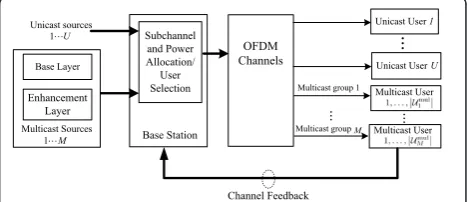
Figure 1 illustrates the downlink mixed multicast and uni-cast OFDMA network that we take into consideration in this article. Here, each original multicast data is com-pressed into a base layer data and an enhancement data at the multicast source in the network. The base layer data contains the most essential information that provides a minimum level video quality. The enhancement layer data is delivered to a set of selected users in a multicast group with better channel conditions. It provides additional information that enhances the video quality of the base layer in proportion to the amount of the received data, under the condition that the requirement of the base layer is satisfied. The base station (BS) will carry out the resource allocation and user selection in a centralized manner. We assume the channels change slowly and the channel gain is stable within a scheduling time slot. The channel information is sent back from all users to the BS. BS can get all the involved perfect CSI to do adaptive sub-channel/power allocation and select suitable user set to serve.
In our model,Gdownlink traffic flows are transmitted toKusers onLsubchannels, where the traffic flows con-tainsUunicast traffic flows andMmulticast traffic flows. We assume that each user receives only one traffic flow
at each time. The user set is denoted by
K=Uuni∪Umul
1 · · · ∪UMmul contains all the users in the
network, where Uuni denotes the unicast user set and Umul
i (i= 1,. . .,M) denotes the user set of multicast
groupi. The symbol |Umul
i | represents the number of
users included in theith multicast group. The total sys-tem bandwidth isBand each subchannel have an equal bandwidthB/L.
M-ary quadrature amplitude modulation (MQAM) is adopted in our system. Without loss of generality, we assume a fixed and the same BER for all users in all subchannels. The achievable transmission data rate of userkin subchannel lcan be expressed as:
Subchannel and Power Allocation/ User Selection
Base Station
OFDM
Channels Unicast User
Channel Feedback
Unicast User 1
Multicast User
Multicast User
U
...
...
Base Layer
Enhancement Layer
Multicast Sources 1M
Unicast sources 1U
Multicast group 1
M
Multicast group
...
Figure 1 Downlink mixed multicast and unicast OFDMA
rl,k=
B Llog2
1 +cPlGl,k N0
, (1)
wherePlandGl,kdenote the transmission power allo-cated to subchannelland the channel gain for userkin subchannell,N0 is the noise power in each subchannel, c≈-1.5/ln(0.2/BER) [25].
To make the base layer data reliably received by all the multicast users in ith multicast group, we take the base layer transmission rate of multicast groupiin sub-channellto be
Bl,i= min k∈Umul
i
rl,k. (2)
The summed base layer transmission rate of the sub-channels which are allocated to the base layer of a mul-ticast group should meet the transmission rate requirement of the base layer to provide the minimum level video quality to users.
For the enhancement layer of multicast group i, we decide its transmission rate in sub-channel l such that the enhancement layer throughput in suchannel l be maximinzed. The enhancement layer throughput of multicast groupiin subchannellrepresents the amount of the received enhancement layer data of all the users in multicast groupiin subchannell. If the enhancement layer transmission rate in subchannel l happens to be the rate of user k in multicast group i, then the enhancement layer throughput of multicast group i in subchannellis
Ekl,i=
n∈Umul
i
rl,k1(rl,n≥rl,k), k∈Umuli . (3)
1(A) is an indicator function that becomes 1 when the condition A is met and 0 otherwise.
When the transmission power in each subchannel is determined, the optimal transmission rate for the enhancement layer of multicast groupi in subchannell, k∗∈Uimul, k∗ ∈Uimul, is determined such that Ek
l,i can
be maximized, i.e., k∗= arg maxk∈Umul
i E
k
l,i. In this case
the maximum enhancement layer throughput of multi-cast groupiin subcarrierl,El, i, becomes Ek
∗
l,i.
The optimization problem can be formulated as (P1):
max
pl,αl,βl,Pl
L
l=1
⎡
⎣
u∈Uuni
ρl,url,u+ M
i=1
(αl,i|Uimul|Bl,i+βl,iEl,i) ⎤ ⎦(4)
s.t.
L
l=1
ρl,url,u≥Rminu , ∀u∈Uuni, (5)
L
l=1
αl,iBl,i≥Rbi, ∀i= 1, 2,. . .,M, (6)
L
l=1
Pl≤Pmax, (7)
ρl,u+αl,i+βl,j≤1, ∀l,∀u,i,j, (8)
ρl,u+ρl,v ≤1, ∀l,∀u=v, (9)
αl,i+αl,j≤1, ∀l,∀i=j, (10)
βl,i+βl,j≤1, ∀l,∀i=j, (11)
ρl,u,αl,i,βl,j∈ {0, 1}, ∀l,∀u,i,j. (12)
whererl, uis either 1 or 0, depending on whether the subchannel lis assigned to unicast user uor not, al, i explains whether the subchannel l is assigned to the base layer of the ith multicast group, bl, j denotes whether the subchannel l is assigned to the enhance-ment layer of the jth multicast group. Constrains (5) and (6) guarantee the rate requirements of each unicast and mutlicast traffic where Rmin
u and Rbi represent the
rate requirement of unicast useruand multicast group i, respectively. Constrain (7) is the total power con-straint where Pmax is the total power of the BS. Con-strains (8-12) ensure that one subchannel can not be reused by a unicast traffic, the base layer of a multicast traffic, and the enhancement layer of a multicast traffic. The optimization problem (P1) is a NP-hard problem. Optimal allocation in which subchannels and power should be allocated jointly poses a prohibitive computa-tional burden at the BS. There, low-complexity subopti-mal algorithms are preferred for its cost-effective and delay-sensitive implementations. Separating the sub-channel and power allocation is a way to reduce the complexity, because the number of variables in the objective function can be reduced. This method of separating subchannel allocation and power allocation is widely used in the resource allocation of OFDMA net-works [7,16]. In the next section, a low-complexity supoptimal allocation scheme based on the above method is proposed.
3 Methods: Heuristic resource allocation and user selection scheme
distributed to each subchannel, i.e. Pl =Pmax/L. This assumption is used only for the subchannel allocation. Next, power allocation is done based on the subchannel allocation results.
Subchannel allocation
Assume that the maximum transmission power of the BS is uniformly distributed among the subchannels. The problem (P1) is transformed as (P2):
max
Proof. For multicast groupi, the base layer throughput
|Umul
enhancement layer throughput of a multicast group is no less than the base layer throughput. Therefore, when
the minimum rate requirements of the traffic are all zero, the problem P2 can be simplified as the following:
max
The subchannel can not be reuse. Suppose the lth subchannel is allocated to unicast user u. Assume that there exists a multicast trafficithat hasEl,i > rl, u. The total throughput can be improved by reallocating the subchannel lfrom unicast user uto mutlicast traffic i. Similar conclusions can be obtained in other situations. Therefore, the subchannel lneed to be assigned to the traffic with the maximum achievable throughput as the Equation (21-23) showed.
According to the above lemma, without considering the rate requirement, in order to maximize the network throughput, the optimal subchannel allocation is to allo-cate each subchannel to the traffic whose achievable throughput in that subchannel is largest. There-fore, we can calculate the achievable throughput of the enhance-ment layer of each multicast traffic and the achievable rate of each unicast traffic in each subchannel, and then allocate each subchannel to the traffic with maximum achievable throughput initally.
After that, we can reallocate the subchannels to meet the rate requirement of each traffic. We hope that the total throughput reduction be minimized in each reallocation and the number of reallocation be kept as low as possible. Next, a cost function is defined to determine whether a subchannel will be reallocated to another traffic.
Based on the above consideration, the cost function for a traffic can be proportional to the decrease of over-all throughput, and inverse proportional to the traffic’s achievable throughput and remaining rate to achieve the rate requirement. The cost function is defined as:
Runireqk ≡max
Finally, we establish a CSA as follows: first, we allocate each subchannel to the traffic with the maximum achievable throughput in it. Second, we determine a subchannel-traffic pair that has the minimum value of cl, k, and assign the subchannel to that traffic. Third, we exclude the selected subchannel from the set of sub-channels,S, and repeat the second step until the trans-mission rate requirements for all traffic are met.
We examine the complexity of proposed subchannel allocation scheme. In our model,Gdownlink traffic flows are transmitted onLsubchannels, where the traffic flows containsUunicast traffic flows andMmulticast traffic flows. To determine the enhancement layer transmission rate of multicast groupiin each subchannel, the scheme needs to sort the user rate in the multicast group first with complexity of |Umul
i | ·log(|Uimul|). Then, we need to
cal-culate |Umul
i | throughput corresponding to |Uimul|
differ-ent transmission rate of enhancemdiffer-ent layer, and |Umul i |
comparisons are need to find the optimal rate to maximize the enhancement layer throughput. The base layer trans-mission rate can be found in the sorting process. LetUmul
max
be the maximum user number in multicast group. There-fore, at most L·M·(2Umul
max+Umulmaxlog(Umulmax))
compari-sons are needed to find the base layer transmission rate and the maximum enhancement layer throughput for all multicast groups in all subchannels. Besides, we need to calculateLUtransmission rate for all unicast users in all subchannel. Then,L · Gcomparisons are need to find the traffic with maximum achievable throughput in each sub-channel. For the subchannel reallocation procedure, we need to calculate at mostL · Gcosts and need at mostL · Gcomparisons to find the subchannel-traffic pair that has
the minimum value costs in each loop. At mostLloop are required to check whether the transmission rate require-ments for all traffic are met. The complexity is bounded byL2· Gin the subchannel reallocation stage. In a conclu-sion, the subchannel allocation scheme has a complexity of O(LMUmul
maxlog(Umaxmul) +L2G) which is less than the
complexity required for the complete search over the pro-blem space which isO(GL).
Power allocation
After the power and subchannls which are allocated to satisfy the rate requirement of a traffic are fixed, the TWF [26] could be done immediately to maximize the achievable throughput of the traffic. We do the TWF for each traffic separately and this method can avoid the minimum required rates not satisfied after new power allocation.
The solution of TWF for unicast trafficuis
Pl= max
the total power allocated to unicast trafficuto satisfy its rate requirement.
The solution of TWF for multicast trafficiis
Pl= max
i is the total power
allo-cated to the base layer of multicast trafficito satisfy its rate requirement.
Given rl, u, al, i, bl, j, the total power assigned to satisfy the rate requirement of all traffic and the user whose rate has been chosen to be the transmission rate of the enhancement layer in each subchannel for each multicast traffic from step 1, the optimization problem (P1) is transformed as (P3):
max
The above problem (P3) can be transformed as (P4): subchannel l is allocated to unicast traffic u, k∗∈Uimul, k∗∈Uimul and gl=Gl,k∗ if subchannel l is
allocated to multicast trafficiwhilek* is the user whose raterl,k*is chosen to be the transmission rate for multi-cast trafficiin subchannellunder the equal power allo-cation assumption.
The solution to the power allocation problem (P4) can be found by using the Lagrange multiplier technique. We define the Lagrangian function as
F=
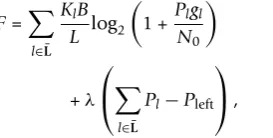
wherel is a Lagrange multiplier and the solution of problem (P4) can be obtained by solving ∂F/∂l = 0. Consequently, the transmission power for each subchan-nel should satisfy
The optimal amount of powerPlallocated to subchan-nellcan be represented by
Pl= max
and we call it AWF.l0in (41) is determined by substi-tuting all the Pl into the constraint equation
l∈¯LPl=Pleft.
Finally, we conclude the proposed resource allocation scheme for mixed multicast and unicast traffic in Table 1.
User selection
Since different users have different channel conditions, some users may get a severely bad channel condition. In this case, it may be not possible to meet the transmis-sion rate requirements of all users even by allocating all the resource. Especially for the multicast group, a bad channel condition user restricts the achievable transmis-sion rate of the base layer and may lead to the outage of the whole multicast group. Then we need to exclude some bad users and provide the service to a limited set of users with a relative good channel conditions. How to decide the user set to serve is a problem. Using an exhaustive searching can get a optimal user set. How-ever, that would take a high complexity. Here we pre-sent a average SNR-based user selection (ASUS) method in Table 2 with a reduced complexity. After the sub-channel allocation is done, the user selection scheme excludes the user with the worst average SNR in each multicast group which did not achieve the minimum rate requirement. Once the ASUS algorithm determines the set of users to serve, the subchannel allocation scheme can be executed again using the set of selected users to maximize the system throughput. The iteration is repeating until all the selected users achieve the rate requirement. In each iteration, the user selection needs
Table 1 The proposed resource allocation scheme
1. Initialization:
2. Allocate each subchannel to the traffic with maximum achievable throughput and setrl,u,bl,jaccording to (21-23) initially. Calculatecl,kfork= 1, . . . ,U+M,l∈ ¯Laccording to (29-32).
3. 1) For each traffic, do calculate the assigned power for the sub-channels which are allocated to satisfy the rate requirement by using the TWF according to (33)(34).
at most Umulmax comparison to select the worst average SNR user for each multicast group.
4 Simulation results
We conduct computer simulations to evaluate the per-formance of our proposed algorithm. For comparison purpose, we also consider three other schemes: (1) PSRG subchannel assignment algorithm proposed in [27] based on a uniform power distribution. Here we determine the pruning threshold for each multicast group in each subchannel such that the throughput of the enhancement layer can be maximized other than fixed the threshold as done in [27]; (2) our proposed CSA based on a equal power allocation; (3) the pro-posed resource allocation scheme in Table 1 (CSA+WF) without user selection method ASUS.
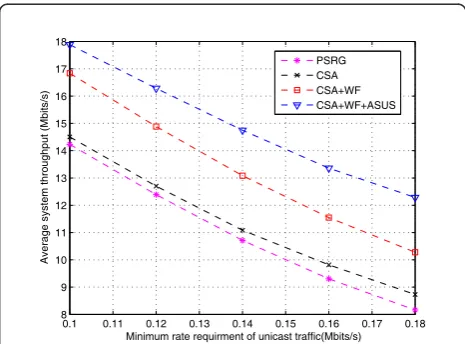
A single cell case with several unicast users and two multicast groups is taken into consideration. All the users are uniformly distributed in the cell and request a rate-adaptive service such as video and audio services. The cell radius is set as 300 m. A COST-WI propagation model is adopted with path lossL(d) = 7.17 + 38.0 log10 (d) wheredis distance in meters [10]. The frequency selective fading channel is a six-path Rayleigh model with an exponential power profile. The number of subchan-nels is 32 and each subchannel is 180 kHz. The power spectral density of AWGN is -144 dB·W/Hz. The BS available total power is 20 W and the desired BER is 10-4. Firstly, we set the number of unicast users to 4, and let one multicast group contains three users while the other contains six users. Figures 2 and 3 show the aver-age network throughput and outaver-age probability versus different minimum rate requirements of unicast traffic. The rate requirement of multicast traffic is fixed as 160 kbits/s. The outage probability means the proportion of the users who do not achieve its minimum rate require-ment. We observe that CSA+WF+ASUS outperforms other schemes. Comparing with PSRG, CSA+WF+ASUS can improved the network throughput about 30% and
decrease the outage probability about 70%. Figures 4 and 5 show the average network throughput and outage probability versus different minimum rate requirements of multicast traffic. The rate requirement of unicast traf-fic is fixed as 160 kbits/s. We can find that CSA + WF + ASUS also outperforms other schemes. On one hand, the superiority of CSA+WF+ASUA results from the waterfilling which improved the achievable rate of traf-fic. On the other hand, the superiority is due to the fact that it deletes some bad channel-condition multicast users to avoid the outage of whole multicast group and saves more resource to the good-channel condition users.
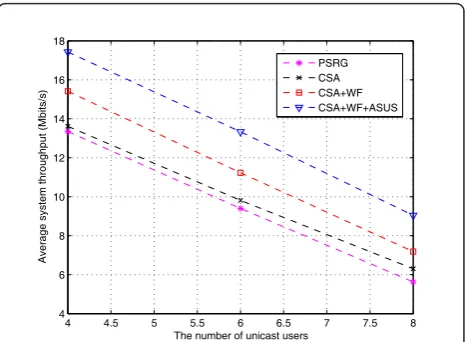
Figures 6 and 7 show the average network throughput and outage probability when varying the number of cast users. The minimum rate requirements of each uni-cast traffic and multiuni-cast traffic are set to 140 kbit/s. We can find that CSA+WF+ASUS outperforms other schemes when varying the numbers of unicast users. As the unicast user number increasing, the throughput of all the four
Table 2 User selection
1. Initialization:
SetU =m| Ll=1αl,mBl,m<Rbm which is the set of multicast groups which did not achieve the rate requirement.
2. Iteration: WhileU =ϕ
for eachmÎU
1) find a useru∗= arg minu∈Umul
m SNRu, SNRu= 1
L·L
l=1PlGl,u
N0.
2) exclude the useru* from setUmmul, setUmmul=Ummul− {u∗}. end
do our proposed cost-based subchannel allocation, reset U =
m|L
l=1ρl,mrl,m<R b m
. end
0.1 0.11 0.12 0.13 0.14 0.15 0.16 0.17 0.18 8
9 10 11 12 13 14 15 16 17 18
Minimum rate requirment of unicast traffic(Mbits/s)
Average system throughput (Mbits/s)
PSRG CSA CSA+WF CSA+WF+ASUS
Figure 2 The average network throughput against the rate
schemes gets lower and the outage gets higher, mainly since the available resource to each user becomes less.
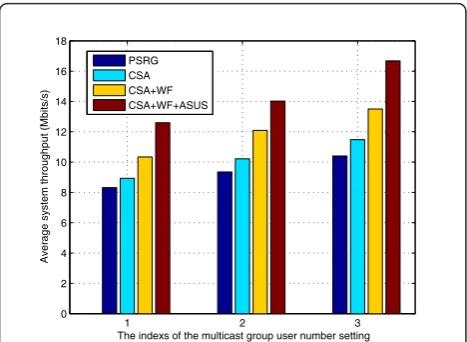
Figures 8 and 9 show the average network throughput and outage probability when varying the setting of the user number in multicast groups. The minimum rate requirements of each unicast traffic and multicast traffic are set to 180 kbit/s. The user number is 3, 4, 5 in the first multicast group, and is 6, 8, 10 in the second group, respectively, corresponding to the setting index 1, 2, 3. For multicast group, both the achievable transmission rate and the supported user number of the multicast group affect the multicast throughput. We can find that when the user number of the multicast group becomes larger, the network throughput and outage probability becomes greater under our user number setting of the multicast groups. The throughput increment mainly because of the sharing nature of the multicast 0.1 0.11 0.12 0.13 0.14 0.15 0.16 0.17 0.18
0 0.05 0.1 0.15 0.2 0.25 0.3 0.35
Minimum rate requirment of unicast traffic (Mbits/s)
Average system outage probability
PSRG CSA CSA+WF CSA+WF+ASUS
Figure 3The average network outage probability against the
rate requirements of unicast traffic.
0.127 0.13 0.14 0.15 0.16 0.17 0.18 0.19 0.2 8
9 10 11 12 13 14 15 16
Minimum rate requirment of multicast traffic (Mbits/s)
Average system throughput (Mbits/s)
PSRG CSA CSA+WF CSA+WF+ASUS
Figure 4 The average network throughput against the rate
requirements of multicast traffic.
0.12 0.13 0.14 0.15 0.16 0.17 0.18 0.19 0.2 0.05
0.1 0.15 0.2 0.25 0.3 0.35 0.4
Minimum rate requirment of multicast traffic (Mbits/s)
Average system outage probability
PSRG CSA CSA+WF CSA+WF+ASUS
Figure 5The average network outage probability against the
rate requirements of multicast traffic.
4 4.5 5 5.5 6 6.5 7 7.5 8
4 6 8 10 12 14 16 18
The number of unicast users
Average system throughput (Mbits/s)
PSRG CSA CSA+WF CSA+WF+ASUS
Figure 6The average network throughput against the number
of unicast users.
4 4.5 5 5.5 6 6.5 7 7.5 8
0 0.05 0.1 0.15 0.2 0.25 0.3 0.35
The number of unicast users
Average system outage probability
PSRG CSA CSA+WF CSA+WF+ASUS
Figure 7The average network outage probability against the
transmission. The outage probability increment may result from the probability that a user gets a bad channel condition getting higher when the user number increases. Also, CSA+WF+ASUS outperforms other schemes when varying the numbers of multicast users.
5 Conclusion
This article considered subchannel and power allocation for mixed multicast and unicast traffic in OFDMA net-works where the multicast traffic employing hierarchical video coding scheme. Our goal was to maximize the sys-tem throughput with a total transmission power con-straint while guaranteeing the rate requirements of all traffic. A CSA was firstly presented. Then we introduced the traditional waterfilling for the subchannels allocated to satisfy the rate requirements of each unicast traffic and the base layer of each multicast traffic, and
proposed an advanced waterfilling method for the remaining subchannels. Besides, an ASUS algorithm was developed to reduce the outage probability when the rate requirements of all traffic can not be satisfied. Simulation results show the system throughput and out-age probability improvement over other algorithms by using our proposed algorithm.
Acknowledgements
This work was supported by NSFC of China (No. 61101071, 61021001, 60972021). This article was presented in part at the IEEE 74th Vehicular Technology Conference, San Francisco, United States, 5-8 September 2011.
Author details
1Tsinghua National Laboratory for Information Science and Technology
(TNList), Tsinghua University, Beijing 100084, P.R.China2Electronic Technology Information Research Institute, MIIT., Beijing 100040, P.R.China
Competing interests
The authors declare that they have no competing interests.
Received: 16 September 2011 Accepted: 12 June 2012 Published: 12 June 2012
References
1. CY Wong, R Cheng, K Letaief, R Murch, Multiuser OFDM with adaptive subcarrier, bit, and power allocation. IEEE J Sel Areas Commun.17, 1747–1758 (1999). doi:10.1109/49.793310
2. W Rhee, JM Cioffi, Increase in capacity of multiuser OFDM system using dynamic subchannel allocation, inProc IEEE VTC 2000 Spring, Tokyo, Japan, 1085–1089 (2000)
3. J Jang, KB Lee, Transmit power adaptation for multiuser OFDM systems. IEEE J Sel Areas Commun.21, 171–178 (2003). doi:10.1109/JSAC.2002.807348 4. D Kivanc, G Li, H Liu, Computationally efficient bandwidth allocation and
power control for OFDMA. IEEE Trans Wirel Commun.2, 1150–1158 (2003). doi:10.1109/TWC.2003.819016
5. G Song, Y Li, Cross-layer optimization for OFDM wireless networks-part I, theoretical framework. IEEE Trans Wirel Commun.4, 614–624 (2005) 6. G Song, Y Li, Cross-layer optimization for OFDM wireless networks-part II:
algorithm development. IEEE Trans Wirel Commun.4, 625–634 (2005) 7. Z Shen, JG Andrews, BL Evans, Adaptive resource allocation in multiuser
OFDM systems with proportional rate constraints. IEEE Trans Wirel Commun.4, 2726–2737 (2005)
8. H Kim, Y Ha, A proportional fair scheduling for multicarrier transmission systems. IEEE Commun Lett.9, 210–212 (2005). doi:10.1109/
LCOMM.2005.03014
9. T Wang, L Vandendorpe, WSR maximized resource allocation in multiple DF relays aided OFDMA downlink transmission. IEEE Trans Signal Process.59, 3964–3976 (2011)
10. L Vandendorpe, N Prasad, X Wang, A successive vonvex approximation algorithm for weighted sum-rate maximization in downlink OFDMA networks, inProc Conf Inf Sci Systems, (Princeton, USA, 2008), pp. 379–384 11. T Wang, L Vandendorpe, Iterative resource allocation for maximizing
weighted sum min-rate in downlink cellular OFDMA systems. IEEE Trans Signal Process.59, 223–234 (2011)
12. Introduction of the Multimedia Broadcast Multicast Service (MBMS) in the Radio Access Network (RAN); Stage 2 (Release 7), 2008, 3GPP RAN, 3G TS 25.346 V7.7.0
13. Interoperability Specification (IOS) for Broadcast Multicast Services (BCMCS): (2006), 3GPP2 TSG-A, A.S0019-A v1.0
14. Mobile WiMAX, Part I, A technical overview and performance evaluation, in
WiMAX Forum, Frederick, USA, 29–30 (2006)
15. H Seo, S Kwack, BG Lee, Channel structuring and subchannel allocation for efficient multicast and unicast services integration in wireless OFDM systems, inProc IEEE Globecom 2007, Washington, USA, 4488–4493 (2007) 16. J Liu, W Chen, Z Cao, KB Lee, Dynamic power and sub-carrier allocation for
OFDMA-based wireless multicast systems, inProc IEEE ICC 2008, Beijing, China, 2607–2611 (2008)
1 2 3
0 2 4 6 8 10 12 14 16 18
The indexs of the multicast group user number setting
Average system throughput (Mbits/s)
PSRG CSA CSA+WF CSA+WF+ASUS
Figure 8The average network throughput when varying the
setting of the user number in multicast groups.
1 2 3
0 0.05 0.1 0.15 0.2 0.25 0.3 0.35 0.4
The indexs of the multicast group user number setting
Average system outage probability
PSRG CSA CSA+WF CSA+WF+ASUS
Figure 9 The average network outage probability when
17. SY Baek, Y Hong, DK Sung, Adaptive transmission scheme for mixed multicast and unicast traffic in cellular systems. IEEE Trans Veh Technol.58, 2899–2908 (2009)
18. Y Silva, A Klein, Power allocation in multi-carrier networks with unicast and multicast services, inProc IEEE ICC 2007, Glasgow, Scotland, 5433–5438 (2007)
19. S McCane, M Vetterli, V Jacobson, Low-complexity video coding for receiver-driven layered multicast. IEEE J Sel Areas Commun.15, 983–1000 (1997). doi:10.1109/49.611154
20. W Li, Overview of fine granularity scalability in MPEG-4 video standard. IEEE Trans Circ Syst Video Technol.11, 301–317 (2001). doi:10.1109/76.911157 21. C Suh, J Mo, Resource allocation for multicast services in multicarrier
wireless communications, inProc IEEE Infocom 2006, Barcelona, Spain, 1–12 (2006)
22. S Kwack, H Seo, BG Lee, Suitability-based subcarrier allocation for multicast services employing layered video coding in wireless OFDM systems, inProc
IEEE VTC 2007 Fall, Baltimore, USA, 1752–1756 (2007)
23. Y Xu, X Wu, J Lui, Cross-layer Qos scheduling for layered multicast streaming in OFDMA wireless networks. Wirel Pers Commun.51, 565–591 (2009). doi:10.1007/s11277-009-9754-8
24. H Deng, X Tao, T Xing, J Lu, Resource allocation for layered multicast streaming in wireless OFDMA networks, inProc IEEE ICC 2011, Kyoto, Japan, 1–5 (2011)
25. S Chung, A Goldsmith, Degrees of freedom in adaptive modulation: a unified view. IEEE Trans Commun.49, 1561–1571 (2001). doi:10.1109/ 26.950343
26. TM Cover, JA Thomas,Elements of Information Theory, Wiley, New York, (1991)
27. DS Baum, J Hansen, J Salo, An interim channel model for beyond-3G systems: extending the 3GPP spatial channel model (SCM), inProc IEEE VTC
2005 Spring, Stockholm, Sweden, 3132–3136 (2005)
doi:10.1186/1687-1499-2012-195
Cite this article as:Denget al.:Qos-aware resource allocation for mixed multicast and unicast traffic in OFDMA networks.EURASIP Journal on Wireless Communications and Networking20122012:195.
Submit your manuscript to a
journal and benefi t from:
7 Convenient online submission 7 Rigorous peer review
7 Immediate publication on acceptance 7 Open access: articles freely available online 7 High visibility within the fi eld
7 Retaining the copyright to your article