R E S E A R C H
Open Access
A tight approximate analytical framework
for performance analysis of equal gain
combining receiver over independent Weibull
fading channels
Abdelmajid Bessate and Faissal El Bouanani
*Abstract
In this paper, a method for approximating the probability distribution of sum of independent and identical Weibull random variables is adopted to analyze the performance of equal gain combiner (EGC) receiver over non-identical Weibull fading channel (WFC). Our main result is to derive a generalized expression of the probability density function (PDF) of the signal-to-noise ratio (SNR) at the EGC output in the case of non-identical WFC. Based on this PDF, accurate approximation of significant performance criteria, such as outage probability (OP), the amount of fading (AoF), and average symbol/bit error probability (ASEP/ABEP), are derived. In addition, we derived the analytical expressions for channel capacities under various adaptation policies such as optimal rate adaptation (ORA), optimal simultaneous power and rate adaptation (OPRA), channel inversion with fixed rate (CIFR), and truncated channel inversion with fixed rate (TCIFR). The proposed mathematical analysis is complemented by several numerical results and validated using Monte Carlo simulation method.
Keywords: Equal gain combining (EGC), Cumulative distribution function (CDF), Probability density function (PDF), Moment generating function (MGF), Average symbol/bit error probability (ASEP/ABEP), Adaptation policies, Fox H-function, Meijer G-function
1 Introduction
Antenna diversity is one of the most practical, effective, and widely employed technique in wireless communica-tion receivers to reduce the effects of fading and to provide increased signal strength at the receiver. Different tech-niques are known to combine the signals received from multiple diversity branches. The most popular diversity techniques are equal-gain combining (EGC), maximal-ratio combining (MRC), selection combining (SC), and a combination of MRC and SC, called generalized-selection combining (GSC). The SC receiver chooses the branch with the strongest instantaneous signal-to-noise ratio (SNR), while MRC provides optimal performance, at the expense of implementation complexity, since it requires knowledge of all channel parameters. In EGC receiver, the signals in all branches are weighted with the same
*Correspondence: [email protected]
ENSIAS Mohammed V University In Rabat, Rabat, Morocco
factor, irrespective of the signal amplitude. Moreover, co-phasing of all input signals is needed to avoid output signal cancellation. The performance of EGC and MRC diver-sity receivers has been extensively conducted in many previous works for several well-known fading statistical models, such as Rayleigh, Rice, and Nakagami—assuming independent or correlative fading [1–6]. The Weibull dis-tribution is a well-known model for describing multipath fading channels in both indoor and outdoor radio prop-agation environments. In [7], novel analytical expressions for the joint probability density function (PDF), moment generating function (MGF), and cumulative distribution function (CDF) are derived for the multivariate Weibull distribution. The presented theoretical results are applied to analyze the performance of several diversity receivers such as SC, EGC, and MRC techniques operating under correlated Weibull fading channels (WFC). For these diversity receivers, several useful performance criteria such as moments of output SNR, including the amount of
fading (AoF), and outage probability (OP) are analytically derived. Moreover, the average symbol error probability (ASEP) for several coherent and noncoherent modula-tion schemes is studied using moment generating funcmodula-tion (MGF) approach. In [8], capitalizing on the general α-μ fading model simple and precise closed-form approxima-tions to the PDF and CDF of the sum of independent and identically distributed (i.i.d) Weibull variates are derived. These approximations find applicability in several wire-less communications issues such as signal detection and combining, linear equalizers, intersymbol interference, and phase jitter [8]. Considering related works, C. Sagias et al. [9, 10], have presented a moments-based approach to analyzing the performance of dual-branch EGC and MRC receivers, operating under either independent or correlated, but not necessary identically distributed WFC. In this respect, significant performance criteria, such as average output SNR, AoF, and spectral efficiency at low power regime, are extracted in closed-forms, using the moments of the output SNR for both independent and correlative fading cases. Using the same approach of the moment, El Bouanani [11–14] has generalized this idea toL-branches over independent and not necessary identi-cally distributed (i.n.i.d) Weibull fading channels for both MRC and EGC receivers. Consequently, he has derived some performance criteria such as AoF, MGF, average capacity (AC), and ASEP in closed forms. In [15], we have generalized the same idea to derive the approximate expressions of MRC performance criteria over correlated WFC.
In this paper, we propose a tight approximate expression of the output SNR PDF by generalizing the approximate CDF convolution derived in [16] to non-identical Weibull random variates (RVs). The tightness of this approximate CDF is proved and validated by using the Kolmogorov– Smirnov statistical method. Based on this approxima-tion, closed expressions of statistical characteristic, of an EGC receiver, given in terms of well-known hypergeomet-ric function, related to PDF, OP, and MGF are derived. Other performance criteria such as AoF, ASEP, average bit error probability (ABEP) , average capacity (AC) under optimal rate adaptation with constant transmit power (ORA), capacity under optimal simultaneous power and rate adaptation (OPRA), channel inversion with fixed rate (CIFR), and truncated channel inversion with fixed rate (TCIFR) schemes are presented in tight closed-form approximation. After this introduction, Section 2 deals with the communication system model with EGC com-biner over Weibull fading channels. Section 3 shows the statistical characteristics of EGC over WFC such as PDF and MGF. Section 4 presents several novel closed-expressions in terms of well-known hypergeometric func-tions such as that AoF, OP, AC, OPRA capacity, CIFR capacity, TCIFR capacity, and ABEP and ASEP for M-PSK
and M-FSK modulation schemes. In Section 5, all results are illustrated and verified by computer simulations using Mathematica software. Finally, Section 6 contains a brief conclusion.
2 Channel model
We consider EGC receiver operating over slow frequency-nonselective WFC. The received channel gain R is expressed as
R=
L
i=1Ri
√
L (1)
WhereLis the number of the receiver antenna andRi
be the fading amplitude corresponding to the received sig-nals on theith EGC-branch, assumed being i.n.i.d Weibull (β,ωi)RV with PDF:
fRi(x)= βxβ−1
ωβi
e−
x ωi
β
,x≥0 (2)
whereβ andωi are the shape and scale parameters ofRi
linked with its second moment by the following expres-sion
ωi=
⎡ ⎣ ER2i
1+ 2β ⎤ ⎦
1 2
(3)
Let Es andN0 denote the average symbol energy and the thermal noise power spectral density, respectively. The instantaneous EGC output SNR is expressed in terms of instantaneous SNRγiat theith input branch as [13]
γ = 1 L
L
i=1 √γ
i
2
(4)
with
γi=
Es
N0
R2i (5)
Letαi=ωi
Es
N0. Substituting (5) in (3), we obtain
αi=
γi
1+β2
3 Statistical characteristics
3.1 PDF of the sum of i.i.d Weibull RVs
Let us bear in mind that the sum PDF of Weibull RVs is till now difficult, if not impossible, to be derived analytically. Among several works tried to approximate it, [16] is one of the most important. The author has derived a very tight approximate CDF for sum of identical(ω = ωi)Weibull
RVs
Hence, its PDF can be approximated by deriving the expression (6)
which represents the PDF of generalized Gamma (GG) RV [17] with parametersωσ,βL, andβ.
3.2 PDF of output SNR at EGC receiver 3.2.1 Case of i.i.d WFC
Lemma 1Let us assume that the scale parameter ofγi
is constant (αi = α = ω√Es/N0). The square root of
instantaneous SNRγiis a Weibull(α,β).
Proofusing the references (2) and (5), and proceeding by Jacobian transform, the PDF of the square root ofγican
be expressed as
f√γi(x)=
which concludes the Lemma proof.
Proposition 2The output SNR at the EGC receiver over
i.i.d WFC can be approximated by a GG
expression in (8), and considering the Lemma above, the equation in (8) can be rewritten as
fT(t)≈ β
Using the expressions (4) and (11), and proceeding by Jacobian transform, we get (10) which concludes the proof of the proposition.
3.2.2 Case of i.n.i.d Weibull RV
It is known that two RVs are equal or very close, respec-tively if and only if their moments are equal or very close, respectively. Let us begin by computing both exact and approximatenth moment of output SNR.
a. Exact nth moment of γ
Let’s define E[γn] = L1nUL(n) the exact nth moment of output SNR at EGC combiner. Using multinomial theorem, it can be seen thatUL(n)can be computed easily by the recurrence relation:
⎧
b. Approximate nth moment of GG RV
Letμbe a real positive andZbe a GGμ,β2L,β2
Substituting the PDF (10) into (14), and taking the
change of variabley= μx β
2
, thenth moment ofZ can be expressed briefly as
EZn=μn
L+2βn
(L−1)! (15)
where
ProofTo compare the exact and approximate nth moment, we will proceed by two approaches. Whenβis sufficiently large, an analytical approach, based on approx-imation at infinity of both exact and approximate nth moments, is used to prove equality between them. Other-wise, plotting the two moment curves, for several values ofϕandβ, will be useful to show the closeness between the two expressions.
a. Analytical approach
LetγAdenote the GG RV that approximates output
SNRγ at EGC receiver. Substituting (18) in (17) and substituting (17) in (15) by takingμ = θ2, thenth exact moment ofγAcan be rewritten as
Eγn
Now, using the identity ([21],/06.05.06.0021.01) for great values ofβ, we obtain the following approx-imation:
where(.)is the digamma function that represents the first derivation of Gamma function.
Substituting (21), (22), (23), and (24) into (20), we deduce that
On the other hand, thenth exact moment of the output SNR can be expressed by using (12) as
Eγn= 1
Based on the same approximation used previously, we can note that
By replacing (28) and (27) into (26), it follows that thenth exact moment can be approximated, for great values ofβ, by
Consequently, for each natural integern, the exact and approximatenth moments can be approximated by the same expression as given by (25) and (29). Thereby, the two RVγ andγAare very close.
b. Curve-based approach
Taking into account that it is very difficult to upper bound the error between exact and approxi-mate moment, we will opt for a graphical approach by plotting the curves of the moments versus the power delay profileϕand the shape parameterβ. See the evaluation section.
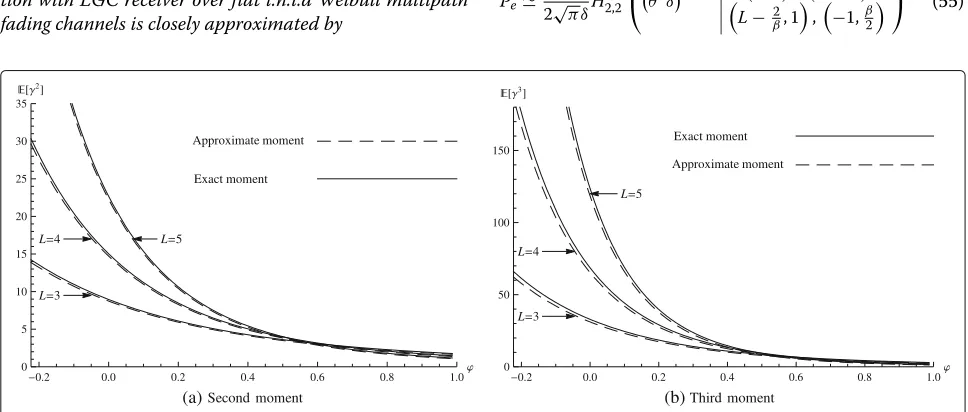
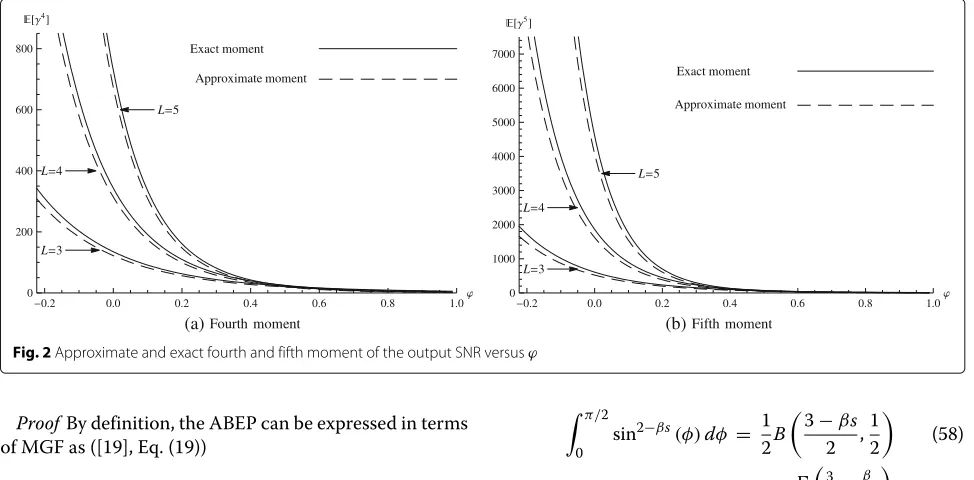
From the results depicted in these figures, we deduct that the fifth first exact and approximate moments are very close, which concludes the proof of the proposition.
Eγn AE
3.3 MGF of the output SNRγ
Proposition 4The moment generating function ofγ for EGC receiver over i.n.i.d Weibull fading channels can be tightly approximated for any positive real t by
Mγ(t) λ
ProofThe moment generating function (MGF) ofγ is by definitionMγ(t) = *0∞exp [−tγ]fγ(γ )dγ, replacing the PDF in reference (16) by its term, we obtain
Mγ(t)=λ
Now, rewriting the PDF in (16) and the exponential function as a Meijer G-function ([21], /07.34.03.0228.01) we obtain the following expression
Mγ(t)=λ
Using the equality ([21], /07.34.21.0012.01) the MGF can be written as mentioned in (30).
4 Performance criteria
4.1 Outage probability of the output SNRγ
Letγth be the minimum SNR threshold that guarantees the reliable communication and having the correspond-ing channel not in outage. Regardcorrespond-ing the CDF and PDF of GG RV given by (6) and (8), respectively, and consider-ing the expression PDF (16), the outage probability can be expressed as
withθis expressed in (17).
4.2 Amount of fading (AoF)
The amount of fading (AoF) is a simple measure for the performance of a diversity system which is defined as
ηγ = μ2 μ2 1
−1 (32)
with μ2 and μ1 are respectively the first and second moment of the output SNRγ.
Let’s compute the first and second approximate moment ofγ from (15) and substituting it into (32). The AoF for an EGC combiner operating under i.n.i.d WFC can be approximated by
4.3 Capacity under ORA policy
The channel capacity under ORA policy CORA can be obtained, in the case of flat-fading channel, by averaging over the distribution of the received SNRγthat of AWGN channel
The capacity under the ORA scheme is also called ergodic capacity. Rewriting the expression of the approx-imate PDF given by (16) by Meijer G-function and sub-stituting it with ([21], /07.34.03.0456.01) into (34), and using the equality ([21], /07.34.21.0012.01), the CORA under EGC diversity over i.n.i.d Weibull fading channels is tightly approximated by a Fox H-function
CORA λ
4.4 Capacity under OPRA policy
The capacity under OPRA policy can improve the ergodic capacity, By varying the rate and power. Letγ0 denotes the optimal threshold SNR below which no data is trans-mitted. Under this scheme, the capacity is known as [18]
COPRA=
Proposition 5The capacity under OPRA policy of EGC receiver operating under i.n.i.d WFC is approximated by
ProofPerforming some algebraic operations and using the integration by parts, the integral in (36) can be rewrit-ten as
Substituting the expression (31) into the first term of
the above equation, and seeing that lim γ→∞ expression in (38) can be reduced to
1
Now, replacing (31) into the second term of Eq. (38), and
using the change of variablet=
On the other hand, the last term of (38) can be easily expressed as
Now, substituting (39), (40), and (41) into (38), we obtain the expression (37) which concludes the proposition’s proof.
4.4.1 Optimal cutoff SNRγ0
The optimal cutoff SNRγ0level, below which data trans-mission is suspended, must satisfy [23]
' +∞ suffers a probability of outagePout, equal to the probability of no transmission, given by
Pout=1−
' +∞
γ0
fγ(γ )dγ
Substituting (16) in (42), and using the same change of variable given above, we find thatγ0must satisfy
2λ
Now, replacing (19) into (43),x0must satisfy
f(x0)=0 (44)
where the functionf is defined by
f(y)= (L,y)y −2/β
θ2 −
L−β2,y
θ2 − (L) (45)
Using the derivative of the upper incomplete gamma function, we obtain ∂f∂(yy) = −βθ22 (L,y)y−β2−1 < 0 for
ally ≥ 0. Moreover, lim
y→0+f(y) = +∞and limy→+∞f(y) =
− (L) <0. Thus, we conclude that there is a uniquex0, consequently a uniqueγ0, for whichf(x0) = 0. Besides, the value of γ0 can be calculated, using any calculation software, by solving (44).
4.5 Capacity under CIFR policy
Proposition 6The capacity under CIFR policy for EGC combiner operating under i.n.i.d WFC is approximated by
CCIFRlog2
Proof The channel capacity under CIFR policy is given by
Using (16) and the same change of variable used above, we obtain
Table 1Values ofandδfor some signaling constellations
Modulation M δ
BPSK 2 1/2 1
BFSK 2 1/2 1/2
M-PSK ≥4 1 sin2(π/M)
M-FSK ≥4 (M−1)/2 1/2
4.6 Capacity under TCIFR policy
Proposition 7The capacity under TCIFR policy of EGC receiver over i.n.i.d WFC is approximated by
CTCIFRlog2
⎡ ⎣1+ θ
2(L−1)!
L− β2 ⎤ ⎦
×e−
γ∗ θ2
β
2 L−1
i=0
γ∗ θ2
β
2i
i!
(49)
whereγ∗is a fixed cutoff fade depth.
ProofThe capacity with truncated channel inversion and fixed rate policy is given by [18] as
CTCIFR=log2
1+*+∞ 1 0 γ−1fγ(γ )dγ
×1−Pout
γ∗
(50)
From (50), it is obvious that CTCIFR = CCIFR(1−Pout(γ∗)). Then by substituting (31) and (46) into (50), we easily obtain (49).
4.7 Average symbol error probability (ASEP)
Proposition 8The ASEP of various M-ary modula-tion with EGC receiver over flat i.n.i.d Weibull multipath fading channels is closely approximated by
Ps √λ
πδH
1,2 2,2
⎛
⎝θ2δ−β/2
)) )) ))
0,β2,−12,β2
L− β2, 1
,
−1,β2
⎞ ⎠
(51)
whereandδare summarized in Table 1.
ProofThe ASEP for M-ary modulation schemes over fading channel is expressed by its definition as
Ps=
' +∞
0
Pse(γ )fγ(γ )dγ (52)
where the instantaneous ASEPPse(γ )is given in terms of the complementary error function as
Pse(γ )=.erfc
"
δγ (53)
then, by rewriting the PDF in (16) and the equation in (53) by Meijer G-function the ASEP in (52) can be tightly approximated by
Ps √λ πδ
' ∞
0
G1,22,0
δγ))))0,11 2
G1,00,1γ θ2
β
2))
)) 0
L−2/β
dγ
(54)
Now, using the identity ([21], /07.34.21.0012.01) we obtain (51) which concludes the proof of the proposition.
4.8 Average bit error probability (ABEP)
Proposition 9The ABEP for various modulation schemes, which are cited in Table 1, can be approximated by
Pe λ
2√πδH
1,2 2,2
⎛
⎝θ2δ−β/2
)) )) ))
0,β2,−12,β2
L−2β, 1,−1,β2
⎞ ⎠ (55)
(a) (b)
(a) (b)
Fig. 2Approximate and exact fourth and fifth moment of the output SNR versusϕ
ProofBy definition, the ABEP can be expressed in terms of MGF as ([19], Eq. (19))
Pe= π
' π/2
0
Mγ
δ
sin2(φ)
dφ (56)
By considering the expression of MGF given in (30), and rewriting it in terms of Mellin-Barnes integral, we get
Pe λ
2π2jδ
+
C
1− β 2s
L− 2
β +s
×
1 θ2δ
−βs
2 ' π/2
0
sin2−βs(φ)dφds
(57)
where C is a complex contour of integration and *π/2
0 sin2−βs(φ)dφ can be expressed, whenRe(βs) < 3, in terms of Beta function as ([21], /06.18.07.0002.01)
Fig. 3Approximate and exact third moment of the output SNR versusβ
' π/2
0
sin2−βs(φ)dφ = 1 2B
3−βs
2 , 1 2
(58)
= √π
2
3
2−
β
2s
2− β2s
Now, by substituting (58) into (57), we obtain the expression (55)
5 Evaluation
In this section, all the analytical expressions are evaluated using Mathematica software. In addition, our approximate PDF and most of other results are validated using numer-ical Monte Carlo simulations from (4) by generatingL× 107 Weibull-distributed random values. Without loss of generality, we have supposed an exponentially decaying power delay profile (PDP) γi/γ1 = exp [−ϕ (i−1)] , where ϕ is the average fading power decay factor [22], and γ1 = 1 for all figures except Figs. 10 and 15. The value of β is assumed to be the same for each receiver branch.
Fig. 5Outage probability ofL-branch EGC diversity
Fig. 6Approximate and simulated PDF of the SNR at the EGC receiver
Fig. 7MGF of the output received SNR at the EGC receiver
Fig. 8Analytical and simulated AoF forL-branch EGC receiver
Fig. 9Shannon capacity ofL-branch EGC diversity
Fig. 11OPRA capacity of 3-branch EGC combiner versusL
The two first figures depict the exact and approximate nth moments of output SNR versusϕforβ = 3 and var-ious values of n. We notice from these curves that the two moments are almost confused (Figs. 1 and 2). In addi-tion, forϕtending towards 1, all curves will be confused regardless ofβandL.
Figure 3 shows the exact and approximate third moment of output SNR versusβforϕ= −0.223. The main remark is that the two moments are nearly confused forL=3 and begin to separate whenLbecomes large.
Figure 4 shows the two curves, that of approximate CDF, and that of the empirical distribution function (EDF). The Kolmogorov–Smirnov statistic quantifies the dis-tance between the EDF and the approximated CDF. From this figure, we deduce that the distance between the two curves is almost null, which proves the tightness of our approximation.
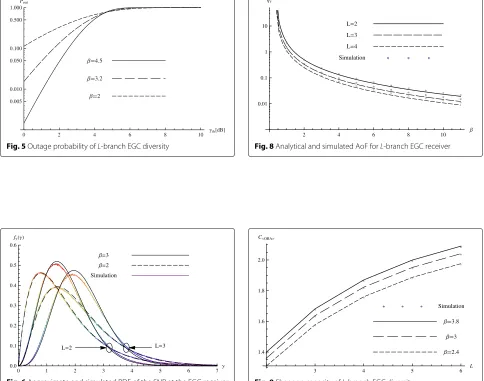
Figure 5 shows the progression of the outage probabil-ity Pout, computed analytically from (31), versus γth for four branches EGC receiver, and various values ofβ. It can be seen that the decrease in outage probability achieved by increasing the shape parameterβand then the system
Fig. 12OPRA capacity of 3-branch EGC combiner versusϕ
Fig. 13CIFR capacity ofL-branch EGC receiver
becomes more reliable. Besides, as γth increases, Pout reaches 1.
Figure 6 presents both the approximate and the sim-ulated PDF of output SNR versus γ for double-branch EGC receiver and triple one. The theoretical curves are traced from (17). Furthermore, for simulated curves, the SNR range [ 0, 7] is divided into 100 subintervals of equal length. What is evident from both curves is that our new analytical expression of PDF is very close to its simulation. Figure 7 displays both the approximate and the sim-ulated MGF of the output SNR. The approximate MGF given by (30) is plotted versustfor many values ofβ(β = 2.8,β=2, andβ =1.5), andL=3. The curves show that the greater isβ , the smaller is the MGF, and its value at t =0 is equal to 1 for any parameter values. What is evi-dent from both curves is that the analytical expression is nearly similar to the simulation of the SNR MGF.
Figure 8 presents both simulated and approximate AoF given by (33). The curves of AoF are plotted versusβfor several values ofL. It can be seen thatηγ decreases asβ andLincreases, which explains the usefulness of several branches at the receiver.
(a) (b)
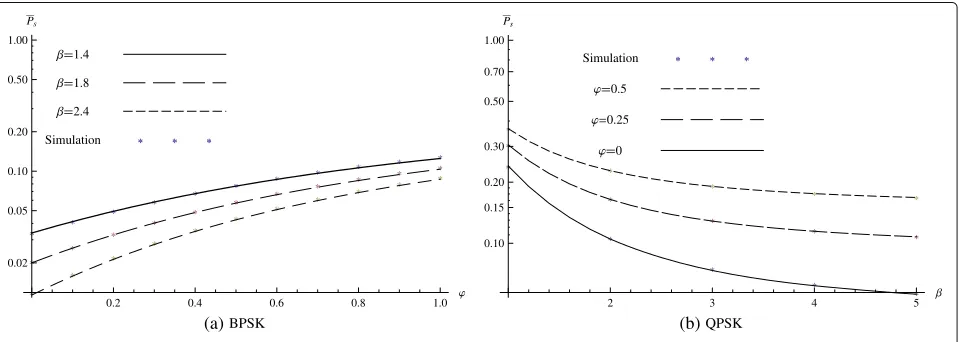
Fig. 15Average error probability of various modulations for 3-branch EGC receiver over i.n.i.d WFC
Figure 9 shows both analytical and simulated ORA capacities versusLfor EGC receiver, plotted respectively from (34), and via Monte Carlo simulation from (35). It can be seen from the two curves that the approx-imate analytical expression of ORA capacity is nearly similar to the simulation one. The capacity is plotted for several values of β, assumed to be the same for each receiver branch, and ϕ = 0.223. Besides, the greater is β, the better is the maximal spectral efficiency of the system.
In Fig. 10, the OPRA capacity, given in (37), versus opti-mal threshold SNRγ0, computed numerically by solving (44), is traced for several values of β, and ϕ = 0.227. From these curves, we can obviously observe that below γ0 = 0.2, no data can be transmitted. Moreover, the greater isβ, the higher is optimal simultaneous power and rate adaptation capacity.
Figure 11 plots both the simulated and the analytical OPRA capacity versus L for ϕ = −0.225 and several values ofβ, expressed in (36) and (37), respectively. We can notice that the greater isL, the higher is the capacity
under OPRA police. Furthermore, as the shape parameter βincreases, the capacity improves.
Figure 12 depicts the OPRA capacity, noted in (37), ver-susϕforL = 3, and many values ofβ. We can conclude that the lower is ϕ, the higher is the capacity. In addi-tion, when the parameterβincreases, the OPRA capacity becomes greater.
Figure 13 shows both analytical and simulated CIFR capacity versusLunder MRC receiver, plotted respectively from (46), and via Monte Carlo simulation from (47), for ϕ = 0.223 and several values ofβ. What is clear from all curves is that the approximate analytical expression of CIFR capacity is closed to the simulated one. It can be also seen that the greater isβ, the better is the capacity.
In Fig. 14, the capacity under TCIFR policy, given in (49), is traced versusLforβ = 2.8,ϕ = −0.223, and sev-eral values of a fixed cutoff fade depthγ∗. This capacity is simulated via Monte Carlo statistical method using (50). It is obvious that the smaller isγ∗, the better is TCIFR capac-ity. Moreover, the diversity orderLincreases gradually the TCIFR capacity regardless ofγ∗.
(a) (b)
Figure 15a, b depicts the simulated and the approxi-mate ASEP and ABEP, given in (51) and (55), respectively. The curves are plotted versus average output SNR (in dB) using the values of parameters summarized in Table 1 of bothM-FSK andM-PSK(M = 2 andM = 4) modula-tion schemes for 3-branch EGC receiver over i.n.i.d WFC. What is clear from these figures is that QFSK improves the system performance considerably compared to the rest of schemes over entire range of γ. Additionally, average error probability decreases as γ increases. Besides, the analytical and the simulated curves are confounded.
Figure 16a, b shows the simulated and the approxi-mate ASEP, given in (51), versus ϕ and β respectively. The curves are plotted, using the parameter values sum-marized in Table 1, for M-PSK (M = 2 and M = 4) modulation schemes and 4-branch EGC receiver over i.n.i.d WFC. We can notice that the smaller is ϕ, the greater is the output SNR; therefore, the ASEP becomes small. Moreover, the analytical curves match the simu-lation ones, which proves the accuracy of the proposed approximation.
6 Conclusions
In this paper, we have derived a new tight approxima-tion for the PDF of output SNR at EGC receiver operat-ing under uncorrelated but not identical Weibull fadoperat-ing channels. Based on this approximate PDF, the analyti-cal expressions of many performance criteria have been derived. All results are illustrated using Mathematica soft-ware and validated by Monte Carlo simulation. The results that we have achieved are far better than all previous works.
Competing interests
The authors declare that they have no competing interests. Received: 24 August 2016 Accepted: 8 December 2016
References
1. MK Simon, M-S Alouini,Digital communication over fading channels, 2nd edn. (Wiley, New York, 2005)
2. VA Aalo, Performance of maximal-ratio diversity systems in a correlated Nakagami-fading environment. IEEE Trans. Commun.43(8), 2360–2369 (1995)
3. P Lombardo, G Fedele, MM Rao, MRC performance for binary signals in Nakagami fading with general branch correlation. IEEE Trans. Commun. 47(1), 44–52 (1999)
4. J Luo, JR Zeidler, S McLaughlin, Performance analysis of compact antenna arrays with MRC in correlated Nakagami fading channels. IEEE Trans. Veh. Technol.50(1), 267–277 (2001)
5. NC Beaulieu, A Abu-Dayya, Analysis of equal-gain diversity on Nakagami fading channels. IEEE Trans. Commun.39(2), 225–234 (1991)
6. A Annamalai, C Tellambura, VK Bhargava, Equal-gain diversity receiver performance in wireless channels. IEEE Trans. Commun.48(10), 1732–1745 (2000)
7. NC Sagias, GK Karagiannidis, Gaussian class multivariate Weibull distributions: theory and applications in fading channels. IEEE Trans. Inf Theory.51(10), 3608–3619 (2005)
8. JCS Santos Filho, M Daoud Yacoub, Simple precise approximations to Weibull sums. IEEE Comm. letters.10(8), 614–616 (2006)
9. GK Karagiannidis, DA Zogas, NC Sagias, SA Kotsopoulos, GS Tombras, Equal-gain and maximal-ratio combining over nonidentical Weibull fading channels. IEEE Trans. on Wireless Comm.4(3), 841–846 (2005) 10. DA Zogas, NC Sagias, GS Tombras, GK Karagiannidis, Average output SNR
of equal-gain diversity receivers over correlative Weibull fading channels. Euro. Trans. Telecomms.16, 521–525 (2005)
11. F El Bouanani, H Ben-Azza, M Belkasmi, New results for the Shannon channel capacity over generalized multipath fading channels for MRC diversity. EURASIP Jour. on Wirel. Comm. Networking, 336 (2012) 12. F El Bouanani,A new closed-form approximations formulas for MRC receiver
over non-identical Weibull fading channel,International Wireless Comm. and Mobile Computing Conference (IWCMC’ 14), (Nicosia, 2014), pp. 600–605
13. F El Bouanani, H Ben-Azza, Unified analysis of EGC diversity over Weibull fading channels. Int. Journal Commun. Syst. (2015). https://www.scopus. com/authid/detail.uri?authorId=55217720500
14. F El Bouanani, H Ben-Azza,Efficient performance evaluation for EGC, MRC and SC receivers over Weibull multipath fading channel. 10th Intern. Conference on Cognitive Radio Oriented Wireless. Networks (CROWNCOM), pp. 347–357, (2015), Doha
15. A Bessate, F El Bouanani,Performance analysis of MRC diversity in correlated Weibull fading channels, Intern.Conference on Wireless Networks and Mobile Communications (WINCOM’15). (2015), Marrakech
16. GJ Schlenker,Methods for calculating the probability distribution of sums of independent random variables. U.S. army armament, munitions and chemical command systems analysis office rock. Island, (1986), Illinois 17. NC Sagias, GK Karagiannidis, PT Mathiopoulos, TA Tsiftsis, On the
performance analysis of equal-gain diversity receivers over generalized gamma fading channels. IEEE Trans. Wirel. Commun.5(10), 2967–2975 (2006)
18. KP Peppas, HE Nistazakis, GS Tombras, An overview of the physical insight and the various performance metrics of fading channels in wireless communication systems. Wireless Communication Systems. INTECH Open Access Publisher (2011)
19. J Cheng, C Tellambura, NC Beaulieu, Performance analysis of digital modulations on Weibull fading channels. IEEE Trans. on Wireless Comm. 3(4), 1124–1133 (2004)
20. M Abramowitz, IA Stegun,Handbook of mathematical functions with formulas, graphs, and mathematical tables, 9th ed. (Dover Press, New York, 1972)
21. Wolfram (2001). The Wolfram functions site (online) available at http:// functions.wolfram.com. Accessed Mar 2016
22. N Kong, LB Milstein, SNR of generalized diversity selection combining with nonidentical Rayleigh fading statistics. IEEE Trans. Commun.48, 1266–1271 (2000)
23. MS Alouini, AJ Goldsmith, Capacity of Rayleigh fading channels under different adaptive transmission and diversity-combining techniques. IEEE Trans. Veh Tech.48(4) (1999)
Submit your manuscript to a
journal and benefi t from:
7Convenient online submission
7Rigorous peer review
7Immediate publication on acceptance
7Open access: articles freely available online
7High visibility within the fi eld
7Retaining the copyright to your article