R E S E A R C H
Open Access
Sleeping mode of multi-controller in
green software-defined networking
Chao Qiu
1*, Chenglin Zhao
1, Fangmin Xu
1and Tianpu Yang
2Abstract
Although promising the formidable configuration, vigorous evolution, and satisfactory performance, software-defined networking (SDN) is in its initial period all the same. Some essential issues still remain not completely resolved, and the scalability of control plane is the most intractable one with the explosive increase of network traffic. To address this issue, many researchers have proposed multiple controllers to realize logically centralized control layer. Our previous research has proposed multi-controller load balancing approach called HybridFlow. In this paper, taking advantage of HybridFlow, we propose anM-Npolicy multiple-controller sleeping mode by switching off redundant controllers when the system is in the light traffic condition. We use queuing theory
to model the operation procedure of controllers and formulate the energy consumption management issue as a0-1
integer linear programming model. Through turning off the redundant controllers when the system is in the scenario of light traffic, the total energy consumption of the whole system can be cut down. Simulation results reveal that the
proposedM-Npolicy multiple-controller sleeping mode achieves superior energy efficiency compared to no sleeping
mode andNpolicy sleeping mode. However, it introduces tolerable time delay.
Keywords: Multi-controller, Sleeping mode, Energy efficiency, Software-defined networking
1 Introduction
Radar networks have achieved great success with more fragile waveform design and diversity. Waveform diver-sity is the technology that allows one or more sensors on board a platform to automatically change operating parameters, e.g., frequency, gain patten, and pulse repe-tition frequency (PRF) to meet the varying environments [1, 2]. It has long been recognized that judicious use of properly designed waveforms, coupled with advanced receiver strategies, is fundamental to fully utilize the capacity of the electromagnetic spectrum [3]. It is fuel-ing a worldwide interest in the subject of waveform design and the use of waveform diversity techniques [4, 5]. Based on the definition of waveform diversity, radar networks need to gain the characteristics of targets and environ-mental information interactively and change firing wave-form flexibly so as to optimize perwave-formance of detection, tracking, and anti-interference. So that it is necessary to
*Correspondence: [email protected]
1School of Information and Communication Engineering, Beijing University of Post and Telecommunications (BUPT), Xï Tu Cheng Road 10, 100876 Beijing, China
Full list of author information is available at the end of the article
improve the flexibility of software and hardware in radar networks. SDN has a potent advantage in the flexibility of networks.
With the TCP/IP protocol, Internet has achieved great success. However, burgeoning trends in the information and communication technologies (ICT) domain, espe-cially along with the appearance of emerging technologies such as cloud computing and big data analysis, these tech-nologies have added further demands on the flexibility and agility of computer networks. To solve current issues and embarrassment of Internet, some clean-slate archi-tectures have been suggested by research communities to build the future Internet architecture. SDN is touted as one of the most promising paradigms [6]. It is an approach to building computer networks that separates and abstracts elements of these systems, which promises to dramatically simplify network control and provide a flexible platform to implement a series of applications [7]. One important traits of SDN is that it allows logical cen-tralization of feedback control with better decisions based on global network view and cross-layer information via a famous protocol called Openflow [8].
In the early days of Openflow, only a single controller is proposed. With the increase of network scale and scala-bility requirements [9], the single controller is the choke point of SDN. In Openflow, the important feature is flow table, which makes the control plane flexibly configure the data plane. The switches in the data plane become “stupid” packet forwarding devices. However, when a new flow arrives which is strange for this switch, the switch will send this “novel” packet to the controller by a packet-in message [8]. The controller makes decisions using current global network view to deal with the received packet-in messages, which also stores the forwarding decision in the flow-mod message to reply the switch. Fatally, a single controller cannot satisfy the demand of large-scale net-work. In the [10], the evidence is given. It analyzes the real traffic of China Education Network and finds that the maximal number of flows per second is about 3 million. In this situation, the controller is in the enormous pres-sure due to the capacity limitation of flow table in TCAM. The throughput of NOX with a single thread is about 21,000 messages per second. Using the multi-threading technique, Maestro [11] improves the controller’s perfor-mance, but the throughput of a single controller is still far away from 3 million. Thus, it can be seen that improving the scalability and reliability of control plane is extremely urgent.
However, using multiple controllers to constitute a log-ically centralized control plane is a famous solution. The issues of multiple controllers have been studied in the literature [12, 13]. In [12], Ethane mainly applies mul-tiple controllers to provide fault tolerance. In [14, 15], researchers have proposed distributed controller mentations called HyperFlow and Onix. These imple-mentations use multiple controllers to manage the entire network and exchange cross-layer information to make sure the consistency of global information, which achieves the logical centralization in the domain and improves the scalability of control plane. The author of [13] pro-poses BalanceFlow, which is a controller load balanc-ing architecture for wide-area network. BalanceFlow uses CONTROLLER X action for switches and elects a super controller to flexibly adjust the flow request.
Obviously, with the appearance of multiple controllers, the energy consumption of SDN will increase observably. Energy efficiency of operating an Internet-scale system is a growing concern due to the increasing energy costs. It is reported that the Information and Communication Tech-nology (ICT) sector is responsible for up to 10% of global energy consumption, and 51% of that is attributed to telecommunication infrastructure and data centers. The US Environment Protection Agency (EPA) estimates that servers and data centers could consume 100 billion kilo-watt hours at a cost of 7.4 billion dollars per year, which is equivalent to the output of 30 nuclear power plants.
Hence, the energy consumption of networks cannot be ignored. As an emerging future network architecture, we need to pay attention to the research of energy consump-tion in SDN foreseeingly. In [10], it proposes a dormant multi-controller model which allows parts of idle con-trollers to enter the dormant state for saving system cost, and when the queue length in the system increases and surpasses threshold N, the system activates all dormant controllers to provide service that we called asN policy sleeping mode in the following paragraph.
In this paper, based on previously proposed multi-controller load balancing approach called HybridFlow, we propose anM-Npolicy multiple-controller sleeping mode by switching off redundant controllers when system is in the light traffic condition. We use queuing theory to model the operation procedure of controllers and for-mulate the energy consumption management problem as an 0-1 integer linear programming model. We pro-pose theM-N policy, which works as follows: when the queue length in HybridFlow system is under light condi-tion and super controller detects the whole queue length of multiple controllers hitting the thresholdM, then starts algorithm to close some appropriate controllers based on the principle of minimum cost function. Selected con-trollers transfer their loads to other concon-trollers accord-ing to the principle of load balancaccord-ing and minimum transmission overhead and time delay and go to sleep-ing mode. Then, the sleepsleep-ing controllers return to work whenNpackets have been accumulated during the sleep-ing period. Compared withNpolicy sleeping mode, our proposed mode can improve energy efficiency. However, with improving energy efficiency, M-N policy sleeping mode introduces more time delay. In addition, based on simulation, with different Mand N, there is the funda-mental tradeoff between energy consumption and time delay.
The rest of this paper is organized as follows. In Section 2, the system model is given. On this foun-dation, the energy efficiency issue to resolve is formu-lated. The sleeping algorithm is introduced in detail in Section 3. Simulation results are presented and discussed in Section 4. Finally, we conclude this study in Section 5.
2 System model
In this section, we briefly present an overview of Hybrid-Flow, the network topology, energy consumption model, and queuing theory model.
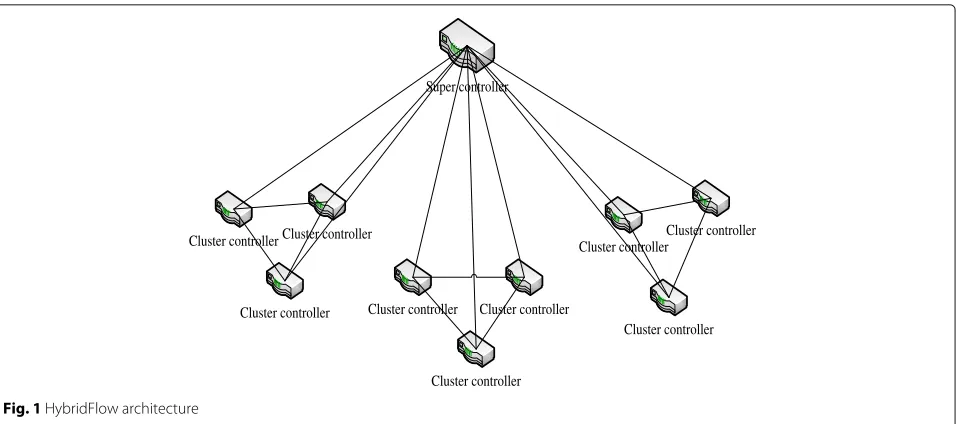
2.1 Overview of HybridFlow
Super controller
Cluster controllerCluster controller
Cluster controller Cluster controller Cluster controller
Cluster controller
Cluster controller
Cluster controller
Cluster controller
Fig. 1HybridFlow architecture
The controller enables to communicate with other trollers which are in the same cluster directly, and con-trollers which belong to different clusters connect with others via super controller. Under such a communicated mechanism, network status is synchronized between all the cluster controllers, such as global view information, topological information, and routing paths. Super con-troller is a special device which has the following function modules: forwarding, storage, calculation, timing, etc. Its main functions are to collect the load status from cluster controllers, correlatively calculate and forward. In addi-tion, super controller connects the cluster controllers from different clusters respectively and monitors the load status of each cluster controller.
2.2 Network topology
HybridFlow consists of a super controller andx*ycluster controllers, and we setX={1,...,x} which denotes the set of xclusters, Y={1,...y} which determines the set ofy clus-ter controllers in one clusclus-ter, and clusclus-ter controllerjini cluster is denoted as cluster controllerij, for short as CCij.
Without loss of generality, we assume the number of clus-ter controllers in each clusclus-ter is the same. The approach could be extended to other scenarios. The cluster can be modeled as the directed full connection graphG={V,E}, where we let the elements in setV denote the nodes in the graphGand the elements in setErepresent the edges in the graphG. In addition, we assume that all of clus-ter controllers enable to go to sleep when receiving the centralized configuration command message from super controller, and the sleeping cluster controller enables to awaken itself when its queuing length exceeds a certain value.
2.3 Energy consumption model
Warkozek et al. [16] introduces the energy model for servers, which considers the server as a black box mod-eling, depending on a few parameters and inputs, whose advantage is the possibility to be generalized with an acceptable error of estimation. And in [16], the energy consumption of servers is expressed as a nonlinear func-tion of the CPU usage of the server, presenting in (1). In this case, server’s power is formulated as a quadratic function of CPU usage.
y=Pidle+(Pmax−Pidle)∗(2u−ur) (1)
wherePidleis the energy consumption when there is no
load; Pmax is the energy consumption when there is full
load; uis the percentage of CPU usage due to the load; andris a parameter whose value is found by experimental measurements, and the proper value ofrshould minimize the quadratic error of estimation. But in this paper, we just need to know the relative value of energy consumption, which is sufficient to determine the effect of the proposed algorithm in this paper, and there is no need to calcu-late the absolute value of energy consumption accurately. Based on the above consideration, we assumer=2 in this paper.
2.4 Queuing theory model
We use queuing theory to model the arrival, processing, and departure of packet-in message in cluster controllers with shutting down time and starting time as shown in Fig. 2.
Time
Fig. 2Energy consumption of the cluster controller with shutting down time and starting time
window mixed system queuing modelM/M/1/m, where the time interval of messages arriving at CCijfollows the
negative exponential distribution with parameterλij, the
time of CCij processing one message follows the
nega-tive exponential distribution with parameterμij, and the
maximum number of queuing packets in each cluster con-troller ism. If there aremmessages queuing in the cluster controller, the newcome message will be discarded imme-diately, which is called instant refused system. If service rate is less than arrival rate (μij < λij), the departure
rate is less than the arrival rate which will result in the congestion and packet loss in the control plane. In this paper, we consider a multiple-controller sleeping mode by switching off redundant controllers when system is in the light traffic condition. So we setμij > λij in the paper.
State-flow Markov chain is shown in Fig. 3. Under the con-trol of super concon-troller, there arex*yqueuing models in HybridFlow.
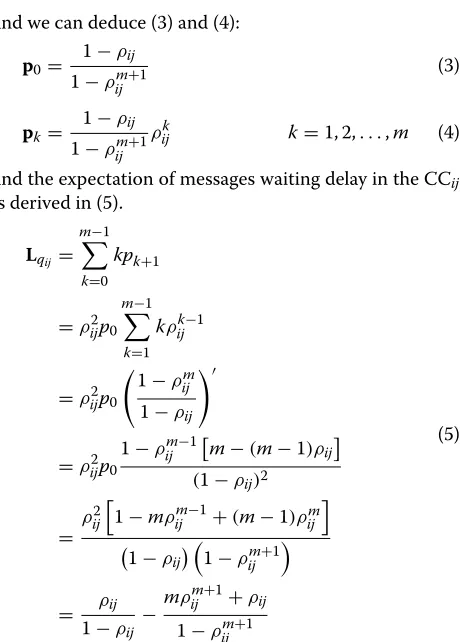
probability ofk messages in system when it is in steady state. We have (2)
m
and the expectation of messages waiting delay in the CCij
is derived in (5).
Lqij =
We can achieve the expectation of processed messages number Lserij in (6), because the number of messages which are being processed is 0 (when CCij is idle) or 1
(when CCijis active). The expectation of message
num-bers in CCij is (7). The average number of messages
arriving at CCijper unit time is (8).
Lserij=1×(1−p0)+0×p0=
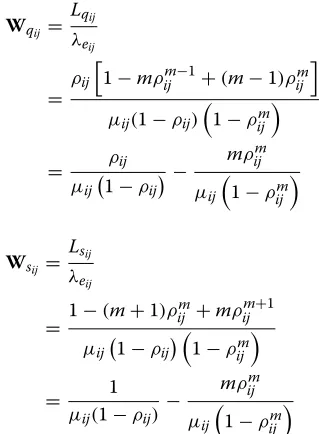
Based on Litter’s Law and (5), (7), and (8), we get average waiting time for messages in (9) and average staying time (which consists of average waiting time and processed time ) for messages in (10).
Wqij=
3 Multi-controller sleeping management
algorithm
In this section, we present the energy consumption man-agement algorithm in HybridFlow and formulate this issue as0-1integer linear programming model, then utilize the M-Npolicy sleeping control in the system.
3.1 Problem formulation
The minimization problem of energy consumption can be formulated as0-1integer linear programming problem as follows:
1. MA: it is largest queue length matrix, in which MAij
is the largest queue length in CCijand after queue
length surpasses MAij, the extra messages will be
discarded.
2. C : it is current queuing length matrix, in whichcijis
queuing length of CCijcurrently.
3. P : it is energy consumption matrix, in whichpijis the
energy consumption value of CCijat this moment
which can be calculated with formula (1) and matrix
MA,C. For example,pijcalculates as follow:
Pij=Pidle+(Pmax−Pidle)
if the CCijis active, and 0 otherwise.
5. Lq: it is average queuing length matrix, of which the
corresponding element is the average queuing length
in CCij, calculated by (5).
6. tr(): it is the trace of matrix.
In the above optimization, the first constraint represents after closing a part of cluster controllers; other clusters enable to accommodate the assigned load. The second constraint ensures system would not discard load because of the limitation of system capacity.
3.2 Algorithm procedure
In this section, we describe the procedure of energy con-sumption management algorithm in detail. The system is started. All cluster controllers report their current loadcij
to super controller everyT seconds, namely the number of packet-in messages queuing in each cluster controller, using loadnoticesignaling whose format is shown in Fig. 4.
When receiving loadnotice signaling, super controller
putscij into matrixC correspondingly and does the
fol-lowing judgment:
sum(C) >M∗sum(MA), situation 1,
sum(C)≤M∗sum(MA), situation 2. (14)
whereCis current queuing length matrix, MA is largest queue length matrix, andMis the starting threshold in M-Npolicy sleeping management algorithm. When situ-ation 1 happens, the below algorithm will not be carried out. Cluster controllers wait for the next cycle to report loadnotice signaling. When situation 2 happens, it shows
that the system is in the light traffic condition and there is no need to make all cluster controllers opened. Closing some cluster controllers enables to reduce the energy con-sumption of system. From (14), we can see that whenM becomes larger, the threshold of starting the algorithm is bigger; the possibility of starting the algorithm is bigger, then the possibility of closing controllers is bigger; more controllers are to be closed in the system. In this case,
energy consumption declines, but when more controllers are in sleeping mode, time delay of transferring sleeping controllers’ packet-in messages increase. In a word, when M becomes bigger, energy consumption decreases and time delay increases. On the contrary, energy consump-tion increases and time delay decreases. We can conclude that there is fundamental tradeoff between energy con-sumption and time delay with a differentM. The simula-tion which is shown in Secsimula-tion 4 also verifies the accuracy of the above analysis.
Energy consumption management algorithm is trig-gered. Using (11) and (12), the super controller knows how many cluster controllers needs to be opened and counts its number in (15). Which cluster controllers need to be closed has CxN∗openy (which means combinatorial number)
kinds of possibilities.
Nopen=sum(S) (15)
In each scheme, super controller calculates the value of cost function in (16) and selects the scheme with mini-mum cost function.
cost= Tdelay Esave
(16)
where Tdelay is time delay of transferring messages of
going to sleep controllers, which consists ofTone(the time
delay of transferring messages in one cluster) andTacross
(the time delay of transferring messages across clusters) in (17).Esaveindicates saved energy calculated with (18).
Tdelay=Tone+Tacross
Tone=tone∗Packetinone Tacross=tacross∗Packetinacross
(17)
wheretoneandtacrosscan achieve by testing experiment.
Packetinoneis the number of messages transferring in one cluster, and Packetinacrossis the number of messages trans-ferring across clusters, which is calculated as follows.
The principle of messages transferring needs to be shown clearly.
1. Priority to transferring messages within one cluster. 2. Messages which are more than the capacity of this
cluster are transferred across the cluster under the control of super controller.
3. System distributes loads according to the method of polling least-connection algorithm.
For example, assuming we calculate cost function of closing CCij, based on the first principle, firstly, super
controller calculatesLscin (19).
Lsc=
If Lsc ≥ 0, it shows that other cluster controllers in
clusterienable to accommodate load from CCij.
Accord-ing to the first principle, all of load of CCij are allocated
within clusteri. Cluster controller CCijuses polling
least-connection algorithm to determine the number of load distribution to other cluster controllers in the same cluster which is called Packetinone. Firstly, cluster controller CCij dispenses one message to the cluster controller which has least messages at this moment; this operation leads to the change of load distribution of the cluster. Secondly, cluster controller CCij also dispenses one message to least
mes-sage controller. In this way, extra mesmes-sages from cluster controller CCijenable to load balance between active
clus-ter controller. The polling least-connection algorithm is as follows.
Algorithm 1Polling least-connection algorithm Input:
The array of messages number of controllers which receive loads,R;
The number of messages which need to be distributed to others,P;
Output:
The array of messages number of controllers which receive loads,R;
1: fori=1;i<p;i+ +do
2: selecting the minimum value inRcalledminR;
3: minR+ +;
4: end for
IfLsc<0, based on the first and second principle, except
for load that clusteri can accommodate, a part of mes-sages from CCijshould be transferred across cluster. The
number of messages transferring in one cluster Packetinone and the number of messages transferring across clusters Packetinacrosscalculate by super controller based on polling least-connection algorithm.
Using the above method, we can determine the number of transferring messages in one cluster and across clus-ters, then achieve Tdelayby (17) andEsave by (18). Based
on Tdelay and Esave, the super controller calculates cost
Sleeping controllers detect the number of queuing length. When queuing length surpasses threshold N which is the threshold of setting up sleeping controllers, sleeping controllers awaken themselves and continue to deal with messages. Otherwise, cluster controllers are still in sleeping mode. WhenNbecomes larger, the threshold of setting up sleeping controllers increases and sleeping controllers have a longer sleeping time, which reduces energy consumption. But in this case, packet-in messages queuing in the sleeping controllers will wait for a longer time, which gives rise to more time delay. In a word, when N becomes bigger, energy consumption decreases and time delay decreases. On the contrary, energy consump-tion increases and time delay decreases. We can conclude that there is also fundamental tradeoff between energy consumption and time delay with a differentN. The simu-lation shown in Section 4 also verifies the accuracy of the above analysis. The algorithm and the actions performed on each of its steps are shown as follows.
Algorithm 2 Multi-controller sleeping management algorithm
1: The number of times system executing algorithm 2, k0;
2: fork=1 :k0do
3: cluster controllers reportloadnotice signaling every
T seconds;
4: ifsum(C) >M∗sum(MA)then 5: return to 3;
6: else
7: Super controller calculates minimum of active controller based on (11) and (12);
8: Super controller calculates cost function of each scheme based on (16), (17) and (18), then selects the minimum scheme of them;
9: Super controller send load transferring strategy and sleeping messages to selected cluster con-trollers;
10: Selected cluster controllers transfer their loads; 11: Selected cluster controllers go to sleep and detect
the number of queuing length
12: if number of queuing length in sleeping con-troller<Nthen
13: return 11;
14: else
15: awaken themselves;
16: end if
17: end if 18: end for
4 Simulation results
In this section, we use computer simulation to evaluate the performance of energy consumption management
algorithm. We first describe the simulation settings, then present the simulation results.
4.1 Simulation settings
1. Simulation tools: we simulate the system and
algorithm in MATLAB.
2. Network topologies: the simulation is carried out in
the topology as follows: there are four cluster controllers and one super controller in HybridFlow,
which is to,m=2,n=2, respectively labeled in
CC11,CC12,CC21,CC22. We assume the simulation
is event-based, and when the network works, cluster controllers receive packet-in messages with
M/M/1/mqueuing theory.
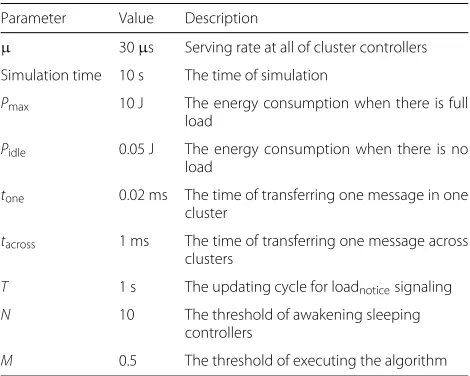
3. Parameter settings: the different seeds are employed
in the simulation, and performances are averaged to estimate the performance of scheme. The values for all parameters in the simulation are summarized in Table 1.
4.2 Performance evaluation results
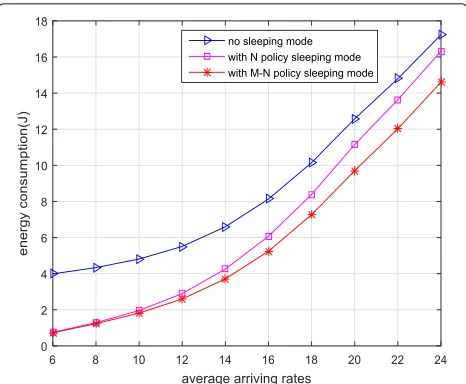
Figure 5 shows the total energy consumption of M-N policy sleeping mode, N policy sleeping mode and no sleeping mode with different average arriving rates. The other parameters are shown in Table 2, and the largest queue length in each cluster controller is the same, which is 20. In Fig. 5, with the increase of arriving rates, the total energy consumption is growing. The reason is that, as the arriving rates is increasing, more Packet-In mes-sages accumulate in the cluster controllers, which results in the larger energy consumption due to load rising. In any case of different arriving rates, we can see in Fig. 5 that the energy consumption of HybridFlow with M-N pol-icy sleeping mode is smaller thanNpolicy sleeping mode and without sleeping mode, which shows the validity of
Table 1Parameters setting in the simulation
Parameter Value Description
μ 30μs Serving rate at all of cluster controllers
Simulation time 10 s The time of simulation
Pmax 10 J The energy consumption when there is full
load
Pidle 0.05 J The energy consumption when there is no
load
tone 0.02 ms The time of transferring one message in one
cluster
tacross 1 ms The time of transferring one message across
clusters
T 1 s The updating cycle for loadnoticesignaling
N 10 The threshold of awakening sleeping
controllers
Fig. 5Total energy consumption versus average arriving rates ofM-N policy sleeping mode,Npolicy sleeping mode, and no sleeping mode
energy consumption management algorithm proposed in this paper. At the beginning of curves of withM-Npolicy sleeping mode and withNpolicy sleeping mode, their per-formance is similar, because when arriving rate is smaller, cluster controllers are often idle, in which case,M-N pol-icy sleeping mode’s advantage is not outstanding. As the increase of arriving rates, its performance is prominent gradually.
Figure 6 shows the relationship between average energy consumption in a packet and average delay in a packet ofM−Npolicy sleeping mode,Npolicy sleeping mode and no sleeping mode with different averageλ. The other parameters are shown in Table 2, and the largest queue
Fig. 6Average energy consumption in a packet versus average delay in a packet in different arriving rates ofM-Npolicy sleeping mode,N policy sleeping mode, and no sleeping mode
length in each cluster controller is the same, which is 20. In Fig. 6, it shows that theM-Npolicy sleeping mode andN policy sleeping mode both lead to the reduction of energy consumption but also introduce a longer time delay. Due to load transferring in the same cluster and between dif-ferent clusters, our proposed mode introduces more time delay, but improves energy efficiency meanwhile.
Figure 7 shows the relationship between average energy in a packet and average delay in a packet in different M with the 25/ms of average arriving rate. We can observe that largerMintroduces more time delay in a packet, but reduces average energy consumption in a packet. When M gets larger, the threshold of starting the algorithm is bigger; when the possibility of starting the algorithm is bigger, then the possibility of closing controllers is bigger; more controllers are to be closed in the system. Hence, energy consumption decreases. When more controllers are in sleeping mode, time delay of transferring sleeping controllers’ packet-in messages increases. In a nutshell, whenMbecomes bigger, energy consumption decreases and time delay increases. On the contrary, energy con-sumption increases and time delay decreases. We can also conclude that there is the fundamental tradeoff between energy consumption and time delay with a differentM.As Mis smaller, performance has an obvious change, which is because the opening threshold in (14) will change a lot with changing ofM. OnceMis larger than a certain degree, and there is no more messages accumulating due to the given average arriving rate, performance will be stable. We can also conclude that there is fundamental tradeoff between energy consumption and time delay with a differentM.
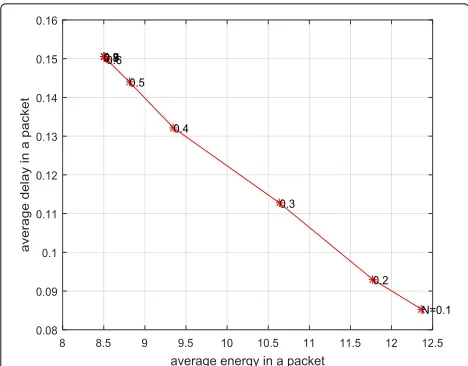
Figure 8 shows the relationship between the average energy consumption in a packet and average delay in a
Fig. 8Average energy consumption in a packet versus average delay in a packet with a differentN
packet of differentN with the 25/ms of average arriving rate. We can see that largerN can reduce average energy consumption in a packet. The reason is that, when N increases, the threshold of setting up sleeping controllers is raised, and controllers will have a longer sleeping time, which reduces average energy consumption. With the increase of N, the delay is growing. The reason is that, as theNis increasing, packet-in messages queuing in the sleeping controllers wait for a longer time, which gives rise to more time delay. Since larger N always reduces average energy consumption, but inevitably increases the average delay, we can conclude that there is the fundamental tradeoff between energy and delay with a differentN.
5 Conclusions
In this paper, we have studied the method of switching off cluster controllers based on HybridFlow architecture to improve energy efficiency. First, we use queuing theory to model the operation procedure of controllers, formu-late the energy consumption management issue as a0-1 integer linear programming model. Through turning off the redundant controllers when the system is in the sce-nario of light traffic, the total energy consumption of the whole system can be cut down. Then, we present the pro-cessing of energy consumption management algorithm with M-N sleeping policy in details. Simulation results show that proposed algorithm exhibits better energy effi-ciency but introduces extra time delay. In further study, we need to improve energy efficiency, and reduce the time delay. Meanwhile, we need to find the relationship between energy efficiency, time delay and thresholdM,N.
Acknowledgements
The project is supported by the Key Program of the National Natural Science Foundation of China (Grant No. 61431008).
Competing interests
The authors declare that they have no competing interests.
Author details
1School of Information and Communication Engineering, Beijing University of
Post and Telecommunications (BUPT), Xï Tu Cheng Road 10, 100876 Beijing, China.2China Mobile Group Design Institute Co., Ltd., Dä ling Street, 100080
Beijing, China.
Received: 20 December 2015 Accepted: 24 November 2016
References
1. Q Liang, X Cheng, SW Samn, NEW: network-e electronic warfare for target recognition. IEEE Trans. Aerospace Electron. Syst.46(2), 558–568 (2010). doi:10.1109/TAES.2010.5461641
2. Q Liang, X Cheng, KUPS: knowledge-based ubiquitous and persistent sensor networks for threat assessment. IEEE Trans. Aerospace Electron. Syst.44(3), 1060–1069 (2008). doi:10.1109/TAES.2008.4655363 3. Q Liang, X Cheng, SC Huang, D Chen, Opportunistic sensing in wireless
sensor networks: theory and application. Comput. IEEE Trans.63(8), 2002–2010 (2014)
4. Q Liang, Automatic target recognition using waveform diversity in radar sensor networks. Pattern Recognit. Lett.29(3), 377–381 (2008) 5. Q Liang, in2006 3rd Annual IEEE Communications Society on Sensor and Ad
Hoc Communications and Networks. Waveform design and diversity in radar sensor networks: theoretical analysis and application to automatic target recognition, vol. 2 (IEEE, 2006), pp. 684–689.
doi:10.1109/SAHCN.2006.288531
6. W Xia, Y Wen, CH Foh, D Niyato, H Xie, A survey on software-defined networking. IEEE Commun. Surv. Tutor.17(1), 27–51 (2015). doi:10.1109/COMST.2014.2330903
7. BAA Nunes, M Mendonca, X-N Nguyen, K Obraczka, T Turletti, A survey of software-defined networking: past, present, and future of programmable networks. IEEE Commun. Surv. Tutor.16(3), 1617–1634 (2014). doi:10.1109/SURV.2014.012214.00180
8. N McKeown, T Anderson, H Balakrishnan, G Parulkar, L Peterson, J Rexford, S Shenker, J Turner, OpenFlow: enabling innovation in campus networks. ACM SIGCOMM Comput. Commun. Rev.38(2), 69–74 (2008)
9. AR Curtis, JC Mogul, J Tourrilhes, P Yalagandula, P Sharma, S Banerjee, DevoFlow: Scaling Flow Management for High-performance Networks. SIGCOMM Comput. Commun. Rev.41(4), 254–265 (2011).
doi:10.1145/2043164.2018466. http://doi.acm.org/10.1145/2043164. 2018466
10. F Yonghong, B Jun, W Jianping, C Ze, W Ke, L Min, A dormant
multi-controller model for software defined networking. Commun. China. 11(3), 45–55 (2014)
11. E Ng, Maestro: A system for scalable OpenFlow control. Technical report, TSEN Maestro-Technical Report TR10-08, Rice University (2010) 12. M Casado, MJ Freedman, J Pettit, J Luo, N McKeown, S Shenker, Ethane:
Taking Control of the Enterprise. SIGCOMM Comput. Commun. Rev. 37(4), 1–12 (2007). doi:10.1145/1282427.1282382. http://doi.acm.org/10. 1145/1282427.1282382
13. Y Hu, W Wang, X Gong, X Que, S Cheng, in2012 IEEE 2nd International Conference on Cloud Computing and Intelligence Systems. BalanceFlow: Controller load balancing for OpenFlow networks, vol. 2 (IEEE, 2012), pp. 780–785. doi:10.1109/CCIS.2012.6664282
14. A Tootoonchian, Y Ganjali, inProceedings of the 2010 internet network management conference on Research on enterprise networking. HyperFlow: A distributed control plane for OpenFlow, (2010), pp. 3–3
15. T Koponen, M Casado, N Gude, J Stribling, L Poutievski, M Zhu, R Ramanathan, Y Iwata, H Inoue, T Hama, S Shenker, inProceedings of the 9th USENIX Conference on Operating Systems Design and Implementation. Onix: d distributed control platform for large-scale production networks (USENIX Association, Berkeley, 2010), pp. 351–364. http://dl.acm.org/ citation.cfm?id=1924943.1924968