Solar wind and its evolution
Takeru K. Suzuki
Department of Physics, Nagoya University, Furo-cho, Nagoya 606-8602, Japan
(Received February 3, 2011; Revised April 6, 2011; Accepted April 11, 2011; Online published March 8, 2012)
By using our previous results of magnetohydrodynamical simulations for the solar wind from open flux tubes, I discuss how the solar wind in the past is different from the current solar wind. The simulations are performed in fixed one-dimensional super-radially open magnetic flux tubes by inputing various types of fluctuations from the photosphere, which automatically determines solar wind properties in a forward manner. The three important parameters which determine physical properties of the solar wind are surface fluctuation, magnetic field strengths, and the configuration of magnetic flux tubes. Adjusting these parameters to the sun at earlier times in a qualitative sense, I infer that the quasi-steady-state component of the solar wind in the past was denser and slightly slower if the effect of the magneto-centrifugal force is not significant. I also discuss effects of magneto-centrifugal force and roles of coronal mass ejections.
Key words:Atmosphere, MHD, planets, solar corona, solar wind, waves.
1.
Introduction
Young solar-type stars are generally very active: X-ray flux is up to∼1000 times larger than the present-day sun (G¨udel et al., 1997; G¨udel, 2004), and the X-ray tem-perature is also higher (Ribas et al., 2005; Telleschi et al., 2005). Observations of young main sequence stars show very strong magnetic field strengths with an order of kG or even larger (Donati and Collier Cameron, 1997; Saar and Brandenburg, 1999; Saar, 2001; see also Donati and Landstreet, 2009 for recent review), which are much stronger than the average strength of 1–10 G of the cur-rent sun. Young stars are generally fast rotators and strong magnetic fields are generated by strong differential rota-tion through dynamo activities of magnetoconvecrota-tion (e.g., Brunet al., 2004). As time goes on, a star loses its angu-lar momentum through magnetic stelangu-lar wind (Weber and Davis, 1967) and the magnetic activities become weak (e.g., Ayres, 1997).
Solar wind is hot plasma emanating from the Sun, and the mass loss rate amounts to∼1012 g s−1 (2×10⁻¹⁴M yr−1) at present. As inferred from high activity of young solar-type stars, I expect that the solar wind was stronger at earlier times. Woodet al.(2002, 2005) observed aster-ospheres of low-mass stars by the Hubble space telescope and determined the mass loss rates. The estimated mass loss rates show a decreasing trend with time, except for very young stars, thought there is still a large scatter in the data, partly because the observed stars range from very low-mass to near solar-mass stars1. At the very early epoch, the mass
loss rate seems to be saturated at∼100 times of the present solar value, but some very young stars show lower mass loss
Copyright cThe Society of Geomagnetism and Earth, Planetary and Space Sci-ences (SGEPSS); The Seismological Society of Japan; The Volcanological Society of Japan; The Geodetic Society of Japan; The Japanese Society for Planetary Sci-ences; TERRAPUB.
doi:10.5047/eps.2011.04.012
rates than the present Sun.
The solar wind roughly consists of two components. The first component is called fast solar wind with speed of 700– 800 km s−1at the earth orbit. Fast solar wind is more steady
and streams out from coronal holes which generally cor-responds to open magnetic flux tube regions. The other component is slow solar wind with speed 400 km s−1. Slow wind is more complex and transient, and in most cases comes from lower latitude regions. Recent HINODE obser-vations show that some portions of the slow wind appear to be originating from open flux tubes near active regions (Imadaet al., 2007; Sakaoet al., 2007; Harraet al., 2008), while there are still debates of other sources for slow wind. As other types of magnetized plasma from the sun, coro-nal mass ejections (CMEs) also are supposed to affect at-mospheres of planets especially at early times. In this pa-per, however, I mainly focus on solar wind from open mag-netic flux tubes, and briefly mention effects of CMEs after-ward. Our group has carried out forward numerical model-ing of the solar wind by usmodel-ing direct magnetohydrodynam-ical (MHD) simulations, in which we can directly test the response of the solar atmosphere to the surface fluctuations and properties of magnetic fields. By using the results of the simulations with parameters suitable for the younger sun, I discuss the solar wind evolution.
2.
Simulation Model
In this section, I briefly describe the simulations of the solar wind. For detail, please refer to Suzuki and Inutsuka (2006, SI06, hereafter). In order to cover the region with huge density contrast fromρ = 10−7g cm−3 at the
photo-1Although the observed stars include not only G-type (solar-analogue) stars but also lower mass K- and M-type stars, it is worth discussing trends because the mechanism of mass loss of these stars are supposed to be similar; the stellar wind is accelerated by wave and turbulent motions associated with magnetic field driven by fluctuation in a surface convective zone.
mensional (1-D) open flux tubes are adopted. The effects of super-radial expansion of flux tubes are incorporated by taking into account an expansion factor in the conservation of magnetic flux of radial (r) component,Br:
Brr2f(r)=const., (1)
where f(r)is a super-radial expansion factor. Most of the solar surface is covered by closed magnetic loop structure. Then, open flux tubes rapidly open above these loops; f is introduced to consider this effect. The same function as in Kopp and Holzer (1976) is adopted for f(r)(see Suzuki and Inutsuka (2006) for detail).
In SI 06 we input the transverse fluctuations of the field line by the granulations at the photosphere. Amplitude,
dv⊥, at the photosphere is chosen to be compatible with the observed photospheric velocity amplitude∼1 km s−1 (Holwegeret al., 1978). SI06 tested various types of spec-tra; in this paper I discuss the results of the power spectra in proportion to 1/ν, whereνis frequency. The surface fluctu-ations generate upgoing Alfv´en waves which contribute to the acceleration of the solar wind in upper regions. At the outer boundaries, a non-reflecting condition is imposed for all the MHD waves, which enables us to carry out simula-tions for a long time until quasi-steady state solusimula-tions are obtained without unphysical wave reflection.
SI06 dynamically treat the propagation and dissipation of the waves and the heating and acceleration of the plasma by solving ideal MHD equations with the relevant physical processes, including the sun’s gravity, radiative cooling, and thermal conduction (Suzuki and Inutsuka, 2005, SI06). I do not take into account stellar rotation, which may be important for very young stars. For the initial condition, we assume a static atmosphere with temperatureT =104K in order to see whether the atmosphere is heated up to coronal temperature and accelerated to accomplish the transonic flow. Fromt = 0, the transverse fluctuations are injected from the photosphere and continue the simulations until the quasi-steady states are achieved.
3.
Solar Wind Response to Surface Condition
By injecting fluctuations from the photospheric surface, the initially cool and static atmosphere is effectively heated and accelerated by the dissipation of the generated upgoing Alfv´en waves. The sharp transition region which divides the cool chromosphere withT ∼104K and the hot coronawithT ∼ 106 K is formed owing to a thermally unstable
region aroundT ∼105 K in the radiative cooling function
(Landini and Monsignori-Fossi, 1990). The hot corona streams out as the transonic solar wind (see Suzuki and Inutsuka, 2005, and SI06 for detail).
The heating and acceleration of the solar wind plasma in inner heliosphere results from the dissipation of Alfv´en waves. In the simple 1-D treatment, Alfv´en waves mainly dissipate via nonlinear mode conversion; slow MHD waves are nonlinearly generated from outgoing Alfv´en waves and the slow MHD waves are damped by shock formation as a result of steepening of wave shape. The shocks also heat up surrounding plasma, which play a
with height as a result of the successive dissipation process, which directly pushes the plasma outward (momentum in-put) in addition to gas pressure.
The young sun is more active than the present-day sun, and therefore, I expect that surface fluctuations are stronger. The properties of the magnetic fields are also supposed to be very different. I discuss how properties of the solar wind are affected by fluctuation amplitudes and magnetic fields at the solar surface.
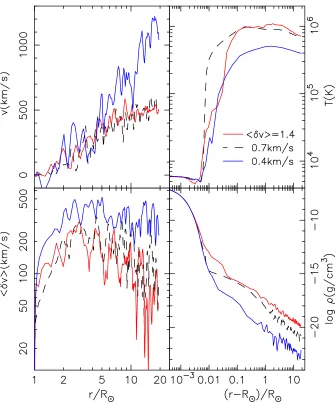
3.1 Dependence on surface fluctuation amplitude Figure 1 shows the response of the solar wind plasma to the surface fluctuations with different amplitudes,dv⊥ = 1.4 km s−1, 0.7 km s−1 and 0.4 km s−1. The intermedi-ate case (dv⊥ = 0.7 km s−1) is a reference case which explains the present-day solar wind.
The maximum temperature ofdv⊥ =0.4 km s−1case is 5×10⁵ K (Table 1), which is cooler than the usual corona. The density is lower than the fiducial case by 1– 2 orders of magnitude because the sufficient mass cannot be supplied to the corona by the chromospheric evaporation owing to the low temperature; the evaporation is drastically suppressed asT decreases, since the conductive flux (Fc∝
T5/2d Tdr) sensitively depends on T. As a result, the mass flux (ρvr) becomes much lower, by a factor of∼50, than
that of the present solar wind.
On the other hand, the largerdv⊥ = 1.4 km s−1 case gives larger coronal density, although the coronal temper-ature is only slightly higher than the tempertemper-ature of the reference case. As a result of the dense corona, the mass flux of the solar wind is∼10 times larger (Table 1). This case shows complicated structure of temperature and den-sity near the solar surface. The temperature starts to in-crease from a deeper location aroundr 0.005R than the other cases. Thanks to this, the decrease of the density is slower (larger pressure scale height) so that the density aroundr =1.01R is two orders of magnitude larger than that of the reference case withdv⊥ = 0.7 km s−1.
How-ever, the temperature decreases slightly instead of show-ing a monotonical increase; it cannot go over the peak of the radiative cooling function atT 105 K (Landini and
Monsignori-Fossi, 1990) because the radiative loss is effi-cient, owing to the large density. The temperature again in-creases fromr1.03Rand above there the corona forms. The coronal density is larger than the that of the reference case as explained above.
A striking feature is that the mass flux of solar winds sen-sitively depends on the input wave amplitude at the solar photosphere. Since the injected energy is proportional to the square ofdv⊥, the difference of the input energy be-tween the small amplitude case (dv⊥ = 0.4 km s−1) and
the large amplitude case (dv⊥ = 1.4 km s−1) is 12.
However, the output mass flux of the large amplitude case is
∼400 times larger than the mass flux of the small amplitude case.
Fig. 1. Structures of corona and solar wind for differentdv⊥ =0.4 (blue), 0.7 (black dashed), and 1.4 km s−1(red). I plot solar wind speed,v
r (km
s−1) (top left), temperature,T(K) (top right), density in logarithmic scale, log(ρ(g cm−3))(bottom right), and rms transverse velocity,dv
⊥(km s−1) (bottom left). Each variable is averaged with respect to time during 28 min (the longest wave period considered).
Table 1. Summary of model parameters and results. The first column shows the input amplitudes of the surface fluctuation. The second column presents the maximum temperatures in the simulation regions. The third column shows proton number density at 1 AU, which is calculated fromnpat the outer boundary of the simulation by assuming the conservation of the mass flux (npvr2f =const.) with constant speed from 0.1 AU to 1 AU. The fourth column shows the solar wind speeds at 0.1 AU (the outer boundary of the simulation region). The fifth column shows mass flux of the solar wind at 1 AU, which is the product of the third and fourth columns.
dv⊥ Tmax np,1 AU v0.1 AU (npv)1 AU
1.4 (km/s) 1.2×10⁶(K) 50 (cm−3) 500 (km/s) 2.5×10⁹(cm−2s−1) 0.7 (km/s) 1.0×10⁶(K) 5 (cm−3) 550 (km/s) 2.8×10⁸(cm−2s−1) 0.4 (km/s) 0.5×10⁶(K) 0.05 (cm−3) 1200 (km/s) 6×10⁶(cm−2s−1)
the scale height becomes smaller and the density decreases rapidly. The Alfv´en speed,vA(=Br/
√
4πρ), changes more rapidly due to the rapid decrease of density and the wave shape is largely deformed, which enhances the reflection. When the input wave energy decreases, a positive feedback operates; a smaller fraction of the energy can reach the coro-nal region. As a result, the density and mass flux of the so-lar wind becomes much smaller than the decreasing factor of the input energy.
In addition to the effect of the wave reflection, the
non-linear dissipation of the Alfv´en waves also plays a role in the sensitive dependence on the input wave energy (SI06). When the input wave energy becomes smaller, the den-sity becomes smaller as explained above. Then, the non-linearity of Alfv´en wave, dv⊥/vA, decreases, not only
because the amplitude, dv⊥, is smaller but also because the Alfv´en speed, vA(∝1/√ρ), is larger. Therefore, the
depen-At earlier epochs the sun is expected to have possessed stronger magnetic field than today, as inferred from obser-vations of young stars (Donati and Collier Cameron, 1997; Saar and Brandenburg, 1999). The configuration of mag-netic fields as well as field strength plays an essential role in determining the physical solar wind conditions. In the 1-D treatment as adopted in this paper, a super-radial expansion factor, f, determines the geometry of flux tubes. Wang and Sheeley (1990, 1991) showed that the solar wind speed at
∼1 AU is anti-correlated with f from their long-term ob-servations. This can be naively understood by energetics consideration; since f directly determines an adiabatic loss of plasma in flux tubes, solar wind plasma in largely ex-panding (larger f) flux tubes undergoes larger energy loss.
By the comparison of the outflow speed obtained by in-terplanetary scintillation measurements with observed pho-tospheric field strength Kojima et al. (2005) have found that the solar wind velocity is better correlated with sur-face magnetic field strength, divided by the expansion fac-tor,Br,0/f: They claim thatBr,0/f is a better index for the
speed of solar wind than individual 1/f or Br,0. The
cor-relation between Br,0/f and solar wind speed is well
ex-plained by Alfv´en waves in expanding flux tubes (Suzuki, 2006). Because the energy flux of input Alfv´en waves is proportional toBr,0, the positive correlation of solar wind
speed with Br,0 is quite natural. The negative correlation
with f reflects the adiabatic loss of Alfv´en waves in ex-panding tubes as explained above.
One can understood the correlation more specifically from nonlinear dissipation of Alfv´en waves as well. The nonlinearity of the Alfv´en waves,dv⊥/vAis controlled by vA ∝ Br ∝ Br,0/f in the outer region where the flux tube
is already super-radially open. Wave energy does not ef-fectively dissipate in the larger Br,0/f case in the subsonic
region because of relatively small nonlinearity, and more energy remains in the supersonic region. In general, en-ergy and momentum inputs in the supersonic region result in higher wind speed, while those in the subsonic region raise the mass flux (ρvr) of the wind by increasing density
(Lamers and Cassinelli, 1999). This indicates that the solar wind speed is positively correlated withBr,0/f.
4.
Evolution of Solar Wind
I have described based on our numerical simulations that the solar wind from open magnetic flux tubes is mainly controlled by the three parameters: surface fluctuation am-plitude,dv⊥, radial magnetic field strength at the photo-sphere, Br,0, and super-radial expansion factor, f, of flux
tubes. Thus, if I can determine these parameters for the young sun, I can estimate the properties of solar wind at that time.
4.1 Surface fluctuation amplitude
I can speculate that dv⊥ was larger at earlier times from circumstantial evidences. First, the rotation of the sun should be faster at earlier times because of loss of angular momentum with time. Hence, in addition to surface convec-tion, interior differential rotation will lead to stronger sur-face fluctuations. From observational facts, younger stars
issue is that a small increase ofdv⊥leads to a large in-crease of mass flux of solar wind.
4.2 Magnetic field—Br,0&f—
Br,0 is also supposed to be larger than today as
im-plied from observations of young stars (Donati and Collier Cameron, 1997; Saar and Brandenburg, 1999). Rossby number, R0, which is defined as the ratio of stellar
rota-tion period to convective turn-over time, is an important in-dex which describes stellar magnetic activities (Noyes et al., 1984). Surface magnetic field strength,Bph, multiplied
by a magnetic areal filling factor,F, is well-correlated with R0−1. Stars with small R0 <0.1, which correspond to fast
rotating young stars, haveBphF =1–10 kG (Saar, 2001).
In some starsF’s are obtained and the values are 50–70%, which shows thatBphis an order of 10 kG in these stars.
If all the magnetic flux is open to the interplanetary space, I can set f =1/F; in reality, however, closed loop structure is more dominant, and then, it is expected that f 1/F. I speculate that super-radial expansion, f, of the young sun was larger as discussed from now, although it is not simple to pin down the specific value. Recently, the configuration of magnetic field has been observed in a number of low-mass stars (e.g. Donatiet al., 2008). Fast rotating solar mass stars possess non-axisymmetric poloidal components with substantial toroidal fields (see figure 3 of Donati and Landstreet (2009)). This implies that the field configuration is quite complicated, and is very different from ordered dipole structure. In comparison with 11-year periodicities of present-day solar activity2, the properties of magnetic
field of the earlier sun resemble the condition of the present-day solar maximum rather than the solar minimum.
During the solar minimum periods, the solar wind con-sists of fast wind which is from mid- to high-latitude re-gions, and slow wind from lower-latitude regions. On the other hand, during the solar maximum periods, most of the regions are occupied by transient slow wind (McComas et al., 2008). At the solar maximum magnetic fields are dominated by a dipole component, while at the solar min-imum higher multi-pole moments become more important showing more complex field configuration (Hakamada et al., 2005). Because the surface is mostly covered with closed magnetic fields during the solar maximum, the field strength in the outer regions is not as strong as that at the so-lar minimum although the field strength at the photosphere is stronger. This fact shows that f is larger during the so-lar maximum. The speed of the soso-lar wind during the soso-lar maximum is slower, which is consistent with the observa-tional trend (Kojimaet al., 2005), because of larger adia-batic loss in open magnetic flux tubes.
Based on these considerations, namely (i) the magnetic field structure of the young sun more resembles the current solar maximum than the solar minimum, and (ii) open flux tubes show larger expansion during the solar maximum be-cause larger surface area is occupied by closed structure, I infer that open magnetic flux tubes of the young sun have
much larger f. I speculate that, even though the magnetic field strength at the footpoints is stronger,Br,0/f, is smaller
at earlier time.
4.3 Solar wind in the past
I would like to discuss how the properties of solar wind change in the past based on the simulation results. I have stated thatdv⊥was larger andBr,0/f was smaller at
ear-lier times. These conditions imply considerably denser but slightly slower solar wind in the past, although it is quite difficult to quantitatively determine the physical condition. 4.4 Limitations
In this paper I neglect the effect of magneto-centrifugal force in driving winds (Weber and Davis, 1967; Mestel, 1968). Under the typical solar condition, if the rotation period is 4 days (6–7 times faster than the present sun) or less, magneto-centrifugal force plays an important role and the wind speed becomes significantly higher (Newkirk, 1980).
Recently, Holzwarth and Jardine (2007) calculated the evolution of solar wind by considering megneto-centrifugal force. They concluded that the solar wind in the past was faster but not so much denser than today, which are differ-ent from my conclusion. Holzwarth and Jardine (2007) as-sumed a constant density at a ‘reference point’, 1.1 times of the stellar radius, which strongly constrains the mass loss rate (see, e.g. section 3 of Lamers and Cassinelli, 1999). In realistic situations, the density at the coronal base, ac-cordingly the density at the reference level, is determined by the energy balance among heating, thermal conduction, and radiative cooling (SI06; see also Suzuki 2007 for dif-ferent types of stars). The base densities of young active stars are larger than those of quiescent stars, and the mass loss rates are supposed to be significantly larger. In this case the wind speed becomes slower because more mass needs to be pushed away. The same tendency on the coronal base density is also reported by Stereborget al.(2011) who per-formed 3D MHD simulations for a young sun.
It is not still possible to discuss the wind speed in a quantitative sense at the moment. My conclusion of the slightly slower wind in the past might be corrected because magneto-centrifugal force could be significant. On the other hand, I suppose that the wind speed is not so high as esti-mated by Holzwarth and Jardine (2007) bacause the coro-nal base density should larger at that time than their as-sumption. Accordingly, the density of the solar wind could be larger than those calculated in Holzwarth and Jardine (2007).
In this paper I focus on quasi-steady-state solar wind from open magnetic flux regions, and do not consider CMEs. While the quasi-steady-state component domi-nantly contributes to the total mass loss from the present-day sun than CMEs, at early times CMEs might play a more important role because of stronger magnetic activi-ties. From the fossil record on the lunar surface, it is in-ferred that the speed of solar wind was faster in the past (Newkirk, 1980; Ray and Heymann, 1980). I infer that the fossil record comprises effects of both quasi-steady state component and CMEs. If strong CMEs dominantly con-tribute to the mass loss, the bulk speed of plasma flow from the sun would be recognized as higher. I speculate that the
fossil inprint on the moon is connected with high CME ac-tivities at early epochs.
5.
Summary
Based on our previous results of MHD simulations, I dis-cuss the evolution of the quasi-steady-state component of solar wind from open flux tubes. The properties of the solar wind are determined by the three parameters, surface fluc-tuation amplitude, magnetic field strength, and expansion of open flux tube. Referring to observational data of young low-mass stars, I suppose that the surface amplitude was larger and the ratio of field strength to flux tube expansion was smaller. Following this speculation, the solar wind in the past was dense and slightly slower than today, while if the effect of magneto-centrifugal force is taken into accout, the speed of the solar wind might be higher at very early epoch than my conclusion. CMEs are also supposed play a more important role in the past than today because of higher magnetic activities. In order to understand the effects of so-lar magnetized plasma on the atmospheres of planets, we need to understand the evolution of CMEs as well as the evoltuion of quasi-steady-state solar wind.
Acknowledgments. This work was supported in part by Grants-in-Aid for Scientific Research from the MEXT of Japan, 19015004, 20740100, 22864006, and Inamori Foundation. The author thanks two anonymous reviewers for many constructive suggestions to improve the paper.
Guest editor M. Yamauchi thanks two anonymous reviewers in evaluating this paper.
References
Ayres, T. R., Evolution of the solar ionizing flux,J. Geophys. Res.,102, 1641–1652, 1997.
Brun, A. S., M. S. Miesch, and J. Toomre, Global-scale turbulent convec-tion and magnetic dynamo acconvec-tion in the solar envelope,Astrophys. J., 614, 1073–1098, 2004.
Donati, J.-F. and A. Collier Cameron, Differential rotation and magnetic polarity patterns on AB Doradus,Mon. Not. R. Astron. Soc.,291, 1–19, 1997.
Donati, J.-F. and J. D. Landstreet, Magnetic field of nondegenerate stars,
Ann. Rev. Astron. Astrophys.,47, 333–370, 2009.
Donati, J.-F.et al., Large-scale magnetic topologies of early M dwarfs,
Mon. Not. R. Astron. Soc.,390, 545–560, 2008.
G¨udel, M., X-ray astronomy of stellar coronae,Astron. Astrophys. Rev.,12, 71–237, 2004.
G¨udel, M., E. F. Guinan, and S. L. Skinner, The X-ray Sun in time: A study of the long-term evolution of coronae of solar-type stars,Astrophys. J., 483, 947–960, 1997.
Hakamada, K., M. Kojima, T. Ohmi, M. Tokumaru, and K. Fujiki, Cor-relation between expansion rate of the coronal magnetic field and solar wind speed in a solar activity cycle,Sol. Phys.,227, 387–399, 2005. Harra, L. K.et al., Outflows at the edges of active regions: Contribution to
solar wind formation?,Astrophys. J. Lett.,676, L147–L150, 2008. Holweger, H., M. Gehlsen, and F. Ruland, Spatially-averaged properties of
the photospheric velocity field,Astron. Astrophys.,70, 537–542, 1978. Holzwarth, V. and M. Jardine, Theoretical mass loss rates of cool
main-sequence stars,Astron. Astrophys.,463, 11–21, 2007.
Imada, S.et al., Discovery of a temperature-dependent upflow in the plage region during a gradual phase of the X-class flare,Pub. Astron. Soc. Jpn.,59, S793–S799, 2007.
Kojima, M., K. Fujiki, M. Hirano, M. Tokumaru, T. Ohmi, and K. Haka-mada, Solar wind properties from IPS observations, inThe Sun and the heliosphere as an Integrated System, edited by Giannina Poletto and Steven T. Suess, 147–181, Kluwer Academic Publishers, 2005. Kopp, R. A. and T. E. Holzer, Dynamics of coronal hole regions. I —
plasmas,Astron. Astrophys. Suppl.,82, 229–260, 1990.
McComas, D. J., R. W. Ebert, H. A. Elliot, B. E. Golestein, J. T. Cosling, N. A. Schwadron, and R. M. Skoug, Weaker solar wind from the polar coronal holes and the whole Sun,Geophys. Res. Lett.,35, L18103, 2008. Mestel, L., Magnetic braking by a stellar wind—I.,Mon. Not. R. Astron.
Soc.,138, 359–391, 1968.
Miyahara, H., Y. Yokoyama, and K. Masuda, Possible link between multi-decadal climate cycles and periodic reversals of solar magnetic field polarity,Earth. Planet. Sci. Lett.,272, 290–295, 2008.
Newkirk, G. Jr., Solar variability on time scale of 105years to 109.6years,
Proc. Conf. Ancient Sun, 293–320, 1980.
Noyes, R. W., L. W. Hartmann, S. L. Baliunas, D. K. Duncan, and A. H. Vaughan, Rotation, convection, and magnetic activity in main-sequence stars,Astrophys. J.,279, 763–777, 1984.
Ray, J. and D. Heymann, A model for nitrogen isotopic variations in the lunar regolith: Possible solar system contributions from a nearby planetary nebula,Proc. Conf. Ancient Sun, 491–512, 1980.
Ribas, I., E. F. Guinan, M. G¨udel, and M. Audard, Evolution of the solar activity over time and effects on planetary atmospheres. I. High-energy irradiances (1-1700øA),Astrophys. J.,622, 680–694, 2005.
Saar, S. H., Recent measurements of (and inferences about) magnetic fields on K and M stars,the 11th Cool Stars, Stellar Systems and the Sun, ASP Conf. Series,223, 292–299, 2001.
Saar, S. H. and A. Brandenburg, The evolution of the magnetic activity cycle period. II. Results for an expanded stellar sample,Astrophys. J., 524, 295–310, 1999.
Sakao, T.et al., Continuous plasma outflows from the edge of a solar active region as a possible source of solar wind,Science,318, 1585–1588, 2007.
Stereborg, M. G., O. Cohen, J. J. Drake, and T. I. Gombosi, Modeling the young Sun’s solar wind and its interaction with Earth’s
paleomagneto-Suzuki, T. K., Structured red giant winds with magnetized hot bubbles and the corona/cool wind dividing line,Astrophys. J.,659, 1592–1610, 2007.
Suzuki, T. K. and S. Inutsuka, Making the corona and the fast solar wind: a self-consistent simulation for the low-frequency Alfv´en waves from photosphere to 0.3AU,Astrophys. J. Lett.,632, L49–L52, 2005. Suzuki, T. K. and S. Inutsuka, Solar winds driven by nonlinear
low-frequency Alfv´en waves from the photosphere: Parametric study for fast/slow winds and disappearance of solar winds, J. Geophys. Res., 111(A6), A06101, 2006 (SI06).
Telleschi, A., M. G¨udel, K. Briggs, M. Audard, J.-U. Ness, and S. L. Skinner, Coronal evolution of the Sun in time: High-resolution X-ray spectroscopy of solar analogs with different ages,Astrophys. J.,622, 653–679, 2005.
Wang, Y.-M. and N. R. Sheeley, Jr, Solar wind speed and coronal flux-tube expansion,Astrophys. J.,355, 726–732, 1990.
Wang, Y.-M. and N. R. Sheeley, Jr, Why fast solar wind originates from slowly expanding coronal flux tubes,Astrophys. J. Lett.,372, L45–L48, 1991.
Weber, E. J. and L. Davis, Jr., The angular momentum of the solar wind,
Astrophys. J.,148, 217–227, 1967.
Wood, B. E., H.-R. M¨uller, G. P. Zank, and J. L. Linsky, Measured mass-loss rates of solar-like stars as a function of age and activity,Astrophys. J.,574, 412–425, 2002.
Wood, B. E., H.-R. M¨uller, G. P. Zank, J. L. Linsky, and S. Redfield, New mass-loss measurements from astrospheric Lyαabsorption,Astrophys. J. Lett.,628, L143–L146, 2005.