R E S E A R C H
Open Access
A general neuro-space mapping technique
for microwave device modeling
Lin Zhu
1*, Jian Zhao
1, Zhuo Li
2,3, Wenyuan Liu
4, Lei Pan
1, Haifeng Wu
5and Deliang Liu
6Abstract
Accurate modeling of nonlinear microwave devices is critical for reliable design of microwave circuit and system. In this paper, a more general neuro-space mapping (Neuro-SM) method is proposed to fulfill the needs of the increased modeling complexity. The proposed technique retains the capability of the existing dynamic Neuro-SM in modifying the dynamic voltage relationship between the coarse model and the desired model. The proposed Neuro-SM also considers dynamic current mapping besides voltage mappings. In this way, the proposed Neuro-SM generalizes the previously published Neuro-SM methods and has the potential to produce a more accurate model of microwave devices with more dynamics and nonlinearity. A new formulation and new sensitivity analysis technique are derived to train the general Neuro-SM with dc, small-, and large-signal data. A new gradient-based training algorithm is also proposed to speed up the training. The validity and efficiency of the general Neuro-SM method are demonstrated through a real 2 × 50 μm GaAs pseudomorphic high-electron mobility transistor (pHEMT) modeling example. The proposed general Neuro-SM model can be implemented into circuit simulators conveniently.
Keywords: Artificial neural network, Space mapping, Neuro-SM, Microwave device modeling
1 Introduction
Microwave transistors are key components in the next
generation wireless communication systems [1–4],
such as cognitive multiple-input multiple-output
(MIMO) systems [5–7], and cognitive relay network
[8, 9]. With the increasing complexity of
communica-tion circuit and system structure, designers rely more heavily on computer-aided design (CAD) software to achieve efficient design. Microwave device models are essential to CAD software. The accuracy of these models can even decide whether the communication circuit and system design is successful or not. Due to rapid technology development in semiconductor in-dustry, new microwave devices constantly arrive. Models suitable for previous devices may not fit new devices well. There is an ongoing need for new accur-ate models.
In recent years, neuro-space mapping (Neuro-SM)
technique [10] combining artificial neural networks
[11] with space mapping [12] has been recognized in
microwave device modeling with the advantages of good efficiency and accuracy. In Neuro-SM, neural networks are used to automatically map and modify an existing equivalent circuit model also called coarse model to a desired/accurate model through a process named training. In order to fulfill the needs of the
increased modeling complexity and the industry’s
in-creasing need for tighter accuracy, several
improve-ments on the basis of [10] were subsequently studied
to enhance the modeling accuracy and efficiency,
such as Neuro-SM with the output mapping [13],
dy-namic Neuro-SM [14], and analytical Neuro-SM with
sensitivity analysis [15]. Neuro-SM with the output
mapping [13] was introduced, through incorporation
of a new output/current mapping, for modeling of microwave devices. Compared to the Neuro-SM
* Correspondence:[email protected]
1School of Control and Mechanical Engineering, Tianjin Chengjian University, Tianjin 300384, China
Full list of author information is available at the end of the article
presented in [10], Neuro-SM with the output map-ping is more suitable for modeling nonlinear devices with more nonlinearity due to the additional and useful degrees of freedom from the output mapping neural network. In order to accurately model nonlin-ear devices which have higher order dynamic effects (e.g., capacitive effect or non-quasi-static effect) than that of the coarse model, dynamic Neuro-SM was
in-troduced [14]. However, when the modeling devices
have both more nonlinearity and high order dynam-ics, in such case, even though existing Neuro-SM
[13, 14] is used to map the coarse model towards
the device data, the match between the trained Neuro-SM models and the device data may be still not good enough. More effective Neuro-SM methods need to be investigated to overcome the accuracy limit of the Neuro-SM presented in [13, 14].
In this paper, we propose a more generalized Neuro-SM approach including not only static map-ping but also dynamic mapmap-ping, and considering both voltage mapping and current mapping for the first time. This paper is a further expansion of the work in [13, 14]. Compared to [13] where only static mapping is used, the proposed technique is more suitable for modeling nonlinear devices with higher order dynamic effects and non-quasi-static effect that may be missing in the coarse model due to
in-clusion of dynamic mapping. Compared to [14], the
general Neuro-SM considers not only input voltage mapping, but also output current mapping, further refining the existing coarse model. In this way, well trained general Neuro-SM model can represent the dynamic behavior and large-signal nonlinearity of the microwave devices more accurately than the coarse model, Neuro-SM model with the output mapping
[13], as well as dynamic Neuro-SM model [14]. The
modeling results of a real 2 × 50 μm GaAs
pseudo-morphic high-electron mobility transistor (pHEMT) demonstrate the correctness and validity of the pro-posed general Neuro-SM technique.
2 Concept of the general Neuro-SM model
Suppose the existing equivalent circuit model is a rough approximation of the behavior of the micro-wave device. We name this existing model as the coarse model. Let the desired model that accurately matches the device data be called the fine model. Just take field effect transistor (FET) modeling as an example, let the gate and drain voltages and currents of the coarse model be defined as vc= [vc1,vc2]T and ic= [ic1,ic2]T, respectively. Let the terminal voltages
and currents of the fine model as vf= [vf1,vf2]T and if= [if1,if2]T, respectively.
Suppose the total number of voltage delay buffers
at gate and drain be the same and both equal to Nv.
Let τ be the time delay parameter. To represent
time-domain behavior, the time parameter t is
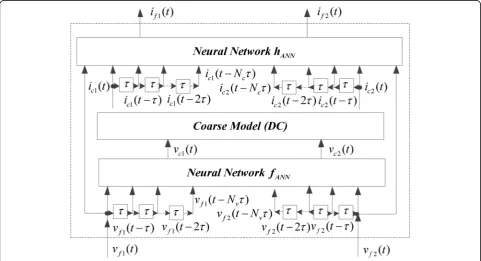
intro-duced. Figure 1 illustrates the signal flow of the
general Neuro-SM model. At first, the present volt-ages of the fine model vf(t) as well as their
histor-yvf(t−τ), vf(t−2τ), …, and vf(t−Nvτ) are mapped
into the coarse model voltages vc(t). Because the
formula of the mapping is unknown and usually nonlinear, a neural network is used to learn and represent the mapping. While the Neuro-SM
pre-sented in [10] uses a static neural network such as
multilayer perceptron (MLP), we propose to use a time delay neural network (TDNN) to map the coarse model to fine model. In functional form, vc(t)
can be described as
vcð Þ ¼t fANN vfð Þt ;vfðt−τÞ;…;vfðt−NvτÞ;w1
;Nv≥0
ð1Þ
where fANN represents the input/voltage mapping
neural network, and w1 is a vector containing all the
weights of the input mapping neural network. As
seen from Eq. (1), voltages at gate and drain of the
coarse model depend on not only the present voltages of the fine model, but also their history sig-nals making the proposed technique more suitable for modeling the dynamic behavior of the nonlinear devices. Then, after the coarse model computation,
the coarse model currents ic(t) can be obtained.
Sup-pose the total number of current delay buffers at
gate and drain be the same and both equal to Nc. At
last, ic(t) and their history ic(t−τ), …, ic(t−Ncτ) as
well as the present voltages of the fine model vf(t)
are mapped by another TDNN to the external cur-rents as
ifð Þ ¼t hANN vfð Þt ;icð Þt ;icðt−τÞ;…;icðt−NcτÞ;w2
;Nc≥0
ð2Þ
where hANN represents the output/current neural
network, and vector w2 contains all the output
map-ping neural network weights. Compared to [14], the
new output neural network mapping further refines the coarse model current signals to produce the fine model outputs. The combined dynamic voltage map-ping neural network, coarse model, and dynamic current mapping neural network is called the general Neuro-SM model.
The proposed general Neuro-SM is more general
than Neuro-SM technique presented in [10, 13, 14].
While Nv= 0, then the general Neuro-SM model
without the output mapping is static Neuro-SM
model [10]. While Nv= 0 and Nc= 0, then the
gen-eral Neuro-SM model belongs to the Neuro-SM
model with the output mapping [13]. While Nv > 0,
then the general Neuro-SM model without the
out-put mapping is the dynamic Neuro-SM model [14].
In this way, the proposed general Neuro-SM gener-alizes the previously published Neuro-SM technique. Furthermore, while Nv> 0 and Nc> 0, a new
Neuro-SM technique is presented for the first time.
Com-pared to the Neuro-SM introduced in [10, 13, 14],
the new Neuro-SM is more suitable for modeling the microwave devices with high order dynamics and nonlinearity due to inclusion of dynamic map-ping as well as current mapmap-ping.
3 Proposed analytical formulation of the general Neuro-SM model for training
The general Neuro-SM model will not be accurate unless the dynamic voltage and dynamic current mapping neural networks are trained suitable. In order to train the general Neuro-SM efficiently with
typical types of transistor modeling data, the
relationship between the dynamic voltage and
current mapping neural networks with typical types
of transistor data, such as DC, bias-dependent S
parameter, and large-signal harmonic data need to be derived.
In the DC case, present voltage signals of the fine model vf(t) as well as its history, i.e.,vf(t−τ), …, and vf(t−Nvτ) are all equal and defined as Vf, DC.
Simi-larly, present current signals of the coarse model ic(t) as well as its history, i.e.,ic(t−τ), …, and ic(t−Ncτ)
are all equal and defined as Ic, DC. The response of
the general Neuro-SM model at Vf, DCcan be
gener-ally described as
The small-signal S parameter of the general
Neuro-SM model can be calculated by transforming its Y
parameters of the coarse model Yc. In functional form,Yf can be described as
YfðωÞ
¼ XNc
l¼0
e−jωlτ∂hTANNðvfðtÞ;icðtÞ;icðt−τÞ;…;icðt−NcτÞ;w2Þ
∂icðt−lτÞ
j
vf ¼Vf:BiasicðtÞ ¼icðt−τÞ ¼⋯¼icðt−NcτÞ ¼IcjVc;Bias
!
TYcðωÞjVc;Bias
XNv
k¼0
e−jωkτ∂fANNT ðvfðtÞ;vfðt−τÞ;…;vfðt−NvτÞ;w1Þ
∂vfðt−kτÞ
j
vfðtÞ¼vfðt−τÞ¼⋯¼vfðt−NvτÞ¼Vf;Bias
!
Tþ ∂hTANNðvfðtÞ;icðtÞ;icðt−τÞ;…;icðt−NcτÞ;w2Þ
∂vfðtÞ
j
vf ¼Vf:BiasicðtÞ ¼icðt−τÞ ¼⋯¼icðt−NcτÞ ¼IcjVc;Bias
!
Tð5Þ
where
Vc;Bias ¼fANNðVf;Bias;Vf;Bias;…;Vf;Bias;
z}|{Nvþ1
;w1Þ ð6Þ
where the first-order derivatives offANN andhANNcan be obtained at the biasVf, Biasusing adjoint neural network
method [15]. Superscriptkandl represent the index of voltage and current delay buffers, respectively. Equation (5)
includes two parts. The first part is in the form of multiplications of three matrices, which are defined as the output/
current Y-mapping matrix, i.e., the sum of products ofe−jωlτand ∂hANN/∂ic,Yparameter matrix of the coarse model
Yc, as well as the input/voltage Y-mapping matrix, i.e., the sum of products ofe−jωkτand∂fANN/∂vf. The other part is
the sensitivity matrix ofhANN. Equation (5) is more general than formulas of small-signalYparameter of the
Neuro-SM models in [10, 13, 14] due to the consideration of the new effects of current mappings and dynamic mappings.
For large-signal case, we need to derive the relationship between HB computation and dynamic voltage and current mapping neural networks so that model training can be performed with harmonic data. Let the harmonic current of
the general Neuro-SM model and coarse model at a generic harmonic frequencyωkbeIf(ωk) andIc(ωk), respectively.
TheIf(ωk) can be evaluated as
I
fð Þ¼
ω
kN
1
TX
NT−1n¼0
h
ANNðv
fð Þ
t
n;
i
cð Þj
t
n vcð Þtn;
i
cð
t
n−
τ
Þj
vcð Þtn;
…
;
i
cð
t
n−
N
cτ
Þj
vcð Þtn;
w
2Þ
W
Nð
n
;
k
Þ
ð7Þ
vcð Þ ¼tn fANN vfð Þtn ;vfðtn−τÞ;…;vfðtn−NvτÞ;w1
ð8Þ
vfðtn−mτÞ ¼ XNH
k¼0
Vfð Þ ωk e−jmωkτWNðn;kÞ;m¼0;1;…;Nv ð9Þ
where the subscript k represents the index of the harmonic frequency, k = 0, 1, 2, …, NH, where NH is the
number of harmonics considered in HB simulation. NT is the number of time sampling points, WN(n,k) is
the Fourier coefficient for the nth time sample and the k-th harmonic, superscript * denotes complex
conju-gate, and m represents the index of voltage delay buffers, m = 0, 1,…, Nv,. As seen from (7)~(9), apart from
changing the nonlinearity of the coarse model, dynamic voltage and current neural network mappings can also change the dynamic order so that the proposed general Neuro-SM has the potential to model the microwave devices with high order dynamics and nonlinearity.
4 Sensitivity analysis of the general Neuro-SM model with respect to mapping neural network weights
Let the number of hidden neurons of the dynamic voltage and current mapping neural networks be Nhv
and Nhc, respectively. Let generic symbols w1, i (i= 1, 2,…, Nhv) and w2, i (i= 1, 2,…,Nhc) be internal
weights of the voltage and current mapping neural network, respectively. w1, i and w2, i are the i-th
compo-nent of vectors w1 and w2, respectively. In order to train the general Neuro-SM efficiently, gradient
infor-mation provided by sensitivities of the model with respect to w1, i and w2, i is needed [16].
(1)DC sensitivity: let the DC output at gate and drain of the general Neuro-SM model beIf, DC. The sensitivities of If, DCwith respect tow1,iandw2,iare described in functional form as
∂If;DC
∂w1;i ¼
∂IT f;DC
∂Ic;DC
!T
∂ITc;DC
∂Vc;DC
!T
∂Vc;DC
∂w1;i
¼ ∂hTANN
Vf;DC;Ic;DCVc;DC;Ic;DCVc;DC;…;Ic;DCVc;DC
z}|{Ncþ1
;w2
∂Ic;DC
!T
Gc
∂fANNðVf;DC;Vf;DC;…;Vf;DC zfflfflfflfflfflfflfflfflfflfflfflfflfflfflfflfflfflfflffl}|fflfflfflfflfflfflfflfflfflfflfflfflfflfflfflfflfflfflffl{Nvþ1
;w1Þ
∂w1;i
ð10Þ
∂If;DC
∂w2;i ¼
∂hANNðVf;DC;Ic;DCVc;DC;Ic;DCVc;DC;…;Ic;DCVc;DC
z}|{Ncþ1
;w2Þ
∂w2;i ð11Þ
where Gc¼ ð∂ITc;DC=∂Vc;DCÞ T
is the DC conductance matrix of the existing coarse model, and the first-order
derivatives ∂fANN/∂w1, i and ∂hANN/∂w2, i can be calculated by neural network backpropagation [17].
(2) S parameter sensitivity: S parameter sensitivity can be obtained by converting its Y parameter sensitivity.
The small-signal Y parameter sensitivities of the general Neuro-SM model with respect to w1, i and w2, i are
where the second-order derivative of the dynamic voltage and current mapping neural networks fANN and
hANN, which are the differentiation of the Jacobian matrix ∂fTANN=∂icðt−lτÞ and ∂fTANN=∂vfðt−kτÞ with respect
to w1, i and w2, i, can be obtained by the adjoint neural network back-propagation [17], respectively.
(3) HB sensitivity: the sensitivities of the large-signal harmonic current of the general Neuro-SM model with re-spect tow1,iandw2,iat a generic harmonic frequencyωk,k= 0, 1, 2,…,NHcan be described in functional form as
whereGc(tn) at the mapped voltage of coarse model vc(tn) is the nonlinear conductance matrix of the existing coarse
model at time pointtn.
5 Sensitivity analysis of the general Neuro-SM model with respect to coarse model parameters
Let x be a generic variable in the coarse model. In case the coarse model parameter needs to be treated as a
variable in circuit optimization, it is useful to obtain the sensitivity for DC, bias-dependentSparameter, and
large-signal HB responses of the general Neuro-SM model due to changes in the generic optimization variablex.
(1)DC sensitivity: the sensitivity ofIf, DCwith respect toxis derived as
∂If;DC
(2)S parameter sensitivity:Sparameter sensitivity with respect to coarse model variablexcan also be calculated by converting itsYparameter sensitivity. TheYparameter sensitivity is shown as
where∂Yc/∂xis the sensitivity forYparameter of the coarse model due to changes inx.∂icr/∂x,r= 1, 2 is the
deriva-tive of coarse model current with respect tox,which can be calculated by coarse model sensitivity analysis.
(3) HB sensitivity: the sensitivity of the harmonic current of the general Neuro-SM model with respect tox at a generic harmonic frequencyωk,k= 0, 1,…,NH is shown in Eq. (18), where∂ic(tn)/∂xis the sensitivity of the
nonlin-ear current of the coarse model with respect toxat time sampletn.
∂Ifð Þωk
6 Proposed training algorithm for the general Neuro-SM model
Training is the key step to determine the general Neuro-SM model. The model development process needs two phases: initial training and formal training.
A.Initial training
Before the nonlinear device data from simulation or measurement is used for formal training, the general Neuro-SM model is first initialized to be equal to the original coarse model. In such case, the dynamic voltage and current neural networks are initialized to learn unit mappings, i.e., to learn the relationshipsvc1(t) =vf1(t),vc2(t) =vf2(t),ic1(t)
=if1(t), andic2(t) =if2(t) in the entire operation range of the nonlinear device.
B.Formal training
In this phase, the weights of dynamic voltage and current mapping neural networks, i.e., w1 and w2, are
trained such that the overall training error of the general Neuro-SM model can be reduced to satisfy the
specifications. The overall training error for combined DC, small-signal S parameter, and large-signal HB
training is defined as the total difference between all nonlinear device data and the general Neuro-SM model as:
where I(.), S(.), and HB(.) are the DC, bias-dependent S parameter, and HB responses of the general Neuro-SM
model, respectively. Take FET modeling as an example, vector I(.) contains gate and drain current If1 and If2,
which can be computed by Eq. (3). Vector S(.) is achieved from the Y matrix defined by Eq. (5). HB responses
of the general Neuro-SM model, i.e., HB(.) can be calculated by Eq. (7). ID, SD, and HBD represent the DC
current, small-signal S parameter, and large-signal HB responses of the modeling device, respectively. The
sub-script k ðk¼1;2;…;NVf2Þ, l ðl¼1;2;…;NVf1Þ, j (j= 1, 2,…,Nfreq), m (m= 1, 2,…,NH), and n (n= 1, 2,…,NP)
denote the indices of Vf2,Vf1, frequency, harmonic frequency, and input power level, respectively. NVf1, NVf2,
Nfreq, NH, and NP are the total number of Vf1, Vf2,frequency, harmonic frequency, and input power level,
re-spectively. Diagonal matrices A, B, and C contain all the scaling factors, which are defined as the inverse of
the minimum-to-maximum range of the ID data, SD data, and HBD data, respectively. The training error
calcu-lation of the general Neuro-SM model for combined DC and S parameter training as well as HB training
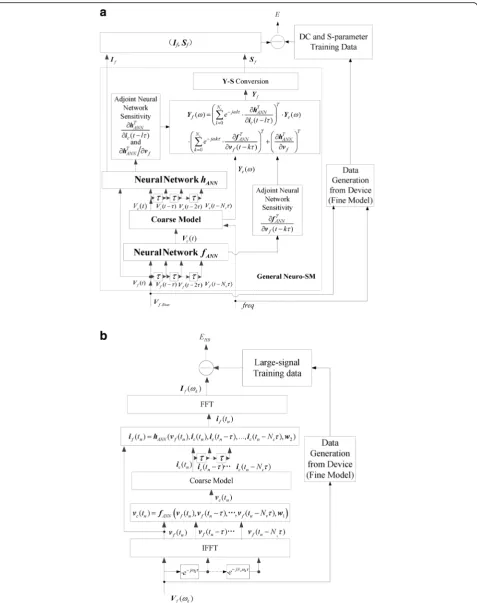
fur-ther illustrates in Fig. 2. Figure 2a, b is error calculation for combined dc and small-signalS parameter training
The objective of the model training is to minimize the errorEdefined in (19) by optimizingw1and w2. In gen-eral, gradient-based training algorithm is used. After training, the general Neuro-SM model with appropriate hidden neurons and delay buffers can accurately repre-sent the nonlinear behavior of the modeling device.
7 Discussion
The proposed Neuro-SM model, after being trained for a specific range, is very good at representing the nonlin-ear behavior of the microwave device within the training region. However, when we use model in a wider range than the training range, inappropriate derivative infor-mation of the model outside the training range may mis-lead the iterative process into slow convergence or even divergence during large-signal simulation. One possible way to solve the divergence problem is to use
appropriate extrapolation technique. For general Neuro-SM technique, a simple and effective extrapolation technique is used to improve the convergence of the model [18].
For simplification, the proposed general Neuro-SM technique is formulated for 2-port field-effect transistor (FET) modeling. This approach can be further extended ton-port network, where all the notations and equations are extended accordingly. After the generalization, the proposed general Neuro-SM technique has the potential to be used for developing models of microwave devices with trapping effect.
The format of the general Neuro-SM model presented so far is to map the voltage input signals between the coarse and fine models. Hence, our approach presented so far is applicable to modeling voltage controlled devices, such as FET and HEMT. It is possible to extend
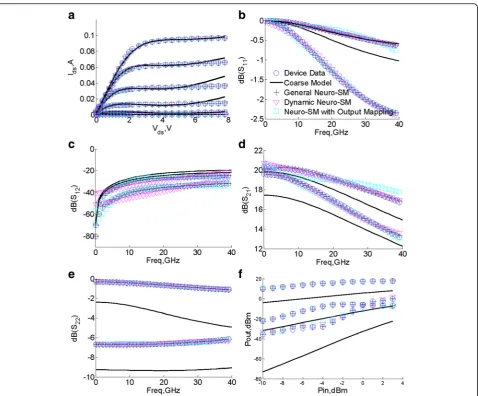
Fig. 3Comparison between the pHEMT device data, coarse model, and three Neuro-SM models.adc.b-eS parameter at two test biase points
the method to a mixed input mapping case, where the dynamic input mappings are for a mixture of port volt-age and current signals. In that way, our approach can be extended to modeling current controlled devices, such as HBT.
The frequency limit of the proposed general Neuro-SM model depends on the frequency limit of training data. For example, if the frequency in the training data extends to millimeter wave bands, the proposed general mapping will be even more important because of the need of capacitive effects, non-quasi-static effects, and
nonlinear effects in the model. In this case, more hidden neurons and time delay buffers maybe needed to guarantee the accuracy of the proposed general Neuro-SM model.
8 A pHEMT modeling using the proposed general Neuro-SM method
This example illustrates the use of the general
Neuro-SM for modeling of a real 2 × 50 μm GaAs pHEMT
device. The training and test data is obtained from measurement. An enhanced Angelov model including a
thermal subcircuit to model the self-heating effect of the device proposed in [19] is used as the existing coarse model. Even though parameters in enhanced Angelov model are extracted as much as possible, there are still distinct differences between the model and measured data. Thus, Neuro-SM is used to bridge the gap between the coarse model and measured data. We then apply the previously published Neuro-SM technique such as
Neuro-SM with the output mapping [13] and dynamic
Neuro-SM [14] to get more accurate models. After train-ing, the accuracy of the two Neuro-SM models is clearly improved compared to that of the coarse model, as
shown in Fig.3. However, the previous Neuro-SM
tech-niques at their best are still insufficient to achieve the desired accuracy. Then, our proposed general Neuro-SM is used to get a more accurate model.
Training was firstly done in NeuroModelerPlus
[20] using DC and bias-dependent S parameter data
for 400 iterations. Then, training refinement was
done using combined DC, bias-dependent S
param-eter, and HB data at 189 different biases for 3600 iterations. Harmonic data used for HB training was measured at 7.5 GHz fundamental frequency and
dif-ferent input power levels (−10~ 3 dBm). Time delay
parameters are both 0.008 ns. The number of hidden neurons for both voltage and current mapping neural networks is 30.
9 Results
After training, we compared the DC, bias-dependentS par-ameter, and large-signal HB responses of the pHEMT de-vice with those computed from the coarse model, Neuro-SM with the output mapping [13], dynamic Neuro-SM [14] with 5 delay buffers and 30 hidden neurons, and the pro-posed general Neuro-SM model with 5 delay buffers and 30 hidden neurons both for dynamic voltage and current map-ping neural networks as shown in Fig.3. In Fig.3a, b–e, f represent the comparisons of dc,S parameter at two test bias points (0.7 V, 2.4 V) and (0.3 V, 5.2 V), as well as HB responses at different input power levels (−10~ 3 dBm), re-spectively. As observed from Fig. 3, the responses com-puted from the proposed general Neuro-SM are closest to the data among all the four models in this comparison. We obtain further improvement in model accuracy using gen-eral Neuro-SM technique because additional and useful de-grees of freedom provided by the new dynamic current mappings at the gate and the drain in the general model. The increased accuracy of the general Neuro-SM model helps to improve the accuracy of circuit and system simula-tion, such as simulation to predict power performance and linearity of high-frequency PA designs.
There are two important factors that impact the accur-acy of the dynamic Neuro-SM model and the proposed general Neuro-SM model, i.e., number of hidden
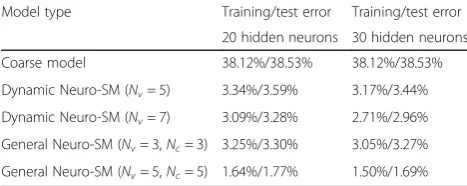
neurons and delay buffers. To show the results further, we compared the training and test error of the dynamic Neuro-SM and general Neuro-SM with different delay buffers and hidden neurons as shown in Table1. As seen
in Table 1, general Neuro-SM with 30 hidden neurons
and 5 delay buffers both for dynamic voltage and current mapping neural networks are suitable for this example.
The proposed general Neuro-SM model can be conveniently implemented into the existing circuit simulators such as Keysight ADS for high-level
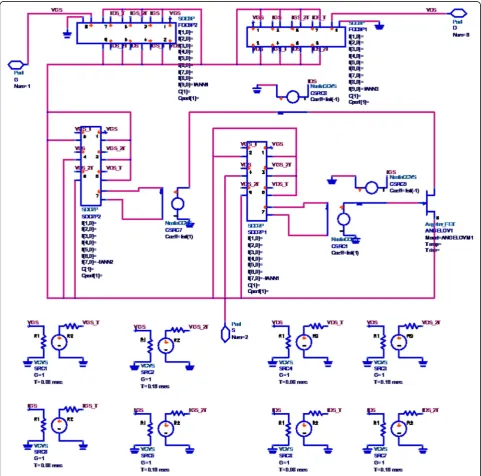
cir-cuit and system design. Figure 4 shows the proposed
general Neuro-SM model structure in ADS. The time delay parameter is 0.08 ns. In this figure, the dy-namic voltage mapping neural networks are embed-ded as the functions in two 7-port symbolically defined devices (SDDs), i.e., SDD7P1, and SDD7P2. Similarly, the dynamic current mapping neural net-works are embedded as the functions in two 9-port SDDs, i.e., SDD9P1 and SDD9P2. Time delay voltage and current signals can be obtained using voltage controlled voltage sources with delay parameters, i.e., SRC1~SRC8. After implementing the general Neuro-SM model into ADS, we have also compared simula-tion speed between coarse model, dynamic Neuro-SM, and the proposed general Neuro-SM model on an Intel i5-3230M 2.6 GHz computer as shown in
Table 2. The simulation was performed by Monte
Carlo analysis of 200 HB simulations. As seen in
Table 2, the simulation time is 48.32 s using coarse
model, compared to 57.17 s using general Neuro-SM, showing that the simulation speed of the pro-posed general Neuro-SM is acceptable in view of its good accuracy.
10 Conclusions
This paper has presented a general Neuro-SM tech-nique for nonlinear device modeling. By modifying the dynamic current and dynamic voltage relation-ships in the existing coarse model, the proposed gen-eral Neuro-SM model can exceed the accuracy limit over the coarse model, the Neuro-SM model with the
Table 1Training and test error comparison of coarse model, dynamic Neuro-SM model, and the proposed general Neuro-SM model after combined DC,Sparameter, and HB training
Model type Training/test error Training/test error
20 hidden neurons 30 hidden neurons
Coarse model 38.12%/38.53% 38.12%/38.53%
Dynamic Neuro-SM (Nv= 5) 3.34%/3.59% 3.17%/3.44%
Dynamic Neuro-SM (Nv= 7) 3.09%/3.28% 2.71%/2.96%
General Neuro-SM (Nv= 3,Nc= 3) 3.25%/3.30% 3.05%/3.27%
output mapping, and the dynamic Neuro-SM model. Compared to previously published Neuro-SM, the proposed general Neuro-SM has demonstrated much improved performance in terms of accuracy by a pHEMT modeling example. The general Neuro-SM model can be applied to microwave circuit and sys-tem design.
Acknowledgements
The authors would like to thank Prof. Q. J. Zhang at Carleton University, Ottawa, ON, Canada, for valuable discussions and insights throughout this work.
Funding
This work is supported by the Fundamental Research Funds for Universities in Tianjin (No. 2016CJ13), partly supported by the Key project of Tianjin Natural Science Foundation (No. 16JCZDJC38600), National Natural Science Foundation of China (No. 61601494, 61602346), and the Research Forums Cooperation Project of ZTE Corporation (2016ZTE04-09).
Availability of data and materials
The training and test data of the microwave transistor is obtained from measurement and can be shared if it is necessary.
Authors’contributions
The authors have contributed jointly to all parts on the preparation of this manuscript. LZ (first author) and JZ contributed to the structure and sensitivity analysis of the general Neuro-SM model. LZ (third author), WL and LP contributed to the training algorithm development. HW and DL contributed to the analysis of simulation results. All authors read and approved the final manuscript.
Competing interests
The authors declare that they have no competing interests.
Publisher’s Note
Springer Nature remains neutral with regard to jurisdictional claims in published maps and institutional affiliations.
Author details
1School of Control and Mechanical Engineering, Tianjin Chengjian University, Tianjin 300384, China.2Tianjin Key Laboratory of Wireless Mobile
Communications and Power Transmission, Tianjin Normal University, Tianjin 300387, China.3College of Electronic and Communication Engineering, Tianjin Normal University, Tianjin 300387, China.4School of Microelectronics, Tianjin University, Tianjin 300072, China.5Chengdu Ganide Technology Co., Ltd., Chengdu 610091, China.6Shijiazhuang Mechanical Engineering College, Shijiazhuang 050003, China.
Received: 27 August 2017 Accepted: 20 January 2018
References
1. Z Li, Y Chen, H Shi, et al., NDN-GSM-R: a novel high-speed railway communication system via named data networking. EURASIP J. Wirel. Commun. Netw.48(1), 1–5 (2016)
2. H Shi, Z Li, D Liu, et al., Efficient method of two-dimensional DOA estimation for coherent signals. EURASIP J. Wirel. Commun. Netw.60, 1–10 (2017)
3. F Zhao, L Wei, H Chen, Optimal time allocation for wireless information and power transfer in wireless powered communication systems. IEEE Trans. Veh. Technol.65(3), 1830–1835 (2016)
4. D Liu, Z Li, X Guo, et al., DOA estimation for wideband chip with a few snapshots. EURASIP J. Wirel. Commun. Netw.28, 1–7 (2017)
5. F Zhao, B Li, H Chen, et al., Joint beamforming and power allocation for cognitive MIMO systems under imperfect CSI based on game theory. Wirel. Pers. Commun.73(3), 679–694 (2013)
6. F Zhao, W Wang, H Chen, et al., Interference alignment and game-theoretic power allocation in MIMO heterogeneous sensor networks
communications. Signal Process.126(9), 173–179 (2016)
7. Z Li, L Song, H Shi, Approaching the capacity of K-user MIMO interference channel with interference counteraction scheme. Ad Hoc Netw.58(4), 286–291 (2017) 8. F Zhao, H Nie, H Chen, Group buying spectrum auction algorithm for
fractional frequency reuses cognitive cellular systems. Ad Hoc Netw.58(4), 239–246 (2017)
9. F. Zhao, X. Sun, H. Chen, et al., Outage performance of relay-assisted primary and secondary transmissions in cognitive relay networks, EURASIP J. Wirel. Commun. Netw., 2014, 60(1).
10. L Zhang, J Xu, M Yagoub, et al.,Neuro-space mapping technique for nonlinear device modeling and large-signal simulation(IEEE MIT-S Int. Microwave Symp, Philadelphia, PA, 2003), pp. 173–176
11. Q Zhang, K Gupta, V Devabhaktuni, Artificial neural networks for RF and microwave design: From theory to practice. IEEE Transaction on Microwave Theory and Techniques51(4), 1339–1350 (2003)
12. J Bandler, Q Cheng, S Dakroury, et al., Space mapping: the state of the art. IEEE Transaction on Microwave Theory and Techniques52(1), 337–361 (2004) 13. L Zhu, K Liu, Q Zhang, et al.,An enhanced analytical neuro-space mapping
method for large-signal microwave device modeling(IEEE MIT-S Int. Microwave Symp. Dig, Montreal, QC, 2012), pp. 1–3
14. L Zhu, Q Zhang, K Liu, et al., A novel dynamic neuro-space mapping approach for nonlinear microwave device modeling. IEEE Microwave and Wireless Components Letters26(2), 131–133 (2016)
15. L Zhang, J Xu, MC Yagoub, et al., Efficient analytical formulation and sensitivity analysis of neuro-space mapping for nonlinear microwave device modeling. IEEE Transaction on Microwave Theory and Techniques53(9), 2752–2767 (2005)
16. Q Song, J Spall, Y Soh, et al., Robust neural network tracking controller using simultaneous perturbation stochastic approximation. IEEE Transaction on Neural Network19(5), 817–835 (2008)
17. Q Zhang, K Gupta,Neural network for microwave design(Artech House, Boson, MA, 2000)
18. L Zhang, QJ Zhang, Simple and effective extrapolation technique for neural-based microwave modeling. IEEE Microwave Component Letter20(6), 301– 303 (2010)
19. L Liu, J Ma, G Ng, Electrothermal large-signal model of III-V FETs including frequency dispersion and charge conservation. IEEE Transaction on Microwave Theory and Techniques57(12), 3106–3117 (2009)
20. NeuroModelPlus_V2.1E, Q. J. Zhang, Dept. of Electronics, Carleton University, Ottawa, ON, Canada.
Table 2Model simulation time comparison between coarse model, dynamic NEURO-SM, and the general Neuro-SM model
Model type HB simulation
Coarse model 48.32 s
Dynamic Neuro-SM 54.23 s