R E S E A R C H
Open Access
Game-theoretic analysis of opportunistic
spectrum sharing with imperfect sensing
Fang Wang
1, Jinting Wang
1*and Wei Wayne Li
2Abstract
We consider the strategic behavior of secondary users (SUs) in a cognitive radio system where SUs opportunistically share a single primary user (PU) band over a coverage area. The service of an SU can be interrupted by a PU in a preemptive manner, and the interrupted SU may abandon the system or wait until the PU band is sensed available. In the latter case, if spectrum sensing errors occur, they will cause misdetections and false alarms which impact the system’s performance heavily. In this paper, we model this problem as a retrial queueing system with server
breakdowns and recoveries in which the interrupted SUs are treated as retrial customers. They will retry for using the PU band after some period of time due to interruptions or misdetections. The arrival of a PU during service of an SU is modeled as a server breakdown, and the recovery time is equivalent to the service time of this PU. We focus on the behavior of arriving SUs who can make decisions on whether to join the system or to balk based on a natural cost structure and the delays caused by PUs’ interruptions, which can be studied as a non-cooperative game. The equilibrium and optimal strategies of SUs are both derived. Furthermore, to bridge the gap between the individually and socially optimal strategies, a novel strategy of imposing an admission fee on SUs to join the retrial group is proposed. Finally, some numerical examples are presented to show the effect of several key parameters on the system performance.
Keywords: Cognitive radio, Imperfect spectrum sensing, Retrial queue, Strategic behavior, Admission fee
1 Introduction
Spectrum is recognized as one of the limited transmission resources which face the challenges of the ever increasing demand for higher data rates and lower latency in com-munication networks. Cognitive radio (CR) first intro-duced by Mitola [1] can alter its transmitter parameters to accommodate the environment where it operates to utilize spectrums more efficiently. The potential of cogni-tive radio is being recognized not only by the military but also by the commercial sector, for example, in intelligent transportation, in cellular communications, and in public safety.
Previous studies have shown that the utility of the spectrum is very low under conventional static spectrum access strategies [2]. As the users’ demands increase while the amount of dedicated spectrum is limited, more and more network users have to choose dynamic spectrum
*Correspondence: [email protected]
1Department of Mathematics, Beijing Jiaotong University, No. 3 Shang Yuan Cun, Beijing, China
Full list of author information is available at the end of the article
access (DSA) which has been considered as a viable solu-tion to alleviate this spectrum scarcity and improve radio communication efficiency. An amount of work focused on the performance analysis of various systems; how-ever, they neglect the competition between different users. The relationship between users and operators of radio networks is also worth considering.
There are two kinds of users in cognitive radio net-works, namely, licensed (primary) users and unlicensed (secondary) users. The secondary users can use the capa-bilities of spectrum sensing, learning, and adaptation to use the licensed spectrum to transmit, thereby enabling coexistence and leading to higher overall spectral effi-ciency. In general, due to the fact that in CR networks primary users (PUs) have priorities over secondary users (SUs) and the arrivals of PUs will interrupt the service of SUs (if any), researchers use queueing systems with break-downs to characterize the interruption process involved. To SUs, the preemptive priority scheme underlying the
CR network implies that the arrival and service of any PU will bring a breakdown and repair process by means of queueing way of saying.
In CR systems, in most cases, there is no centralized controller to regulate channel access. Hence, a rational secondary user needs to give his strategies relying on local information and has to adapt to the environment quickly. It is natural to form a spectrum market including cooperation, pricing, and leasing since PUs have a limited number of spectrum bands. In these spectrum markets, user behaviors can be modeled and analyzed by economic games. Tran et al. [3] studied delay-sensitive secondary users via pricing strategies in a dynamic spectrum market with a single PU band. Do et al. [4] considered a duopoly market with cooperative and non-cooperative models and provided the analysis of the pricing effect on equilib-rium behavior of SUs by using the M/G/1 queue with breakdown.
Game-theoretic spectrum sharing criteria could be used to maximize both primary and secondary users’ satisfac-tion (see [5–7]). Several studies in the literature [8–11] considered the decentralized behavior of SUs and adopted queueing-game approach to investigate the interactions between PUs and SUs in the CR networks. Li and Han [8] studied the discrete model in a more applicable way which obtained the threshold of queue length to char-acterize the optimal joining strategy of SUs. Do et al. [9] investigated the socially optimal strategy of SUs in unobserved queueing system in cognitive radio base sta-tion. Jagannathan et al. [10] illustrated SUs utilizing white spaces that were not used by PUs in the unobservable case by the same model but did not consider the opti-mization strategy. All of these works [8–10] assumed that there is a queue in front of the PU band and the new arrivals of SUs will enter the queue according to a first-in-first-out (FIFO) discipline. Recently, Wang and Li [11] considered the strategic behavior of SUs with retrials but assumed that the interrupted SU did not leave the service area and it would get service immediately once the occu-pied PU completed service and left the band. It should be noted that, in all the aforementioned papers, spectrum sensing is assumed to be perfect. None of these works con-sidered sensing failure problem although sensing failures occur in practice and have non-ignorable impact on the system.
Indeed, spectrum sensing plays a vital role in CR net-works due to unreliability of wireless channels and users’ congestions. In principle, spectrum sensing is imperfect. When an idle band is sensed busy, a false alarm is said to occur. A misdetection refers to the situation that a busy band is sensed idle. These two kinds of errors have sig-nificant effects on the performance of CR systems. The probability of a false alarm and that of a misdetection should be kept below a certain level to guarantee the
QoS of PUs and also SUs, i.e., the system performance is acceptable. In [12–18], the authors took imperfect sensing into account. Hoang et al. [12] considered a CR sys-tem with one single slotted channel sharing by a PU and an SU, and the problem was formulated as a par-tially observable Markov decision process. It was shown that the optimal control policies could achieve significant performance gain. In [14], a two-dimensional discrete-time Markov chain is used to model a multiple-channel CR system with imperfect sensing. In [15], the multiple-channel CR system with unreliable spectrum sensing was discussed and the authors employed a two-dimensional continuous-time Markov chain model to analyze the sys-tem. However, strategic behavior of SUs has not been taken into account in these studies and the above mod-els cannot reflect the decentralized behavior of SUs along with the opportunistic sharing operation in practice.
In this paper, we focus on the strategic behavior of SUs in CR networks from a game-theory point of view. More specifically, we consider the general carrier sense multiple access (CSMA) protocol arising from wireless communi-cation networks. The basic idea of this CSMA protocol lies in the fact that packets start transmission only if no transmission is ongoing and “listen before talk” protocol is adopted. That is, every user before attempting any trans-mission listens whether somebody else is already using the channel, avoiding the possible collision. To characterize these factors, we model the CR system as a constant retrial queueing system with server breakdowns, where SUs get access to the PU band according to “listen before talk” pro-tocol as retrial customers. The PU band is considered as a server, and the PUs have the higher priority over all SUs. When the PU arrives, it will occupy the PU band imme-diately no matter whether the band is serving an SU or is in an idle state. Under the assumption of imperfect spec-trum sensing, an extensive study of the Nash equilibrium and the socially optimal strategies for all SUs is carried out in this paper. Besides, to use the PU band more efficiently and eliminate the difference between the equilibrium and the socially optimal strategies, a novel approach of impos-ing an appropriate admission fee for SUs that decide to join the orbit is proposed under sensing failure. In this way, it is feasible to induce individually optimizing SUs to behave in a socially optimal way.
In the work of Wang and Li [11], they assumed that the interrupted SU would not leave the service area and it will get service immediately once the occupied PU completes his service. As a result, the new arrivals of SUs during this period (the waiting period of interrupted SU in the ser-vice area) have to enter the retrial orbit for later attempts. Evidently, this is more realistic in CR networks. To sum-marize, the contributions of this paper lie in the fact that we study the SUs’ joining behavior in CR networks with a single bandwidth under imperfect spectrum sensing along with constant retrial queueing system for the first time.
The paper is organized as follows. Section 2 presents the model descriptions. In Section 3, we derive the aver-age sojourn time for the arriving SUs who decide to enter the cognitive radio base station when they are not informed the system’s information with imperfect spec-trum sensing. The equilibrium joining probabilities and socially optimal strategies of SUs are derived. An appro-priate admission fee is proposed to eliminate the differ-ence between these two strategies. Section 4 illustrates the effect of various performance measures on the sys-tem by analytical and numerical comparisons. Finally, in Section 5, we give some conclusions.
2 System model
We consider a cognitive radio base station which incor-porates a single PU band that is shared by SUs. It means that the PU band can transmit either one PU packet or one SU packet at one time. We regard the PU band as a server. As PUs have high priorities to use the band, an emerging PU should be served immediately no mat-ter whether the band is serving an SU or in an idle state. SUs can opportunistically use the band when it is not occupied.
The primary SUs and PUs arrive to the system accord-ing to a Poisson process with ratesλsandλp, respectively.
The service time for SUs (or PUs) follows an exponen-tial distribution with rateμs (orμp). If the server is free
when an SU arrives, the SU starts service immediately. Otherwise, if the arriving SU finds the server unavail-able or an SU in service is squeezed out by an PU, in both cases, the SU will enter an artificial waiting space called “retrial orbit” in order. When the PU band becomes idle, it will be sensed by the first SU in the orbit and the inter-sensing time follows an exponential distribution with parameterθ. The arrival processes of PUs and SUs, service processes of PUs and SUs, sensing process, and retrial process of SUs are mutually independent of each other.
If the spectrum sensing is perfect, the QoS experienced by PUs should not be affected by the SUs. However, in practice, a PU may experience disruptions by the SUs’ imperfect sensing. The first case is that if a secondary user searches for the occupied band incorrectly as idle status,
collisions will occur. The second kind of disruption to a PU may occur when an ongoing SU transmitting on a given band fails to detect the emergence of an arriving primary user on that band. We refer to these two detec-tion errors as class-A and class-B misdetecdetec-tion events, respectively. In this paper, we will only consider class-B misdetection events.
Misdetection events can negatively impact the perfor-mance of the system. When a misdetection event occurs, an ongoing SU may incorrectly detect that there is no PU arriving, but in fact, there is a PU entering the band. The PU will be blocked and the SU will be dropped into the retrial orbit at the same time. Meanwhile, a false alarm may also happen when an ongoing SU incorrectly detects the presence of a PU on the same channel, but in fact, there is no PU entering the channel. Once this occurs, the SU will be dropped into the retrial orbit. In this paper, we denote bypmandpf the probabilities of misdetection and
false alarm, respectively.
Every arriving SU who wants to get service at the cog-nitive radio base station can decide whether or not to join the system. We will consider the unobservable case that SUs do not know the information (i.e., whether the PU band is available or not and the total SUs in the retrial orbit) about the system. After each service completed, an SU will get a reward ofRunits. And the cost for delay in the system is charged by C units pet time unit. All SUs want to maximize their own benefit and they are risk neutral. It is irrevocable for their decisions on join-ing or balkjoin-ing accordjoin-ing to their assessment on the reward against the costs.
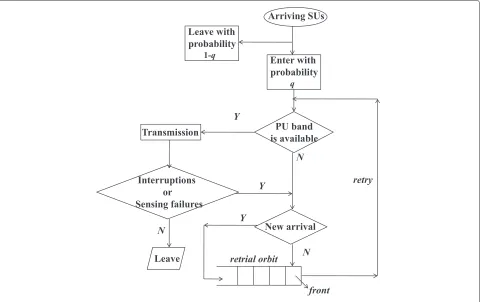
In the game-theoretic spectrum sharing model depicted in Fig. 1, we characterize SUs’ strategies by a valueq ∈ [ 0, 1] which is the probability an SU decides to enter the system (thus, with probability 1− q, the SU decides to leave the system), i.e., the effective entering probability for SUs isλsq. As all SUs are allowed to take their own
deci-sions, this system can be regarded as a non-cooperative game and the aim of our investigation is to derive the sym-metric Nash equilibria. We will study the SUs’ equilibrium behavior and socially optimal strategies in the unobserv-able retrial queueing systems under the impact of sensing failures. Moreover, to use the PU band more efficiently and eliminate the difference between the equilibrium and the socially optimal strategies, we propose an effective approach of imposing an appropriate admission fee for SUs that decide to join the system. This control policy can induce individually optimizing SUs to behave in a socially optimal way and therefore to utilize the spectrum more economically.
For convenience, all notations used in this paper are listed in Table 1. For simplicity, denote by
η ≡ 1−pm−pf
λp and ξ ≡ pmλp + pfμs,
Fig. 1Game-theoretic spectrum sharing model with imperfect sensing
3 Equilibrium analysis and optimal control
In this section, we first study the stability condition of this system and then give a game-theoretic equilibrium anal-ysis. An optimal control policy is discussed based on the gap between equilibrium strategy and the socially optimal strategy of SUs.
3.1 Stability condition and expected delay
Let(I(t),N(t))represent the state of the system at time
Table 1Important notations
Symbol Explanation
R Reward for each service
C Cost per time unit
λs Arrival rate for primary SUs
λp Arrival rate for primary PUs
μs Transmission rate for SUs
μp Transmission rate for PUs
θ Constant retrial rate
pm The probability of misdetection
pf The probability of false alarm
p Admission fee
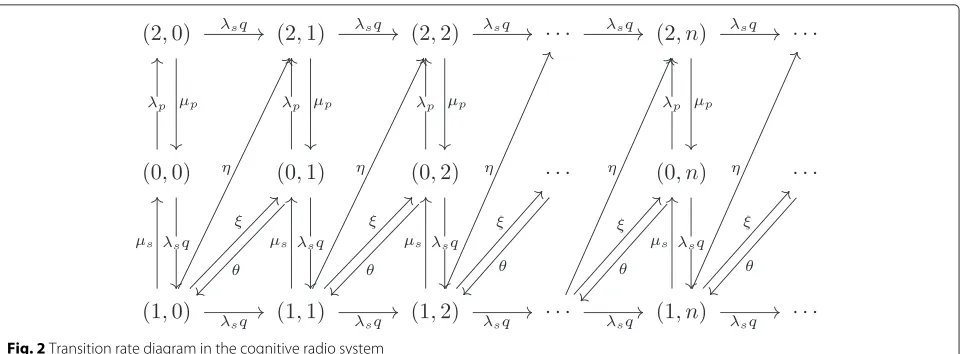
t, where I(t) denotes the state of the server (0, idle; 1, serving an SU; 2, serving a PU) andN(t)records the num-ber of the customers in the retrial orbit. From the model description, it is obvious that the process{I(t),N(t),t ≥ 0} is a continuous Markov chain with state space = {(i,j),i = 0, 1, 2,j ≥ 0}. The system states and transition rate diagram are shown in Fig. 2.
Proposition 1. The quasi-birth-and-death (QBD) pro-cess {I(t),N(t)} is positive recurrent if and only if the condition
(λsq+θ)
μpμs−λsq(μp+η)
>λsq
λp+μp
(μs+η+ξ)
is established.
Proof. The proof is given in Appendix 1.
Fig. 2Transition rate diagram in the cognitive radio system
byp(i,j), the steady-state probability of state(i,j)and the balance equations of the system is given below.
λp+λsq
p(0, 0)=μpp(2, 0)+μsp(1, 0), (1)
λp+λsq+θ
p(0,j)=μpp(2,j)+μsp(1,j)
+ξp(1,j−1),j=1, 2,. . ., (2)
(μs+η+ξ+λsq)p(1, 0)=θp(0, 1)+λsqp(0, 0) (3)
(μs+η+ξ+λsq)p(1,j)=θp(0,j+1)+λsqp(1,j−1)
+λsqp(0,j),j=1, 2,. . .,
(4)
μp+λsq
p(2, 0)=λpp(0, 0), (5)
μp+λsq
p(2,j)=λpp(0,j)+λsqp(2,j−1)
+ηp(1,j−1),j=1, 2,. . .. (6) We define the partial generating functions:
pi(z)=
∞
j=0
zjp(i,j), i=0, 1, 2. (7)
Multiplying Eqs. (1)–(6) byzj and summing up overj, we get the following equations.
(λp+λsq+θ)p0(z)−θp(0, 0)=μpp2(z)+μsp1(z)
+ξzp1(z), (8)
(μs+λsq(1−z)+η+ξ)zp1(z)=(λsqz+θ)p0(z) −θp(0, 0), (9)
(μp+λsq(1−z))p2(z)=ηzp1(z)+λpp0(z). (10) After eliminatingp(0, 0)from Eqs. (8) and (9) and com-bining with Eq. (10), we get
λsqp0(z)=(μs−λsqz)p1(z)−λsqp2(z). (11)
Inserting z = 1 into Eqs. (10) and (11), we get the relations betweenp0(1),p1(1)andp2(1)as follows:
p2(1) = λp(μs−λs
q)+λsqη
(λp+μp)λsq
p1(1),
p0(1) = μpμs−(μp+η)λs q
(λp+μp)λsq
p1(1).
By virtue of the normalizing condition
∞
j=0
(p(0,j)+p(1,j)+p(2,j))=p0(1)+p1(1)+p2(1)=1,
we can get the probabilities that the PU band is idle, occu-pied by an SU, or occuoccu-pied by a PU, respectively, given by
p0(1) = μpμs−
μp+η
λsq
λp+μp
μs
, (12)
p1(1) = λs q
μs
, (13)
p2(1) = λp(μs−λs
q)+λsqη
λp+μp
μs
. (14)
The expected number of customers in the retrial orbit under the stateiis therefore given by
E[Ri]=
∞
j=0
jp(i,j),i=0, 1, 2.
With the help ofpi(z), we obtain that
Differentiating Eqs. (8), (10), and (11), and takingz =1
From Eqs. (15)–(17), we can easily get the expressions ofp0(1),p1(1)andp2(1). Hence, the expected number of customers in the system is given by
N=
Further, the expected delay of an arriving SU is given by
T(q) = N
λsq
. (19)
3.2 Nash equilibrium
Based on the results obtained above, the equilibrium behavior of SUs is given as follows.
Theorem 1.In the considered model, a unique mixed equilibrium strategy which is the joining probability qeis
given by
Proof. The proof is presented in Appendix 2.
Remark 1.Suppose that qis the joining probability of other arriving SUs, if q < qe, we can conclude that the
expected net benefit of the tagged SU is positive once he enters the system. In this case, the unique response is 1. Similarly, the unique best response is 0 ifq >qe. What is
more, any strategy between 0 and 1 is a best response if q=qe. This shows that an individual’s best response is an
decreasing function of the strategy by the others, i.e., the higher the joining probability selected by the others, the lower is one’s best response. Therefore, we have an “avoid the crowd” (ATC) situation. We conclude that qe is the
unique equilibrium strategy.
3.3 Socially optimal strategy
Now, we turn our attention to social optimization. In the real situation where resources are limited, this queueing system considered from a social point of view is of great significance. The social objective function is defined as
Ssoc = λsq(R−CT(q)), (21)
where λsq is the effective arrival rate. Let qsoc be the
optimal joining strategy. By solving q∗ = arg max
we can get the following results.
Theorem 2.In the considered model, a unique socially optimal joining probability qsocadopted by the SUs which
can be expressed as
qsoc =
Proof. Since T(q) is increasing with q, the function to be maximized is strictly concave and has a unique maximumq∗.
We can infer q∗ ≤ qe due to d(dqSsoc)|q=qe = λs(R −
CT(qe))− λsqeCdTdq(q)|q=qe ≤ 0. It shows that
individ-ual optimization leads to a longer queue than the desired socially optimal strategy. We can impose an appropriate admission fee on the SUs who enter the system to gap this difference.
3.4 Admission fee
We have derived the equilibrium strategy and the social optimization strategy of SUs upon arrival. It is easy to see that these two strategies do not coincide with each other, and the relationship q∗ ≤ qe holds. From the
manage-rial point of view, this leads to the fact that the limited resources will be used excessively, as all users want to max-imize their own benefit regardless of others. In order to reduce the gap between individual and social optimization and let SUs behave in a socially optimal way, the adminis-trator of the cognitive radio base station is likely to impose a constant admission feepon SUs when they decide to enter the system.
When the admission fee pis imposed, the reward for an SU who enters the system is reduced into R−p. As the administrator absorbs every SU’s surplus, then the equilibrium joining strategyqe(p)is changed into
1) R−p≤CT(0):qe(p)=0;
2) CT(0) <R−p<CT(1):qe(p)satisfies the equation
CT(qe(p))=R−p;
Under the condition of being imposed an admission fee, the social benefit of the system is λq[R − p − CE[T(λ)] ]+λqp which equals to Ssoc. Note that as the
admission feephas no effect on the social objective func-tion, the final socially optimal joining strategy will not be changed. To eliminate the difference between the equi-librium joining strategy and the socially optimal solution, an optimal admission fee p∗ should satisfy the equation qsoc=qe(p∗).
4 Numerical examples
In this section, we focus on the effects of different param-eters on the behavior of SUs via numerical examples. More concretely, we first examine how the equilibrium and socially optimal entrance probabilities are affected by changing the values of parametersλ,μ,η,β,θ, andR. It is not hard to find thatq∗is smaller thanqein all these
figures, as explained before. The impact of misdetections on equilibrium and socially optimal behavior can also be observed.
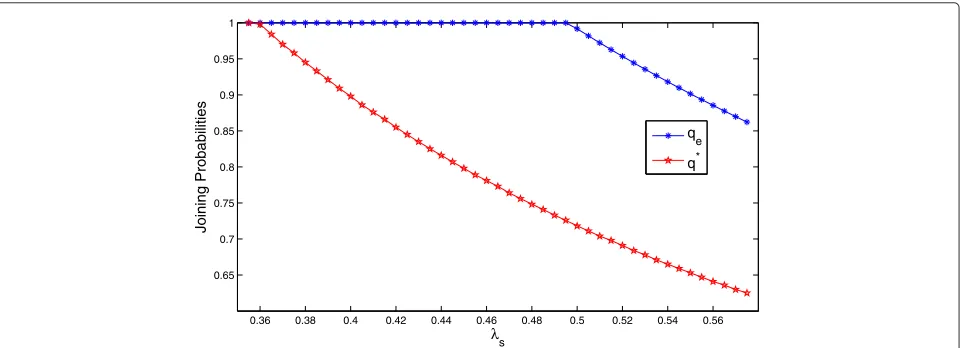
It is shown in Fig. 3 that bothqeandq∗are decreasing
as the arrival rateλs increases. This is because whenλs
increases, arriving SUs who do not know whether the PU band is available or not will see more blocked SUs waiting in the retrial orbit. So the arriving SUs are less inclined to join the orbit to avoid more waiting cost as they are not allowed to balk during their waiting. Figure 4 depicts the influence of service rateμson the strategic entrance
prob-abilities. We observe thatqe andq∗ are increasing with
respect toμs. It can be explained that the increasing
ser-vice rate of PU band benefits SUs waiting in the retrial orbit as the completing service time for SUs get faster. As in Fig. 5, the strategic entrance probabilities decreases as the arrival rate λp of PUs increases. This is due to the
priority of PUs, and whenλpincreases, the interruption
times per unit become more frequent. The server needs some time to serve the PU. So SUs are reluctant to join the orbit upon arrival. The system will get more loaded as the server’s breakdown become more frequent. Considering the influence ofμp on these two entrance probabilities,
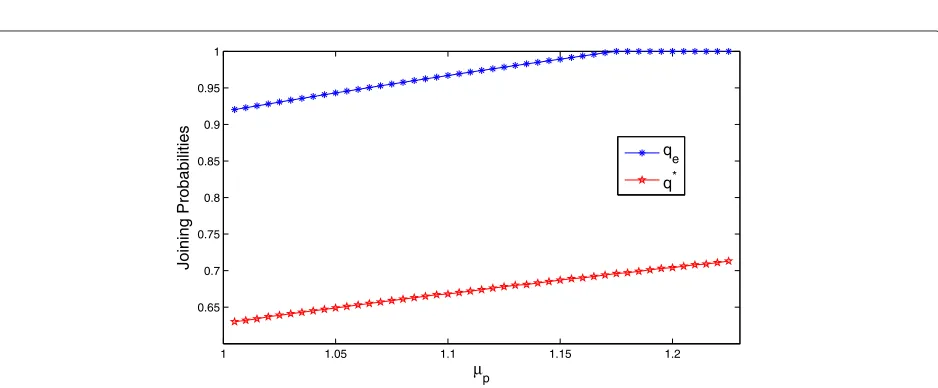
we observe in Fig. 6 that along with the increasing ofμp,
the expected sojourn time for an PU becomes shorter. There will be more opportunities for arriving SUs who stay in the orbit to use the PU band. When it comes toθ in Fig. 7, PUs are more willing to join the system in pace with the increasing retrial rate of the SUs in orbit. When
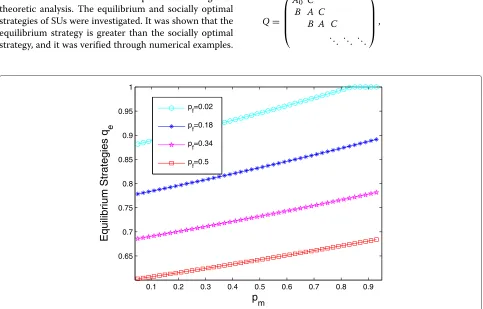
θ increases, SUs will have more probabilities to get suc-cessful to retry for using the PU band during the same period. All the above figures show that the equilibrium strategies of SU are larger than the socially optimal strat-egy, so it is of significance to impose an admission on the administrator of the network. As for the impact of the probabilities of misdetection and false alarm on the behavior of SUs, it can be seen from Fig. 8 that arriv-ing SUs will be more likely to enter the system as pm
increases and the phenomenon is reverse aspf increases.
Because the arriving PU will be forced to drop when mis-detection occurs, the SUs’ waiting time in the retrial orbit will be reduced. However, ifpf increases, the SU who is
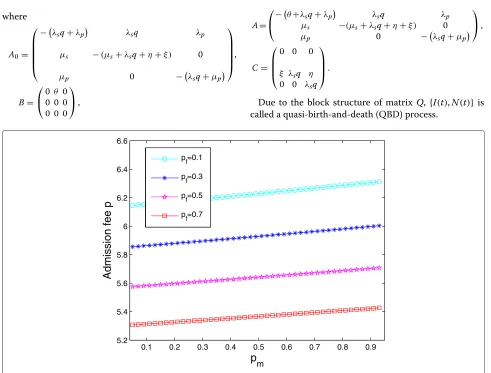
in service tends to give up and enters the retrial orbit, which incurs negative externalities on those who stay in the retrial orbit. The same phenomenon is observed for the maximum social strategies as shown in Fig. 9. It is interesting to see that in Fig. 10, the arriving SUs will be imposed more fees aspm increases or pf decreases,
because the amount of SUs in the system will increase in both cases and the negative externalities lead to these results.
0.36 0.38 0.4 0.42 0.44 0.46 0.48 0.5 0.52 0.54 0.56 0.65
0.7 0.75 0.8 0.85 0.9 0.95 1
λs
Joining Probabilities
q
e
q*
1.25 1.3 1.35 1.4 1.45 1.5 1.55 0.55
0.6 0.65 0.7 0.75 0.8 0.85 0.9 0.95 1
μs
Joining Probabilities
q
e
q*
Fig. 4Equilibrium and social optimization joining probabilities vs.μsforR=10,C=1,λs=0.4,λp=0.4,μp=2,θ=0.7,pm=0.001, and pf=0.001
0.5 0.55 0.6 0.65 0.7
0.55 0.6 0.65 0.7 0.75 0.8 0.85 0.9 0.95 1
λp
Joining Probabilities
q
e
q*
Fig. 5Equilibrium and social optimization joining probabilities vs.λpforR=10,C=1,μs=2,λs=0.4,μp=2,θ=0.7,pm=0.001, and pf=0.001
1 1.05 1.1 1.15 1.2
0.65 0.7 0.75 0.8 0.85 0.9 0.95 1
μp
Joining Probabilities
qe
q*
0.4 0.45 0.5 0.55 0.6 0.55
0.6 0.65 0.7 0.75 0.8 0.85 0.9 0.95 1
θ
Joining Probabilities
q
e
q*
Fig. 7Equilibrium and social optimization joining probabilities vs.θforR=10,C=1,μs=2,λs=0.4,λp=0.4,μp=2,pm=0.01, andpf =0.01
5 Conclusions
In this paper, we considered the SUs’ joining behavior in cognitive radio network with a single bandwidth under imperfect spectrum sensing. We used the constant retrial queueing system with server breakdowns to model the actual situations in which the PUs own priority over SUs and SUs will retry their luck for service if interrupted or blocked upon arrival. The SUs’ joining behavior were described from an economic viewpoint based on game-theoretic analysis. The equilibrium and socially optimal strategies of SUs were investigated. It was shown that the equilibrium strategy is greater than the socially optimal strategy, and it was verified through numerical examples.
To eliminate the gap between equilibrium strategy and socially optimal strategy, we proposed a control policy that imposes an admission fee on each joining SU in order to utilize the PU band more efficiently.
Appendix 1: Proof of Proposition 1
Proof. Using the lexicographical sequence for the states, the infinitesimal generatorQcan be written as
Q=
⎛ ⎜ ⎜ ⎜ ⎝
A0 C B A C
B A C . .. ... ...
⎞ ⎟ ⎟ ⎟ ⎠,
0.1 0.2 0.3 0.4 0.5 0.6 0.7 0.8 0.9
0.65 0.7 0.75 0.8 0.85 0.9 0.95 1
p
m
Equilibrium Strategies q
e
pf=0.02
pf=0.18
pf=0.34
pf=0.5
0.1 0.2 0.3 0.4 0.5 0.6 0.7 0.8 0.9 0.5
0.55 0.6 0.65 0.7 0.75 0.8 0.85 0.9 0.95
p
m
Optimal Social Strategies q
soc pf=0.1
pf=0.3
p f=0.5
pf=0.7
Fig. 9Optimal social strategies vs.pmforR=10,C=1,μs=2,λs=0.4,λp=0.4,μp=2, andθ=0.7
where
A0=
⎛ ⎜ ⎜ ⎜ ⎜ ⎝
−λsq+λp λsq λp
μs −(μs+λsq+η+ξ) 0
μp 0 −λsq+μp ⎞ ⎟ ⎟ ⎟ ⎟ ⎠,
B=
⎛ ⎝00 0 0θ 0
0 0 0
⎞ ⎠,
A=
⎛ ⎝−
θ+λsq+λp λsq λp
μs −(μs+λsq+η+ξ) 0
μp 0 −λsq+μp
⎞ ⎠,
C=
⎛ ⎜ ⎜ ⎝
0 0 0
ξ λsq η 0 0 λsq
⎞ ⎟ ⎟ ⎠.
Due to the block structure of matrix Q, {I(t),N(t)}is called a quasi-birth-and-death (QBD) process.
0.1 0.2 0.3 0.4 0.5 0.6 0.7 0.8 0.9
5.2 5.4 5.6 5.8 6 6.2 6.4 6.6
p
mAdmission fee p
pf=0.1
p f=0.3
pf=0.5
p f=0.7
First, we assume
SinceDis reducible, the Theorem 7.3.1 in [19] gives the condition for positive recurrence of the QBD. After per-mutation of rows and columns, the Theorem 7.3.1 states that the QBD is positive recurrent if and only if
υ
where1is a column vector with all elements equal to one, and υ is the unique solution υD = 0,υ1 = 1. After some algebraic manipulation, the QBD process is positive recurrent if and only if
(λsq+θ)
are established. The right side of the inequality is always greater than zero which infers to
μpμs> λsq(μp+η).
Therefore, the Eqs. from (12) to (14) are greater than zero which is reasonable.
Appendix 2: Proof of Theorem 1
Proof. The expected waiting time of the tagged SU who choose to enter system is increasing with the same strate-giesqadopted by other SUs. We can output the expected waiting time as in (25).
T(q)
Differentiating the denominator in the second fraction (denoted asg(q)) ofTwe can obtain
g(q)= −λs(2λsq+θ)μp+η−λsλp(μs+η+ξ)
−λsμp(η+ξ) <0.
Thus, it is decreasing with q. Observing the whole expression ofT, it is mean to identify the monotonicity of λp(μs−λsq)+λsqη
g(q) . It is easier to prove the inverse
fac-tion which is λ g(q)
p(μs−λsq)+λsqη is monotone decreasing asq
increases. Just differentiate the objective function, and we omitted it.
Therefore, the payoff for the tagged SU who chooses to enter the system (means that the tagged SU selects the strategy 1) when all others select strategyqis
S(q)=R−CT(q).
For all the arriving SUs, each has two pure strategies: to join or balk and a mixed strategy. We denote these pure and mixed strategies by a fractionq, 0 ≤ q ≤ 1. So the mixed strategy means an SU enters the system with prob-abilityqand not to join with probability 1−q. Letqebe
the individual equilibrium strategy of each SU, then we analyze the equilibrium behavior of arriving SUs as three cases below:
1) R≤CT(0). An SU who joins can get a negative benefit when there are no other SUs entering the system. So his decision is not to join. Therefore, the strategy of joining with probabilityqe=0is an
equilibrium strategy.
2) CT(0) <R<CT(1). We can specify that ifqe=1,
then an SU who joins gets a negative benefit. So this is not an equilibrium strategy. Ifqe=0, an SU who
joins obtains a positive profit which is more than by balking (the benefit is 0). Thus, this is not an equilibrium strategy too. Therefore, there exists a unique equilibrium strategyqesuch thatCT(qe)=R.
3) R≥CT(1). In this case, any arriving SU will obtain a non-negative profit even if all other SUs join the system. So, the only one equilibrium strategy of joining the system isqe=1. And joining is a
dominant strategy.
Competing interests
The authors declare that they have no competing interests.
Acknowledgments
This work was supported by the National Natural Science Foundation of China (Grant Nos. 11171019, 71390334 and 71571014), the 111 Project of China (B16002) and US National Science Foundation (Grant Nos. 1137732 and 1241626).
Author details
1Department of Mathematics, Beijing Jiaotong University, No. 3 Shang Yuan
Cun, Beijing, China.2Department of Computer Science and the NSF Center for Research on Complex Networks, Texas Southern University, Houston, TX 77004, Houston, USA.
Received: 30 December 2015 Accepted: 14 May 2016
References
1. J Mitola III, Cognitive radio for flexible mobile multimedia communications. Mobile Netw. Appl.6, 435–441 (2001)
2. Q Zhao, BM Sadler, A survey of dynamic spectrum access. IEEE Signal Process. Mag.24, 79–89 (2007)
3. NH Tran, CS Hong, Z Han, S Lee, Optimal pricing effect on equilibrium behaviors of delay-sensitive users in cognitive radio networks. Selected Areas in Commun. IEEE J.31(11), 2566–2579 (2013)
5. S Lee, H Choi, CK Kim, in9th International Symposium on Communications and Information Technology (ISCIT 2009). A game-theoretic analysis of spectrum sharing in cognitive radio networks, vol. 9, (2009), pp. 415–416 6. A Garhwal, PP Bhattacharya, A study on dynamic spectrum access
techniques for cognitive radio. Intl. J. Next-Generation Netw. (IJNGN). 3, 15–32 (2011)
7. J Elias, F Martignon, A Capone, E Altman, Non-cooperative spectrum access in cognitive radio networks: a game theoretical model. Comput. Netw.55, 3832–3846 (2011)
8. H Li, Z Han, Socially optimal queuing control in CR networks subject to service interruptions: to queue or not to queue? IEEE Trans. Wireless Commun.10, 1656–1666 (2011)
9. CT Do, NH Tran, M Van Nguyen, S Lee, Social optimization strategy in unobserved queueing systems in cognitive radio networks. IEEE Commun. Lett.16, 1944–1947 (2012)
10. K Jagannathan, I Menache, E Modiano, G Zussman, Non-cooperative spectrum access-the dedicated vs. free spectrum choice. IEEE J. Selected Areas Commun.30, 2251–2261 (2012)
11. J Wang, W Li, Non-cooperative and cooperative joining strategies in cognitive radio networks with random access. IEEE Trans. Veh. Technol. doi:10.1109/TVT.2015.2470115
12. AT Hoang, Y-C Liang, DTC Wong, Y Zeng, R Zhang, Opportunistic spectrum access for energy-constrained cognitive radios, IEEE Trans. Wireless Commun.8(3), 1206–1211 (2009)
13. I Suliman, J Lehtomaki, T Braysy, K Umebayashi, inProc. IEEE Personal Indoor and Mobile Radio Communications. Analysis of cognitive radio networks with imperfect sensing, (2009), pp. 1616–1620
14. X Gelabert, O Sallent, JP Romero, R Agusti, Spectrum sharing in cognitive radio networks with imperfect sensing: a discrete-time Markov model. Comput. Netw.54, 2519–2536 (2010)
15. S Tang, BL Mark, Modeling and analysis of opportunistic spectrum sharing with unreliable spectrum sensing. IEEE Trans. Wireless Commun. 8, 1934–1943 (2009)
16. T Ngatched, S Dong, AS Alfa, Analysis of cognitive radio networks with channel assembling, buffering, and imperfect sensing. Wireless Commun. Netw. Conf. (WCNC).2013, 952–957 (2013)
17. AE Shafie, Optimal spectrum access for cognitive radios, arXiv preprint, arXiv:1208.4508 [cs.IT] (2012). http://arxiv.org/abs/1208.4508 18. O Altrad, S Muhaidat, A Al-Dweik, Opportunistic spectrum access in
cognitive radio networks under imperfect spectrum sensing. IEEE Trans. Veh. Technol.63, 920–925 (2014)
19. G Latouche, V Ramaswami, Introduction to matrix analytic methods in stochastic modeling. ASA-SIAM Series on Statistics and Applied Probability, Philadelphia, Pennsylvania (1999)
Submit your manuscript to a
journal and benefi t from:
7Convenient online submission 7Rigorous peer review
7Immediate publication on acceptance 7Open access: articles freely available online 7High visibility within the fi eld
7Retaining the copyright to your article