R E S E A R C H
Open Access
Modeling and analyzing interference signal
in a complex electromagnetic environment
Chun-tong Liu, Rong-jing Wu, Zhen-xin He
*, Xiao-feng Zhao, Hong-cai Li and Peng-zhi Wang
Abstract
Electronic jamming is the key technology of electronic countermeasure, for which models and simulations are studied on noise jamming, deception jamming, and chaff jamming. In the noise jamming, the simulation analysis of radio frequency noise jamming is conducted and the theoretical models of other forms of noise jamming are built. The simulation analysis of range-gate pull off (RGPO) is carried out in the deception jamming. In addition, theoretical modeling and simulation analysis of chaff jamming are carried out with the Monte Carlo method. Simulation results show that the models are correct and can be used to simulate the statistical characteristics of chaff jamming. With the development and wide application of electronic technology, radar, communication, navigation, and IFF signals constitute a complex electromagnetic environment. It is a must to study electronic jamming technology in the complex electromagnetic environment, which will play an indispensable role in the construction of information team and victory in the countermeasure of information technology.
Keywords:Electromagnetic environment, Electronic jamming, Mathematical model, Simulation analysis
1 Introduction
The Gulf war and the Kosovo war show that the electronic countermeasure kicks off and exists in the whole process of war, affecting the war process and pattern, which is the mainstream and a significant feature of information warfare [1]. Radar jamming and anti-jamming ability have become the key factors in the electronic countermeasure. The detection and intentional electronic interference of launch task of the foreign spy satellites are inevitable to affect the electromag-netic safety of the launch site, which seriously threatens the space launch task of each country [2]. In complex elec-tromagnetic environments, the elecelec-tromagnetic interfer-ence has greatly damaged the performance of the guidance equipment. Guidance equipment under electromagnetic interference cannot be properly guided and lose targets. Therefore, it is significant to study electromagnetic inter-ference in a complex electromagnetic environment, which will play an indispensable role in the construction of information team and victory in the countermeasure of information technology. It also has practical significance in anti-interference research for guidance equipment.
Electronic attack is the fighting force which can destroy the target directly by the active use of an electromagnetic spectrum or directional energy. Electronic attacks against radar include non-destructive actions and destructive actions. Non-destructive action is to reduce or offset the operational effectiveness of enemy radar by using suppressing jamming and deception jamming [3].
The development of electronic jamming and anti-jamming technology has brought unprecedented chal-lenges to the guidance equipment. Radar jamming reduces the lethality of the guidance equipment yet improves the survival ability of the target [4]. The new strategy should be proposed in air defense guidance equipment system to meet the current electronic warfare needs after carefully studying the development of airborne electronic counter-measure technology [5]. At present, there have been a large number of researches concerning the electronic interfer-ence, but most of them are based on a certain kind of inter-ference. The research scope is relatively scattered and lacks comprehensive interference analysis and model study [6]. This paper analyzes the theory of mathematical modeling and simulation of common types of electronic jamming, which will play an important role in the identification of enemy electronic jamming and electronic jamming to en-emies. It has important practical significance in the current
* Correspondence:[email protected]
Xi’an Research Institute of High Technology, Xi’an city, Shaan Xi Province 710025, China
tees equipment normal function and personnel’s safety [7]. Radar countermeasure and counter-countermeasure is one of the important contents of electronic warfare. The interference of radar is mainly classified into background and artificial interference, and the latter is the focus of our study. Artificial interference can be classified into active jamming and passive jamming. Active jamming can be further classified into the suppression of jamming and de-ception jamming according to the principle of interference signal. Under the complex electromagnetic environment, how to analyze the jamming effect is of great value [8]. The mathematical modeling and analysis of common jamming signals are discussed in the following parts. 2.1 Radio frequency noise jamming
Masking jamming is used to cover or flood useful signals by using noise or jamming signals similar to noise and to pre-vent radar from detecting targets. Its basic principles are as follows: internal noise and external noise exist in any radar, detection of radar targets is conducted in these noises, and the detection is based on a certain probability criterion.
Radio frequency noise jamming is one of the effect-ive ways of masking jamming. The radio frequency (RF) noise jamming can be obtained by direct amplifi-cation of microwave noise, and its mathematical model can be expressed as follows:
ujð Þ ¼t unð Þt ⋅cos ωjtþϕð Þt
ð1Þ
where un(t) satisfies the Rayleigh distribution and ϕ(t)
satisfies uniform distribution in [0,2pi],un(t) andϕ(t) are
independent of each other, and ωj is the carrier
fre-quency and it is a constant.
The noise is a power signal and its power is limited, but the energy is unlimited. So the power spectrum is used to express its frequency characteristics. Its power spectral density expression is
Gjð Þ ¼f
ference bandwidth, and fjis the center frequency of RF
noise jamming. If the medium frequency of the receiver
has a rectangular feature, after the radio frequency noise is received by the receiver, the output interference signal of the medium-frequency amplifier is still narrowband Gauss noise, and its power spectrumGj(f) is as follows:
Gjð Þ ¼f jHið Þf j2⋅Gjðf−fiÞ
where fi is the center frequency of the receiver and
Δfr is the medium bandwidth of the receiver. The
correlation function of the RF noise can be obtained according to Fourier transform relation between the correlation function and the power spectrum density
Fig. 1Simulation flow chart of RF noise
function of the signal. The correlation function of the RF noise satisfies
Rið Þ ¼τ
Z ∞
0
Gið Þf cos2πfτdf
¼σ2 i
sinπΔfrτ
πΔfrτ cos2πΔfiτ ð4Þ
After the linear detector, the Gauss white noise distribution becomes Rayleigh distribution
PiðUvÞ ¼
Uv
σ2 v
⋅e
U2v 2σ2
v; Uv>0 ð5Þ
whereσ2v¼k⋅σ2 (kis the amplification factor of the lin-ear detector).
In practice, the RF noise signals and radar signals are often simultaneously entered into the radar receiver and build the model for the mixed signals of both.
Set target echo signal as single-frequency signal, and then
s tð Þ ¼us⋅cosðw0tÞ ð6Þ
The expression of the mixed signals of the output signal of the receiver and the noise is
ujð Þ þt s tð Þ ¼unð Þt ⋅cos ωjtþϕð Þt
þus⋅cosðw0tÞ
¼uið Þt ⋅cosðωitþϕð Þt Þ
ð7Þ where ui(t) is the amplitude of the synthesized signal
and the probability distribution is the rice distribution.
2.2 Range-gate pull off
Range-gate pull off (RGPO) can be applied to radar systems of different ranging systems. Its basic principle is to make radar tracking systems track interference signal whose distance is gradually farther away from the target position and then to make radar fail to capture target position information.
RGPO can be roughly divided into three stages: stop delay period, towing period, and termination period. In the first period, jammers amplify and forward signals quickly to make time delay difference between the target echo and itself short enough to enter the radar range gate; due to its higher power of interference signal, the range gate cannot lock the exact interference signal. When the Fig. 3Envelope distribution and phase distribution of RF noise jamming.aThe envelope obeys the Rayleigh distribution.bThe phase obeys the uniform distribution
stop delay period ends or when the range gate locks inter-ference signal, it comes to the second period, towing period. In this period, time delay of a jammer’s forwarding signal is gradually extended to increase distance between the interference signal and target signal in a range dimen-sion. Because the range gate is locked in the interference signal, the target has been dragged out of the range gate gradually. Then the change rule of time delay of the inter-ference signal can be expressed as dτ(t)/dt=v(t), where
τ(t) and v(t) are the towing distance and towing speed, respectively. Finally, when the target is dragged out of the range gate, it comes to the termination period, in which the jammer is turned off or stops forwarding the inter-ference signal, and the radar returns back to the search state because there is no signal within the range gate.
Based on the analysis of the target echo model, the target echo signal received by the receiver can be obtained by
The signal of RGPO satisfies
J tð Þ ¼Ajexp jðωcþωdÞ t−
whereAs is the signal amplitude of the real target; Ajis
the amplitude of the interference signal and Aj> As; ωc
is the carrier frequency of the radar; ωd is the Doppler
frequency; R(t) is the real distance of the target;Δtj(t) is
the delay time of the signal of RGPO compared with the normal echo signal of the target and it changes with time; andCis the speed of light.
Assuming that the target is moving at a constant speed, when adopting the linear or parabolic dragging ways, the distance function of the false target can be expressed as follows:
whereRis the distance of the target;V1is the velocity of
the target; V2 is the towing speed of the linear towing;
and ais the towing acceleration of the parabolic towing. According to the principle of radar delay ranging, the distance change of the interference signal is converted into time delay and we can obtain
Δtjð Þ ¼t
Chaff jamming takes advantage of a large number of randomly distributed metallic scatterers which are put into the air to produce scattering wave and interferes with radar [9]. Chaff jamming is widely used in elec-tronic warfare because of its simple manufacturing, low cost, and strong applicability. The conventional chaff scattering mechanism is resonant scattering, so it has a narrow band. It will increase complexity to use broadband. The Monte Carlo method for the stochas-tic problems mainly consists of three steps: the first step is to build model of problems; the second step is to conduct statistical experiments; and the third step is to solve the problem based on the experimental results.
When analyzing chaff echo power, we regard each chaff as a single unit and only consider the first reflec-tion. Assuming that the echo signal delay is known, the echoes of all chaff units are superimposed together to get the chaff cloud echo.
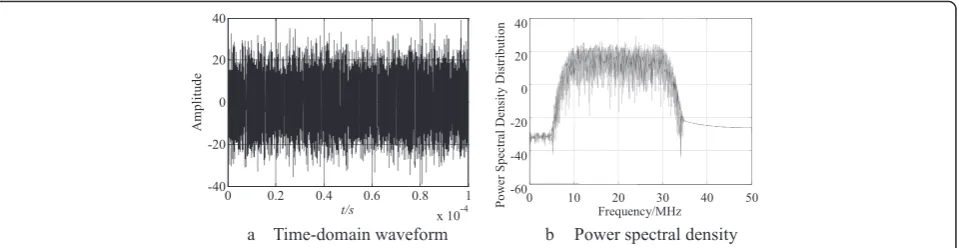
Based on the above assumptions, the chaff cloud echo signal can be treated as a random sampling of zero-mean Fig. 6Performance simulation of echo with RF noise whenus/σi= 0.1.aTime-domain waveform.bPower spectral density
complex Gauss stochastic process. Statistical integral form of the chaff cloud echo signal is as follows:
S0ð Þ ¼t
receipt signal,cis the speed of light;t0is the echo delay;
∑(ct0/2) is the average power of the chaff cloud
reflec-tion, andZ(t) is a zero-mean complex Gaussian random processes and it satisfiesE[|dZ(t)|2] =dt.
The average power of the chaff cloud reflection is derived as
whereAis the volume of chaff cloud. The mean value of the echo power is as follows:
E 1
Fourier transform on both sides of the equation can be used to get autocorrelation function
E S0ð Þf1 S
Based on simple scattering theory, the frequency response to chaff cloud can be expressed as
Scð Þ ¼f
Chaff cloud echo can be obtained by convolution between the emission signal and response to chaff cloud. While it corresponded to the frequency domain, its fre-quency response is the product of both
S0ð Þ ¼f Sið Þf Scð Þf ð17Þ
The simulation method is used to solve the frequency response to chaff cloud. LetX(T) andY(T) be two zero-mean real normal processes.
So the zero-mean complex Gauss stochastic process is described as
Z tð Þ ¼X tð Þ þiY tð Þ ð18Þ
Then,
E dZ tj ð Þj2¼E d X tj ½ ð Þ þiY tð Þj2 ¼dE X 2ð Þ þt Y2ð Þt
¼d D X tf ½ ð Þ þD Y t½ ð Þg
ð19Þ
For E[|dZ(t)|2] =dt, the zero-mean complex Gauss random process can be expressed as
Z tð Þ ¼1
2½Nð0;tÞ þiNð0;tÞ ð20Þ
cloud echo signal in the frequency domain, and the corresponding signal form in the time domain can be obtained after Fourier inverse transform.
3 Computer simulation analysis
3.1 RF noise jamming simulation
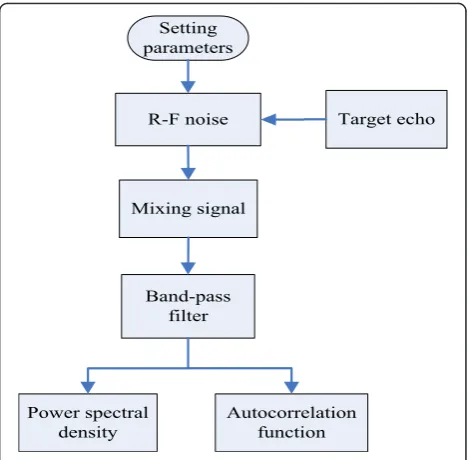
We design MATLAB program for RF noise and carry out computer simulations. The simulation parameters are set as follows: the sampling frequency is 80 MHz; the bandwidth of the band-pass filter is 28 MHz; and the noise figure is 1.1. A simulation flow chart is shown in Fig. 1.
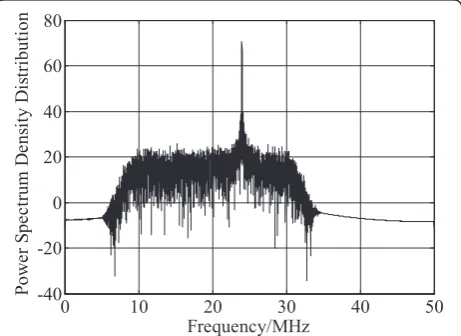
Simulation results are shown in Figs. 2 and 3.
It can be seen from the graph that the envelope of the RF noise obeys the Rayleigh distribution and the phase obeys the uniform distribution, which is consistent with the theoretical analysis.
Through the filter, autocorrelation function and power spectrum density function of the RF noise are shown in Figs. 4 and 5. It can be seen that Fig. 9Algorithm flow chart of distance deception jamming
power spectral density shows the filter shape through a band-pass filter and autocorrelation function shows characteristics of a single-frequency signal, which is consistent with the theoretical analysis.
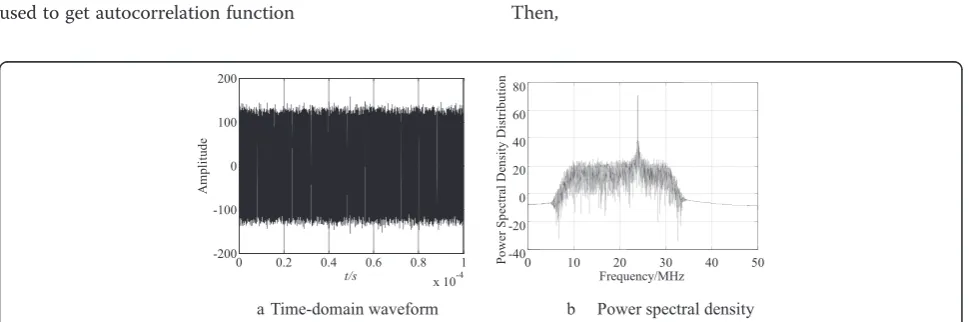
Respectively, us/σi= 0.1; 1; 10, the computer
simu-lation results of the signal superimposed with noise are shown in Figs. 6, 7, and 8. It can be seen that the output amplitude of the receiver under RF noise jamming shows the following distribution. Echo sig-nals’ magnitude is no longer the original form of a rectangular pulse under the influence of RF noise jamming and varies around the average potential of noise. As the interference power increases, the sig-nal is submerged in the noise interference and it cannot be detected and identified.
3.2 RGPO simulation
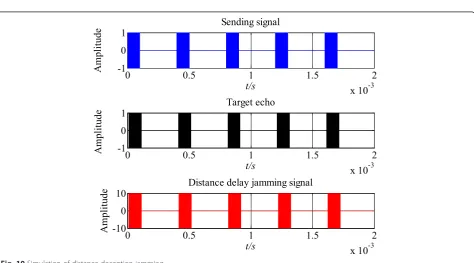
Assume that the carrier frequency of the radar emission signal is 8 MHz, the pulse repetition frequency is 3 kHz, the duty ratio is 1/4, the sampling frequency is 80 MHz, and the range gate is towed at a constant speed. The simulation parameters are as follows: R= 4 km, V1= 0 m/s,t1= 0.3 ms, t2= 2 ms,V2= 106m/s, and jamming to signal ratio is 12 dB. A flow chart of deception jam-ming simulation algorithm is shown in Fig. 9.
Figure 10 shows that the interference signal is formally exactly the same as the target signal except amplification of amplitude before 0.3 ms. They both have the same time delay compared to the emission signal, about 27μs which is consistent with the target distance. Distance towing begins at 0.3 ms, and then the interference signal and the target signal differ. Compared with the emission signal, time delay of the interference signal is gradually increased within each pulse period and the delay of target signal remains unchanged, so the distance between the interference signal and the tar-get signal becomes larger, which is consistent with the theoretical analysis. It verifies the validity of the simulation model.
3.3 Chaff jamming simulation
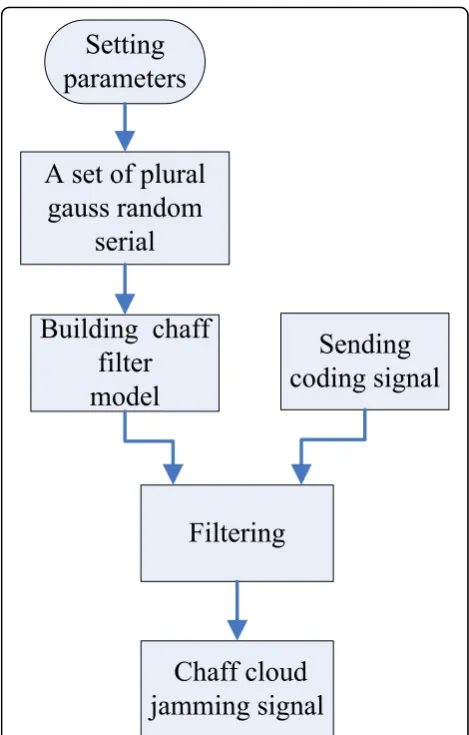
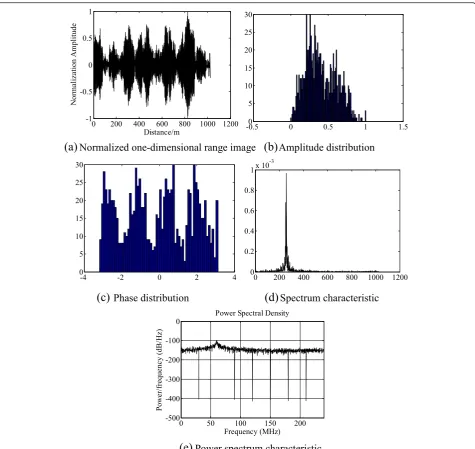
Assuming chaff is uniformly distributed in a 150-m-diameter sphere, there is a total of 1.5 × 10⁸ dipoles. Phase encoding signal emitted by radar is simulated at a medium frequency of 55 MHz and an algorithm flow chart of simulation is shown in Fig. 11.
It can be seen from Fig. 12 that the normalized ampli-tudes satisfy Rayleigh distribution; phases satisfy uniform distribution within (−pi, pi); spectrum broadens to a cer-tain extent around 55 MHz. Power spectrum satisfies the Gauss distribution whose mean value is about 55 MHz. Therefore, the simulation results are consistent with the statistic characteristics of chaff echo.
Computer simulations of RF noise jamming, RGPO, and chaff jamming are carried out in this paper. Accord-ing to the results of computer simulation, the simulation achieves the expected goal and correctly reflects the mathematical model. By comparing the simulation re-sults of the different parameters, the related interference process can be simulated.
In the simulation of RF noise jamming, the process is simulated that the useful signal is submerged by the noise signal and cannot be detected or identified. The simulation characteristics of the envelope and phase of the noise signal are consistent with the theoretical ana-lysis. The results of RGPO simulation and chaff jamming simulation are the same as what is expected.
4 Conclusions
For new radar electronic systems and new communication equipment that continue to emerge, the corresponding electronic countermeasure tactics technology has also been rapidly developed. To meet the objective requirements of
the electronic warfare theory research and practical testing, many electronic warfare simulation systems have been produced at home and abroad with the help of the rapidly developed modeling theory and computer net-work technology. Therefore, it is urgent for electronic countermeasure researchers to comprehend and master the system simulation technology in time [10]. We analyzed the mathematical model of the common electronic interferences in a complex electromagnetic environment and conducted computer simulation of RF noise jamming, RGPO, and chaff jamming. Simulation analyses verify the validity of the mathematical model of the electronic interference. This study will be helpful
in further study on the electronic interference and suppression.
Competing interests
The authors declare that they have no competing interests.
Acknowledgements
This work is partially supported by the National Nature Science Foundation of China under Grant 41404022 and the Nature Science Foundation of Shannxi Province under Grant 2015JM4128.
References
1. B Gao, S Lv, J Zhao, Implementation of effectiveness evaluation simulation system for ECM. Syst. Eng. Electron27(10), 1738–1739 (2005)
2. Z Li,Research on Complicated Electromagnetic Environment and Its Applications for Launch Mission(Chinese Academy of Sciences, China, 2009) 3. Y Zhang, N Tong, G Zhao,Principle of Radar Electronic Warfare(National
Defense Industry Press, Beijing, 2006)
4. J Su, Z Song, Q Fu et al., Joint tracking method for the unresolved decoy and target with monopulse radar. J. Radars4(2), 160–161 (2014) 5. B Tao, An ECCM model and the technical development trends to the
demands of the future EW combat. Syst. Eng. Electron10, 49–50 (1993) 6. F Ji,Modeling and Simulation of Radar Electronic Jamming(Dalian University
of Technology, China, 2013)
7. G Zhao,Principle of Radar Countermeasure(Xidian University Press, Xi’an, 2005) 8. X Shen, G Wang, L Wang et al., Effect evaluation for electronic jamming
aircraft against netted surveillance radars. Syst. Simul20(4), 997–1001 (2008) 9. J Chen,Chaff Jamming Principle(National Defense Industry Press, Beijing, 2007) 10. Y Chen, G Shao, S Zhang et al., Study on the key techniques in a simulation
system of synthetic EW. Syst. Eng. Electron22(2), 68–69 (2000)
Submit your manuscript to a
journal and benefi t from:
7Convenient online submission 7Rigorous peer review
7Immediate publication on acceptance 7Open access: articles freely available online 7High visibility within the fi eld
7Retaining the copyright to your article