LETTER Earth Planets Space,59, 1061–1066, 2007
Mapping absolute migration of global mid-ocean ridges
since 80 Ma to Present
Desiderius C. P. Masalu
University of Dar Es Salaam, Institute of Marine Sciences, PO Box 668, Zanzibar, Tanzania
(Received October 27, 2006; Revised June 8, 2007; Accepted August 2, 2007; Online published September 28, 2007)
We have computed and mapped the absolute migration of global mid-ocean ridges in the past 80 m.y. and found that ridges have migrated substantially during that period. Presently, the faster-migrating ridges are Pacific-Antarctic, Central Indian, Southeast Indian, Juan de Fuca, Pacific-Nazca, Antarctic-Nazca and Australia-Antarctic ridges which migrate between 3.3 and 5.5 cm/yr. The slower-migrating ridges are Mid-Atlantic and Southwest Indian ridges which migrate between 0.3 and 2.0 cm/yr. Comparing these results with mantle tomog-raphy and geochemistry suggests that slower-migrating ridges have deeper depth of origin than faster-migrating ridges, implying a correlation between migration velocity and depth of origin of ridges. The reconstructed South-western Indian ridge (near 44◦E) between 60 Ma and Present, lies atop reconstructed Central Indian ridge between 80 and 50 Ma, and the present-day Antarctic-Nazca or (Chile) ridge lies atop the reconstructed East Pacific Rise at 70 Ma. Furthermore, the South Mid Atlantic Ridge and the East Pacific Rise near 10◦S appear to have been stationary relative to the mantle for the last 80 m.y. These observations suggest that different portions of the mantle have undergone different recycling history, and may explain the origin of mantle heterogeneities.
Key words:Mid-ocean ridge, tectonics, tomography, absolute migration, melt, magnetic lineations.
1.
Introduction
Over the past two decades, absolute migration of mid-ocean ridges has been correlated with major observable fea-tures of the ridges. For example Steinet al.(1977) corre-lated spreading asymmetry with migration rate, and Davis and Karsten (1986) explained asymmetry in seamount abundance by absolute ridge migration. Ridge migration rate is also thought to be an important factor that influences the diversity of ridge-crest lavas and the compositional uni-formity of ridge-crest basalts (Davis and Karsten, 1986). Rapid migration of mid-ocean ridge has been cited as a possible cause of melting asymmetry (Scheireret al., 1998; Buck, 1999; Evanset al., 1999). Recently, ridge migration has been used to explain depth and geochemical disconti-nuities between the southern East Pacific Rise and Antarc-tic ridges (Small and Danyushevsky, 2003), and the vari-ation in ridge morphology that results from melt focusing across discontinuities (Carbotteet al., 2004). In plate tec-tonics mid-ocean ridges are considered to be passive fea-tures the motions of which are governed by the interactions and motions of global plates, a property that makes absolute migration of ridges, a potential recorder of global tecton-ics. Despite its apparent importance, mapping of historical absolute migration of mid-ocean ridges has not previously been defined and done. We attempt to compute and map the absolute migration of global mid-ocean ridges since 80 Ma.
Copyright cThe Society of Geomagnetism and Earth, Planetary and Space Sci-ences (SGEPSS); The Seismological Society of Japan; The Volcanological Society of Japan; The Geodetic Society of Japan; The Japanese Society for Planetary Sci-ences; TERRAPUB.
2.
Method and the Data
New seafloor forms at mid-ocean ridges when molten magma passively upwells into the narrow space between two diverging plates (Reynolds and Langmuir, 1997; Dziak et al., 2004; Detrick, 2000). Magnetic minerals in the magma align in the direction of the prevailing geomagnetic field, thus recording the age of the new seafloor. Therefore, if we determine the age of the seafloor and can construct a relevant plate motion model in the hotspot reference frame, we can locate the ridge when the seafloor formed. A dig-ital age grid for the world’s seafloor with a grid node in-terval of 6 arc minutes is available (Muelleret al., 1997) which was compiled using the geomagnetic time scale of Cande and Kent (1995) for anomalies younger than chron 34 (83 Ma). Using the digital age grid and models for absolute plate motion of Duncan and Clague (1985) and Mueller et al.(1993) we reconstructed the paleolocations of global mid-ocean ridges from 80 Ma to present, by ro-tating seafloor age isochrons at intervals of 10 m.y. from their present to their former locations. For detailed in-vestigation of the migration of the ridges we selected 27 ridge segments, picked their corresponding age isochrons on both sides, and reconstructed their paleolocations us-ing the method outlined above and computed the absolute migration speed for each ridge. Two criteria were consid-ered in determining the segments; first the availability of as many as possible identified magnetic isochrons from Chron 34 to Present on both sides of the segment, and secondly, location of the segment on the ridge. Whenever it was pos-sible segments that were about evenly distributed along or located about the centre of the ridge were selected. The aim was to finally get a better estimation of the absolute
1062 D. C. P. MASALU: MAPPING ABSOLUTE MIGRATION OF GLOBAL MID-OCEAN RIDGES SINCE 80 MA TO PRESENT
Fig. 1. Absolute migration of global mid-ocean ridges since 80 Ma. Pattern lines are reconstructed past locations of ridges. Numbers in the insert index are years before Present. Crosses show ridge segments used for detailed study and computation of migration speed. Text identifiers are:JUAN(Juan de Fuca ridge),PacAnt(Pacific-Antarctic ridge),PacNazca(Pacific-Nazca ridge),AntNaz(Antarctic-Nazca ridge),SMAR(South Mid-Atlantic Ridge),CMAR(Central Mid-Atlantic Ridge),NMAR(North Mid-Atlantic Ridge),SEIR(Southeast Indian Ridge),CIR(Central Indian Ridge), SWIR(Southwest Indian Ridge) andAustAntar(Australia-Antarctic ridge). Note: For the purpose of this paper theSEIRextends from the Indian Triple Junction to 115◦E where it joins with theAustAntar.
(a)
(b)
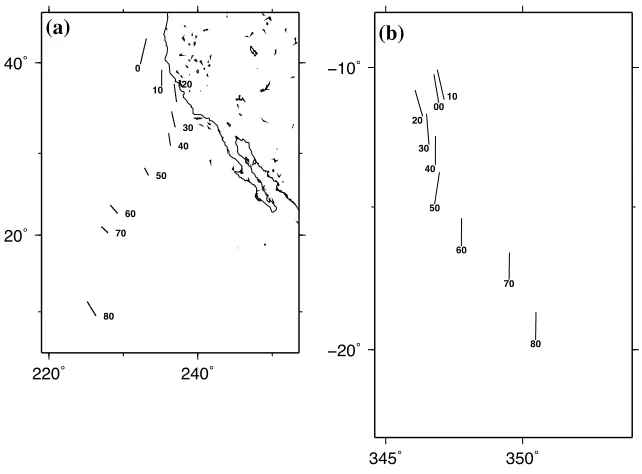
Fig. 2. Absolute migration of some of the selected ridge segments. Solid thick line segments are reconstructed past locations of the ridge segments as indicated by the adjacent number in million years from the present. (a) southernmost segment of the Juan de Fuca ridge, and (b) segment from the SMAR. Other panels as in Fig. 1.
tion speed of the ridge from the stacked absolute migration speed profiles of the segments. This is because absolute migration speed varies at each portion of the ridge. The number of profiles that were stacked for computation of av-erage absolute migration speed and errors for ridges in this study were as follows: Central Indian Ridge—4, Southeast Indian Ridge—6, Southwest Indian Ridge—4, Australia-Antarctica Ridge—4, Pacific–Australia-Antarctica Ridge—4, Pacific-Nazca Ridge—4, Juan de Fucca Ridge—1, Antarctica-Nazca Ridge—6, South Mid-Atlantic Ridge—8, Central Mid-Atlantic Ridge—4, and North Mid-Atlantic Ridge—8.
recon-D. C. P. MASALU: MAPPING ABSOLUTE MIGRATION OF GLOBAL MID-OCEAN RIDGES SINCE 80 MA TO PRESENT 1063
Fig. 3. Stacked profiles of migration speeds of global mid-ocean ridges with errors shown as deviation from the mean. No error bars are shown for JUAN because identified lineations from only one side of the segment were used. Other panels as in Fig. 1.
structions based on the Indo-Atlantic and Pacific hotspots do not agree with each other. This disagreement might in-dicate that there is a missing plate boundary somewhere, but it could also be that some of the hotspots are moving relative to each other at rates on the order of 20 mm/yr. Re-sults from the latest IODP cruise (Leg 197) to the Emperor Seamounts suggests that the Hawaiian hotspot was mov-ing southwards from∼81–43 Ma at rates of 30–50 mm/yr (Tardunoet al., 2002). Muelleret al.(1993) tried to estab-lish an absolute framework for all plates but were unable to include the Pacific plates in their model. For that reason we use Duncan and Clague (1985) model for Pacific ridges and Muelleret al.(1993) model for all other ridges. Even considering these sources of errors our results appear to be reasonable, and present the first overview of global motion of mid-ocean ridges.
3.
Migration of Global Mid-ocean Ridges
Our results indicate that global mid-ocean ridges have migrated extensively in the past 80 m.y. (Fig. 1). All ridges appear to be migrating but we also note other observations. The East Pacific Rise or EPR (which includes the PacNazca ridge and its northern adjacent Pacific-Cocos ridge) which was probably one ridge with the Juan de Fuca ridge (JUAN) in the past, appears to have rotated clockwise by about 50◦ in the last 80 m.y. and its central section have not migrated extensively. On the other hand the Southern Mid-Atlantic Ridge (SMAR) displays very small lateral migration. How-ever, reconstructions based on the selected ridge segments
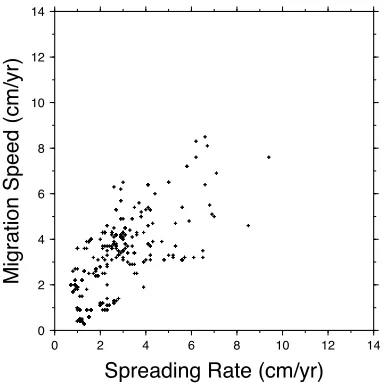
Fig. 4. Absolute migration velocity versus spreading velocity for ridges in this study.
1064 D. C. P. MASALU: MAPPING ABSOLUTE MIGRATION OF GLOBAL MID-OCEAN RIDGES SINCE 80 MA TO PRESENT
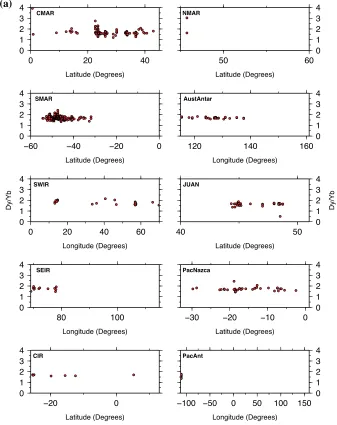
Fig. 5. Dy/Yb ratios of mid-ocean ridges in this study. (a) Along the ridges, and (b) Versus absolute migration speed of ridges. Other panels as defined in Fig. 1. Data from PetDB (http://petdb.ldeo.columbia.edu/petdb).
Fig. 5. (continued).
Contrary to SMAR, the Central Mid Atlantic Ridge (CMAR) between the equator and the 40◦N latitude, and the Northern Mid Atlantic Ridge (NMAR) north of the 40◦N latitude, have been migrating westerly between 80 Ma and Present (Fig. 1), away from SMAR. The implied location of the boundary between SMAR and CMAR is consistent with the Equatorial Atlantic Region (EAR), an area
charac-terized by a dense pattern of mostly medium to large offset fracture zones (Mueller and Smith, 1993). The EAR records a plate boundary between the North and South American plates (Roest and Collette, 1986) that seems has been in ex-istence for the last 80 Ma.
4.
Resampling of the Mantle
D. C. P. MASALU: MAPPING ABSOLUTE MIGRATION OF GLOBAL MID-OCEAN RIDGES SINCE 80 MA TO PRESENT 1065
This implies that these ridges have been sampling same lo-cations of the mantle for the last 80 Ma. These observations suggest that different portions of the mantle have undergone different recycling history, and may have important thermo-chemical implications for the mantle. They thus offer a pos-sible mechanism of origin of lateral heterogeneities in the mantle, and variations of the chemistry of global mid-ocean ridges (e.g., Grahamet al., 2001). It is important to note here that the exact relative motion between the plates, upper mantle and lower mantle is not known. However, relative to the lower mantle the plates and the upper mantle move in opposite directions, to a large extent cancelling each other out (e.g., Argus and Gross, 2004). The relative motions be-tween plates, upper mantle and lower mantle may thus not greatly affect the above results.
5.
Absolute Migration Speed and Mantle
Tomog-raphy
Absolute migration speed of ridges that were investigated are shown in Fig. 3. The ridges divide into two groups: the slower-migrating ridge group including the CMAR, SMAR, NMAR and SWIR ridges, and the faster-migrating ridge group which includes all other ridges. Presently, the slower-migrating ridges migrate between 0.3 and 2.0 cm/yr whereas the faster-migrating ridges migrate between 3.3 and 5.5 cm/yr.
We compare our results with seismic velocity anoma-lies beneath global mid-ocean ridges. Su et al. (1992) show that seismic velocity anomalies associated with mid-ocean ridges, appear as continuous features to 300 km depth. For the NMAR, SMAR, Pacific-Antarctic ridge (PacAnt), SWIR, and Carlsberg ridges, mantle velocities remain slower than normal on average down to at least 400 km depth, and may persist to 600 km depth. Except for the PacAnt, ‘deep-rooted’ ridges are the slower migrat-ing (Fig. 3). Although falls in the faster-migratmigrat-ing ridges group, the PacAnt is the slowest in the group. So, the cut-off point between “faster” and “slower” migrating ridges may be∼3.5 cm/yr which seems to be consistent with the velocity found by Small and Sandwell (1994) which distin-guishes between mid-ocean ridges that have a ridge-crest versus those that have a median valley. This is supported by the observation that migration velocity of ridges increase proportionally with spreading velocity (Fig. 4). These re-sults imply a possible correlation between absolute migra-tion speed and depth of origin of mid-ocean ridges whereby faster-migrating ridges have shallow depth of origin while slower-migrating ridges have deeper depth of origin. This suggests that slower migrating ridges allow the develop-ment of stable and deep rooted mantle convection cells be-neath them; whereas faster migrating ridges probably cause some disturbances to mantle convection cells beneath them, thus allow only development of shallow rooted convection cells. Unfortunately, the resolutions of the currently avail-able models of mantle tomography do not allow us to di-rectly quantify this apparent correlation. Furthermore, this study cannot strictly distinguish between the two possibili-ties, that is, the slower migrating ridges have deeper origins because they are migrating more slowly or, are they migrat-ing more slowly because they have deeper origins.
6.
Discussion
One of the most important dynamic processes in the Earth’s interior is thermal convection in the mantle. Two methods are used to study temperature variations in the up-per mantle: study of trace- and major-element chemistry of basalts erupted at mid-ocean ridges which is directly influ-enced by the temperature of the mantle beneath (e.g., Klein and Langmuir, 1987; Hellebrandet al., 2001; Humler and Besse, 2002) and seismic velocity studies (e.g., Su et al., 1992; Zhang and Tanimoto, 1992).
Klein and Langmuir (1987, 1989) studied the chemical systematics of global Mid-Ocean Ridge Basalts (MORB) and explained them by variations among different melt-ing columns. In their model, hotter mantle material (from deeper depth) intersects the solidus at greater depth and pro-duces a taller melting column, leading to greater mean pres-sures and extent of melting whereas cooler mantle mate-rial (from shallow depth) intersects the solidus at shallower depth and produces a shorter melting column, leading to lower mean pressures and extent of melting. This model can be combined with our results whereby, faster-migrating ridges correspond to ridges with cooler mantle sources and slower-migrating ridges correspond to ridges with hotter mantle sources. The combined result suggests that the man-tle beneath faster-migrating ridges have undergone smaller extents of melting whereas that beneath slower-migrating ridges have undergone greater extents of melting which may influence their chemistry.
Furthermore, during the creation of new Earth crust at mid ocean ridges, melt from the partially melted fertile upper mantle is extracted to the spreading centre, and the residual depleted mantle flows horizontally away (Mar-tinez and Taylor, 2002; Hauri, 1999; Benoitet al., 1999). This model when considered with our results has important implications. Firstly, the observation that the SWIR and present-day AntNazca (also known as Chile ridge) appear to be tapping portions of the mantle as other ridges did in the past suggests that basalts from these ridges may record two or more phases of recycling or the combined effect. They may show greater extents of melting and/or may be more depleted. Secondly, our result show that two sections of the global mid-ocean ridge system, the SMAR and EPR near 10◦S, have remained stationary for the last 80 m.y. Because these ridges have been sampling same portions of the man-tle for a long time, may be sampling deeper manman-tle and their chemistry may be different from the rest of the ridges that have been migrating.
1066 D. C. P. MASALU: MAPPING ABSOLUTE MIGRATION OF GLOBAL MID-OCEAN RIDGES SINCE 80 MA TO PRESENT
since 80 Ma, i.e., SMAR and PacNaz (which corresponds to the location where the EPR have remained stationary) have the highest upper ranges of the Dy/Yb ratios indicating they are sampling deeper mantle than the other ridges (Fig. 5(b)).
7.
Conclusions
We have computed and mapped the absolute migration of global mid-ocean ridges for the past 80 m.y. Absolute migration speed and depth of origin of ridges appear to cor-relate whereby slower-migrating ridges have deeper depth of origin than faster-migrating ridges. The cutoff point be-tween “faster” and “slower” migrating ridges is∼3.5 cm/yr. The SWIR and present-day Chile ridge appear to be tapping portions of mantle as other ridges did in the past, and the SMAR and EPR near 10◦S appear to have been stationary relative to the mantle for the last 80 m.y. This suggests that different portions of the mantle have undergone different recycling history.
Acknowledgments. I thank C Small, and L Lawver for their con-structive comments that helped in improving this paper. I also thank S Uyeda and W Sager for their advice that shaped the orig-inal version of this paper. This work was mainly supported by the Japan Society for the Promotion of Science (JSPS). The Japan Students Service Organization (JASSO) also partially supported this work through a fellowship to the author to complete the work at the Department of Geosystem Engineering, Graduate School of Engineering, University of Tokyo in Professor Kensaku Tamaki’s laboratory.
References
Acton, G. D. and R. G. Gordon, Paleomagnetic tests of Pacific plate recon-structions and implications for motion between hotspots,Science,263, 1246–1254, 1994.
Argus, D. F. and R. S. Gross, An estimation of motion between the spin axis and the hotspots over the past century,Geophys. Res. Lett.,31, L06614, doi:10.1029/2004GL019657, 2004.
Beavan, J., P. Tregoning, M. Bevis, T. Kato, and C. Meertens, Motion and rigidity of the Pacific Plate and implications for plate boundary deformation,J. Geophys. Res.,107, 2261, doi:10.1029/2001JB000282, 2002.
Benoit, M., G. Ceuleneer, and M. Polve, The remelting of hydrothermally altered peridotite at mid-ocean ridges by intruding mantle diapirs, Na-ture,402, 514–518, 1999.
Buck, R., Mapping mantle melting,Science,286, 692, 1999.
Cande, S. C. and D. V. Kent, Revised calibration of the geomagnetic time scale for the late Cretaceous and Cenozoic,J. Geophys. Res.,100, 6093– 6098, 1995.
Carbotte, S. M., C. Small, and K. Donnelly, The influence of ridge migra-tion on the magmatic segmentamigra-tion of mid-ocean ridges,Nature,429, 743–746, 2004.
Davis, E. E. and J. L. Karsten, On the cause of the asymmetric distribution of seamounts about the Juan de Fuca ridge: ridge-crest migration over a heterogeneous asthenosphere,Earth Planet. Sci. Lett.,79, 385–396, 1986.
Detrick, R. S., Portrait of a magma chamber,Nature,406, 578–579, 2000. Dixon, T. H., A. Mao, and S. Stein, How rigid is the stable interior of the
North American plate?,Geophys. Res. Lett.,23, 3035–3038, 1996. Duncan, R. A. and D. A. Clague, Pacific plate motion recorded by linear
volcanic chains, inThe Ocean Basins and Margins, 7A, pp. 89–121, edited by A. E. M. Nairnet al., Plenum Publishing, New York, 1985. Dziak, R. P., D. K. Smith, D. R. Bohnenstiehl, C. G. Fox, D. Desbruyeres,
H. Matsumoto, M. Tolstoy, and D. Fornari, Evidence of a recent magma dike intrusion at the slow spreading Lucky Strike segment, Mid-Atlantic Ridge,J. Geophys. Res.,109, doi:10.1029/2004JB003141, 2004. Evans, R. L., P. Tarits, A. D. Chave, A. White, G. Heinson, J. H. Filloux,
H. Toh, N. Seama, H. Utada, J. R. Booker, and M. J. Unsworth,
Asym-metric electrical structure in the mantle beneath the East Pacific Rise at 17◦S,Science,286, 752–756, 1999.
Graham, D. W., J. E. Lupton, F. J. Spera, and D. M. Christie, Upper-mantle dynamics revealed by helium isotope variations along the southeast Indian ridge,Nature,409, 701–703, 2001.
Hauri, E., Mid-ocean ridges—One more time, from the top,Nature,402, 469–471, 1999.
Hellebrand, E., J. E. Snow, H. J. B. Dick, and A. W. Hofmann, Coupled major and trace elements as indicators of the extent of melting in mid-ocean ridge peridotites,Nature,410, 677–681, 2001.
Humler, E. and J. Besse, A correlation between mid-ocean ridge basalt chemistry and distance to continents,Nature,419, 607–609, 2002. Klein, E. M. and C. H. Langmuir, Global correlations of ocean ridge basalt
chemistry with axial depth and crustal thickness,J. Geophys. Res.,92, 8089–8115, 1987.
Klein, E. M. and C. H. Langmuir, Local versus global variations in ocean ridge basalt composition: A reply,J. Geophys. Res.,94, 4241–4252, 1989.
Kogan, M. G., G. M. Steblov, R. W. King, T. A. Herring, D. I. Frolov, S. G. Egorov, V. Levin, A. Lerner-Lam, and A. Jones, Geodetic constraints on the rigidity and relative motion of Eurasia and North America,Geophys. Res. Lett.,27, 2041–2044, 2000.
Martinez, F. and B. Taylor, Mantle wedge control on back-arc crustal accretion,Nature,416, 417–420, 2002.
Molnar, P. and J. Stock, Relative motions of hotspots in the Pacific, At-lantic, and Indian Oceans since late Cretaceous time,Nature,327, 587– 591, 1987.
Mueller, R. D. and W. H. F. Smith, Deformation of the oceanic crust between the North American and South American plates,J. Geophys. Res.,98, 8275–8291, 1993.
Mueller, R. D., J.-Y. Royer, and L. A. Lawver, Revised plate motions relative to hotspots from combined Atlantic and Indian Ocean hotspot tracks,Geology,21, 275–278, 1993.
Mueller, R. D., W. R. Roest, J.-Y. Royer, L. M. Gahagan, and J. G. Sclater, Digital isochrons of the world’s ocean floor,J. Geophys. Res.,102, 3211–3214, 1997.
Reynolds, J. R. and C. H. Langmuir, Petrological systematics of the Mid-Atlantic Ridge south of Kane: Implications for ocean crust formation,J. Geophys. Res.,102, 14,915–14,946, 1997.
Roest, W. R. and B. J. Collette, The fifteen twenty fracture zone and the North American–South American plate boundary,J. Geol. Soc. London, 143, 833–843, 1986.
Scheirer, D. S., D. W. Forsyth, M.-H. Cormier, and K. C. Macdonald, Shipboard geophysical indications of asymmetry and melt production beneath the East Pacific Rise near the MELT experiment,Science,280, 1221–1224, 1998.
Small, C. and L. V. Danyshevsky, Plate-kinetmatic explanation for mid-ocean ridge depth discontinuities,Geology,31, 399–402, 2003. Small, C. and D. T. Sandwell, Imaging mid-ocean ridge transitions with
satellite gravity,Geology,22, 123–126, 1994.
Socquet, A., C. Vigny, N. Chamot-Rooke, W. Simons, C. Rangin, and B. Ambrosius, India and Sunda plates motion and deformation along their boundary in Myanmar determined by GPS,J. Geophys. Res.,111, B05406, doi:10.1029/2005JB003877, 2006.
Stein, S., H. J. Melosh, and J. B. Minster, Ridge migration and asymmetric sea-floor spreading,Earth Planet. Sci. Lett.,36, 51–62, 1977. Su, W., R. L. Woodward, and A. M. Dziewonski, Deep origin of mid-ocean
ridge seismic velocity anomalies,Nature,360, 149–152, 1992. Tarduno, J. A. and J. Gee, Large-scale motion between Pacific and Atlantic
hotspots,Nature,378, 477–480, 1995.
Tarduno, J. A., R. A. Duncan, and D. W. Scholl, Motion of the Hawaiian Hotspot: A Paleomagnetic Test—Sites 1203–1206, Proc. ODP, Vol. 197 Init. Rep., ODP Texas A&M University, Texas, 2002. Also available online at: http://www-odp.tamu.edu/publications/197 IR/197ir.htm. Tregoning, P., Plate kinematics in the Western Pacific derived from
geode-tic observations,J. Geophys. Res.,107, doi:2001JB000406, 2002. Uyeda, S. and A. Miyashiro, Plate tectonics and the Japanese islands: A
synthesis,Geol. Soc. America Bull.,85, 1159–1170, 1974.
Zhang, Y.-S. and T. Tanimoto, Ridges, hotspots and their interpretation as observed in seismic velocity maps,Nature,355, 45–49, 1992.