R E S E A R C H
Open Access
Limit cycles in a quartic system with a
third-order nilpotent singular point
Xinli Li
**Correspondence:
[email protected] School of Business, University of Shanghai for Science and Technology, Shanghai, P.R. China Logistic School, Linyi University, Linyi, P.R. China
Abstract
In this paper, limit cycles bifurcating from a third-order nilpotent critical point in a class of quartic planar systems are studied. With the aid of computer algebra system MAPLE, the first 12 Lyapunov constants are deduced by the normal form method. As a result, sufficient and necessary center conditions are derived, and the fact that there exist 12 or 13 limit cycles bifurcating from the nilpotent critical point is proved by different perturbations. The result in [Qiu et al. in Adv. Differ. Equ. 2015(1):1, 2015] is improved.
Keywords: Quartic system; Nilpotent critical point; Lyapunov constants; Bifurcation of limit cycles
1 Introduction
An isolated critical pointO(0, 0) is called a nilpotent singular point if the linear part of systems has double zero eigenvalues but the matrixes of the linearized systems at the origin are not identically null. Over the past twenty years, many different kinds of topological phase portraits around a nilpotent critical point have been given in [2]. Some results before 1980 were also introduced in [3]. It is well known that it is more difficult to study a phase
portrait around a nilpotent critical point than around an element critical point. However, more and more attention has been paid to the center problem and bifurcation of limit cycles of a system with a nilpotent critical point recently.
By a proper linear transformation, the planar autonomous analytic system with a nilpo-tent critical point can always be changed into
dx
dt =(x,y) =y+
∞
k+j=2
akjxkyj,
dy
dt=(x,y) =
∞
k+j=2
bkjxkyj,
(1.1)
where(x,y) and(x,y) are analytic functions in the neighborhood of origin.
On the basis of the discussion in [3], the origin of system (1.1) is a monodromic critical point if and only if
(x,f(x) =αx2n–1+ox2n–1, α= 0,
∂ ∂x +
∂ ∂y
y=f(x)
=βxn–1+oxn–1,
β2+ 4nα< 0,
(1.2)
wherenis a positive integer. The origin is called a (2n– 1)-order nilpotent critical point. In [4], local behavior of an isolated nilpotent critical point for polynomial Hamiltonian systems was investigated. They proved that there are exactly three cases: a center, a cusp, or a saddle. Then, for quadratic and cubic Hamiltonian systems, they obtained necessary and sufficient conditions for a nilpotent critical point to be a center, a cusp, or a saddle. Some special systems were also studied in [5, 6] by this method. Furthermore, limit cycle bifurcation near a double homoclinic loop passing through a nilpotent saddle by studying the analytical property of the first-order Melnikov functions for general near-Hamiltonian systems was studied in [7]. They obtained the conditions for the perturbed system to have 8, 10, or 12 limit cycles in a neighborhood of the loop with seven different distributions. Recently, the expansion of the first Melnikov function appearing by perturbing an inte-grable and reversible system with a homoclinic loop passing through a nilpotent singular point was investigated in [8], and the authors got the formulas for computing the first coefficients of the expansion. Some other methods were also developed recently. For ex-ample, in [9], it was proved that all the nilpotent centers are limit of linear type centers; and consequently, the Poincare–Lyapunov method to find linear type centers can be also used to find the nilpotent centers. Quasi-homogeneous vector fields with a nilpotent and mon-odromic isolated singular point were investigated in [10]. They also proved for this system the existence of a Lyapunov function, and they solved theoretically the center problem for such a system. Bifurcation theory for finitely smooth planar autonomous differential sys-tems was considered in [11]. Theory of rotated equations was discussed in [12] and was applied to a population model.
In fact, Theorem 19.10 in [3] shows when condition (1.2) holds, there exist formal trans-formations
u=x+
∞
k+j=2
akjxkyj,
v=y+
∞
k+j=2
bkjxkyj,
dt dτ = 1 +
∞
k+j=1
ckjxkyj,
(1.3)
such that (1.1) becomes the Liénard equation
du
dτ =v+F(u),
dv dτ =αu
2n–1, (1.4)
where
F(u) = 1
nβu
n+oun. (1.5)
Furthermore, if condition (1.2) holds, there exist analytic transformations in the neigh-borhood of origin of (1.3) to make (1.1) be changed into the Liénard equation
du dτ =v,
dv dτ =αu
2n–1+v
∞
k=n–1
Bkuk, Bn–1=β, (1.6)
soB2kcould be thought of as Lyapunov constants of (1.1).
third-order nilpotent singular point
dx
dt =y–b12x
2y+a
12xy2+a03y3+a40x4+a31x3y+a22x2y2– 4b04xy3+a04y4,
dy dt= –2x
3+b
21x2y+b12xy2+b03y3+b40x4– 4a40x3y– 3 2a31x
2y2 +b13xy3+b04y4
(1.7)
are studied by using the normal form method, one more limit cycle is found.
The rest of this paper is organized as follows. In Sect. 2, with the aid of computer al-gebra system MAPLE, the first 12 Lyapunov constants are computed by the normal form method. Sufficient and necessary center conditions are derived. In Sect. 3, the fact that there exist 12 or 13 limit cycles bifurcating from the nilpotent critical point is proved. Henceforth, we give a lower bound of cyclicity of a nilpotent critical point for quartic polynomial systems. The result in [1] is improved.
2 Lyapunov constants and center conditions
According to normal form theory, for system (1.1), we can find analytic transformations in the neighborhood of origin to transform system (1.7) into (1.6). Applying the recursive formulae in [28] to carry out calculations, we have the following theorem.
Theorem 2.1 The first12quasi-Lyapunov constants at the origin of system(1.7)are given as follows:
B2=
b21 3 ,
B4=
2(a12+ 3b03)
5 ,
B6=
b40(2a22+ 3b13)
35 ,
B8= –
(2a22+ 3b13)a31
15 ,
B10= 10
77(3a40b03– 2b04)(2a22+ 3b13),
B12= –2
3003b03(342a22+ 539a40b12– 26b13)(2a22+ 3b13), (2.1)
B14= – 1 83,655b03
36,504a04+ 17,745a340– 20,744a22b12– 31,116a40b212
(2a22+ 3b13),
B16= 14 1,680,705b03
217,464a03a22+ 398,853a22a240+ 334,620a40b203 + 326,196a03a40b12+ 561,522a340b12+ 12,244a22b212+ 18,366a40b312
Case1: 2a22+ 3a40b12= 0
B18=
b03(2a22+ 3b13) 133,545,457,890(2a22+ 3a40b12)
409,339,646,784a322a40 – 76,483,842,435a22a540
+ 265,048,602,624a222b203+ 100,943,142,300a440b203
+ 2,055,888,104,472a222a240b12
– 125,814,214,890a640b12+ 1,353,439,930,752a22a40b203b12
+ 3,384,047,982,384a22a340b212+ 1,433,800,540,224a240b203b212 (2.2) – 3,536,917,504a222b312+ 1,831,845,046,410a440b312
– 10,610,752,512a22a40b412– 7,958,064,384a240b512
,
B20= –b03(2a22+ 3b13)f1,
B22=b03(2a22+ 3b13)f2,
B24=b03(2a22+ 3b13)f3.
Case2: 2a22+ 3a40b12= 0
B16= 7 663a40b03
264b203– 29a240b12
(2a22+ 3b13),
B18= – 1 627a
3 40b03
154a03+ 462a240– 87b212
(2a22+ 3b13),
B20= 1 70,686a
3 40b03b12
9779a240– 1740b212(2a22+ 3b13),
B22=
4,589,527 6,273,135a
7
40b03(2a22+ 3b13).
(2.3)
For each k= 2, . . . , 11,B2=B4=· · ·=B2k–2= 0have been set.fi,i= 1, 2, 3,are given in the
Appendix.They have26, 30, 48terms,respectively. Theorem 2.1 directly shows the following assertion.
Proposition 2.1 For system(1.7),the first twelve Lyapunov constants at the origin are zero if and only if one of the following three conditions is satisfied:
b21=a12=b03=b40=a31=b04= 0; (2.4)
b21= 0, a12= –3b03, a22= – 3b13
2 ; (2.5)
b21=a31=b40=b04=b13=a04=a22=a40= 0, a12= –3b03. (2.6)
According to Proposition 2.1, we have the following theorem.
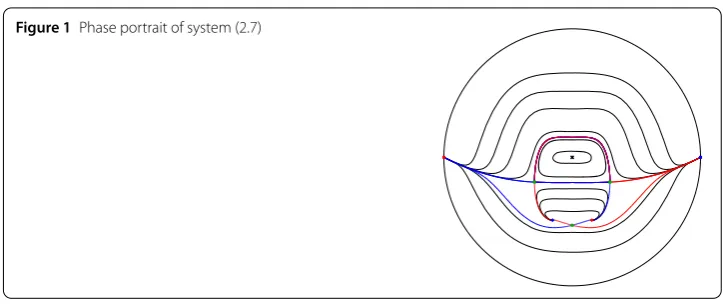
Figure 1Phase portrait of system (2.7)
Proof When condition (2.4) is satisfied, system (1.7) can be brought to
dx
whose vector field is symmetric with respect to they-axis. An example when all parameters are equal to 1 is given in Fig. 1.
When condition (2.5) holds, system (1.7) can be rewritten as follows:
dx
which has an analytic first integral
H1(x,y) =1
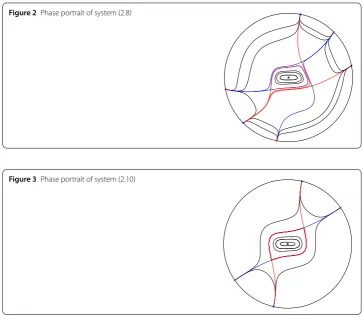
An example when all parameters are equal to 1 is given in Fig. 2. When condition (2.6) holds, system (1.7) becomes
dx
which has an analytic first integral
H2(x,y) =1
Figure 2Phase portrait of system (2.8)
Figure 3Phase portrait of system (2.10)
Remark2.1 The center condition of system (1.7) is the same as the center condition of system in [1].
3 Bifurcation of a limit cycle from the origin of system (1.7)
In this section, two perturbation methods are given in order to obtain more limit cycles. The first method is called perturbation method of small parameters by perturbing the coefficients. The second method is double bifurcation.
3.1 Perturbation method of small parameters
At first, we will prove that the perturbed system of (1.7) can generate twelve limit cycles en-closing an elementary node at the origin of unperturbed system (1.7) when the third-order nilpotent critical pointO(0, 0) is a 12th-order weak focus by perturbing the coefficients.
B2=B4=B6=B8=B10=B12=B14=B16=B18=B20=B22= 0, =B24= 0 show the fol-lowing.
Theorem 3.1 For system (1.7), the origin is a 12th-order weak focus if and only if a22b03b12(2a22+ 3b13)= 0and
b21=b40=a31= 0,
a12= –3b03,
b04= 3a40b03
b13=
342a22+ 539a40b12
26 ,
a04= –
28,665a3
40+ 56,568a22b12+ 91,700a40b212– 6848b12b13
58,968 , (3.1)
a03= –(398,853a22a240+ 334,620a40b032+ 561,522a340b12+ 12,244a22b212 + 18,366a40b312)/(108,732(2a22+ 3a40b12)),
b203=f4/(468(566,343,168a222+ 215,690,475a440+ 2,891,965,664a22a40b12 + 3,063,676,368a240b212)),
where
f4= –409,339,646,784a322a40+ 76,483,842,435a22a540 – 2,055,888,104,472a222a240b12
+ 125,814,214,890a640b12– 3,384,047,982,384a22a340b212 + 3,536,917,504a222b312
– 1,831,845,046,410a440b312+ 10,610,752,512a22a40b412 + 7,958,064,384a240b512.
(3.2)
Proof FromB2=B4=B6=B8=B10=B12=B14=B16=B18= 0, we obtain
b21=b40=a31= 0,
a12= –3b03, b04= 3a40b03
2 ,
b13=
342a22+ 539a40b12
26 ,
a04= –
28,665a340+ 56,568a22b12+ 91,700a40b212– 6848b12b13
58,968 ,
a03= –(398,853a22a240+ 334,620a40b032+ 561,522a340b12+ 12,244a22b212 + 18,366a40b312)/(108,732(2a22+ 3a40b12)),
b203=f4/(468(566,343,168a222+ 215,690,475a440+ 2,891,965,664a22a40b12 + 3,063,676,368a240b212)),
(3.3)
and let
f12=Res[f1,f2,a22], f13=Res[f1,f3,a22],
f12andf13have 20, 23 terms, respectively.
Res[f12,f13,b12] = 6.48339335810581×1015,074a167240 .
Next, we study the perturbed system of (1.7) given by
Hence, when the conditions in (3.3) are satisfied, we have
∂(B2,B4,B6,B8,B10,B12,B14,B16,B18,B20,B22) the origin. Namely the following theorem holds.
Theorem 3.2 If the origin of system(1.1)is a12th-order weak focus,for0 <δ,ε1,then,
for system(3.4),in a small neighborhood of the origin,there exist exactly12small amplitude limit cycles enclosing the origin O(0, 0),which is an elementary node.
3.2 Double perturbation method
Figure 4Phase portrait of system (3.6)
System (3.6) is called double perturbed system of system (1.7). When 0 <|ε|1, system (3.6) has three real singular points in the neighborhood of the origin, namelyO(0, 0) and
P1,2(±ε; 0).
By transformation
x=ε(u±1),
y= 2ε2 (δ±a40ε 2u) –ρv 1±ε(–b12ε+a31ε2)
,
t= τ 2ρε,
ρ= 1±ε∓b12ε+a31ε2
1∓b40 2 ε
–δ∓a40ε2 2
,
P1,2(±ε, 0) of system (3.6) can be shifted to the origin, and we obtain a new system in the form of
dξ
dτ =(ξ,η,ε,δ) = δξ
ρ –η+
∞
k+j=2
Akj(ε,δ)ξkηj,
dη
dτ =(ξ,η,ε,δ) =ξ+ δη
ρ +
∞
k+j=2
Bkj(ε,δ)ξkηj,
(3.7)
where(ξ,η,ε,δ) and(ξ,η,ε,δ) are power series in (u,v,ε,δ) with nonzero convergence radius. SoP1,2(±ε, 0) of (3.6) are fine foci whenδ= 0, and weak foci or centers whenδ= 0. When the origin of system (1.7) is a 12th-order weak focus, the first Lyapunov constant of system (3.7) at origin is
V1= – 1
4b21ε+o(ε)= 0
whenε→0. So it leads to bifurcations of two small-amplitude limit cycles around the two symmetric singular pointsP1,2(±ε, 0) of (3.6). Similarly, summarizing the above results yields the following theorem.
of one limit cycle enclosing each of P1,2(±ε, 0),and eleven limit cycles enclosing both(ε, 0)
and(–ε, 0)in the neighborhood of origin.
So, an example which can generate 13 limit cycles by perturbing the quartic system with a nilpotent critical point is given in this section. The following result is easy to obtain from the above discussion.
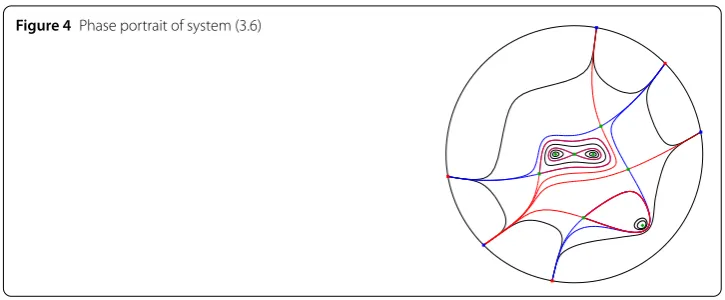
Theorem 3.4 Ifδ= 0,b21= 0,a12= –3b03,a22= –3b213,there exist two centers P(±ε, 0)and
a saddle(0, 0)in(3.6).
The Phase portrait of system (3.6) with two centersP(±ε, 0) and a saddle (0, 0) was given in Fig. 4.
4 Conclusion
LetM(n) denote the maximal number of small-amplitude limit cycles bifurcating from either an elementary focus or a center. There have been many results in the literature.
M(2) = 3 was obtained by Bautin in 1952 [29]. For n= 3, the existence of 11 small-amplitude limit cycles around a singular point was proved by [30], which is the best result so far for cubic systems, namelyM(3) = 11. For a quartic system, using the techniques de-veloped in [31], 21 limit cycles around an elementary focus or a center were found in [32]. For the result to quintic systems, 26 limit cycles around an elementary focus or a center were found in [32]. The authors have improved the bounds known up to now for quar-tic and quinquar-tic systems. Regarding the maximal number of small-amplitude limit cycles bifurcating from a nilpotent singular point, nine limit cycles were found in [28]. In [1], 12 limit cycles were obtained for a quartic system with a nilpotent singular point. In this paper, we obtained 13 limit cycles which can be bifurcated from a third-order nilpotent singular point by the normal form method. We also check our computation by the inverse integrating factor method. The result in [1] is improved.
Appendix
f1= 232,806,990,642,173,234,650,476,969,984a722 – 477,044,769,321,151,747,627,094,876,160a522a440 – 82,502,158,763,349,110,891,893,788,000a322a840 + 13,425,916,805,077,472,438,495,878,125a22a1402 + 3,626,132,661,875,872,721,780,739,145,728a622a40b12 – 4,874,662,820,265,947,537,539,453,516,800a422a540b12 – 432,703,859,977,355,762,471,434,258,500a222a940b12 + 19,056,777,587,139,908,577,974,512,500a1403b12 + 23,278,576,817,946,630,221,224,920,219,648a522a240b212 – 19,532,242,491,602,183,368,669,540,915,200a322a640b212
– 752,717,192,943,025,488,830,965,062,750a22a1400b 2 12
– 38,225,551,446,390,544,749,673,769,232,000a222a740b312
– 433,744,350,169,117,045,973,492,828,250a1401b312
– 763,796,971,844,160,152,666,112,000a5 22b412 + 160,998,064,918,174,797,651,106,928,670,720a3
22a440b412 – 36,568,732,582,402,041,283,807,931,942,400a22a840b412 – 5,773,134,335,673,254,169,280,512,000a422a40b512 + 189,440,538,958,857,143,945,451,460,248,576a222a540b512
– 13,711,504,717,817,841,782,955,386,017,440a9 40b512 – 14,167,203,178,857,126,540,705,792,000a322a240b612
+ 121,457,742,579,096,223,411,904,427,643,392a22a640b 6 12
– 11,593,248,573,008,543,300,370,432,000a222a340b712
+ 32,837,212,576,741,882,904,483,077,930,752a740b712
+ 2,245,173,056,476,346,827,726,848,000a22a440b 8 12
+ 5,064,667,464,745,198,665,216,000,000a5 40b912,
f2= –1,024,947,112,912,004,777,224,251,017,134,080a622a 3 40
– 266,474,629,928,468,613,669,557,286,240,000a422a740
+ 2,872,149,434,420,042,500,705,386,405,000a222a1140
– 445,566,812,245,372,227,872,915,578,125a1540
+ 291,969,434,543,132,541,842,261,954,002,944a722b12 – 12,365,037,948,610,082,121,455,696,104,857,600a522a440b12 – 1,807,720,964,924,211,050,490,834,741,684,000a322a840b12 + 7,826,499,497,633,136,164,923,512,183,750a22a1240b12 + 4,469,135,964,829,014,341,045,756,192,882,688a622a40b212 – 60,534,442,756,814,886,093,718,953,699,609,600a422a540b212
– 4,533,006,178,962,510,464,756,656,493,703,000a222a940b212
+ 4,340,383,679,701,089,115,056,480,723,750a1340b212
+ 28,237,918,683,246,180,995,584,983,497,637,888a522a240b312 – 154,765,499,379,216,156,315,309,044,374,560,000a322a640b312
– 4,995,407,878,226,678,735,912,107,001,119,500a22a1040b 3 12
+ 95,810,653,920,815,635,406,440,880,887,398,400a422a340b412
– 218,742,243,627,424,283,250,241,241,440,195,200a222a740b412
– 2,045,744,749,175,487,458,544,170,912,128,500a1140b412
– 813,586,646,290,453,924,746,048,307,200a522b512
– 162,486,461,423,769,223,728,413,597,878,998,720a22a840b 5 12
– 6,641,496,500,058,207,978,636,233,932,800a422a40b612 + 219,763,449,413,443,714,186,877,891,390,908,416a222a540b612
– 49,659,806,636,672,871,688,527,633,292,144,800a940b612
– 19,064,228,662,213,309,723,664,174,284,800a322a240b712
+ 138,807,072,047,279,379,408,768,873,696,863,232a22a640b 7 12
– 23,587,375,541,476,906,005,078,756,556,800a222a340b812
+ 36,965,323,313,333,940,486,460,749,189,299,712a7 40b812 – 11,144,873,921,049,570,121,957,903,564,800a22a440b912 – 543,085,211,944,693,588,070,611,353,600a540b1012,
f3= 50,981,886,359,079,612,587,706,382,255,372,752,829,487,775,744a922a 2 40
– 37,067,692,293,092,445,441,750,012,511,920,751,446,131,343,360a722a640
+ 10,870,813,246,986,673,638,486,304,086,018,078,167,585,088,000a5 22a1040 + 1,865,468,139,566,284,196,816,322,839,970,936,660,955,650,000a3
22a1440 – 603,923,588,989,755,945,512,889,950,992,874,035,584,843,750a22a1840
+ 1,022,486,657,553,039,896,608,738,191,617,360,223,834,828,963,840a822a340b12 – 458,337,148,013,787,047,780,469,938,840,107,759,739,495,546,880a622a740b12 + 127,105,557,085,114,016,587,071,383,065,327,336,213,508,880,000a422a1140b12 + 10,293,584,307,015,442,523,985,281,679,548,906,547,040,893,750a222a1540b12 – 819,782,869,838,484,626,774,512,854,042,791,435,270,625,000a1940b12 – 27,151,592,389,373,137,926,236,904,088,746,183,800,075,059,200a922b212
+ 8,940,700,083,625,325,227,481,046,577,354,689,218,587,001,880,576a722a440b212
– 2,327,073,899,335,537,014,385,148,389,219,002,199,314,773,084,160a522a840b212 + 576,812,223,109,715,545,609,263,444,945,637,012,697,548,425,000a322a1240b212 + 19,397,906,489,183,486,274,296,855,420,984,668,056,392,746,875a22a1640b
2 12
– 555,569,150,979,780,182,547,784,105,215,654,496,407,493,017,600a822a40b312 + 44,829,701,780,109,113,211,300,344,287,213,556,558,697,675,620,352a622a540b312
– 6,211,455,356,481,472,181,416,216,543,937,020,596,156,227,558,400a422a940b312
+ 1,248,196,196,928,988,776,133,983,498,657,830,652,209,486,940,000a222a1340b312
+ 12,244,662,313,483,580,417,405,784,575,032,932,936,001,725,000a1740b312
– 4,916,346,647,424,871,457,169,961,006,248,839,236,974,280,704,000a722a240b412
+ 142,279,577,432,706,147,170,857,397,343,977,295,082,151,327,531,008a522a640b412 – 9,290,899,349,623,044,173,008,296,104,827,167,661,839,731,769,600a322a1040b412
– 24,711,797,748,969,205,614,634,795,454,823,111,714,629,117,542,400a622a340b512
+ 296,723,701,499,161,287,704,516,622,860,637,906,314,000,798,846,976a422a740b512
– 7,598,375,984,298,187,054,214,113,602,180,794,604,878,607,085,440a222a1140b512
+ 515,403,389,037,848,152,893,742,601,009,301,446,964,737,813,250a1540b512
+ 89,151,402,261,964,717,348,593,902,889,295,518,105,600,000a722b612
– 77,871,378,889,486,757,955,374,362,879,501,321,944,798,907,596,800a522a440b612
+ 406,912,841,296,344,786,726,551,685,152,696,660,334,511,488,737,280a322a840b612
– 2,959,508,856,221,408,195,975,754,548,025,003,389,634,647,181,120a22a1402b 6 12
+ 1,212,459,455,348,222,745,203,216,678,389,937,329,930,240,000a622a40b712 – 159,874,291,856,994,698,343,598,397,136,909,959,783,750,585,548,800a422a540b712
+ 354,030,364,127,034,481,692,680,776,563,146,077,303,717,016,684,544a222a940b712
– 338,017,002,725,212,903,867,985,105,175,332,778,568,798,931,040a1340b712
+ 6,672,226,780,950,021,057,789,431,484,431,911,931,084,800,000a522a240b812
– 214,346,332,995,384,744,374,932,391,608,747,042,625,686,988,390,400a322a640b812
+ 177,421,389,360,763,691,749,439,937,259,376,019,693,424,578,797,568a22a1040b 8 12
+ 19,201,252,172,312,399,449,409,674,516,768,771,434,086,400,000a422a340b912
– 181,375,047,489,804,263,451,726,975,105,980,803,657,328,001,024,000a222a740b912
+ 39,043,027,707,216,401,602,019,440,086,182,542,407,958,295,162,112a1140b912
+ 31,126,909,610,212,084,842,208,982,324,018,330,311,065,600,000a322a440b1012
– 88,077,082,183,082,163,309,945,475,832,601,170,419,458,062,745,600a22a840b 10 12
+ 28,187,565,565,757,221,229,117,444,517,422,578,375,065,600,000a222a540b1112
– 18,735,560,247,850,408,809,771,660,270,641,909,467,182,488,371,200a940b1112
+ 12,916,473,356,332,131,362,657,092,325,292,496,398,581,760,000a22a640b1212 + 2,179,454,745,027,373,896,621,572,921,424,926,638,080,000,000a7
40b1312.
Funding
We would like to thank the support of Shandong Provincial Natural Science Foundation, China (No. ZR2014FL017, No. ZR2017MF050) and Project of Shandong Province Higher Educational Science and technology program (No. J17KA049).
Competing interests
The author declares that they have no competing interests.
Authors’ contributions
All authors contributed equally and significantly in writing this article. All authors read and approved the final manuscript.
Publisher’s Note
Springer Nature remains neutral with regard to jurisdictional claims in published maps and institutional affiliations.
References
1. Qiu, J., Li, F.: Two kinds of bifurcation phenomena in a quartic system. Adv. Differ. Equ.2015(1), 1 (2015) 2. Zhang, Z., Li, C.: On the number of limit cycles of a class of quadratic Hamiltonian systems under quadratic
perturbations. Adv. Math.26(5), 445–460 (1992)
3. Amelikin, B.B., Lukashivich, H.A., Sadovski, A.P.: Nonlinear Oscillations in Second Order Systems. BGY lenin.B. I. Press, Minsk (1992) (in Russian)
4. Han, M., Shu, C., Yang, J.: Polynomial Hamiltonian systems with a nilpotent critical point. Adv. Space Res.46(4), 521–525 (2010)
5. Jiang, J., Zhang, J., Han, M.: Limit cycles for a class of quintic near-Hamiltonian systems near a nilpotent center. Int. J. Bifurc. Chaos19(06), 2107–2113 (2009)
6. Yang, J., Han, M.: Limit cycle bifurcations of some Liénard systems with a nilpotent cusp. Int. J. Bifurc. Chaos20(11), 3829–3839 (2010)
7. Han, M., Yang, J., Xiao, D.: Limit cycle bifurcations near a double homoclinic loop with a nilpotent saddle. Int. J. Bifurc. Chaos22(08), 1250189 (2012)
8. An, Y., Han, M.: On the number of limit cycles near a homoclinic loop with a nilpotent singular point. J. Differ. Equ.
258(9), 3194–3247 (2015)
9. Giacomini, H., Gine, J., Llibre, J.: The problem of distinguishing between a center and a focus for nilpotent and degenerate analytic systems. J. Differ. Equ.227(2), 406–426 (2006)
10. Algaba, A., García, C., Reyes, M.: The center problem for a family of systems of differential equations having a nilpotent singular point. J. Math. Anal. Appl.340(1), 32–43 (2008)
11. Han, M., Sheng, L., Zhang, X.: Bifurcation theory for finitely smooth planar autonomous differential systems. J. Differ. Equ.264, 3596–3618 (2018)
12. Han, M., Hou, X., Sheng, L., Wang, C.: Theory of rotated equations and applications to a population model. Discrete Contin. Dyn. Syst., Ser. A34(8), 2171–2185 (2018)
13. Algaba, A., García, C., Gine, J.: Nilpotent centers via inverse integrating factors. Eur. J. Appl. Math.27(5), 781–795 (2016) 14. Liu, Y., Li, J.: New study on the center problem and bifurcations of limit cycles for the Lyapunov system (I). Int. J. Bifurc.
Chaos19(11), 3791–3801 (2009)
15. Liu, Y., Li, J.: New study on the center problem and bifurcations of limit cycles for the Lyapunov system (II). Int. J. Bifurc. Chaos19(9), 3087–3099 (2009)
16. Liu, Y., Li, J.: Bifurcations of limit cycles and center problem for a class of cubic nilpotent system. Int. J. Bifurc. Chaos
20(08), 2579–2584 (2010)
17. Liu, Y., Li, F.: Double bifurcation of nilpotent focus. Int. J. Bifurc. Chaos25(03), 1550036 (2015) 18. Liu, T., Wu, L., Li, F.: Analytic center of nilpotent critical points. Int. J. Bifurc. Chaos22(08), 1250198 (2012)
19. Li, F.: Bifurcations of limit cycles in a quintic Lyapunov system with eleven parameters. Chaos Solitons Fractals45(11), 1417–1422 (2012)
20. Li, F., Liu, Y., Li, H.: Center conditions and bifurcation of limit cycles at three-order nilpotent critical point in a septic Lyapunov system. Math. Comput. Simul.81(12), 2595–2607 (2011)
21. Takens, F.: Singularities of vector fields. Publ. Math. IHES43, 47–100 (1974)
22. Strozyna, E., Zoladek, H.: The analytic normal for the nilpotent singularity. J. Differ. Equ.179, 479–537 (2002) 23. Moussu, R.: Symétrie et forme normale des centres et foyers degeneres. Ergod. Theory Dyn. Syst.2, 241–251 (1982) 24. Alvarez, M.J., Gasull, A.: Monodromy and stability for nilpotent critical points. Int. J. Bifurc. Chaos15(4), 1253–1265
(2005)
25. Gamero, E., Freire, E., Ponce, E.: Normal forms for planar systems with nilpotent linear part, Bifurcation and chaos. In: Analysis, Algorithms, Applications, pp. 123–127. Birkhäuser, Basel (1991)
26. Alvarez, M.J., Gasull, A.: Generating limits cycles from a nilpotent critical point via normal forms. J. Math. Anal. Appl.
318, 271–287 (2006)
27. Colak, I.E.: Hamiltonian linear type centers and nilpotent centers of linear plus cubic polynomial vector fields. Ph.D. thesis, Universitat Autònoma de Barcelona (2014)
28. Yu, P., Li, F.: Bifurcation of limit cycles in a cubic-order planar system around a nilpotent critical point. J. Math. Anal. Appl.453(2), 645–667 (2017)
29. Bautin, N.: On the number of limit cycles which appear with the variation of coefficients from an equilibrium position of focus or center type. Math. Sb. (N.S.)30, 181–196 (1952)
30. Zoldek, H.: Eleven small limit cycles in a cubic vector field. Nonlinearity8, 843–860 (1995)
31. Christopher, C.: Estimating limit cycle bifurcations from centers. In: Differential Equations with Symbolic Computation, pp. 23–35. Birkhäuser, Basel (2005)