R E S E A R C H
Open Access
Performance analysis of distributed cluster-based
MAC protocol for multiuser MIMO wireless
networks
Azadeh Ettefagh
*, Marc Kuhn, Celal E
ş
li and Armin Wittneben
Abstract
It is known that multiuser multiple-input multiple-output (MIMO) communication can enhance the performance of wireless networks. It can substantially increase the spectral efficiency of wireless networks by utilising multiuser interference rather than avoiding it. This paradigm shift has most impact on the medium access control (MAC) protocol because most existing MAC protocols are designed to reduce the interference. In this article, we propose a novel cluster-based carrier sense multiple access with collision avoidance (CB-CSMA/CA) scheme. The proposed scheme enables multiuser MIMO transmissions in wireless local area networks (WLANs) by utilising the multiuser interference cancellation capability of the physical layer. In this article we focus on the performance analysis of CB-CSMA/CA. We investigate saturation throughput applying optimum backoff parameters and in the presence of synchronisation errors. Furthermore, we study the impact of different clustering methods on non-saturation throughput. We show that CB-CSMA/CA improves throughput significantly compared to the CSMA/CA scheme used in the IEEE 802.11 system. It is a promising approach for a variety of network configurations including typical infrastructure WLANs as well as many other wireless cooperative networks.
Keywords:Cluster-based CSMA/CA, Cooperative wireless networks, MIMO, WLAN, Infrastructure network, Clustering
I. Introduction
Multiuser multiple-input multiple-output (MIMO) com-munication is an effective approach to improve the per-formance of a wireless system by realising distributed spatial multiplexing and/or diversity gains. However, the current WLAN MIMO standard, IEEE 802.11n, supports only point-to-point MIMO links [1]. The IEEE 802.11n specifies the medium access control (MAC) and physical (PHY) layers to enhance the data rate of wireless local area networks (WLANs) using MIMO techniques. The main channel access method of the IEEE 802.11 MAC protocol, i.e. the distributed coordination function (DCF), is based on carrier sense multiple access with collision avoidance (CSMA/CA) [2]. While multiuser MIMO techniques can provide spatial multiplexing gains even in networks with single-antenna stations (STAs), DCF prevents this by a collision avoidance mechanism. Therefore, in order to realise distributed spatial multiplexing gains, the interference avoidance
scheme should be modified to facilitate controlled interference.
Contribution of this work
First we briefly devise a novel cluster-based MAC as
extension of CSMA/CA to utilise the multiuser interfer-ence mitigation capability of PHY. The proposed scheme is simple and can be applied to different
infra-structure or ad hoc networks with or without relays.
According to the proposed cluster-based CSMA/CA (CB-CSMA/CA) scheme, nodes in a network, including stations (STAs) and access point (AP) or relays, are allo-cated to different clusters. The nodes belonging to the same cluster are allowed to transmit at the same time, provided that there are enough degrees of freedom [3] available to efficiently decode the desired stream at the destination.
In this article, we focus on the MAC performance analysis. We investigate the performance bounds of CB-CSMA/CA for a representative application: a network which consists of a multiple-antenna AP and several
* Correspondence: [email protected]
Communication Technology Laboratory, ETH Zurich, 8092, Switzerland
single-antenna STAs. We present comprehensive perfor-mance results of the considered application and of a reference system, which is based on the IEEE 802.11n standard. As it will be explained in Section III, in a net-work with an AP which has four antennas the uplink throughput of CB-CSMA/CA is about 2.5 times higher than that of IEEE 802.11n.
In order to find out how the proposed protocol per-forms in realistic scenarios we investigate the through-put in different situations. We estimate performance bounds of the CB-CSMA/CA protocol under different conditions. We study the maximum throughput, which can be obtained by properly adjusting the backoff para-meters. Then we focus on performance analysis in rea-listic scenarios where for example the protocol fails to meet its basic requirements due to synchronisation
errors. We denote this problem by the term
event-syn-chronisation error. We evaluate the impact of event-syn-chronisation errors on the network throughput under saturation condition analytically and by simulations. Furthermore, we evaluate the non-saturation throughput and investigate impact of different clustering methods on throughput. In addition to the IEEE 802.11 reference, we compare the results with another multiuser protocol which has been proposed in [4].
Related Work
Several papers consider the MAC enhancement to sup-port concurrent multiuser transmissions [4-8] or to resolve collisions [9,10]. However, as it will be explained in more detail in the following paragraphs, the proposed CB-CSMA/CA differs from the existing methods in sev-eral ways, including the backoff procedure.
Park et al. [5] have proposed a MAC protocol mitigat-ing interference by usmitigat-ing multiple antennas at the recei-vers. In [8], the authors proposed a MAC protocol which considers the spatial correlation between the sig-nal and interference to decide whether multiple links should transmit simultaneously or not. In their proposal, links are allowed to contend for the channel sequentially while transmitting data packets simultaneously. The throughput of the multipacket reception in a WLAN has been investigated in [4], where the authors consider an uplink scenario with a multiple-antenna AP. In their scenario simultaneous multiuser transmissions up to a certain number can be decoded by the AP and hence are not considered as collision. However, in their work, contrary to CB-CSMA/CA, there is no systematic way to exploit multiuser transmissions.
A MAC protocol with antenna arrays is suggested for
ad hoc networks in [6]. The antenna array is used to null the interference from neighbours. In this scheme, bandwidth is divided into two orthogonal channels: a data and a control channel. The nodes use a CSMA/
CA-based scheme on the control channel to acquire the channel and learn about ongoing transmissions by mon-itoring this channel. Similarly, concurrent transmissions from different users may be allowed by applying the busy-tone medium access [7]. In this method, out of band busy-tones on control channels are used to notify nodes about the number of actual streams and hence, avoid collisions.
In [9], the authors suggest a MAC protocol with the ability to resolve collisions. According to this protocol, when collisions occur, the collided packets have to be buffered. In the subsequent time slots, a set of nodes behave as non-regenerative relays and forward the signal they have received during the collision slot one by one. This method has been extended and applied to a large-scale wireless sensor network by dividing the network into several clusters [10]. In [10] each cluster has a clus-terhead, and the nodes in a cluster only communicate with the clusterhead. Collisions within a cluster are resolved as in [9], while the clusterhead acts like a base station. Contrary to [9] and [10], in which the authors focus on the diversity techniques, we focus on utilising the spatial multiplexing gain in CSMA/CA-based systems.
In [11], we have presented the basic idea of
CB-CSMA/CA and applied it to an ad hocscenario where
several amplify-and-forward relays performed multiuser interference cancellation. This has been done by choos-ing appropriate relay gain allocations. However, in [11] we have only considered a simple scenario where all STAs where perfectly event-synchronised and always had packets ready to be transmitted.
The CB-CSMA/CA scheme has some distinct advan-tages compared to existing proposals: it requires neither sequential contention per node for the data transmission as it is needed in [5] and [8], nor a control channel as in [6,7], or [9]. Besides, by grouping nodes into clusters, the collision probability of the CB-CSMA/CA depends on the number of contending clusters rather than the total number of contending stations. As it has been shown in [11], the CB-CSMA/CA collision probability is considerably reduced compared to the standard IEEE 802.11 MAC. Furthermore, in contrast to [4] where there is a multipacket transmission only if accidentally more than one STA transmit in a time slot, the CB-CSMA/CA is designed such that each transmission attempt contains as many data packets as possible.
Outline
investigate the CB-CSMA/CA performance bounds in Section IV in which we analyse throughput for optimum backoff window parameters, asynchronous case, where STAs in a cluster transmit independently, and non-saturation scenarios where different clustering methods are applied. Conclusions are drawn in Section V.
II. Cluster-based CSMA/CA protocol
Assume a network where multiple users can transmit independent data streams simultaneously and the desti-nation nodes can efficiently decode the desired signal out of multiple streams. This is possible if there are enough degrees of freedom available at the destinations, e.g. each destination has enough antennas, or appropri-ate cooperation exists among nodes. In such a network, to enhance the spectral efficiency, multiple nodes should be able to transmit simultaneously. In order to do so, we classify the nodes in a network into clusters. The nodes belonging to the same cluster access the channel at the same time. Similarly, nodes belonging to the same clus-ter may receive simultaneous streams provided that the intended stream at each destination can be decoded. Consequently, the spectral efficiency for the given sys-tem improves.
Similar to multiple transmissions from a cluster, a cluster may receive several simultaneous streams if the multiuser interference can be cancelled, either directly at the destination, or for example by setting proper gain factors at the transmitters or at the amplify-and-forward (AF) relays. Hence, from the MAC layer point of view, the clusters replace the individual nodes, and the nodes belonging to the same cluster look like a single entity. Consequently, the probability of collision in the network can be substantially reduced.
We consider three types of clusters: source-, destina-tion- and relay-clusters. In a system with Vclusters in total, we denote thevth cluster by Cv, wherevÎ {1, 2,
..., V }. A cluster which generates the data packets is called the source-cluster and denoted byCsv. The size of the source-cluster is limited by the maximum number of concurrent streams which can be efficiently decoded. A cluster which includes the target receivers is a desti-nation-cluster and denoted byCdv. Even though forming a destination-cluster is not always necessary, for simpli-city we assume that the destinations of a given source-cluster belong to a single destination-source-cluster. It should be noted that a source-cluster and its destination-cluster may interchange their functions at different time slots. A relay-cluster, denoted by Crv, is a cluster of relays which receives and forwards data to other clusters with-out private benefit.
Clusters can be formed based on a certain application or a given structure. For example, in an infrastructure network with a multiple-antenna AP, the AP forms
clusters of STAs such that it can decode multiple streams in the uplink (for example by successive inter-ference cancellation), or separates them in downlink transmissions (for example by performing zero-forcing). Since in the infrastructure mode all STAs associate with the AP, it is aware of each new STA entering its net-work or any STA leaving it. The AP can cluster nodes such that neighboured STAs belong to a single cluster or as it will be explained in Section IV-C adaptively allo-cate STAs which have packets ready to be transmitted to one cluster. The maximum size of the clusters is determined by the number of antennas at the AP.
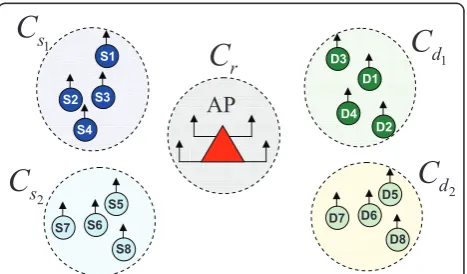
The AP itself constitutes a single-member clusterCr. Figure 1 depicts a scenario where the AP has four antennas and each source- and destination-cluster con-sists of four single-antenna STAs.
Throughout this article we consider a wireless net-work where STAs belong to the same basic service set (BSS).aFurthermore, for practical reasons, we consider only half-duplex nodes which are not able to transmit and receive simultaneously. We focus on the data
trans-mission phase and assume that clusters are defined a
priori.
A. Basics of CB-CSMA/CA
According to the CB-CSMA/CA, the nodes in a cluster behave similar to a single node, i.e. they access the channel at the same time and transmit simultaneously. Therefore, assuming the DCF access method is used, we need to consider two major modifications to the current backoff procedure: (i) having the same initial backoff duration for all cluster members and (ii) updating this value at the same time. The first requirement can be achieved for example by having the same random gen-erator seed in each cluster, so that the same pseudo-ran-dom numbers are generated. In infrastructure networks the AP informs STAs in a cluster about the initial value
D3
D4 D1
D2
S5 S7 S6
S8
AP
S1
S2 S3
S4
D5 D7 D6
D8
2
s
C
1s
C
r
C
C
d12 d
C
Figure 1An infrastructure network with four antennas at the AP and 8 source-destinations pairs. AP acts as relay for
of the contention window (CW) and, as explained in Section II-C, informs STAs in case they need to update it. As a second requirement, the STAs within a cluster
should be event-synchronous.b This is necessary since
according to the IEEE 802.11, the CW doubles after any unsuccessful transmission up to a maximum value [2]. Thus, after a transmission, STAs in a cluster should all know whether they need to increase the CW or not, as explained in the next subsection. In this way, each node in a cluster contends only with other clusters and not with other nodes in the same cluster. We assume that the clusters are constructed in a way that the destina-tions are able to decode the intended message. Conse-quently, simultaneous transmissions of the STAs within a cluster are resolved and do not lead to collisions.
The clusters access the channel one after the other in a similar way as single nodes act in the current CSMA/ CA systems. As it will be shown in the next section, the event-synchronisation error leads to a throughput loss but the CB-CSMA/CA is relatively robust to such errors. In the worst case scenario, when all cluster members are not synchronous anymore, the CB-CSMA/ CA performance gets close to that of the standard
CSMA/CA.c
In a single-input single-output (SISO) WLAN system, the header of each transmitted frame can be ideally decoded by any node which is in the communication range of the transmitter. Accordingly nodes within a WLAN learn about an ongoing transmission by decod-ing the headers which include the duration field. How-ever, the situation changes in a CB-CSMA/CA system, where several frames might be transmitted in parallel. The system is structured in such a way that each desti-nation is able to decode its intended packet’s header as well as its payload. However, other nodes in the network may not be able to do so. In order to solve this problem, a cluster common preamble should be sent prior to the data transmission.
The common preamble, which is sent at the lowest rate, could have a similar format as that of the legacy preamble of the PLCP header used in the IEEE 802.11n mixed format [1].dIt additionally includes the address of the source-cluster and its LENGTH field should be set to the maximum length of all concurrent packets. The maximum value can be either set to the value specified by the standard for all transmissions or adaptively set by the AP according to the actual traffic and cluster struc-ture for each cluster. In the latter case the AP informs the STAs about this value once it forms the cluster.
B. PHY layer requirements
The existing IEEE 802.11n supports only MIMO point-to-point links. However advanced signal processing techniques have enabled distributed multiuser MIMO
transmissions. In order to efficiently decode an intended data packet in the presence of multiuser transmissions, the interference from other nodes has to be cancelled out. This can be done similar to point-to-point MIMO networks by successive or parallel interference cancela-tion. The main difference is that here individual nodes participate in each transmission and form some sort of a virtual antenna array.
In the current WLAN, the receivers estimate the channels by receiving the training sequence in the PLCP preamble of each frame. In CB-CSMA/CA, each trans-mission attempt may consist of several simultaneous streams. Therefore, orthogonal training sequences are allocated to different STAs within a source-cluster. The orthogonal training sequences can be designed as pro-posed in the IEEE 802.11n for MIMO transmissions, where for each transmit chain, the training field is cycli-cally shifted [1].
It should be noted that in OFDM systems, as long as the sum of the maximum delay offset and the channel delay spread is shorter than the cyclic prefix, both the multiuser interference and the inter-symbol interference can be mitigated. Since we focus on indoor scenarios the maximum channel delay spread and distances between nodes are quite small. As, in this article, our main goal is to analyse the performance of MAC layer, we assume an ideal PHY layer with perfect time and fre-quency synchronisation and no channel or decoding errors.
C. Collision detection
In WLANs, packets may fail due to collisions and chan-nel errors. The cause of failure, however, cannot be dis-tinguished in current WLAN systems [12,13]. Hence, in both cases, the backoff interval increases exponentially up to a maximum value which is specified by the stan-dard. However, in the event of a channel error, the bin-ary exponential backoff may reduce efficiency and cause unfairness. An inherent advantage of our proposed CB-CSMA/CA is its ability to differentiate between these losses in practical SNR regimes. As explained in the next paragraph, this feature can be optionally used to enhance the performance.
If the common preamble cannot be decoded, it can be assumed that a collision has occurred. However, if the common preambles collide, the information about involved clusters may not be obtained. Hence, a short packet, called contention window update request (CWUR) packet, should be broadcasted to all clusters. In infrastructure networks this is performed by the AP. Upon reception of CWUR all source-clusters enter the next backoff process. However, only the source-clusters which have been involved in the pending transmission increase their CW unless the maximum CW value has already been reached. In the latter case they keep the maximum CW for the upcoming transmission.
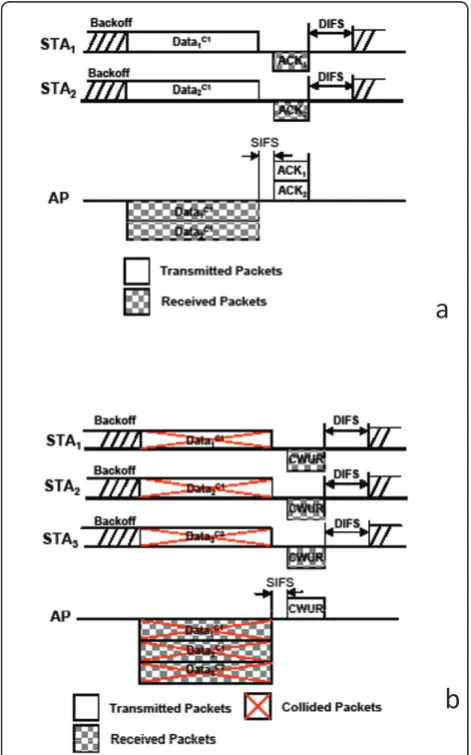
Figure 2 shows the uplink transmission in an
infrastruc-ture network, where the AP has two antennas and STA1
and STA2belong to clusterCs1, while STA3is a member of clusterCs2. In Figure 2(a) an example of a successful transmission is shown, where STAs inCs1have a shorter backoff than STAs inCs2, hence they transmit first. In Figure 2(b) both clusters begin to transmit at the same time and hence a collision occurs. In this figure super-script ciabove the data indicates the source-cluster from
which the data packet is originated while subscriptjbelow the data or ACK specifies the respective STA.
III. Outline of representative applications and the analytical model
In this section first we introduce a CB-CSMA/CA appli-cation which is considered throughout this article. Furthermore, we explain the reference application, oper-ating based on the standard, and another multiuser transmission protocol. Then we briefly review the exist-ing model for calculatexist-ing the throughput of a CSMA/ CA-based network and point out the modifications which have to be considered for CB-CSMA/CA applications.
A. Applications
The proposed CB-CSMA/CA has wide applicability to different cooperative wireless networks. Appropriate applications include cooperative scenarios like multiuser zero-forcing relaying (MUZFR) [14] and two-way relay-ing [15], which require multiple STAs to transmit simul-taneously and are not supported by the current WLAN MAC. Besides, any multiuser WLAN scenario that is supported by the standard MAC, is more efficient under the CB-CSMA/CA if multiuser interference can be cancelled.
In this article we focus on infrastructure networks where the AP is equipped with multiple antennas. For the analysis we only consider uplink transmissions. Hence, the AP acts as the receiver and all other STAs transmit to the AP. Thead hoccase where several relays assist the communication between sources and destina-tions is explained in [11].
1) CB-CSMA/CA application
In this article we use a representative application to quantify the performance of the CB-CSMA/CA scheme. This application is an uplink scenario in an infrastruc-ture network with a multiple-antenna AP. The system
consists of an AP withNa antennas andn STAs, each
equipped with a single antenna. Hence, at each
trans-mission attempt NaSTAs should be able to transmit in
parallel. In order to do so, sources are grouped into clusters and operate based on CB-CSMA/CA as explained in Section II. Although we only focus on uplink in this article, multiple transmissions in downlink can be supported by the CB-CSMA/CA protocol in a similar way.
a
b
Figure 2CB-CSMA/CA access mechanism in an infrastructure network with a multiple-antenna AP as the receiver. In(a)an
example of a successful transmission is shown, where STA1and
2) Reference 1–IEEE 802.11 MAC Protocol
As a first reference system, we consider the above-men-tioned infrastructure network which operates based on the IEEE 802.11 DCF. Therefore, in this reference sys-tem, at each time instant at most one node is allowed to access the channel.
3) Reference 2–a multiuser MIMO protocol
In addition to the standard CSMA/CA, we compare the results with those of a multipacket reception protocol described in [4]. In [4] and [16] the authors have pro-posed a multipacket reception (MPR) protocol and investigated its performance for various types of net-works and parameters. In [4], uplink transmissions in an infrastructure network are considered, where the AP has
Naantennas. STAs compete for the channel according
to the DCF request to send/clear to send (RTS/CTS) mechanism. However, if accidentally more than one STA transmits in a time slot and the AP can decode the RTS frames, it sends the CTS frame to all senders. This can be done as long as the number of concurrent trans-missions are less or equal to Na. Afterwards the trans-mitters send their data packets simultaneously to the AP. The suggested MAC closely follows the standard MAC, however, some modifications are required. For
example, as the AP does not have anya priori
knowl-edge about the transmitters and their channels, it should apply blind techniques to decode the RTS frames. Furthermore, it has to allocate orthogonal training sequences to the transmitters once it sends the CTS frames [4].
B. Throughput analysis
Throughput is defined by the average payload bits which are transmitted successfully in a time slot divided by the duration of the time slot, i.e.Tslot. We mainly consider saturation throughput where there is always a packet in the buffer of each station ready for transmission. How-ever, in Section IV-C non-saturation throughput and impact of the presence of packets in buffers on the throughput are studied.
In this article we use Bianchi’s model [17] as the basis for calculating the collision and transmission probabil-ities. In [17] an ideal channel with no channel errors, hidden nodes or capture is assumed. All nodes operate in saturation condition. Furthermore, no retransmission limit is considered. The model has been validated in [17] for IEEE 802.11b parameters. In [18] the authors have considered the IEEE 802.11a parameters and showed that the results using the original model are very close to the results obtained from a more accurate model introduced in [18].
As shown in [17], analysis of the Markov chain model leads to the following equations which have to be solved numerically to obtain the transmission and conditional
collision probability (collision probability given that a STA transmits) in a network withncompeting stations:
Pcol= 1−(1−τ)n−1, (1)
τ = 2(1−2p)
(1−2p)(W+ 1) +pW(1−(2p)m), (2)
whereWandmcan be calculated from the minimum
and maximum contention window sizes, denoted by
CWminandCWmax, respectively, as follows:W=CWmin + 1 andCWmax= 2mW- 1
For the CB-CSMA/CA application we need to adapt the basic model. For scenarios where all members of clusters are perfectly event-synchronised we just need to replace the number of STAs in the original model by the number of clusters, Nc. However, as it will be shown in the next section, further changes are required for cases where one or more STAs are not event-synchro-nous anymore.
For the reference model and the MPR we can directly apply the equations given in [17] and [4], respectively, to calculate transmission and collision probability. Due to space limit we do not repeat those equations here and refer the interested reader to [17] and [4].
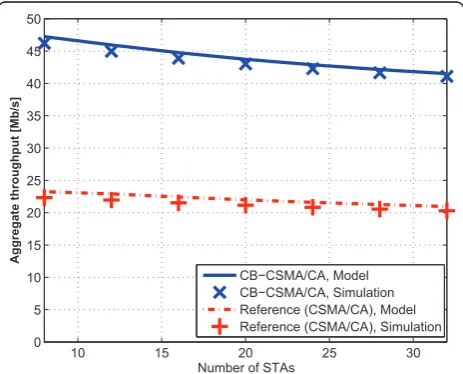
Saturation throughput forNa= 4 for both CB-CSMA/
CA and the standard CSMA/CA are depicted in Figure 3. A link rate of 19.5 Mb/s (PHY rate of 26 Mb/s and a coding rate of 3/4) is assumed for CB-CSMA/CA appli-cation. This is one of the IEEE 802.11n possible data rates. Since there are four antennas at the AP, in the reference system at each transmission attempt there is a
10 15 20 25 30
0 5 10 15 20 25 30 35 40 45 50
Number of STAs
Aggregate throughput [Mb/s]
CB−CSMA/CA, Model
CB−CSMA/CA, Simulation
Reference (CSMA/CA), Model Reference (CSMA/CA), Simulation
1 × 4 single-input multiple-output (SIMO) link. Com-pared to a SISO link, for the reference system the maxi-mum spectral efficiency gain of log(4) = 2 b/s/Hz (or 40 Mb/s for a system with 20 MHz bandwidth) can be expected [19]. Here as an extreme case (in favour of the reference system), we have increased the data rate of the reference system compared to the CB-CSMA/CA appli-cation to the next higher rate of IEEE 802.11n (58.5 Mb/s which can be achieved by a PHY rate of 78 Mb/s and coding rate of 3/4).
For both systems control packets are transmitted at the lowest data rate, i.e. 6.5 Mb/s. As it can be observed in this figure, CB-CSMA/CA can improve the through-put significantly. The results are verified by comthrough-puter simulations. The simulation results are also plotted in the same figure. As it is expected simulated results fol-low the analytical results closely and the results become more accurate as the network size grows. The para-meters which are used for numerical investigations throughout this article are given in Table 1.
IV. Performance bounds
In this section we analyse throughput upper and lower bounds of the CB-CSMA/CA application under different conditions. First we calculate the maximum saturation throughput and compare the results with the through-put of the reference system and that of the MPR proto-col. Then the performance of the CB-CSMA/CA protocol in non-ideal conditions, e.g. where STAs in a cluster cannot transmit simultaneously or some of them may not have packets to transmit, is considered. The former is achieved by taking the impact of event-syn-chronisation error on the network throughput into con-sideration. The latter is done by considering non-saturation throughput and impact of different clustering methods on the network throughput. In practice, throughput of a CB-CSMA/CA application may vary between the calculated bounds.
A. Maximum saturation throughput
First we estimate the upper bound of the throughput by
varying the transmission probability τ and finding the
maximum throughput for a network with n STAs. In
order to do so we can either calculate throughput results for different values of τ and find the τ* which maximises the throughput or findτ* as explained in [13] by applying the following equation:
τ∗ = 1 +
1 + 2n(nn−21)ω ω(n−1)
(3)
whereω=Tc/swithTcbeing the time duration when the channel is sensed busy due to collision andsbeing the duration of a time slot which is 9 μs according to IEEE 802.11n [1].
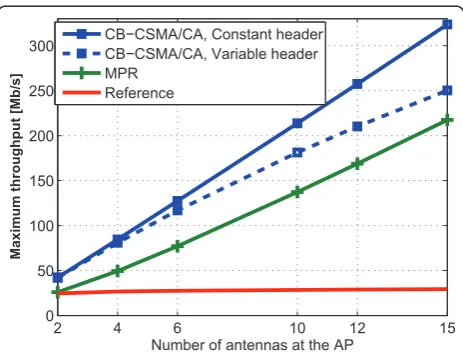
The maximum throughput for CB-CSMA/CA and MPR versus the number of antennas at the AP are plotted in Figure 4. The throughput of the reference sys-tem is also plotted for comparison. In the CB-CSMA/ CA application the cluster size increases with the num-ber of antennas at the AP,Na. In the MPR application the maximum number of simultaneous transmissions which can be supported by the AP is increased withNa. While a constant rate per link of 58.5 Mb/s is assumed for all CB-CSMA/CA and MPR setups, link data rate of the reference system has been increased logarithmically
with the number of antennas at the AP.e This is done
since in the CB-CSMA/CA application, the antennas at the AP are used to cancel the multiuser interference but in the reference system we have SIMO links where at each time instant the antennas at the AP are only used for a single transmission. In all setups number of STAs is set ton= 60.
Table 1 The analysis parameters
Parameters CB-CSMA/CA MPR
SIFS 16μs 16μs
DIFS 34μs 34μs
Propagation delayδ 1μs 1μs
CWmin 15 15
CWmax 1023 1023
Slot times 9μs 9μs
Payload sizeL 1024 byte 1024 byte
Basic rate 6.5 Mb/s 6.5 Mb/s
MAC Header (Data) 40 byte 34 byte
MAC Header (ACK, CTS) 14 byte 20 byte
RTS MAC Header N/A byte 20 byte
CWUR MAC Header 8 byte N/A byte
2 4 6 10 12 15
0 50 100 150 200 250 300
Number of antennas at the AP
Maximum throughput [Mb
/s]
CB−CSMA/CA, Constant header CB−CSMA/CA, Variable header MPR
Reference
For the CB-CSMA/CA application two types of train-ing sequences have been considered. As explained in Section II, time-orthogonal training sequences per clus-ter-members can be used to make channel estimation possible at the AP. In this way, the header length increases as the cluster size becomes larger. In Figure 4 the results for this case are denoted as variable header. However, training sequences may be orthogonalised in other domains such as frequency. In this way duration of the header does not change with the cluster size, cf.,
CB-CSMA/CA constant header curve in Figure 4. In
this figure constant headers are assumed for the MPR application.
As we can observe in Figure 4, CB-CSMA/CA gains more than other applications from increasing Na. How-ever, note that for very large cluster sizes, overhead increases as long as orthogonal training sequences in time are applied. It should be noted that the results in Figure 4 are the upperbound of throughput. In practice where the CW parameters are fixed, the throughput of the considered applications are below the values shown here.
B. Impact of event-synchronisation errors on CB-CSMA/CA performance
So far we have assumed perfect event-synchronisation in all clusters. Consequently, each time when a cluster accesses the medium, all of its members transmit con-currently. However, in practice members of a cluster may become event-asynchronous when for example one or more of them cannot receive or decode the CWUR packet. This may happen if any of the members are in a deep fade. In this section we study the impact of event-synchronisation errors on the throughput performance of the CB-CSMA/CA. However, to quantify the MAC layer performance again PHY channels are assumed to be perfect.
An event-synchronisation error can originate from dif-ferent types of errors, including decoding errors on con-trol frames and hidden nodes. In this chapter we assume that event-synchronisation errors occur due to decoding errors. Hence, the original backoff model can still be applied.
In the presence of an event-synchronisation error a subset of STAs in a cluster may be silent while the others are transmitting. Consequently, the number of parallel streams is not the same as the cluster size anymore.
In CB-CSMA/CA even if all STAs in all clusters become event-asynchronous, the conditional collision probability is reduced compared to the CSMA/CA case. This is due to the fact that simultaneous transmissions from the same cluster can still be decoded. It should be
noted that in CB-CSMA/CA the preambles are defined in such a way that multiple streams originated from a single cluster can be decoded. On the other hand, if for example two STAs, each from one cluster, begin to transmit simultaneously, the training sequences may not be orthogonal any more and hence the receiver cannot estimate the channel and decode the packets. This hap-pens even if the receiver has multiple antennas. There-fore, it is assumed that collision occurs if at least two stations which belong to different clusters begin to transmit at the same time regardless of the number of parallel streams.
We begin the analysis by considering a symmetric scenario where all clusters suffer from synchronisation errors in the same way. Then we extend the scenario
to a general case in which each STAi has an
event-synchronisation probability of Psei. For all scenarios, we investigate the throughput equations as a function of Pse.
Again we consider the uplink of an infrastructure net-work where the AP has four antennas and each source-cluster contains four single-antenna STAs. We assume that all clusters can support a link data rate of 58.5 Mb/ s regardless of the number of parallel streams. This could be the case in the high SNR regime where this rate could be supported on individual links.
First we consider a simple symmetric scenario, where
allNc clusters have the same number of asynchronous
STAs. Assuming each cluster has a total number ofNnc
STAs from which,k STAs are event-asynchronous. In
this way, in the worst case scenario all STAs are asyn-chronous, i.e.k=Nnc and each cluster seesk(Nc- 1) =
Nnc(Nc - 1) contending units at each transmission
attempt.
1) Worst case scenario, k = Nnc
First we assume that all STAs in clusters encounter syn-chronisation errors. We study an extreme case where
Pse is assumed to be equal to 1, (i.e. all members of
clusters are with probability one asynchronous). Taking the MAC layer into account, this is the worst case which can happen and hence the throughput values in this case give the lower bound of the CB-CSMA/CA throughput.
In this case, a collision happens if one or more STAs in a cluster transmit while any other STA from any other cluster transmits at the same time. It should be noted that even in this case simultaneous transmis-sions of multiple STAs within a cluster can be resolved and hence do not lead to collisions. The collision probability given that at least one STA transmits can be calculated by taking into account the collision
prob-ability in an equivalent CSMA/CA, with n = NcNnc
other node from the same cluster transmits while other clusters are silent:
Pcol= 1−(1−τ)NcNnc−1
−
Nnc−1
i=1
Nnc−1 i
τi(1−τ)Nnc−1−i
×(1−τ)Nnc(Nc−1).
(4)
Pcol can also be directly obtained by taking into
account the total number of contenders, i.e. the number of contending STAs which belong to other clusters:
Pcol= 1−(1−τ)(Nc−1)Nnc. (5)
As expected, for identical parameters, Equations 4 and 5 lead to the same result.
Since all members of clusters are asynchronous, the aggregate throughput of all clusters is defined by:
S=
Nckm=1
k m
τm(1−τ)(k−m)mL
Tslot ×
(1−Pcol)(1−Pe), (6)
where k= Nnc and Tslot is the duration of the time window which can be obtained using:
Tslot=Pidσ+Ps(1−Pe)Ts+ (1−Pid−Ps)Tc+PePsTe, (7)
wherePid,Ps andPeare the probabilities that the slot is idle, contains a successful transmission and channel error, respectively. Ts, Tcand Teare the average time required for successful data transmission, collision and channel error.Psand Pidcan be calculated from the fol-lowing equations:
Ps=NcPt(1−Pcol),
Pid= (1−τ)NncNc,
(8)
wherePtis the probability that at least one STA in a cluster transmits in a slot:Pt=km=1(km)τm(1−τ)(k−m).
Throughout this article we focus on MAC layer
fea-tures and we setPeto 0. For the CB-CSMA/CA
applica-tionTsand Tccan be obtained from:
Ts=TData+ SIFS +δ+TACK+δ+ DIFS,
Tc=TData+δ+ SIFS +TCWUR+δ+ DIFS,
where TData andTACK are the duration of the data
(including the common preamble) and the ACK trans-mission, respectively, andTCWURis the duration of the CWUR frame. The duration of the data and a control frames in an OFDM-based WLAN can be obtained as follows [20]:
TData=TPLCPP+TPLCPSIG
+ DataMACHeader + (16 + 6)/8 + L
BpS(M)
·Tsym,
(9)
TControl=TPLCPP+TPLCPSIG
+ MACHeader + (16 + 6)/8 BpS(M)
·Tsym,
(10)
where TPLCPP, TPLCPSIGand Tsym are the durations of the PHY layer convergence protocol preamble (PLCP), PLCP SIGNAL and one OFDM symbol, respectively. The number of bytes per OFDM symbol for a given
modulation Mand the payload size are denoted by BpS
(M) andL, respectively.
As it is expected by setting Nnc to 1 and Nc to be
equal to the number of STAs, n, (6) reduces to the
throughput equation in the standard case, i.e. Eq. (13) in [17].
The normalised throughput of the worst case scenario, where all STAs encounter synchronisation errors with probability one, is plotted in Figure 5. Normalised throughput is a unitless parameter which is defined by the time used for payload transmission divided by the total time needed for that transmission, i.e. Tslot. We also depict the throughput of a reference system based on the standard CSMA/CA. It is assumed that both sys-tems transmit at the same data rate. This is a sensible assumption since even for CB-CSMA/CA with high probability only one node transmits at each transmission attempt. In this section we, furthermore, focus on the high SNR regime where CB-CSMA/CA can also operate at the highest PHY data rate defined by the standard regardless of the number of parallel streams.
8 12 16 20 24 28 32 36 40 44 48 52 56 0
0.1 0.2 0.3 0.4 0.5
Number of STAs
N
orma
lise
d
t
h
roug
h
put
CB−CSMA/CA, first setup: worst case Reference (CSMA/CA)
CB−CSMA/CA, second setup
Figure 5 Comparison of normalised throughput results obtained using the model with those from simulations,Pse= 1.
For the CB-CSMA/CA applications, it has been assumed that multiple transmissions from more than one cluster always lead to collisions. This is the worst case as in practice different frames from different clus-ters may still have orthogonal training sequences and hence the AP can decode those frames as long as the number of streams does not exceed the number of antennas at the AP.
It can be observed that in the worst case scenario, when all STAs are event-asynchronous, the CB-CSMA/ CA throughput is reduced to that of the reference sys-tem. It should be noted that even in this scenario the collision probability of the CB-CSMA/CA is smaller than that of the standard CSMA/CA, however, the head-ers in CB-CSMA/CA are longer than that in the refer-ence system due to the common preamble and the orthogonal training sequences. For large network size, this leads to slightly smaller throughput in CB-CSMA/ CA as compared to that of the standard CSMA/CA, cf., Figure 5.
In order to validate the results obtained from the model, we have simulated the same scenario in MATLAB. The normalised throughput obtained from simulations are compared with those obtained from the analytical model in Figure 5. As it can be observed, results from the model match the simulation. The model becomes more accurate as the network size increases.
For the CB-CSMA/CA application, in addition to the worst case scenario, a second set of the results is shown in Figure 5. In this case, we have assumed that there are totallyNnc=Nagroups of orthogonal training sequences
and collisions occur only when either more than Na
STAs transmit at the same time or two or more STAs with non-orthogonal training sequences transmit con-currently. The simulated results for this case are also depicted in Figure 5. As it has been expected the second setup has higher throughput than the first one.
2) Asymmetric scenario
In practice different clusters may have different channel conditions and hence we extend the study to cover asymmetric scenarios. In this section, we consider an asymmetric scenario where only one cluster suffers from synchronisation errors. In this case we need to distin-guish between two different categories of clusters: (i) Categoryiwhich has only one cluster, i.e.Ci. Each STA
in Ci has a non-zero Pse. (ii) The second category
includes all other clusters with Pse = 0. We denote the clusters in this category byCjwherej≠i.
Since the clusters in the latter category are all per-fectly event-synchronised, the members ofCi face
colli-sions only when any STA ofCibegins to transmit while
any other cluster transmits at the same time. Therefore,
the collision probability of Ciwhenkof its members are
asynchronous is defined by:
Pcol(k)
i = 1−(1−τ
(k)
j )Nc−1, (11)
where superscript (k) indicates dependency onk.
P(colk)j=
On the other hand, for anyCjin the second category,
a collision happens if it transmits and at the same time any other cluster from the same category or any of the STAs inCibegin to transmit. Accordingly, for this
cate-gory collisions occur with different probabilities, depending on the number of clusters as well as the
number of asynchronous STAs within the Ci, see (12)
above.
In this scenario again we can use (2) to calculate τi.
For each k, Equations 2, 11 and 12 can be solved
numerically.
For each transmission attempt ofCi, there are
differ-ent numbers of parallel streams. The number of parallel streams depends on the number of asynchronous STAs
within Ci and whether they transmit by chance at the
same time or not. To calculate the throughput of cluster
Ci we first need to determine the probability that k
STAs out ofNnciSTAs inCiare asynchronous, i.e.
(i) the first group consists of Nnci−ksynchronised STAs, these nodes access the channel at the same time and act as a single unit. The transmission probability of this group is denoted byPta.
(ii) the second group consists ofkasynchronous mem-bers, these STAs access the channel individually, how-ever, some of them may by chance transmit at the same time. We denote the transmission probability of this group byPtb.
The probability that only STAs inCitransmit is:
The probability that only one of the clusters from the second category transmits is:
Psj(k)= (Nc−1)τj(k)(1−P (k)
colj). (16)
Hence, throughput of cluster Ci and aggregate
throughput of all other clusters are, respectively, expressed as:
whereTslotis equal to:
Tslot=Pidσ+
where PidandPc, i.e. probability that collisions occur in a slot, are, respectively, given by:
Pid=
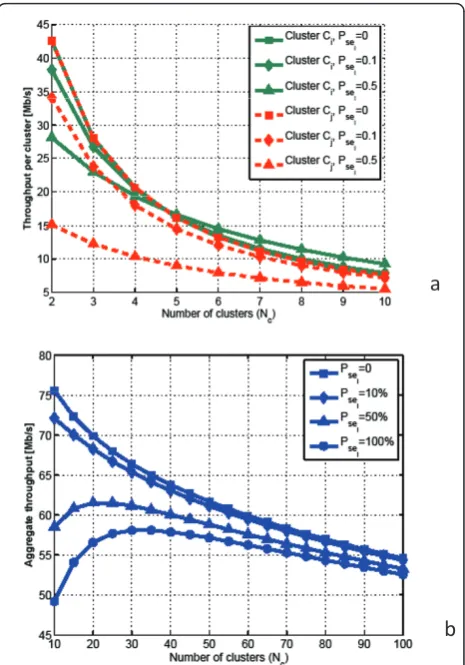
The throughput of each cluster category is shown in Figure 6(a). As the number of clusters increases, the throughput of Ci improves with increase inPsei. when
Pseiincreases, with high probability there are more
asyn-chronous STAs in Ci. However, as simultaneous
trans-missions from Ci can be resolved and hence are not
considered as collisions, this only increases the collision
probability of other clusters. Consequently, Ci may
transmit with higher probability and thus benefit from longer backoff durations at other clusters. For the same reason the throughput of any other cluster degrades whenPseiincreases.
The aggregate throughput versus the number of clus-ters for different values of Psei has been depicted in Figure 6(b). As it is expected, an event-synchronisation error leads to throughput loss and the aggregate throughput decreases whenPseiincreases. However, the throughput values for different Pseiget close to each other for a large number of clusters. The impact of a single cluster Cialmost disappears once the number of
clusters becomes very large.
3) General scenario
In this section, we will consider a general and more rea-listic case, where members of each cluster may suffer from synchronisation errors with a certain probability.
It is assumed that each clusterCihasNnciSTAs out of whichki are asynchronous. For each cluster, the
colli-sion probability depends on the number of total units, i. e. asynchronous and synchronous STAs, in other
clu-sers. Consequently, for 0≤ki≤Nnci where
For any number of asynchronous STAs in each cluster the transmission probability can be obtained by solving the set of equations given in (20) and (2). Accordingly, the transmission probability of synchronous and asyn-chronous STAs in eachCican be calculated as follows:
P(k1,k2,...,knc)
Figure 6Throughput when each STA inCisuffers from
Here and in the following, for simplicity we denote the superscript(k1,k2, ...,knc)by(k˜). The probability that
ki out of NnciSTAs are asynchronous can be obtained from (13), however, herek may take different values in different clusters. In this scenario, the probability that only members of one cluster transmit also depends on
(k˜)and can be obtained as follows:
The throughput of each cluster is given by:
Si=
whereTslot can be calculated from the following equa-tions:
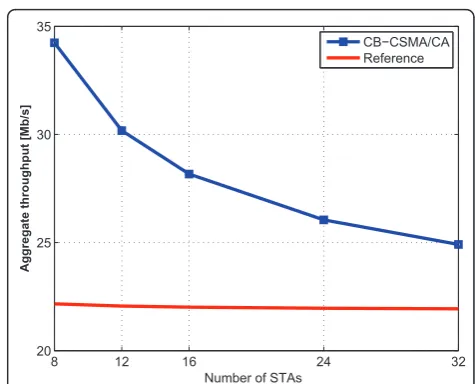
Applying the above equations, we evaluate the throughput of the general scenario where Psei of each cluster is chosen uniformly from the interval [0, 1]. Each time the throughput of each cluster and the aggregate throughput are calculated. ThenPsei values are set to
new random numbers. The results are shown in Figure 7. Although the throughput is degraded compared to the case where all STAs are event-synchronous, it is still much higher than that of the CSMA/CA system.
C. Impact of clusterings on CB-CSMA/CA non-saturation throughput
In unsaturated conditions STAs may or may not have a packet to transmit, depending on the traffic arrival rate. In order to calculate the transmission probability under unsaturated condition, we can apply the Markov chain model as proposed in [21]. In this model, compared to the saturation model, a new state is introduced, which indicates the probability that there is at least one packet to be transmitted in the buffer. This probability is denoted by q. As it is shown in [21], in this case the transmission probability can be obtained from:
τ= 2(1−2p)q
q[(1−2p)(W+ 1) +pW(1−(2p)m)] + 2(1−q)(1−p)(1−2p), (28)
Assume l as the average packet arrival rate at each
STA. For a traffic model with Poisson packet arrival process and for a small buffer size the probabilityqcan be calculated from [22]:
q= 1−e−λTslot, (29)
whereTslotcan be obtained from (7).
In non-saturation scenarios, grouping different STAs into a cluster can impact the network throughput. This happens since STAs in a cluster may or may not have a packet to send. Here we distinguish between two types
of clusterings: non-adaptive clustering where clusters
are formed regardless of the presence of queued packets
8 12 16 24 32
20 25 30 35
Number of STAs
Aggregate throughput [Mb/s]
CB−CSMA/CA
Reference
Figure 7Throughput of the general case where STAs in each clusterCisuffer from event-synchronisation errors with
and adaptiveclustering where STAs which have packets to transmit are allocated to the same clusters. Adaptive clustering can for instance be achieved by using the polling information in the contention-free (CF) period. The AP can adaptively change clusters based on the information obtained during the contention-free period. According to IEEE 802.11e [23], STAs which do not have any queued packet to send, reply the CF-Poll by a Null frame. As a result, the hybrid-coordinator (here the AP) can form clusters by taking only STAs with queued packets into account. As each CF period is followed by a contention period, the clusters can be formed during CF period and can remain the same during the conten-tion period.
1) CB-CSMA/CA with non-adaptive clustering
First we consider a scenario where clusters are defined independently of the presence of packets in their queues. Let us assume a worst case scenario where a cluster begins to compete for the channel as soon as all of its members have packets ready to send. Although in practice members of a cluster should be able to transmit even if other members remain idle, this scenario shows an extremely inefficient way of clustering under unsatu-rated condition. Accordingly, for the CB-CSMA/CA throughput analysis we have to replaceq in (28) byqNnc.
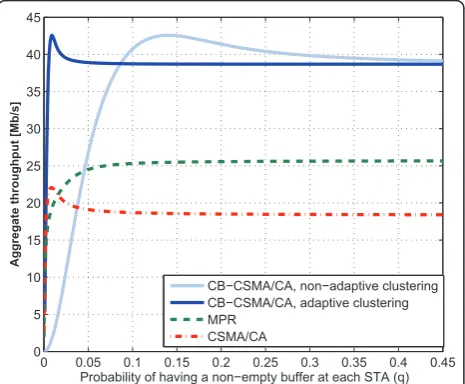
Non-saturation throughput of CB-CSMA/CA protocol with the considered non-adaptive clustering is depicted in Figure 8. For the purpose of comparisons, the throughput of the MPR as well as that of the IEEE 802.11n DCF basic access mechanism are also shown.
At q = 1 each STA has a non-empty buffer with
prob-ability one and the system is saturated. It can be observed that the CB-CSMA/CA achieves higher
throughput above a certain threshold. For very low
values ofq, CB-CSMA/CA throughput is below that of
the other systems. This happens since clusters are defined independently of the packet arrival rate and each cluster transmits only if all of its members have packets to transmit. The results in Figure 8 are calcu-lated forn= 24.
CSMA/CA achieves slightly higher throughput for
very low value ofqas compared to MPR. While MPR is
performed using RTS/CTS handshake, the CSMA/CA is based on the basic access mechanism. Hence, in the region where the collision probability is small CSMA/ CA benefits from smaller overheads.
2) CB-CSMA/CA with adaptive clustering
In this part we assume an adaptive clustering method. According to this method, for each transmission attempt, we select STAs which have packets in their buffer and put them together in clusters. In this way,
assuming nSTAs and Nnc = 2, we can form a cluster
with two members as soon as there are at least two STAs which have packets in their buffer. This happens with the probability1−(1−q)n−(n
1)q(1−q)n−1.
Throughput results for this scenario withn= 24 are
depicted in Figure 8. It can be observed that the CB-CSMA/CA protocol with adaptive clustering outperforms
both the MPR and CSMA/CA for most values ofq.
V. Conclusion
In this article we proposed a novel cluster-based CSMA/ CA scheme which supports multiuser streams and reduces the collision probability in a network.
The CB-CSMA/CA protocol showed a promising throughput improvement compared to a reference system based on IEEE 802.11. The analysis of event-synchronisa-tion errors shows that the CB-CSMA/CA is relatively robust to the event-synchronisation error and in the worst case it performs similar to the standard CSMA/CA.
The CB-CSMA/CA outperforms both MPR and CSMA/CA in saturation as well as unsaturation mode with medium and high probability of non-empty buffers. However, to benefit from CB-CSMA/CA for low packet arrival rates, we should apply an adaptive clustering. The adaptive clustering takes the presence of packets in the STAs into account and it can be performed by using the information obtained in the polling phase.
Endnotes a
The BSS is defined as the basic building block of an IEEE 802.11 network [2]. It is assumed that the stations within a BSS are in the communication range of each other.
b
We denote all errors which cause different backoff window values at nodes within a same cluster, as event-synchronisation error.
0 0.05 0.1 0.15 0.2 0.25 0.3 0.35 0.4 0.45
0 5 10 15 20 25 30 35 40 45
Probability of having a non−empty buffer at each STA (q)
Aggregate throughput [Mb/s]
CB−CSMA/CA, non−adaptive clustering
CB−CSMA/CA, adaptive clustering
MPR CSMA/CA
c
Even in this case concurrent transmissions from each cluster, which may still happen accidentally, do not lead to collision. Hence, the CB-CSMA/CA has lower colli-sion probability than that of CSMA/CA.
d
It consists of the short and the long training sequences and a SIGNAL field. The SIGNAL field includes a RATE and a LENGTH field, one reserved bit, a parity bit and 6 tail bits and is one OFDM symbol long.
e
It should be noted that due to the wide range of values on the y-axis, variation of the reference curve withNais not visible.
Abbreviations
AP: access point; AF: amplify-and-forward; BSS: basic service set; CF: contention-free; CW: contention window; CWUR: contention window update request; DCF: distributed coordination function; MIMO: multiple-input multiple-output; MPR: multipacket reception; MUZFR: multiuser zero-forcing relaying; PHY: physical; RTS/CTS: request to send/clear to send; STAs: stations; SISO: single-input single-output; SIMO: single-input multiple-output; WLANs: wireless local area networks.
Competing interests
The authors declare that they have no competing interests.
Received: 12 September 2010 Accepted: 11 July 2011 Published: 11 July 2011
References
1. Wireless LAN Medium Access Control (MAC) and Physical Layer (PHY) Specifications, Amendment 5: Enhancements for Higher Throughput, IEEE Std. 802.11n(Oct. 2009)
2. Wireless (LAN) Medium Access Control (MAC) and Physical Layer (PHY) Specifications, IEEE Std. 802.11, 1999 Edition (ISO/IEC 8802-11:1999)
3. D Tse, P Viswanath,Fundamentals of wireless communication, 1st edn. (Cambridge, UK: Cambridge University Press, 2005)
4. P Zheng, Y Zhang, S Liew, Multipacket reception in wireless local area networks, inIEEE International Conference on Communications, ICC, pp. 3670–3675 (2006)
5. P Minyoung, RW Heath, S Nettles, Improving throughput and fairness for MIMO ad hoc networks using antenna selection diversity, inIEEE Global Communications Conference, Globecom.1, 3363–3367 (2004)
6. J Mundarath, P Ramanathan, BV Veen, Nullhoc: A MAC protocol for adaptive antenna array based wireless ad hoc networks in multipath environments, inIEEE Global Communications Conference, Globecom.5, 2765–2769 (2004)
7. D Wang, U Tureli, Joint MIMO-OFDM and MAC design for broadband
multihop ad hoc networks, inEURASIP journal on Wireless Communications and Networking.2006, 1–9 (2006)
8. B Ke, Y Zhang, S Liew, Media access control with spatial correlation for MIMO ad hoc networks, inIEEE International Conference on Communication, ICC, 3660–3665 (2007)
9. R Lin, A Petropulu, A new wireless network medium access protocol based on cooperation.IEEE Transactions on Signal Processing.53(12), 4675–4684 (Dec. 2005)
10. L Dong, A Elanchezian, JC de Oliveira, A Petropulu, Multicluster ALLIANCES: A high throughput and energy efficient approach for wireless sensor networks, inAsilomar conference on Signals, Systems and Computers, 300–304 (2006)
11. A Ettefagh, M Kuhn, C Eşli, A Wittneben, Performance of a cluster-based MAC protocol in multiuser MIMO wireless LANs. International ITG Workshop on Smart Antennas, WSA (2010)
12. Q Pang, SC Liew, V Leung, Design of an effective loss-distinguishable MAC protocol for 802.11 WLAN.IEEE Communications Letters.9, 781–783 (2005). doi:10.1109/LCOMM.2005.1506701
13. K Medepalli, FA Tobagi, On optimization of CSMA-CA based wireless LANs-part I-impact of exponential backoff, inIEEE International Conference on Communication, ICC, pp. 2089–2094 (2006)
14. A Wittneben, B Rankov, Distributed antenna systems and linear relaying for gigabit MIMO wireless, inIEEE Vehicular Technology Conference, VTC Fall, 3624–3630 (2004)
15. B Rankov, A Wittneben, Spectral efficient protocols for half-duplex fading relay channels, inIEEE Journal on Selected Areas in Communication.25(2), 379–389 (Feb. 2007)
16. YJ Zhang, PX Cheng, SC Liew, How does multiple-packet reception capability scale the performance of wireless local area networks?.
IEEE Transactions on Mobile Computing.8(7), 923–935 (July 2009) 17. G Bianchi, Performance analysis of the IEEE 802.11 distributed coordination
function.IEEE Journal on Selected Areas in Communication.18, 535–547 (2000). doi:10.1109/49.840210
18. I Tinnirello, G Bianchi, Refinements on IEEE 802.11 distributed coordination function modeling approaches.IEEE Transactions on Vehicular Technology.
59(3), 1055–1067 (2010)
19. A Paulraj, R Nabar, D Gore, Introduction to space-time wireless communications, 1st edn. (Cambridge, UK: Cambridge University Press, 2003)
20. D Qiao, S Choi, KJ Shin, Goodput analysis and link adaptation for IEEE 802.11a wireless LANs.IEEE Transactions on Mobile Computing.1(4), 278–292 (2002). doi:10.1109/TMC.2002.1175541
21. F Daneshgaran, M Laddomada, F Mesiti, M Mondin, Unsaturated throughput analysis of IEEE 802.11 in presence of non ideal transmission channel and capture effects.IEEE Transactions on Wireless Communications.
7(4), 1276–1286 (2008)
22. D Malone, K Duffy, D Leith, Modeling the 802.11 distributed coordination function in nonsaturated heterogeneous conditions, in IEEE/ACM Transactions on Networking.15(1), 159–172 (Feb. 2007) 23. Wireless LAN Medium Access Control (MAC) and Physical Layer (PHY)
specifications, Amendment 8: Medium Access Control (MAC) Quality of Service Enhancements, IEEE Std.802.11e (2005)
doi:10.1186/1687-1499-2011-34
Cite this article as:Ettefaghet al.:Performance analysis of distributed cluster-based MAC protocol for multiuser MIMO wireless networks.
EURASIP Journal on Wireless Communications and Networking20112011:34.
Submit your manuscript to a
journal and benefi t from:
7Convenient online submission
7Rigorous peer review
7Immediate publication on acceptance
7Open access: articles freely available online
7High visibility within the fi eld
7Retaining the copyright to your article