R E S E A R C H
Open Access
Mobile user-preference-based data dissemination
on mobile P2P networks
Dohoon Kim, Young-Gab Kim and Hoh Peter In
*Abstract
A considerable number of studies have been performed recently on mobile peer-to-peer networks (MOPNETs), as the number of services based on mobile devices has increased. However, existing studies still reveal numerous shortcomings, such as bandwidth overhead, and redundant transmission in terms of multi-broadcast between peers. Especially, owing to the characteristics of MOPNETs, it is extremely important to determine broadcast size and to disseminate data within the limited environment of the network. The mechanism directly affects how well resource information in a mobile device is discovered and how data are transmitted. In this context, it is vital to efficiently disseminate data to be able to arrange hierarchal sequences of resource information of each mobile device for better search performance. Especially, it is also vital to determine the broadcast size, considering the consumption patterns of mobile users. In this article, we propose an adaptable algorithm that determines weighted values and disseminates data using the high-order Markov chain (HoMC). We apply weighted values in consideration of the MOPNET environment. In addition, the proposed HoMC-based Mobile User-preference-based Data Dissemination algorithm was simulated with a Qualnet simulator. Results show that the proposed algorithm performs 17.3% better, on average, in terms of data dissemination, than the existing dissemination methods.
Keywords:rank-based broadcast, high-order Markov Chain, mobile P2P networks, Qualnet
1. Introduction
Mobile peer-to-peer network (MOPNET) [1] is an emerging infrastructure designed to facilitate informa-tion sharing among mobile devices. It has been adopted for diverse purposes, such as social networks, transpor-tation, mobile electronic commerce, emergency response [2], and homeland security [3]. Data dissemination is an essential component for publication of or subscription to the resource information among dynamic mobile users on a MOPNET, since resource discovery is a main issue of MOPNET [4,5]. However, many communication problems have been reported in the MOPNET environ-ment, including non-adaptiveness, implosiveness, query overlaps, resource blindness, and communication over-head. In addition, transmission of unnecessary data in a limited network environment often leads to loss of a
mobile system’s power capacity and bandwidth, and
delay and loss of packets. Hence, it is necessary to decide an efficient algorithm of data dissemination for
resource discovery, and disseminate data in a stable and timely fashion. Especially, dissemination of the rank-based broadcast (RBB) [6,7] is performed, only after the ranks (i.e., priority of broadcast) and the broadcast sizes are determined for queries and resource information (i. e., reports) occurring on a MOPNET. However, knowing the number of queries and reports being called is insuf-ficient for exact broadcasting. Therefore, determination of exact broadcast size becomes possible through analy-sis of a mobile user’s queries and reports to overcome limitations lingering in the traditional RBB. The new approach also secures high accuracy and matched throughput in dissemination. This study proposes an
adaptive method in consideration of an account user’s
preferences that are tallied, based on the frequency of user query requests during data dissemination. It reduces unnecessary transmission by sharing the resources that are most frequently requested by users. It contrasts with traditional methods, such as the RBB. In this respect, our proposed mechanism facilitates efficient sharing and transmission of low bandwidth and limited content seeds in a limited network environment, or the * Correspondence: [email protected]
Department of Computer Science and Engineering, Korea University, Seoul, Korea
MOPNET. A mobile user-preference-based data disse-mination (MUDD) method has been proposed in this article, based on the high-order Markov chain (HoMC) [8,9]. Hardware characteristics limit the number of con-tent items available on a MOPNET for each mobile user’s communication purposes. Thus, application of the HoMC, which facilitates learning with a limited number of data, improves the accuracy and the volume of data processing. Moreover, it is further intended to optimize our proposed algorithm with weighted values to maxi-mize query hit rates.
The remainder of this article is organized as follows: Section 2 describes the related work for data dissemina-tion methods, such as tradidissemina-tional flooding-based method, gossiping method and RBB; Section 3 explains the proposed technique, which is a MUDD using HoMC; a Qualnet, (a network simulator)-based simula-tion result is described in Secsimula-tion 4; and Secsimula-tion 5 con-cludes this article and suggests future research.
2. Related work
Various researches have been proposed in the limited wireless network environment to operate the data disse-mination task efficiently.
Chatzigiannakis et al. [10] proposed a new data disse-mination protocol for wireless sensor networks, which pulls additional knowledge about the network to subse-quently improve data forwarding toward the sink. This extra information is still local, limited, and obtained in a distributed manner. This extra knowledge is acquired by only a small fraction of sensors. Thus, the extra energy cost only marginally affects the overall protocol effi-ciency. The protocol has low latency and manages to propagate data successfully, even in the case of low den-sities. However, the proposed mechanism has a limita-tion in that it does not support adaptive data dissemination, because it does not reflect the real net-work condition. In contrast, our proposed model makes a feature of adaptive data dissemination based on self-adjusting the various parameters in terms of the actual network conditions.
Prasad Sistla et al. [11] examined the dissemination of availability reports on resources in MOPNETs, where moving objects communicate with each other via short-range wireless transmission. Each disseminated report represents an observed spatial-temporal event, and the relevance of the report to a moving object decays, as the age of the reported resource and the distance from its location increase. In addition, they proposed an oppor-tunistic approach, in which an object propagates the reports it carries (namely, the information that it has about these resources) to objects encountered and obtains new reports in exchange. Least relevant reports are discarded after each exchange to limit the
communication data volume of future exchanges. Their theoretical and experimental analysis indicates that the opportunistic dissemination algorithm automatically lim-its the global distribution of a report to a bounded spa-tial area and to the duration for which it is of interest. To some extent, our solution is similar to the Opportu-nistic Resource Exchange model, but we use a different propagation manner, a user-preference training-based probability model because of different application requirements. That is, it is important to broadcast the packet to other nodes more precisely in a limited net-work environment.
Li et al. [12] presented an Efficient Multi-Source data dissemination scheme (EMS), efficient multi-source data dissemination in P2P networks. Nodes are organized in a two-layer structure by leveraging node heterogeneity: the upper layer is based on the DHT protocol and com-posed of powerful and stable nodes, while the nodes at the lower layer attach to physically close upper layer nodes. Data objects are replicated and forwarded along implicit trees, based on the DHT route table. The aver-age path length for delivering objects to all nodes con-verges toO(log n) automatically, wherenis the number of nodes in the application. However, this approach has to evaluate the performance with different capacity pro-files. In contrast, this article presents a comparative ana-lysis of the proposed model and existing algorithms. In general, several methods have been devised to dissemi-nate data. Flooding-based method [13,14], gossiping-based method [15,16], and the RBB [6,7] are typical examples.
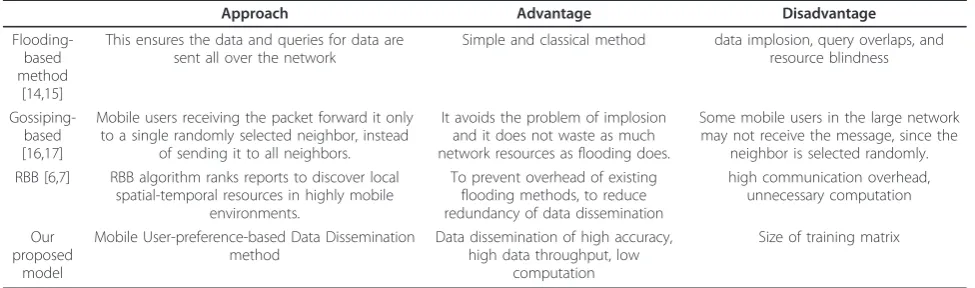
A flooding-based method emits queries and reports on the content list to randomly chosen targets over the net-work. The method serves as a foundation for the other advanced methods. The method, however, fails to over-come several inherent problems, such as data implosion, query overlaps, and resource blindness. A gossiping-based method was proposed to reduce the frequency of the implosion and the system overhead. Reports are transmitted to the randomly selected targets that are concerned with a particular content under the new approach. However, some mobile users on a large net-work may not receive the message at all, since a neigh-bor is selected randomly. Thus, the gossiping method
does not provide a reliable method of data
dissemination.
top-ranked reports (k-1) are sent in each broadcast round; namely, reports are ranked to prevent the overhead of existing flooding methods and to reduce redundancy of data dissemination. However, high communication over-head of a RBB with large resources degrades its search performance. The RBB algorithm is not efficient, though, since every mobile user calculates the expecta-tion value to determine ranks, a process that is not always necessary. Thus, a need arises for a more effi-cient algorithm to reduce the overheads from communi-cation and unnecessary computation.
It is necessary to consider not all, but only the mobile users related to user preferences and their affected mobile users to achieve a heightened efficiency. Table 1 compares studies on data dissemination methods in terms of pros and cons.
3. Mobile User-preference-based Data Dissemination (MUDD) on a MOPNET
The aim of data dissemination with preference of mobile user means an efficient information resource sharing in a limited network environment, such as MOPNET. In addition, an advantage of this approach is its support of a personalization service. Especially, searching for the data of interest through queries should be efficient to share in the continuous information resource between mobile users. Thus, analysis of an account of mobile user’s pre-ferences is required for efficient information resource. Accordingly, the proposed model in this study analyzes
user’s preference using HoMC to decide the broadcast
size and then to disseminate data to other nodes.
We define to help understand terms in our proposed model more clearly. Rank refers to the matching sum of queries received by each mobile user and retained resource information. The query list refers to the sum of queries retained by all users on a MOPNET. In addition, report denotes the content list to which the rank values
retained by each mobile user are applied. The term
pre-ferencerefers to the resulting value(s) from the analysis
of a user’s content-consuming patterns through the
HoMC function at the rate of matching a mobile user’s
reports with the number of queries from other users. Figure 1 illustrates how each mobile user
communi-cates with each other for the user’s preference-based
broadcast on a MOPNET. When the new mobile user (a) enters a MOPNET environment, the new mobile user retains the native query and the broadcast size (k -1) on her or his report list, and broadcasts the modified report list to all users. Other mobile users (b) analyze their own preferences with the received report list and the native query from the new inserted mobile user. Further, each user (c) computes and updates ranks of each report with the analytic results. Then, all users rebroadcast their own query to other users, along with the modified report list. Once user preferences are trained, the broadcast algorithm becomes more efficient, since users tend to request most-frequently-used queries repeatedly, especially, in certain domains, such as social networks and transportation for commuters. Accuracy in data dissemination gradually increases, as time passes, with the help of the effective training algorithm.
3.1 Overview of MUDD
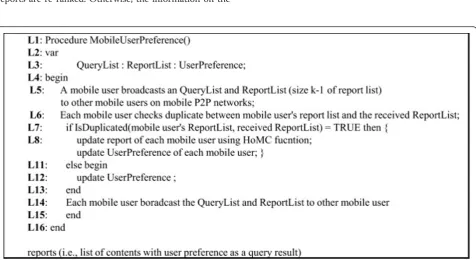
Figure 2 illustrates the pseudocode of how the user-pre-ference-aware broadcast algorithm works.
In the initial stage, the n number of mobiles users
exchange and store their query lists and report lists to form a MOPNET.
1. A mobile user broadcasts to other users thek-1
number of report lists and one query of her or his interest in the course of session formation on a MOPNET. (L5)
2. Each mobile user checks the received query and
the k-1 number of reports against her or his own
report lists to detect overlap. (L6)
3. Once detected, each user updates her or his report lists by analyzing her or his preferences through the
Table 1 Comparison of studies on data dissemination methods
Approach Advantage Disadvantage
Flooding-based method
[14,15]
This ensures the data and queries for data are sent all over the network
Simple and classical method data implosion, query overlaps, and resource blindness
Gossiping-based [16,17]
Mobile users receiving the packet forward it only to a single randomly selected neighbor, instead
of sending it to all neighbors.
It avoids the problem of implosion and it does not waste as much network resources as flooding does.
Some mobile users in the large network may not receive the message, since the
neighbor is selected randomly. RBB [6,7] RBB algorithm ranks reports to discover local
spatial-temporal resources in highly mobile environments.
To prevent overhead of existing flooding methods, to reduce
Data dissemination of high accuracy, high data throughput, low
computation
HoMC algorithm. Simultaneously, the information on each user’s preferences is updated. (L7˜L8)
4. When overlapping is not found among the lists, the preference information is updated as such, with-out any further modification. (L11˜L13)
5. Each mobile user broadcasts queries of her or his interest and report lists to other users. (L14)
Otherwise, it computes ranks, based on user prefer-ence, and registers the relevant information. To which and how many target mobile users the reports are to be re-broadcast is determined when queries and reports are sent with the broadcast size “k-1”. The process will be detailed in the following subsections.
3.2 MUDD process
Each mobile user receives queries from the sensors of the other mobile users to disseminate the queries through broadcast. If the received queries exist on the list of the mobile user, then the queries and their related reports are re-ranked. Otherwise, the information on the
queries and the reports is updated to the mobile user
O’s list. The duplicates are checked for each received
query, and only the copy with the smallest rank is kept. That is, this process attempts to significantly reduce duplicated transmissions by disseminating only new data to old neighbors, or only old data to new neighbors. 3.2.1 Computation of rank
Equation (1) defines the report as the sum of all rele-vance values to rank a mobile user’s preference. Foreign queries, or the queries of the other mobile user O, are received from other mobile users, and these foreign queries constitute non-native queries. Let (Q1, Q2, ..., Qn) be the queries related to a mobile user O. The
fol-lowing expression defines the report of each mobile user at the timet(i.e.,a(RP)) in consideration of the ranks of
mobile user preferences:
Rank(a(RP)) = n
i=1
match(a(RP),Qi) (1)
Figure 1MUDD on a MOPNET illustrates how each mobile user communicates with each other for the user’s preference based broadcast on a MOPNET.
The relevance of a report “a(RP)” to a query “Q“ is
determinable, ifQ(a(RP)) = true and match(a(R),Q) = 1.
Otherwise, Q(a(RP)) = false and match(a(RP)),Q= 0.
That is, the process denotes the meaning of “match” in equation (1). Finally, the mobile user (Q1) sequentially
prepares reports on the query and report list, and broadcasts queries and reports on the information required to be shared on the query and report list.
3.2.2 Training of mobile user’s preference
We have designed the functionP and computed mobile
user preferences in a HoMC, as shown in equation (2), to train user-preference ranks through the HoMC:
P= ((X(t+ 1) =xj|X(t) =xi,X(t−1)) =xk, ... ,X(t−r+ 1) =xm) = (nxj c
i=1
nxj) (2)
where, x: the number of objects, r: an order of Markov,
nx: the number of received queries, and X: an eigen
function about user-preference with time
Equation (2) assumes the r-thordered Markov model.
Thus, the assumption leads to the conclusion that the condition probability at the point of t+1 is obtainable through an expressionX (t+1) =xj, if ther-thstate
tran-sition has occurred previously. 3.2.3 Decision of broadcast size
In addition, the size of the mobile user-preference prob-ability is determined, which is the upper bound, to com-pute a broadcast size“k“as depicted in equation (3).
k=P×100 (3)
That is, the result of the “k“ function is incorporated in the average receipt rate of queries (i.e.,. a random variable).
3.2.4 Expectation of broadcast size
When the reports on the interested topics are prepared from the query and report list, equation (4) is used to determine the expectation values for pairing with queries. An expectation value, in turn, denotes how to more cor-rectly match the reports information in the sending mobile user and the queries in the receiving mobile user. In addition, it is adaptable to the size of the time dura-tion, since the last broadcast of a mobile user,O. That is, the expected value‘E(X)’[7] of a random variable for the broadcast size“k“on the list is determined based on this idea, as depicted in equation (4):
2πλk
where parameters of symbols are defined as shown in Table 2, to compute the expected values in equation (4). Thus, a mobile user broadcasts, to other mobile users, the reports on a native query of a broadcast size k. If the size kis used to determine the broadcast size, it is possible to reduce unnecessary broadcasts between users, and to dynamically apply it to them.
3.2.5 Parameter optimization for HoMC
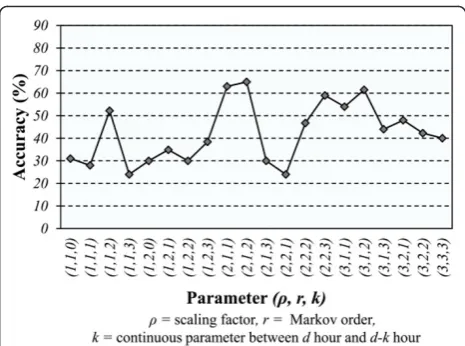
The accuracy of our model was compared for each of the parameter values (r,r, k) to estimate optimal para-meters of the HoMC-based RBB, as shown in Figure 3. In detail, ris the scaling factor optimal value of which is computed, based on the empirical tests shown later.
Moreover, r represents the degree of a HoMC, and k
represents the continuation weighted-parameter “w“
between thed-kand the d hour. These optimal
para-meters are derived from equation (5), as follows:
wjd−1,d(t+ 1) =ρ(1 +τdj,d−1(t+ 1)) =
k
i=1
wjd−1,d(t+ 1) (5)
whereτ: number of recommendation report
Accordingly, accuracy (j) is computed as depicted in equation (6):
φ=ω∩τ
ω ×100, whereω:number of mobile users interest packet (6)
In the first-order Markov chain, the parameter values
are r = 1, r = 1, and k= 0, and the mean accuracy is
33%. In addition, when the parameter values arer= 1,r
= 2, andk = 0, the second-order Markov chain shows
an accuracy of 30% on average. Thus, if the order of a Table 2 Symbol definition for expectation value
Symbol Description
l Number of moving objects per unit in the MOPNET field e Transmission range of each moving object in meters k Number of reports (i.e. broadcast size) p The probability that a moving object attempts to start a
broadcast
p’ The probability that a moving object starts per second T The volume of transmitted packets per second
Markov chain increases, then the number of combina-tion patterns also increases. Thus, the low coverage is detectable through insufficient training reports. Figure 3 shows the result of a HoMC-based MUDD with weighted values, whenr>1 andk >1. Upon application
of optimized parameters, whenr= 2,r = 1, andk= 2,
the accuracy increases and reaches above maximum 68%. Therefore, when a set of optimized parameters, or (2, 1, 2), is selected, our proposed model performs 17.3% better in terms of accuracy than the existing RBB algorithm does. The optimal parameter set is actively formed and used, depending on relevant MOPNET components (e.g., the number of mobile users, the net-work bandwidth, the device performance, and the signal strength).
4. Simulation Results 4.1 Simulation Environment
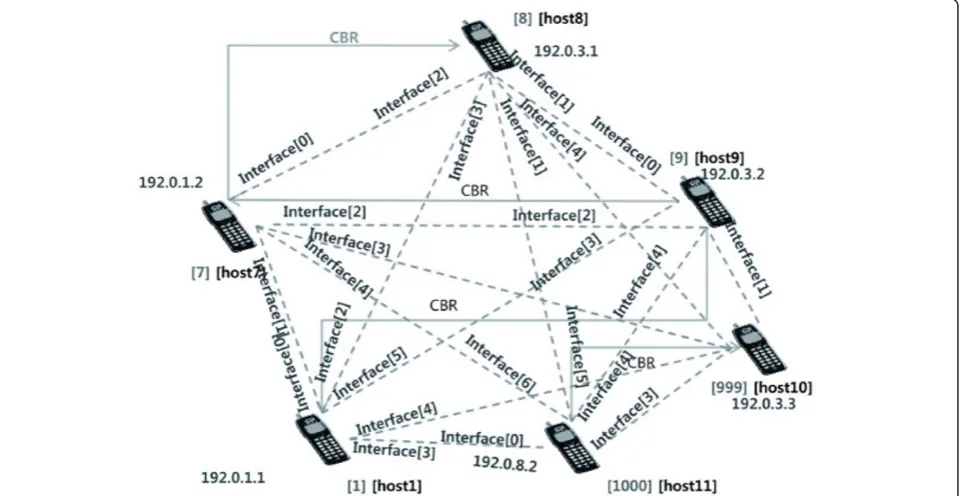
The Qualnet simulator [17] is employed to construct the proposed model to simulate efficient data dissemination based on user preference. A P2P network was created on a MOPNET that had one thousand mobile users, as depicted in Figure 4. In particular, at the start of the simulation, 1000 users were randomly positioned over an area of half a square mile. Each user was assigned to a random position within the area. Eight pairs of source and destination users were selected; these users commu-nicated at a constant bit rate. Each source user ran-domly sent 512-byte packets to destination users during
the simulation. The average simulation duration was 25 with 0.1-s, intervals inserted in between.
4.2 Mobile User-preference-based Data Dissemination on a MOPNET
One of the 1000 mobile users was selected randomly. Then, the datasets on the selected mobile user’s prefer-ences were collected for six 10-min periods, using the HoMC on a MOPNET. Specifically, as shown in Table 3, the preference datasets of the mobile user are pre-sented as r1, r2,...,r8 through the 8 × 8 transition
matrix, which has been designed to train a mobile user’s preferences. This assumed that all combination sets of two valuesc’(ri,rj) are compared to each other via the 8
× 8 matrix to compute the mobile user’s preferences.
Then, the combination set with the two highest values was selected. From Table 3, the transition of the
sto-chastic characteristics of the mobile user’s tendency
inferred along the time line is determined by the equa-tion (7) given below:
ˆ
P(X(t+ 1) =xj|X(t) =c) =
j∈c
nij(ri,rj)
c
j=1
i∈c
nij
(7)
Based on the computational results of equation (7), the c’ = (r1, r4) was recommended for its two highest
values, or r1 (0.4) and r4 (0.33), since other
combina-tions, or (r1, r2), (r1,r3), ...,(r7, r8), were smaller than
(r1,r4). Furthermore, Table 4 illustrates how to measure
the rank of a report to be broadcast, which has been adjusted by the weight value. Thus, r1(1.4) and r3(1.6)
were chosen by a. r3 was selected instead, however,
since the weight value of the report (r3) was higher than
that ofr1 (1.6 >1.4). Likewise, the above equation
con-tinuously computes ranks of the other reports.
Figure 5 compares the original RBB algorithm to
RBB’s values through the HoMC-based MUDD. In the
ideal case, once a moving object enters the system, it immediately receives all the reports that have ever been generated in the system, and it instantaneously receives every report that is generated during its lifespan. In this context, our model performs better than the existing RBB algorithm in terms of corresponding match
throughput, and proves that it is more adaptable to the time duration and the size of data dissemination through the HoMC-based MUDD optimization. Further-more, in our model, dissemination and ranking of queries enable a mobile user to broadcast the selected reports in such a way as to maximize bandwidth utiliza-tion. Furthermore, when disseminating data in consid-eration of mobile user’s preferences, as shown in Figure 5, the match throughput showed a 19% improvement on average, compared to those under traditional RBBs. Especially, when the number of users reached 500 or more, the processed volume was 30.1% higher on aver-age. The findings indicate that the learning result via the Markov chain is in direct proportion to the number of users. In addition, as shown in Figure 6, this pro-posed model yields good performance in terms of preci-sion, recall, and accuracy.
As illustrated in Figure 6, user-preference-based broadcasting produced a 97% true positive and a 96% precision. That is, each mobile user on a MOPNET Table 3 Preferred calculation from data, using first-order
Markov Chain
r1 r2 r3 r4 r5 r6 r7 r8
r1 3 0 2 3 1 0 0 0
r2 4 0 3 3 1 0 0 0
r3 2 0 3 2 0 0 0 0
r4 6 0 4 5 0 0 0 0
r5 0 0 1 1 0 0 0 0
r6 0 0 0 0 0 1 0 0
r7 0 0 0 0 0 0 2 0
r8 0 0 0 0 0 0 0 0
i∈c’
nij(r1,r4) 9 0 6 8 1 0 0 0
i∈c’
nij(r1,r4)
c
j=1
i∈cnij
0.4 0 0.25 0.33 0.04 0 0 0
Table 4 Preferred calculation, using HoMC with weight values
r1 r2 r3 r4 r5 r6 r7 r8
α=ωjd−1,d(t+ 1)
1.4 1 1.6 1.3 1.1 1 1 1
β=
i∈c
nij
9 0 6 8 1 0 0 0
γ =
i∈c
αnij 13 0 9.7 8 1 0 0 0
δ=
i∈c
nij
c
j=1
i∈cnij
0.4 0 0.3 0.2 1 0 0 0
a, weight value of each state;b, total frequency of states;g, total weight value of each states;δ, preference value.
Figure 5Match throughput of MUDD compares the original RBB algorithm to RBB’s values through the HoMC-based MUDD.
broadcasts accurate information to each other. Thus, it is fair to say that they are well trained.
5. Conclusions
Existing many researches have tried to solve data
disse-mination problems, such as loss of a mobile system’s
power capacity and bandwidth, and delay and loss of packets in terms of data dissemination. In spite of these efforts, there are lots of limitations, such as non-adap-tiveness, implosiveness, query overlaps, resource blind-ness, and communication overhead in the MOPNET environment. In order to overcome these issues, we
ana-lyzed mobile user’s preferences which mean a user’s
content-consuming patterns. As a result, we can reduce the implosion impact caused by queries and resource information sent out from mobile users.
This article proposed an adaptive method with an account user’s preferences that are tallied, based on the frequency of user query requests during data dissemina-tion. It reduces unnecessary transmission by sharing the resources that are most frequently requested by users. It contrasts with traditional methods, such as the RBB. In this respect, our proposed mechanism facilitates efficient sharing and transmission of low bandwidth and limited content sent in a limited network environment, or the MOPNET. Thus, we proposed a method to discover resources, considering a user’s preferences to gain better insight into the performance of a mobile device. Discov-ery is conducted through the HoMC to build a MOP-NET with each user. Then, this model was compared to the original RBB, and then juxtaposed with an ideal case. In addition, this proposed model sets priorities in data dissemination, based on predetermined conditions,
such as a user’s preferences, and corresponding
responses, such as reports. The following results were achieved applying this research: First, it was possible to rank a query report related to a user’s preferences and then to create, based on the accuracy of a MOPNET, optimal parameter sets. Second, we implemented a dynamic network with a Qualnet simulator. Thus, the proposed HoMC-based MUDD algorithm was simu-lated. The results showed that the proposed algorithm performed 17.3% better, on average, in terms of data dissemination, than other existing dissemination meth-ods. Third, we employed a broadcast methodology in our algorithm which was based on prioritized data to overcome resource limitations. It is recommended that future studies investigate various wireless networks, such as IEEE 802.11, 802.15, and 802.16. Furthermore, this proposed model will use optimized algorithms, such as a hidden Markov Model, as the basis for increasing the number of users and queries on a MOPNET.
Acknowledgements
This research was partially supported by: the MKE-ITRC (NIPA-2011-C1090-1131-0008), Software Engineering Technologies Development program of NIPA, and the Center of the Seoul Development Institute (WR080951, Establishment of Bell Labs in Seoul/Research of Broadband Convergent Networks and their Enabling Technologies), and the Second Brain Korea 21 Project.
Competing interests
The authors declare that they have no competing interests.
Received: 4 April 2011 Accepted: 4 October 2011 Published: 4 October 2011
References
1. HP Frank Fitzek, Hassan Charaf, Mobile Peer to Peer (P2P): A Tutorial Guide, (Wiley, August 2009)
2. BS Manoj, AH Baker, Emergency response information systems: Emerging trends and technologies.Communications of the ACM.50(3), 29–31 (2007). doi:10.1145/1226736.1226760
3. Information Sharing for Homeland Security: A Brief Overview,CRS Report for Congress USA(2005)
4. P Trunfio, D Talia, H Papadakis, Peer-to-Peer resource discovery in Grids: Models and systems. Future Generation Computer Systems, Elsevier23(7), 864–878 (Aug 2007). doi:10.1016/j.future.2006.12.003
5. D Leslie Filfe, Le Gruenwald, Research Issues for Data Communication in Mobile Ad-Hoc Network Database System. SIGMOD Record, 671–677 (2008) 6. Y Luo, O Wolfson, Mobile P2P Databases. Encyclopedia of GIS, 671–677
(2008)
7. O Wolfson, Bo Xu, Huabei Yin, Hu Cao, Search-and-Discover in Mobile P2P Network Databases.Distributed Computing Systems 2006, ICDCS 26th IEEE International Conference on(2006)
8. Wai-Ki Ching, K Michael Ng, Markov Chains: Models, Algorithms and Application. Springer online, 111–139 (2006)
9. E Adrian Raftery, A model for high-order Markov chains. inJournal of the Royal Statistical Society, ed. by Series B, 3: 528–539 (1985)
10. I Chatzigiannakis, Athanasios Kinalis, Sotiris Nikoletsea, Efficient and Robust Data Dissemination using Limited Extra Network Knowledge.DCOSS 2006, LNCS 4026, 218–233 (2006)
11. A Prasad Sistla, Ouri Wolfson, Bo Xu, Opportunistic Data Dissemination in Mobile Peer-to-Peer Networks. inProceedings of the 9th International Symposium on Spatial and Temporal Databases, LNCS, 346–363 (2005) 12. Zhenyu Li, Zengyang Zhu, Gaogang Xie, Zhongcheng Li, Efficient
Multi-source Data Dissemination in Peer-to-Peer Networks.IFIP International Federation for Information Processing 2008, LNCS, 409–120 (2008)
13. R Oliveira, L Bernardo, Flooding Techniques for Resource Discovery on High Mobility MANETs. Workshop on WAN (2005)
14. Q Lv, P Cao, E Cohen, K Li, S Shenker, Search and replication in unstructured peer-to-peer networks. inProceedings of ACM ICS(2002) 15. A Datta, S Quarteroni, K Aberer, Autonomous Gossiping: A Self-Organizing
Epidemic Algorithm for Selective Information Dissemination in Wireless Mobile Ad-Hoc Networks.The International Conference on Semantics of a Networked World(2004)
16. M Jelasity, A Montresor, O Babaoglu, Gossip-based aggregation in large dynamic networks.ACM Transaction on Computer Systems219–252 (2005) 17. Qualnet, http://www.scalable-networks.com/products/qualnet/
doi:10.1186/1687-1499-2011-118