R E S E A R C H
Open Access
Fuzzy-based congestion control for wireless
multimedia sensor networks
Cagatay Sonmez
1*, Ozlem Durmaz Incel
2, Sinan Isik
1,3, Mehmet Yunus Donmez
1,4and Cem Ersoy
1Abstract
Congestion is a challenging problem for sensor networks because it causes the waste of communication and reduces energy efficiency. Compared to traditional wireless sensor networks, the probability of congestion occurrence in wireless multimedia sensor networks is higher due to the high volume of data arising from multimedia streaming. In this article, problems for multimedia transmission over wireless multimedia sensor networks are examined and sensor fuzzy-based image transmission (SUIT); a new progressive image transport protocol is proposed as a solution. SUIT provides fuzzy logic-based congestion estimation and an efficient congestion mitigation technique which decreases the image quality on-the-fly to an acceptable level. In case of congestion, SUIT drops some packets of the frames in a smart way and thus transmits frames to the sink with lower, but acceptable quality. In this way, SUIT improves the continuity of the video streaming. We evaluate the performance of SUIT by comparing it with two different competitors. The first one is an example transport protocol, namely Fuzzy Logic-Based Congestion
Estimation. The second one is a buffer occupancy-based congestion control mechanism which is commonly used in previous studies. According to the simulation results, SUIT provides better energy consumption, frame delivery, frame loss and frame latency performance than its competitors.
Keywords: Wireless multimedia sensor networks; Transport layer; Image transmission; Fuzzy logic; Congestion control
1 Introduction
With the recent developments in sensor technology, typ-ical sensor nodes are able to capture multimedia datavia low-cost hardware such as CMOS cameras and micro-phones. Such low-cost devices which are capable of cap-turing multimedia information from the environment have made it possible to develop applications for wire-less multimedia sensor networks (WMSNs) [1]. A WMSN is formed with a large number of distributed embedded devices which are equipped with camera modules. These devices are able to retrieve multimedia content from the environment and are able to extract video and audio streams, still images as well as the scalar sensor data from the multimedia content. WMSNs have generated much interest in recent years due to their potential to enable a large class of applications such as surveillance systems, traffic control systems, environment monitoring, control of manufacturing processes in industry.
*Correspondence: [email protected]
1Computer Networks Research Laboratory, Netlab. Department of Computer Engineering, Bogazici University, Bebek 34342, Istanbul, Turkey
Full list of author information is available at the end of the article
Congestion is one of the major challenges for wireless networks. With respect to the characteristics of WMSNs, multimedia traffic produces bursty high-load traffic in the network [2]. Therefore, probability of congestion in WMSNs is higher than traditional Wireless Sensor Net-works (WSNs) due to the large amount of video traffic. Addition to the waste of communication and energy that it causes, congestion negatively affects reliability due to the packet losses and degrades the overall performance of the network and quality-of-service (QoS) of the application. Congestion control is a difficult task for wireless networks because identifying the occurrence of congestion is not as simple as in wired networks. Generally, congestion con-trol protocols for WSNs consider specific parameters such as local buffer occupancy, packet arrival rate, and packet service time. However, deciding on the level of conges-tion based on a specific parameter may give incorrect results [3]. Instead of using a specific congestion indica-tor, using multiple indicators, such as a fuzzy logic-based mechanism proposed in this article, can provide better congestion detection performance.
Implementation of multimedia coding techniques is another major challenge for WMSNs. The encoder used in wireless sensors should have high compression capa-bility, low complexity and high error resiliency. Predictive video coding techniques such as H.263 or MPEG (Moving Picture Experts Group) family provide quite good com-pression. However, these coding techniques are asym-metric such that the encoder is more complex than the decoder. They use a complex motion estimation algo-rithm in the encoding phase. Since sensor nodes have energy, memory, and computational-speed constraints, such encoding techniques are not appropriate for sensor devices. Therefore, a significant number of the WMSN applications are using JPEG (Joint Photographic Experts Group) images due to its lower complexity and adequate compression capabilities [4-6].
Motivated by these discussed facts, in this article we focus on the following question: ‘How much efficiency can be achieved in detecting and mitigating congestion in WMSNs by using a fuzzy logic-based congestion detec-tion method and image quality adaptadetec-tion?’ To answer this question, we propose sensor fuzzy-based image trans-port (SUIT) which is a new progressive image transtrans-port protocol that provides fuzzy logic-based congestion esti-mation and subsequent mitigation techniques. SUIT is designed for target monitoring applications where sensor nodes start transmitting video frames when they detect any target in their field-of-view (FoV). Since sensor nodes generate event-based video data, there is bursty traffic in the intended application. According to the mobility pattern of the targets in our application scenario, they are expected to leave the FoV after a short period. If we used a congestion detection scheme where congestion is announced by the sink node, the congestion notification sent by the sink node may be received after the target leaves the sensor node’s FoV because the target is mov-ing and there are many hops from source to sink which may cause high packet delay. Due to the characteristics of short-interval bursty traffic, SUIT does not provide a back-pressure mechanism to inform sensor nodes about the congestion. Main goal of SUIT is increasing the frame delivery performance by decreasing the quality (while maintaining an acceptable threshold), as frames are flow-ing over the intermediate sensors. In case of congestion, SUIT adapts the frame sending rate and instead of drop-ping the whole frame, it reduces the frame quality (as well as the frame size) by dropping subframes of progres-sively encoded JPEG without corrupting the image file. Thus, SUIT transmits images to the sink with lower, but acceptable quality. In this way, SUIT improves the conti-nuity of the video streaming. To the best of our knowledge, SUIT is the first transport protocol proposed for WMSNs which is able to mitigate congestion by adjusting image quality while image data are being transmitted. Extensive
simulations are performed to evaluate the performance of the SUIT protocol. For congested network cases, SUIT provides better performance, in terms of frame deliv-ery, frame loss, frame latency, than its competitors while providing acceptable image quality.
The contributions of this paper are the following:
• We propose a fuzzy logic-based congestion
estimation approach to detect congestion efficiently.
• We introduce a new combination of three different
congestion indicators to get a more accurate measurement of the congestion.
• We propose a novel congestion mitigation technique
which can perform quality adaptation on-the-fly and provide a considerable frame delivery and latency performance gain.
• We present a protocol which utilizes the cross-layer
functionalities and makes use of cross-layer information exchange among the application, transport, MAC and routing layers.
The organization of the paper is as follows: In Section 2, literature review on congestion and transport protocols for wireless sensor networks is detailed. In Section 3, design and architecture of the SUIT protocol are intro-duced. In Section 4, the performance of the proposed SUIT protocol is evaluated with a real-life scenario. Section 5 concludes our study and provides possible direc-tions for future research.
2 Related work
A transport protocol is responsible for the reliable delivery of data from source to destination. However, an efficient transport protocol should also handle network congestion because congestion deteriorates the QoS by causing buffer overflow that may lead to larger queuing delays and higher packet loss [7]. Moreover, it can lead to transmission collision at the MAC layer which requires retransmis-sion of the colliding packets. Since wireless sensor nodes are energy-constrained devices, retransmission wastes the limited energy. Energy consumption is an important chal-lenge for the sensor devices due to their limited and mostly irreplaceable battery.Therefore, improvement in energy efficiency while transmitting data over WSNs has been widely studied [8,9]. Misra et al. [2] discuss the performance of protocols performing congestion control while multimedia streaming over WMSN. Basically, con-gestion control protocols should detect the concon-gestion successfully, notify the associated sensor nodes and then apply the subsequent mitigation techniques.
congestion estimation. In WSNs, commonly used conges-tion indicators are local buffer occupancy, channel load, packet arrival rate, and packet service time. Event to Sink Reliable Transport (ESRT) [10] protocol and Fusion [11] detect congestion by monitoring local buffer occu-pancy, whereas Congestion Control and Fairness (CCF) [12] and Rate-Controlled Reliable Transport (RCRT) [13] protocols use packet service time to estimate congestion. Congestion Detection and Avoidance (CODA) [14] uses both local buffer occupancy and channel load for con-gestion detection. Similarly in [15], local queue lengths and channel conditions are used for predictive conges-tion control. Fuzzy-Based Congesconges-tion Estimaconges-tion (FCE) [16] and SenTCP [17] calculate congestion level using the buffer occupancy and packet arrival rate. In [18], conges-tion is estimated by comparing the input traffic rate and the maximum allowable transmission rate. Interference-Minimized Multipath Routing (I2MR) [19] detects con-gestion by monitoring the size of data transmit buffer using exponential weighted moving averages. In [20], the occurrence of a congestion is decided when the queue occupancy is greater than a given threshold or when the collision rate is above a given threshold.
After detecting the congestion, neighbor sensor nodes should be informed about it. Two common methods are used for this issue. Congestion can be informed explicitly or implicitly. Protocols which perform notification pro-cess explicitly send a message to the relevant sensor nodes. Other protocols perform this step implicitly by inserting a congestion notification flag into the header of outgo-ing packets as a piggyback. Explicit notification broutgo-ings an extra communication overhead to the network. Implicit notification requires fewer packet transmissions, but takes longer to effect. CODA and Fusion use explicit notifica-tion to inform neighbor nodes, whereas Siphon [21] and senTCP inform neighbor nodes implicitly. In [18], conges-tion is also notified implicitly, but the message includes the new rate of each child node instead of the congestion level. In I2MR, if an intermediate node detects conges-tion, it removes all pending packets from its own data transmit buffer and then sends a congestion notification packet, which is relayed reliably by all the upstream nodes along the path, to inform the source explicitly. In [20], congestion is notified explicitly. When the congestion has occurred, a congestion notification message, which con-tains the node id and path id, is sent back to the sources for each path id known by the node. On the other hand, SUIT does not use either explicit or implicit congestion notification because both methods are too slow to react for preventing congestion in event-based target monitor-ing applications where targets leave the FoV of sensors within a short interval.
For congestion mitigation, various methods are pro-posed. These methods are adapting data transmission
rate, redirecting data traffic to different sensors, and using back-pressure techniques to inform neighbor sensor nodes not to forward data. The proposed method in [18] is adjusting the source traffic rates at the upstream nodes to achieve low packet loss probability. Adapting the data transmission rate, which is performed by CODA, Fusion, CCF and I2MR is the most commonly used method for mitigating congestion. In [20], as the congestion notifi-cation message is arrived, the non-congested links are marked with theinUse flag. Then the traffic is reparti-tioned to the non-congested link to prevent congestion and provide fairness. Siphon proposes a virtual sink con-cept. Virtual sinks are specialized nodes and they are different from the physical sink. They have both primary low power mote radio and secondary long-range radio. For congestion mitigation, instead of changing the event rate, Siphon redirects the packet to the virtual sinks. On the other hand, the SPEED protocol [22] uses a back-pressure re-routing scheme to reduce the congestion in the network.
the number of packets forwarded by the suspected node divided by the number of packets forwarded by the other sensor nodes. For the packets forwarded by the suspected node, the delay is calculated by dividing the actual delay by the expected delay and the validity is calculated by dividing the number of valid packets to the number of all packets. According to the fuzzy result, the malicious nodes are detected and useless packets are dropped to increase the packet delivery rate.
FCE [16] is the closest work to ours and it also uses a fuzzy logic-based congestion control. Like SUIT, FCE cal-culates the congestion periodically via a fuzzy logic-based calculation and three different congestion levels described asslight congestion, somewhat congested, andvery heavy congestion. However, FCE and SUIT differ in the parame-ters used for the fuzzy logic system (FLS) and the conges-tion mitigaconges-tion technique. FCE uses buffer occupancy and packet arrival rate values as an input for the FLS. How-ever, SUIT uses buffer occupancy of the parent (next-hop) sensor node, the ratio of incoming to outgoing packets and the number of contenders. As the congestion mitiga-tion technique, both protocols adapt the data sending rate, but SUIT also performs a new technique which decreases the image quality by dropping the relevant packets while images are being transmitted. Additionally, FCE classifies packets into three categories depending on the type of service layer. According to the congestion level, it applies a packet drop policy to provide the best QoS. However, SUIT has only one service which contains only real time video packets and therefore does not classify packets.
Monitoring local buffer occupancy is a commonly used technique in congestion detection [10,11]. We implement a competitor transport protocol which utilizes similar congestion control mechanism with ESRT and we called it as Queue-Based Congestion Control (QCC) protocol. Similar to ESRT, QCC periodically checks the buffer occu-pancy to estimate congestion, and adapts the data send-ing rate in case of congestion. However, QCC does not use the back-pressure technique to inform sensor nodes about the congestion level. Since back-pressure technique is not necessary for video streaming application scenar-ios and provides poor performance, QCC discards the back-pressure feature of ESRT. QCC protocol is briefly explained in Section 4.
3 SUIT Protocol design principles
Sensor fuzzy-based image transport (SUIT) is an image transport protocol which provides a fuzzy logic-based congestion control mechanism. The main idea behind SUIT is transmitting the maximum number of frames to the sink by decreasing the frame quality to an accept-able level in case of congestion. With this method, it is possible to transmit frames with lower quality instead of dropping them. Thus, SUIT increases the average frame
delivery which is an important QoS metric for video streaming applications. In addition, a novel congestion mitigation technique which is presented in Section 3.6 makes it possible to adapt video quality on the intermedi-ate sensors.
SUIT streams a sequence of JPEG images instead of con-ventional predictive video coding techniques. SUIT can work with both sequential JPEG (SJPEG) and progressive JPEG (PJPEG) formats. It also supports restart marker fea-ture of JPEG coding. In SJPEG, each image component is encoded from left to right and top to bottom route. Therefore, while downloading a large image with slow connection, the image is displayed line by line. In order to see the whole image, the file should be downloaded completely. For SJPEG, a single bit error can lead to a complete loss of synchronism at the decoder which results in a completely unusable picture. To overcome this prob-lem, JPEG has a restart marker feature. Restart marker is used in JPEG to divide data segments into independent blocks. It is mostly used on unreliable networks to pro-vide resynchronization of the decoders. The advantage of the restart marker is its high packet loss resilience. If there is a bit error or data loss inside the marked block, only the related block becomes useless rather than the whole frame. Restart marker is used with both SJPEG and PJPEG images.
performance of SUIT is evaluated by using PJPEG images in Section 4.
3.1 Connectionless communication
Considering the example target monitoring application, SUIT sends all the video data as a burst when the target is detected in the FoV. In case of congestion, frame rate is adapted on the source nodes and image frame quality is decreased on the intermediate nodes by the proposed congestion mitigation technique explained in Section 3.6. It provides connectionless communication and does not provide packet reliability. SUIT also does not require con-firmation message of a receiver about the sent packet. Receiver (sink) can detect the missing packets by mon-itoring the sequence number of the incoming packets but it does not inform the sender about the transmis-sion result. Generally, reliable transport protocols send ACK/NACK-based feedback packet to the source. How-ever, for streaming video data, this method is not appro-priate because source node cannot wait for the response of the sink before sending packets or frames. For this reason, packet-based reliability cannot be applied for mul-timedia streaming. Instead of providing guaranteed deliv-ery of all packets, connection between the sender and receiver can be monitoredviacontrol packets. For contin-uous video streaming, status of the connection should be known to detect errors during streaming and to provide better QoS. For example, video conferencing applications check the connection speed in order to adapt incom-ing and outgoincom-ing video resolution. However, SUIT does not monitor the connection either because it is assumed that predominant captured video period is very short so that all of the data may be completely transmitted from the source before getting a control message from the sink.
3.2 Packet ordering
In WSN applications, packets may be received out of order due to multihop topology of the network [27]. Packets of the same sensor may have different paths because of the routing layer decision. Therefore, out of order deliv-ery should be handled for WMSN applications. SUIT has a mechanism for reordering packets.
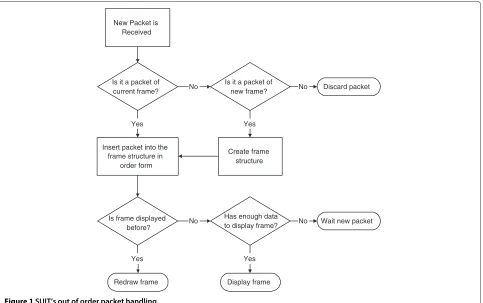
In order to display an image, SUIT waits for all pack-ets of a frame for sequentially encoded JPEG images. If the JPEG is progressively encoded, the application can dis-play each received sub-frame gradually. Thus, a frame or sub-frame can only be displayed after the whole num-ber of packets of the relevant frame or sub-frame are received. Every SUIT packet has a source ID, frame num-ber and a sequence numnum-ber which is increased by one for each created packet. In the application layer, SUIT tracks the sequence number of the incoming packets. When all of the packets of a frame (or sub-frame if image is
progressive) are received, the packets are ordered by the application and then displayed. In Figure 1, out-of-order packet handling mechanism of SUIT is depicted.
3.3 Packet prioritization
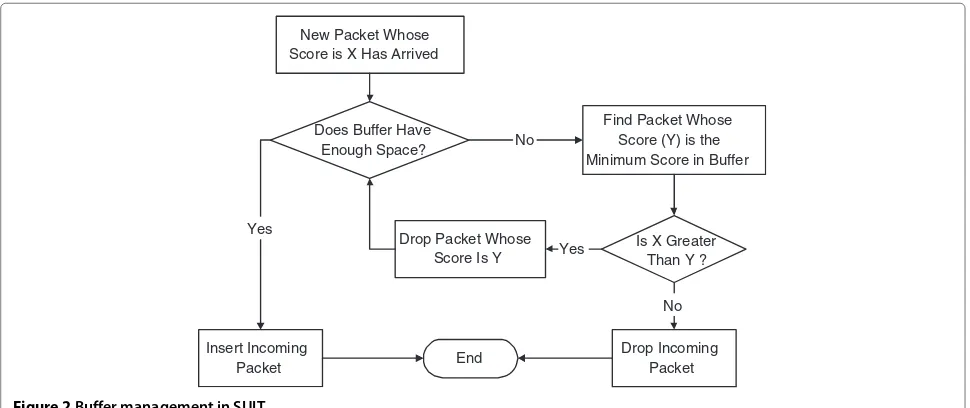
The buffer management in transport layer is an important issue in WMSNs because it has a considerable impact on the overall network efficiency and QoS which is depen-dent to the application requirements. For video surveil-lance applications, the primary requirement is delivering the video frames as fast as possible. SUIT has only one type of packet (video fragment packet) so there is only one queue at the transport layer instead of having a couple of prioritized queues. SUIT assigns a score for each packet for prioritizing them to improve QoS performance. When the transport layer buffer is full, the packets which have the lowest score are dropped. Score of the packet is calcu-lated by using three parameters; current hop count of the packet, average delay of the packet, and frame index of the packet.
Current hop count value is embedded to the packet header. This value is assigned as zero when the packet is created at the source. At each hop, the receiver node increases the current hop value by one. The packet which visits more intermediate nodes until it reaches the sink has higher probability of drop-out than the packet which visits fewer sensors between the source and the sink. Therefore, SUIT gives a higher priority to the packets whose current hop count is higher than the others. Depending on the maximum hop count that the topology allows, the possible hop-count value space is divided into four intervals using the pointsh1,h2, andh3, whereh1<h2<h3. The weight of current hop count (Wh) is calculated with the following
formula:
New Packet is Received
Is it a packet of current frame?
Create frame structure Insert packet into the
frame structure in order form
Has enough data to display frame? Is it a packet of
new frame?
Is frame displayed before?
No
Yes Yes
No
Yes Yes
Discard packet
Redraw frame Display frame
No
Wait new packet No
Figure 1SUIT’s out of order packet handling.
d3whered1 < d2 < d3. The weight of the average delay (Wd) is calculated with the following formula:
Wd = ⎧ ⎪ ⎪ ⎨ ⎪ ⎪ ⎩
3 if average delay≤d1 2 ifd1<average delay≤d2 1 ifd2<average delay≤d3 0 ifd3<average delay
(2)
For surveillance applications, Durmus et al. show that the initial frames of an event are more valuable, so they assign higher priority to the initial frames [28]. There-fore, we take into consideration the use of frame index as another QoS metric. In order to distinguish packets based on their frame index, the source sensor embeds the frame index into the packet header. SUIT gives higher pri-ority to the packets which is a fragment of the first frames of the detected target. While calculating the weight of frame index (Wf), a thresholdFthwhich can be changed depending on the application requirements is used.Wf is
calculated with the following formula:
Wf =
2 if frame index<Fth
1 ifotherwise (3)
To assign a score to a packet, weights of each parameter are calculated and then multiplied with each other. The packet which has the minimum score is dropped when the queue is full. While calculating the weights, some
specific points and thresholds are used in the aforemen-tioned formulations. These values can be varied according to the network topology and the network characteristics. The values used in the simulations in Section 4 are deter-mined experimentally and the ones which provide the best performance gain are selected.
Compared to a non-weighting system, the advantage of a weighting system is that the system can favor a specific parameter value according to the system requirements. Our weighting system aims to distinguish the frames according to the traversed hop count, average delay and the index of the frame. It favors the frames traversing more hops to reduce energy waste, the frames with lower average delay to eliminate out-of-date frames to preserve energy and the firstFframes from a sensor on detection of a target to preserve valuable information. Hence, by treat-ing the frames differently, the weighttreat-ing system provides the performance gain and energy conservation which are important metrics to be considered in MWSNs. The over-all process is illustrated in the flowchart given in Figure 2.
3.4 Cross layer design
Does Buffer Have
No New Packet Whose
Score is X Has Arrived
Enough Space?
Find Packet Whose Score (Y) is the Minimum Score in Buffer
Is X Greater Than Y ? Yes
No
Insert Incoming Packet
Drop Incoming Packet Yes
Drop Packet Whose Score Is Y
End
Figure 2Buffer management in SUIT.
data. Layered network design has a lot of advantages. It reduces the complexity of the design, development and testing phases because each layer focuses on its own task and it does not have to consider other layers. Another advantage is that, the layered network allows different types of network hardware and software to communicate with each other.
Unlike the conventional network application, WMSN applications run on a specific device. They are not designed for different network hardware and software possibilities such as different network cards, operating systems and applications. So, separating layers strictly is not required for WMSN applications. Moreover, the lay-ers may need to share some information with each other to provide better QoS. The main goal of the cross-layer approach is increasing the performance of wireless net-works by using the interactions between various layers of the protocol stack. However, exchanging information over two or more layers does not mean that there is no layered architecture. Breaking all of the layers can destroy modularity and leads to spaghetti design which results in various negative consequences [29]. Therefore, the interaction of the layers is very important. There are several studies which propose cross-layer optimiza-tion techniques and explain why a cross-layer soluoptimiza-tion is needed for WMSNs citeSu2006,Ghalib2010.
SUIT uses a cross-layer approach to exchange informa-tion among layers. However, layering is not completely left, so that the advantages of the layered design are still preserved. SUIT has its own application layer and trans-port layer but it does not provide a MAC and routing layer. Any MAC and routing layer can be used under SUIT by extending themviaa messaging module. SUIT can work with such protocols as long as they provide the necessary information which is mentioned later in this section.
The application layer is responsible for generating and viewing images. Images can be both SJPEG and PJPEG with or without restart markers. The source sensor is capable of fragmenting the image and the sink is capa-ble of defragmenting it. In conventional layered designs, the application layer does not request information from the lower layers but in SUIT, the application layer gets the congestion level from the transport layer. According to the congestion level, it adapts the video rate as explained in Section 3.6.
One of the required features of the MAC layer is sharing and collecting sensor-specific information in order to pre-dict the status of the medium more accurately. In SUIT, the MAC layer can access the occupancy of the transport layer queue and piggybacks this value into each outgoing packet including RTS and CTS packets. The receiver sen-sor should read the packet header at the MAC layer and generate a table which stores the buffer occupancy of the neighbors. During the fuzzy logic-based congestion esti-mation, the transport layer uses the elements of this table. Moreover, the transport layer requests the ID of the next hop sensor node from the routing layer during the process of congestion estimation. As a result, the transport layer uses data from both MAC and routing layers.
In summary, the cross-layer design of SUIT creates interactions across layers by enabling flow of information on both sides. The main aim of this design is to achieve gains in the overall system performance without corrupt-ing modularity. This does not leave the philosophy of layered designs but provides a messaging system among layers.
3.5 Congestion detection mechanism
exactly occurs in WMSNs. The most commonly used indicator for WSNs is high buffer occupancy. However, monitoring a sensor node’s buffer may not be sufficient since event-based multimedia data produces bursty high-load traffic in WSNs [3]. SUIT proposes three indicators to be used for congestion decision. These indicators are the following:
• Ratio of incoming to outgoing packets within a time
window: The ratio is calculated based on a sliding window. Hence, it overcomes the momentary changes in traffic and leads to more stable results than the instantaneous buffer occupancy.
• Number of contenders: The contenders are the
neighbor nodes which have packets in their queue waiting to be sent in the contention region at the MAC layer, not on the path. Number of contender is calculated by using RTS/CTS packets which are generated by the neighbor nodes. If there are too many contenders, collision probability is higher. Therefore, the number of contenders is an effective indicator for congestion.
• Buffer occupancy of the parent (next-hop) sensor
node: It is an important metric since it provides information about the environment. If the buffer occupancy of next hop sensor node is high, the congestion probability will also be high.
SUIT uses a fuzzy logic system (FLS) to map these three congestion metrics into a single value. In this study, we prefer to use fuzzy logic system for congestion estima-tion because of the following advantages. A fuzzy control system does not require a precise model and a formu-lation for dynamic and complex systems where the rela-tionship between system output and control inputs is very hard to be formulated explicitly and precisely with mathematical equations [32]. This feature of fuzzy logic control makes it possible to fully exploit the dynamics in the congestion detection in WMSNs. Moreover, as a formal methodology to emulate the intelligent decision-making process of a human expert, fuzzy logic control provides an effective and flexible way to arrive at a def-inite conclusion based on imprecise information. There-fore, it can easily deal with various uncertainties inside WMSNs.
The components of the proposed FLS are singleton fuzzifier, product inference engine and centroid defuzzi-fier. Since FLS uses three metrics, the fuzzy set consists of three fuzzy variables as
A=(α,β,γ ) (4)
whereαis the number of contenders,βis the buffer occu-pancy percentage of parent (next-hop) sensor node andγ is the fuzzy variable term for the traffic load. Traffic load
is the ratio of incoming packets to outgoing packets, and is therefore defined as
γ = γin γout
(5)
Inputs and outputs of the FLS are non-numeric lin-guistic variables. Instead of using numerical values, FLS uses variables from natural language. Our FLS has three linguistic variables namedLOW (L),MEDIUM(M), and HIGH (H) which determine the congestion level of the system.
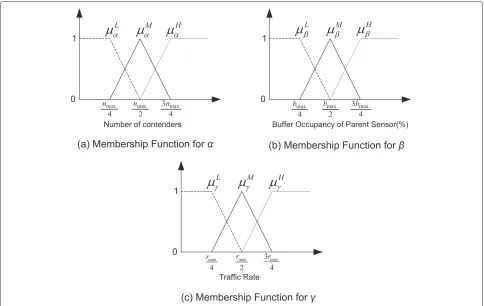
Membership functions are defined to be used in fuzzifi-cation and defuzzififuzzifi-cation steps. In our case, we have three membership function set and each of the set has different function for L, M and H linguistic variables. Member-ship functions can be in different forms such as triangular, trapezoidal, piecewise linear, Gaussian, or singleton [33]. We are using triangular shapes due to the ease of compu-tation considering the limited processing power available on the sensor devices. The functions can be computed using four basic operations and do not require complex operations such as integration and quadratic formulas. In Figure 3 membership functions for the fuzzy variablesα, β andγ are depicted, wherenmaxrepresents the number of maximum contenders, bmax represents the maximum buffer occupancy andrmaxrepresents the maximum traf-fic rate, up to the transmission in progress. Generally, the degree of membership value for each fuzzy variable is decided based on experimentation. In the simulations, the maximum and average values for these variables are deter-mined experimentally. The critical points in membership functions can be calculated in terms of the upper bounds of the network indicators. In this work,nmaxis assigned as 8,bmaxis assigned as 100 andrmaxis assigned as 2.
The first step of our FLS is the fuzzification step. The proposed FLS uses a singleton fuzzifier to map each crisp value to a fuzzy value using membership functions. Since FLS has three linguistic variables, the fuzzifier defines three fuzzy classes named L, M and H for each fuzzy variable:
F:(α,β,γ )→(αf,βf,γf) (6)
χf =µL
χ(χ),µMχ(χ),µHχ(χ)
(7)
whereχrepresents the variablesα,βandγ. Fuzzy values are calculated viamembership functions of the fuzzifier which are presented in Figure 3. For example, if the num-ber of contenders, α, of the sensor node is 5, then the correspondingαf is [0,0.5,0.5] sinceµLα(5)= 0,µMα(5) = 0.5 andµHα(5) = 0.5 as can be seen in Figure 3a. If the buffer occupancy of the next-hop sensor node, β, is 50, then the corresponding βf is [0,1,0] since µL
β(50) = 0,
µM
Figure 3Membership functions for the fuzzy variables (a)α, (b)βand (c)γ.
the traffic rate ,γ, of the sensor node is 1.25, then the cor-respondingγf is [0,0.5,0.5] sinceµLγ(1.25)= 0,µMγ(1.25)= 0.5 andµHγ(1.25)=0.5 as can be seen in Figure 3c.
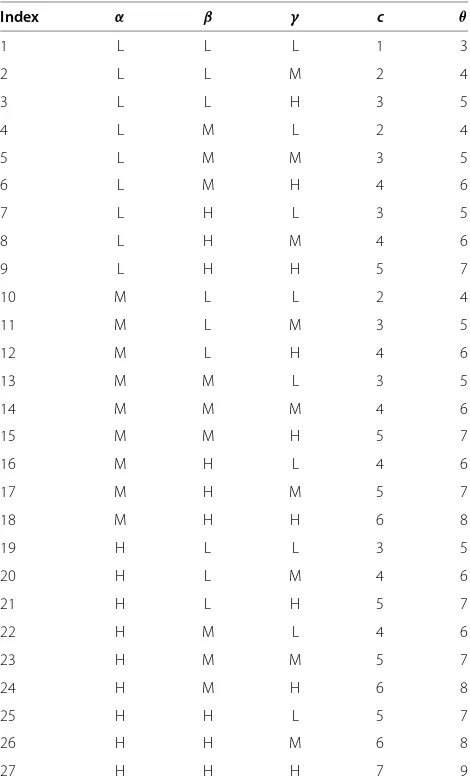
The second and the most important step of our FLS is the inference step. Inference is used to combine fuzzy rules from the fuzzy rule base which is constructed to con-trol the output variable. A fuzzy rule is a simple IF-THEN rule with a condition and a conclusion. Since there are three fuzzy variables and three fuzzy classes for each fuzzy variable, the rule base contains 33 = 27 different rules. The output of each rule is calculated by the rule evaluation method (REM) and results are mapped to a consequence classc. The structure ofrin our rule base is defined as:
r : ifαrisfαrandβrisfβrandγrisfγrthen output isfcr
(8)
where each offαr,fβrandfγris one of the fuzzy classesL,M orH.
In the proposed REM, all of the variables have the same effect for congestion decision. Therefore, all of the fuzzy variables have the same importance. The weights of the fuzzy classes forα, β and γ are set as 1 forL, 2 forM and 3 forH. The output of a ruleθr is calculated by
sum-ming up the weight of fαr, fβr andfγr. Table 1 shows the rule base of our fuzzy inference system (FIS), where the
θ column corresponds to the output values of the rules which are calculated using the REM and theccolumn cor-responds to the consequence fuzzy classes determined by the unique values ofθ. As shown in Table 1,θvalue can be a number between 3 and 9, hence there are 7 consequence fuzzy classes.
We use the product-inference rule in our FIS, since it allows a mathematical simplification in the defuzzification process and is commonly used in practice. Hence,
µr =µf
r
α
α(α)·µf
r
β
β(β)·µ
fr
γ
γ(γ )·µf
r c
c(θr) (9)
where µfcr
c is the membership functions of the
conse-quence fuzzy classes defined in Figure 4 andµfααr,µf r
β
β and
µfγr
γ are the membership functions in the rule r corre-sponding to the fuzzy classes of the fuzzy variables forα, βandγ, respectively.
Table 1 Fuzzy rules in the knowledge base
Index α β γ c θ
1 L L L 1 3
2 L L M 2 4
3 L L H 3 5
4 L M L 2 4
5 L M M 3 5
6 L M H 4 6
7 L H L 3 5
8 L H M 4 6
9 L H H 5 7
10 M L L 2 4
11 M L M 3 5
12 M L H 4 6
13 M M L 3 5
14 M M M 4 6
15 M M H 5 7
16 M H L 4 6
17 M H M 5 7
18 M H H 6 8
19 H L L 3 5
20 H L M 4 6
21 H L H 5 7
22 H M L 4 6
23 H M M 5 7
24 H M H 6 8
25 H H L 5 7
26 H H M 6 8
27 H H H 7 9
also calculates center of gravity of the output membership function in the defuzzification phase of their fuzzy-based congestion control algorithm. However, calculating the center of the gravity of a trapezoid is a complex pro-cess and not appropriate for the sensor devices due to their limited processing capability and battery. In order to decrease the complexity of the defuzification step, we determine the membership function of each consequence
2 3 4 5 6 7 8 9 10
1
µ
c1µ
c2µ
c3µ
c4µ
c5µ
c6µ
c7Figure 4Membership functions of the consequence classes.
fuzzy class as an isosceles triangle whose abscissa value of its apex is equal to theθ value of the corresponding con-sequence class. In Figure 4, membership functions of the consequence classes are depicted.
Output of the centroid defuzzifier can be calculated easily by using Equation 10.
ω= 27
r=1 θrµr
27
r=1
µr (10)
whereθr is the output of the rule r andµr is the output
product-inference engine. Defuzzification is the final step in FLS. After applying the centroid defuzzifier, the output of the FLS,ω, becomes a crisp value between 3 and 9.
3.6 Congestion mitigation mechanism
SUIT classifiesωinto three classes asNot Congested(NC), Slightly Congested(SC) andFairly Congested(FC) by using two threshold values. Congestion mitigation is not applied for the NC level because in this case, sensor nodes have enough capacity to handle the network traffic. SUIT con-gestion mitigation algorithm is activated if the network is SC or FC. Our mitigation algorithm has two major pro-cedures to decrease the congestion. These propro-cedures are rate adaptation and quality adaptation.
Rate adaptation takes place in the source sensor which has a target in its FoV and generates image frames. The source sensor generates video in the application layer based on the congestion level which is calculated in the transport layer. Since SUIT is a cross-layer proto-col, the application layer can request the required data from underlying layers. Application layer can define three different video rates according to three congestion level classes defined in SUIT. Depending on the sensors’ data rate and encoded image size, the choice of rates should be configured by the application. A generic function for the rate adaptation is given in Equation 11.
r= ⎧ ⎨ ⎩
r1 ifL=NC r2 ifL=SC r3 ifL=FC
(11)
whereLis the congestion level andris the video rate of application.r1,r2andr3are the video rates defined by the application and their values should be asr1>r2>r3.
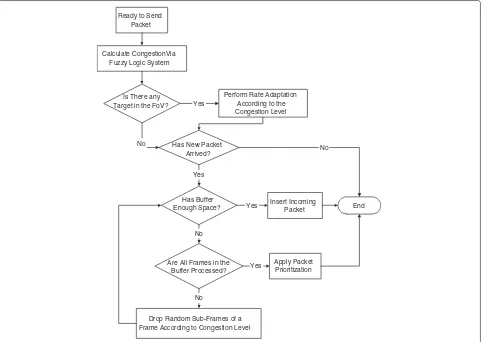
of some subframes of PJPEG. In order to distinguish sub-frames of the image, the SUIT packet has two types of information in its packet headers. These data are the num-ber of total subframes that the related frame has, and the sub-frame index that the packet belongs to. Decreas-ing the quality is the responsibility of the transport layer. Thus, the application layer always generates full-quality images. In our quality adaptation technique, all PJPEG images are processed starting from the lowest score to highest score (scoring was explained in Section 3.3). In this process, subframes of the PJPEG images are ran-domly selected and dropped. According to the application requirements, fewer subframes are dropped for the SC case while more subframes are dropped for the FC case. However, the quality cannot be decreased more than a threshold defined for the application. This quality adapta-tion process is ended when adequate space in the buffer becomes available. If there is still not enough space in the buffer after all images are processed, images are dropped according to the packet prioritization policy.
In summary, in order to mitigate congestion, SUIT per-forms rate adaptation at the source node and quality adap-tation on the intermediate nodes. The rate adapadap-tation is commonly used by WSNs applications, but quality adap-tation is a novel technique which can be applied for PJPEG images while they are being transmitted. The overall con-gestion mitigation process is illustrated in the flowchart given in Figure 5.
4 SUIT Performance evaluation
The performance of SUIT’s congestion control is evalu-ated with extensive simulations and it is compared with two different congestion detection and mitigation tech-niques. These competitors use QCC and FCE [16] based congestion detection and rate adaptation as the conges-tion mitigaconges-tion technique. The reason for selecting FCE as a competitor of SUIT protocol is to compare SUIT’s fuzzy logic-based congestion estimation with another fuzzy logic-based approach. QCC is selected as the second competitor for comparing our protocol with a non-fuzzy logic-based approach but also a queue based congestion estimation technique, which is commonly used to esti-mate congestion in WSNs . To estiesti-mate congestion, QCC uses only buffer occupancy and FCE uses both packet arrival rate and buffer occupancy, whereas SUIT uses buffer occupancy, traffic rate and also number of con-tenders around a sensor node. The intention of selecting these competitors is to evaluate the performance gain achieved when using these 3 parameters instead of using 1 or 2 parameters while deciding on congestion.
The implementation of QCC is inspired by the protocols which monitor the local buffer occupancy of the sensor nodes in order to estimate congestion such as (ESRT) [10] and Fusion [11]. To determine the congestion level
of the network, instead of using single threshold, QCC uses two thresholds between 0% and 100% to adapt the result of QCC congestion to SUIT’s rate adaptation. If the buffer occupancy rate is lower than the first thresh-old, the congestion level of the network is considered as Not Congested. If the buffer occupancy rate is between two thresholds, the congestion level of the network is consid-ered asSlightly Congested. If the buffer occupancy rate is higher than the second threshold, the congestion level of the network is considered asFairly Congested.
FCE [16] uses a fuzzy logic-based congestion estima-tion mechanism which has two fuzzy variables;net packet arrival rateandbuffer occupancy. The result of FCE con-gestion estimation mechanism is a numeric value which can be 0, 0.5 or 1. We adapt the result of FCE congestion to SUIT’s rate adaptation by assigningNot Congestedfor 0,Slightly Congestedfor 0.5 andFairly Congestedfor 1.
SUIT’s congestion control provides fuzzy logic-based congestion detection and two congestion mitigation tech-niques. One of the mitigation techniques is data rate adaptation and the other one is quality adaptation while packets are being transmitted over the sensor nodes. SUIT’s competitors use their own congestion detection mechanisms. As for congestion mitigation, they only use rate adaptation at source sensor which streams image frames.
4.1 Implementation considerations and simulation parameters
OPNET [34] network simulation tool is used for the implementation and simulation of the SUIT protocol. We set up a target monitoring application scenario for the simulations. The motivation for this scenario is monitor-ing movement patterns of movmonitor-ing targets by usmonitor-ing the camera extension of the sensor nodes. In this scenario, number of transmitted frames is more important than the quality of the frames as long as they have an acceptable quality. In the simulations, targets are moving according to the random waypoint mobility model because of its wide-usage in simulating mobile network scenarios with mobile users. This target mobility model is designed in a way to allow targets to move in all parts of the area of interest so that the spatial distribution of the video data traffic sources are distributed uniformly over the surveil-lance area. Sensor nodes use binary detection model to detect target. According to the binary detection model, the probability of sensing a target is equal to 1 if the target is in the FoV of the sensor node.
Ready to Send Packet
Calculate CongestionVia Fuzzy Logic System
Is There any Target in the FoV?
Perform Rate Adaptation According to the Congestion Level
Has Buffer Enough Space?
Drop Random Sub-Frames of a Frame According to Congestion Level
Are All Frames in the Buffer Processed?
Apply Packet Prioritization Insert Incoming
Packet End
Yes
No
Yes
No
No
Yes Has New Packet
Arrived?
Yes
No
Figure 5Operation of congestion mitigation algorithm.
packet, we did not use the service differentiation mech-anism of Diff-MAC. All SUIT packets are considered as video packets. In order to use Diff-MAC with SUIT, the following modifications are applied:
• An inter-layer communication module is
implemented to exchange information with other layers.
• A module is implemented in order to construct
neighbor buffer occupancy table (NBOT). This module piggybacks the buffer occupancy information into the outgoing packet header and reads this information from each packet that the sensor can hear regardless of the packet destination.
• A module is implemented in order to distinguish
SUIT packets with respect to their importance. It chooses different number of retries according to the importance level.
IEEE 802.15.4 compliant radio has low cost and low power attributes. Thus, these radios are widely used for WSN implementation [36]. In the market, there are several radio modules which are compliant with IEEE
802.15.4 standard. Most of the radios of Atmel, Chipcon and Microchip provide 250-kbps data rate [37]. However, for multimedia transmission 250-kbps data rate is not adequate. Chulsung Park et al. design a high data-rate wireless sensor node named as eCAM [38]. Their sensor node provides 1 Mbps data rate and their camera mod-ule can operate as a JPEG compressed still camera. Also Atmel designs an IEEE 802.15.4 compliant single chip ATmega128RFA1 [39] which can provide up to 2 Mbps data rate. Since high data-rate transmission should be used for multimedia streaming applications, we deter-mine the data rate as 2 Mbps in our simulations according to the capabilities of these example radios. In order to simulate a real application more accurately, a realistic link model proposed in [40] is used in the simulations. Zuniga et al. use the log-normal shadowing model proposed in [41] as the radio propagation model and they use the signal-to-noise ratio (SNR) to calculate the probability of successfully receiving a packet.
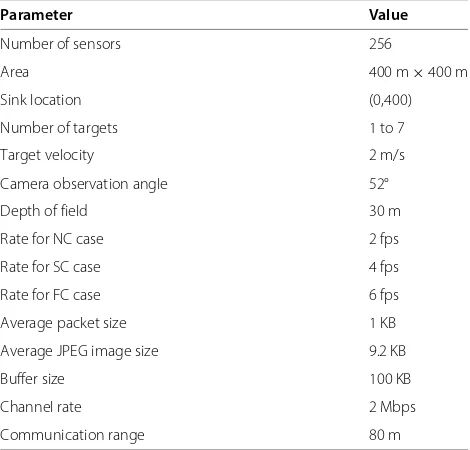
whose detection range is 30 m and observation angle is 52°. GPSR [42] protocol is used as the routing protocol due to its simplicity and common usage. There are one to seven targets which are moving in the environment. The target is assumed to be a pedestrian whose veloc-ity is 2 m/s. When the target enters the FoV, the sensor node’s camera starts generating video. The images used in simulations are Sub Quarter Common Intermediate Format (SQCIF) progressively encoded JPEG images which have a resolution of 128× 96. SQCIF can have a small resolution for the video streaming applications, but it is a proper format that can be used with the determined data rate which is 2 Mbps to maintain the desired frame rates. If the date rate of the sensor devices increases by technological improvements, other formats with higher resolution can be used. Other significant parameters used in our simulations are listed in Table 2.
In order to evaluate the performance of SUIT on a con-gested WMSN, we study the scenarios where congestion is generated on the relay nodes. In these scenarios, we make sure that the generated data traffic does not exceed the capacity of the source nodes. Therefore, the data load on the relay nodes is increased without dropping packets at the source node. To achieve this, we increase the num-ber of intruders on the deployment area and create video traffic over relay nodes from multiple source nodes.
4.2 Performance evaluation of congestion control techniques
One of the most important metrics for application QoS is the average received frame rate at the sink. In Figure 6,
Table 2 Simulation parameters for the evaluation of SUIT
Parameter Value
Number of sensors 256
Area 400 m×400 m
Sink location (0,400)
Number of targets 1 to 7
Target velocity 2 m/s
Camera observation angle 52°
Depth of field 30 m
Rate for NC case 2 fps
Rate for SC case 4 fps
Rate for FC case 6 fps
Average packet size 1 KB
Average JPEG image size 9.2 KB
Buffer size 100 KB
Channel rate 2 Mbps
Communication range 80 m
Target mobility model: random waypoint; detection model: binary FoV; MAC protocol: Diff-MAC [35]; routing protocol: GPSR [42].
1 2 3 4 5 6 7
2 4 6 8 10 12 14
Number of Intruders
Average Frame Rate Received at Sink Node (frames/sec.)
SUIT QCC FCE
Figure 6Average received frame rate at the sink.
comparison of the average received frame rate is depicted. TheX-axis shows the number of targets which is varied to increase the load in the network. If the network is not congested, all protocols provide a similar frame rate, i.e. with 1 to 3 targets. However, when the network is getting congested, the SUIT protocol can transmit more frames than the other protocols. The reason for this result is the congestion mitigation technique of SUIT which performs quality adaptation on the fly. In a congested network, SUIT can decrease the buffer fullness by decreasing the quality of the images. However, other protocols have to drop incoming frames. As shown in Figure 6, without quality adaptation, the maximum frame rate that can be received by the sink is 10 fps, whereas SUIT allows the sink to receive more than 13 fps.
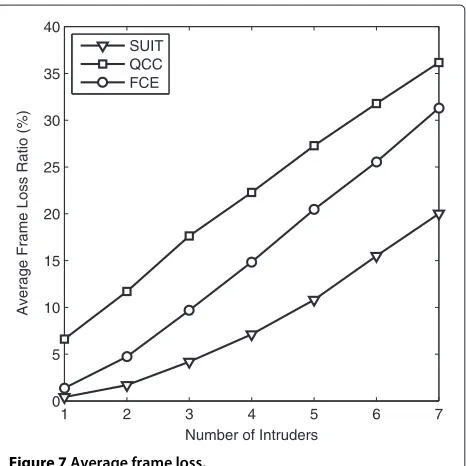
A protocol can transmit more frames if it generates excessive number of frames, but number of dropped frames should also be considered. So the frame loss ratio is another important QoS metric. In Figure 7, the frame loss performances of the protocols are given. For all of the cases, SUIT has better frame loss performance than QCC-and FCE-based congestion detection protocols. QCC has worse performance than FCE because it calculates the congestion level in an optimistic manner and generates more frames than FCE. Therefore, compared to FCE, QCC provides a better average received frame rate at the sink but worse frame loss performance.
1 2 3 4 5 6 7 0
5 10 15 20 25 30 35 40
Number of Intruders
Average Frame Loss Ratio (%)
SUIT QCC FCE
Figure 7Average frame loss.
performance with FCE. However, as the load increases, the latency gap between SUIT and FCE widens up to 4 s, which means 28% performance gap. The main reason for the performance gap between SUIT and the other pro-tocols is the average size of the frames. If the network congestion increases, SUIT decreases the frame quality, so the size of the frames decreases. Since small-sized frames are transmitted faster than the original frames, SUIT provides the best frame latency performance.
The performances of the protocols are compared in terms of average energy consumption per sensor node
1 2 3 4 5 6 7
0 2 4 6 8 10 12 14 16
Number of Intruders
Average Source to Sink Latency of Frames (sec)
SUIT QCC FCE
Figure 8Average frame latency.
in Figure 9. The average energy expenditure is related to the number of generated frames at source nodes. As shown in Figure 10, QCC always generates more frames than SUIT and FCE so it consumes more energy than the other protocols. SUIT produces more frames than FCE, and therefore, it consumes more energy than FCE if the load is light (if the number of targets is lower than three). However, when the network is getting congested, energy expenditure of SUIT provides better results and the per-formance gap between the SUIT and other protocols gets wider. Since the SUIT protocol can shrink the size of frames in congested networks, it transmits lower num-ber of packets and exhibits better performance in terms of energy consumption in highly loaded networks.
The frame rates at source sensor nodes are calcu-lated in a different manner for each protocol. SUIT and FCE use fuzzy logic-based approach whereas QCC uses local buffer occupancy for deciding on the conges-tion level. According to the congesconges-tion level, the frame rate is assigned dynamically while generating images. In Figure 10, the average calculated frame rate at the source sensor nodes is illustrated. All of the protocols decrease the frame rate as the network is getting congested. QCC estimates the congestion level optimistically and therefore calculates higher frame rates than the others. On the other hand, FCE estimates the congestion in a pessimistic man-ner and calculates lower frame rates than the others. SUIT provides a balanced congestion levelviaits efficient fuzzy logic-based congestion estimation technique. Therefore, SUIT provides better performance than its competitors in all QoS metrics, except of the average received frame quality.
1 2 3 4 5 6 7
1 2 3 4 5 6 7
Number of Intruders
Average Energy Consumption per Node (mJ/node)
SUIT QCC FCE
1 2 3 4 5 6 7 2
2.5 3 3.5 4 4.5 5 5.5 6
Number of Intruders
Average Frame Rate at Source Sensors (frames/sec)
SUIT QCC FCE
Figure 10Average frame rate at source nodes.
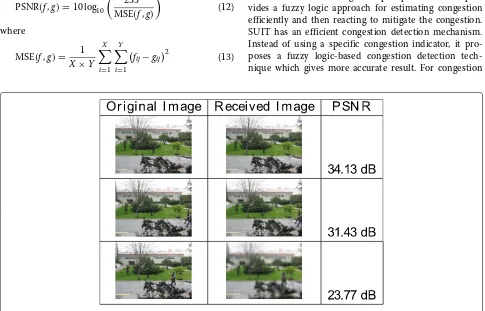
The quality of PJPEG images are compared with respect to the peak signal-to-noise ratio (PSNR) values. PSNR is a well-known image quality metric and widely used [43]. For two grey-level (8 bits) imagesf andgwhose dimensions areX×Y, PSNR calculation is defined as
PSNR(f,g)=10 log10
2552 MSE(f,g)
(12)
where
MSE(f,g)= 1 X×Y
X
i=1
Y
i=1
fij−gij 2
(13)
In Figure 11, visual examples of PSNR values are given for PJPEG images. The images shown in the tables are selected randomly from the image set which is received by the sink sensor. For the image quality performance eval-uation of the protocols, the average PSNR values of the received images are used and the PSNR values are cal-culated using Equation 12. Again, in these simulations, we varied the number of targets. Average quality of the received frames for QCC and FCE are the same and PSNR values for the received frames are computed as 35 dB, whereas the average PSNR values of the received frames for SUIT are a bit lower than the other protocols and for the worst case (when there are seven targets in the area) is observed as 32.5 dB. Since the main goal of SUIT is delivering more frames with lower delay and lower energy consumption by decreasing the image quality to an accept-able level, it is not surprising that the average PSNR values of the images transmitted with the SUIT protocol are lower. As discussed in [44,45], 32.5 dB is a sufficient qual-ity for our target monitoring application and can be used for object detection algorithms at the sink side. Therefore, images with 32.5 dB still have fairly good quality.
5 Conclusion
In this paper, we proposed a new protocol, SUIT, based on the necessities of efficient multimedia transmission over WMSNs. SUIT is an image transport protocol which pro-vides a fuzzy logic approach for estimating congestion efficiently and then reacting to mitigate the congestion. SUIT has an efficient congestion detection mechanism. Instead of using a specific congestion indicator, it pro-poses a fuzzy logic-based congestion detection tech-nique which gives more accurate result. For congestion
mitigation, SUIT provides two different techniques. The first technique is adapting video frame rate at source sensor nodes. The second one is a novel congestion mit-igation technique which can adapt the quality of images on-the-fly. Main contributions of the SUIT protocol are using a new combination of three congestion indica-tor in fuzzy logic-based congestion estimation approach, proposing a cross-layer information exchange method among different layers, and applying a quality adaptation technique which decreases the image quality while they are being transmitted. To the best of our knowledge, mit-igating congestion by decreasing image quality on-the-fly is a new technique proposed by SUIT.
A surveillance application scenario is implemented and extensive simulations are conducted in OPNET to verify our approach. SUIT protocol is compared to QCC-based and FCE-based congestion control protocols. Especially for congested network cases, SUIT outperforms other protocols in all aspects except of image quality. As we mentioned before, the main goal of SUIT protocol is providing better performance in terms of energy con-sumption, frame delivery, frame loss and frame latency by decreasing the quality without sacrificing image quality too much. So, the quality of received image performance of SUIT is lower than the other protocols as expected. However, the average image quality of the SUIT protocol is still satisfactory.
As a future work, we plan to apply fuzzy logic-based packet prioritization while dropping packets from the local queue. In our current implementation, packets are dropped according to their weights. Weights are calcu-lated based on the predefined rules. However, a fuzzy logic-based approach can provide more fairness on queue management. In addition, we want to improve the tar-get detection process by implementing a communication module between neighboring sensor nodes. The sensor nodes which monitor the same area, can communicate with each other in order to prevent transmitting the same image of the target for better application performance.
Competing interests
The authors declare that they have no competing interests.
Acknowledgements
This work is supported by the European Community’s Seventh Framework Programme (FP7-ENV-2009-1) under the grant agreement FP7-ENV-244088 FIRESENSE, by COST Action COST IC0906 WiNeMO Wireless Networking for Moving Objects and by the Turkish State Planning Organization (DPT) under the TAM Project, number 2007K120610. A shorter version of this manuscript was accepted as an invited paper in the Fifth IFIP International Conference on New Technologies, Mobility and Security (NTMS’2012).
Author details
1Computer Networks Research Laboratory, Netlab. Department of Computer
Engineering, Bogazici University, Bebek 34342, Istanbul, Turkey.2Department
of Computer Engineering, Galatasaray University, Besiktas 34349, Istanbul, Turkey.3Department of Mathematics, Bogazici University, Bebek 34342,
Istanbul, Turkey.4Information Technologies R&D, NETAS, Istanbul, Turkey.
Received: 4 November 2013 Accepted: 4 April 2014 Published: 23 April 2014
References
1. S Poojary, M Pai, Multipath data transfer in wireless multimedia sensor network, inProceedings of the International Conference on Broadband, Wireless Computing, Communication and Applications (BWCCA), (2010), pp. 379–383
2. S Misra, M Reisslein, G Xue, A survey of multimedia streaming in wireless sensor networks. IEEE Commun. Surv. Tutorials.10(4), 18–39 (2008) 3. M Maimour, C Pham, D Hoang, A congestion control framework for
handling video surveillance traffics on WSN, inProceedings of the 2009, International Conference on Computational Science and Engineering -Volume 02(CSE ’09 2009), pp. 943–948
4. W Yu, Z Sahinoglu, A Vetro, Energy efficient, JPEG 2000 image transmission over wireless sensor networks, inProceedings of the IEEE Global Telecommunications Conference (GLOBECOM),Volume 5, (2004), pp. 2738–2743
5. A Boukerche, Y Du, J Feng, R Pazzi, A reliable synchronous transport protocol for wireless image sensor networks, inIEEE Symposium on Computers and Communications (ISCC), (2008), pp. 1083–1089 6. A Mammeri, A Khoumsi, D Ziou, B Hadjou, Energy-efficient transmission
scheme of JPEG images over visual sensor networks, inProceedings of the 33rd IEEE Conference on Local Computer Networks LCN, (2008), pp. 639–647 7. C Wang, K Sohraby, B Li, M Daneshmand, Y Hu, A survey of transport
protocols for wireless sensor networks. IEEE Netw.20(3), 34–40 (2006) 8. Y Liu, N Xiong, Y Zhao, A Vasilakos, J Gao, Y Jia, Multi-layer clustering
routing algorithm for wireless vehicular sensor networks. Commun. IET. 4(7), 810–816 (2010)
9. L Xiang, J Luo, A Vasilakos, Compressed data aggregation for energy efficient wireless sensor networks, inSensor, Mesh and Ad Hoc Communications and Networks (SECON) 2011 8th Annual IEEE Communications Society Conference on, (2011), pp. 46–54
10. Y Sankarasubramaniam, O Akan, I Akyildiz, ESRT: event-to-sink reliable transport in wireless sensor networks, inProceedings of the 4th ACM International Symposium on Mobile Ad Hoc Networking and Computing (MOBIHOC), (2003), pp. 177–188
11. B Hull, K Jamieson, H Balakrishnan, Mitigating congestion in wireless sensor networks, inProceedings of the International Conference on Embedded Networked Sensor Systems (SenSys), (2004), pp. 134–147 12. CT Ee, R Bajcsy, Congestion control and fairness for many-to-one routing
in sensor networks, inProceedings of the International Conference on Embedded Networked Sensor Systems (SenSys), (2004), pp. 148–161 13. J Paek, R Govindan, RCRT: Rate-controlled reliable transport protocol for
wireless sensor networks. ACM Trans. Sensor Netw (TOSN).7(3), 1--45 (2010) 14. CY Wan, SB Eisenman, AT Campbell, CODA: congestion detection and
avoidance in sensor networks, inProceedings of the International Conference on Embedded Networked Sensor Systems (SenSys), (2003), pp. 266–279
15. M Zawodniok, S Jagannathan, Predictive congestion control protocol for wireless sensor networks. IEEE Trans. Wireless Commun.6(11), 3955–3963 (2007)
16. S Munir, YW Bin, R Biao, M Man, Fuzzy logic-based congestion estimation for QoS in wireless sensor network, inProceedings of the IEEE Wireless Communications and Networking Conference (WCNC), (2007), pp. 4336–4341
17. C Wang, K Sohraby, B Li, SenTCP: a hop-by-hop congestion control protocol for wireless sensor networks, inProceedings of the IEEE International Conference on Computer Communications (INFOCOM), (2005) 18. MH Yaghmaee, DA Adjeroh, Priority-based rate control for service
differentiation and congestion control in wireless multimedia sensor networks. Comput. Netw.53(11), 1798–1811 (2009)
19. JY Teo, Y Ha, CK Tham, Interference-minimized multipath routing with congestion control in wireless sensor network for high-rate streaming. Mobile Comput. IEEE Trans.7(9), 1124–1137 (2008)
20. M Maimour, C Pham, J Amelot, Load repartition for congestion control in multimedia wireless sensor networks with multipath routing, in3rd International Symposium on Wireless Pervasive Computing 2008. ISWPC, 2008.(2008), pp. 11–15
Proceedings of the 3rd International Conference on Embedded Networked Sensor Systems(ACM New York, NY, USA, 2005), pp. 116–129 22. T He, J Stankovic, C Lu, T Abdelzaher, SPEED: a stateless protocol for
real-time communication in sensor networks, inProceedings of the 23rd International Conference on Distributed Computing Systems, (2003), pp. 46–55
23. Z Wan, N Xiong, N Ghani, A Vasilakos, L Zhou, Adaptive unequal protection for wireless video transmission over IEEE 802.11e networks. Multimedia Tools Appl.62(3), 1–31 (2013)
24. C Basaran, KD Kang, M Suzer, Hop-by-hop congestion control and load balancing in wireless sensor networks, in2010 IEEE 35th Conference on Local Computer Networks (LCN), (2010), pp. 448–455
25. UU Alias, Swathiga, C Chandrasekar, An efficient fuzzy based congestion control technique for wireless sensor networks. Int. J. Comput. Appl. 40(14), 47–55 (2012)
26. M Zarei, A Rahmani, A Sasan, M Teshnehlab, Fuzzy based trust estimation for congestion control in wireless sensor networks, inProceedings of the International Conference on Intelligent Networking and Collaborative Systems (INCOS), (2009), pp. 233–236
27. M Li, Z Li, A Vasilakos, A survey on topology control in wireless sensor networks: taxonomy, comparative study, and open issues. Proc. IEEE. 101(12), 2538–2557 (2013)
28. Y Durmus, A Ozgovde, C Ersoy, Distributed and online fair resource management in video surveillance sensor networks. IEEE Trans Mobile Comput.11, 835–848 (2012)
29. V Kawadia, P Kumar, A cautionary perspective on cross layer design. IEEE Wireless Commun.12, 3–11 (2005)
30. W Su, T Lim, Cross-layer design and optimization for wireless sensor networks, inSeventh ACIS International Conference on Software Engineering, Artificial Intelligence, Networking, and Parallel/Distributed Computing (SNPD), (2006), pp. 278–284
31. G Shah, W Liang, X Shen, Cross-layer design for, QoS support in wireless multimedia sensor networks, in2010 IEEE Proceedings of the Global Telecommunications Conference (GLOBECOM 2010), (2010), pp. 1–5 32. A Vasilakos, K Zikidis, ASAFES.2: a novel, neuro-fuzzy architecture for fuzzy
computing based on functional reasoning, inFuzzy Systems, 1995. International Joint Conference of the Fourth IEEE International Conference on Fuzzy Systems and The Second International Fuzzy Engineering Symposium., Proceedings of 1995 IEEE Int,Volume 2, (1995), pp. 671–678
33. JM Mendel, Fuzzy logic systems for engineering: a tutorial, inProceedings of the IEEE,Volume 83, (1995), pp. 345–377
34. OPNET Modeler. https://www.opnet.com/solutions/network_rd/modeler. html. [accessed at May 2012]
35. MA Yigitel, OD Incel, C Ersoy, Design and implementation of a QoS-Aware MAC protocol for wireless multimedia sensor networks. Comput. Commun.34(16), 1991–2001 (2011)
36. CF Garcia-Hernandez, PH Ibarguengoytia-Gonzalez, J Garcia-Hernandez, JA Perez Diaz, Wireless sensor networks and applications: a survey, in
International Journal of Computer Science and Network Security (IJCSNS),
Volume 7, (2007), pp. 264–273
37. AHF Abdul Abdul Hamid, RA Rashid, N Fisal, SK Syed Yusof, Development of IEEE802.15.4 based wireless sensor network platform for image transmission, inInternational Journal of Engineering and Technology (IJET),
Volume 9, (2009), pp. 112–118
38. C Park, PH Chou, eCAM: ultra compact, high data-rate wireless sensor node with a miniature camera, inProceedings of the 4th International Conference on Embedded Networked Sensor Systems (SenSys), (2006), pp. 359–360
39. Atmel Corporation,8-bit AVR Microcontroller with Low Power2.4GHz Transceiver for ZigBee and IEEE 802.15.4. Rev. 8266CS-MCU Wireless-08/11 2011
40. M Zuniga, B Krishnamachari, Analyzing the transitional region in low power wireless links, inProceedings of the First Annual IEEE Communications Society Conference on Sensor and Ad Hoc Communications and Networks, (SECON), (2004), pp. 517–526 41. K Sohrabi, B Manriquez, G Pottie, Near ground wideband channel
measurement in 800-1000 MHz, inProceedings of the IEEE 49th Vehicular Technology Conference,Volume 1, (1999), pp. 571–574
42. B Karp, HT Kung, GPSR: greedy perimeter stateless routing for wireless networks, inProceedings of the 6th Annual International Conference on Mobile Computing and Networking, (2000), pp. 243–254
43. A Hore, D Ziou, Image quality metrics: PSNR vs. SSIM, inProceedings of the 20th International Conference on Pattern Recognition (ICPR), (2010), pp. 2366–2369
44. T Liu, Y Wang, J Boyce, H Yang, Z Wu, A novel video quality metric for low bit-rate video considering both coding and packet-loss artifacts. Selected Topics Signal Process. IEEE J.3(2), 280–293 (2009)
45. A Chan, K Zeng, P Mohapatra, SJ Lee, S Banerjee, Metrics for evaluating video streaming quality in lossy IEEE 802.11 wireless networks, in2010 Proceedings IEEE INFOCOM, (2010), pp. 1–9
doi:10.1186/1687-1499-2014-63
Cite this article as:Sonmezet al.:Fuzzy-based congestion control for wireless multimedia sensor networks.EURASIP Journal on Wireless Communi-cations and Networking20142014:63.
Submit your manuscript to a
journal and benefi t from:
7Convenient online submission
7Rigorous peer review
7Immediate publication on acceptance
7Open access: articles freely available online
7High visibility within the fi eld
7Retaining the copyright to your article