R E S E A R C H
Open Access
Resource allocation for asymmetric multi-way
relay communication over orthogonal channels
Christoph Hausl
1*, Onurcan I
ş
can
1and Francesco Rossetto
2Abstract
We consider the wireless communication of common information between several terminals with the help of a relay as it is for example required for a video conference. The transmissions of the nodes are divided in time and there is no direct link between the terminals. The allocation of the transmission time and of the rates in all directions can be asymmetric. We derive a closed form expression of the optimal time allocation for a given ratio of the rates in all directions and for given signal-to-noise ratios of all channels. For specific channel conditions that guarantee that the network is not“too asymmetric”we further obtain a closed form expression of the optimal rate ratio such that the sum-rate is maximized under the assumption that the time allocation is optimally chosen. We also show that at least one of the terminals should not transmit own data to maximize the sum-rate, if the network is“too asymmetric”.
1 Introduction
1.1 Multi-Way relaying with network coding
Consider a multi-way relay system where Nterminals want to exchange their independent information packets with the help of a half-duplex relay over time-orthogo-nalized noisy channels. Such a setup can be used for example for a video conference between Nterminals on earth via a satellite. The task of the relay is to efficiently forward its received signals to all terminals, such that every terminal can decode the messages of each other terminal. For this aim, we consider a decode-and-for-ward scheme where the relay transmits a network encoded version of its received packets. In previous work it was shown that network coding [1] allows an efficient bidirectional relay communication [2-4] with higher throughput than one-way relaying. In this work, we consider network coding for a multi-way relay sys-tem, which extends bidirectional relaying to more than two terminals.
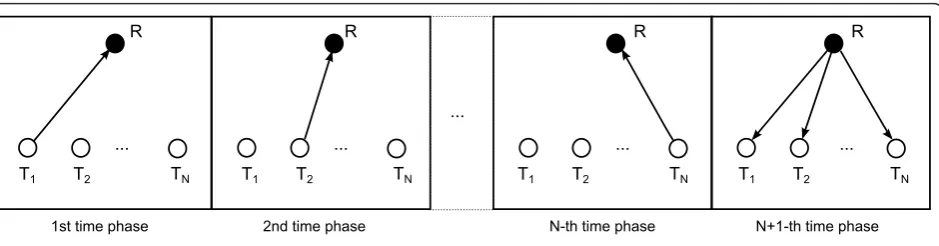
Figure 1 depicts the multi-way relay communication model with time-orthogonalized channels. We consider a strategy where the transmission time is divided intoN + 1 time phases. During the firstNtime phases (termed as uplink), the terminals transmit to the relay (the other
terminals cannot receive these signals) and in the last time phase (termed as downlink), the relay broadcasts packets which can be heard by all other terminals. The key idea to apply network coding in this setup is that the relay broadcasts to the terminals a function, for example a bitwise XOR, of its received packets. The terminals decode the required packets from the relay transmission and use their own packet as side informa-tion. This scenario withN = 2 terminals and one relay is mainly studied in the literature astwo-way relaying. For the two terminal-case, the achievable rates of several strategies were considered in [4-8].
Multi-way relaying was first treated independently in [9] and [10]. The authors of [9] focused on the achiev-able rate region and the diversity-multiplexing tradeoff of several strategies with a half-duplex constrained relay. The authors of [10] focused on the achievable rate region of several strategies with a full-duplex relay. Moreover, they considered a more general system model than in [9] that included the grouping of terminals into clusters which is also not considered in our paper. In [11] a scheme called functional decode-and-forward was proposed for the multi-way relay channel, where the relay decodes and forwards a function of the messages of the source nodes. The same authors extended their work also in [12,13]. Another work on multi-way relay-ing was done in [14,15] where the authors consider non-regenerative relaying with beamforming. The same
* Correspondence: [email protected] 1
Institute for Communications Engineering, Technische Universität München, 80290 Munich, Germany
Full list of author information is available at the end of the article
authors considered similar scenarios with regenerative relaying in [16] and multi-group multi-way relaying in [17,18]. Code design for the multi-way relay channel withN= 3 terminals and with direct link between the terminals was considered in [19].
1.2 Contribution of this paper
We consider scenarios with asymmetric channel quality and asymmetric data traffic. For example, such scenarios arise for a video conference via a satellite where some of the terminals have a better receive antenna and desire a high received data rate to show the video on a large screen whereas the other terminals have a smaller receive antenna and require a lower data rate.
The main contribution of this work is the optimiza-tion of the time and rate allocaoptimiza-tion parameters for such setups. This work extends the optimization parts of [20], where we only considered N= 2 terminals, to an arbi-trary number of terminals. This is the first work which concentrates on the optimization of the resource alloca-tion for multi-way relay systems with asymmetric chan-nels. Moreover, we obtain insights about the scalability of the network coding gain with the network size.
After introducing the system model in Section 2, we consider in Section 3 how to optimally allocate the transmission time to the terminals and the relay and how to optimally allocate the rates of the terminals such that the sum-rate is maximized. We first derive a closed form expression of the optimal time allocation for given rate ratios and given signal-to-noise ratios (SNRs) of all channels. Then, we show that the optimization of the rate allocation under the assumption that the time allo-cation is optimally chosen can be transformed into a lin-ear optimization problem that is solvable with computationally efficient algorithms. Moreover, we obtain a closed form expression for the rate optimiza-tion that is valid for specific channel condioptimiza-tions that guarantee that the network is not“too asymmetric”. If the network is “too asymmetric”, at least one of the terminals should not transmit own data to maximize the sum-rate. In Section 4 we provide examples to show
how the optimization can increase the system perfor-mance. Section 5 concludes the work.
2 System model
2.1 System setup
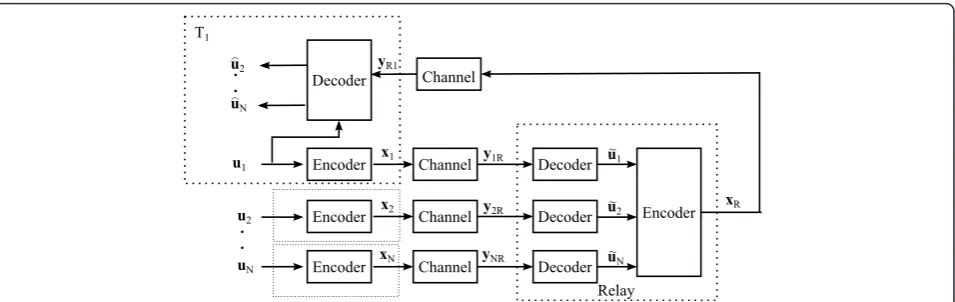
Consider a multi-way communication betweenN term-inals Ti with 1≤ i≤ Nvia a relay where each terminal wants to communicate common information to all other terminals. We do not consider private information that is only intended for a subset of all terminals. The infor-mation bits of terminaliare segmented in packetsuiof length Ki. The packets carry statistically independent data. At Ti, the bits uiare protected against transmis-sion errors with channel codes and modulators which output the blockxicontainingMisymbols. Titransmits xi to the relay with power Pi in the i-th of the N+1 time phases. We consider a time-division channel with-out interference between nodes.
The relay demodulates and decodes in the i-th time phase the corrupted versionyiRofxito obtain the hard
estimateu˜iabout ui. Then, the estimates u˜iof all
term-inals are network encoded and modulated to the block xRcontaining MRsymbols. The relay broadcastsxRto
all terminals with powerPRin theN+ 1-th time phase.
Tireceives the corrupted versionyRi ofxRin theN+
1-th time phase. Based onyRi and on the own informa-tion packetui, the decoder at Tioutputs the hard esti-matesuˆiaboutujfor alljbetween 1 andNexcept forj =i.
The total number of transmitted symbols is given by
M=MR+
N
i=1Mi. The transmitted rate in information bits per symbol from TiisRi =Ki/M. The transmitted
sum-rate of the system is given by
R=N
i=1Ri=
N
i=1Ki
/M. We define the time
allo-cation parameters θi = Mi/M for 1 ≤ i ≤ N and
θR = 1−Ni=1θi. Moreover, we define the rate ratiossi =Ri/Rfor 1≤i≤ NwithNi=1σi= 1. Note that the rate
ratios are defined differently compared to [20]. The
... T1
... T2
... TN
... ...
T1 T2 TN T1 T2 TN T1 T2 TN
R R
R R
1st time phase 2nd time phase N-th time phase N+1-th time phase
block diagram of the system model is depicted in Figure 2.
2.2 Channel model
All channels are assumed to be AWGN channels and thus the received samples after the matched filter are
yiR=hiR·xi+ziR (Titransmits) (1)
yRi=hRi·xR+zRi (R transmits) (2)
with the channel coefficientshiRandhRi for 1≤i≤N
modeling path loss and antenna gains. The noise values zkare zero-mean and Gaussian distributed with variance N0·W/2 per complex dimension, whereW denotes the
bandwidth.
The SNRs are given bygiR=Pi·hiR/(N0W) and bygRi
=PR·hRi/(N0 ·W).
3 Optimization of time and rate allocation
In this section we consider the problem of how to opti-mally allocate the transmission time to the terminals and to the relay and how to optimally allocate the rates of the terminals such that the sum-rate is maximized. We extend the work in [20] fromN= 2 to an arbitrary number of terminals.
3.1 Achievable rate region
Assuming the system model given in the previous sec-tion, the data of Tican be decoded reliably at all other terminals, if the following conditions hold for all iin 1 ≤i≤N:
nel inputs. The conditions in (3) ensure that the relay is able to decode reliably while the conditions in (4) ensure that the terminals are able to decode reliably. The conditions in (4) can be obtained from [21]. A simi-lar result has been derived in [22] where more a priori information is assumed than in our channel model. For N= 2 these conditions are derived in [5] and [23].
3.2 Optimal time allocation
In this section we consider the optimization of the time allocation parameters θ−= [θ1θ2...θN]T such that the
sum-rate R is maximized for given rate ratios σ− = [σ1σ2...σN]T. Formally, the optimization is stated
whereasais given by
a= min
and the arguments of the minimum in (6) follow from (3), from (4), fromRi=si·Rand fromθR = 1−
N i=1θi.
The step from (6) to (7) is done to ensure that the sec-ond argument of the minimization is independent ofi.
The solution of the optimization follows by setting the first and the second argument in (7) to equality for alli with 1≤i≤N:
The optimization can be solved in this way, because
•the first argument increases monotonically withθi,
•the second argument decreases monotonically with
θi,
•it is guaranteed that the first and the second argu-ment have a cross-over point for C(γiR)≥0 and
C(γRi)≥0.
In order to find theN unknownθi∗, Nequations are provided by (9). As long as theseNequations are line-arly independent, the optimal time allocation parameters θ∗can be obtained by
Eq. (10) can be further simplified by using the matrix inversion lemma [24]
(B+UAV)−1=B−1−B−1UA−1+VB−1U−1VB−1
where we setA=a,V= [1... 1]1 ×N,U=VTand Bas
a diagonalN×Nmatrix withC(γiR)/σias thei-th
diag-onal element. Accordingly, the optimal time allocation parametersθi∗for alliare given by
and the corresponding achievable sum-rateRis given by
This also shows that the matrix in (10) is invertible if
C(γiR)>0holds for alli. Moreover, it can be seen from Eq. (12) that if the uplink capacityC(γiR)of terminal Ti is increased, the allocated time for that terminal decreases. Another interesting observation is that θi∗
depends on all uplink capacities and only on one down-link capacity given in (8). It does not depend on the other downlink capacities.
3.3 Optimal time and rate allocation
Based on the result in the previous section we consider the optimal choice for the rate ratiosσ− = [σ1σ2...σN]T
such that the sum-rate R of the system is maximized when the time allocation θ−= [θ1θ2...θN]T is chosen
optimally. Formally, the optimization is stated as
σ∗= arg max
The optimization in (13) can be expressed as the fol-lowing linear optimization problem [25]:
[σ∗b∗] = arg min
This allows to solve the problem with computationally efficient numerical algorithms. Note that in this expres-sion b = 1/a is included as additional optimization variable.
σ∗
is achievable at this vertex. The vertex[σ−∗
Sb cal AND (derivation in Appendix 6.1). We denote net-works where (17) is not fulfilled for anyi Î {1, 2,...,N} as“too asymmetric”for full network coding, because the vertex[σ−∗
Sb
∗
S]is the only solution of the optimization
problem where it is possible that σi∗>0for alli Î {1,
2,...,N} (derivation in Appendix 6.1). That means if (17) is not fulfilled for anyi Î{1,2, ...,N}, at least oneσi∗is
zero. Those terminals do not transmit any packet at all. It is also interesting to see that for reciprocal channels (C(γRi) =C(γiR)for alli Î {1, 2,...,N}) both conditions in (17) are identical.
Although the explicit solution in (15) could be also obtained numerically with the linear optimization, it is worthwhile to express it explicitly, because Condition (17) is fulfilled for specific networks that are of practical relevance, for example
•for completely symmetric networks where all capa-cities are equal (C(γiR) =C(γRi) =C for all i Î
{1,2,...,N}),
•for“close-to-symmetric”networks in the sense that the set of all terminal-indices {1, 2,..., N} is split into the four disjoint subsets Nb, Nu, Ndand Nrwith cardinalities |Nb| =Nb, |Nu| = Nu, |Nd| =Nd and |Nr| =Nr, =N−Nb−Nu−Nd and that the following properties are fulfilled:
◦C(γiR) =C(γRi) =C+δfor alli∈Nb
◦C(γiR) =C+δandC(γRi) =Cfor alli∈Nu
◦C(γiR) =CandC(γRi) =C+δfor alli∈Nd
◦C(γiR) =C(γRi) =Cfor alli∈Nr
◦δis constrained to be in the following interval (derivation in Appendix 6.2):
δ
•for networks with reciprocal channels, where
C(γiR) =C(γRi)≤
capacity. Note that Condition (20) becomes more strict
with growing N, because N
N−1 approaches to 1 and hence the capacities of the channels should be closer to the average capacityCDin order to fulfill the conditions given in (17).
•for networks with N= 2 withC(γ2R)≥C(γR2)and
C(γ1R)≥C(γR1) (for example for all reciprocal channels).
Moreover, the explicit solution in (15) can be regarded as an appropriate initial point for numerical algorithms.
withu= 1/C(γ1R)−1/C(γ2R), where the optimal rate
is achievable. For the last case in (21) and (22) Condi-tion (17) is fulfilled and thus, the optimal rate allocaCondi-tion and the corresponding rate are given by (15) and (16), respectively. The optimization of the other two cases is derived in [20]. We conclude from (21) that network
coding should only be used for
−1/C(γR2)≤1/C(γ1R)−1/C(γ2R)≤1/C(γR1)to achieve the maximum sum-rate. Otherwise the network is “too asymmetric” and it is optimal to communicate only in one direction for achieving the maximum sum-rate. If network coding should be used, the optimal rate ratio
s* depends only on the links from the relay to the term-inals. As mentioned previously, forC(γ2R)≥C(γR2)and
C(γ1R)≥C(γR1)the result of the optimization in (21) simplifies and it is always optimal to use network coding withρ∗=C(γR1)/C(γR2).
3.4 Reference system without network coding
In this section we describe a reference system for the multi-way relay communication, where no network cod-ing is used. In this scheme the transmission time is split into 2Ntime phases. The firstNphases are the same as in Section 2 and the nextNphases are used by the relay to forward the packets that it received in the first N phases to the terminals (During theN+i-th phase, the received packet from the i-th phase is broadcasted). For comparison with the network coding case, we also opti-mize the time allocation and the rate ratio.
3.4.1 Achievable rate region
In this system, the following conditions have to hold for alliin 1 ≤i≤Nin order to ensure a reliable communi-cation between each terminal [26]:
R≤ θi
3.4.2 Optimal time allocation
We first consider the optimization of the time allocation vectorθ−= [θ1θ2...θN−1]T for a given rate ratio vector
σ− = [σ1σ2...σN]T. Considering the conditions in (24),
the optimization can be stated as follows:
θ−∗= arg maxθ
The solution of the optimization can be found simi-larly to the one in Section 3.2 by setting the 2Nterms in Eq. (26) to equality. We set every term in Eq. (26)
equal to the very last term
with 2N- 1 unknowns. Without loss of generality, we assume that the notation is chosen such that
C(γR1)≤C(γR2)≤ · · · ≤C(γRN)is valid. This implies
achievable sum-rateRis given by
3.4.3 Optimal time and rate allocation
Based on the result in the previous section we consider the optimal choice for the rate ratiosσ− = [σ1σ2...σN]T
such that the sum-rate R of the system is maximized when the time allocationθ is chosen optimally. Formally the optimization is stated as
σ∗= arg max
One solution of the optimization is given by
σ∗ optimal rate allocation parameter is given by
σ∗
This means it is optimal to communicate only in one direction to maximize the sum-rate. The solution can be obtained similarly to the derivation in Section 3.3.
4 Examples
4.1 Example 1
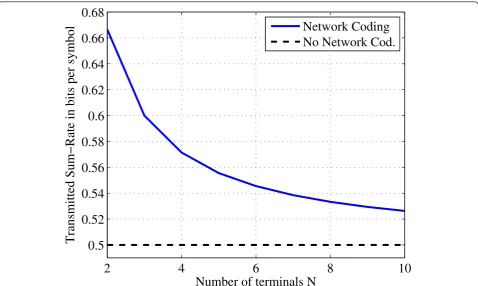
Consider a symmetrical setup with N terminals where all the channels are of the same quality with C(γ) = 1 bits per symbol. If the optimization of the time and rate allocation parameters is done according to the previous sections, we obtain for the case with network coding according to (15), (16) and (11)
σ∗
For the case without network coding we obtain according to (35)
R∗= 1
2. (44)
The achievable sum-rateRdependent on the number of terminalsNis shown in Figure 3. It can be seen that R for the case without network coding is constant, whereas if network coding is applied, the sum-rateRis always larger compared to the case without network coding. Another important result is that the largest gain is achieved forN = 2 terminals and with increasingN the gain due to network coding decreases. Note that contrary to the considered transmitted sum-rate, the received sum-rate ((N-1)·R) would increase with grow-ingN.
4.2 Example 2
Consider a two-terminal example with
as network coding thresholds. IfC(γ1R)is not between these thresholds, network coding should not be used to maximize the sum-rate. By using network coding the optimal sum-rate can be increased to 0.88 bits per chan-nel use atC(γ1R) = 1.2, while the sum-rate without net-work coding is 0.75 bits per channel use. This corresponds to an increase of 17.5% in spectral efficiency.
4.3 Example 3
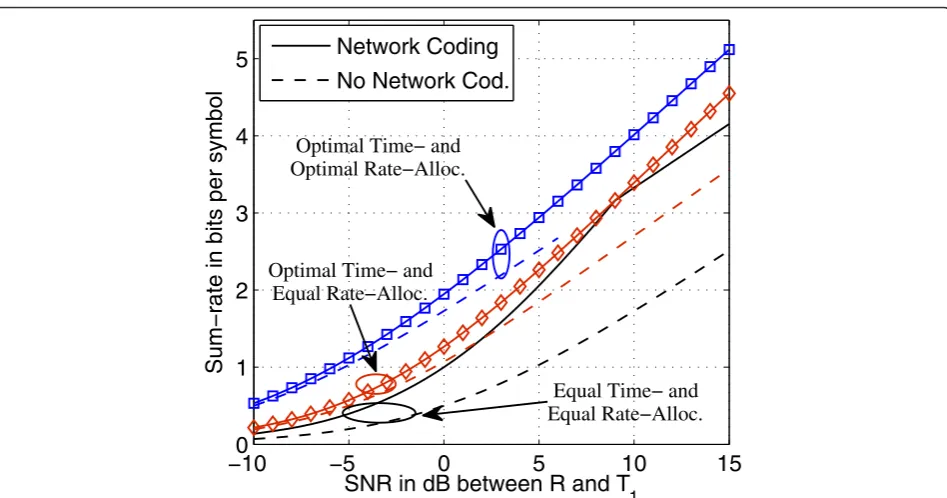
Figure 5 depicts the achievable sum-rateRover the SNR
gR1from R to T1 in a scenario withN= 5 terminals. All
other SNRs are set to gR1+ 10 dB. The reason for the
lower channel receive-quality at T1 could be a smaller
antenna with a lower gain compared to the other term-inals. We consider systems with and without network coding and assume Gaussian distributed channel input distributions. If both time and rate allocation are opti-mized, network coding gains more than 1.4 dB com-pared to the system without network coding for a sum-rate ofR= 4.0 bits per symbol. If the time allocation is optimized for an equal rate allocation, network coding gains more than 1.3 dB forR= 3.0 bits per symbol. For an equal time and rate allocation, network coding gains more than 2.5 dB forR= 2.0 bits per symbol.
The systems with the optimal time and rate allocation perform best and gain for a sum-rate ofR= 2.0 bits per symbol more than 5.3 dB compared to the correspond-ing systems with equal rates.
If both time and rate allocation are optimized and net-work coding is used, the terminal T1 with the weakest relay-terminal channel transmits with the largest rate. For example, forgR1= 10 dB the optimal allocation vectors are
given by σ−∗= [0.540 0.115 0.115 0.115 0.115]T,
θ∗= [0.287 0.061 0.061 0.061 0.061]Tandθ∗
R = 0.4690.
4.4 Example 4
Figure 6 shows the achievable rates for a scenario simi-lar to the previous example with N= 2 terminals. All other SNRs thangR1are again set togR1+ 10 dB.
If both time and rate allocation are optimized, net-work coding gains more than 4.0 dB compared to the system without network coding for a sum-rate of R= 4.0 bits per symbol. If the time allocation is optimized for an equal rate allocation, network coding gains more than 3.4 dB forR = 3.0 bits per symbol. For an equal time and rate allocation, network coding gains more than 6.9 dB for R= 2.0 bits per symbol. This confirms the observation in Example 1 that the gain due to net-work coding is maximized forN= 2.
2
4
6
8
10
0.5
0.52
0.54
0.56
0.58
0.6
0.62
0.64
0.66
0.68
Number of terminals N
Transm
itte
d
Sum−Rate
in
bi
ts per sym
b
o
l
Network Coding
No Network Cod.
0
0.5
1
1.5
2
2.5
0
0.5
1
1.5
2
2.5
3
C(
γ
1R
)
Network Coding
No Network Cod.
Optimal
Sum−Rate
Optimal
Rate−Alloc.
ρ
*
ρ
*
Figure 4Example 2: Optimal rate allocationρ∗=σ2∗/σ1∗and sum-rateR*for network coding and corresponding values without network coding forC(γR1) = 3, C(γR2) = 2andC(γ2R) = 1in a two-terminal case[20].
−10
0
−5
0
5
10
15
1
2
3
4
5
SNR in dB between R and T
1Sum−rate in bits per symbol
Network Coding
No Network Cod.
Equal Time− and
Equal Rate−Alloc.
Optimal Time− and
Equal Rate−Alloc.
Optimal Time− and
Optimal Rate−Alloc.
The systems with the optimal time and rate allocation perform best and gain for a sum-rate ofR= 2.0 bits per symbol more than 3.4 dB compared to the correspond-ing systems with equal rates.
If both time and rate allocation are optimized and net-work coding is used, the terminal T1 with the weakest
relay-terminal channel transmits with the largest rate. For example, forgR1= 10 dB the optimal allocation vectors are
given by σ∗= [0.66 0.34]T, θ∗= [0.397 0.206]T and θR∗= 0.397.
The rate for equal time and rate allocation with net-work coding changes its pre-log-factor from 1 to 0.5 at
gR1 = 9 dB because the rate is limited by the
communi-cation to the terminals for gR1 < 9 dB and by the
com-munication to the relay forgR1> 9 dB.
The considered networks in the Examples 3 and 4 are never “too asymmetric”in the range -10 dB ≤gR1≤15
dB and thus, the explicit expression in (16) can be always used to calculateR*.
5 Conclusion
We considered communication systems with multiple terminals and one relay where the terminals want to trans-mit their packets to each other. We derived closed form expressions for the optimal time allocation. We also obtained a closed form expression for the optimal rate allocation that is valid for specific channel conditions that guarantee that the network is not “too asymmetric”. If these conditions are not fulfilled we showed that the opti-mization can be solved efficiently with linear optiopti-mization algorithms. For asymmetric channel conditions, the sum-rate is larger if we allow the time and sum-rate allocation to be
asymmetric as well. It turns out that the largest gain due to network coding is obtained forN= 2 terminals and the gain decreases with increasingN.
In further work, efficient code design for asymmetric multi-way relay systems could be considered.
6 Appendix
6.1 Derivation of optimal rate allocation
We want to show under which conditions the vertex [σ−∗
S b
∗
S]whose elements are given according to (15) is
the solution of the optimization in (14). The derivation follows [25, Chapter 3.1]. First, we transform the optimi-zation problem in (14) with the help of slack variables si to its corresponding standard form which is given by
x∗ = arg min
Sum−rate in bits per symbol
whereas0l; denotes an all-zero row vector of lengthl.
The problem containsn= 2•N+ 1 variables withm= N+ 1 equality constraints. A vectorx Î ℝnis a vertex ifA•x=bis fulfilled andn-melements of x are zero [25, Theorem 2.4].
We only consider the vertex x∗S= [σ−∗
Sb
∗
S0N]Twithsi= 0 for alliÎ{1, 2,...,N} which is given by
[σ−∗ Sb
∗
S]T=B−1·b (45)
whereas Bis a m ×m matrix which consists of the firstmcolumns of A. This is the only vertex where no
siwithiÎ {1,2,..., N} is constrained to be zero, because b = 0 andsi = 0 leads tosi= 1 which would implysj≤ 0 forjÎ{1, 2,..., N}/i.
The vertexx∗Sis optimal if
cT−cTS·B−1·A≥0n (46)
and
B−1·b≥0Tm (47)
is fulfilled whereascSis the vector which contains the
firstmelements of c [25, Chapter 3.1]. The condition in (46) is for the last N elements equivalent to the left hand side in Condition (17) and the condition in (47) is for the first Nelements equivalent to the right hand side in Condition (17). The conditions (46) and (47) are always fulfilled for the other elements. The correspond-ing solution of the optimization in (15) follows from (45).
6.2 Derivation ofδ-Interval for“Close-to-Symmetric” networks
The first argument of the maximum in (18) follows from the right hand side of (17) forC(γRi) =C. The
sec-ond argument of the maximum in (18) follows from the left hand side of (17) forC(γiR) =C. The first argument of the minimum in (19) follows from the right hand side of (17) forC(γRi) =C+δ. The second argument of
the minimum in (19) follows from the left hand side of (17) forC(γiR) =C+δ.
7 Competing interests
The authors declare that they have no competing interests.
8 Acknowledgements
The authors are supported by the Space Agency of the German Aerospace Center and the Federal Ministry of Economics and Technology based on the agreement of the German Federal Parliament (support code 50YB0905). C. Hausl is also supported by the EC-funded Network of Excellence NEWCOM+ + (contract n. 216715). The authors thank Prof. Gerhard Kramer and Michael Heindlmaier for their helpful comments.
Author details
1Institute for Communications Engineering, Technische Universität München, 80290 Munich, Germany2DLR, Institute of Communications and Navigation, 82234 Weßling, Germany
Received: 3 March 2011 Accepted: 18 January 2012 Published: 18 January 2012
References
1. R Ahlswede, N Cai, SYR Li, RW Yeung, Network Information Flow. IEEE Transactions on Information Theory.46(4), 1204–1216 (2000). doi:10.1109/ 18.850663
2. RW Yeung, SYR Li, N Cai, Z Zhang,Network Coding Theory, Part I: Single Source, Volume 2now Publishers (2005)
3. Y Wu, PA Chou, SY Kung, Information Exchange in Wireless Networks with Network Coding and Physical-Layer Broadcast, inConference on Information Sciences and Systems (CISS)(2005)
4. P Larsson, N Johansson, KE Sunell, Coded Bidirectional Relaying. inIEEE Vehicular Technology Conference851–855 (2006)
5. SJ Kim, P Mitran, V Tarokh, Performance Bounds for Bi-Directional Coded Cooperation Protocols. IEEE Transactions on Information Theory.54(11), 5235–5241 (2008)
6. P Popovski, H Yomo, Physical Network Coding in Two-Way Wireless Relay Channels. inIEEE International Conference on Communications (ICC), 707–712 (2007)
7. G Kramer, S Shamai (Shitz), Capacity for Classes of Broadcast Channels with Receiver Side Information. inIEEE Infromation Theory Workshop (ITW), 313–318 (2007)
8. C Hausl, J Hagenauer, Iterative Network and Channel Decoding for the Two-Way Relay Channel. inIEEE International Conference on Communications (ICC)1568–1573 (2006)
9. T Cui, T Ho, J Kliewer, Space-Time Communication Protocols for N-Way Relay Networks. inProc IEEE Globecom Conference, 1–5 (2008)
10. D Gunduz, A Yener, A Goldsmith, H Poor, The multi-way relay channel. in
International Symposium on Information Theory (ISIT), 339–343 (2009) 11. L Ong, S Johnson, C Kellett, An optimal coding strategy for the binary
multi-way relay channel. IEEE Communications Letters.14(4), 330–332 (2010)
12. L Ong, S Johnson, C Kellett, The Capacity Region of Multiway Relay Channels Over Finite Fields With Full Data Exchange. IEEE Transactions on Information Theory.57(5), 3016–3031 (2011)
13. L Ong, S Johnson, C Kellett, The capacity of a class of multi-way relay channels. inIEEE International Conference on Communication Systems (ICCS), 346–350 (2010)
14. A Amah, A Klein, Non-regenerative multi-way relaying with linear beamforming. inIEEE International Symposium on Indoor and Mobile Radio Communications (PIMRC), 1843–1847 (2009)
15. A Amah, A Klein, Beamforming-Based Physical Layer Network Coding for Non-Regenerative Multi-Way Relaying. inEURASIP Journal on Wireless Communications and Networking(2010)
16. A Amah, A Klein, A transceive strategy for regenerative antenna multi-way relaying. inIEEE International Workshop on Computational Advances in Multi-Sensor Adaptive Processing (CAMSAP), 352–355 (2009)
17. A Amah, A Klein, Multi-Group Multi-Way Relaying: When Analog Network Coding Finds Its Transceive Beamforming. inIEEE Wireless Communications and Networking Conference (WCNC)(2010)
18. A Amah, A Klein, Regenerative Multi-Group Multi-Way Relaying. IEEE Transactions on Vehicular Technology.60(7), 3017–3029 (2011) 19. O Iscan, I Latif, C Hausl, Network coded multi-way relaying with iterative
decoding. inIEEE International Symposium on Indoor and Mobile Radio Communications (PIMRC), 482–487 (2010)
20. C Hausl, O Iscan, F Rossetto, Optimal time and rate allocation for a network-coded bidirectional two-hop communication. inEuropean Wireless Conference (EW), 1015–1022 (2010)
21. E Tuncel, Slepian-Wolf Coding over Broadcast Channels. IEEE Transactions on Information Theory.52(4), 1469–1482 (2006)
22. LL Xie, Network Coding and Random Binning for Multi-User Channels. in
10th Canadian Workshop on Information Theory(2007)
24. R Horn, C Johnson,Matrix Analysis, (Cambridge University Press, 1990) 25. D Bertsimas, J Tsitsiklis,Introduction to Linear Optimization, (Athena
Scientific, 1997)
26. G Kramer, M Gastpar, P Gupta, Cooperative Strategies and Capacity Theorems for Relay Networks. IEEE Transactions on Information Theory.
51(9), 3037–3063 (2005). doi:10.1109/TIT.2005.853304
doi:10.1186/1687-1499-2012-20
Cite this article as:Hauslet al.:Resource allocation for asymmetric multi-way relay communication over orthogonal channels.EURASIP Journal on Wireless Communications and Networking20122012:20.
Submit your manuscript to a
journal and benefi t from:
7Convenient online submission
7Rigorous peer review
7Immediate publication on acceptance
7Open access: articles freely available online
7High visibility within the fi eld
7Retaining the copyright to your article
![Figure 4 Example 2: Optimal rate allocationnetwork coding for ρ∗ = σ ∗2 /σ ∗1and sum-rate R* for network coding and corresponding values without C(γR1) = 3, C(γR2) = 2and C(γ2R) = 1in a two-terminal case [20].](https://thumb-us.123doks.com/thumbv2/123dok_us/957299.1117185/9.595.58.542.432.712/figure-example-optimal-allocationnetwork-network-corresponding-values-terminal.webp)