MP-01.01
Abiraterone Acetate Plus Low-Dose Prednisone Has a Favorable Safety Profile, Improves Survival and Produces PSA and Radiographic Responses in Post-Docetaxel Metastatic Castration-Resistant Prostate Cancer: Results from COU-AA-301, a Randomized, Double-Blind, Placebo-Controlled, Phase III Study
Saad Fred1, de Bono Johann S2, Haqq Christopher M3, Logothetis Christopher
J4, Fizazi Karim5, North Scott6, Chi Kim N7, Ellard Susan L7, Cheng Tina8,
Kheoh Thian3, Scher Howard I9, Molina Arturo3
1Centre Hospitalier de l’Université de Montréal, Montreal, Quebec, Canada; 2Royal Marsden Hospital, Sutton, United Kingdom; 3Ortho Biotech Oncology
Research & Development (a unit of Cougar Biotechnology, Inc.), Los Angeles, CA, USA; 4MD Anderson Cancer Center, Houston, TX, USA; 5Institut Gustave
Roussy, Villejuif, France; 6Cross Cancer Center, Edmonton, AB, Canada; 7BC
Cancer Agency, Vancouver, BC, Canada; 8University of Calgary, Calgary,
AB, Canada; 9Memorial Sloan-Kettering Cancer Center, New York, NY, USA
Introduction and Objective: Abiraterone acetate (AA) is an androgen biosynthesis inhibitor that selectively inhibits CYP17, blocking testicular, adrenal, and prostatic intratumoral androgen synthesis. Studies suggest that some metastatic castration-resistant prostate cancers (mCRPCs) remain dependent on androgen receptor (AR) signaling.
Methods: In COU-AA-301 patients (pts) with docetaxel-treated mCRPC were randomized 2:1 to AA (1000 mg) + prednisone (P) (5 mg BID) (n=797) or placebo + P (n=398) at 147 centers in 13 countries. The primary end-point was overall survival (OS). PSA and radiographic assessments were adapted from PSAWG criteria (Bubley, JCO, 1999). Safety assessments were standard.
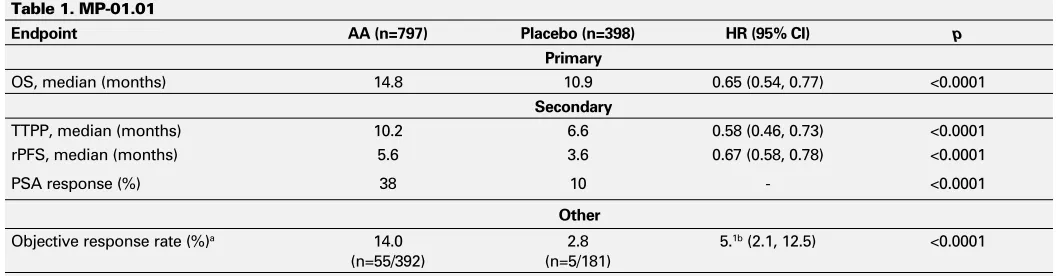
Results: Based on a pre-specified interim analysis, the IDMC recommended the study be unblinded. Efficacy results from 1195 enrolled patients are presented (Table 1). Grade 3/4 AEs occurred in 55% of pts with AA vs 58% with placebo. Frequently occurring (>5%) adverse events (AEs) with AA vs placebo were: fatigue (8% vs 10%), anemia (7.5% vs 7.4%), back pain (6% vs 10%), and spinal cord compression (3% vs 5%). The most common grade 3/4 laboratory-related AEs were decreased lymphocytes (21% vs 23%) and increased ALP (18% vs 13%).Grade 3/4 AEs of special interest (AA vs placebo) were: fluid retention (2.3% vs 1%), hypokalemia (3.8% vs 0.8%), LFT abnormalities (3.5% vs 3.0%), hypertension (1.3% vs 0.3%), and cardiac disorders (4.1% vs 2.3%). The cardiac disorders were
predominantly arrhythmias; there was no imbalance in cardiac AEs with an outcome of death (1.1% vs 1.3% with AA vs placebo).
Conclusions: AA + P has a favorable safety profile and significantly improves OS, TTPP, rPFS, PSA response rate, and radiologic response rate in patients with mCRPC post docetaxel. This Phase III study confirms that AA provides clinical benefit following medical/surgical castration in post-docetaxel mCRPC.
MP-01.02
Prevention of Bone Loss Using Risedronate in Patients Starting Androgen Deprivation Therapy: Canadian Urologic Oncology Group (CUOG) Trial P-05
Saad Fred1, Abdenour Nabid2, Izawa Jonathan3, Jewett Michael4, Eiley David5,
Gleave Martin6, Nguyen Thu-Van7, Ruether Dean5, Lattouf Jean-Baptiste1 1Department of Urology, CHUM, Montreal, QC, Canada; 2Department
of Radiation Oncology, CHUS, Sherbooke, QC, Canada; 3Department of
Urology, UHN, Toronto, ON, Canada; 4Department of Urology, VGH,
Vancouver, BC, Canada; 5Department of Medical Oncology, Alberta Cancer
Board, Calgary, AB, Canada; 6Department of Urology, Lakeshore General
Hospital, Montreal, QC, Canada; 7Department of Radiation Oncology,
CHUM, Montreal, QC, Canada
Introduction and Objectives: Bone loss due to androgen deprivation ther-apy (ADT) is well established and has been implicated with a higher risk of fractures. Prevention of bone loss has been studied using various strate-gies using IV and oral bisphosphonates and more recently subcutaneous denosumab. The primary objective was to determine the feasibility and efficacy using weekly risedronate to prevent bone loss at 1 year in men beginning ADT. The primary endpoint of the study was change in lumbar spine (LS) BMD at 1 year.
Methods: Trial was begun in 2005 and ended in 2009. 140 patients starting ADT (less than 3 months prior to study entry) were randomized to receive weekly risedronate or placebo. BMD of the lumbar spine and hip was performed at baseline and at 1 year. Bone markers (Serum and urinary CTX, Bone Specific Alkaline phosphatise and osteocalcin) were obtained at baseline as well as at 3, 6, 12 months. Descriptive statistics were used to describe patient populations at baseline and changes from baseline. Analysis of covariance was used to test differences between treatment
Moderated Posters 1: Oncology – Prostate
June 20, 2011, 1440-1640
Table 1. MP-01.01
Endpoint AA (n=797) Placebo (n=398) HR (95% CI) p
Primary
OS, median (months) 14.8 10.9 0.65 (0.54, 0.77) <0.0001
Secondary
TTPP, median (months) 10.2 6.6 0.58 (0.46, 0.73) <0.0001
rPFS, median (months) 5.6 3.6 0.67 (0.58, 0.78) <0.0001
PSA response (%) 38 10 - <0.0001
Other
Objective response rate (%)a 14.0
(n=55/392)
2.8 (n=5/181)
5.1b (2.1, 12.5) <0.0001
groups for the changes from baseline with the baseline value being the covariate.
Results: Baseline characteristics were balanced between groups. One year LS-BMD were available for 118 patients. Patients on placebo had a statistically significant bone loss at 1 year for LS-BMD (p=0.012) and LS-T-Scores (p=0.0003). LS-BMD and LS-T-Scores remained unchanged for patients treated with risedronate. The differences in the changes from baseline in LS-BMD and LS-T-Scores between two groups were signifi-cantly different. Changes from baseline for the Hip BMD and Hip T-Scores were not observed.
Conclusions: Risedronate was well tolerated and prevented bone loss of the LS at 1 year in patients initiating ADT.
MP-01.03
Urinary PCA3 and Cancer Progression under Active Surveillance of Prostate Cancer
Fradet Vincent, Levesque Jerome, Bergeron Alain, Lacombe Louis, Dujardin Thierry, Tiguert Rabi, Fradet Yves
Departement de chirurgie, CHUQ Université Laval, Laval, QC, Canada
Introduction and Objectives: Active surveillance of low-risk prostate cancer is now routinely used in clinical practice. Yet, about 30-40% of patients will experience cancer progression over time and need treat-ment with curative intent. A biomarker predictive of cancer progression is lacking. In this retrospective cohort study, we sought to determine the clinical utility of the urinary PCA3 test.
Methods: Patients with Gleason 6 prostate cancer were enrolled in a IRB-approved phase II study of active surveillance complemented with prescription of a 5-alpha-reductase inhibitor (5ARi) drug (dutasteride or finasteride). Informed consent was obtained from each patient before enrolment. Repeat prostate biopsy was recommended after 6-12 months of surveillance, then yearly. All 84 patients in whom urine was col-lected after digital rectal examination of the prostate before the baseline diagnostic biopsy are reported here. Urinary RNA was stabilized with UTM buffer (GeneProbe). Urine was stored at -80C until PCA3 test was performed at GeneProbe central laboratory. Trends were tested using Mantel-Haenszel chi-square statistic. Cox regression models were fitted for time-dependent events.
Results: At baseline, mean age was of 63.8 (SD 7.0), mean PSA was of 5.5 (SD 2.6) and mean prostate volume of 42.3 mL (SD 20.2). Median follow-up time was 18.2 months and the median number of repeat prostate biopsies was 2. The median PCA3 score was of 13.4 (range 0-2123.3). PCA3 score did not differ across 5ARi drug type (p=0.40). PCA3 was categorized using cut-off values of 35 (high 14; low 70). The baseline PCA3 score was predictive of first repeat biopsy findings (trend
p=0.01): of the 70 patients (83.3%) with PCA3 score <35, 44 patients (62.9%), 21 (30.0%) and 5 (7.1%) had no cancer, persistence of Gleason 6 and upgrade to Gleason 7 or more, respectively. Of the 14 patients (16.7%) with a PCA3 score ≤ 35, 4 patients (28.6%), 5 (35.7%) and 5 (35.7%) had no cancer, persistence of Gleason 6 and upgrade to Gleason 7 or more, respectively. The baseline PCA3 score was also predictive of the last repeat biopsy findings (trend p=0.013, not detailed). Patients with a PCA3 score ≤35, had an almost 4-fold greater risk of upgrade to Gleason 7 or more than patients with a PCA3 score <35 (Hazard Ratio 3.5; 95%CI: 1.4-8.9; p=0.009). No other clinical parameter (PSA, PSA density, gland volume, number of cores involved, age) was predictive of Gleason upgrade.
Conclusion: The urinary PCA3 test predicts cancer progression (or missed higher grade cancer at diagnosis) when under active surveillance. PCA3 test may help better select men for active surveillance or better adapt surveillance strategy.
MP-01.04
Safety Profile of Robot-Assisted Radical Prostatectomy: A Standardized Report of Complications in 3317 Patients
Trinh Quoc-Dien1,2, Agarwal Piyush1, Sammon Jesse1, Bhandari Akshay1,
Dabaja Ali1, Diaz Mireya1, Dusik-Fenton Stacey1, Satyanarayana
Ramgopal1, Simone Andrea1, Baize Brad1, Menon Mani1
1Vattikuti Urology Institute, Detroit, MI, USA; 2Cancer Prognostics and
Health Outcomes Unit, Centre Hospitalier de l’Université de Montréal, Montreal, QC, Canada
Introduction and Objectives: Previous studies attempting to study com-plications after robot-assisted radical prostatectomy (RARP) are limited by small numbers, short follow-up, or lack of risk-factor analysis. The objective of this study was to document complications after RARP by strict application of standardized reporting criteria.
Material and Methods: Between January 2005 and December 2009, 3317 consecutive patients underwent RARP at a tertiary referral cen-ter. Median follow-up was 24.2 months (interquartile range: 12.4-36.9). Transperitoneal RARP was performed by one of five surgeons: two expe-rienced, and 3 beginners. Complications were captured by exhaustive review of multiple datasets including our prospective prostate cancer database, claims data, electronic medical and institutional morbidity and mortality records, and reported according to the Martin-Donat criteria. Complications were stratified by type (medical / surgical), Clavien clas-sification and timing of onset. Multivariable analysis of factors predictive of complications was performed.
Results: The median hospitalization was 1 d. There were 349 compli-cations in 302 patients (9.1%), including a transfusion rate of 2.2%. We detected 81 medical complications in 801 patients (2.4%) and 268 surgical complications in 222 patients (6.7%). There were 223 minor (Clavien I- II) and 126 major (Clavien III-V) complications. 278 (79.7%) complications occurred within 30 d, 18 (5.2%) within 31-90 d, and 53 (15.2%) after 90 d from surgery. On multivariable analysis, only cardiac co-morbidity was predictive for medical complications whereas cardiac, hepatic, and gastrointestinal diseases and positive lymph node status were predictive for surgical complications. Limitations of this study are that it represents results from a single high volume referral center and does not include the learning curve of the two most experienced surgeons.
Conclusions: RARP was a safe operation with an overall complication rate of 9.1%. Most complications occurred within 30 days of surgery. On risk factor analysis, cardiac co-morbidity was predictive for both medical and surgical complications.
MP-01.05
Impact of Prevalent Vertebral Fracture on Overall Survival in Men Receiving Androgen Deprivation Therapy for Nonmetastatic Prostate Cancer
Saad Fred1, Smith Matthew R2, Egerdie Blair3, Sieber Paul4, Tammela
Teuvo LJ5, Ke Chunlei6, Leder Benjamin7, Dansey Roger6, Goessl Carsten6 1Centre Hospitalier de l’Université de Montréal, Montreal, QC, Canada; 2Massachusetts General Hospital Cancer Center, Boston, MA, USA; 3Urology Associates Urologic Medical Research, Kitchener, ON, Canada; 4Urological Associates of Lancaster Limited, Lancaster, PA, USA; 5Tampere
University Hospital, Tampere, Finland; 6Amgen Inc, Thousand Oaks, CA,
USA; 7Massachusetts General Hospital Endocrine Unit, Boston, MA, USA
Methods: OS during 36 months of treatment was analyzed by presence or absence of radiographically-confirmed PVFs in the overall population (median age: 75 years; median ADT duration: 20.5 months), and was adjusted for stratification factors of age (<70 vs ≥70 years) and ADT ment duration (≤6 vs >6 months). We also analyzed OS by placebo treat-ment (n=734; mean age: 76 years; median prior duration of ADT: 20.4 months) or denosumab treatment (n=734; mean age: 75 years; median prior duration ADT: 20.8 months). PVFs were assessed by lateral spine radiographs of T4–L4 vertebrae at baseline in a blinded fashion by a central reader using the Genant vertebral fracture scoring system.
Results: PVFs were present in 22% (329/1468) of subjects enrolled at baseline. The on-study death rate was higher for subjects with PVFs compared with those without PVFs, 7.6% (25/329) vs 5.1% (53/1035; HR=1.57; p=0.062). After adjusting for age group and ADT duration, the death rate remained higher in subjects with PVFs compared with those without PVFs (HR=1.55; p=0.07). Within each treatment arm, on-study death rate for subjects with PVFs compared with those without PVFs was 9.2% (16/174) vs 4.6% (23/504) with HR=2.14, p=0.019 for placebo, and 5.8% (9/155) vs 5.7% (30/531) with HR=1.09, p=0.81 for denosumab. The hazard ratio (PVF: without PVF) adjusted for age group and ADT dura-tion was placebo: HR=2.13, p=0.021; denosumab: HR=1.08, p=0.84.
Conclusions: Men with prostate cancer on ADT who had PVF at baseline appeared to have shorter overall survival.
MP-01.06
The Impact of Nerve-Sparing on Capsular Incision into Tumor during Radical Prostatectomy
Preston Mark A1, Lantz Andrea G1, Breau Rodney H1, Morash Christopher1,
Gerridzen Ronald G1, Bella Anthony J1, Doucette Steve2, Eastham James
A3, Scardino Peter T3, Cagiannos Ilias1
1Division of Urology, University of Ottawa, Ottawa, ON, Canada; 2Ottawa Health Research Institute, Ottawa, ON, Canada; 3Department
of Urology, Urology Service, Memorial Sloan-Kettering Cancer Center, New York, NY, USA
Introduction and Objective: Capsular incision (CI) into tumor during radical prostatectomy (RP) has a detrimental effect on recurrence-free survival. However, factors influencing the likelihood of CI are largely unknown. Our objective was to evaluate the impact of nerve-sparing RP on CI into tumor.
Methods: A retrospective review was conducted of 9915 consecutive patients with prostate cancer treated at the Ottawa Hospital and at Memorial Sloan–Kettering Cancer Center, both tertiary academic centers, between 1985 and 2010. All patients underwent an open, laparoscopic or robotic RP. Our primary endpoint was the presence of capsular inci-sion (positive margins with no extraprostatic exteninci-sion). The effect of nerve-sparing on capsular incision was determined using univariate and multivariate logistic regression analyses adjusting for age, prostate specific antigen (PSA), Gleason sum, clinical stage, RP modality, and RP date in the multivariate model. Patients who received pre-operative hormones (n=369) or had incomplete data (n=3456) were excluded.
Results: Patients underwent open (n=4067), laparoscopic (n=1519) or robotic (n=504) prostatectomy. Approximately 6.1% (370/6090) of patients had CI. On univariate analysis, patients undergoing bilateral nerve-sparing were significantly more likely to have CI (OR 2.89 (1.36, 6.16), p=0.006) than those who had a nerve resection. Patients who underwent unilateral nerve-sparing had similar rates of CI as did those with nerve resection (OR 1.09 (0.43, 2.77), p=0.85). On multivariate analysis, patients undergoing bilateral nerve-sparing were significantly more likely to have CI (OR 2.21 (1.02, 4.75), p=0.04) than those who had a nerve resection. Capsular incision was significantly more likely in patients treated with robotic prostatectomy than either open (OR 1.69 (1.15, 2.56), p=0.009) or laparoscopic RP (OR 1.92 (1.27, 2.86),
p=0.002). There were similar CI rates between open and laparoscopic RP within this analysis. CI was more likely in patients with Gleason 7 disease than with Gleason 8-10 (OR 2.53 (1.32, 4.87), p=0.005) but less likely with more recent date of surgery (OR 0.92 (0.88, 0.96), p<0.0001). Age, clinical stage, PSA, and unilateral nerve sparing were not significantly associated with CI.
Conclusions: Bilateral nerve-sparing during RP significantly increases the likelihood of capsular incision into tumor during radical prostatectomy. This data highlights the challenges of radical prostatectomy in balanc-ing oncologic and functional outcomes in addition to the learnbalanc-ing curve associated with technologic advancement.
MP-01.07
Uniform Anatomic Template for Pelvic Lymph Node Dissection during Radical Prostatectomy: Comparison of Open, Laparoscopic and Robot-Assisted Procedures
Silberstein Jonathan, Power Nicholas, Vickers Andrew, Parra Raul, Coleman Jonathan, Pinochet Rodrigo, Touijer Karim, Scardino Peter, Eastham James, Laudone Vincent
Departments of Surgery, Urology Service, Memorial Sloan-Kettering Cancer Center, New York, NY, USA
Introduction: To compare outcomes of pelvic lymph node dissection (PLND), with inclusion of the hypogastric nodal region, in patients undergoing a radical prostatectomy (RP) performed by differing surgical approaches—open radical retropubic (ORP), laparoscopic (LRP) or robot-assisted laparoscopic prostatectomy (RALP)— in a concurrent contem-poraneous series with standardized indications and uniform templates.
Methods: From January 1 – September 1, 2010 we analyzed all patients who underwent primary RP regardless of surgical approach. PLND was performed on almost all patients with ≥2% nomogram predicted risk of PLND (high risk) and at the surgeon’s discretion in all others. A standard-ized template including the external, obturator, and hypogastric node packets was used, regardless of approach. Differences in lymph node yield between surgical approaches were compared using multivariable linear regression with adjustment for clinical stage, biopsy Gleason grade, PSA, and age.
Results: In this analysis 475 patients were included (187 ORP, 114 LRP, 174 RALP) and 399 (84%) underwent PLND. There were no differences in oncologic characteristics between surgical approaches. The median yield for ORP, LRP and RALP were 18, 17, and 16, respectively. Adjusted differences between groups were significant (p=0.036). Rates of LNI were high (14% ORP, 6% LRP and 12% RALP) with no significant difference in LNI between approaches (p=0.11). PLND was performed in 98% (n=314) of high risk patients, regardless of approach. Variations in individual surgeons median LNY were greater (10–28) than variations in median LNY between surgical approaches (16-18).
Conclusions: PLND, including the hypogastric nodal packet, can be per-formed by any approach with slightly different yield but similar pathologic outcomes. High LNY and LNI relative to prior series are commensurate with standardization to a uniform template which includes hypogastric nodes and is particularly evident among higher risk patients.
MP-01.08
Reverse Stage Shift at a Tertiary Care Center: Escalating Risk in Men Undergoing Radical Prostatectomy
Silberstein Jonathan, Power Nicholas, Vickers Andrew, Fine Samson, Scardino Peter, Eastham James, Laudone Vincent
Departments of Surgery, Urology Service, Memorial Sloan-Kettering Cancer Center, New York, NY, USA
Purpose: To evaluate changes in clinical and pathological characteristics of prostate cancer in patients treated surgically at a large tertiary care center in the context of increased use of active surveillance (AS) and minimally invasive surgery (MIS).
Materials: We performed retrospective review of 6,624 patients with localized prostate cancer who underwent radical prostatectomy from 2000–2010 at Memorial Sloan-Kettering Cancer Center. Patients were stratified by surgical approach (open, laparoscopic or robotic) and risk categories (low, intermediate, or high). Patients with low-risk disease, without intervention and minimum followup of 6 months were considered to have elected AS.
cases. The percentage of patients in intermediate- and high-risk catego-ries increased over time, while the percentage in the low-risk category decreased (OR per year 0.91, 95% CI 0.89, 0.92, p<0.0005). The propor-tion of surgery patients with Gleason 6 tumors decreased over time (OR per year 0.87, 95% CI 0.85, 0.88; p<0.0005) while pathologic stage and Gleason score increased (p<0.0005). The proportion of low-risk cases decreased across all types of surgery, with the largest decrease in robotic surgery (p<0.0005).
Conclusions: We observed a reverse stage shift in patients undergoing radical prostatectomy since 2000 despite the introduction and rapid pro-liferation of MIS. These findings may be due to increased use of AS and institutional focus on treatment of higher-risk disease.
MP-01.09
Autologous Blood Transfusion Does Not Protect from Homologous Blood Use During or After Open Radical Prostatectomy
Liberman Daniel1, Sun Maxine2, Abdo Al’a1, Johal Rupi1, Djahangirian,
Orchidée1, Zorn Kevin1, Pharand Daniel1, Shariat Shahrokh F3, Perrotte
Paul1, Karakiewicz Pierre I1,2
1Department of Urology, University of Montreal Health Center,
Montreal, QC, Canada; 2Cancer Prognostics and Health Outcomes Unit; 3Department of Urology, Weill Medical College of Cornell University,
New York, NY, USA
Introduction: The rationale for autologous blood transfusion (ABT) is to protect from homologous blood transfusion (HBT) and possible transmis-sion of blood-borne infections and to conserve donor blood stocks. We examined ABT rates and trends as well as the rates of simoultaneous HBT to quantify the potential protective effect of ABT on HBT rates in open radical prostatectomy (ORP).
Methods: Between 1999 and 2008 in the state of Florida, 105 institutions provided access to ABT at ORP. At these centers, 20246 ORPs were performed. Rates and trends of ABT with or without HBT were assessed. Univariable and multivariable logistic regression analyses focused on prediction of HBT in patients who received ABT. Variables included age, race, surgical volume, and baseline Charlson Comorbidity Index (CCI).
Results: The overall rate of ABT was 9.2%. The proportion of patients receiving ABT remained stable over time (8.8-9.1%; p=0.2). Most ABTs occurred at ORP patients operated by low SV surgeons (50.1%). The rate of ABT use increased the most at ORPS performed by low SV surgeons (40.6-67.9%). The rate of HBT during the same period of time increased from 5.8 to 11.1% (p<0.001). The rate of HBT in patients receiving ABT was 9.1%. Conversely, the rate of HBT was 6.4% in patients not receiving ABT (p<0.001). Moreover, the use of ABT did not protect from HBT in any individual study year. ABT rate was 11.0% at ORP performed within the low SV tertile vs 9.8 and 6.5% in respectively the intermediate and high SV tertile (p<0.001). After adjusting for all covariates, patients oper-ated by low and intermediate SV surgeons were respectively at 1.8 and 1.6-fold higher risk of ABT than patients operated by high SV surgeons (p<0.001). In multivariate analysis, HBT use was more frequent in patients receiving ABT (OR: 1.5, p<0.001).
Conclusions: Our data indicate that ABT use does not protect from HBT. Instead, ABT patients are 1.5 times more likely to require HBT. Additionally, low SV represents an important determinant of ABT use and indicates that less experienced surgeons use this modality more frequently than their high volume counterparts.
MP-01.10
Long-Term Cancer Outcomes after Radical Prostatectomy and Selective Salvage Radiotherapy in 1670 Pt2-3N0M0 Patients by Margins Status: Quantification of Overtreatment with Adjuvant Radiotherapy for All Positive Margins
Fradet Vincent, Lodde Michele, Mauermann Julian, Deschenes-Rompré Marie-Pier, Caron André, Lacombe Louis, Dujardin Thierry, Fradet Yves Departement de chirurgie, CHUQ Université Laval, Quebec, QC, Canada
Introduction and Objective: The impact of positive surgical margins after radical prostatectomy on tumour recurrence and the necessity of adjuvant radiotherapy (RT) remains unclear. We analyse the outcomes of patients with pT2-3 N0 M0 prostate cancer without adjuvant radiotherapy after radical prostatectomy (RP) in relation to the use of salvage RT, stratified by margins status.
Methods: From the 2292 patients in our institutional database with pT2 or pT3 N0M0 prostate cancer without evidence of metastasis at time of RP, we excluded 622 patients. Exclusion criteria were neoadjuvant or adjuvant androgen deprivation therapy (ADT), adjuvant RT within 6 months of surgery or a detectable PSA at 3 months after RP. Incidence of biochemical recurrence, bone metastasis and start of salvage radio-therapy or hormonal treatment was assessed comparing margin-positive and margin-negative patients.
Results: 668 patients were margin-positive, of which 143 received salvage radiotherapy after a mean time of 36.4 ± 26.8 months, whereas 525 patients (78.6%) did not receive salvage treatment. Median follow-up was 92.7 and 75.6 months for margin- positive and -negative patients, respectively. At the end of follow-up, cancer-specific mortality in the radiation group was <1% (1 patient) compared to <1% (4 patients) in the radiation-free margin-positive group. 10 yr Kaplan-Meier estimates for bone metastasis-free survival was 99% for margin-negative patients and 97% for margin-positive patients (log-rank p=0.0505). In multivariate Cox regression analysis corrected for standard pathologic features, posi-tive surgical margins after RP failed to prove a significant impact on time to bone metastasis (HR 1.284(95%CI 0.525-3.143; p=0.5835) whereas pathological stage and especially Gleason score were strong predictors. Of the margins positive patients only 5% of those 525 patients who did not receive salvage RT received definitive ADT contrasting with 68% of those 143 patients who received salvage RT.
Conclusions: Only 20% of patients with positive surgical margins in this series received salvage RT. Only 5% of those who did not receive salvage RT progressed to definitive ADT, suggesting that adjuvant RT would have been an overtreatment for the great majority. Biomarkers and risk factors of late progression may improve the selection of patients for adjuvant RT.
MP-01.11
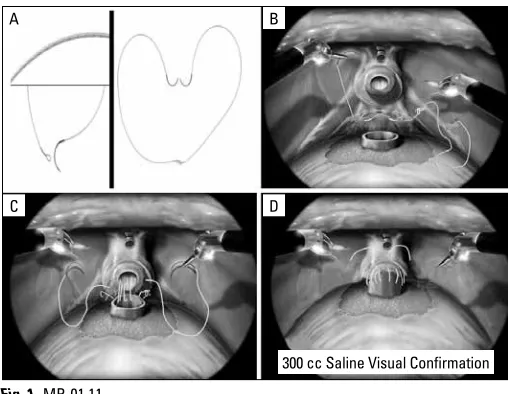
Prospective, Randomized Use of the Barbed Vloc Self-Retaining Suture to Facilitate Vesicourethral Anastamosis During Robot Assisted Radical Prostatectomy: Time Reduction and Cost Benefit
Zorn Kevin, Widmer Hugues, Liberman Dan, Lattouf Jean-Baptiste, Karakiewicz Pierre, Denis Ronald, El-Hakim Assaad
University of Montreal Hospital Center, Montreal, QC, Canada
Introduction: The Van Velthoven vesicourethral anastamosis (VUA) is commonly used for urinary reconstruction during robot-assisted radical prostatectomy (RARP). Compared to standard monofilament posterior reconstruction (PR) and VUA technique, we sought to evaluate the effec-tiveness of an interlocked, barbed VLOC 180 suture (Covidien, Mansfield, MA) for urinary reconstruction.
Results: Compared to our conventionalreconstruction technique, there was a significant reduction in mean nurse setup time of suture mate-rial (31 vs 294 sec; p<0.01) and reconstruction time (13.1 vs 20.8 min; p<0.01). Need to readjust suture tension or place additional LapraTy clips to establish a watertight closure was observed in 8 (32%) vs 2 (8%) of cases (p=0.03). A cost reduction was also seen at our institution (48.05$ vs 70.25$CAN) with the use of the interlocked VLOC technique. Time to foley removal was comparable between groups (4.1 vs 4.2 days, p=0.87). With a mean followup of 6.2 months, no delayed clinical anastamotic leaks or bladder neck contractures were observed in either group. Pad-free continence outcomes at 1 (76%vs80%,p=0.73), 3 (84% vs 88%,p=0.68) and 6 months (89% vs 90%,p=0.95) were also comparable.
Conclusions: The unidirectional barbed VLOC suture appears to provide a safe, more efficient and cost effective PRand VUA during RARP. Use of the interlocked VLOC suture technique prevents slippage, precluding the need for assistance, knot tying, and constant reassessing of anasto-mosis integrity.
MP-01.12
Intermittent Androgen Deprivation Therapy in the Management of Castrate Resistant Prostate Cancer (CRPCa): Results of a Multi-institutional Randomized Prospective Clinical Trial
Organ Michael1, Wood Lori1, Wilke Derek2, Skedgel Chris3, Thompson
Kara3, North Scott4, Cheng Tina5, Winch Susan1, Rendon Ricardo1 1Department of Urology, Dalhousie University, Halifax, NS, Canada; 2Department of Radiation Oncology, Dalhousie University, Halifax,
NS, Canada; 3Department of Medicine, Dalhousie University, Halifax,
NS, Canada; 4Department of Medical Oncology, University of Alberta,
Edmonton, AB, Canada; 5Department of Medical Oncology, University
of Calgary, Calgary, AB, Canada
Background: Patients who develop CRPCa typically continue on androgen deprivation therapy (ADT). Whether these patients need to remain on ADT has not been well studied. We conducted a multi-center random-ized trial to compare intermittent versus continuous approach to ADT in CRPCa patients. Overall survival, health related quality of life (QOL) and cost were the main endpoints. We hypothesized that the intermittent approach would be cost-saving while maintaining similar oncologic and QOL outcomes.
Methods: CRPCa patients were randomized 1:2 to continuous or intermit-tent luteinizing hormone releasing hormone agonists (LHRHa). Patients were followed with clinical assessments, laboratory investigations, and QOL questionnaires (EORTC QLQ-C30 or PROSQOLI) every 2 months. If the serum testosterone rose above castrate levels (1.75 nmol/L), LHRHa
were re-initiated. The study was designed to close if >50% of patients needed to restart ADT in the intermittent arm.
Results: 31 patients were followed with a median follow-up of 26.8 months; 18 in the intermittent arm and 13 in the continuous. 12/18 patients on the intermittent arm were re-initiated on LHRHa at a median time of 17.9 months. There was no difference in overall or cancer-specific survival between the two arms. There was no statistically-significant dif-ference in QOL between the two arms at 0 and 12 months. The total mean costs at 24 months were significantly lower in the intermittent arm (3135 $CAD vs 8253 $CAD, p=0.0167) compared to the continuous arm largely due to the reduced costs of the LHRHa.
Conclusions: We have observed that intermittent ADT in patients with CRPCa, using a testosterone of >1.75 ngmol/L as a trigger to re-initiate LHRHa, results in a substantial cost savings with no negative impact on oncologic and QOL outcomes. These findings need to be corroborated in a study with a larger sample size.
MP-01.13
Population Based Study of the Treatment of Patients with Prostate Cancer in British Columbia
Tyldesley Scott1, So Alan2, Peacock Michael1, Morris William James1,
Kim-Sing Charmaine1, Carter Michael2, Quirt Jill1, Pickles Tom1 1Department of Radiation Oncology, BC Cancer Agency, Vancouver,
BC, Canada; 2Department of Urologic Sciences, University of British
Columbia, Vancouver, BC, Canada
Introduction and Objectives: Cancer Care Ontario has described goals for quality care for radical prostatectomy (RP) including a positive margin rate of less than 25% for those with pT2 disease. Three randomized trials have demonstrated that post radical prostatectomy (RP) adjuvant radia-tion therapy (RT) decreases biochemical relapse for men with adverse pathology and, in the most mature trial, improves overall survival. Our objectives were: 1) To describe the use of RT, Androgen Deprivation Therapy (ADT) and RP in a contemporary series of prostate cancer patients at a population level in British Columbia (BC) and 2)To describe the pathologic stage, and margin status and use of post RP adjuvant RT for those treated with RP.
Methods: All incident patients with prostate cancer diagnosed between January 2005 and December 2007 were identified from the BC tumour registry. Cases were then linked to radiotherapy records which included dose and modality (high dose external beam (EBRT), and Brachytherapy (BT)), and to pharmacy records that included all androgen deprivation therapy (ADT) prescriptions. The pathology reports in the tumour registry were reviewed to determine cases treated with RP and to determine risk factors for relapse (nodal status, seminal vesicle (SV) invasion, extracap-sular extensions (ECE) and positive margins). Post operative assessment by an oncologist and the use of post operative adjuvant RT within 6 months of RP for those with risk factors for relapse were identified.
Results: Overall, 9223 patients with prostate cancer were identified. Primary therapy within 12 months of diagnosis was RP in 2081 (23%), EBRT in 2008 (22%), BT in 688 (8%), ADT in 1338 (14%), and no initial therapy (i.e., active surveillance or watchful waiting) in 3109 (33%). Positive margins were found in 37% of all patients treated with RP, and 30% and 57% of those with pT2 and pT3 disease respectively. Of the 1015 post RP patients (47% of all RP cases) with adverse RP pathology (positive margins, ECE or SV invasion), 230 (23% of those with these risk factors) were seen within 6 months of RP by an oncologist and 2% had adjuvant RT.
Conclusions: The majority of patients with prostate cancer in BC in 2005 to 2007 were treated with curative intent. One quarter were treated with RP, and one third were treated with RT. Positive margin rates for pT2 cancers exceeded the Ontario goal rate of 25%. The majority (75%) of those with risk factors for relapse after RP were not seen within 6 months of RP by an oncologist, and very few received adjuvant RT.
A
C D
300 cc Saline Visual Confirmation B
MP-01.14
The Effect of ADT on Objective Cognitive Performance and Self-Reported Cognitive Function in Men with Prostate Cancer
Marzouk Shireen, Alibhai Shabbir, Duff-Canning Sarah, Naglie Gary, Tannock Ian, Tomlinson George, Leach Marc, Hussain Faiza
Division of Medical Oncology and Hematology, Princess Margaret Hospital and University of Toronto, Toronto, ON, Canada
Background: ADT is used to treat almost 50% of prostate cancer (PC) patients. Despite slowing disease progression and prolonging survival, ADT is associated with numerous side effects. However, the impact of ADT on self-reported and objective cognitive function remains unclear.
Methods: Three groups of males age 50+ were included; PC patients start-ing continuous ADT (n=77), PC controls not receivstart-ing ADT (n=85), and healthy controls (n=83). A self-reported cognitive function questionnaire (FACT-Cog) and a battery of neuropsychological tests examining 8 cogni-tive domains were administered at baseline, 6 months and 12 months later. The FACT-Cog scores and the battery test scores were compared between groups at baseline, and change scores over the 12 month period were analyzed using ANOVA and multi-variable linear regression. To examine whether changes in objective cognitive scores correlated with changes in FACT-Cog scores, Pearson correlations were calculated.
Results: FACT-Cog scores obtained at baseline did not significantly dif-fer between the 3 groups (p>0.05). ADT users did not report a greater decline in self-cognitive function overtime compared to PC controls or healthy controls (p=0.21). Attention and Processing Speed, Visual Memory, Language and Executive Function scores did not significantly differ between groups (p>0.05). At 12 months, ADT users had signifi-cantly declined on the Longest Digit Span Forwards (Immediate Memory), Spatial Span Backwards (Working Memory), and Card Rotations tasks (Visuospatial Ability) (p<0.05). Correlations between FACT-Cog and objective cognitive test scores were weak at baseline and overtime (all r<0.20).
Conclusions: Preliminary analyses suggest little or no deleterious effect of ADT on self-reported cognitive function over 12 months. Objective cognitive performance of ADT users declined over 12 months on 3 cogni-tive tests, indicating a possibility of ADT’s long-term impact on selected cognitive domains. Correlations between FACT-Cog scores and objective cognitive performance were poor.
MP-01.15
Treatment for Recurrent Localized Prostate Cancer Following Radiation Failure with High Intensity Focused Ultrasound: Initials Results
Autrán Gómez Ana Maria, Al-Zahrani Ali, IzawaJonathan, ChinJoseph Department of Urology, University of Western Ontario, London Health Sciences Centre, London, ON, Canada
Introduction and Objective: Local relapse after External Beam Radiation (EBRT)or Brachytherapy (BT) for localized PCa has been reported in 30-40%. Current salvage therapy alternatives include radical prostatec-tomy, BT, cryotherapy and high-intensity focused ultrasound (HIFU). HIFU is a minimally invasive ablation technique using ultrasound waves ostatectomy.
Methods: From April 2006 to Sept 2009, 62 patients (pts) with histo-logical confirmed diagnosis of recurrent localized PCa after EB RT or BT, with clinical stage T1-T2, PSA level ≤10ng/mL, pre Gleason score ≤8 in absence of distant metastasis were submitted to treatment using Sonablate®500. PSA levels, IPSS and IIEF-5 questionnaires were assessed at 45, 90, 180 days and 12 months respectively. Biopsy was done at 180 days post-HIFU. Biochemical failure was defined according to the Phoenix criteria. Mann- Whitney U test was used p<0.05 for statistical significance.
Results: Age 68.01±5.27 yrs, PSA 4.08±2.96 ng/mL, prostate volume 25.59±9.59 cc. IPSS 7.52±4.81, IIEF-5 9.10±8.42 scores. 25(40%) cases, Gleason ≤6, 24(39%) Gleason 7 and 13(21%) Gleason 8. 55 pts (89%) had EBRT and 7(11%) had BT. 16 (26%) pts had androgen deprivation pre HIFU. Mean follow-up was 16 months. At follow-up, 13 (21%) pts
pre-sented local relapse by Day 180. Progression Free Survival at 3 years was 60%. At univariable analysis, prostate volume (p=0.010), IPSS (p=0.002), and IIEF-5 (p=0.010) showed statistically difference at 12 months com-pared with the basal values. The median PSA value 0.77ng/mL, 0.62ng/ mL, 0.80 ng/mL and 0.64ng/mL at 45, 90, 180 and 12 months respec-tively. Complications incontinence 2(3%), rectourethral fistula 2(3%), and urinary retention 3(5%).
Conclusion:Our initials results using HIFU (Sonablate®500 system) showed a low rate of complications with acceptable oncologic results at short-term. HIFU as salvage treatment is promising treatment option, espe-cially for suboptimal candidates for salvage prostatectomy. Furthermore prospective multicenter controlled trials are underway.
MP-01.16
Long Term Complications in Men after Radical Prostatectomy Who Have Early or Late Radiation
Gani Johan1, Yim Harold1, Radomski Sidney B1, Catton Charles2 1Division of Urology, Toronto Western Hospital, University of Toronto,
Toronto, ON, Canada; 2Department of Radiation Oncology, Princess
Margaret Hospital, University of Toronto, Toronto, ON, Canada
Introduction and Objective: Men with prostate cancer who are treated with early radiation after radical prostatectomy (RP) may have increased risk of urinary incontinence, bladder neck contracture (BNC) or urethral stricture (US) as compared to those treated with late radiation. This is thought to be due to radiation damage on healing tissues postoperatively. We undertook to evaluate the complication rates of men treated with surgery followed by early or late external beam radiation (RT).
Methods: Retrospective outcomes were determined up to 3 years post treatment for 652 patients who underwent a RP followed by early RT (<6months after surgery) or late RT (≥6 months after surgery) between Jan 2000 – Oct 2007. Urinary incontinence was defined as the presence of any leakage. BNC and US were diagnosed on cystoscopic findings. Fisher’s T test was used to analyze the data.
Results: 162 (24.8%) patients had early radiation and 490 (75.2%) had late radiation. Mean age at RP was 60.4 years (range 41-76 years). Mean time to early and late RT was 3.6 months (range 1-5 months) and 30.1 months (range 6-171 months) respectively. The median radiation dose was 66Gy (range 50 – 70Gy). Of the early RT patients, 88/162 (54.3%) were incontinent postoperatively. Of these, 42 (25.9%); 30 (18.5%) and 27 (16.7%) were incontinent at 1, 2 and 3 years post RT respectively. Of the late RT patients, 170/490 (34.7%) were incontinent postoperatively. Of these, 95 (19.4%); 82 (16.7%) and 72 (14.7%) were incontinent at 1, 2 and 3 years post RT respectively. BNC developed postoperatively in 27/652 (4%) patients, US in 10/652 (1.5%) and 1 patient developed both. At 3 years post RT, 23/27 BNC resolved, 1 persisted and 3 were status unknown. At 3 years post RT, 6/10 US had resolved and 4/10 were status unknown. Throughout the 3 years post RT, 16 new BNC occurred (12 resolved) and 5 new US occurred (3 resolved). There was no significant difference in rates of incontinence, BNC and US between early and late radiation at 3 years post RT.
MP-01.17
Prognostic Merit of High-Grade Prostatic Intraepithelial Neoplasia in Determining the Future Probability of Developing Adenocarcinoma of the Prostate
Zadra Joseph1,2, Hoare Dylan1, Ray Andrew1, Hartsburg Cory1, Iocca
Angelo1
1Department of Surgery, Royal Victoria Hospital, Barrie, ON, Canada; 2Department of Surgery, McMaster University, Hamilton, ON, Canada
Introduction and Objective: There have been conflicting reports regard-ing the need for repeat Trans Rectal Ultrasound (TRUS) guided prostate biopsies following the diagnosis of high-grade prostatic intraepithelial neoplasia (HGPIN). We have evaluated this issue in our community where 10-12 core biopsies (Bx) are the standard.
Method: 1368 biopsies (1129 patients) from 2005 to 2010 were retrospec-tively analyzed. Age, PSA value at time of biopsy, number and location of cores sampled were all documented. The pathological states of each core functioned as the primary evaluative measure. Patients were included only if their PSA was between 4-10.
With a 5% level of significance, an absolute z value of 1.960 would have to be observed between HGPIN and negative CaP progression rates for HGPIN to be considered of significant effect.
Results: 755 patients met the inclusion criteria outlined in the Methods. Among this subset of patients, 6.2% of initial Bx patients exhibited HGPIN. 48.9% of these patients underwent re-Bx. 30.4% of this cohort progressed to CaP upon re-Bx (median re-Bx rate = 4.1 months). Among the eligible Bx patients, 54.7 % exhibited negative pathological results upon their first biopsy. 28.8% of these patients underwent repeat biopsy. 40.3% of patients belonging to this initially negative cohort proceeded to demonstrate carcinoma upon re-Bx (median re-Bx rate = 21.1 months). The rates of CaP progression for initial HGPIN (30.4%) and negative (40.3%) patient cohorts were not significantly different (z=1.023,
p=0.3063). Single and multi focal HGPIN patients however, exhibited different rates of CaP progression. 16.7% of single focal cases progressed to cancer. 45.5% of multi focal cases showed CaP upon re-Bx (z=1.499,
p =0.1339).
Conclusion: The overall prognostic value of HGPIN was not statistically significant when measured against the observed development of CaP in the negative biopsy patients. However, multifocal HGPIN had a higher incidence of progression to cancer on re-biopsy than unifocal HGPIN. These findings suggest that only patients with multifocal HGPIN warrant repeat TRUS biopsy of the prostate.
MP-01.18
Open Radical Prostatectomy in the Elderly: A Case for Concern?
Ismail Salima1,2, Johal Rupinder1,2, Liberman Daniel1,2, Jeldres Claudio1,2,
Morgan Monica1,2, Djahangirian, Orchidée1,2, Sun Maxine 2, Karakiewicz
Pierre1,2
1Department of Urology, Université de Montréal, Montreal, QC,
Canada.; 2Cancer Prognostics and Health Outcomes Unit, Montreal,
QC, Canada
Introduction and Objective: Open radical prostatectomy (ORP) in individuals aged 75 years or older may be associated with a limited survival benefit. We tested the hypothesis that ORPs in elderly patients are predominantly performed at low volume and/or at non-academic institutions.
Materials and Methods: Within the Health Care Utilization Project Nationwide Inpatient Sample (NIS) we focused on patients in whom ORP was performed within the 10 most contemporary years (1998-2007). In those individuals, we examined the rate of ORP in elderly patients accord-ing to intraoperative and in-hospital complication rates. Subsequently, we stratified the rates according to annual hospital volume (AHV) tertiles and institutions type. Multivariable logistic regression analyses further adjusted for race and baseline Charlson Comorbidity Index (CCI).
Results: Overall, 115623 patients undergoing ORP were identified, among those 2110 individuals were aged 75 years or older (1.8%). The annual ORP rate ranged from 2.6 to 2.0% (p=0.9). The vast majority of elderly patients treated with ORP were operated at low (36.4%) and intermediate
(35.9%) volume institutions. The intraoperative complications were higher at low (2.7%) and intermediate (2.5%) volume hospitals than at high volume centers (1.9%, p=0.6). Similarly, the rates of in-hospital complica-tions were also higher at low (19.2%) and intermediate (17.0%) volume hospitals, than at high volume centers (13.3%, p=0.02). Intraoperative complications were 2.7 vs 2.1% (p=0.3) and in hospital complications were 19.1 vs 13.9% (p=0.002) at non-academic vs academic institutions, respectively.
Conclusion: It is worrisome that the vast majority and of elderly patients is treated at low or intermediate volume (72.3%) and/or non-academic (56.2%) hospitals. This finding is even more worrisome, since the com-plication rates at lower volume institutions are higher. More favourable in-hospital complication rates were also recorded for teaching institutions than for non-teaching centers.
MP-01.19
The Effects of Exercise on Prostate Cancer in the Active Surveillance Cohort
Vandersluis Avi1, Venier Natalie1, Colquhoun Alexandra1, Fleshner Neil2,
Klotz Laurence1, Venkateswaran Vasundara1
1Department of Surgery, Sunnybrook Health Sciences Centre, Toronto,
ON, Canada; 2Department of Surgery, Princess Margaret Hospital,
Toronto, ON, Canada
Introduction and Objectives: It is well established that the risk of devel-oping prostate cancer (PCa) is largely influenced by lifestyle behaviours. While a number of studies have shown an inverse correlation between increased exercise and PCa risk and progression, others have yielded mixed results. In addition, the mechanisms underlying the relationship between exercise and PCa are largely unknown. Presently, we aim to investigate the association between exercise and PCa progression in the Active Surveillance Prostate Cancer (AS) cohort and to gain insight into the molecular mechanisms involved. We hypothesize that exercise reduces PCa progression by improving immune function and body composition, altering the insulin axis, and reducing oxidative stress.
Materials and Methods: The AS cohort at the Sunnybrook Health Sciences Centre consists of patients with early-stage, locally confined PCa who have not undergone radical treatment for their cancers. 100 men on AS, as well as 100 men initially on AS but who have since been radically treated, will complete a lifestyle assessment questionnaire. Participants are asked about their exercise behaviours from the time of their PCa diagnosis, as assessed by the WHO STEPS Instrument. Total exercise is calculated in terms of metabolic equivalent task hours (MET-hours) per week. Additionally, serum samples will be obtained from participants for PCa biomarker analysis.
Results: Preliminary data has been obtained from 73 untreated and 37 treated patients, with a mean age of 68.10 ± 8.78 years and 73.35 ± 6.86 years, respectively. Mean BMI (kg/m2) in the untreated group is 26.65 ± 3.46 compared to 27.54 ± 3.90 in the treated group. For the 37 treated patients, the time between diagnosis and treatment varied greatly between patients, ranging from 0.38 to 11.20 years, with a mean of 4.24 ± 2.58 years. Initial results indicated that, from the time of diagnosis, untreated patients (mean: 87.78 ± 55.56 MET-hours per week) reported 34% more exercise than treated patients (mean: 65.71 ± 54.64 MET-hours per week). As patient accrual is ongoing, we will re-evaluate the results upon study completion. Mechanistic studies have not yet been completed.
MP-01.20
Robot−Assisted Laparoscopic Prostatectomy (RALP): Initial Single Surgeon Series
Wong Carson, Strom Kurt, Gu Xiao, Spaliviero Massimiliano
Department of Urology, The University of Oklahoma Health Sciences Center, Oklahoma City, OK, USA
Introduction and Objectives: RALP is a relatively new procedure for the treatment of clinically localized prostate cancer. We report our experi-ence.
Methods: Using an anterior approach, a bladder neck sparing RALP was performed. Clinical outcomes and adverse events are analyzed.
Results: 219 patients were identified having a mean PSA of 6.0 ± 4.5 ng/ mL. Clinical stage included 206 (94.1%) T1c and 13 (5.9%) T2a, having a mean Gleason score of 6.5 ± 0.8. Average blood loss and hospital duration were 101.0 ± 147.5 mL and 1.2 ± 0.9 days, respectively. 185 (84.5%) patients had bilateral, 19 (8.7%) had unilateral and 15 (6.8%) did not undergo nerve sparing prostatectomy. The urethral catheter was removed at a median 5.0 ± 3.5 days. Of the 146 patients having a mini-mum 12 month follow-up, 136/146 (93.1%) achieved urinary continence without pads within 12 months, with a mean time to continence of 10.8 ± 8.7 weeks. 164/204 (80.3%) of those undergoing either unilateral or bilateral nerve-sparing had post−surgery penile rehabilitation [phospho-diesterase-5 inhibitor ± vacuum erection device (VED)]. 72/164 (43.9%) patients had baseline SHIM ≥ 21, of whom 32 / 72 (44.4%) reported sexual potency post-surgery. The mean Gleason score was 6.5 ± 1.0. 36/219 (16.4%) patients had positive surgical margins. 2 (1.0%) pTx, 31 (14.2%) pT2a, 13 (5.9%) pT2b, 144 (65.7%) pT2c and 29 (13.2%) pT3 cancers were reported, having a mean prostate volume of 44.8 ± 12.7 mL. Adverse events included 5 (2.2%) prolonged urine leak, 3 (1.4%) pelvic hematoma, 1 (0.5%) urinary tract infection, 2 (1.0%) deep vein thrombosis and 5 (2.2%) bladder neck contractures.
Conclusions: RALP is an effective treatment option for clinically localized prostate cancer with low patient morbidity.
MP-01.21
Head to Head Comparison Of two Currently Used Nomograms Predicting Side Specific Extra Capsular Extension to Indicate Nerve Sparing during Radical Prostatectomy
Bladou Franck1, Walz Jochen2, Salem Naji2, Gravis Gwenaelle2, Brunelle
Serge2
1Department of Urology, Jewish General Hospital, McGill University,
Montreal, QC, Canada; 2Paoli Calmettes Cancer Institute, Marseilles,
France
Background: Two tools predicting the probability of side specific extra capsular extension (ECE) are available in the literature to help w ith patient selection for nerve sparing (NS) during radical prostatectomy. They allow decisions about unilateral, bilateral or no nerve sparing procedures. The aim of the study w as a head to head comparison of these tools via an
external validation combined with a probability cut-off identification.
Methods: For external validation, 362 prostate half lobes of patients who underwent robotic assisted radical prostatectomy were used. All data were prospectively filed in a computer database. Prostatectomy specimens were processed according to the Stanford protocol. The full models of the nomograms of Ohori et al. and Steuber et al. were applied to the dataset using PSA and side specific clinical stage, biopsy Gleason score, %positive cores, and %cancer in cores as predictors. Nomogram derived predictions of ECE were used for external validation using discrimination for predictive accuracy (area under the ROC curve), calibration plots and cut-off identification.
Results: In the study cohort, median age was 61 years, and median PSA 6.6ng/mL. Clinical stage was T1c in 71.8%, T2a in 20.4%, T2b in 6.1% and T2c in 1.7%. Biopsy Gleason was <= 6 in 42%, 7 in 52% and >7 in 6%. Pathologically organ confined cancer was observed in 79.6% and pT3a in 14.4% and pT3b in 6.1%. The predictive accuracy of the Ohori nomogram was at 0.84 and of the Steuber Nomogram at 0.83 (comparison
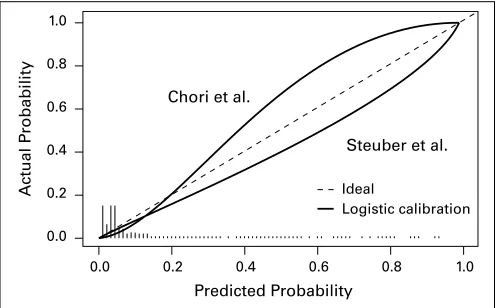
p>0.05). In the calibration plot (Figure 1), the Steuber nomogram showed less departures from ideal predictions then the Ohori nomogram. The best probability cut-off to allow NS for the Ohori nomogram seemed to be <9%, permitting NS in 59.8% of all cases and being associated with a false negative rate of 13.5%, a sensitivity 86.4% and a specificity of 65.8%. The best cut-off for the Steuber nomogram seemed to be 8%, permitting NS in 54.5% and associated with a false negative rate 10.8%, a sensitivity of 89.1% and a specificity of 60.0%.
Conclusions: The Ohori et al and the Steuber et al. nomograms allow highly accurate and comparable predictions of the risk of side specific ECE. This allows reliable treatment decision making for NS. The most appropriate probability cut-off to indicate NS seems to be 9% for the Ohori et al. nomogram and 8% for the Steuber et al. nomogram.
MP-01.22
TMPRSS2:ERG and PCA3 Transcript Markers for Urine-Based Prostate Cancer Detection with High Specificity and Sensitivity
Violette Philippe, Nguyen Phuong-Nam, Chan Sam, Tanguay Simon, Kassouf Wassim, Taguchi Yosh, Aprikian Armen, Chen Junjian
Department of Surgery, Division of Urology, McGill University, Montreal, QC, Canada
Introduction and Objectives: Both TMPRSS2:ERG fusion and PCA3 ue to prostate cancer (PCa), and have great potential for noninvasive diagnosis and prognosis of prostate cancer in patients’ bodily flu-ids. Our study objectives are to study the specificity, sensitivity and clinical utility of a panel of TMPRSS2:ERG fusion isoform markers in urine from diverse clinical contexts and to evaluate the correlation between TMPRSS2:ERG and PCA3 markers in urine specimens.
Methods: A total of 101 subjects were enrolled in 2008 from urological oncology clinics to form three study groups: 44 PCa free, 46 confirmed PCa and 11 negative prostate biopsies. The PCa free group included females, healthy young men and post-radical prostatectomy patients. The confirmed PCa group composed of patients under active surveillance, scheduled for treatment or with metastatic disease. Urine was collected after attentive digital rectal exam and coded to blind group allocation for laboratory test. RNA from urine sediments was analyzed using a panel of 4 TMPRSS2:ERG fusion markers along withPCA3, PSA, ERG markers using quantitative PCR.
Results: Our fusion markers demonstrated a very high technical speci-ficity and a sensitivity of detecting a single fusion-positive cancer cell (VCaP) in the presence of 3000-9000 cells in urine sediments. In clini-cal analysis, no fusion-positive samples in the PCa free group (0/44), while 16 of 46 (34.8%) fusion-positive samples in the confirmed PCa group. The fusion incidence varied significantly among three PCa sub-groups. The clinical sensitivity increased to 45.4% in cancer patients prior to treatments. The fusion markers were detected in 2 of 11 (18.2%) biopsy-negative patients, suggesting potentially false negative biop-sies. Interestingly, the fusion status was strongly associated with the over-expression of PSA and PCA3 markers in urine. The two biopsy-negative cases detected with the TMPRSS2:ERG fusion also exhibited strong PCA3 over-expression in urine.
Actual P
robability
Predicted Probability Chori et al.
Steuber et al.
Ideal
Logistic calibration 1.0
0.8
0.6
0.4
0.2
0.0
0.0 0.2 0.4 0.6 0.8 1.0
Conclusions: Our new panel of isoform-specific fusion markers pro-vided a very specific and sensitive tool for urine-based detection of PCa. Theses markers can potentially be used to diagnose patients with PCa who have negative biopsies. PCA3 marker is highly associated with the TMPRSS2:ERG fusion status in urine and may be coupled with the fusion markers for molecular diagnosis of false biopsy-negative patients.
MP-01.23
Active Inflammatory State and Reactivity of Normal Prostate Epithelium and Aggressive Prostate Cancer
Fradet Vincent1, Neveu Bertrand2, Moreel Xavier2, Bergeron Alain2, Larue
Helene2, Fradet Yves1
1Departement de chirurgie (urologie), Université Laval, Québec, QC,
Canada; 2Laboratoire d’Uro-Oncologie Expérimentale, Université Laval,
Quebec, QC, Canada
Introduction and Objective: Chronic inflammation is emerging as a potential prostate cancer causal factor. However, very little is known about the interaction of normal prostate inflammation on carcinogen-esis. Here, we sought to determine effect of the inflammatory status and reactivity of normal prostate epithelial cells on prostate carcinogenesis.
Methods: Patients signed an IRB-approved informed consent. Cell culture of human primary prostatic epithelial cells were derived from 24 radical prostatectomy or cystoprostatectomy specimens, of which 15 had aggres-sive prostate cancers (Gleason ≥8 or pathological stage T3). Prostate needle biopsies were taken in normal areas of the peripheral zone of the gland. Biopsies were incubated overnight in complete MEM (37°C-5% CO2) containing type III collagenase (800 U). Dispersed cells were centrifuged, suspended in 13 mL complete KSFM and transferred in a 75 CC cell culture flask. Confluence was reached within 2 to 3 weeks. Characterization of the cultured epithelial cells was made through immun-ofluorescence using AE1/AE3 (DAKO, dilution 1:25) antibody specific to cytokeratins. Green Alexa Fluor 488 was the secondary antibody and nuclei stained with blue DAPI.
Induction and measure of inflammation: 7200 cells/well were seeded in 96 well plates. In half of the wells, poly (I:C) 10 μg/mL was added to induce inflammation and plates were incubated for 20 hours. IL-8 content in the culture medium was evaluated using the human IL-8 Elisa Max deluxe set-Biolegend, after removal of the culture medium, washing and fixing of cells in formalin. IL-8 production was normalized to total DNA, measured using a DRAQ5 LI-COR protocol. The Fligner-Policello statistic was used to compare IL-8 expression across groups because of unequal dispersions.
Results: Cultured epithelial cells expressed a typical prostate epithelial cell cytokeratin pattern. Cell cultures derived from patients harbouring aggressive cancers produced significantly (p=0.049) more IL-8 (median: 15.4; IQR: 6.2-24.8) than cultures derived from patients harbouring less aggressive cancers (median: 6.9; IQR: 3.8-9.9). The production of IL-8 induced by poly(I:C) did not differ across cancer groups (p=0.182). Use of NSAID before surgery did not differ (Fisher’s exact p=0.259) between patients with more or less aggressive cancers; and did not affect IL-8 production.
Conclusions: A high baseline pro-inflammatory status of normal prostate epithelium is associated with a more aggressive form of prostate cancer. More research to decipher the possibly causal relationship linking inflam-mation to prostate carcinogenesis is needed.
MP-01.24
Association of Adipokines with Prostate Cancer and High Grade Disease Depends on Body Mass Index
Trottier Greg1, Connor Mike2, Zeppieri Jordan2, Margel David1, Fernandes
Kimberly A1, Finelli Antonio1, Evans Andrew3, van der Kwast Theodorus
H3, Hersey Karen1, Fleshner Neil E1
1Department of Surgical Oncology, University Health Network, University
of Toronto, Toronto, ON, Canada; 2Department of Kinesiology and
Health Science, York University, Toronto, ON, Canada; 3Department of
Pathology, University Health Network, University of Toronto, Toronto, ON, Canada
Introduction and Objectives: Diet and obesity are associated with pros-tate cancer (PCa). We set out to determine if a group of serum adipokines were associated with PCa or high grade disease at biopsy.
Methods: Prospectively collected serum specimens from the GU Biobank at the Princess Margaret Hospital were utilized. From this biobank, 50 patients with Gleason 6 PCa, 50 patients with HG Gleason ≥7 PCa and 100 patients with negative biopsies were randomly chosen in a case-control fashion. For each group 50% of patients were chosen with a BMI ≤27 and 50% were chosen with a BMI >27. A panel of 11 adipokines (Adiponectin, leptin, PAI, Resistin, HGF, IL-1beta, IL-6, IL-8, MCP1, NGF, TNF alpha) were assayed from each patient. Association of adipokines with PCa or HG PCa was evaluated by receiver operating characteristic curve (ROC)/area under the curve (AUC) analysis and univariate logistic regression (LR).
Results: This patient cohort had a median PSA of 5.8 ng/mL, a median age of 62 years and a median BMI of 27.2 kg/m2. None of the adipokines
correlated with BMI except leptin (p<0.01). There were no significant correlations between individual adipokines. ROC analysis showed that Resistin (AUC 0.64; 95% CI 0.5-0.74) and MCP-1 (AUC 0.61; 95% CI 0.49-0.72) were the top ranked markers for discriminating cancer from no cancer among those with a BMI ≤27. In those with a BMI >27, IL-1 beta (AUC 0.61; 95% CI 0.49-0.72) and IL-6 (AUC 0.61; 95% CI 0.49-0.70); displayed the best discrimination. In the case of HG disease, NGF (AUC 0.69; 95% CI 0.57-0.81) and IL-1 beta (AUC 0.66; 95% CI 0.54-0.78) were most predictive among those with a BMI >27, while neither were predictive in the lower BMI group. Conversely, MCP-1 (AUC 0.61; 95% CI 0.47-0.73) and adiponectin (AUC 0.60; 95% CI 0.45-0.74) demon-strated the highest discrimination among those with a BMI ≤27. Using LR, only MCP-1 (OR 1.83, p=0.05) was associated with PCa among the low BMI group, while none of the markers were significant in the high BMI group. By contrast, NGF (OR 2.61; p=0.01) and IL-1 beta (OR 2.46;
p=0.03) maintained an association with HG disease among the high BMI group, with none of the markers being significant in the lower BMI group.
Conclusions: Several adipokines demonstrate potential as predictive markers of PCa when BMI stratified. Of note, NGF was the only adiop-kine with selective discrimination for HG PCa.
MP-01.25
Potential Utility of a Germ-Line Genetic Test for Prostate Cancer Diagnosis in a Canadian Cohort
Trottier Greg1, Kader A Karim2, Lockwood Gina 1, Chadwick Karen1,
Zheng Lily2, Sun Jielin2, Kim Seong-Tae 2, Lawrentschuk Nathan1, Xu
Jianfeng2, Fleshner Neil E1
1Department of Surgical Oncology, University Health Network, University
of Toronto, Toronto, ON, Canada; 2Center for Cancer Genomics,
Departments of Genomics and Personalized Medicine Research, Urology, and Biostatistical Sciences, Wake Forest University School of Medicine, Winston-Salem, NC, USA
Methods: Using the prospective Princess Margaret Hospital GU serum biobank we evaluated the performance of a genetic test based on 33 SNPs for its ability to predict for overall and high-grade (HG, Gleason ≥7) PCa in 745 Caucasian men. The genetic test was compared with existing PCa risk factors including age, family history, digital rectal examination (DRE) and PSA using the area under the receiver operating characteristic curve (AUC) along with univariable and multivariable logistic regression analyses.
Results: 48% and 23% of these patients were diagnosed with overall PCa and HG disease, respectively. For overall PCa risk, the genetic score outperformed all other risk factors examined including PSA with AUCs of 0.64 vs 0.55 respectively. In a multivariable model incorporating PSA,
DRE and age, the OR for the genetic test was 2.72 (p<0.001) with an AUC of 0.69 for the whole model compared to 0.63 without the genetic test. With regard to HG disease the AUC of the genetic test was 0.63 which compared favourably to PSA (AUC 0.62) and DRE (0.64). In a multivariable model the genetic score was an independent predictor for HG disease and added to a model containing age, PSA and DRE (AUC 0.72 vs 0.75 respectively).