P1
A Mechanism of Hypoxia-induced Immune Escape in Prostate Cancer Cells
D. Robert Siemens, Thomas K. Hamilton, Ivraym Barsoum, Xin Li, Ellen Miles, Janet Elliott, Charles H. Graham.
Kingston General Hospital, Kingston, ON, Canada.
Background: We previously showed that hypoxia induces resistance to NK cell-mediated lysis in prostate cancer cells through a mechanism that involves the shedding of NK cell-activating ligands (MICA) from the cell surface. Furthermore, we were able to block this hypoxia-induced shed-ding of MICA, as well as resistance to NK-mediated lysis, by activating NO signalling in the cancer cells. Here we explore the mechanisms of this hypoxia-mediated prostate cancer immune escape.
Methods: To determine whether tumour cell resistance to lysis by NK cells is dependent on HIF-1transcriptional activity we knocked down HIF-1α using validated siRNA. We investigated hypoxic regulation of the metal-loproteinase disintegrins ADAM 10 and 17 utilizing Western blot, qPCR and confocal immunofluorescence and their role in hypoxia-induced shed-ding of MICA (on flow cytometry) with siRNA knockdown experiments. Standard 4-hour chromium release assays were used to determine effects on NK-mediated lysis. Finally, we examined whether endogenous nitric oxide signalling regulates the hypoxia-induced up-regulation of the ADAMs and HIF-1α using nitroglycerin or 8-bromo-cGMP.
Results: Knockdown of HIF-1α in DU145 prostate cancer cells abro-gated the hypoxia-induced down-regulation of surface MICA levels (P < 0.001(ANOVA) as well as hypoxia-induced resistance to NK cell-mediated lysis. ADAM17 expression decreased in hypoxic conditions but ADAM10 increased and was confirmed by confocal immunofluorescence and qPCR (P < 0.05). Down-regulation of ADAM10 expression significantly attenuated the hypoxia-induced release of MICA on flow cytometry and forced down-regulation of HIF-1α expression prevented the hypoxia-induced increase of ADAM10 transcript levels (P<0.01). Activation of nitric oxide signalling with either nitroglycerin (1 µM) or 8-bromo-cGMP (10 nM) effectively attenuated the hypoxia-induced increases in ADAM10 transcript levels. Also, Western blot analysis revealed that nitroglycerin (1 µM) was able to block the accumulation of HIF-1α in DU145 cells incubated in hypoxia. Conclusions: Taken together, our findings demonstrate a novel mechanism by which hypoxia contributes to immune escape in prostate cancer cells. Furthermore, they reveal that activation of nitric oxide signalling interferes with this pathway. These findings are important because they indicate that nitric oxide mimetics could potentially be used as immunosensitisers in the treatment and/or prevention of prostate cancer.
P2
Factors Affecting Delay in Eligibility for Systemic Therapy Following Cytoreductive Nephrectomy
Rebecca L. O’Malley1, Katherine A. Brewer1, Matthew H. Hayn1, Hyung L. Kim2, Willie Underwood, III1, Thomas Schwaab1.
1Roswell Park Cancer Institute, Buffalo, NY, USA, 2Cedars-Sinai Medical Center, Los Angeles, CA, USA.
Background: Randomized-controlled trials demonstrated a survival advan-tage for patients undergoing cytoreductive nephrectomy (CN) with inter-feron therapy for the treatment of metastatic renal cell carcinoma (mRCC). Whether this advantage persists in the era of newer systemic therapies (ST) and minimally invasive surgery is unclear. We examined eligibility for ST following CN and resulting effects on survival at an institution where targeted therapies and minimally invasive techniques are favored. Methods: Patients with mRCC who underwent CN between 2002 and 2010, were identified. Those ineligible for ST > 2 months following surgery were considered delayed and compared to those not delayed. Reasons for delay and effect on overall survival (OS) were investigated, including an analysis of surgical morbidity fulfilling Martin criteria.
Results: Characteristics are in Table 1. Most patients underwent open (35%) or laparoscopic (54%) radical nephrectomy (1 patient was unresectable). Six % experienced intraoperative complications (IOCs) and 48% experienced postoperative complications (POCs) within 30 days of surgery. Only 8% of POCs were Clavien grade >2. At a median follow-up of 12.5 months (IQR 4.1 - 30.8), 8% of patients were free of disease, 18% were alive with disease and 74% were dead of disease (no patient died of other causes). Median OS for the entire cohort was 14.6 months. A total of 28% experi-enced delayed eligibility for ST. Reasons for delay were related to surgery in 33%, disease progression in 56% and both in 11%. Comparison of the delay vs. no delay groups revealed more IOCs (p=0.01), more high-grade POCs (17% vs. 4%, p=0.09) and median OS of 4.8 vs. 18.9 months. Pathologic T4 and sarcomatoid disease predicted poor outcomes with median OS of 9.8 and 7.6 months, respectively. Controlling for grade and stage, delay in ST and sarcomatoid features independently predicted poor OS (HR 2.61, p=0.01 and HR 2.25, p=0.02).
Conclusions: Delay in eligibility for ST following CN adversely affects OS and is most commonly due to disease related factors; although intraopera-tive and high grade complications may contribute. Those with evidence of
Moderated Poster Session I: Oncology 1
Thursday, October 27, 2011, 3:15 pm – 5:00 pm
S165
CUAJ • October 2011 • Volume 5(5Suppl3) © 2011 Canadian Urological Association
Table 1. P2. Clinicopathologic characteristics of the entire cohort.
No. Symptoms at presentation (%) 39 (60)
No. only 1 site of metastasis (%) 43 (66)
No. lung only mets (%) 28 (43)
No. Charlson comorbidity index >6 (%) 18 (28)
No. Clear cell (%) 59 (92)
No. Lymphovascular invasion (%) 34 (53)
No. Sarcomatoid features (%) 15 (23)
No. Fuhrman Grade 3-4 (%) 49 (77)
No. Pathologic stage T4 (%) 15 (23)
T4 or sarcomatoid disease features may best be served by ST followed by CN only in those exhibiting response.
P3
Peri-operative and Renal Function Outcomes of Minimally Invasive Partial Nephrectomy for Renal Tumors between 4 and 10 cm
Katherine Brewer1, Rebecca L. O’Malley1, Matthew H. Hayn1, Mohab W. Safwat1, Hyung L. Kim2, Willie Underwood, III.1, Thomas Schwaab.1 1Roswell Park Cancer Institute, Buffalo, NY, USA, 2Cedars-Sinai Medical Center, Los Angeles, CA, USA.
Background: Due to recent understanding of the cardiac morbidity and mortality associated with chronic kidney disease (CKD), indications for nephron-sparing surgery are expanding. Although minimally invasive par-tial nephrectomy (MPN) requires advanced technique, the advantages are appealing to both patients and hospitals. To investigate feasibility of MPN in larger tumors, we compared outcomes of MPN and minimally invasive radical nephrectomy (MRN) for tumors 4-10 cm.
Methods: Using our IRB-approved prospective renal tumor database, we identified patients who underwent MPN or MRN (laparoscopic or robot-assisted) from August 2004 to September 2010, for a clinically localized, solitary renal mass 4-10 cm in size. Surgical and renal function outcomes were compared between the 2 groups, including; operative time, esti-mated blood loss (EBL), transfusion rate, length of stay (LOS), positive margin rate (PSM), complications (Cxs), decrease in glomerular filtration rates (eGFR), as estimated by the Chronic Kidney Disease Epidemiology Collaboration formula, and development of stage 3 CKD.
Results: Of the 153 patients identified, 108 and 45 underwent MRN and MPN, respectively. Pre-operative patient and tumor characteristics were similar between the groups including: age, gender, race, smok-ing status, number of previous abdominal surgeries, body mass index, Charlson comorbidity index, American Society of Anesthesiologists sta-tus, Eastern Cooperative Oncology Group performance stasta-tus, and tumor size and centrality, and R.E.N.A.L. score. Tumor size was larger in the MRN group (6.8 ±1.7cm vs. 5.3 ±1.3cm, p<0.001). Operative times, LOS and PSM were similar between the groups (p=0.966, p=0.245 and p=0.150, respectively). Mean EBL was higher in the MPN group (401.8 vs. 157.1 ml, p<.001) but intra-operative and post-operative transfusion rates were similar (p=0.507 and p=0.219 respectively). MPN rates of Cxs were similar to the MRN group, including intra-operative (4.4% vs. 7.4%, p=0.507), any post-operative (36.7% vs. 24.8%, p=0.806) and high Clavien-grade post-operative Cxs (4.4% vs. 3.7%, p=0.945) respectively. Pre-operatively, eGFR and rate of stage 3 CKD were similar between the groups. Post-operative decline in eGFR was greater in the MRN group (21.2±12.9 vs. 12.0±13.2 mL/min, p<0.001) as was the rate of new stage 3 CKD (58.9 vs. 31.3%, p=0.011).
Conclusions: MPN is a safe option in patients with tumors 4-10cm in size, with peri-operative outcomes similar to patients undergoing MRN. MPN should be considered in the treatment of larger renal masses due to the superior renal function outcomes.
P4
The Association between Tumour Density and Prostate Cancer Recurrence Following Radical Prostatectomy
Luke T. Lavallée1, Rodney H. Breau, FRCSC1, Mark Preston1, Guyanna Raju2, Steve Doucette1, Ronald Gerridzen1, James A. Eastham3, Chris Morash1, Ilias Cagiannos1.
1The University of Ottawa, Ottawa, ON, Canada, 2The University of Pittsburgh, Pittsburgh, PA, USA, 3Memorial Sloan-Kettering Cancer Center, New York, NY, USA.
Background: Tumour density may be an independent prognostic factor in men with prostate cancer. The purpose of this study was to evaluate the association between prostate cancer tumour density and recurrence following radical prostatectomy.
Materials and Methods: Between 1995 and 2007, 645 patients from The Ottawa Hospital or Memorial Sloan-Kettering Cancer Center had
cancer and prostate volumes measured from radical prostatectomy speci-mens. Tumour density was defined as the relative tumour to prostate volume (tumour volume/prostate volume) and recurrence was defined as a PSA >0.2 ng/ml and rising, or post-operative use of radiation or hormonal therapy. Associations between tumour density and recurrence are adjusted for pre-operative PSA, prostatectomy Gleason sum, tumour stage and margin status.
Results: Median follow-up was 40.8 months. Tumour density was associ-ated with pre-operative PSA, Gleason sum, tumour stage, and surgical margin status (all p10% had a 2.7 times greater hazard of recurrence compared to patients with a TD < 5% (95%CI 1.41, 5.19; p=0.003). Despite the independent association between tumour density and recur-rence, the clinical value of tumour density remains in question as the discriminative performance (AUC) of predictive models only improved from 0.865 to 0.876.
Conclusions: Prostate cancer tumour density is associated with known prognostic factors and is also independently predictive of recurrence following radical prostatectomy.
P5
Successful Implementation of a Communities of Practice (CoP) Model to Facilitate Quality Improvement Initiatives in Prostate Cancer Surgery
Mark A. Preston1, Rodney H. Breau1, Robin Morash2, Jennifer Smylie2, Dean A. Fergusson3, Ilias Cagiannos1, Michael Fung-Kee-Fung2, Christopher Morash1.
1University of Ottawa, Ottawa, ON, Canada, 2Department of Surgery and Regional Cancer Program, Ottawa, ON, Canada, 3Ottawa Health Research Institute, Ottawa, ON, Canada.
Background: Communities of Practice (CoP) in the context of cancer surgery have been previously described as “regional collaboratives” struc-tured to link quality improvement initiatives to individual and group pro-fessional development. This platform has the potential to greatly enhance the collaboration within the multidisciplinary cancer team both at the intra-disciplinary and inter-disciplinary levels to improve the quality of cancer surgery care. We describe the successful implementation of a novel regional prostate cancer surgery model designed to provide high quality care in a defined geographic region (Champlain Region of Ontario; population 1.2 million).
Methods: In 2006, the Champlain Regional Prostate Cancer Surgery CoP formed with representatives from five hospitals, 4 of which perform radi-cal prostatectomy (RP). The CoP includes all surgeons performing RP, pathologists and radiologists from each hospital, hospital administrators, a regional CoP Advance Practice Nurse, social workers, clinical nurses and a designated nurse care facilitator at each hospital. As a result, the fol-lowing keys to improving quality of surgical care were identified: regional infrastructure; development of a comprehensive Cancer Assessment Clinic (CAC); regional participation in Multidisciplinary Cancer Conferences (MCC’s); development of cancer surgery standards; and sharing of perfor-mance data at regular regional workshops. Here we will present prospec-tively-collected performance data and quality initiative measurements. Results: Over the 5 year period from 2006-2010, regional utilization of a locally created Assessment Guideline is now 100%. Participation in MCC’s has increased by 280%. A central CAC opened in 2007. Utilization uptake of a standardized regional Clinical Pathway has gone from 40% to 70%. Individual surgeon case volumes and margin status data are presented regionally every 6 months. PT2 positive margin data improved at every hospital in the CoP. For Hospital 1 the pT2 positive margin improved from 18% in 2006 to 9% in 2010 (212 cases per year). Hospital 2 improved from 31% to 17% (43 cases per year) and Hospital 3 from 50% to 25% (26 cases per year).
CUAJ • October 2011 • Volume 5(5Suppl3) S167
P6
Open versus Robotic Super-Radical Prostatectomy
Stefanie A. Seixas-Mikelus1, Diana C. Mehedint1, Rameela Chandrasekhar1, Gregory E. Wilding1, James L. Mohler2.
1Roswell Park Cancer Institute, Buffalo, NY, USA, 2Roswell Park Cancer Institute & University of North Carolina at Chapel Hill, Buffalo, New York & Chapel Hill, North Carolina, NY, USA.
Background: Super-radical (dissection outside Denonvilier’s fascia) prostatectomy (SRP) has been advocated for high-risk prostate cancer. A robotic approach may compromise oncological principles and outcomes. Open (OSRP) and robot-assisted (RSRP) prostatectomy techniques were compared for complications and functional and oncological outcomes. Methods: Between October 1987 and February 2010, 197 men diagnosed with clinically localized prostate cancer underwent primary unilateral or bilateral SRP at University of North Carolina or Roswell Park Cancer Institute by a single surgeon. One hundred seventeen men underwent open SRP (OSRP) and 80 men underwent robotic SRP (RSRP). A prospec-tively populated database was interrogated retrospecprospec-tively.
Results: Median age was 65 for OSRP and 62 for RSRP. The 2 groups were similar by race and clinical stage. Preoperative PSA was higher in OSRP than RSRP (7.8 vs 5.9; p=0.029). Seventeen percent of patients had biopsy Gleason sum 8-10 in each group. Biopsy Gleason sum ≤ 6 was more common in OSRP (44%) than RSRP (10%) (p<0.0001), which probably reflects changes in Gleason grading. Median follow up was 81.5 months for OSRP and 27.9 months for RSRP.
Median operative time was 225 minutes for OSRP and 299 minutes for RSRP (p<0.0001). Estimated blood loss (RSRP 225ml; ORSP 1600ml) and length of hospital stay (RSRP 1 day; OSRP 4 days) favored RSRP (both p<0.0001). Intra-operative complications were similar between groups (p=0.153). However, there were 9 rectal injuries in OSRP and only 3 in RSRP; all were repaired primarily without sequelae. Excluding blood transfusions, the total number of postoperative complications and their Clavien grades were similar. Continence (Social: OSRP 90%, RSRP 95%; Perfect: OSRP 69%, RSRP 68%) and potency (unilateral SRP: OSRP 30%, RSRP 24%) rates were similar between the 2 groups. Forty patients (87%) in OSRP and 20 patients (65%) in RSRP with capsular penetra-tion appeared converted to surgical margin negative status by the wide excision. PSA biochemical progression occurred in 51 patients (44%) in OSRP and 18 patients (23%) in RSRP. On univariate analysis, 2 year biochemical progression-free survival (bPFS) was 67% OSRP and 75% RSRP (p=0.1327). On multivariate analysis, preoperative PSA was the only significant predictor of bPFS (p<0.0001).
Conclusion: Super-radical prostatectomy can be performed robotically with equivalent functional and oncological outcomes.
P7 – PRIZE WINNING ESSAY
Gleason Scoring Patterns Following Implementation of ISUP Consensus Modifications in Contemporary Practice
Himanshu Aggarwal, Tipu Nazeer, Badar M. Mian. Albany Medical College, Albany, NY, USA.
Background: Heterogeneity of Gleason scoring is a significant problem due to its potential impact on clinical management of prostate cancer. In order to improve the consistency of Gleason scoring, International Society of Urological Pathology (ISUP) consensus conference recom-mended several modifications to the existing Gleason scoring system in 2005. We sought to determine the impact of these modifications on the overall Gleason scoring patterns and the rate of concordance between the biopsy (bGS) and prostatectomy Gleason score (pGS).
Methods: We identified 536 men who underwent radical prostatectomy after an extended biopsy (average 12 cores) at our institution. We divided the patients into two groups: Group 1: Pre-ISUP, January 2001-June, 2005, 323 men; Group 2: Post-ISUP, July 2005-December 2009, 213 men. The Gleason scores were grouped into three clinically relevant risk categories: low risk (6 or less), intermediate risk (7), and high risk (8 or above). The outcomes measured in this study included the overall distribution of Gleason scores and any change in the concordance between bGS and pGS amongst the two groups.
Results: Both groups were similar in their clinico-pathologic character-istics including age, mean PSA, mean prostate size, abnormal DRE and mean percentage of biopsy cores involved. There was significantly higher overall mean bGS and pGS reported in post-ISUP group than in pre-ISUP group (p=0.005 and p=0.002, respectively). There was a significant decrease in the reporting of bGS and pGS < 6 in post-ISUP group than in pre-ISUP group (p=0.01and p=0.009, respectively). In addition, there was significantly increased reporting of pGS > 8 in post-ISUP group than in pre-ISUP group (p=0.03). There were no statistically significant differ-ences for overall concordance, upgrading or downgrading between bGS and pGS amongst the two groups. However, in the post-ISUP group, bGS 7 was much less likely to be downgraded to pGS 6 when compared to pre-ISUP group (p=0.007).
Conclusions: The modified scoring system results in higher mean Gleason scores and a lower rate of Gleason 6 in both the biopsy and the prosta-tectomy specimens. Except for bGS 7, no difference in the concordance between bGS and pGS were noted. More precise prediction of Gleason score is important when counseling patients and when comparing studies from different eras.
P8
Intralymphatic Delivery of Platinum Based Chemotherapeutics Are Possible: An Experimental Study
Murat Zor, Ibrahim Yildirim, Seref Basal, Halil Yaman, Mustafa Ozturk, Hasan Cem Irkilata, Serdar Goktas, Murat Dayanc.
Gulhane Military Medical Academy, Ankara, Turkey.
Background: Platin based chemotherapeutic agents are widely used and highly effective anti-tumor agents for the treatment of many cancers especially for testicular carcinoma. Systemic chemotherapy regimens with cisplatinum have been associated with several toxicities. Thus, a loco-regional therapy approach may greatly reduce the toxicity. For this purpose, we designed this experimental study to investigate whether local chemotherapeutic injection is superior to systemic cisplatinum injection for retroperitoneal lymph nodes.
P9
Prostate Cancer in the Elderly: Frequency of Advanced Disease at Presentation and Disease-specific Mortality
Emil Scosyrev, Edward Messing, Supriya Mohile, Dragan Golijanin, Guan Wu.
University of Rochester, Rochester, NY, USA.
Background: Prostate cancer (PC) screening is currently not recommended for men older than 75 years of age. The purpose of this study was to deter-mine the frequency of advanced PC at initial diagnosis in different age groups and to examine the association of age with PC-specific mortality. Methods: Records of 464,918 patients diagnosed with PC during 1998-2007 were obtained from the Surveillance, Epidemiology, and End Results database. Advanced PC was defined as M1 disease. Age was grouped as: <50, 50-54, 55-59, 60-64, 65-69, 70-74, 75-79, 80-84, 85-89, 90+. The cumulative incidence of death from PC was computed using Gray’s method.
Results: The frequency of M1 PC at presentation was 9,865/343,664=3% for age categories <75; 3,167/65,212=5% for 75-79; 3,063/36,094=8% for 80-84; 1,963/15,256=13% for 85-89; and 819/4,692=17% for 90+. The 5-year cumulative incidence of death from PC was 3%-4% for all PC patients in any age category <75; 7% for 75-79; 13% for 80-84; 20% for 85-89; and 30% for 90+. Although patients 75+ years old at PC diagnosis represented just over a quarter (121,254/464,918=26%) of all PC cases, they contributed almost half (9,012/18,877=48%) of all M1 cases and more than half (12, 200/22,955=53%) of all PC deaths.
Conclusions: Compared to younger patients (<75 years old), older patients on average present with more advanced disease, have a greater risk of death from PC despite higher death rates from competing causes, and contribute more than half of all PC deaths. Awareness of this issue may improve future outcomes for elderly patients with PC.
P10
Short-term Patient Reported Quality of Life After Robot-Assisted Radical Cystectomy Using the Convalescence and Recovery Evaluation (CARE)
Shabnam Rehman, Katherine Brewer, Andrew P. Stegemann, Michael Poch, Tushar Kesavadas, Matthew H. Hayn, Abid Hussain, Rameela Chandrasekhar, Gregory E. Wilding, Khurshid A. Guru.
Roswell Park Cancer Institute, Buffalo, NY, USA.
Background: Radical cystectomy and urinary diversion in patients with invasive bladder cancer can have a significant impact on patient quality of life (QoL). The goal of this study was to determine the short-term health status and immediate post operative recovery of patients who underwent robot-assisted radical cystectomy (RARC) utilizing the Convalescence and Recovery Evaluation (CARE).
Methods: Ninety-one patients who underwent RARC adequately com-pleted CARE preoperatively and postoperatively. Baseline health status was measured preoperatively and postoperative CARE scores were calcu-lated between postoperative day (POD) 7 and POD 90. Outcome mea-sures were calculated based on the CARE difference index (CDI), which was defined as the difference between baseline CARE score and POD 7 CARE score. The primary outcome was time to recover 90% of the CDI. Results: Mean age at RARC was 69 years (range 42-86). Sixty-eight patients (74%) were male. Thirty-eight patients underwent
extracorpo-real urinary diversion and 52 patients underwent intracorpoextracorpo-real urinary diversion. Comparison of preoperative and POD 7 scores demonstrated a 48% decline in the total CARE score. Decline of specific CARE domains were 14%, 34%, 56%, and 66% against their baseline score for cognition, pain, gastrointestinal, and activity domains, respectively. Mean time to recover 90% of the CDI for the total CARE domain was 63 days. Mean time to recover 90% of the CDI for the pain and cognition domains was 33 days and 57 days, respectively. Mean time to recover 75% of the CDI for the gastrointestinal domain was 37 days. Patients did not recover 90% of the CDI for the gastrointestinal domain within the 90-day follow up period. Patient recovery of 90% of the CDI for the activity domain was 82 days (Fig. 1).
Conclusions: Patients who underwent RARC approached their preop-erative baseline within 90 days using the Convalescence and Recovery Evaluation in the total CARE, pain, cognition, and activity domains but not in the gastrointestinal domain.
P11
Nerve-sparing Is Associated with an Increased Risk of Capsular Incision into Tumor (pT2R1) During Radical Prostatectomy Mark A. Preston1, Rodney H. Breau, Andrea G. Lantz1, Christopher Morash1, Ronald G. Gerridzen1, Anthony J. Bella1, Steve Doucette2, James A. Eastham3, Peter T. Scardino3, Ilias Cagiannos1.
1University of Ottawa, Ottawa, ON, Canada, 2Ottawa Health Research Institute, Ottawa, ON, Canada, 3Department of Urology, Memorial Sloan-Kettering Cancer Center, New York, NY, USA.
Background: Capsular incision into organ-confined tumor (pT2R1) dur-ing radical prostatectomy (RP) increases the risk of biochemical recur-rence. However, factors influencing the likelihood of capsular incision are largely unknown. Our objective was to evaluate the impact of nerve-sparing on risk of capsular incision into tumor.
Methods: We evaluated a historical cohort of consecutive RP patients treated at either of two tertiary care centers between 1985 and 2010. Our primary outcome was the presence of capsular incision into tumor (posi-tive margins with no extraprostatic extension). The association between nerve-sparing and capsular incision was adjusted for PSA, Gleason sum, clinical stage, RP modality, and RP date in the multivariate model. Patients who received pre-operative hormones (n=369), radiation (n=5) or had incomplete data (n=2891) were excluded.
Results: Of 9915 eligible patients, 4347 had open RP, 1581 had laparo-scopic RP and 631 had a robotic RP. Approximately 6.2% (414/6650) of patients had capsular incision. Patients with bilateral nerve-spare were significantly more likely to have capsular incision (OR 2.89 (1.35, 6.15), p=0.006) compared to those with nerve resection. Adjusting for potential confounders, patients with bilateral nerve-spare were more likely to have capsular incision (OR 2.29 (1.06, 4.91), p=0.03) than those who had nerve resection. Capsular incision was significantly less likely in patients treated with open (OR 0.59 (0.40, 0.88, p=0.01) or laparoscopic RP (OR 0.53 (0.35, 0.80, p=0.003) compared to robotic. Risk of capsular incision has decreased over time (OR 0.93/year (0.90, 0.99), p<0.0001). Clinical stage, PSA, and unilateral nerve sparing were not significantly associated with capsular incision.
Conclusions: Bilateral nerve-sparing during RP significantly increases the likelihood of capsular incision into tumor during radical prostatectomy.
Table 1. P8. Serum and lymph node mean platinum concentrations and statistical analysis.
Serum Platinum Concentrations (μg/L)
(mean±SD)
Lymph Node Platinum Concentrations (μg/L)
(mean±SD)
L S P value L S P value
Cisplatin 324±57.9 817.7±162.7 0.02 2.1±0.3 1.0±0.3 0.02
Carboplatin 935.7±151.8 2013±151.8 0.02 46.3±17.2 10.4±4.0 0.02
Oxaliplatin 145.2±22.4 275.5±13.3 0.04 20.8±9.5 11.2±2.6 0.04
CUAJ • October 2011 • Volume 5(5Suppl3) S169 This data highlights the challenges of radical prostatectomy in
balanc-ing oncologic and functional outcomes in addition to the learnbalanc-ing curve associated with technologic advancement.
P12
Evaluation of Surgical Outcomes after Robot-Assisted Radical Cystectomy Using POSSUM and the Portsmouth Predictor Equations
Kevin P. Krul, Kevin Moore, Andrew P. Stegemann, Matthew H. Hayn, Rameela Chandrasekhar, Gregory E. Wilding, Khurshid A. Guru. Roswell Park Cancer Institute, Buffalo, NY, USA.
Background: Use of the Physiological and Operative Severity Score for Enumeration of Mortality and Morbidity (POSSUM) and Portsmouth POSSUM (P-POSSUM) has been validated to control for patient and operative variables and allow for direct surgical review at the 30th post-operative day. Our objective was to conduct a surgical audit of our performance using POSSUM and P-POSSUM as predictive indicators of morbidity and mortality after robot-assisted radical cystectomy (RARC). Methods: One hundred eighty-nine patients who underwent RARC were retrospectively examined to determine POSSUM scores, P-POSSUM scores, and predicted and observed 30, 60 and 90-day morbidity and mortality. Patients were stratified according to their risk percentile, and
Time (days) 100
80
60
40
20
0
Total CARE S
core
Time (days) 100
80
60
40
20
0
CARE
Acti
vity S
core
Time (days) 100
80
60
40
20
0
CARE Cogniti
ve S
core
Time (days) 100
80
60
40
20
0
CARE Gastrointestinal S
core
Time (days) 100
80
60
40
20
0
7 21 35 49 63 77 91 7 21 35 49 63 77 91
7 21 35 49 63 77 91
7 21 35 49 63 77 91
7 21 35 49 63 77 91
CARE P
ain S
core
predicted and observed events were compared at 30, 60 and 90 days using the Hosmer and Lemeshow chi-square.
Results: Seventy-seven percent (n=146) of patients were male, mean age was 69 (range 36-90) years, and 43% (n=82) had ASA scores ≥3. The 30-day mortality and morbidity rates were 1% and 41%, respectively. The ninety-day mortality and morbidity rates were 5% and 49%, respectively. Depictions of the observed (Obs.) events and expected (Exp.) events are shown in Table 1, Table 2, Table 3 and Table 4.
Conclusions: RARC performed at our institution has significantly bet-ter outcomes than predicted by POSSUM and P-POSSUM. Controlling
for patient mix using these equations, robot-assisted radical cystectomy demonstrates better 30-day mortality compared to previously published studies on open radical cystectomy.
Table 1. P12.
Score 1 2 4 8
Physiologic
Age <60 61-70 >71
Cardiac Signs Normal Cardiag Drugs or steroids Edema warfarin,
borderline cardiomegaly
Increased jugular venous pressure, cardiomegaly
Respiratory Signs Normal
Breath short on exertion, mild chronic obstructive
pulmonary disease
Breath short on stairs, moderate chronic obstructive pulmonary
disease
Breath short at rest, any other
Systolic blood pressure
(mm Hg) 110-129 130-170 or 100-109 >170 or 90-99 Less than 90
Pulse rate (bpm) 50-80 81-100 or 40-49 101-120 >120 or <40
Glascow Coma Score 15 12-14 9-11 <9
Serum urea (mmol/l) <7.5 7.5-10 10.1-15 >15
Serum sodium (mmol/l >136 131-135 126-130 <126
Serum potassium
(mmol/l) 3.5-5.0 3.1-3.4 or 5.1-5.3 2.9-3.1 or 5.1-5.3 <2.9 or >5.9
Hemoglobin (gm/l) 13.0-16.0 11.5-12.9 or 16.1-17.0 10.0-11.4 or 17.1-18.0 <10 or >18
White cell count (X 109/l) 4.0-10.0 10.1-20.0 or 3.1-3.9 >20.0 or less than 3.1
Electrocardiogram Normal Atrial Fibrillation (60-90
bpm) Any other
Operative
Operation category Minor Intermediate Major Major+
No. procedures 1 2 >2
Total blood loss (ml) 100 or less 101-500 501-999 1,000 or greater
Peritoneal soiling None Serous Blood <250 cc Local Pus Any other
Malignancy None Primary only Nodal metastasis Distant metastasis
Table 2. P12. Predicted vs. observed mortality POSSUM equation
Risk (Percentile)
# Patients
Mean % Predicted
Risk
Predicted
Events Observed Observed : Expected
(# * %) 30 Day 60 Day 90 Day 30 Day 60 Day 90 Day
>0 - <=5 12 3.9775 0 1 1 1 - -
->5 - <=10 60 7.3996 4 1 1 2 0.25 0.25 0.5
>10 - <=15 43 12.7586 5 0 1 1 0 0.2 0.2
>15 - <=20 24 17.2526 4 0 0 1 0 0 0.25
>20 - <=25 21 21.6968 5 0 2 3 0 0.4 0.6
>25 - <=30 14 26.9614 4 0 1 1 0 0.25 0.25
>30 - 100 15 42.3855 6 0 0 1 0 0 0.17
0-100 189 14.8148148 28 2 6 10 0.07142857 0.21428571 0.35714286
CUAJ • October 2011 • Volume 5(5Suppl3) S171
P13
Short-term Patient Reported HRQOL Status after Robot-Assisted Radical Cystectomy Using the Bladder Cancer Index and Body Image Scale
Katherine Brewer, Michael A. Poch, Andrew P. Stegemann, Shabnam Rehman, Mohamed A. Sharif, Abid Hussain, Joseph D. Consiglio, Gregory E. Wilding, Khurshid A. Guru.
Roswell Park Cancer Institute, Buffalo, NY, USA.
Background: To assess health-related quality of life (HRQOL) outcomes for patients undergoing robot-assisted radical cystectomy and urinary diversion using the Bladder Cancer Index (BCI) and Body Image Scale (BIS).
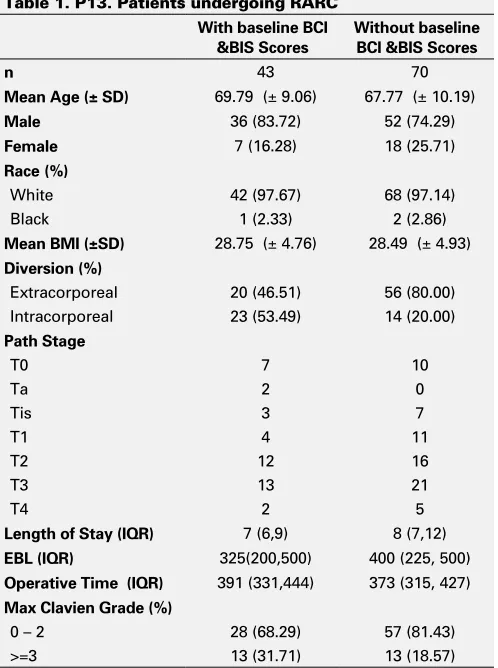
Methods: All patients with a diagnosis of non-metastatic bladder cancer from 2005-2010 were routinely asked to complete HRQL questionnaires upon presentation to Roswell Park. Patients were divided between those who underwent cystectomy and those who did not. Baseline question-naire scores were then compared. Patients who then underwent radical cystectomy with an ileal conduit urinary diversion were then asked to complete post operative follow-up HRQL questionnaires at standard post operative time points. Patients were then divided based on ileal conduit technique, age, and complication grade for subgroup analyses (Table 1). Results: One hundred eighty-six patients met inclusion criteria for assess-ment of baseline characteristics. Forty-three (23%) patients underwent cystectomy and post-operative follow up. Seventy patients underwent cystectomy and had adequate follow up questionnaires but did not complete pre-operative questionnaires. There was no difference in base-line BCI scores in the urinary, bowel or sexual domain scores between those patients that underwent cystectomy and those patients that did not. Additionally there was no difference in baseline BIS score between
those patients that underwent radical cystectomy and those that did not. There was never a significant decline in urinary BCI score in the urinary domain post operatively. Initial decline in the bowel score was noted at
Table 3. P12. Predicted vs. observed morbidity using POSSUM equation
Risk
(Percentile) # Patients
Mean % Predicted
Risk
Predicted
Events Observed Observed : Expected
(# * %) 30 Day 60 Day 90 Day 30 Day 60 Day 90 Day
>=0 - <=40 7 34.3057 2 2 2 2 1 1 1
>40 - <=50 17 45.404 8 7 7 10 0.88 0.88 1.25
>50 - <=60 28 55.7856 16 10 14 15 0.63 0.88 0.94
>60 - <=70 29 64.4528 19 11 14 14 0.58 0.74 0.74
>70 - <=80 41 75.3274 31 14 15 15 0.45 0.48 0.48
>80 - <=90 47 85.0513 40 21 22 23 0.53 0.55 0.58
>90 - 100 20 93.4123 19 13 15 15 0.68 0.79 0.79
0-100 189 71.4285714 135 78 89 94 0.57777778 0.65925926 0.6962963
P value <0.0001 <0.0001 0.001
Table 4. P12. Predicted vs. observed mortality using P-POSSUM equation
Risk
(Percentile) # Patients
Mean % Predicted
Risk
Predicted
Events Observed Observed : Expected
(# * %) 30 Day 60 Day 90 Day 30 Day 60 Day 90 Day
>=0 - <=5 106 2.7206 3 2 3 5 0.67 1 1.67
>5 - <=10 52 7.3989 4 0 2 2 0 0.5 0.5
>10 - <=15 16 12.5238 2 0 1 2 0 0.5 1
>15 - <=20 8 17.053 1 0 0 0 0 0 0
>20 - 100 7 36.6098 3 0 0 1 0 0 0.33
0-100 189 6.87830688 13 2 6 10 0.15384615 0.46153846 0.76923077
>90 - 100 20 93.4123 19 13 15 15 0.68 0.79 0.79
0-100 189 71.4285714 135 78 89 94 0.57777778 0.65925926 0.6962963
P value <0.0001 <0.0001 0.001
Time
P LOT Urinary Bowel Sexual 80
100
70
60
50
40
30
20
10
0
Pre-surgery 0-1 mth 1-2 mths 2-4 mths 4-10 mths 10-16 mths 16-24 mths >2 yrs
Mean BCI score p/m s.e.m.
the 0 - 1 month time period but returned to baseline by the 1 - 2 month period and remained at baseline beyond 24 months. Initial decline in BCI scores were greatest for the sexual function domain but did return to baseline by the 16 - 24 month period (Fig. 1).
Conclusions: Based on BCI and BIS score HRQL outcomes for those patients undergoing RARC are similar to those reported for open cases.
P14
Incidence, Pathology, and Management of Intraluminal Thrombus at Post-Chemotherapy Retroperitoneal Lymph Node Dissection
Paul H. Johnston, Stephen D. W. Beck, Liang Cheng, Richard Bihrle, Richard S. Foster.
Indiana University, Indianapolis, IN, USA.
Background: We determined the incidence of intraluminal thrombi involving major vasculature in patients with metastatic testis cancer at time of post-chemotherapy retroperitoneal lymph node dissection (PC RPLND).
Methods: Our testicular cancer database was queried from January 1990 to June 2010, identifying 1704 patients undergoing PC
RPLND. Two-hundred and forty patients required some form of vascular resection or reconstruction. Of these, 89 patients had 98 intraluminal thrombi involving major vasculature. Results: Location of the 98 thrombi included IVC in 72, Aorta in 1, Renal vein in 20. Management of the 72 caval thrombi included cavectomy in 36, partial cavectomy in 9 and thrombectomy in 27. Of the 20 renal vein
thrombi, management included nephrectomy in 18 and thrombectomy in 2. The single aortic thrombus was managed with aortic resection and replacement. Pathology revealed bland thrombi in 31, necrosis in 23, teratoma in 28, active germ cell cancer in 12 and sarcoma in 4. Additional procedures at time of PC RPLND included nephrectomy in 32, bowel resection in 7, liver resection in 6, thoracotomy in 6, and vertebral resec-tion in 3. Seventeen major complicaresec-tions occurred (Clavien Grade III or worse) including 2 deaths. Average EBL was 1165 mL (69 patients had EBL recorded), and average hospital stay was 9.3 days.
Conclusions: The incidence of intraluminal thrombi at PC RPLND is 5.8%, and significant pathology was observed in 61%. Surgeons undertaking PC RPLND should be well-versed in vascular techniques.
P15
One Year Updated Comparative Cost-Analysis of Robotic-Assisted Laparoscopic Prostatectomy and Open Prostatectomy Jeffrey J. Tomaszewski, Benjamin J. Davies, Stephen V. Jackman, Ronald L. Hrebinko, Joel B. Nelson.
University of Pittsburgh School of Medicine, Pittsburgh, PA, USA. Background: Radical prostatectomy accounts for approximately one-half of the $1.7 billion cost of prostate cancer treatment. Utilization of robotic-assisted laparoscopic prostatectomy (RALP) has increased rapidly. The cost efficacy of RALP remains undetermined. Our objective was to perform a comparative cost-analysis of RALP and open radical prosta-tectomy (RRP).
Methods: We retrospectively reviewed all patients undergoing RALP (n=115) or RRP (n=358) by one of four surgeons at a single institution over a 12 month period. Hospital length of stay (LOS), operative time, hospital charges, reimbursement, and direct and indirect hospital costs were analyzed and compared. Ratio of costs-to-charges (RCC) rates was applied to each charge amount to calculate costs. Detailed cost informa-tion was obtained according to charge origin.
Results: Mean LOS between patients undergoing RALP (1.2 ± 0.6 days) and RRP (1.4 ± 0.8 days) was comparable (p>0.05). Mean OR time was 56% longer in patients undergoing RALP (258 ± 57 minutes) compared to RRP (144 ± 20 minutes). Mean total costs for RALP exceeded the total costs for RRP by 74% ($11,154 versus $8269; p<0.05). Most of the difference was due to surgical supply and operating room costs ($8458 RALP versus $4,006 RRP; p<0.05). Total nursing costs were significantly greater for RRP than for RALP ($2,307 versus $876; p<0.05). 76% of the total costs associated with robotic prostatectomy were related to the robotic technique ($2565 direct, $2201 indirect). The ancillary, cardiol-ogy, imaging, administrative, laboratory and pharmacy costs were not significantly different. The operating margin for RRP and RALP is $1324 and negative $4013, respectively.
Conclusions: In this single institution analysis, total actual costs associated with RALP were significantly greater than costs for RRP. Higher operating room costs account for the increased cost of RALP.
P16
Long-term Outcome of Randomized Trial between Cryoablation And External Beam Therapy for Locally Advanced Prostate Cancer (T2c−T3b)
Ali Al-zahrani, Ana Maria Autran, Andrew Williams, Glenn Bauman, Joseph Chin.
London Health Science Center, London, ON, Canada.
Introduction and Objective: Our primary objective is to assess and com-pare the survival outcomes between cryoablation (CRYO) and External Beam Radiation Therapy (EBRT) in locally advanced prostate cancer (T2c−T3b).
Methods: Patients with cT2c−cT3b prostate cancer (CaP), initially recruited for the trial from 1999 to 2002, were randomized to either pri-mary CRYO or EBRT. All patients received neoadjuvant hormonal therapy (HT) for 3 months prior and continued for 3 months after the procedures. Patients underwent regular trans−rectal ultrasound and biopsy till 24 months of follow−up and as clinically indicated thereafter. Biochemical
Table 1. P13. Patients undergoing RARC
With baseline BCI
Male 36 (83.72) 52 (74.29)
Female 7 (16.28) 18 (25.71)
Race (%)
White 42 (97.67) 68 (97.14)
Black 1 (2.33) 2 (2.86)
Mean BMI (±SD) 28.75 (± 4.76) 28.49 (± 4.93)
Diversion (%)
Extracorporeal 20 (46.51) 56 (80.00)
Intracorporeal 23 (53.49) 14 (20.00)
Path Stage
EBL (IQR) 325(200,500) 400 (225, 500)
Operative Time (IQR) 391 (331,444) 373 (315, 427)
Max Clavien Grade (%)
0 – 2 28 (68.29) 57 (81.43)
CUAJ • October 2011 • Volume 5(5Suppl3) S173 failure was based on the Phoenix criteria (PSA nadir + 2ng/dl).
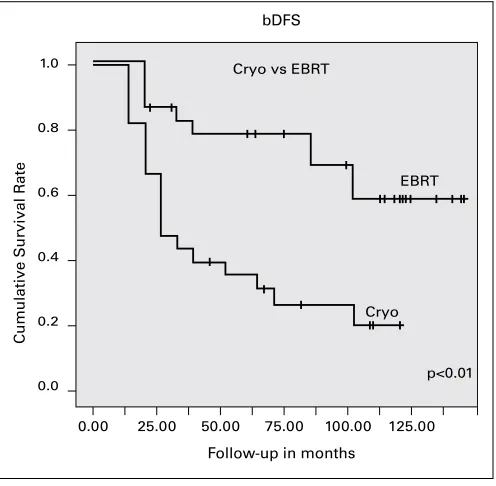
Results: Median follow−up was 105.2 (± 35.8) months. Sixty two patients completed the trial. Preoperative demographic and clinicopathological characteristics of both groups were comparable. There was greater reduc-tion in prostate volume in the CRYO group after intervenreduc-tion (−54% vs 34%) (p≤0.01). DSS and OS were comparable between both groups. The 8−year bDFS rate was significant lower in the CRYO group (17.4% vs 59.1%) (p=0.01) (Fig. 1).
Conclusion: This randomized trial showed that CRYO was inferior in attaining bDFS close to 9 years in patients with locally advanced CaP (cT2c-T3). CRYO may be more suited for less bulky CaP or longer neo-adjuvant HT is required for optimal bDFS.
P17
Accuracy of Upper Urinary Tract Urothelial Carcinoma (UUTUC) Staging prior to Nephroureterectomy
Emma E. Bendaña, Scott Tobis, Sriram Venigalla, Bryce Allio, Jean Joseph, Hani Rashid, Guan Wu, Edward Messing, Dragan Golijanin.
University of Rochester, Rochester, NY, USA.
Background: Survival rates for upper urinary tract urothelial carcinoma (UUTUC) depend upon the stage and grade of disease. Treatment deci-sions are based on preoperative grading and staging. The objective of this study was to analyze the accuracy of preoperative clinical staging for UUTUC when compared to final pathologic data following nephro-ureterectomy.
Methods: A ret- rospective chart review was completed for patients with UUTUC treated with nephroureterectomy (open, laparoscopic or robotic) at one tertiary care medical center between 1998 and 2010. Data col-lected included patient demographics, bladder cancer history, preopera-tive disease grade and stage, perioperapreopera-tive parameters, final pathologic data, and postoperative outcomes.
Results: A total of 97 patients underwent nephroureterectomy and had complete records to review during the study time frame. Of the 97 patients reviewed 54 had a biopsy completed or attempted prior to nephroure-terectomy. A total of 32 of the 54 biopsies were positive (59%) and 3 of the 54 were negative (5%). One biopsy could not be processed because of problems with processing the specimen and one biopsy was found to be necrotic tissue. The remaining 17 patients had inconclusive biopsies
or biopsies that could not be completed (31%). Only 11 of the 54 eli-gible patients (20%) had tumor grades on final pathology that matched preoperative biopsy grades. 22 of the 54 eligible patients (41%) had their tumors upgraded based on preoperative biopsy.
A total of 61 patients (63%) had preoperative urine cytology available. 23 were diagnosed as high grade, 13 low grade, and 5 were considered negative. 20 of the 61 patients (33%) had inconclusive urinary cytology. Only 24 of the 61 patients (39%) had their final disease grade correlate with preoperative cytology. However 33 patients (54%) with cytology ini-tially identified as low grade disease, negative or inconclusive were found to have high grade disease on final pathology. Of these 33 “upgraded” patients, 20 had a lymphadenectomy (60%) performed at the time of nephroureterectomy.
A total of 74 patients had either voided cytology or biopsy informa-tion available preoperatively. Of these 74 patients 52 were “upgraded” postoperatively (70%). Of these “upgraded” patients 32 (61%) had lymph-adenectomy.
Conclusions: Preliminary results from this study indicate that preoperative grading of upper urinary tract urothelial tumors is frequently inaccurate. The majority of these tumors are upgraded upon final pathology, which suggests that performance of a lymphadenectomy during nephroureter-ectomy should not be excluded if preoperative assessment fails to show high grade disease.
P18
Comparison of Renal Tumor Scoring Systems
Luke T. Lavallée, Darren Desantis, MD, Fadi Kamal, Brian Blew, James Watterson, Christopher Morash, Ilias Cagiannos, Rodney H. Breau. The University of Ottawa, Ottawa, ON, Canada.
Background: Standardizing preoperative assessment of renal tumors allows improved classification, risk stratification, and comparison of thera-peutic outcomes. Three models of quantitative assessment; R.E.N.A.L. Nephrometry, C Index, and PADUA, have been proposed. The purpose of this study was to compare available renal tumor scoring systems to partial nephrectomy ischemia time.
Methods: Patient characteristics (age, sex, pre-operative renal function, diabetes, hypertension, smoking history, heart disease) and computed tomography (CT) images for 94 partial nephrectomy patients were reviewed. Tumor characteristics were recorded for all components of each scoring model. Renal ischemic time was obtained from operative reports. Results: Median R.E.N.A.L. score was 7 (IQR 5.7-8.3), median PADUA score was 8 (IQR 7.7-9.7) and median C index was 3.92 (SD 2.10). Mean ischemia time was 24 (SD 11) minutes. Individual tumor characteristics (diameter, nearness, and medial/lateral location) were strongly associ-ated with ischemia time (p<0.05). Adjusting for potential confounders, C index (-1.35min per c-index unit 95%CI -2.38, -0.33, p=0.01) and PADUA score (1.66min per PADUA unit 95%CI 0.02, 3.3, p=0.05) were significantly associated with ischemia time. R.E.N.A.L. Nephrometry score was associated with ischemia time, but this association was not statisti-cally significant (1.1min per R.E.N.A.L. unit 95%CI -0.34, 2.53, p=0.1). Conclusions: Renal tumor characteristics are associated with ischemia time and proposed scoring systems are useful descriptors of tumor com-plexity.
Cumulati
ve Survi
val R
ate
0.00 25.00 50.00 75.00 100.00 125.00
0.0 0.2 0.4 0.6 0.8 1.0
Follow-up in months bDFS
Cryo vs EBRT
EBRT
Cryo
p<0.01
P19
External Validation of a Biomarkers Based Algorithm to Predict Pathological Stage Prior to Radical Cystectomy
David Margel1, Peter Bostrom1, Ofer Yossepowitch2, Jack Baniel2, Alexandre Zlotta1, Neil Fleshner1.
1Princess Margaret Hospital, University Health Network, Toronto, ON, Canada, 2Rabin Medical Center, Beilinson, Petah-Tikva, Israel.
Background: The role of neoadjuvant chemotherapy prior to radical cystectomy in patients with muscle invasive bladder cancer remains debated. The need of tools to identify patients who would benefit from chemotherapy is pertinent. We have previously published a preoperative algorithm to predict non organ confined disease. This algorithm included serum tumor markers (CEA CA-125 and CA 19 9) as well as clinical parameters. Our aim was to validate the accuracy of this algorithm in an independent, external cohort.
Methods: We used the Toronto, University Health Network, Genitourinary Bio-bank to measure preoperative serum levels of CEA, CA 125 and CA 19-9 in 76 consecutive patients with clinically organ confined bladder cancer (cT2 or less) who underwent radical cystoprostatectomy. Clinical stage, presence of hydronephrosis, presence of carcinoma in situ, and initial tumor size >3 cm were retrieved from our prospective bladder infor-mation system database and incorporated into our marker-based algo-rithm. A numeric score was generated for each patient and a previously published cut-off was used to predict the presence extravesical disease. The accuracy of the model was quantified with the area under the curve (AUC) and the positive and negative predictive values were calculated. Results: On pathologic evaluation, 38 patients (50%) were found to have organ-confined tumors and 38 patients (50%) had extravesical disease. The AUC of the algorithm was 0.79 (95% CI, 0.69-0.89). The positive and negative predictive values were 79% (95% CI, 71%-87%) and 74% (95% CI, 66%-82%), respectively.
Conclusions: We have externally validated a precystectomy model to predict pathological stage based on clinical parameters and oncofetal serum markers. The algorithm may possibly aid in selecting patients who would benefit from neoadjuvant chemotherapy prior to cystectomy.
P20
PSA Outcomes after Cesium Prostate Brachytherapy Benjamin T. Ristau, ushil Beriwal, Ryan P. Smith,Ronald M. Benoit. UPMC, Pittsburgh, PA, USA.
Background: Prostate brachytherapy has been accepted as an oncologi-cally effective treatment for men with clinioncologi-cally localized prostate cancer. Traditionally, Iodine (125I) and Palladium 103 (103Pd) have been the isotopes of choice for prostate brachytherapy. In 2003, the FDA approved Cesium 131 (131Cs) as a new isotope for prostate brachytherapy. The proposed advantage of 131Cs is a shorter duration of the urinary morbidity associated with prostate brachytherapy, which may be due to the shorter half-life of the isotope (9.7 days). However, the long-term oncologic outcomes of 131Cs prostate brachytherapy remain to be determined. The present study reports short-term PSA outcomes after prostate brachy-therapy with 131Cs.
Methods: All patients who underwent prostate brachytherapy with 131Cs and had at least 24 months of follow-up were included in the study. Results are reported for the total cohort and stratified by risk group and treatment received (monotherapy, combination therapy, or trimodal therapy). The Phoenix definition (absolute nadir plus 2 ng/mL) was used to define biochemical freedom from disease (BFD).
Results: One hundred and fifty-six patients underwent prostate brachy-therapy with 131Cs and had at least 24 months of follow-up. At two years, 152 of the 156 evaluable patients (97.4%) in the total cohort remain BFD. Stratified by risk, 70/70 (100%) patients in the low risk category are BFD, 67/68 (98.5%) of patients in the intermediate risk category are BFD, and 15/18 (83.3%) of men in the high risk category are BFD at two years. By treatment category, 111/112 (99.1%) of men treated with monotherapy are BFD, 28/30 (93.3%) of men treated with combination therapy are BFD, and 13/14 (92.8%) of men treated with trimodal therapy are BFD. At two years, the median PSA is 0.2 ng/mL. A total of 81 and 23 patient have been followed to 3 and 4 years respectively. The median PSA for patients in both these cohorts is < 0.1ng/mL.