R E S E A R C H
Open Access
Adaptive projective lag synchronization of
uncertain complex dynamical networks with
delay coupling
Ghada Al-mahbashi
1*, Mohd Salmi Md Noorani
1, Sakhinah Abu Bakar
1,2and
Mohammed Mossa Al-Sawalha
2*Correspondence:
[email protected] 1School of Mathematical Sciences,
Faculty of Science and Technology, Universiti Kebangsaan Malaysia, UKM, Bangi, Selangor, Malaysia Full list of author information is available at the end of the article
Abstract
This paper investigates the problem of projective lag synchronization behavior with delayed coupling in drive-response dynamical networks model with identical and non-identical nodes. An adaptive control method is designed to achieve the projective lag synchronization with constant time delay and with time-varying coupling delay. In addition the model harbors fully unknown parameters and disturbances. By using Lyapunov stability theory and adaptive laws, the unknown parameters are estimated. In addition, the unknown bounded mismatch and disturbance terms are also overcome by the proposed control. Finally, the simulation results reveal that the states of the dynamical network with delayed coupling can be asymptotically synchronized onto a desired scaling factor under the designed controller. Additionally, the results prove the validity of the proposed method.
Keywords: drive-response dynamical networks; projective lag synchronization; adaptive control; disturbance; coupling delay
1 Introduction
In the past few years, synchronization of dynamical systems has shown interesting be-haviors which have received increasing attention in various fields of industry and various sciences [–]. Meanwhile, many kinds of synchronization have been proposed [–] and various control methods have been reported to achieve the different kinds of synchroniza-tion for complex networks [–].
In many practical situations, time delay may cause undesirable dynamic behaviors such as oscillation, instability, and poor performance. Therefore, the development of synchro-nization of complex dynamical networks with time delays is very important.
In [] Guo studied lag synchronization of complex networks with non-delay coupling by proposing pinning control. On the basis of adaptive control, Jiet al.[] proposed a method with lag synchronization between uncertain complex dynamical networks CDNs with constant delay coupling. Wanget al.[] proposed function projective synchroniza-tion (FPS)in CDNs having constant delay coupling and non-identical reference nodes and both network nodes and reference have unknown parameters and bounded external dis-turbances. Zhang and Zhao [] investigated both projective and lag synchronization
tween general complex networks via impulsive control. Based on an adaptive feedback controller, projective lag synchronization of the general complex dynamical networks was proposed with non-delay coupling and different nodes []. In [] Rui-Jinet al.proposed several nonlinear controllers to realize the problem of projective synchronization with non-delayed and constant delayed coupling in drive-response dynamical networks con-sisting of identical nodes and different nodes.
Motivated by the above discussion, the aim of this paper is to deal with the problem of a projective lag synchronization (PLS) scheme in drive-response dynamical networks (DRDNs) model with coupling delayed consisting of identical and different nodes. Both the drive and the network nodes have uncertain parameters and disturbance. Based on Lyapunov stability theory, an adaptive control method is designed to achieve the projective lag synchronization in DRDNs with constant and time-varying coupling delay. Adopting adaptive gains laws, the unknown parameters are estimated. In addition, the controller is designed to overcome the unknown bounded disturbance. In conclusion, the network is asymptotically synchronized with the proposed method. Moreover, numerical simulations are performed to verify the effectiveness of the theoretical results.
The rest of this paper is organized as follows: the DRDNs model with delay coupling is introduced in Section . A general method of PLS in a drive-response dynamical net-works (DRDNs) model with constant coupling delayed by an adaptive control method is discussed in Section . Section deals with a further investigation of PLS in a drive-response dynamical networks (DRDNs) model with time-varying coupling delayed by us-ing the proposed method. Examples and their simulations are shown in Section . Finally, the conclusions are presented in Section .
2 Model description
Consider a controlled complex dynamical network with delay coupling consisting ofN linearly and diffusively different nodes with both uncertain parameters and disturbance, described as follows:
˙
xr i(t) =gi
xri(t)+Gixri(t)θi+c N
j=
aijxrj(t–di) +i(t) +ui(t), i= , , . . . ,N, ()
wherexr
i = (xri,xri, . . . ,xrin)T∈Rndenotes the state vector of theith node,gi: Rn−→Rn andGi: Rn−→Rn×miare the known continuous nonlinear function matrices determining the dynamic behavior of the node,θiis the unknown constant parameter vector,ui∈Rn is the control input,cis the coupling strength, anddi≥ is an unknown coupling delay. Here=diag(γ,γ, . . . ,γn) is the inner coupling matrix withγi= for theith state vari-able,i.e.matrixdetermines the variables with which the nodes in system are coupled. A= (aij)N×N ∈RN×N is the coupling configuration matrix representing the topological structure of the networks, whereaijis defined as follows: if there exists a connection be-tween nodeiand nodej(j=i), thenaij> , otherwiseaij= , and the diagonal elements of matrixAare defined by
aii= – N
j=,j=i
The reference node is described as follows:
˙
xd(t) =fxd(t)+Fxd(t)+
d(t), ()
where the superscripts dstand for the drive system;xd= (xd
,xd, . . . ,xdn)T ∈Rndenotes the state vector of the drive system, f : Rn−→RnandFi: Rn−→Rn×mi are the known continuous nonlinear function matrices determining the dynamic behavior of the node; is the unknown constant parameter vector, anddcontains the mismatched terms.
The projective lag synchronization error is defined as
ei(t) =xri(t) –αxd(t–τ), i= , . . . ,N, ()
whereαis the nonzero a scaling factor,τ> is a constant representing time delay or lag. Then the objective of this paper is to design a controllerui(t) such that the reference nodes () and dynamical networks () are asymptotically synchronized such that
lim
t−→∞x r
i(t) –αxd(t–τ)= , i= , . . . ,N, ()
which means that the network () is projective lag synchronized with reference node (). The error dynamics is obtained:
˙
ei=gixri(t)+Gixri(t)θi(t) +c N
j=
aijej(t–di) +ui(t) +i(t)
–αfxd(t–τ)+Fxd(t–τ)(t) +d(t)
, i= , . . . ,N. ()
Assumption .[] For any positive constantεithe time-varying disturbancei(t) is boundedi.e.i(t) ≤εi.
3 PLS in DRDNs with constant delay
In this section, we design an adaptive control method to realize projective lag synchro-nization for uncertain complex dynamical networks with constant delay coupling.
Theorem . The projective lag synchronization error()is asymptotically stable with a given time delayτ and scaling factorα,by using the following control input and adaptive laws:
ui(t) = –qiei(t) –βisgn
ei(t)–gixri(t)–Gixri(t)θˆi(t)
+αfxd(t–τ)+Fxd(t–τ)(ˆ t), i= , . . . ,N, ()
˙ˆ
θi(t) =kGTi
xri(t)ei(t), ()
˙ˆ
(t) = –kFiT
xdi(t–τ)ei(t), ()
˙
qi(t) =kei(t)Tei(t), ()
˙
βi(t) =kei(t)Tsgn
ei(t)
, ()
Proof Construct the Lyapunov function candidate as follows: βi∗are positive constants.
The time derivative ofV(t) along the error dynamics () is
˙
By application of the control input () to the error dynamics˙ei(t) we have
˙
From the adaptation laws ()-(),V˙ is inferred as follows:
˙ product. Then we have
We use the fact xTy≤xTSx+yTS–yfor any vectorx,y∈Rm, and a positive definite matrixS∈Rm×m. From the assumption , the following inequality is inferred:
i(t) –αd(t)≤i(t) –αd(t)≤i(t)+αd(t)≤εi, whereεiis a positive constant. We have
˙
V ≤ c
eT(t)PTPe(t) + e
T(t–di)e(t–di) –q∗eT(t)e(t)
+ N
i=
εi–β∗ei(t)+ e(t)
Te(t) – e(t–di)
Te(t–di)
≤eT(t)
c
PTP–q∗+ I
e(t) +
N
i=
εi–β∗ei(t)
≤λ–q∗e(t)Te(t) + N
i=
εi–β∗ei(t),
whereλ=λmax(c PTP+I
). Therefore, by taking appropriateq∗andβ∗such that
λ–q∗< ,
εi–β∗< , i= , , . . . ,N,
we obtain
˙
V≤–e(t)Te(t).
SinceVis positive definite andV˙ is negative definite, the errorei(t) is asymptotically stable in the sense of Lyapunov stability theory and the networks () projective lag synchronizes the drive system () asymptotically by the control () and the update laws ()-(). This
completes the proof.
4 PLS in DRDNs with time-varying delayed coupling
The adaptive control method is designed to realize projective lag synchronization for un-certain complex dynamical networks with time-varying delay coupling.
Theorem . We assume a given synchronization scaling factorαand propagation delay τ(t).The projective lag synchronization with time-varying delayed coupling in the drive-response dynamical networks can be realized if the control input and adaptive lows are chosen as
ui(t) = –qiei(t) –βisgn
ei(t)–gixri(t)–Gixri(t)θˆi(t)
+αfxd(t–τ)+Fxd(t–τ)(ˆ t), i= , . . . ,N, ()
˙ˆ
θi(t) =kGTi
xri(t)ei(t), ()
˙ˆ
(t) = –kFiT
˙ eters for the reference node()and network(),respectively.
Proof Choose the Lyapunov function candidate as follows:
V(t) =
The rest of the proof is similar to Theorem . According to the Lyapunov stability theory, the error system is asymptotically stable. This completes the proof.
5 Illustrative example
This section presents the drive-response dynamical networks with three identical, differ-ent nodes systems, unknown parameters, and disturbance, which are used to show the ef-fectiveness of the proposed schemes obtained in the previous sections. We use the Lorenz system as drive system, which is described as follows:
⎛
where the unknown parameters vector and mismatch terms are chosen as = [] = [ ],d(t) = [cos(t) sin(t)sin(t)].
The inner coupling matrix=I×and the coupling configuration matrixA= (aij) is chosen to be
A=
5.1 Synchronization with constant delay
We discuss the problem of PLS in drive-response dynamical networks with identical and different nodes consisting of fully unknown parameters, mismatch terms, and disturbance with constant delay coupling.
.. Synchronization with identical nodes
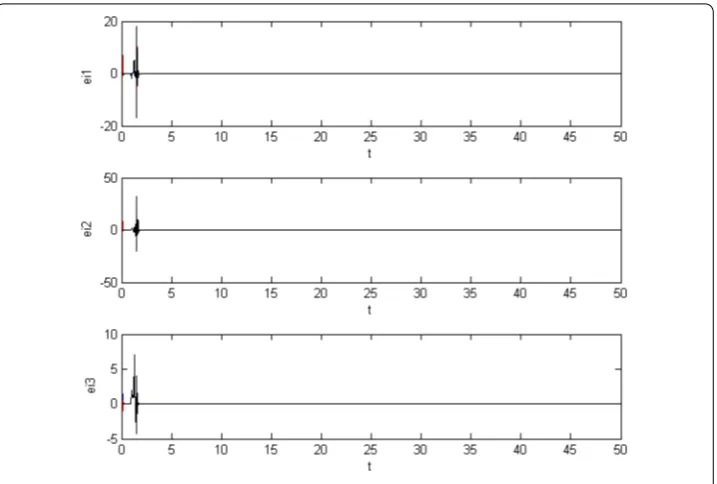
Figure 1 The synchronization errorei(t) =xr i(t) –αx
d(t–τ).
which can be described as follows:
⎛ ⎜ ⎝
˙
xri
˙
xr i
˙
xr i
⎞ ⎟ ⎠=
⎛ ⎜ ⎝
–xr
ixri xr
ixri ⎞ ⎟ ⎠+
⎛ ⎜ ⎝
xri–xri –xr
i xri+xri
–xr
i ⎞ ⎟ ⎠
⎛ ⎜ ⎝
θi θi
θi ⎞ ⎟ ⎠
+c
j=
aijxrj(t–di) +i(t) +ui. ()
Here the unknown parameters vector is θ = [ ]T. The disturbance signals are chosen asi= [.cos(t)sin(t) .sin(t) .cos(t)].
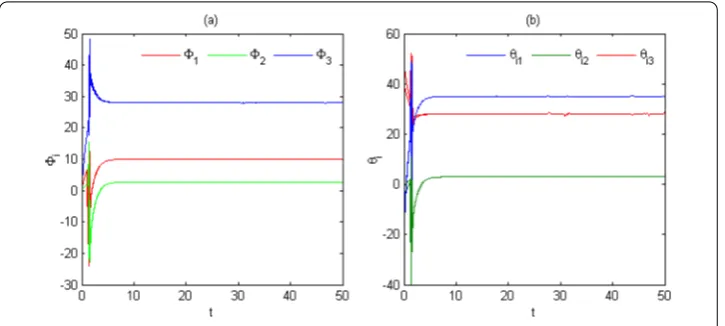
In these numerical simulations, we assume thatc= .,α= ,di= ., andτ = . The gains of the adaptive laws ()-() arek= ,k= ,k= ,k= .. We take the initial states asxd() = [ – –]T,xr
i() are chosen in [–, ] randomly, andˆ=θˆi=qi=βi= . The numerical results are presented in Figures and . The time evolution of the syn-chronization errors is illustrated in Figure , which displayse−→ with t−→ ∞. The identified parameters of the reference node and network nodes are depicted in Figure (a) and Figure (b), which converge to their real values. These results verify that the proposed control () with adaptive laws ()-() makes the network () projective lag synchronized, even if the network and the reference node () have fully unknown parameters, mismatch terms, and disturbances.
.. Synchronization with different nodes
Figure 2 The estimated parametersφiˆ (a) andθiˆ(b).
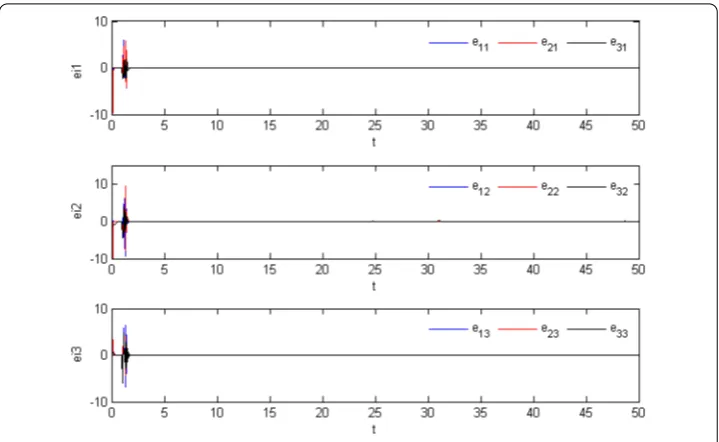
The time evolution of the synchronization errors is illustrated in Figure , which
dis-playse−→ witht−→ ∞. The estimated parameters of the reference node and network nodes are depicted in Figure (a) and Figure (b), respectively, which converge to their
real values. These results prove that the proposed control () with adaptive laws ()-() makes the network () projective lag synchronized if the drive system and the network
Figure 3 The synchronization error of different nodes.
Figure 4 The estimated parametersφiˆ (a) andθiˆ(b) with constant coupling delay.
5.2 Synchronization with varying coupling delay coupling
In this subsection, a drive-response dynamical networks with three identical, different node systems, fully unknown parameters, mismatch, and disturbance terms are used to show the effectiveness of the proposed schemes obtained in the previous sections.
.. Synchronization with identical nodes
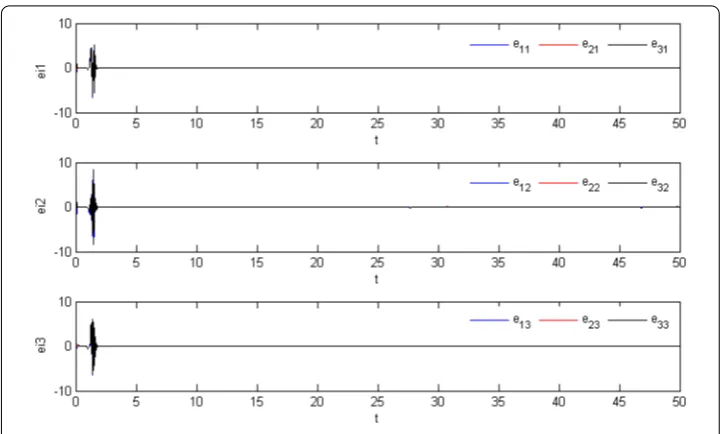
Figure 5 The synchronization error of identical nodes with time-varying delay.
The time evolution of the synchronization errors is depicted in Figure , which displays e−→ witht−→ ∞. The estimated parameters of the reference node and network nodes are depicted in Figure (a) and Figure (b), which converge to their real values. These re-sults verify that the proposed control () with adaptive laws ()-() makes the network () projective lag synchronized.
.. Synchronization with different nodes
The chaotic Chen system, the Lu system, and the Rossler system are chosen as nodes of complex dynamical networks; complex dynamical networks with time-varying coupling delay can be described as follows:
Figure 6 The estimated parametersφiˆ (a) andθiˆ(b) with time-varying coupling delay. In Figure shows the time evolution of the synchronization errors. The estimated pa-rameters of the reference node and network nodes are depicted in Figure (a) and Fig-ure (b), respectively, which converge to their real values. These results verify that the proposed control () with adaptive laws ()-() makes the network () projective lag synchronized, even though the drive system and the network have unknown parameters.
6 Conclusion
Figure 7 The synchronization error of different nodes with time-varying delay.
Figure 8 The estimated parametersφiˆ (a) andθiˆ(b) with time-varying coupling delay.
Competing interests
The authors declare that they have no competing interests.
Authors’ contributions
All authors contributed equally to this work. They all read and approved the final version of the manuscript.
Author details
1School of Mathematical Sciences, Faculty of Science and Technology, Universiti Kebangsaan Malaysia, UKM, Bangi,
Selangor, Malaysia. 2Department of Mathematics, Faculty of Science, University of Hail, Hail, Saudi Arabia.
Acknowledgements
The authors would like to acknowledge the grant: UKM Grant DIP-2014-034 and Ministry of Education, Malaysia grant FRGS/1/2014/ST06/UKM/01/1 for financial support.
Received: 30 June 2015 Accepted: 10 November 2015
References
1. Pandit, SA, Amritkar, RE: Characterization and control of small-world networks. Phys. Rev. E60(2), 1119 (1999) 2. Strogatz, SH: Exploring complex networks. Nature410, 268-276 (2001)
4. Xiao, Y, Xu, W, Li, X, Tang, S: Adaptive complete synchronization of chaotic dynamical network with unknown and mismatched parameters. Chaos17, 033118 (2007)
5. Shahverdiev, EM, Sivaprakasam, S, Shore, KA: Lag synchronization in time-delayed systems. Phys. Lett. A292, 320-324 (2002)
6. Wu, Y, Li, C, Wu, Y, Kurths, J: Generalized synchronization between two different complex networks. Commun. Nonlinear Sci. Numer. Simul.17(1), 349-355 (2012). doi:10.1016/j.cnsns.2011.04.026
7. Length, F: Anti-synchronization of complex delayed dynamical networks through feedback control. Sci. Res. Essays
6(3), 552-558 (2011). doi:10.5897/SRE10.760
8. Liu-Xiao, G, Zhen-Yuan, X, Man-Ferg, H: Adaptive projective synchronization with different scaling factors in networks. Chin. Phys. B17(11), 4067 (2008)
9. Liu, J, Liu, S, Yuan, C: Modified generalized projective synchronization of fractional-order chaotic Lu systems. Adv. Differ. Equ.2013, 374 (2013)
10. Botmart, T, Niamsup, P: Exponential synchronization of complex dynamical network with mixed time-varying and hybrid coupling delays via intermittent control. Adv. Differ. Equ.2014, 116 (2014)
11. Zhang, S, Yu, Y, Wen, G, Rahmani, A: Stochastic quasi-synchronization for uncertain chaotic delayed neural networks. Int. J. Mod. Phys. C25, 1450029 (2014)
12. Wang, S, Cao, H: Cluster lag synchronization of complex networks with nonidentical dynamical nodes via adaptive control. In: 2015 International Conference on Automation, Mechanical Control and Computational Engineering. Atlantis Press (2015)
13. Louzada, VHP, Araujo, NAM, Andrade, JS, Herrmann, HJ: Breathing synchronization in interconnected networks. Sci. Rep.3, 3289 (2013)
14. Wu, Y, Liu, L: Exponential outer synchronization between two uncertain time-varying complex networks with nonlinear coupling. Entropy17(5), 3097-3109 (2015)
15. Al-Mahbashi, G, Noorani, MS, Abu Bakar, S: Projective lag synchronization in drive-response dynamical networks. Int. J. Mod. Phys. C (2014). doi:10.1142/S0129183114500685
16. Wen, B, Zhao, M, Meng, F: Pinning synchronization of the drive and response dynamical networks with lag. Arch. Control Sci.24(3), 257-270 (2014)
17. Zhao, M, Zhang, H, Wang, Z, Liang, H: Synchronization between two general complex networks with time-delay by adaptive periodically intermittent pinning control. Neurocomputing144, 215-221 (2014)
18. Zheng, S: Projective synchronization analysis of drive-response coupled dynamical network with multiple time-varying delays via impulsive control. Abstr. Appl. Anal. (2014). doi:10.1155/2014/581971
19. Sun, Y, Li, W, Ruan, J: Generalized outer synchronization between complex dynamical networks with time delay and noise perturbation. Commun. Nonlinear Sci. Numer. Simul.18(4), 989-998 (2013)
20. Sun, HY, Li, N, Zhao, DP, Zhang, QL: Synchronization of complex networks with coupling delays via adaptive pinning intermittent control. Int. J. Autom. Comput.10(4), 312-318 (2013)
21. Guo, W: Lag synchronization of complex networks via pinning control. Nonlinear Anal., Real World Appl.12(5), 2579-2585 (2011). doi:10.1016/j.nonrwa.2011.03.007
22. Ji, DH, Jeong, SC, Park, JH, Lee, SM, Won, SC: Adaptive lag synchronization for uncertain complex dynamical network with delayed coupling. Appl. Math. Comput.218(9), 4872-4880 (2012). doi:10.1016/j.amc.2011.10.051
23. Wang, L, Yuan, Z, Chen, X, Zhou, Z: Adaptive function projective synchronization of uncertain complex dynamical networks with disturbance. Commun. Nonlinear Sci. Numer. Simul.16, 987-992 (2011)
24. Zhang, Q, Zhao, J: Projective and lag synchronization between general complex networks via impulsive control. Nonlinear Dyn.67(4), 2519-2525 (2011). doi:10.1007/s11071-011-0164-6
25. Wu, X, Lu, H: Projective lag synchronization of the general complex dynamical networks with distinct nodes. Commun. Nonlinear Sci. Numer. Simul.17(11), 4417-4429 (2012)