R E S E A R C H
Open Access
GLR test for OFDM system identification using
pilot tones pattern
Mohamed-Rabie Oularbi
1*, Saeed Gazor
2, Sebastien Houcke
1and Abdeldjalil A¨ıssa-El-Bey
1Abstract
In the context of cognitive network architecture, an opportunistic cognitive receiver must identify the present active networks. In this article, we propose an efficient algorithm for the identification of OFDM networks exploiting the pilot patterns used in these standards which are prescribed uniquely by their underlying standards. These pilots are inserted for the channel estimation and synchronization between the base stations and their users. The proposed generalized likelihood ratio test (GLRT) not only allows a cognitive observer to detect the active networks by analyzing the observed signals but also performs channel estimation, time-frequency synchronization as well as estimation of the noise variance. These informations are of a great interest for Quality of Service estimation in the purpose of an association with the base station. The proposed solution is applicable to the existing standards (e.g., LTE, WiMAX, WiFi), doesn’t require any signaling overhead to be embedded on the pilot tones, is computationally inexpensive and only requires to know the pilot patterns. An other GLRT is proposed as a pre-detector which ignores the pilot
information and allows to reduce the computational cost of the system for the cases where a large number of patterns/systems are to be tested.
1 Introduction
The rapid growth of wireless communications resulted in the proliferation of wireless devices and services. The demand for radio spectrum is dramatically increasing, while, most of the usable electromagnetic spectrum has already been licensed out. This policy has led to a sporadic use and shortage of the spectrum for new emerging wire-less applications. To remedy this inefficiency, dynamic spectrum access techniques are proposed [1,2] allowing users to share spectrum where some licensed bands are opened to unlicensed cognitive users provided that they do not produce a perceptible interference to the primary users. This culminated in the formation of the IEEE 802.22 working-group [3] which aims at using the cognitive radio (CR) technology [4,5] as a key to dynamic spectrum access in the prescribed portion of TV frequency spectrum [6]. Cognition is defined as the capability of sensing the radio environment and evaluating the capabilities of alternate configurations. This enables a more flexible, efficient and reliable spectrum utilization. In such a context, the need
*Correspondence: [email protected]
1Institut Telecom, Telecom Bretagne, UMR CNRS 3192 Lab-STICC, Universit´e Europ´eenne de Bretagne, Bretagne, France
Full list of author information is available at the end of the article
to identify the network appears when a cognitive receiver attempt to initiate a connection to a network. In fact, the cognitive users have to distinguish the IEEE 802.22 signals form the signals emitted by the TV broadcasting.
A second context where the cognitive receiver has to detect the activity of compatible surrounding wireless net-works, is when applying the concept of always best con-nected (ABS) [7]. The concept of ABS allows multi-mode cognitive devices to move between different technologies in order to approach the QoS requirement. Seamless cog-nitive immigration from one technology to another one is known as vertical handover [8,9]. Before triggering a vertical handover, an opportunistic cognitive device has no knowledge about the active surrounding networks and must identify them. In a static spectrum allocation, the devices can easily detect the activities in their allocated spectrum bands using some existing technique such as energy detection [10], matched filters [11], etc. Unfortu-nately in cognitive networks, the allocated spectrum to the base stations (BSs) changes dynamically over time and space. Under those conditions a CR device must be enabled to identify passively the active compatible sys-tems which are accessible in a given set of frequency bands. The spectrum is divided into a finite number of
sub-bands. The goal is to develop efficient algorithms for such a task in each sub-band. An intuitive approach is to perform detection using the cross-correlation between the observed signal and the known preamble sequence of the network of interest. Unfortunately, this approach involves long delays, for example, in the IEEE 802.22, the super-frame preamble is broad-casted only once every 160 ms [12]. Since, the cognitive device must sense multi-ple sub-bands, such a delay is not tolerable and makes this approach too expensive. In addition, this approach does not make use of extra knowledge about the structure of the signals in different networks (e.g., the involved pilot signals). In this article, we propose an alternative solution which exploits the known pilot patterns of the involved standards.
The orthogonal frequency division multiplexing (OFDM) is used in the physical layer of many of the existing networks and is also provisioned as the best candidate for most of future cognitive networks [13]. The OFDM is advantageous in cognitive networks not only because of its flexibility and scalability but more importantly because it is deemed that it allows simpler management of spectral resources.
We can categorize the existing algorithms for OFDM systems identification in four groups. The first group pro-poses some blind techniques [14-16] that permit to extract the OFDM signal parameters and then search those values in a lookup table to determine the corresponding sys-tem. These techniques have a high computational cost, and only the inter-carrier spacing appears to be a good signature for the actual existing systems [14]. In addi-tion, new radio architectures such as the cognitive radio systems are converging to a common physical layer. For such future systems, it is very probable that this sig-nature will be no longer available. The second group exploits the OFDM signal properties such as cyclic prefix (CP) cyclo-stationarity [17-19] to extract the inter-carrier spacing. Unfortunately, the performance of the CP cyclo-stationarity based algorithms degrades as the length of the channel impulse response approaches the cyclic pre-fix duration. In [20], CP and preamble cyclo-stationarity are jointly used. However, independent cognitive receivers often miss to catch the preamble, as they observe the sig-nals at random time intervals. Specially for reducing the power consumption, the cognitive receivers shall acquire signals samples only over short intervals. In such cases, the preamble is highly likely lost, which leads to loss of the cyclo-stationary property. The third group pro-poses to embed some specific signatures in the physical signal and broadcast it, always. To allow unique identi-fication of all possible co-existing systems, a number of signatures must be provisioned which adds spectral over-head. The cognitive devices must be able to regenerate these signatures and manipulate the received signals at
low cost (i.e., the computational complexity must be rea-sonable). Authors in [21-23] proposed to dedicate some selected sub-carriers and induce a cyclo-stationary sig-nature. Unfortunately such a technique add overhead, reduce network capacity and are not applicable for the existing OFDM networks. Finally, in [24-26], authors pro-posed to exploit the pilot patterns which is a signature already embedded in many existing OFDM networks (for example in WiFi, WiMAX, LTE). These pilot signals are transmitted for other reasons such as synchronization [27-29] and channel estimation [30-32]. This approach is more efficient since no spectral overhead is needed. In [25], a method is proposed for a comb-type configura-tion of the pilots where assuming a finite sequence of pilots. This method is only efficient for the assumed con-ditions. Unfortunately, the technique proposed in [26] is dedicated only to LTE signals. The first proposed method in [24] relies on the periodic redundancy often induced between pairs of pilot symbols. The second proposed method is dedicated to the case where the pilots are mod-ulated by a pseudo random sequence, authors in [24] proposed to exploit the properties of the pseudo ran-dom generator. These methods require the knowledge of the position of the pilots in time and frequency, and are only applicable if these pilots have some known redun-dant relation (either in the form of known correlation or in the form of a pseudo random sequence), which make them not applicable in all cases. We must note that these pilot tones are often modulated initially by a pseudo random sequence and then by a binary phase-shift key-ing (BPSK) or a quadrature phase-shift keykey-ing (QPSK) signal to carry system control information; i.e., the mod-ulating sequences are usually unknown to the third part observers. For example BPSK is used in WiFi and WiMAX and QPSK is used in LTE. Thus, we develop a method to identify the activity of such a system which is appli-cable under absence of the knowledge about the pilot modulating sequence.
In this article, we propose a method that exploit the pilot positions, and assume that they are modulated by a PSK signal. The proposed method is applicable to all existing standards since it does not require any knowl-edge or redundancy in the modulating symbols. A gen-eralized likelihood ratio (GLR) detector which estimates the unknown channel gain, the unknown pilot modu-lating sequence, the noise variance and also performs time-frequency synchronization is here proposed. Thus, this method also allows third party observers to read the control channel information.
is proposed in Section 4. The Simulations results are detailed in Section 5. The synchronization impairments and the data modulating sequence impact on the per-formance of the algorithm are discussed in Sections 5.2 and 5.3, respectively. Finally, Section 6 concludes the article.
2 Signal model and problem statement
We assume that in a given frequency band, a transmitted OFDM signal consists ofNsub-carriers, the discrete-time baseband equivalent transmitted signal is given by
x(m)=
whereEsis the average signal power,nandkare the time
and the frequency indexes, respectively, cn,k is the nth
symbol on subcarrierk,Dis the cyclic prefix length, and
g(m) is the pulse shaping filter. The modulating symbol
cn,k is either a data symboldn,k or a pilot symbolpn,k as
where the pilot patternP represents the set of all pilot positionsν = (n,k)such that nandk are the temporal location and the subcarrier index of a pilot, respectively. We here assume that the pilot patternP is known by the receiver and that the data symbolsdn,k are independent
and identically distributed (i.i.d). In Section 5, we extend the proposed derivation to include the time and frequency synchronization. Interestingly, the pilot sequence pn,k is
either a QPSK or BPSK signal in existing systems, i.e.,
pn,k ∈ {±1,±
√
−1}. In this article, we exploit this prop-erty in order to detect if a given pattern P with such a modulation is present.
As an example, Figure 1 shows the configuration of the IEEE 802.16e downlink-partial usage of sub-channels (DL-PUSC). There is N = 512(the FFT length) sub-carriers which include 360 data-sub-carriers, 60 pilot-subcarriersand 92null-subcarriers(46 left guard band and 45 right guard band and one DC). The pilot signals are
dedicated for various estimation purposes and are repro-ducible at the receiver. No signal is transmitted in the
null-subcarriersin order to enable the signal to naturally decay and create the FFT “brick wall” shaping [33]. In this example, the setPis defined as
P = {(n,k(n,nc,q))|nc=0,. . ., 29, n∈Z q∈ {0, 1}},
We must note that our proposed algorithm is applica-ble to other standards where the pilot pattern is defined differently.
Let{h(l)}Ll=−01denotes the baseband equivalent discrete-time finite impulse response of the channel. In the deriva-tion of our algorithm, we assume that the channel is time invariant and L < D. However, our simulation results reveal that the proposed algorithm performs well in slow time varying channels (see example in Section 5). The received samples of the OFDM signal are expressed as
y(m)=e−j(2π εmN−τ+ϕ) cularly symmetrical complex white Gaussian (CSCWG) process, i.e., w(m) ∼ N 0,σ2 with zero mean and unknown variance ofσ2. We define εas the carrier fre-quency offset (normalized by the sub-carrier spacing) between the active system and the observer,ϕis the ini-tial arbitrary phase mismatch, τ is the timing delay. For convenience and easy tailoring of our algorithm, we first assume that the system is synchronized, i.e.,(ε,τ,ϕ) is known and is pre-compensated to be zero. This can be realized using any existing algorithm in the literature. In Section 5, we show how the proposed algorithm can be used to perform the synchronization, or to initialize any other synchronization algorithm. Applying a fast Fourier
frequency index
time index
0 46 60 74 256 465 511
...
...
...
Null tones Data tones Pilot tones
transform (FFT) to (5), it can be easily shown that the symbols cn,k are observed viaYn,k as follows (for when (ε,τ, varphi)=(0, 0, 0)) Since the applied transformation in (6) is orthonormal, the noise processWn,k in (7) is also a CSCWG process with
zero mean and unknown variance ofσ2. We can rewrite (7) in a matrix form as
LetH0andH1denote the hypotheses that the OFDM
sig-nal is absent or present, respectively. Under H0the first
term in (7) is absent and the observed signals has an i.i.d Gaussian distribution, i.e.,
UnderH1two scenarios are possible. Either an OFDM
system is active with the desired pilot patternP or Yis produced by another OFDM network with an unknown pilot pattern. In this section, we propose a GLR detector to testH1for a known pilot pattern. In Section 3.2, we
rec-ommend an algorithm as a pre-detection process which detects the activity of a system without using the pilot pat-tern information. This inexpensive detector allows us to reduce the computational cost without any performance loss. In this section, we testH0againstH1given a known
patternP.
UnderH1, we now assume that the signalcn,kis present
including a given pilot pattern P as in (2). We useν = (n,k)as the time-frequency pair index. We denotePk =
{(n,k)|∀n} ∩P as the subset of pilot indexes for a given sub-carrier k. It is obvious that {Pk}Nk=−01 is a partition
for P. We denote Pk = {(n,k)|∀n} −P as the subset
of time-frequency pair indexes which are not pilot for a given frequency indexk. The cardinal number of a setA is denoted by|A|. Since the transmitter uses the adap-tive modulation and coding (AMC), and disposing of no information about the distribution of the received data symbols, we assume that the samples situated on a given sub-carrierkfollows a complex Gaussian distribution of zeros mean and a variance σk2, constant over a given k.
where C is defined as the vector of transmitted pilot symbols with a length of|P|.
3 Proposed algorithms
In this section, we first introduce the identification algorithm. Then by ignoring the pilot pattern we pro-pose a pre-detection algorithm that allows to consider-ably reduce the computational cost of the identification process.
3.1 Identification algorithm
Given Equations (9) and (10), the problem of detecting an OFDM signal using a pilot patternPcan be expressed by the following binary hypothesis test:
⎧
To derive the GLR detector we first maximize (9) with respect to σ2 and (10) with respect to (σ2,{σk2}) and obtain the ML estimates of σ2 and σk2, respectively, as follows
f(Y;H1,σ2,σk2)=
Now, we have to maximize (15) with respect toCandH. This is equivalent to minimizeν∈P
k|Yν −Hkcν| 2with
respect toHk and the pilot symbols for all sub-carriers k with Pk = ∅. The elementscν are PSK symbols. For
this case, a fast optimal algorithm recently proposed in [34] that can be employed for this optimization problem with a computational complexity order of|Pk|log2(|Pk|)
per sub-carrier. Using this fast algorithm in [34] the com-putational cost of this optimization isk|Pk|log2(|Pk|).
A suboptimal algorithm is also proposed in [35] (involves very small performance loss) with a reduced computa-tional complexity order of|Pk|per sub-carrier and hence
its overall computational cost is|P|.
We provide the data{Yν}ν∈Pk to the procedure in [34]
and obtain the ML estimates of the symbolscν hereafter
denoted bycν. In this case, the ML estimate ofHkis given
Substituting (16) andcν obtained from the procedure in
[34] in (??), the ML estimate ofσ2underH1becomes
Substituting (17) in (11) underH0, the ratio of the
likeli-hood functions becomes
Equivalently, the Log-Likelihood Ratio L(Y,P) =
log(L(Y,P))is
are constants. Thus, we define the fol-lowing statistic test to decide if the pattern is present or not
where the detection threshold ηdet can be obtained by Monte-carlo simulation, assuming that the pattern P is absent (see Section 5 for more details). This detection threshold is independent of the SNR and of the noise variance. Indeed, one can check easily that the test statis-tic presented in (20) is invariant to the transformation
G(Y) = αY, whereα is an arbitrary number. This makes it computable as summarized in Algorithm 1 without the knowledge of these two lasts parameters.
The proposed algorithm performs an N-point Fast Fourier Transform (FFT) onMframes, and then detects |P|PSK symbol by the algorithm proposed in [34]. Taking into account the complexity of each term in (20), the over-all Computational Complexity (CC) isMN(2+log2N)+
k|Pk|log2|Pk| + |P| forMframes using the optimal
algorithm in [34] andMN(2+log2N)+2|P|using the suboptimal algorithm in [35]. For example in [24], authors have considered a case with M = 24, 30 pilots pairs
Algorithm 1Identification Algorithm
1: ObserveMOFDM symbols and stack them inY;
2: Extract cyclic prefix and performN-point FFT;
3: Estimate the pilot sequenceCusing [34];
4: Compute the test statisticT(Y,P)thanks to (20);
5: CompareT(Y,P)to the detection thresholdηdet; 6: ifT(Y,P) > ηdetthen
7: The desired system is active; 8: else ifT(Y,P) < ηdetthen 9: The desired system is inactive;
10: end if
and N = 2048. In this case, the overall complexity of their algorithm is approximately 5.4×10⁵ MAC where each MAC consists of one complex multiplication and one addition. For this case, the complexity of our proposed algorithm is 6.45×10⁵operations which is slightly more expensive (less than 19 %) than the one proposed in [24]. Since the computational cost of the FFT is predominant in the both algorithm, these algorithms have similar order of computational costs.
3.2 Pre-detection algorithm
Assume that there is multiple candidates for the pilot pattern. For such a case if none of systems are active, exe-cuting the detector proposed in the previous section is a waste of resources, specially if the pilot pattern at the receiver is not synchronized with the true value. For such a cases, we propose a coarse pre-detector to test of any sys-tem is active or not without using the information about the pilot locations. This computationally inexpensive pre-detection algorithm considers no information about pilot samples assuming that the corresponding symbols are Gaussian like data and is insensitive to time and frequency synchronization. We must emphasize the aim of the pro-posed pre-detector is not to detect PUs like in [36-39], but is to filter out the unlikely cases and to reduce the com-putational cost of the detection procedure, specially in the cases cited above. In this context, the detection of a system at very low SNRs is a waste of time and resources. Indeed, detecting a system in a range of SNR where our identifier does not perform well is inconvenient. In addition, a verti-cal handover process is only performed if a system with a reasonably high SNR is detected to satisfy the link quality condition.
Let the hypothesisH2denotes that a system is active.
Note thatH2includesH1. In this case the p.d.f ofYis the
same as expressed in equation (10) with the exception that we must ignoreP. Therefore, the first product term is the same as the second term, i.e.,
f(Y;H2,σk2)=
where Y(k) denotes the kth column of the matrix
Y and is assumed to have a Gaussian distribution with zero-mean and variance of σk2. The ML esti-mate of σk2 is σk2 = M1Y(k)2 and f(Y;H2,σk2) =
. Thus using Equation (15), the LR function is given by
L(Y)=
L(Y)is the harmonic mean
of
average of the ratios of energies in sub-carriers to the total energy. In addition MN√1L(Y) is a measure of the spectral
flatness of the data, i.e; the ratio of the geometric mean to the arithmetic mean of the sub-carriers energies. Obvi-ously underH0for the white Gaussian noise, the spectrum
is completely flat and it is expected thatL(Y)is minimized. Otherwise, as the BS is using the AMC, the energy in dif-ferent sub-carriers are not necessarily equal and hence
L(Y) is increased. Taking logarithm of (22), the log-LR for the pre-detector is defined as the decision statistic as follows
which is a measure of the homogeneity index of {Y(k)2)}Nk=−01. This pre-detector is summarized in Algorithm 2. The distribution of the ratio of the geomet-ric mean to the arithmetic mean of random samples from a distribution has been studied in [40]. Unfortunately, the obtained expression is very hard to manipulate. In cur-rent standards, the productMN is a large numbera. To the best of our knowledge for this detector, the exact anal-ysis is very complicated and the only existing analanal-ysis is recently carried out by S Akhavan-Astaneh and S Gazor (unpublished work) for the asymptotic case whereMNis large enough. We can prove that the distribution of the decision statisticL(Y)in (24) under bothH0andH1
con-verges to a normal distribution asMN → ∞with means and variances that cost in our case
E[L;H0] =MN(ψ (MN)−ψ (M)),
⎧ a better performance is achieved when the center of the two normal pdfs are far apart, which happens only if the
σk2s are heterogeneous, i.e., the source spectrum observed is non flat. Figure 2 depicts the empirical pdfs, the nor-mal pdfs in (25) and (26) ofL underH0 andH1, where M = 12, N = 512 and the σk2 are random variables chosen uniformly in the interval [ 1, 2]. This reveals that our theoretical expressions are accurate.Therefore, the probabilities of false alarm and mis-detection of L are approximated as follows [41]
1: ObserveMOFDM symbols and stack them inY;
2: Extract cyclic prefix and performN-point FFT;
3: Compute the test statisticL(Y)thanks to (24)
4: CompareL(Y)to the detection thresholdηpre; 5: ifL(Y) > ηprethen
6: A system is active;
7: else ifL(Y) < ηprethen 8: Only noise is present; 9: end if
IfLis greater than the threshold, the hypothesisH2is
validated. Only in this case, we need to testH1againstH0
usingPand (20). We propose to choseηprein (24) andηdet
in (20) such that the constant false alarm probabilityPfa,pre
of (24) is slightly higher thanPfaof (20). The reason is that
possible false alarms of (24) are further processed in (20). In contrast, if (24) fails to detect the activity of the sys-tem no further processing is applied. The proposed pre-detector has a computational cost ofMNlogN +2MN. Assuming that there are Np feasible pilot pasterns that
needed to be tested, the overall computational cost of the
Figure 2The empirical pdfs of the pre-detector statisticLunder
H0andH1and the approximated normal distribution in (25) and (26), withM=24,N=512,σ2
kchosen according to uniform law in the interval [1,2].
combined pre-detection andNpdetection isMNlogN+
2MN +NpPfa,pre k|Pk|log2|Pk| + |P|
MAC. Such a combination is more cost effective for larger values of
Np since we can set Pfa,pre to a relatively feasible small
number.
4 Summary of the proposed sensing unit
Our proposed detector should be implemented in the base-band processing unit [42,43] of a cognitive receiver. We assume that the spectrum is divided to a finite number of frequency channels which are used by different net-works. The proposed detector is used to identify and to detect the activity of these networks.
In our method, we need to assume that the sampling frequencies (and the bandwidth) used by these networks are all multiple integer factor of a constant value. This allows us to use one single module to identify all possible networks sharing the same bandwidth. We assume that
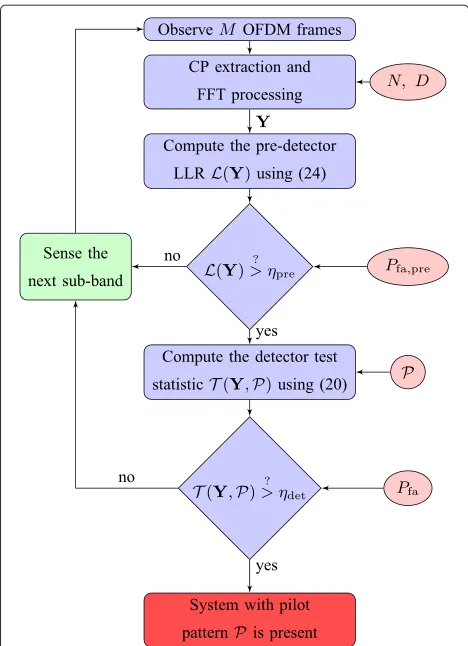
N,DandP are given for all specific networks of inter-est. A flow chart for the proposed spectrum sensing unit is illustrated in Figure 3. First, the sampled data are pro-cessed using FFT in order to obtainYn,kas in (6). Then, the
pre-detection is performed by computing LLRL(Y)and comparing it with a (pre-calculated) thresholdηpre as in (24). This thresholdηpreis set to satisfy a desiredPfa,pre. If
this LLRL(Y)is less than the threshold, this sub-channel is declared as vacant and the next sub-channel will be pro-cessed. Otherwise ifL(Y) > ηpre, the system will make
Figure 3A flow chart for the proposed architecture for the base-band spectrum sensing unit of the cognitive receiver.
ensure that the pre-detector is not eliminating potential events that are susceptible of being active systems, its probability of false alarm must be chosen large enough. This is because it filters some of the events and the miss-detection probability of a cascade system is less than that of each sub-system. Simulations in Section 5 show that to achieve good results we should choosePfa,pre>10Pfa.
5 Simulations
5.1 Synchronous case
Simulations are investigated on OFDMA signals, all the results are averaged over 1000 Monte-Carlo runs assume a perfect synchronization. In our simulations, the thresh-olds are determined experimentally, as follows: the deci-sion statistics for 104independent trials in the absence of
signal are sorted in a descending order and the threshold is chosen as the %100×Pfa-percentile of the resulting data.
For example forPfa =0.02, the threshold is chosen as the
0.02×104=200th ordered data; i.e., such that %100×Pfa
of the decision statistics are above the threshold. We have chosenM = 24 as the number of observed symbols for our simulations, (note that in WiMAX Mobile 24 symbols represents 2.5 ms).
First, we analyze the performance of the pre-detector for a 512 sub-carrier OFDM system withD = 64, 60 pilots, 360 data, 91 guard and 1 DC sub-carrier. The data sym-bols dn,k are randomly chosen from a QPSK, 16-QAM
or 64-QAM constellations with equal probabilities. The signal to noise ratio is defined as SNR = 10 log10(σEs2). The propagation channel is simulated as a discrete time frequency selective channel assuming that{h(l)}Ll=−01 are independent with zero-mean Gaussian distribution. We assume an exponential decay profile for the variance of
h(l), i.e.,E[|h(l)|2]= Ge−l/μforl = 0,. . .,L−1, where
Gis chosen such thatLl=−01E[|h(l)|2]=1. Figure 4 shows the probability of missed detection (Pmis=1−Pd, where Pdis the detection probability) versus the SNR for various
values of false alarm probability. As expected, we could achieve a lower probability of missed detection with-out using the pilot pattern information provided that we allow a higher false alarm ratePfa,prefor the pre-detector
thanPfa.
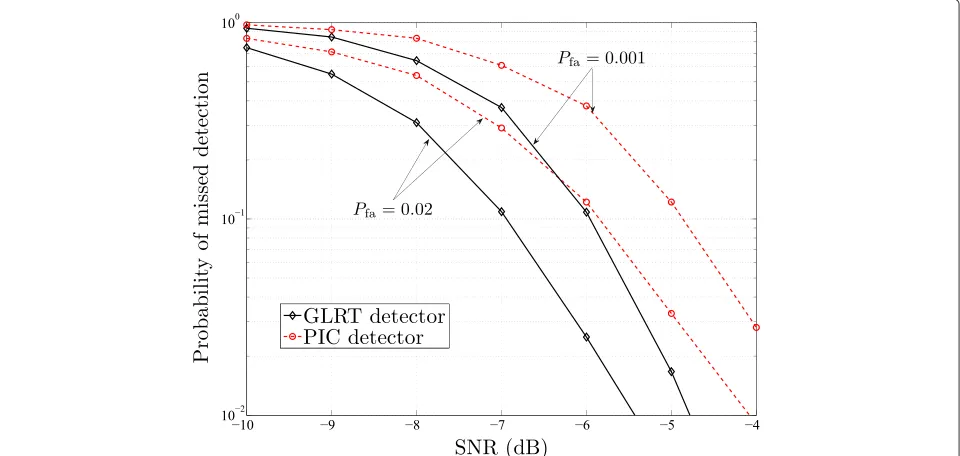
Following the simulation set up in [24], we compare our proposed detector with their method. The pilot configu-ration is comb-type (i.e., a given sub-carrier is dedicated to pilots ∀n), the correlation induced between pilots is such that pn,k = pn+2,k+210, the pilots are BPSK
sym-bols. We also normalize the data vector in each sub-carrier by its own standard deviation in order to obtain a less sensitive criterion to the unknown received signal gain as proposed in [24]. Figure 5 shows the performance of the proposed GLRT when compared to the pilot induced cyclo-stationarity detector (PICD) proposed in [24] for
Pfa=0.02 andPfa =0.001. We clearly see that the GLRT
outperforms the PICD by almost a 1 dB gain.
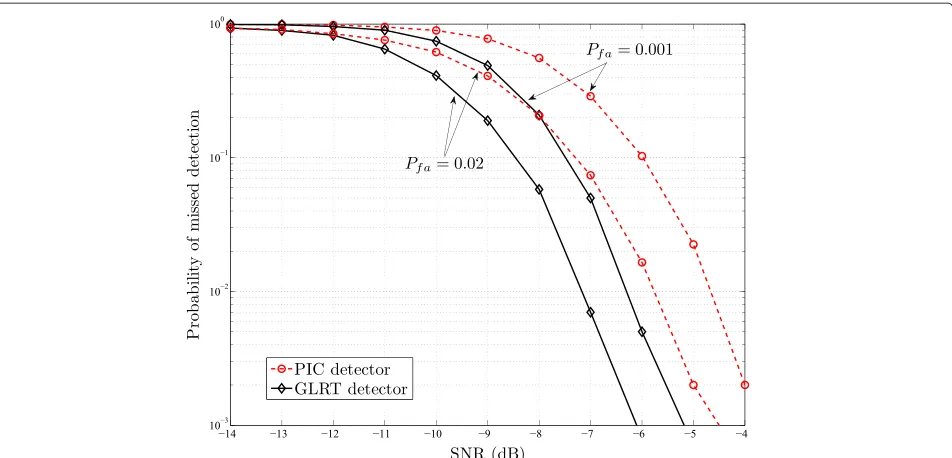
As a more realistic scenario, we consider the case of Mobile WiMAX DL-PUSC configuration [33] as illus-trated in Figure 1, where the pilots are BPSK symbols 2.54 dB boosted compared with data sub-carriersb. We assume that the transmit power for all data sub-carriers are equal, anddn,kare randomly and independently
cho-sen from a QPSK, 16-QAM or 64-QAM constellation. The propagation channel is generated by the same man-ner as in the previous simulation. We assume thatpn,k = pn,k+210since the algorithm in [24] requires such a
inten-tionally embedded correlation. Figure 6 compares the performance of GLRT with that of the PICD for Mobile WiMAX DL-PUSC configuration forPfa=0.02 andPfa =
0.001. We observe that the GLRT still conserves its 1 dB gain noticed in the previous context. In addition to this performance gain, the GLRT also extracts and provides several additional information, e.g., it estimates the noise variance and the channel response which are very good metrics that can be used to evaluate the link between the cognitive user and the base station.
Figure 4Probability of missed detection of the predetector versus SNR,N=512,M=24,μ=0.25D.
zero mean and variance ofσk2−σ2. However in practice, this assumption is not necessarily true; and in most stan-dards, this sequence is selected from a set of constellation points and is not a normal random process. To investi-gate the robustness of the proposed detectors versus this assumption, we have performed a number of simulations wheredn,kare randomly and independently chosen from a
QPSK, 16-QAM or 64-QAM constellation and compared
the results with the case of Gaussian data. For Figure 7 the false alarm rate is set toPfa = 0.02 and the sequence dn,k is generated to have either a Gaussian pdf or a
non-Gaussian pdf. In the non-non-Gaussian case,dn,kgenerated as Q-QAM sequence whereQis 4, 16, or 64 with equal prob-abilities. For each of these distributions, we considered two cases (1) an equal power is allocated to all frequency bins (dn,kis a white noise) and (2) the transmitter allocates
Figure 6Probability missed detection in the WiMAX DL-PUSC configuration (see Figure 1),N=512,M=24,μ=0.25D.
different power to different frequency bins (for exam-ple, this non-flat power allocation could be the result of a water-filling). For non-uniform power allocation, the power allocated to each frequency bin depends on the channel between the user and the base station which is unknown to the observer. Thus for simplicity, forQ-QAM the allocated powerE[|dn,k|2is adjusted/normalized as a
function of Qsuch that the minimum constellation dis-tance is constant for all bins. This figure reveals that
the performance proposed detectors are not sensitive the validity of the assumption that dn,k is Gaussian.
How-ever, the power allocation has significant impact on the detection performance of all algorithms.
In Figure 8, the receiver operating characteristic (ROC) curves are plotted for both pre-detector and detec-tor and different number of observed symbols M. As expected the performance of the algorithm increases as
Mincrease. This is justified intuitively, as more samples
Figure 8Receiver operating characteristic curves for different number of observed OFDM frames values, SNR=−12 dB,N=512, μ=0.25D, for the WiMAX DL-PUSC configuration (see Figure 1).
results in more information and more accurate estimation of unknown parameters and hence the detection perfor-mance improves. Unfortunately we can not increase M
arbitrarily since it determines the acquisition time (the time lag before a decision is made), for instance 12, 24, and 48 observed OFDM symbols represent 1.25, 2.5, and
5 ms time-lag for WiMAX Mobile. Thus in practice, these curves represent the trade-off between the time-lagMand
(Pfa,Pfa,pre)for a given required performance.
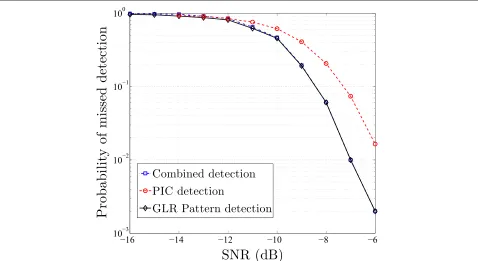
In Figure 9, the performance of the cascade combi-nation of the pre-detection and the GLRT is compared with that of the PICD and that of the proposed GLRT
without any pre-detection. The curves for the GLRT and the PICD are plotted for Pfa = 0.02. For the cascade combination, first the pre-detection in (24) is performed with a Pfa,pre = 0.2. Then if any signal is pre-detected,
the identification algorithm in (20) is performed with a
Pfa = 0.02. We observe that their performance are very
similar. This is justified by the fact that the pre-detector performs well in the SNR operating range, i.e., the missed detection probability of the pre-detector is very small and it is very unlikely that potential candidate is rejected by the pre-detector. This is why the performance of the cas-cade combination is not deteriorated compared with that of GLRT.
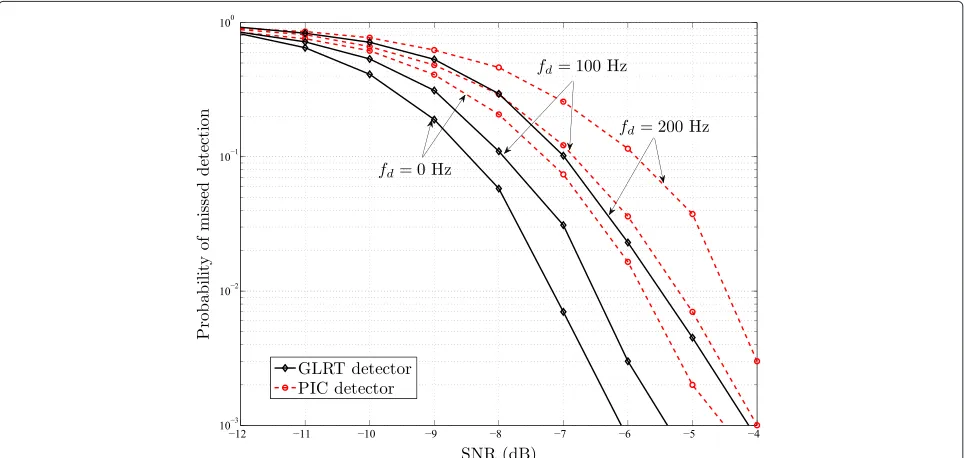
Figure 10 highlights the effect of time varying chan-nels on the performance of the GLRT detector. Time variation has been simulated using Jake’s model [44] for values of the maximum Doppler frequenciesfd = 0, 100
and 200 Hz and a false alarm rate of Pfa = 0.02. We
clearly observe that the proposed method is also robust to Doppler spread. For example for a doppler of 200 Hz, both algorithms lose about 1.33 dB.
5.2 Asynchronous case
All derivations in this article so far was based on the assumption that the observer is fully synchronized with the active systems. Unfortunately in practice, the observer could not be synchronized with the systems which are not detected yet. Thus here, we consider the case in which
(ε,τ,ϕ)defined in (5) is not zero. It is easy to see that the phase shift mismatch ϕ has no impact on the proposed
algorithms, since the decision statistics are invariant to the transformationG(y(m))=y(m)ejϕ. However, the fre-quency offsetεand the time delayτresult in inter-carrier interference (ICI) and inter-symbol interference (ISI), respectively. In other words, the impact ofεandτ appear as an unknown shift in frequency and time, respectively. A number of techniques are proposed in the literature like Schmidl-Cox [45], Minn-Bhargava [46] or Shi-Serpedin [47]. Unfortunately, these techniques require that a periodic pattern to be present in the signal. This requirement is practically not satisfied for the defined standards. Moreover, the cognitive receiver can only pro-cess a random portion of the signal; this makes it highly unlikely to pick up one OFDM symbol containing the periodic pattern.
To overcome this problem we propose another approach. After applying the FFT to the data instead of (6), we obtain
Yn,k
= √1
N N−1
m=0
y[n(N+D)+D+m−τ]e−2iπ(kmN+ε)
(28)
For the synchronization purpose, we search on all discrete values ofτ as a multiple integer factor ofN+Dandεas a multiple integer factor of inter carrier frequency spac-ing. So, we could either shift in time and in frequency the received signal to match the pilot pattern or equivalently shift back the pilot pattern to math the unknown discrete
values of(ε,τ ). LetPε,τ denotes the known pilot pattern
shifted back in frequencyεand in timeτ. We define the following decision statistic
max
(ε,τ ){T(Y,Pε,τ)} H1
≷
H0 η, (29)
whereT is defined in (20). It is obvious that the(ε,τ )=
arg max
ε,τ {T
(Y,Pε,τ)}are maximum likelihood estimates of
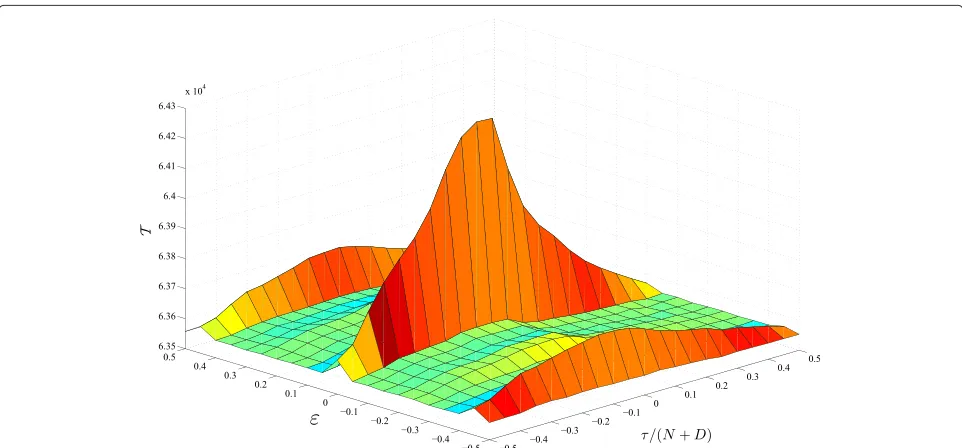
ε and τ. Thus, this detector jointly performs synchro-nization along with the detection. This is highlighted in Figure 11, where the values of the test statistic are plotted for different frequencies and timing offsets using a signal model similar to the one depicted in Figure 1 for a fully synchronized case. The SNR is set to 0 dB, the number of observed OFDM symbols is set toM=24. The time offset is varying in the intervalτ ∈[−0.5(N+D), 0.5(N+D)] and the frequency offsetε∈[−0.5, 0.5]. The Figure shows that the test statistic is maximum forε=0 (no ICI) andτ =0 (no ISI) which confirms thatε,τ are the ML estimates of
εandτ.
To study the impact of this approach, we performed sim-ulations where the received signal is suffering from a dis-crete time-frequency mismatch such thatτ ∈[−0.5(N+ D), 0.5(N +D)] and the frequency offsetε ∈[−0.5, 0.5]. The maximization described in 29 is achieved by explor-ing discrete value within the two described intervals. Each interval is sampled into 11 uniformly distributed values. Thus we have to compute 121 values of the decision statis-tic, the maximum is achieved when the couple(τˆ,ε)ˆ is
nearest to the true values(τ,ε). In order to keep the false alarm rate to the expected value, maximizing the cost function implies to adjust the detection threshold. In fact, ifKεandKτdenote the number of discrete frequency and
time shifts, respectively, thenKεKτ test statistics have to
be computed. Assuming that underH0 the test statistic
values are independent from one shift to another. Thus, the detection threshold has to verify
(FT,H0(ηdet))KεKτ =1−Pfa. (30)
The obtained results for a WiMAX configuration are plot-ted in Figure 12. Compared to the synchronous case (Figure 6), we first remark that both algorithms suffer a performance loss of about 1 dB. In addition to this com-mon loss, the proposed GLRT is also loosing about 1 dB gain against the PIC detector. This is due to the shape of the test statistic (Figure 11) versus(ε,τ ). This shows that for the synchronization our criterion compared to the PIC criterion is much sharper and has faster decay around the true value(ε,τ ).
The computational complexity of (29) isKεKτtimes that
of (20). However, employing the cascade combination and using a judiciously chosen valuePfa,pre, the average
com-putational cost is considerably reduced. In this case, if no signal is present less computational resource is wasted for synchronization. Under H0, the computational cost
is CC0 = CCpre+KεKτPfa,preCCGLRT, where CCpreand
CCGLRT are the computational cost of the pre-detector
and the GLRT detector, respectively. UnderH1, the
com-putational cost is CC1 = CCpre + KεKτPd,preCCGLRT,
where Pd,pre is the detection probability of the
Figure 12Effect of synchronization impairment on the performance of the proposed algorithm, WiMAX DL-PUSC configuration (see Figure 1),N=512,M=24,μ=0.25D,τ∈[−0.5(N+D),0.5(N+D)]andε∈[−0.5, 0.5].
detector. The overall CC of the receiver is CC =
P[H0] CC0+(1−P[H0])CC1. Figures 13, illustrate the
overall computational cost of the receiver versusPfa,prefor
different values ofP0and SNR. The CC increases asPfa,pre
increases, and thus, a judicious choice onPfa,prehas to be
done to maintain a good performance of the pre-detector providing a reasonable overall CC.
5.3 Discussion on the case where the data symbols are PSK signals
For current and most known future systems, the pilot symbols are PSK signals. This particularity has been exploited in this article and allows us to make use of the algorithm proposed in [34]. For high SNRs between the BS and the receiver, the data symbols are drawn
Figure 14Behavior of the test statistic in a case where BPSK symbols are present everywhere, the pilots are BPSK symbols 2.54 dB boosted, SNR=0dB, WiMAX DL-PUSC configuration (see Figure 1),N=512,M=24,μ=0.25D.
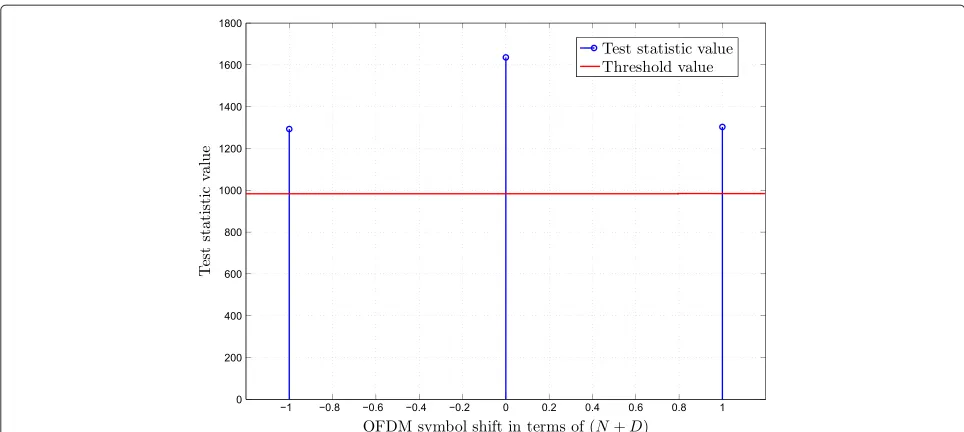
from a large number of constellation points such as 16-QAM or 64-16-QAM. However as an observer, the cognitive device can intercept a communication between a BS and a mobile with a low SNRs, where to fit the BER require-ment the number of constellation points is reduced. Thus, we observe BPSK or QPSK signals not only on pilot posi-tions but also on the data posiposi-tions in the sub-carriers with lower SNRs. Since our method relies on the pattern of PSK signals, a false alarm can be triggered when the pilot pattern is absent but when the tested position contains PSK signals of the same order of the desired pilot pat-tern, misleading our decision. However, we can get around this problem exploiting the fact that the pilots are always boosted in power in the existing standards (for example, 3 dB for WiFi, 2.54 dB for WiMax). This power difference could be easily exploited to identify the pilot pattern using an exhaustive search similar to (29). Figure 14 shows the test statistic value for the signal model plotted in Figure 1. The length of the pilot pattern is equal to 2, thus we computedT when shifting the signal by one OFDM sym-bol forward and backward. As expected, the test statistic values are greater than the threshold, however, the test statistic is maximum only for the correct position of the pattern since the pilots are boosted.
6 Conclusion
In this article, we presented a new method for the detection of active OFDM based systems. The proposed method exploit the pilot pattern embedded into existing standards as a characteristic for such a detection and is based on a GLR test. The presented algorithm is compu-tationally inexpensive and does not require any overhead
or modification into the actual structure of the PHY layer of the networks of interest. The performance of the pro-posed method is compared against the PICD propro-posed in [24]. The proposed technique outperforms the pilot based identifiers proposed in the literature and shows an equivalent robustness to the propagation environment. Since this algorithm, in contrast to the PICD, does not exploit any a-priori information about the pilot correla-tion it could be employed for all other existing standards such as LTE, DVB-T. We also proposed another GLRT-based pre-detector which ignores the pilot information and is just used as a filter in order to reduce the com-putational cost for the cases where a large number of possible systems/patterns need to be tested. Moreover as a side product, the proposed detector performs noise variance estimation, channel magnitude estimation and time-frequency synchronization. These extracted infor-mation can be used to sense the quality of service of the detected network.This knowledge will also help the user to chose the network offering the best link quality, approaching the always best connected concept.
Endnote
ae.g., when observing 24 symbols (2.5 ms) in the WiMAX
standards using 512 sub-carriersMNcosts 12288.
bNote that as we can see in Equation (20), the test
statistic does not depend on the pilots power. Thus, the algorithm works even if the pilot and data tones have the same power.
Competing interests
Author details
1Institut Telecom, Telecom Bretagne, UMR CNRS 3192 Lab-STICC, Universit ´e
Europ´eenne de Bretagne, Bretagne, France.2Electrical and Computer Engineering Department, Queen’s University, Kingston, Ontario, Canada.
Received: 17 July 2012 Accepted: 7 February 2013 Published: 15 March 2013
References
1. U.S. FCC, Review of Spectrum Management Practicies. Tech. Rep. Federal Communications Commission (2002)
2. U.S. FCC, Second Report and Order and Memorandum Opinion and Order, in the Matter of Unlicensed Operation in the TV Broadcast Bands Additional Spectrum for Unlicensed Devices Below 900 MHz and in the 3 GHz Band. Tech. Rep. Federal Communications Commission (2008) 3. IEEE 802.22 WG, IEEE 802.22 Working Group on Wireless Regional Area
Networks Enabling Rural Broadband Wireless Access Using Cognitive Radio Technology. http://www.ieee802.org/22/. [Online; accessed 24-Sep-2010]
4. J Mitola, GQ Maguire, Cognitive radio: making software radios more personal. IEEE Personal Commun.6(4), 13–18 (1999)
5. S Haykin, Cognitive radio: brain-empowered wireless communications. IEEE J. Sel. Areas Commun.23(2), 201–220 (2005)
6. U.S. FCC, Notice of Proposed Rulemaking, in the Matter of Unlicensed Operation in the TV Broadcast Bands (ET Docket no. 04-186) and Additional Spectrum for Unlicensed Devices below 900 MHz and in the 3 GHz Band. Tech. Rep. FCC ET Docket 04–113 (2004)
7. E Gustafsson, A Jonsson, Always best connected. IEEE Trans. Wirel. Commun.10(1), 49–55 (2003)
8. Z Dai, R Fracchia, J Gosteau, P Pellati, G Vivier, inIEEE International Conference on Communications, ICC’08. Vertical Handover Criteria and Algorithm in IEEE802.11 and 802.16 Hybrid Networks, (2008), pp. 2480–2484
9. J McNair, F Zhu, Vertical handoffs in fourth-generation multinetwork environments. IEEE Trans. Wirel. Commun.11(3), 8–15 (2004) 10. H Urkowitz, Energy detection of unknown deterministic signals. Proc.
IEEE.55(4), 523–531 (1967)
11. D Cabric, SM Mishra, RW Brodersen, inConference on Signals, Systems and Computers, 2004. Conference Record of the Thirty-Eighth Asilomar, vol. 1. Implementation issues in spectrum sensing for cognitive radios (IEEE, pp. 772–776
12. C Stevenson, G Chouinard, Z Lei, W Hu, S Shellhammer, W Caldwell, IEEE 802.22: the first cognitive radio wireless regional area network standard. IEEE Commun. Mag.47(1), 130–138 (2009)
13. D Birru, S Shankar, C Cordeiro, K Challapali, IEEE 802.22: an introduction to the first wireless standard based on cognitive radios. J. Commun. 1(1), 38–47 (2006)
14. A Bouzegzi, P Ciblat, Jallon, New algorithms for blind recognition of OFDM based systems. Elsevier Signal Process.90(3), 900–913 ((2010)) 15. A Punchihewa, VK Bhargava, C Despins, Blind estimation of OFDM
parameters in cognitive radio networks. IEEE Trans. Wirel. Commun. 10(3), 733–738 (2011)
16. N Han, G Zheng, SH Sohn, JM Kim, in4th International Conference on Wireless Communications, Networking and Mobile Computing, WiCOM’08. Cyclic autocorrelation based blind OFDM detection and identification for cognitive radio, (2008), pp. 1–5
17. M Oner, F Jondral, On the extraction of the channel allocation information in spectrum pooling systems. IEEE J. Sel. Areas Commun. 25(3), 558–565 (2007)
18. T Yucek, H Arslan,OFDM signal identification and transmission parameter estimation for cognitive radio applications, (2007), pp. 4056–4060 19. H Li, Y Bar-Ness, A Abdi, OS Somekh, W Su, in1st International Conference
on Cognitive Radio Oriented Wireless Networks and Communications. OFDM modulation classification and parameters extraction, (2006), pp. 1–6
20. A Al-Habashna, OA Dobre, R Venkatesan, DC Popescu, inIEEE International Conference on Communications (ICC). Joint cyclostationarity-based detection and classification of mobile wimax and lte ofdm signals, (2011), pp. 1–6
21. PD Sutton, KE Nolan, LE Doyle, Cyclostationary signatures in practical cognitive radio applications. IEEE J. Sel. Areas Commun.26(1), 13–24 (2008)
22. K Maeda, A Benjebbour, T Asai, T Furuno, T Ohya, inIEEE 2nd International Symposium on New Frontiers in Dynamic Spectrum Access Networks, DySPAN. Recognition among OFDM-based systems utilizing cyclostationarity-inducing transmission, (2007), pp. 516–523 23. K Maeda, A Benjebbour, T Asai, T Furuno, T Ohya, inEurasip Journal on
Wireless Communications and Networking. Cyclostationarity-inducing transmission methods for recognition among OFDM-based systems, (2008), pp. 1–14, 10.1155/2008/586172
24. F-X Socheleau, S Houcke, P Ciblat, A Aissa-El-Bey, Cognitive OFDM system detection using pilot tones second and third-order cyclostationarity. Elsevier Signal Process.91(2), 1–17 (2011)
25. Y-H Jung, YH Lee, Use of periodic pilot tones for identifying base stations of FH-OFDMA systems. IEEE Commun. Lett.10(3), 192–194 (2006) 26. A Al-Habashna, OA Dobre, R Venkatesan, Popescu D C, inGLOBECOM 2010,
2010 IEEE Global Telecommunications Conference. Cyclostationarity-based detection of lte ofdm signals for cognitive radio systems, (2010), pp. 1–6 27. AJ Coulson, Maximum likelihood synchronization for OFDM using a pilot symbol: algorithms. IEEE J. Sel. Areas Commun.19(12), 2486–2494 ((2001)) 28. TM Schmidl, DC Cox, Robust frequency and timing synchronization for
OFDM. IEEE Trans. Commun.45(12), 1613–1621 (1997) 29. A Viholainen, T Stitz, T Ihalainen, M Renfors, inEURASIP Journal on
Advances in Signal Processing, vol. 2010:741429. Pilot-based synchronization and equalization in filter bank multicarrier communications (EURASIP, 2010), pp. 1–18
30. Y Li, Pilot-symbol-aided channel estimation for OFDM in wireless systems. IEEE Trans. Veh. Technol.49(4), 1207–1215 (2000)
31. S Colieri, M Ergen, A Puri, A Bahai, inIEEE 56th Vehicular Technology Conference, 2002. Proceedings. VTC 2002-Fall, vol. 2. A study of channel estimation in OFDM systems (IEEE, 2002), pp. 894–898
32. S Colieri, M Ergen, A Puri, A Bahai, Channel estimation techniques based on pilot arrangement in OFDM systems. IEEE Trans. Broadcast. 48(3), 223–229 (2002)
33. IEEE Std 802.16, Part 16: air interface for broadband wireless access systems, Amendment 2: Physical and Medium Access Control layers for Combined Fixed and Mobile Operation in License Bands and Corrigendum, IEEE, vol. 1(2005), pp. 1-822
34. S Gazor, M Derakhtian, AA Tadaion, Computationally efficient maximum likelihood sequence estimation and activity detection for M-PSK signals in unknown flat fading channels. IEEE Signal Process. Lett.17(10), 871–874 (2010)
35. AA Tadaion, M Derakhtian, S Gazor, MM Nayebi, MR Aref, Signal activity detection of phase-shift keying signals. IEEE Trans. Commun.54(6), 1143–1143 (2006)
36. E Axell, EG Larsson, Optimal and sub-optimal spectrum sensing of OFDM signals in known and unknown noise variance. IEEE J. Sel. Areas Commun. 29(2), 290–304 (2011)
37. S Bokharaiee, HH Nguyen, E Shwedyk, Blind spectrum sensing for OFDM-based cognitive radio systems. IEEE Trans. Veh. Technol.60(3), 858–871 (2011)
38. H shin Chen, W Gao, D Daut, Spectrum sensing for OFDM systems employing pilot tones. IEEE Trans. Wirel. Commun.8(12), 5862–5870 (2009)
39. J Font-Segura, X Wang, Glrt-based spectrum sensing for cognitive radio with prior information. IEEE Trans. Commun.58(7), 2137–2146 (2010) 40. RE Glaser, The ratio of the geometric mean to the arithmetic mean for a
random sample from a gamma distribution. J. Am. Stat. Assoc.71(354), 480–487 (1976)
41. S-M Kay,Fundamentals of Statistical Signal Processing, Volume II: Detection Theory, ((Prentice Hall, Upper Saddle River, 1998). ISBN 0-13-504135-X 42. IF Akyildiz, W-Y Lee, MC Vuran, S Mohanty, Next generation/dynamic spectrum access/cognitive radio wireless networks: a survey. Comput. Netw. Elsevier.50(13), 2127–2159 (2006)
43. F-K Jondral, Software-defined radio basics and evolution to cognitive radio. EURASIP J. Wirel.Commun. Network.3, 275–283 (2005)
44. WC Jakes,Microwave Mobile Communications. (John Wiley and Sons Inc., New York, 1975)
46. H Minn, VK Bhargava, in2000 IEEE 51st Vehicular Technology Conference Proceedings, vol. 1. A simple and efficient timing offset estimation for OFDM systems, VTC 2000-Spring Tokyo, 2000), pp. 51–55
47. K Shi, E Serpedin, Coarse frame and carrier synchronization of ofdm systems: a new metric and comparison. IEEE Trans. Wirel. Commun. 3(4), 1271–1284 (2004)
doi:10.1186/1687-1499-2013-72
Cite this article as:Oularbiet al.:GLR test for OFDM system identification using pilot tones pattern.EURASIP Journal on Wireless Communications and Networking20132013:72.
Submit your manuscript to a
journal and benefi t from:
7Convenient online submission 7Rigorous peer review
7Immediate publication on acceptance 7Open access: articles freely available online 7High visibility within the fi eld
7Retaining the copyright to your article
![Figure 1 An example for pilot pattern configuration (for 802.16e WiMax DL-PUSC),data-subcarriers N = 512 subcarriers which include 360, 60 pilot-subcarriers and 92 null-subcarriers (46 left guard band and 45 right guard band and one DC) [33].](https://thumb-us.123doks.com/thumbv2/123dok_us/969844.1119080/3.595.58.539.627.707/figure-example-conguration-subcarriers-subcarriers-include-subcarriers-subcarriers.webp)
![Figure 2 The empirical pdfs of the pre-detector statistic L underH0 and H1 and the approximated normal distribution in (25)and (26), with M = 24, N = 512, σ 2k chosen according touniform law in the interval [1,2].](https://thumb-us.123doks.com/thumbv2/123dok_us/969844.1119080/7.595.306.541.85.276/empirical-detector-statistic-approximated-distribution-according-touniform-interval.webp)
![Figure 12 Effect of synchronization impairment on the performance of the proposed algorithm, WiMAX DL-PUSC configuration (seeFigure 1), N = 512, M = 24, μ = 0.25D, τ ∈[ −0.5(N + D), 0.5(N + D)] and ε ∈[ −0.5, 0.5].](https://thumb-us.123doks.com/thumbv2/123dok_us/969844.1119080/14.595.56.539.473.711/eect-synchronization-impairment-performance-proposed-algorithm-conguration-seefigure.webp)