R E S E A R C H
Open Access
Performance analysis for an enhanced
architecture of IoV via Content-Centric
Networking
Zhuo Li
1,2,3*, Yutong Chen
4, Deliang Liu
5and Xiang Li
6Abstract
TCP/IP protocol gradually exposes many shortcomings such as poor scalability and mobility. Content-Centric Networking is a new architecture which cares about the content itself rather than its source. Therefore, this paper proposes a novel IoV architecture which based on Content-Centric Networking and tests its transmission
interference time, transmission delay, and throughout in network layer. The experimental results show that the novel architecture is superior to the current IoV in the communication performance.
Keywords:Content-Centric Networking, Internet of Things, Internet of Vehicles, Performance
1 Introduction
As a key member of the Internet of Things (IoT), Internet of Vehicles (IoV) will greatly change the future life [1]. IoV turns each participating vehicle into a mobile node and make vehicles connect to each other; hence, it creates a network with a wide range. The basic types of IoV communications could be divided into Vehicle to Vehicle (V2V) communications and Vehicle to Road (V2R) communications [2]. With On-board Unit (OBU) and Roadside Unit (RSU) as network nodes, IoV enables vehicles to transmit data in a single hop or multi-hop [3]. OBU is used as the network terminal node to transmit information toward other OBU and RSU. RSU which deploys along the road is the fixed node in V2R communi-cations [4]. OBU links with local Internet service provider through RSU, so it can visit remote Internet server. There-fore, RSU plays a role of gateway in IoV.
To achieve many outstanding functions such as intelli-gent traffic management, intelliintelli-gent vehicles control, and dynamic information service, IoV needs to meet follow-ing basic communication requirements [5]: (1) relatively low communication delay, (2) sufficient transmission distance, and (3) high reliability under high-speed
mobile environment. Meanwhile, the network topology of IoV is complicated and changes rapidly, the time of duration of communications link is short, and the moving range of nodes is broad [6]. The current IoV which mainly adopts IEEE WAVE protocol stack, deploys TCP/IP protocol on transport layer and network layer to be compatible with IP network [7, 8]. Compared with other wireless communication technique, WAVE already has excellent communication performances such as low transmission delay (0.0002 s), long transmission distance (1000 m), and high transmission rate (27 Mbit/s) [9]. But because of basing on IP address, WAVE could not support the mobility well. Continuously, changes in the network topology will cause frequent reallocation of IP address and make current IoV architecture not applicable to communication scenarios which focus on the content itself rather than its provenance [10, 11]. So, it is urgent to find a revolutionary solution to build a new architecture of IoV which can response to the development better [12]. Therefore, a novel architecture of IoV named CCN-IoV was firstly proposed. Compared with IP network, CCN-IoV located the content chunks of CCN in network layer, fundamentally changes the traditional end-to-end transmission mode, and improves mobile communica-tion performance of IoV. Then, the paper develops experimental measurements for the network layer to find transmission interference time, transmission delay, and throughout under different application * Correspondence:[email protected]
1
Tianjin Key Laboratory of Wireless Mobile Communications and Power Transmission, Tianjin Normal University, Tianjin 300387, China 2College of Electronic and Communication Engineering, Tianjin Normal University, Tianjin 300387, China
Full list of author information is available at the end of the article
scenarios. Experimental results show that CCN-IoV has better communication performance.
The other parts of the paper are as follows: the second section introduces CCN, the third section pre-sents CCN-IoV in detail, the forth section evaluates the performance of CCN-IoV, and the last section is the conclusion.
2 Content-Centric Networking
Aiming at the deficiency of IP network, Van Jacobson put forward Content-Centric Networking (CCN) in 2009. Different from the IP network, CCN is content-oriented, no longer focuses on interface address or host location information [13]. So, CCN fundamentally changes the IP package structure as well as addressing mode. What is more, CCN has characteristics of short transmission delay, low power consumption, and high reliability, so it can fully respond to the future develop-ment of mobile Internet [14].
Compared with IP network, CCN exchanges Interest and Data for communication which is driven by con-sumers [15]. Interest from customers and Data from producer are the two types of CCN packets, both of them identify the content by name which is opaque to the network. Inspired by the structure of URLs, CCN uses a hierarchical data structure for name [16]. And the name of content is divided into a number of components which represent the context and relation-ships of data elements. Compared with the IP address, name has stronger expressive ability due to the semantic meaning and improves the efficiency of routing and forwarding.
Furthermore, CCN uses the adaptive forwarding plane to guide the routing and forwarding of packets [17]. An adaptive forwarding strategy can send Interests along optimum paths to avoid congestion and failures, balance payload, detect, and react to attacks such as prefix hijacking and Distributed Denial of Service (DDoS). On the adaptive forwarding plane, each NDN router main-tains three data structures: a Pending Interest Table (PIT), a Forwarding Information Base (FIB) [18, 19], and a Content Store (CS). PIT stores all the Interests that a
router has forwarded but not satisfied yet. FIB is similar to the routing table in IP network, which provides the path information for forwarding. However, CCN allows the simultaneous use of multiple interfaces to forward the same Interest and the IP network can only use one interface. What is more, CS is a temporary cache of Data which received recently, so it is convenient to satisfy future Interests and save the bandwidth of network.
CCN has advantages of balancing network payload, reducing network traffic, and improving communica-tion reliability. Applying CCN to IoV can meet needs of IoV development for big data, high data rate, and low latency communication. At present, there are few researches focus on combining CCN with IoV, and the research on the performance test of the novel architecture has not been reported.
3 CCN-IoV
In this section, combined with IoV characteristics and demands, we introduce a novel architecture of IoV which based on CCN in detail and describe the commu-nication process of CCN-IoV.
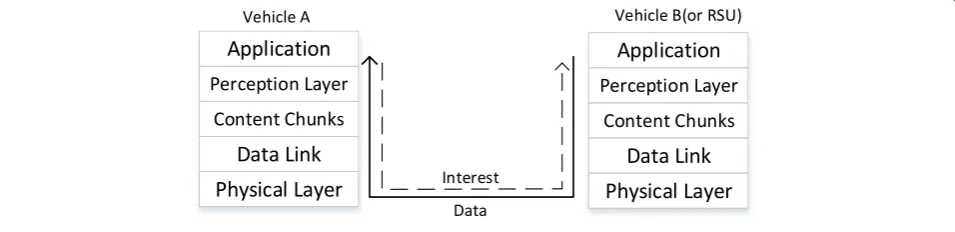
The architecture of CCN-IoV is divided into five parts: physical layer, data link layer, network layer, perception layer, and application layer, among which perception layer is composed with various kinds of sensors and gateway, so it could collect information of vehicles, traffic state, and road environment. Network layer seems to be the neural center and brain of IoV, it uses content chunks of CCN to transmit and handle information that acquired from perception layer. Application layer will support different applications which pay attention to what the content is, such as accident handling and dynamic traffic guidance.
Network layer of IoV based on CCN exchanges Interest and Data to communicate according to names. Compared with traditional IP network architecture, CCN-IoV could support in-network caching and multi-cast na-tively without any additional protocols or mechanisms. The communication process is shown as Fig. 1: vehicle A packs name into Interest and broadcasts it toward potential producers. In the course of broadcasting,
when a middle node of the route receives the Interest and has data matching it, the Data will be returned to vehicle A using the Interest path in reverse. Otherwise, vehicle A needs to get response from the server of CCN-IoV. Then, the Data will be cached in the middle nodes on the path according to the name so that they can reply following Interests which request the same data. Therefore, CCN-IoV will greatly reduce the post-back pressure of network and improve the efficiency of flow management. So, it is quite fit for the situation which topology changes frequently and supports content-oriented applications.
In conclusion, CCN-IoV can realize the high reli-ability and low delay of data transmission. Compared with the current IoV, CCN-IoV has more simplified structure and more efficient communication process.
4 Evaluation and discussion
CCN-IoV uses content chucks of CCN in network layer, so, in this section, we mainly evaluated the performance of network layer by measuring transmission interference time, transmission delay, and throughout. In particular,
there are few researches on the transmission interference time of IoV, so we refer to the parameter of high-speed railway mobile communication system GSM-R [20]. Results show that CCN-IoV has more excellent commu-nication performance than the current IoV.
4.1 Experimental setup
Experiments are implemented in C++ and Python lan-guages, tested on a PC with an Inter Corei5-3470 CPU of 3.20 GHz and DDR3 SDRAM of 4GB. We use the CCN simulator called ndnSIM 2.0 [21] to simulate and experiment. To make the same underlying transport environment as IP network, we configure and modify the interface module of physical layer and data link layer in ndnSIM 2.0 [22], so the experimental results are more comparable and persuasive.
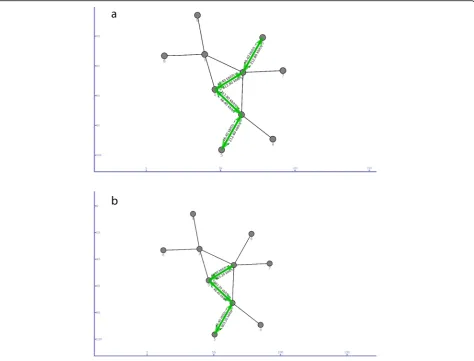
By using ndn::AppDelayTracer of ndnSIM 2.0, we can record the transmission status of packets in a text file, so it is easy to analyze the experimental results in various communication environments. The experimental topology consists of 10 nodes is shown in Fig. 2.
a
b
According to the current demands for communica-tion, we test transmission interference time, trans-mission delay, and throughout under different application scenarios. Packets are routed and for-warded based on the best route strategy. The net-work bandwidth is set to be 10 MHz, costumer sends 200 Interests per second. By simulating the communication process that vehicles exchange 100 bytes Data, the communication performance of V2V are tested. In the same way, by simulating the process that RSU releasing 340 bytes Data to vehicles, we can estimate the communication performance of V2R. Mean-while, in order to evaluate the mobility of CCN-IoV, we let vehicles move rapidly and then respectively simulate conditions that vehicle interrupts connection with surrounding vehicle and RSU.
4.2 Transmission interference time
The set maximum moving speed of vehicles is 180 Km/ h, the distance between two base stations is 500 m, and the initial distance between vehicles is 250 m. Vehicles and RSUs have the same communication range which is 250 m. Because of referring to the transmission interfer-ence time of GSM-R, the switching time between two base stations is set to be 300 m. To test the mobility, vehicle 5 is set to be disconnected with RSU 1 at 1.000000 s and connected with RSU 2 at 1.300000 s. Besides, the transmission interference time of CCN is related to the network bandwidth as well as the amount of Interests sent by customer per second, but it has nothing to do with the packet payload. Therefore, whether in V2V or V2R communications, CCN-IoV has the same transmission interference time. In this paper, we only analyze the transmission interference time in the V2R communications, and vehicle 5 requests data to RSU 2.
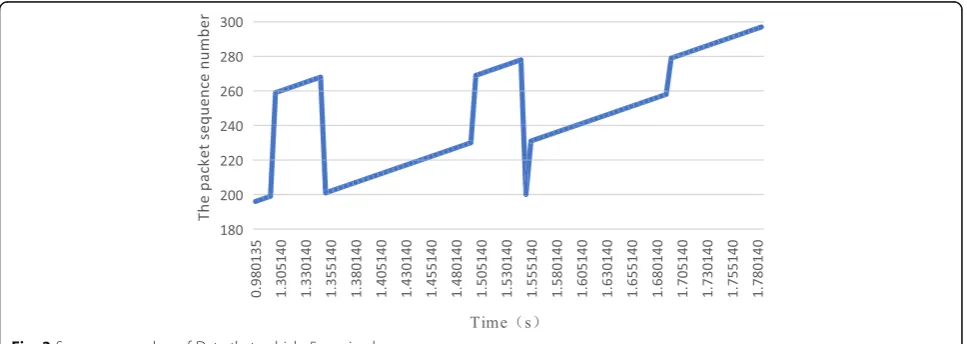
Before the communication link broke, vehicle 5 broadcast Interests toward RSU 2, then Interests passed through RSU 1 and arrived at RSU 2 finally. When RSU 2 received Interests, it packed correspond-ing content in Data and sent it to vehicle 5. The ex-periment results show in Fig. 3. The serial numbers that vehicle 5 received changed linearly before 1.000000 s, which proves that the data transmission is normal. Vehicle 5 received no.199 Data at 0.995135 s and continued sending Interests to RSU 2 in order from 0.995135 to 1.000000 s. Because moving rapidly, vehicle 5 disconnected with RSU 1 at 1.000000 s, Data and Interest cannot be transferred through the com-munication link. But because of in-network caching, Data that responded by RSU 2 would be cached in the RSU 1 and RSU 2. When vehicle 5 connected with RSU 2 at 1.300000 s, it started to receive no.259 Data. Later, the serial numbers of Data that vehicle 5 re-ceived increases linearly until no.268 Data is rere-ceived at 1.345140 s. Owing to not receiving Data that vehicle 5 requested during 0.995135s~1.000000 s, vehicle 5 would retransmit expired Interests. Then, vehicle 5 may receive Data that both cached in the network
routers, and RSU 2 responded latest during
1.300000~1.690140 s.
In conclusion, after the reconstruction of the communication link, the Data transmission process (from 1.300000 to 1.690140 s) is disturbed. At last, the communication process recovered at 1.690140 s. Therefore, the transmission interference time of CCN-IoV is 390 ms and can meet future demands of mobility well.
4.3 Transmission delay
4.3.1 Transmission delay in the V2V communications Vehicle 5 is set to request data from vehicle 6. Before the communication link broke, vehicle 5 broadcasts
Interests toward vehicle 6, Interests passed through RSU 1、RSU 2 then arrived at vehicle 6. Then, vehicle 6 returned Data which payload is 100 bytes to vehicle 5. The experimental results are shown in Table 1, when the communication link was not interrupted, the transmis-sion delay of network layer is less than 0. 076264 ms. But vehicle 5 disconnected with RSU 1 at 1.000000 s, and the Data that vehicle 6 responded subsequently would be cached in RSU 1 and RSU 2 due to in-network caching. So, when vehicle 5 connected to RSU 2 at 1.300000 s, the transmission delay of Data no.200 to no.258 requested before needs less than 0.071160 ms. Hence, in the V2V, the transmission delay of CCN-IoV is less than 0.076264 ms.
4.3.2 Transmission delay in the V2R communications Vehicle 5 is set to request data from RSU 2. Before the communication link broke, vehicle 5 broadcasts Interests
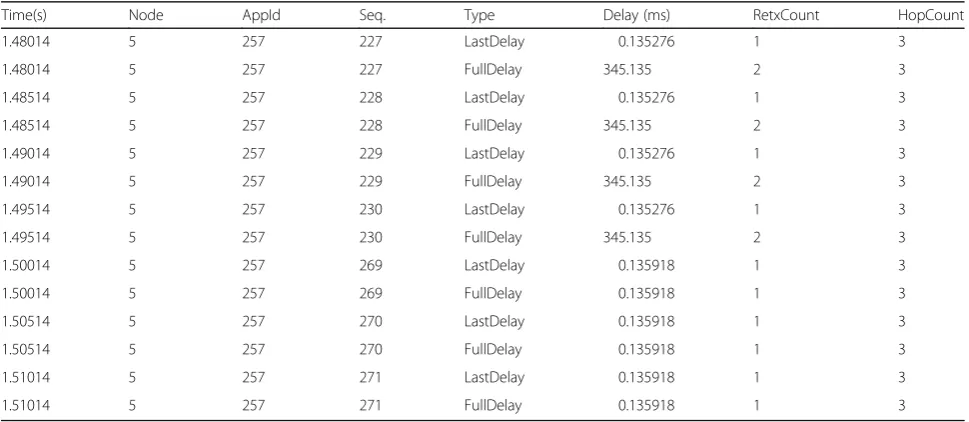
toward RSU 2, Interests passed through RSU 1, then arrived at RSU 2 finally. After that, RSU 2 returned Data which payload is 340 bytes to vehicle 5. The experimental results are shown in Table 2, when the communication link was not interrupted, the transmission delay of network layer is less than 0.135918 ms. But vehicle 5 disconnected with RSU 2 at 1.000000 s, and the Data that RSU 2 responded subsequently would be cached in RSU 1 and RSU 2 due to the in-network caching. So, when vehicle 5 connected to RSU 2 at 1.300000 s, the transmis-sion delay of Data no.200 to no.258 which requested before needs less than 0.135276 ms. Hence, in the V2V, the transmission delay of CCN-IoV is less than 0.135918 ms.
In conclusion, whether in the V2V or V2R commu-nications, the transmission delay of network layer is less than 0.200000 ms which WAVE requires. From this point of view, CCN-IoV is better than the current IoV.
Table 1Transmission delay in the V2V communications
Time Node AppId Seq. Type Delay (ms) RetxCount HopCount
1.48008 5 257 227 LastDelay 0.076264 1 4
1.48008 5 257 227 FullDelay 345.076 2 4
1.48508 5 257 228 LastDelay 0.076264 1 4
1.48508 5 257 228 FullDelay 345.076 2 4
1.49008 5 257 229 LastDelay 0.076264 1 4
1.49008 5 257 229 FullDelay 345.076 2 4
1.49508 5 257 230 LastDelay 0.076264 1 4
1.49508 5 257 230 FullDelay 345.076 2 4
1.50008 5 257 269 LastDelay 0.077116 1 4
1.50008 5 257 269 FullDelay 0.077116 1 4
Table 2Transmission delay in the V2R communications
Time(s) Node AppId Seq. Type Delay (ms) RetxCount HopCount
1.48014 5 257 227 LastDelay 0.135276 1 3
1.48014 5 257 227 FullDelay 345.135 2 3
1.48514 5 257 228 LastDelay 0.135276 1 3
1.48514 5 257 228 FullDelay 345.135 2 3
1.49014 5 257 229 LastDelay 0.135276 1 3
1.49014 5 257 229 FullDelay 345.135 2 3
1.49514 5 257 230 LastDelay 0.135276 1 3
1.49514 5 257 230 FullDelay 345.135 2 3
1.50014 5 257 269 LastDelay 0.135918 1 3
1.50014 5 257 269 FullDelay 0.135918 1 3
1.50514 5 257 270 LastDelay 0.135918 1 3
1.50514 5 257 270 FullDelay 0.135918 1 3
1.51014 5 257 271 LastDelay 0.135918 1 3
4.4 Throughout
Throughout is defined as the number of data that nodes successfully transmit in unit time. Experimental results are shown in Fig. 4, throughout is 212.8 kbit/s in the V2V communications and 603.2 kbit/s in the V2R communications. Throughout is related to the payload of Data. Compared with 100~300 kbps which is demanded for IoV based on WAVE, the network layer of CCN-IoV has more reliable communication performance.
5 Conclusions
In view of the rapid development of IoV and disad-vantages of IP network, this paper proposed a novel IoV architecture named CCN-IoV which deploys content chunks of CCN in the network layer. The paper also tested and evaluated the performance of CCN-IoV, experimental results show that the com-munication performance is better than the current IoV.
Acknowledgements
This research was supported by the National Natural Science Foundation of China (61602346).
Authors’contributions
ZL conceived this study, performed the simulations, and wrote the manuscript. YC, DL, and XL participated in the co-ordination of the study, data monitoring, and drafted the manuscript. All authors read and approved the final manuscript.
Competing interests
The authors declare that they have no competing interests.
Publisher’s Note
Springer Nature remains neutral with regard to jurisdictional claims in published maps and institutional affiliations.
Author details 1
Tianjin Key Laboratory of Wireless Mobile Communications and Power Transmission, Tianjin Normal University, Tianjin 300387, China.2College of Electronic and Communication Engineering, Tianjin Normal University, Tianjin 300387, China.3Department of Computer Science, University of Arizona, Tucson, AZ 85721, USA.4School of Microelectronics, Tianjin University, Tianjin 300072, China.5Shijiazhuang Mechanical Engineering College, Shijiazhuang 050003, China.6College of computer and Information Engineering, Tianjin Normal University, Tianjin 300387, China.
a
b
Received: 15 March 2017 Accepted: 23 June 2017
References
1. F Yang, S Wang, J Li et al., Wireless communication over ZigBee for automotive inclination measurement. China Commun.11(10), 1–15 (2014) 2. KM Alam, M Saini, AE Saddik, Toward social internet of vehicles: concept,
architecture, and applications. Access IEEE3, 343–357 (2015)
3. BC Cheng, CT Chou, CH Chang et al., Survey on networking for internet of vehicles. J. Internet Technol.14(7), 1007–1019 (2013)
4. A Abdrabou, W Zhuang, Probabilistic delay control and road side unit placement for vehicular ad hoc networks with disrupted connectivity. IEEE J. Sel. Areas Commun.29(1), 113–120 (2011)
5. C Englund, L Chen, A Vinel et al., Future applications of VANETs, inVehicular ad hoc Networks, 2015, pp. 525–544
6. HJ Tang, Research on system architecture and key technologies of IOV. Netw. Secur. Technol. Appl. (2013)
7. VD Khairnar, K Kotecha, Performance of vehicle-to-vehicle communication using IEEE 802.11p in vehicular ad-hoc network environment. Int. J. Netw. Secur. Appl.5(2), 78–83 (2013)
8. YL Morgan, Notes on DSRC & WAVE standards suite: its architecture, design, and characteristics. IEEE Commun. Surv. Tutorials12(4), 504–518 (2010) 9. S Eichler, Performance evaluation of the IEEE 802.11 p WAVE communications
standard, inIEEE 66th Vehicular Technology Conference, 2007 10. W Lucas, Z Lixia, W Ryuji et al., Data naming in vehicle-to-vehicle
communications, inIEEE INFOCOM 2012 Workshop on Emerging Design Choices in Name-Oriented Networking, 2012, pp. 382–333
11. C Jaeyoung et al., A survey on content-oriented networking for efficient content, inIEEE Communications Magazine, 2011, pp. 121–126
12. Q Karagiannis, O Altintas, E Ekici et al., Vehicular networking: a survey and tutorialon requirements, architectures, challenges, standards and solutions. IEEE Commun. Surv. Tutorials13(4), 584–616 (2011)
13. V Jacobson et al.,Networking Named Content. CoNEXT’09, New York, 2009, pp. 1–12
14. L Zhang, Deborah Estrin, Jeffrey Burke, et al. Named data networking (NDN) project,Technical Report NDN-0001, 2009. http://www.named-data.net/ 15. D Saxena, V Raychoudhury, N Suri, Named data networking: a survey.
Comput. Sci. Rev.19(1), 15–55 (2016)
16. L Zhang, A Afanasyev, J Burke, Named data networking[J]. ACM SIGCOMM Comput. Commun. Rev.44(3), 66–73 (2014)
17. Y Kim, Y Kim, J Bi et al., Differentiated forwarding and caching in named-data networking. J. Netw. Comput. Appl.60, 155–169 (2015)
18. T Song et al., Scalable name-based packet forwarding: from millions to billions, inProceedings of the 2nd International Conference on Information-Centric Networking(ACM, 2015), pp. 19–28. http://dl.acm.org/citation. cfm?id=2810166.
19. Z Li et al., Hybrid wireless networks with FIB-based named data networking. EURASIP J. Wirel. Commun. Netw.1(2017), 54 (2017)
20. SM Siour, MM Mousa, Analysis of modified high-speed GSM-R path loss model and handoff hysteresis margin of viaduct scenario, inInternational Conference on Computational Intelligence, Communication Systems and Networks(IEEE, 2015), pp. 219–223. http://ieeexplore.ieee.org/document/ 7311159/.
21. S Mastorakis, A Afanasyev, I Moiseenko, ndnSIM 2.0: a new version of the NDN simulator for NS-3. Technical Report NDN-00281(1), 1–8 (2015) 22. JA Fernandez, K Borries, L Cheng, V Kumar, D Stancil, F Bai, Performance of