Secret sharing on innite graphs
Laszlo Csirmaz
Central European University
Abstract
We extend the notion of perfect secret sharing scheme for access structures with innitely many participants. In particular we investigate cases when the participants are the vertices of an (innite) graph, and the minimal qualied sets are the edges. The (worst case) information ratio of an access structure is the largest lower bound on the amount of information some participant must remember for each bit in the secret { just the inverse of the information rate. We determine this value for several innite graphs: innite path, two-dimensional square and honeycomb lattices; and give upper and lower bounds on the ratio for the triangular lattice.
It is also shown that the information ratio is not necessarily local, i.e. all nite spanned subgraphs have strictly smaller ratio than the whole graph. We conclude the paper by posing several open problems.
Key words. Secret sharing scheme, information theory, innite graph, lattice.
1 Introduction
Secret sharing scheme is a method of distributing a secret data among a set of participants so that only qualied subsets are able to recover the secret. If, in addition, unqualied subsets have no extra information, i.e. their joint shares is statistically independent of the secret, then the scheme is called perfect. The description of the qualied subsets among all possible subsets of participants is the access structure. In this paper only perfect secret sharing schemes are considered; when we speak about a secret sharing scheme, it is assumed to be perfect.
The most frequently investigated property is the eciency of the system: how many bits of information the participants must remember for each bit of the secret in the worst case. This amount is the (worst case) information ratio of the system, which is just the inverse of the most commonly used information rate. (The name comes from the analogy to noisy channels.) Next to the the worst case, the average is also a good measure of the eciency; in this paper by information ratio we mean the worst case one.
Determining the (worst case or average) information ratio, even in special cases, turned out to be extremely hard, both theoretically and technically. Several particular classes of access structures were investigated separately: access structures on four or ve element sets [15, 19], access structures with three or four minimal sets [16], but most importantly access structures where the minimal qualied subsets are of size two | the so-called graph access structures [2, 3, 4, 7, 11, 12, 20].
Here we start the research in a new direction: we consider access structures with innitely many participants. In the exposition we restrict ourselves to graph access structures. Our denitions, and some of the results, generalize easily for arbitrary access structures. [5] investigated secret sharing systems on innite domain with nite access structures.
We determine the exact value of the (worst case) information ratio for a couple of innite graphs. This part uses a new result on the exact information ratio for a particular family of graphs (Theorem 4.2). We also show that the information ratio is not necessarily local, i.e. there are cases when this number for the whole graph is larger than that of any of its nite subgraph (Corollary 4.6).
The paper is organized as follows. In the next session we recall the denition of a perfect secret sharing system, dene the worst case and average information ratio, and introduce the so-called entropy method [3, 4, 6, 19]. Section 3 denes secret sharing systems on innite structures. We introduce a generalizations of the decomposition technique for the innite case (Theorem 3.6), and show that Stinson's celebrated bound works in the innite case as well (Corollary 3.9). In section 4 we determine the exact information ratio of a particular family of graphs. It is used to prove the optimality of several constructions in section 5. Finally section 6 concludes the paper, and list some problems. For undened notions and for an introduction to secret sharing schemes see [2] or [7]; for those in information theory consult [10].
All logarithms in this paper are of base 2.
2 Denitions
This section denes some of the most important notions which are used in the paper. First we recall some graph properties, then give a formal denition of a (nite) perfect secret sharing scheme based on graphs. Finally we connect perfect secret sharing schemes to certain submodular functions.
Let G = hV; Ei be a (nite or innite) graph with vertex set V and edge set E. A subset A of V is independent if there is no edge between vertices in A. A covering of the graph G is a collection of subgraphs of G such that every edge is contained on one of the (not necessarily spanned) subgraphs in the collection. The collection is k-covering if every edge of G is covered exactly k times. For subsets of vertices we usually omit the [ sign, and write AB for A [ B. Also, it v 2 V is a vertex then Av denotes A [ fvg.
A perfect secret sharing scheme S for a nite graph G is a collection of random variables v
for each v 2 V and a s(the secret) with a joint distribution so that
(i) if vw is an edge in G, then v and w together determine the value of s;
(ii) if A is an independent set, then sand the collection fv : v 2 Ag are statistically
indepen-dent.
The size of the discrete random variable is measured by its entropy, or information content, and is denoted by H(), see [10]. This amount has to be well dened and nite, consequently all random variables in this paper are assumed to be nite, i.e. they can take only nitely many dierent values with positive probability. This is the main obstacle one has to overcome when dening a secret scheme on innite domain.
The information ratio for a vertex (or participant) v 2 G is H(v)= H(s). This value tells how
many bits of information v must remember for each bit in the secret. The worst case (or average) information ratio of S is the highest (resp. average) information ratio among all participants.
Given a graph G its information ratio is the inmum of the corresponding value for all perfect secret sharing schemes S dened on G.
Denition 2.1 The information ratio of the (nite) graph G, denoted as R(G), is dened as
R(G) = inf
S maxv2V
H(v)
H():
The widely used information rate is the inverse of this value. While the \information rate" is the customary measure in the literature, we found its inverse, the ratio, to be more intuitive, furthermore certain expressions are easier to write and understand using the ratio.
As it has been pointed out in [1], it is not evident that the \inmum" in Denition 2.1 should actually be taken by some scheme S, i.e. whether the inmum is always a minimum. [1] presents a general access structure where the inmum is not taken by any scheme. For access structures based on graphs the question whether inf = min is an open problem.
dene the real-valued function f as
f(A)def= H(fvH(): v 2 Ag): (1)
Clearly, the information ratio of S is the maximal value in ff(v) : v 2 V g, while the average information ratio is the average of these values. Using standard properties of the entropy function, cf. [10], following inequalities hold for all subsets A, B of the participants:
(a) f(;) = 0, and in general f(A) 0 (positivity); (b) if A B V then f(A) f(B) (monotonicity);
(c) f(A) + f(B) f(A \ B) + f(A [ B) (submodularity).
It is well known that for two (nite) random variables and , the value of determines the value of i H() = H(), moreover and are (statistically) independent i H() = H() + H(). Using these facts and the denition of the perfect secret sharing scheme, we also have
(d) if A B, A is an independent set and B is not, then f(A)+1 f(B) (strong monotonicity); (e) if neither A nor B is independent but A\B is so, then f(A)+f(B) 1+f(A\B)+f(A[B)
(strong submodularity).
The celebrated entropy method, see, e.g., [2], can be rephrased as follows. Prove that for any real-valued function f satisfying properties (a){(e), for some vertex v 2 G, f(v) r. Then, as functions coming from secret sharing schemes also satises these properties, conclude, that the (worst case) information ratio of G is also at least r.
Note that this method is not necessarily universal, as properties (a){(e) are too weak to capture exactly the functions coming from entropy see [17]. However, for graphs all existing lower bound proofs use the entropy method, and no example is known where the entropy method would not work.
3 The case of innite graphs
Trying to dene secret sharing on an innite object one faces several problems. As there are innitely many participants, one has to dene innitely many random variables with a joint distribution. But innitely many pairwise random bits (probably needed for any construction) require huge event space, where the standard entropy function does not exist. We used entropy as a tool to dene the relative size of a share compared to the secret, but even nding such a weaker notion is problematic; see Problem 6.1
Rather than dening the information ratio directly, we choose an indirect way. In case of graphs the set of participant might be innite, but the minimal qualied subsets are nite, namely pairs. Thus it seems quite natural to consider nite restrictions. Our starting point is the following easy, but very useful fact about secret sharing schemes on nite graphs. The fact generalizes easily to other access structures as well.
Fact 3.1 Suppose G0 is a spanned subgraph of G. The information ratio of G0 is at most as large
as the information ratio of G, i.e. R(G0) R(G).
In general, this claim is not true for arbitrary subgraphs. By Shamir's result in [18], R(Kn) = 1
where Kn is the complete graph on n vertices, while by [7], there is a graph G0 Kn where
R(G0) 0:25 log n.
Looking at an innite graph as the \limit" of its nite spanned subgraphs, Fact 3.1 suggests the following denition:
Denition 3.2 The information ratio R(G) for the innite graph G is
By fact 3.1 this is a sound denition, and applying to a nite G gives back the original value. If the (nite) graph G is the disjoint union of G1 and G2, i.e. there are no cross edges between
G1and G2, then any secret sharing scheme on G is simply a composition of a secret sharing scheme
on G1, and another one on G2.
Claim 3.3 If G has several connected components, then
R(G) = supfR(G0) : G0 is a connected component of G g:
Consequently, in denition 3.2 it is enough to consider connected nite subgraphs of G only. We have dened the information ratio of an innite graph as a supremum. It is a natural question whether this value is actually taken, or is it a proper one.
Denition 3.4 The graph G is local if there is a nite spanned subgraph G0 of G such that
R(G) = R(G0). Otherwise G is not local.
Of course, when R(G) is innite then G cannot be local as no nite graph has innite infor-mation ratio. Locality is interesting only when R(G) is nite.
When constructing secret sharing schemes the most frequently used tool is Stinson's decom-position technique from [20]. For our case it can be worded as
Theorem 3.5 (Stinson) Let Gi G be arbitrary subgraphs of G, and assume that each edge of
G is in at least k of the subgraphs. Let Si be a perfect secret sharing scheme on Gi such that Si
assigns Si(v) bits to v 2 G for each bit in the secret (Si(v) = 0 if v =2 Gi). Then there is a scheme
S on G which assigns
S(v) = 1kXSi(v)
bits to v for each bit in the secret.
This theorem is meaningful for nite graphs only. The following generalization, however, holds for innite graphs as well.
Theorem 3.6 Let Gi G be arbitrary (nite or innite) subgraphs of G, and assume that each
edge of G is in at least k of the subgraphs. For a vertex v 2 G dene ri(v) = 0 if v =2 Gi, and
ri(v) = R(Gi), i.e. the information ratio of Gi otherwise. Then
R(G) sup
v2G
P ri(v)
k :
Proof Let us denote the value of the sup on the right hand side by r; we may assume that r is nite otherwise there is nothing to prove. Let G0 G be a nite spanned subgraph of G.
According to Denition 3.2, we need to check that there is a perfect secret sharing scheme S on G0 which assigns at most r bits to each vertex of G0 for each bit in the secret.
As G0 has nitely many edges, we can choose a nite set I of the indices of the subgraphs G i
such that each edge of G0 is in at least k of the subgraphs in the family fG
i : i 2 Ig. For i 2 I
let G0
i be the spanned subgraph of Gi restricted to the vertices of G0. As R(Gi) = ri and G0i is a
spanned subgraph of Gi, by Fact 3.1 there is a secret sharing scheme Si on G0i which assigns at
most ri bits to all v 2 G0i for each bit in the secret. By Theorem 3.5 then there is a scheme S
which assigns
S(v) = k1X
i2I
Si(v) 1k
X
i2I
ri(v)
P ri(v)
k r
bits to v 2 G0, which was wanted.
s r
r
r
r HH
HHH r C
C C
CCr @ @ @ @ @ r
` ` ` ` ` `
r
Figure 1: Secret sharing on a star
Claim 3.7 If G is empty (independent), then R(G) = 0. Otherwise R(G) 1.
The complete graph on (countably) innitely many points is denoted by K1, and the (innite)
graph where one point is connected to an innite independent set is denoted as Star1.
Claim 3.8 R(K1) = R(Star1) = 1.
Proof All nite spanned subgraph of K1is the complete graph. By Shamir's result in [18] all of
them have ratio 1, thus their sup is also 1.
As for the other graph, R(Star1) 1 by Claim 3.7. We show that this value is also 1.
Each nite, connected spanned subgraph of Star1 is a (nite) star. Let the secret be the random
bit s 2 f0; 1g, and let r 2 f0; 1g be selected randomly and independently from s. The center of the star will get s r, and all other vertices get r. This is a perfect secret sharing scheme; all participants get 1 bit, and the secret is 1 bit as well (see gure 1). Thus the ratio in this case is 1 as well.
Corollary 3.9 If the maximal degree of G is d, then R(G) (d + 1)=2.
Proof For each vertex v in G consider the star Gv with center v and all edges outgoing from v
as rays. These subgraphs Gv cover all edges twice, and each vertex is in at most d + 1 of these
subgraphs (once as center, and d times as endpoint of a ray). Now R(Gv) = 1 by Claim 3.8, and
apply Theorem 3.6.
4 Lower bounds: the comb
Almost all lower bounds use the celebrated entropy method, see [3, 4, 6, 19] which has been outlined at the end of section 2. We shall use this method for a particular family of graphs, which will then be used to determine the exact ratio of several innite graphs as well.
. . .
1 2 k 1 k
1 2
Figure 2: The graphs Combk and Comb2
Denition 4.1 For k 2 Combkis the graph on 2k vertices as indicated on gure 2, in particular
Comb2is the path of length 3. Comb1 is the innite comb with no 2-degree vertex.
The main result of this section is
Theorem 4.2 For k 2, R(Combk) = 2 1=k.
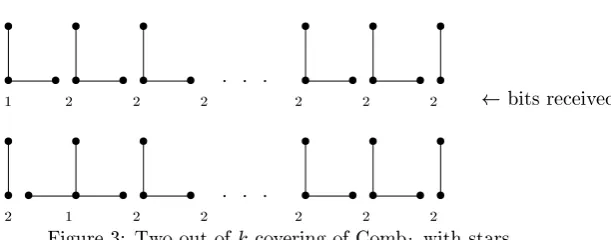
Proof By using Stinson's decomposition method we show that the ratio is 2 1=k. Figure 3 indicates the rst two of the k dierent covers of Combk; each component in a cover is a star on
1 2 2 2
. . .
2 2 2 bits received
. . .
2 2 2
2 2
2 1
Figure 3: Two out of k covering of Combk with stars
For the other direction we use the entropy method. Label the bottom vertices of Combk from
left to right as A1, A2, : : : ; Ak, the top vertices as a1, : : : ; ak so that ai is connected to Ai only.
Let f be any real valued function which satises properties (a){(e) from section 2 for the particular access structure which is dened by the edges of Combk. Then
k
X
i=1
f(Ai) 2k 1: (2)
If we can show this, then we are done. The sum of k terms is at least 2k 1, thus at least one of them is (2k 1)=k. Given any secret sharing scheme on Combk, the particular choice in (1) for
the function f satises (a){(e), consequently for at least one Ai we have
f(Ai) = H(H(Ai)
s)
2k 1 k ;
i.e. someone must remember at least 2 1=k bits for each bit in the secret.
To nish the proof, we state and prove two lemmas, 4.3 and 4.4. Inequality (2) is just the sum of the claims in the lemmas.
Lemma 4.3 Pki=1f(Ai) f(A1A2: : : Ak) + k 2.
Proof In general for any 2 ` k,P`i=1f(Ai) f(A1A2: : : A`) + ` 2 which we will prove by
induction on `. When ` = 2 the claim is f(A1)+f(A2) f(A1A2), which is just the submodularity
(c).
Now suppose we know the claim to be true for ` 1; to conclude it for ` it is enough to check that whenever ` 3 then
f(A1A2: : : A` 1) + f(A`) f(A1: : : A`) + 1: (3)
As ` 3, both A1: : : A` 1 and A` 1A` contain edge, i.e. they are a qualied sets. Then property
(e) says that
f(A1A2: : : A` 1) + f(A` 1A`) f(A1: : : A`) + f(A` 1) + 1
as the singleton A` 1 is not qualied. By the submodularity (c) we have
f(A` 1) + f(A`) f(A` 1A`):
Adding up the last two inequalities we get (3), as required. Lemma 4.4 f(A1A2: : : Ak) k + 1.
Proof Let X = fA1A2: : : Akg, and consider the dierences
di= f(Xa1: : : ai) f(a1: : : ai):
As f(;) = 0, the value we are interested in is d0. The trick is to consider these dierences in
reverse order. As fXa1: : : akg is qualied, while fa1: : : akg is not, condition (d) gives 1 dk.
P3 : : : P1 : : :
A A A A AA A A A A A A AA A A A A A A A A
Figure 4: Paths, honeycomb, and 2-lattice
Now both fAia1: : : aig and fXa1: : : ai 1g are qualied, their intersection, which is
fAia1: : : ai 1g, is not, thus (e) gives
f(Aia1: : : ai) + f(Xa1: : : ai 1) f(Aia1: : : ai 1) + f(Xa1: : : ai) + 1:
Furthermore the submodularity (c) tells
f(a1: : : ai) + f(Aia1: : : ai 1) f(Aia1: : : ai) + f(a1: : : ai 1)
Adding these up and rearranging we get di+ 1 di 1, as needed.
Theorem 4.5 The information ratio of Comb1 is 2.
Proof Each connected component of Comb1 is a spanned subgraph of Combk for some k,
con-sequently, by Theorem 4.2, its information ratio is < 2.
On the other hand, for each natural number k, Combk is a spanned subgraph of Comb1, thus
R(Comb1) is at least supkf 2 1=kg = 2.
Corollary 4.6 Comb1 is not local, i.e. all of its nite spanned subgraphs have smaller
informa-tion ratio.
5 Examples
The path of length n (with n + 1 vertices) is denoted as Pn, and P1 is the innite path, or
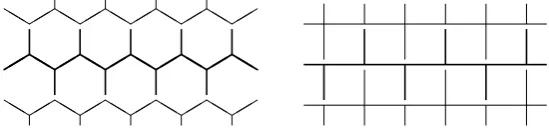
the 1-dimensional lattice. The honeycomb is the two-dimensional tiling of the plane with regular hexagons. The two-dimensional (square) lattice is the usual checkered paper like tiling (see g 4), and the triagonal tiling is the tiling with regular triangles (g 7).
Example 5.1 R(P1) = 3=2.
Proof We have seen that Comb2 is the same graph as the path of length 3, thus by Theorem
4.2 R(Comb2) = R(P3) = 3=2. (For other proofs see, e.g. [2, 3, 6], or the Appendix.) As P3
is a spanned subgraph of P1), we have R(P3) = 3=2 R(P1). For the other direction we use
Figure 5: Covering P1 by stars
Theorem 3.6 for the 2-cover indicated on gure 5. All subgraphs in the cover are stars having ratio 1; each edge is covered twice and each vertex gets 3 bits. Thus R(P1) 3=2.
bb bb bb bb bb "
" "" "" "" "" "" "" "" "" "" b
b bb bb bb bb
"
" "" "" "" "" bb bb bb bb bb
Figure 6: The comb as spanned subgraph
Proof As each vertex has degree 3, Corollary 3.9 says that the ratio is at most 2. On the other hand the, honeycomb contains the innite comb as a spanned subgraph (left picture on gure 6). Consequently 2 = R(Comb1) R(honeycomb).
Example 5.3 R(2-lattice) = 2.
Proof Here each vertex has degree 4, thus Corollary 3.9 gives only 5=2. We could, however, apply Theorem 3.6 directly for the four-cycles C4 indicated on gure 4. Each edge is covered once, and
each vertex is in two cycles. As C4has information ratio 1 we proved that the information ratio for
the 2-lattice is 2. The statement on C4can be shown as follows: let the random bit s 2 f0; 1g
be the secret, and pick r 2 f0; 1g randomly and independently from s. Give r to the rst and third node in C4, and r s to the two other nodes.
The lower bound follows from the fact that the innite comb can be embedded to the 2-lattice as a spanned subgraph, see Figure 6.
The proof given here does not tell whether the 2-lattice is local or not. In the Appendix we show that a particular graph on 8 vertices has information ratio 2. That graph is a spanned subgraph of the 2-lattice, thus the 2-lattice is not local.
Example 5.4 2 R(triangle lattice) 12=5.
Proof The lower bound follows again from the fact that the comb can be embedded into this lattice as well, see gure 7.
bb bb bb bb bb "
" "" "" "" "" b b """ " """" " """" " """" " """" " b b b b b b b b b b b b b b b b b b b b b b b b bb
bbbbbbbbbbbbbbbbbbbb " " " "" " " " " " " " " " " " " " " " " " " " " """" "" bb bbbb
bb bbbb
"""" ""
r r
s + r
s r Figure 7: The triangle lattice
The construction which gives the upper bound 12=5 is due to Peter Gergely [13]. Consider the diamond-shaped graph on four vertices at the right hand side of gure 7. This graph has ratio 1, which can be shown as follows: pick the secret s from f0; 1; 2g uniformly, and pick a random r from the same set. Give r to nodes on the left and on the right, give s + r mod 3 to the top vertex, and s r mod 3 to the bottom vertex. Any two connected vertices can recover the secret s, moreover each assigned number is independent of s. The two unconnected vertices receive the same share, thus their joint information is independent of the secret as well. Both the secret and the shares have entropy log 3, thus the ratio is 1.
The cover consists of all spanned subgraphs of the triangle lattice isomorphic to this graph. It is easy to check that this is a 5-cover (each edge is in 5 of such subgraphs), and each vertex is covered 12 times. By Theorem 3.6 this gives 12=5 as an upper bound.
The countable universal or random graph is the unique (up to isomorphism) graph on countable many vertices which has the property that picking nitely many vertices viand numbers "i2 f0; 1g,
there exists a vertex in the graph which is connected to vi just in case "i= 1.
: : : : : :
: : : : : :
: : : : : :
: : : : : :
Figure 8: The ladder and a cover
Proof As we have remarked, there is a graph of n vertices with information ratio 0:25 log n, see [7]. As all nite graphs can be embedded into the universal graph as spanned subgraphs, its information ratio is at least 0:25 log n, i.e. not bounded.
Example 5.6 The information ratio for the innite binary tree is 2.
Proof Lower bound: for each k the graph Combkcan be embedded into this graph, consequently
R 2.
Upper bound: we show that each tree has information ratio 2 by using the Theorem 3.6. We may assume that the tree is connected. Pick any vertex and consider it as \root." Direct the edges recursively away from the root. When all edges has been directed, each node has one invertex except for the root which has none. Consider the stars with center at a vertex consisting of all outgoing edges. Each edge is covered exactly once, and each vertex gets one or two bits (one bit for the root and leaves, and two bits for all other vertices).
In [9] it has been proved that all nite trees have information ratio 2 1=k for some integer k 1. Therefore the information ratio of an innite tree is the sup of numbers of this form. If T is an innite tree, then either R(T ) = 2, and then T is not local (as, e.g., is the case for the complete binary tree in Example 5.6), or R(T ) = 2 1=k for some integer k 1, and then T is local.
Example 5.7 There is an innite graph with information ratio 5=3.
Proof Consider the (rooted) complete binary tree from example 5.6, and insert a new vertex at the midpoint of every edge. This will be our graph T .
As three-tooth comb can be embedded into T , its information ratio is R(T ) R(Comb3)
= 2 1=3. The upper bound comes from Theorem 3.6: we dene a 3-cover by stars so that each vertex gets 5 bits; this gives R(T ) 5=3. First take the stars with center at the inserted new vertices and both edges as rays. Second take stars at the old vertices with all incident edges as rays, but take them twice. That way an old vertex gets 2 1 + 3 bits (two from the double star, and one from each new neighbor), while a new vertex gets 2 2 + 1 bits, as required.
Example 5.8 The innite ladder L on gure 8 has information ratio 10=6 R(L) 11=6. Proof The upper bound comes from the following construction (see gure 8). The 1-cover on the right has period 6. It uses stars and C4, both assigns a single bit for each bit in the secret. In a
period all vertices get 2 bits, except for one in the top, and one in the bottom which get only 1 bit. Shifting this cover by 1, : : :, 5 we get a 6-cover, and each vertex gets a total of 11 bits. By Theorem 3.6 the upper bound follows.
For the lower bound one can observe that the innite path is a spanned subgraph. Unfortu-nately this gives only 9=6. For the missing 1=6 we prove in the Appendix that the graph G1 on
gure 9 has information ratio 10=6. As this is a spanned subgraph of the ladder, we are done. We remark that the ladder of width 2 has information ratio 2. It is a spanned subgraph of the 2-lattice ( 2), and contains Comb1 as a spanned subgraph ( 2).
6 Conclusion and further problems
structures based on graphs pose special challenges. They are easier to dene, have a transparent, and sometimes trivial, structure.
In this paper we extended the denition of secret sharing for innitely many participants, and gave a denition for its information ratio. We consider this extension to be an important contribution, and hope to see further, interesting applications.
We have used a compactness-type denition to overcome the diculty of innite entropy: the information ratio is dened as the sup of the ratio for the nite embedded structures. The rst problem is to nd an appropriate denition of the \relative information content" for arbitrary random variables.
Problem 6.1 Given two random variables and , dene their relative size, which is the analog of H()= H() when both and are nite.
In [5] the authors show that the secret and shares, as random variables, cannot be based on a countable domain, even if the number of participants is nite. The paper also contains the following using reals numbers: let the secret s be uniform in [0; 1), then choose the shares i of
the rst k 1 of the participants uniformly and independently in [0; 1), and choose k 2 [0; 1) so
that
s= 1+ : : : + k 1+ k (mod 1)
It is easy to check that s is independent of any set of k 1 shares, and, of course, all shares
determine the secret uniquely. Just as in the nite case, this scheme can be used as a building block to create a perfect secret sharing when all qualied subsets are nite: simply distribute s
for each qualied subset independently. In this case each participant will receive as many shares as many minimal qualied sets it is in. In particular, if the scheme is based on a graph, then this number will be the degree of the vertex.
In case of nite complete graphs the above construction has extremely high information ratio. Shamir's construction from [18] is more ecient, it has the lowest possible information ratio 1. Can Shamir's construction be generalized for the innite case? The beginning is easy. Pick elements xi of a eld for each participant, and pick the point xs for the secret (these values are public).
Choose a secret linear function p(x) = ax + b according to a certain distribution. The value of the secret is s = p(xs); and the shares are i = p(xi). Clearly all pair of shares determine the
function p, thus the value s. What is not clear why s and i should be independent.
Problem 6.2 Do there exists a distribution for which sand i are always independent when the
linear functions are taken (a) over reals, (b) over some appropriately chosen eld?
By the result of [5] the eld cannot be countable. Here and in all problems \determines" can (and should) mean that sis determined uniquely with probability 1.
Existence of an \innite" threshold scheme seems to be a pure probability theoretical question. Problem 6.3 Do there exists a perfect scheme where the secret is independent of nitely many of the shares, but is determined by innitely many of them? Or at least do there exist a rump scheme where the secret is independent of any nite collection of the shares, but is determined by any conite collection (i.e. all but nitely many) of shares?
We return to schemes based on graphs. In almost all examples we have used Theorem 3.6, the generalization of Stinson's decomposition theorem. Does it generalize for innite sharing schemes as well?
Problem 6.4 Suppose that Giis (an arbitrary) subgraph of G, and Si is a perfect secret sharing
scheme on Gi. Assume moreover that all edges of G is contained in at least t of the subgraphs.
Does it follow that there is perfect secret sharing scheme on G?
The problem is that the secret in Si might have arbitrary distribution, and it is not clear how to
combine them.
In the Examples section we have computed the information ratio for several innite graphs. In two cases: the triangle lattice (Example 5.4) for the ladder (Example 5.8) we could only give estimates.
We conjecture that for the triangle the upper bound, for the ladder the lower bound is the right value.
We have seen two examples for non-local graphs: the comb, and the complete binary tree. Both of them have information ratio 2, but every nite spanned subgraph has smaller information ratio.
Problem 6.6 Is there any non-local graph with information ratio strictly below 2? In fact is the following stronger conjecture true:
Problem 6.7 Is it true that if R(G) < 2 then R(G) = 2 1=k for some integer k?
References
[1] A. Beimel, N. Livne: On matriods and non-ideal secret sharing, In: Proc. of the third Theory of Cryptography Conference, Lecture Notes in Computer Science, Vol 3876(2006) pp. 482{501 [2] C. Blundo, A. De Santis, D. R. Stinson, U. Vaccaro: Graph Decomposition and Secret Sharing
Schemes Journal of Cryptology, Vol 8(1995) pp. 39{64.
[3] C. Blundo, A. De Santis, R. D. Simone, U. Vaccaro: Tight Bounds on the Information Rate of Secret Sharing Schemes Designs, Codes and Cryptography, Vol 11(1997) pp. 107{110 [4] R. M. Capocelli, A. De Santis, L. Gargano, U. Vaccaro: On the size of shares of secret sharing
schemes Journal of Cryptology, vol 6(1993), pp. 157{168
[5] B. Chor, E. Kushilevitz: Secret sharing over innite domains Journal of Cryptology, Vol 6(1993) pp. 87{96
[6] L. Csirmaz: The size of a share must be large Journal of Cryptology, vol 10(1997) pp. 223{231 [7] L. Csirmaz: Secret sharing schemes on graphs, Studia Mathematica Hungarica, in print {
available as IACR preprint http://eprint.iacr.org/2005/059
[8] L. Csirmaz: Exact rate of secret sharing schemes on d-dimensional cube, manuscript [9] L. Csirmaz, G. Tardos: Exact information rate of trees, manuscript
[10] I. Csiszar and J. Korner: Information Theory. Coding Theorems for Discrete Memoryless Systems, Academic Press, New York, 1981.
[11] M. van Dijk: On the information rate of perfect secret sharing schemes Designs, Codes and Cryptography, Vol 12(1997) pp. 143{169
[12] M. van Dijk, T. Kevenaar, G. J. Schrijen, P. Tuyls: Improved constructions of secret sharing schemes by applying (,!)-decompositions Inf. Processing Letters, vol 99(2006) pp. 154{157 [13] P. Gergely: Personal communication
[14] O. Ferras, J. Mart-Farre, C. Padro: Ideal Multipartite Secret Sharing Schemes Preprint (2006) http://www-ma4.upc.edu/ cpadro/papers/mltprtt.pdd
[15] W. Jakson, K. M. Martin: Perfect secret sharing schemes on ve participants, Designs, Codes and Cryptography, Vol 9(1996) pp. 233-250
[16] J. Mart-Farre, C. Padro: Secret sharing schemes with three or four minimal qualied subsets Designs, Codes and Cryptography, Vol 34(2005) pp. 17{34
[17] F. Matus: Matroid representations by partitions, Discrete Mathematics, vol 203(1999) pp. 169{194
[18] A. Shamir: How to share a secret, Communications of the ACM, vol 22(1979), pp. 612{613 [19] D. R. Stinson: An explication of secret sharing schemes, Designs, Codes and Cryptography,
Vol 2(1992) pp. 357{390
a b c d B C
a b c d A B C D
Figure 9: The graphs G1and G2
Appendix
We determine the exact information ratio for the graphs G1and G2 of gure 9. G1is a spanned
subgraph of the innite ladder in Example 5.8 while G2 is a spanned subgraph of the 2-lattice
(but not of the ladder).
Claim 6.8 The information ratio of G1 is 5=3.
Proof For the upper bound consider the following 3 covers of G1. The rst cover consists of the
cycle BbcCB (assigning 1 bit for each secret bit), plus the two edges ab and cd. Using this cover nodes b and c get two bits, all other nodes get one bit. The second cover contains the star with rays ba, bB, bc; the path Ccd and the edge BC. Here a, b, and d get one bit, all other nodes get two bits. The third cover is the mirror image of the second one: the star cb, cC cD, the path abB, and the edge BC. Using all three covers all edges are covered three times, and every node gets either three (a and d), or ve bits (all the rest).
For the lower bound we use the entropy method. Assume f satises properties (a){(e) listed at the end of section 2. We claim that
f(b) + f(c) + f(C) 5; (4)
i.e. at least one of b, c and C gets 5=3 bits for each bit in the secret.
First we give a strengthening of the usual proof that the information ratio of the path of length 3 is at least 3=2. That proof goes by showing that f(bc) f(abcd) f(ad)+2. As abcd is qualied and ad is not, f(abcd) f(ad) 1. That is, f(b) + f(c) f(bc) 3, therefore either f(b) or f(c) is 3=2. Here we show that in this inequality f(abcd) can be replaced by f(acd):
f(a) + f(b) f(ab)
f(ab) + f(bc) f(b) + f(abc) + 1 f(abc) f(ac) + 1
f(ac) + f(ad) f(a) + f(acd) f(bc) + f(ad) f(acd) + 2
Second, we take into account the vertices B and C as well:
f(c) + f(C) f(cC)
f(cd) + f(cC) f(c) + f(cdC) + 1 f(acd) + f(cdC) f(cd) + f(acdC)
f(acdC) f(adC) + 1 f(adC) + f(adB) f(ad) + f(adBC)
f(adBC) f(adB) + 1 f(C) + f(acd) f(ad) + 3
Proof R(G2) 2 as G2is a spanned subgraph of the 2-lattice, and the 2-lattice has information
ratio 2. On the other hand, let f be again any function satisfying (a){(e); we claim that
f(bc) + f(BC) 8: (5)
As f(b) + b(c) + f(B) + f(C) f(bc) + f(BC) 8, the lower bound 2 follows.
Each of the inequalities below are instances of one of the properties (a){(e) of the function f:
f(a) + f(b) f(ab)
f(ab) + f(bc) 1 + f(b) + f(abc)
f(acAC) f(acA) f(acACD) f(acAD) 1 f(acABC) f(acAC) 1
f(ac) f(a) f(acB) f(aB)
f(acB) f(aB) 1 + f(acABC) f(aABC) f(abc) f(ac) f(abcA) f(acA)
f(bc) 4 + f(abcA) f(aABC)
Swapping lower case and upper case letters leaves the graph unchanged, thus we also have the \swapped" instance: