Research
This article has been peer reviewed.
Can Fam Physician 2012;58:662-7
Editor’s kEy points
• The difficulties encountered by
international medical graduates (IMGs) during their residencies and with the certification examinations are not only owing to a lack of medical knowledge, but also to the way in which they have learned how to transfer their knowledge and to integrate this knowledge with the skills needed in order to develop critical thinking and also to consolidate their clinical reasoning skills to be able to make pertinent clinical judgments.
• This study found that the IMGs who
completed clerkships and became Canadian medical graduates performed as well as the Canadian medical graduates who were not IMGs did.
• Clerkship experiences enable IMGs to
learn and consolidate clinical medicine skills in the appropriate structured environment.
Abstract
Objective To identify factors that help predict success for international medical graduates (IMGs) who train in Canadian residency programs and pass the Canadian certification examinations.
Design A retrospective analysis of 58 variables in the files of IMGs who applied to the Collège des médecins du Québec between 2000 and 2008.
Setting Quebec.
Participants Eight hundred ten IMGs who applied to the Collège des médecins du Québec through either the “equivalency pathway” (ie, starting training at a residency level) or the “clerkship pathway” (ie, relearning at the level
of a medical student in the last 2 years of the MD diploma).
Main outcome measures Success factors in achieving certification. Data were analyzed using descriptive statistics and ANOVA (analysis of variance).
Results International medical graduates who chose the “clerkship pathway” had greater success on certification examinations than those who started at the residency level did.
Conclusion There are several factors that influence IMGs’ success on certification examinations, including integration issues, the acquisition of clinical decision-making skills, and the varied educational backgrounds. These factors perhaps can be better addressed by a regular clerkship pathway, in which IMGs benefit from learner-centred teaching and have more time for reflection on and understanding of the
North American approach to medical education. The clerkship pathway is a useful strategy for assuring the integration of IMGs in the North American health care system. A 2-year relearning period in medical school at a clinical clerkship level deserves careful consideration.
Clerkship pathway
A factor in certification success for international medical graduates
Cet article a fait l’objet d’une révision par des pairs.
Can Fam Physician 2012;58:662-7
La voie de l’externat
Un facteur favorisant l’obtention du droit de pratique
par les médecins qui ont été diplômés à l’étranger
Anne-Marie MacLellan
MD CM CSPQ FRCPCCarlos Brailovsky
MD MA(Ed) MCFPC (Hon)François Miller Sylvie Leboeuf
Résumé
Objectif Identifier les facteurs qui permettent de prévoir la réussite des médecins diplômés à l’étranger (MDÉ) qui suivent les programmes de résidence et passent les examens de certification canadiens.
Type d’étude Analyse rétrospective de 58 variables provenant des dossiers de MDÉ qui ont fait une demande au Collège des médecins du Québec entre 2000 et 2008.
Contexte Le Québec.
Participants Huit cent dix MDÉ qui ont fait une demande au Collège des médecins du Québec soit par la voie de l’équivalence (c.-à-d. ceux qui commencent leur formation au niveau de la résidence) ou par la voie de l’externat (c.-à-d. ceux qui reprennent leurs études au niveau des deux dernières années de médecine).
Principaux paramètres à l’étude Facteurs favorisant la réussite à l’examen de certification. Les données ont été analysées à l’aide de statistiques descriptives et par analyse de variance (ANOVA).
Résultats Les médecins diplômés à l’étranger qui ont choisi la voie de l’externat ont obtenu un meilleur taux de réussite à l’examen de certification que ceux qui avaient commencé au niveau de la résidence.
Conclusion Plusieurs facteurs influent sur la réussite des MDÉ aux examens de certification, y compris certains problèmes d’intégration, l’acquisition d’habiletés pour la prise de décisions cliniques et la diversité de leur formation antérieure. Pour mieux tenir compte de ces facteurs, on pourrait favoriser la voie habituelle de l’externat, qui permet aux DMÉ de bénéficier d’un enseignement centré sur l’étudiant, et de disposer de plus de temps pour étudier et comprendre l’approche nord-américaine de la formation médicale. La voie de l’externat représente une stratégie utile pour faciliter l’intégration des MDÉ au système de santé nord-américain. Il y a lieu d’envisager sérieusement une période de 2 ans de stages cliniques en faculté de médecine.
points dE rEpèrE du rédactEur
• Les difficultés que rencontrent les
médecins qui ont été diplômés à l’étranger (MDÉ) durant leur résidence et lors des examens de certification sont dues non seulement à un manque de connaissances médicales mais aussi à la façon dont ils ont appris à traduire et à intégrer leurs connaissances en termes d’habiletés nécessaires pour développer une pensée critique et pour consolider leur rendement en matière de raisonnement clinique afin d’être en mesure d’avoir un jugement clinique approprié
• Cette étude a montré que les MDÉ qui ont
effectué leur externat et qui ont obtenu un diplôme de médecine canadien avaient un aussi bon rendement que les diplômés de médecine canadiens qui n’étaient pas des MDÉ.
• Grâce à l’externat, les MDÉ sont capables
Research
|
Clerkship pathway
T
wo recent Canadian studies1,2 have shown thatinter-national medical graduates (IMGs) continue to have difficulty passing the Certification Examination in Family Medicine even though they have successfully completed family medicine residency training in accred-ited Canadian residency programs.
In 2010, Andrew showed that IMGs had a pass rate of 58% on the Certification Examination in Family Medicine compared with a pass rate of 95% among Canadian med-ical graduates (CMGs). A specific training site for IMGs to train alongside CMGs was created to help address some of the challenges faced by IMGs who were start-ing North American residency trainstart-ing. Experienced fac-ulty members also gave extra coaching (eg, examination preparation). Interestingly, in this study the in-training evaluations of the IMGs did not differ statistically from the in-training evaluations of the CMGs.1
MacLellan et al2 looked at examination outcomes for
IMGs and concluded the following:
IMGs have a much lower success rate on the Certification Examination in Family Medicine than CMGs do. This is the case even though the IMGs have passed several screening competency examinations and have successfully completed a 2-year accredited family medicine residency program.2
The average success rate on the Certification Examination in Family Medicine was 56.0% for IMGs, compared with 93.5% for Canadian or American graduates.
MacLellan and colleagues suggested that several factors might be important in ensuring a successful outcome; “inte-gration issues, the acquisition of clinical decision-making abilities, and the variability of medical education across the world are hypothesized to be important variables.”2
Although articles have been written about these issues, there have been few Canadian studies that have followed IMGs from their prescreening examinations to the expected outcome of successfully passing certifica-tion examinacertifica-tions.
In Quebec there are 2 ways IMGs can acquire a reg-ular licence to practise medicine: obtain recognition of the equivalence of their MD diploma (known as the “MD-equivalence pathway”), or complete the “clerkship pathway.” Candidates who select the MD-equivalency pathway must first successfully pass medical knowledge examinations and then a clinical assessment exami-nation in the form of an objective structured clinical examination (OSCE); all are prerequisites for eligibility to apply for residency positions. International medical graduates then complete a residency program and pass the certification examinations.
The clerkship pathway entails admission to one of the medical schools in Quebec and completion of the final 2 years of medical school including clerkship, resulting
in the granting of a Canadian medical degree, and then requires residency training and success on the certification examinations. The faculties of medicine in Quebec accept between 5 and 8 IMGs each year at clerkship levels to fill the vacant places of Canadian students who have aban-doned their studies or were required to withdraw.
The purpose of this study is to identify certification success factors that will be helpful for IMGs. Under the auspices of the Collège des médecins du Québec (CMQ), we have completed a retrospective analysis of 810 files of IMGs who applied to the CMQ between 2000 and 2008 in order to obtain a regular permit to practise med-icine through either the MD-equivalency pathway or the clerkship pathway.
MEtHods
After approval from the CMQ Ethics Committee on Research, the analysis of 810 files of IMGs was com-pleted. The study design identified and quantitatively analyzed more than 58 variables, including credentials, results and scores on the CMQ OSCE before entry into residency, admission to postgraduate medical education, length of training, and success on certification examina-tions. The data were analyzed using descriptive statis-tics and ANOVA (analysis of variance), which was used to compare the duration of the residency training for each group of candidates.
rEsuLts
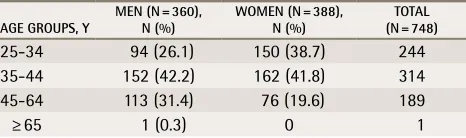
Out of 810 IMGs who applied to the CMQ between 2000 and 2008 in order to obtain a regular licence to practise without restrictions in Quebec, 548 (67.7%) obtained recog-nition of the equivalence of their MD diploma, 200 (24.7%) did not complete the initial steps in the MD-equivalency pathway (they were unsuccessful in passing some or all of the pre-residency examinations described above, so they could not apply for the next step in this pathway, which was a residency position), and 62 (7.7%) were accepted into the clerkship pathway. Table 1 describes the age distribu-tion of the candidates in the MD-equivalency pathway.
Of the 548 candidates who obtained recognition of the equivalence of their MD diploma, 56.9% were admitted to
table 1
. Candidates in the MD-equivalence pathway,
by age group
AgE gRouPS, Y MEn (n = 360), n (%) WoMEn (n = 388), n (%) (n = 748)ToTAL
25-34 94 (26.1) 150 (38.7) 244
35-44 152 (42.2) 162 (41.8) 314
45-64 113 (31.4) 76 (19.6) 189
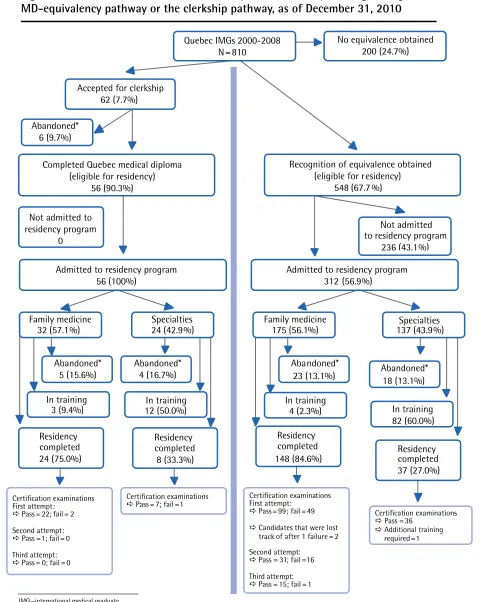
residency positions (Figure 1). Obtaining the MD equiva-lency does not automatically lead to a residency position. The universities admit those candidates who fulfil their admission criteria. Of the 312 candidates admitted into residency, 175 (56.1%) were accepted into a family medi-cine residency in Quebec and 137 (43.9%) into another specialty residency.
Out of the 148 candidates who finished their training in family medicine as of December 2010, 99 candidates passed the Certification examination at the first attempt after an average of 26.7 (SD 1.6) months of training. The 49 who failed the first try trained for a longer period of time (on average 29.9 months of training) before their first attempt at the Certification examination. This differ-ence was significant (P < .01).
An average of 35.9 months of training was required for the 31 candidates who were successful at the sec-ond attempt and 6 additional months (41.9 months) were necessary for the 16 others to pass on the third attempt. Canadian medical graduates trained on average 24.1 months to obtain their Certification in Family Medicine. These differences were statistically significant (P < .001).
For the 137 candidates who were admitted to spe-cialty residency programs other than family medicine, 42.1% were training in anatomic pathology, internal med-icine, general surgery, or psychiatry. As of December 2010, 37 had completed their residencies and 36 out of 37 had passed their certification examinations. One can-didate chose not to write the Royal College of Physicians and Surgeons of Canada certification examination and decided to train for an additional year. Eighty-two candi-dates were still in training, and 18 had either abandoned or were required to withdraw from their residency pro-grams owing to difficulties, either academic or otherwise.
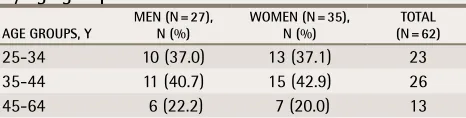
When we looked at the data from the 62 candidates who were accepted into the clerkship pathway, 56 com-pleted their MD studies and obtained their Canadian MD degree; 5 candidates abandoned; and 1 was asked to withdraw from the faculty of medicine. All age groups were represented, with 10 candidates being between 45 and 55 years of age. Table 2 shows the age distribution of the candidates in the clerkship pathway.
All 56 candidates were accepted into residency pro-grams, 57.1% in family medicine (19 women and 13 men) and 42.9% in other specialty programs (11 women and 13 men). It is interesting to note that 62% had taken the CMQ OSCE or the Medical Council of Canada Qualifying
Examination Part II before being accepted into the clerk-ship pathway. This means that these candidates had also attempted to succeed in the MD-equivalency pathway and that they had either failed the OSCE or were not accepted in a residency program. Their results on the Certification Examination in Family Medicine were similar to those of the candidates who chose the clerkship path-way directly. From these observations we can postulate that there was no selection bias that would explain the good performance of this whole group of candidates.
As of December 2010, of the 32 candidates accepted into family medicine residency programs, 24 had com-pleted their residencies, 3 were still in training, and 5 had abandoned their residency training in Quebec. Twenty-two out of the 24 passed their Certification examinations on the first attempt; 1 passed after the second attempt; and 1 did not retry the examination. When we compared the global results of family medicine Certification exami-nations of these IMGs who had completed their Canadian clerkship before entry into family medicine residency with those of CMGs who had completed their residency in family medicine, we found that the success rates were 95.6% and 93.5% for IMGs and CMGs, respectively. The average duration of training for these “clerkship IMGs” was 24.4 months for the first attempt at the Certification examinations. Two candidates were allowed to sit the Certification examination after 12 months of residency training, and 1 candidate did so after 17 months. One candidate required 28 months of residency before pass-ing the examination on the first attempt.
Of the 24 candidates in specialty programs, 4 aban-doned their studies or were required to withdraw from their residency programs. The 20 remaining candidates were admitted in 14 different residency programs; 25% were training in general specialties such as internal med-icine, general surgery, and psychiatry. As of December 2010, 12 were still in training and 8 had completed their training. Interestingly, 7 out of these 8 candidates passed the Royal College of Physicians and Surgeons of Canada certification examinations on the first attempt. We noted that their length of training was shorter than for CMGs (by a few months). We surmise that some of them received credit for part of their previous training if they had com-pleted postgraduate training elsewhere.
discussion
The most original and important part of our study is the finding that the IMGs who complete Canadian clerk-ships and become CMGs perform as well as CMGs who are not IMGs do. One can surmise that the difficulties encountered by IMGs during their residency and with the certification examinations cannot be owing only to a lack of medical knowledge but also, and more
table 2
. Candidates in the clerkship pathway,
by age group
AgE gRouPS, Y MEn (n = 27), n (%) WoMEn (n = 35), n (%) (n = 62)ToTAL
25-34 10 (37.0) 13 (37.1) 23
35-44 11 (40.7) 15 (42.9) 26
Research
|
Clerkship pathway
Figure 1. Outcomes for IMGs who were accepted in residency training through the
MD-equivalency pathway or the clerkship pathway, as of December 31, 2010
Quebec IMGs 2000-2008
N=810
Recognition of equivalence obtained
(eligible for residency)
548 (67.7 %)
Admitted to residency program
312
(56.9%)
Not admitted
to residency program
236 (43.1%)
Certification examinations Pass = 36
Additional training required =1
Abandoned*
18 (13.1%)
In training
82 (60.0%)
Specialties
137 (43.9%)
Residency
completed
37 (27.0%)
Certification examinations First attempt:
Pass = 99; fail = 49
Candidates that were lost track of after 1 failure =2 Second attempt:
Pass = 31; fail = 16
Third attempt: Pass = 15 ; fail = 1
Family medicine
175 (56.1 %)
Abandoned*
23 (13.1%)
Residency
completed
148 (84.6%)
In training
4 (2.3%)
Family medicine
32 (57.1%)
Abandoned*
5 (15.6%)
In training
3 (9.4%)
Residency
completed
24 (75.0%)
Certification examinations First attempt:
Pass = 22; fail = 2
Second attempt: Pass = 1; fail = 0
Third attempt: Pass = 0; fail = 0
Abandoned*
4 (16.7%)
In training
12 (50.0%)
Specialties
24 (42.9%)
Residency
completed
8 (33.3%)
Certification examinations Pass = 7; fail = 1
Abandoned*
6 (9.7%)
No equivalence obtained
200 (24.7%)
Accepted for clerkship
62 (7.7%)
Completed Quebec medical diploma
(eligible for residency)
56 (90.3%)
Not admitted to
residency program
0
Admitted to residency program
56 (100%)
IMG—international medical graduate.
realistically, to the way in which they have learned how to transfer their knowledge and to integrate this knowledge with the skills needed in order to develop critical thinking, as well as to consolidate their clini-cal reasoning skills to be able to make pertinent cliniclini-cal judgments. These skills are developed and practised by North American medical students during their clerkship. The practical clinical exposure during clerkship seems to be invaluable for integration into residency. During the transition of US medical students from pre-clinical to clerkship rotations, clerkship directors in 10 US medical schools identified several issues that stu-dents were struggling with, including adjusting to the culture of patient care in clinical settings; accessing, applying, or restructuring clinical knowledge for clinical reasoning; performing clinical skills (technical, interper-sonal, interpretive); understanding roles, responsibilities, and expectations; and engaging in self-directed learning, experiential learning, or self assessment.3
We believe that the clerkship experiences enable IMGs to learn and consolidate clinical medicine skills in the appropriate structured environment.
Bates and Andrew suggest in a thoughtful com-mentary that
the difficulties sometimes experienced in the training of IMGs can shift postgraduate programs to a more learner centered approach, where the roots of learn-ing (and the difficulties of performance) are explored in the context of the learner.4
Unfortunately, even though most postgraduate programs do have special orientation and integration programs for IMGs and as the first 2 cited articles1,2 have
demon-strated, relearning at the residency level is probably not ideal for most IMGs who are not ready for practice.
In a previous article2 we hypothesized that there
could be several factors influencing success on certifi-cation examinations, including integration issues, the acquisition of clinical decision-making skills, and the varied educational background of IMGs. These factors perhaps can be better addressed by a regular clerkship pathway, in which IMGs benefit from learner-centred teaching and have more time for reflection and under-standing of the North American approach to medical education. Wong and Lohfeld explained that IMGs had to complete a 3-phase process of loss, disorientation, and adaptation “in order to feel fully integrated into their professional environments.”5 Searight and Gafford
described findings from interviews with IMG family medicine residents with medical school training from India, Macedonia, Bosnia-Herzegovina, the Philippines, Egypt, and Iraq on several aspects of behavioural sci-ences education that might not have been taught abroad.6 Whelan wrote:
[S]pecific programs and strategies need to be devel-oped and put in place early in the GME [graduate medical education] experience—or even before entry into GME—to assist IMGs in understanding the con-text for, and issues associated with, providing opti-mum health care in the United States.7
Perhaps going back to medical school in a North American environment at a clerkship level allows IMGs to relearn or to learn in a different fashion. They can then integrate their previous knowledge and clinical skills with the practical aspects of clinical decision making, which is so important in North American med-ical undergraduate and residency programs.
The study also allowed us to identify factors predic-tive of success on the CMQ OSCE on admission into residency and at the certification examinations. These will be the subject of another article.
Limitations
The main limitations of this part of the study are the small number of IMGs in the clerkship pathway and the lack of information on why some of them abandoned the clerkship pathway.
Conclusion
International medical graduates succeed much better through the clerkship pathway than when starting at a residency level. Our study clearly demonstrates a use-ful strategy for assuring the integration of IMGs into the North American health care system. This strategy entails that medical schools will need to admit more IMG can-didates into the clerkship pathway, which might not be easy owing to stretched university resources; however, this option deserves careful consideration.
Dr MacLellan is Director of the Medical Education Division and Assistant Secretary at the Collège des médecins du Québec in Montreal. Dr Brailovsky is Emeritus Professor at Laval University in Quebec. Mr Miller is Educational Consultant at the Collège des méde-cins du Québec. Mrs Leboeuf is Assistant Director of the Medical Education Division at the Collège des médecins du Québec.
Acknowledgement
Funding for this study was provided by the Collège des médecins du Québec and by the Ministère de la Santé et des Services sociaux du Québec. We thank the Collège des médecins du Québec Medical Education Division staff, particularly Mme Ginette Plante.
Contributors
All the authors contributed to the concept and design of the study; data gathering, analysis, and interpretation; and preparing the manuscript for submission.
Competing interests
None declared
Correspondence
Dr Anne-Marie MacLellan, Collège des médecins du Québec, Medical Education Division, 2170 René-Lévesque Ouest, Montreal, QC H3H 2T8; telephone 514 933-4441, extension 5302; e-mail [email protected]
References
1. Andrew RF. How do IMGs compare with Canadian medical school graduates in a family prac-tice residency program? Can Fam Physician 2010;56:e318-22. Available from: www.cfp.ca/ content/56/9/e318.full.pdf+html. Accessed 2012 Apr 17.
2. MacLellan AM, Brailovsky C, Rainsberry P, Bowmer I, Desrochers M. Examination outcomes for international medical graduates pursuing or completing family medicine residency train-ing in Quebec. Can Fam Physician 2010;56:912-8.
3. O’Brien B, Cooke M, Irby DM. Perceptions and attributions of third-year student struggles in clerkships: do students and clerkship directors agree? Acad Med 2007;82(10):970-8. 4. Bates J, Andrew R. Untangling the roots of some IMG’s poor academic performance. Acad
Med 2001;76(1):43-6.
5. Wong A, Lohfeld L. Recertifying as a doctor in Canada: international medical graduates and the journey from entry to adaptation. Med Educ 2008;42(1):53-60. Epub 2007 Dec 13. 6. Searight HR, Gafford J. Behavioral science education and the international medical graduate.
Acad Med 2006;81(2):164-70.