A CIS-ACTING MUTATION WITHIN
THE
MATaLOCUS OF
SACCHAROMYCES CEREVZSZAE THAT PREVENTS EFFICIENT
HOMOTHALLIC MATING-TYPE SWITCHING
DEBORAH WYGAL MASCIOLI AND JAMES E. HABER*
Department of Biology and Rosenstiel Basic Medical Sciences Research Center, Brandeis Uniuersity, Waltham, Massachusetts 02254
Manuscript received January 1, 1979 Revised copy received October 1, 1979
ABSTRACT
Homothallic strains of Saccharomyces cerevisiae are able to switch from one mating-type to the other as frequently as every cell division. We have identified a cis-dominant mutation of the M A T a locus, designated MATa-inc, that can be converted to M A T a at only about 5% of the normal efficiency. In homothallic MATa-inc/mata* diploids, the MATa-inc locus switched to
M A T a in only one of 30 cases, while the rnata* locus switched to M A T a in all 30 cases. The MATa-inc mutation can be “healed” by a series of switches, first to M A T a and then to a normal allele of MATa. These data are consistent with the “cassette” model of HICKS, STRATHERN and HERSKOWITZ (1977), in which mating conversions involve the transposition of wild-type copies of a or a information from silent genes elsewhere in the genome. The MATa-inc mutation appears to alter a DNA sequence necessary for the replacement of M A T a by MATa. The MATa-inc mutation has no other effect on M A T a functions. In heterothallic backgrounds, the mutation has no effect on the sensi- tivity to a-factor, synthesis of a-factor, expression of barrier phenotype or ability to mate or sporulate.-The MATa-inc allele does, however, exhibit one pleiotropic effect. About 1% o€ homothallic MATa-inc cells become com- pletely unable t o switch mating type because of mutations at HMa, the locus proposed to carry the silent copy of a information.---In addition, we have
isolated a less efficient allele o€ the HO gene.
HE
interc.onversion of mating type in yeast appears to occur by the trans- position of genetic information, rather than by mutation (HICK, STRATHERN and HERSKOWITZ 1977). In heterothallic strains of yeast, a haploid cell of the amating type can be converted into an a mating-type cell, or vice versa, at a fre- quency of about 1 0-6, while in homothallic strains, mating-type switching may occur as frequently as once every cell generation (HAWTHORNE 1963; HICKS and
HERSKOWITZ
1976a; 1977). In wild-type strains of Saccharomyces cerevisiae, the expression of mating-type maps to a single locus ( M A T ) on the right arm of chromosome ZZZ. However, a number of lines of evidence suggest that there must also be other, normally silent, copies of mating-type information. For example, a cell carrying a mutant mata allele can be interconverted, first to a MATa cell,* To whom correspondence should be addressed.
342 D. W. MASCIOLI A N D J. E. HABER
and then back to a normal M A T a cell (TAKANO, KUSUMI and OSHIMA 1973;
HICKS
and HERSKOWITZ 1977). A similar healing of mutations of the a mating type (first interconverted to M A T a and then to a wild-type M A T a allele) has also been shown for two different mutations (KLAR, FOGEL and RADIN 1979;WYGAL
andHABER
1977). The fact that mutant alleles of mating type can be healed ledHICKS,
STRATHERN and HERSKOWITZ (1977) to argue that there must be silent copies of mating-type information that serve as “libraries” for the trans- position of copies of mating-type information to the M A T locus. These unex- pressed copies of mating-type information appeared to be either located at or controlled by the genes H M a and H M a(TAKANO
and OSHIMA 1970; NAUMOV end TOLSTORUKOV 1973; HARASHIMA, NOGI and OSHIMA 1974). These two loci are on opposite sides of the centromere of chromosome ZZZ, and both are far from the M A T locus (HARASHIMA and OSHIMA 1976). These genetic analyses further suggested that both H M a and hma contain or control silent copies of a mating-type information, while H M a and hma contain or control a mating-type sequences (HICKS, STRATHERN and HERSKOWITZ 1977). The idea that these H M loci are the sites of silent mating-type information has also received strong sup- port from studies of mutations of two other genes, marl and cmt. Both of these mutations permit the expression of the normally silent copies of mating-type information at H M a and H M a and confer a nonmating phenotype on haploids because of the simultaneous expression of a and a information from M A T , H M a and H M a (KLAR, FOGEL and MACLEOD 1979; HABER and GEORGE 1979).
How mating-type information is transposed is not known. However, in homo- thallic strains, where mating-type interconversions occur as frequently as once every cell generation, one can identify mutations that block the efficient inter- conversion of mating-type information. In wild-type strains, mating-type switch- ing produces a n equal number of M A T a and M A T a cells, and these cells readily mate to form a colony of nonmating M A T a / M A T a diploid cells. A mutation that reduces the normal efficiency of homothallic switching results in a colony con- sisting of many haploid cells of the original spore mating type, as well as a few haploids of the opposite mating type, and some diploids found by conjugation of cells of both mating types. These colonies, therefore, have a distinctive unequal dual mating phenotype easy to recognize and follow in genetic analyses (HABER and GARVIK 1977). One such class of mutations is comprised of defective alleles of HO (NAMOV, KONDRATIEVA and TOLSTORUKOV 1974; MASCIOLI and HABER 1979, see below). A second class of mutations includes other genes apparently required for normal mating-type interconversion. One such “switch7’ (swil )
mutation, which is unlinked to HO, M A T , H M a or HMa, has been described in detail (HABER and GARVIK 1977).
M A T I N G - T Y P E SWITCHI1\SG M U T A N T IN YEAST 343
It
can be “healed” to a normal MATa allele by an infrequent switch to MATa, followed by a subsequent switch to MATa. We have also found that when the normal homothallic switching process is inhibited by MATa-inc, mutations of HMa can be recovered at a high frequency.MATERIALS A N D ME T H O D S
Strains: A complete list of strains, their sources and genotypes i s given in Table 1. Homo- thallic strain T1059-18E (A132) was kindly provided by Y. OSHIMA, and strain Z164-8D (JIM) by M. and R. ESPOSITO. Homothallic strains Y55-2, Y55-4 and Y55-6 were derived as spontaneous auxotrophic mutants from a wild-type Saccharomyces strain (Y55), originally isolated by WINGE. These Y55 strains have homothallism genes (HO, HMa, and H M a ) com- pletely equivalent to those described by HARASHIMA, NOGI and OSHIMA (1974) and HABER and GARVIK (1977). The mala* strain was obtained from Y. KASSIR and G. SIMCHEN. All other heterothallic strains were derived from strains originally obtained from the Yeast Stock Center, Berkeley, California.
Growth and sporulation: All manipulations were carried out on agar plates unless otherwise indicated. For sporulation, cells were pregrown at 30” for two days on YEPD agar plates (1% yeast extract, 2% bactopeptone, 2% dextrose, 2% agar) and then replica plated onto sporulation plates containing 1 % potassium acetate supplemented with 0.04% dextrose, amino acids, adenine and uracil (SHERMAN, FInK and LUKINS 1970). The sporulation plates were incubated at 30” and, after tw:, to three days, the percentage sporulation was determined by counting asci and cells in a haemocytometer. Buds were not counted separately.
For microdissection, the cell walls of asci were digested with glusulase (Endo Labs) and microdissected on agar slabs as described by MORTIMER and HAWTHORNE (1969). Germinated spores were tested f o r nutritional requirements by replica plating onto nutritional drop-out plates (SHERMAN, FINK and LUKINS 1970) and tested for mating type, as described below.
Mating-type tests: The mating-type test has been previously described by HABER (1974). Colonies to be tested, containing a t least one auxotrophic marker, were replica plated onto a YEPD plate and cross-streaked with MATa and MATcy haploid tester strains carrying a differ- ent auxotrophic marker. The YEPD plates were incubated overnight to allow any mating to occur and replica plated onto minimal medium plates (2% dextrose, 2% agar, 0.67% Yeast Nitrogen Base without amino acids) so that only diploid colonies formed from successful matings at the intersections could grow. Mating type was scored after 24 h r at 30”. Dual mating colonies were again scored after 48 hr.
The a-factor and a-factor assays were performed using the methods of DUNTZE, MACKAY and MANNEY (1970) and MACKAY and MANNEY (1974), respectively. To determine sensitivity to (Y factor, unbudded cells of the strain to be tested were micromanipulated next to a dense, overnight growth of M A T a haploid strain A28. The plates were incubated at 30” and screened for the presence of “shmoos” at three-hour intervals.
For determining a-factor production, the strain to be tested was grown overnight on a YEPD plate to a dense confluent growth. Unbudded MATa cells were micromanipulated next to the test strain and the plate incubated at 30”. The presence of “shmoos” was monitored at three- hour intervals.
The barrier assay was performed as described by HICKS and HERSKOWITZ (1976b). This test demonstrates the ability of M A T a cells to bind x inactivate extracellular 01 factor.
Construction of the MATa-inc/mata*/mata*/MATa tetraploid: The mala* mutation has been shown by KASSIR and SIMCHEN (1976) to be recessive to other M A T alleles. Thus, a mata*/MATn diploid has an cy mating type and does not sporulate. A mata*/MATa diploid
344 D. W. MASCIOLI A N D J. E . H A B E R
TABLE I
Strains
Strain Genotype
Haploids+: A51 A52 A28 A57 A68 A87 A47 A48 A89 A88 DW3 DW32 17-15 T1059-18B
Homothallic diploids$: Y55-2 Y 5 5 4 Y55-6 Z164-8D
DW36
DW32/Y55-72B DW36/A87-18B DW3 6/A87-37C DW128 DW129 DW128/A87-14B
DW129/A87-2B DW129/A87-11A DW 129/A87-11 B DW36/A87-18L+lA D W36/A87-18b-l B DW36/A87-18b-lC DW36/A87-18b-lD
DW79 DW80 DW105 DW90
Tetraploids: DDW510 DW32fY55-7C
DW36/A87-2B
M A T a tyr1 met13 leu2-27 ade2 canl M A T a l e d - 1 ura3 lys2 hisl M A T a ade5
M A T a met1 ura1 ade2 M A T a his4 trp5 cryl M A T a leu2 adel his4
M A T a leu2-1 thr4 ura3 lys2 ade8 M A T a ade2 led-27 ura3
M A T a his4 adel leu2 lys2 thr4 M A T a his4 adel leu2 lys2 MATa-inc lys2 ade2 his1 MATa-inc cry1 trp5 his4
mata* leu1 ura3 ade2 rme
M A T a HO H M a hma adel his4 leu2 thr4 gal-1
HO H M a H M a his6 can1 HO H M a H M a lysx trp3 can1 HO H M a H M a metx trp3 canl
HO H M a H M a ade2-I lys2-1 trp5-20 ura1 MATa-inc HO H M a H M a a d d his1 can1 MATa-inc HO H M a H M a cry1 trpl his4 metx
MATa-inc HO H M a H M a his1 lys2 ade2 HO H M a H M a adel ade2
HO H M a H M a adel ade2
MATa-inc HO H M a H M a 1ysZ ade2 hisl MATa-inc HO H M a H M a ade2 aded his1 HO H M a H M a his4 his1 leu2 ade2 HO H M a H M a leu2
HO H M a H M a his1 ade2 lys2 ura3 HO H M a H M a ade2 lys2
HO H M a H M a ade2 HO H M a H M a ade2 HO H M a H M a ade2 HO H M a H M a ade2
HO-1 H M a H M a hisl M A T a
MATa-inc HO H M a H M a trp5 ade2 lys2 ural MATa-inc HO H M a H M a ade2 his1 lys2 HO H M a H M a cry1 ade2 his4 trp5 MATa-inc HO H M a H M a cryl ade2 tyrl
mata'
+
ho H M a H M a rme ade2 leu1 ura3 f-+
f mats*+
ho H M a H M a rme ade2 leu1 ura3 f-+
+
% A X _ _ _ _ _ _ _ _ _ _ _
HO
HMa
HMa:
+ a x 5F-+---+-
__57-
Strain
DDW51 I
MATING-TYPE SWITCHING MUTANT I N YEAST
TABLE I-Continued
Genotype
m t a * f ho HMa HMa rme a b 2 ura3 leu1
+
$. mats' f ho HMa HMa rme ade2 ura3 leu1 f4-
MATa cryl HO HMa HMa f a h 2 4- f f f MATa f ho HMa HMa f ade2
+
f ura1 met1 _ _ - _ - _ _ - _ _ _ _ _ _ _ _ - -- - _ _ _ _ _ _ _ _ _ _
_ _ f
his4 _ _
+
345
-
+
---
+
trp5 __
+
f All strains are heterothallic, of genotype ho HMa HMa, unless otherwise indicated.
$ Homothallic diploids are homozygous at all loci except MAT. They are MATa/MATa a t mating type unless indicated as MATa-inc strains. Because MATa-inc strains can switch mating type inefficiently, these strains too can be found as MATa-inc/MATu diploids.
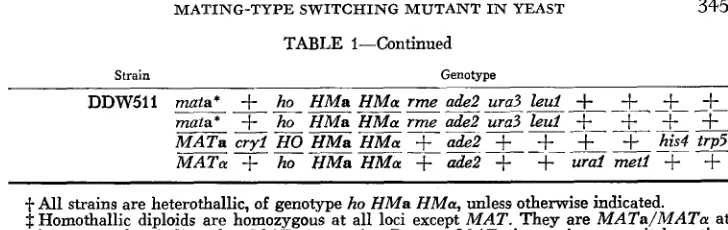
h r after mixing the cells. The resulting mata*/MATa diploid was again mated with the mata* strain and zygotes isolated three h r after mixing the cells. The mata*/mata*/MATa triploid was mated with cells of MATa-inc strain DW90, and nonmating colonies capable of sporulation were selected. These nonmating sporulating colonies are MATa-inc/mata*/mata*/MATa tetraploids. The MATa-inc strain DW90 carried both an HO allele and the marker cryl, which is very tightly linked to MAT. The mata' strain also carried the recessive mutation rme, which permits MATor/mata* and MATa/mata* strains to sporulate, but only at a level of about 1% sporulation (KASSIR and SIMCHEN 1975). Thus, the tetraploid has the partial genotype cryl MATa-inc/CRYl mata*/CRYi mata*/CRYi mator HD/ho/ho/ho RME/rme/rme/RME.
An equivalent tetraploid DDW511 containing a normal MATa allele instead of MATa-inc was also constructed by mating the mata/mzta*/MATa triploid with spores of a homothallic cry1 ade2 diploid (DW105).
Isolation of mutations of MATa: The MATa-inc mutation described in this paper was dis- covered while selecting and characterizing MATa mutations altered in mating or sporulation functions. A MATor strain A51 was treated with ethyl methanesulfonic acid to a level of about
40% survival (SHERMAN, FINK and LUKINS 1970). The mutagenized strain was then mated with another MATa strain A52 to recover rare MATa/MATor diploids arising from the inter- conversion of MATa to MATa. Scven hundred nonmating MATa/MATa diploids heterozygous for the leucine heteroalleles leu2-I and ku2-27 and for canl/CANl were recovered. From these diploids, haploid MATa segregants were recovered as canavanine resistant, leucine-proto- trophic colonies. From the random spores isolated in this fashion, MATa cells were then tested for possible defects in mating or sporulation functions. One MATa strain appeared to have an
altered sporulation gene that was suppressed by the temperature-sensitive amber suppressor, SUP4-3 (RASE-MESSENGUY and FINK 1973). The defect in sporulation appeared to map at MAT, but frequently reverted to normal MATa function (WYGAL and HARER 1977; MASCIOLI 1979).
To determine if the lack of stability of the sporulation defect was related to healing of mutant alleles of MAT (HICKS and HERSKOWITZ 1977), one such haploid strain (DW3) carrying the sporulation mutation was crossed with spores OI the homothallic strain, Y55-2. Among the meiotic segregants obtained from this cross were colonies carrying HO that had strong a and weak cy mating, rather than the nonmating phenotype expected of wild-type homothallic strains. The MATa-inc mutation that gives rise to those colonies is the subject of this paper. In sub- sequent analysis of strain DW3 and its offspring, the original sporulation defect was not inherited. The reversion of this defect did not, however, affect the MATa-inc mutation, which was stable in heterothallic strains.
RESULTS
Identification of a mutation affecting mating-type interconversion: The hap- loid heterothallic a mating-type strain DW3, described in MATERIALS AND
346 D. W. MASCIOLI A N D J. E. H A B E R
diploid was dissected, we expected to find tetrads containing two nonmating colonies (resulting from the formation of diploids from homothallic segregants) and two colonies able to mate (from two heterothallic spores). As shown in Table 2, 50 of the 66 tetrads analyzed contained colonies with an unequal dual- mating phenotype, in which there were more cells mating as a than as a. This (a>,) phenotype is characteristic of colonies derived from homothallic MATa spores that are unable to switch mating types efficiently enough to give rise to a nonmating colony
(HABER
and GARVIK 1977). The ( a > a ) colonies all seemed to be from segregants carrying HO, as there were always two colonies in every tetrad that were either nonmatnig or ( a > , ) . The two other colonies in each tetrad were either a maters or a maters and were assumed to be heterothallic(ho) cells.
From the assumption that all nonmating and ( a > a ) mating colonies contained HO, we could analyze the segregation pattern in Table 2 to conclude that the
( a > , ) phenotype appeared only in colonies derived from HO MATa spores. For example, there were nine tetrads in which both ho alleles apparently segregated with MATa to yield two LY mating colonies per tetrad. In these nine tetrads, where
HO presumably was inherited with MATa, all of these 18 segregants had an
( a > a ) phenotype. Conversely, in 16 tetrads where the two MATa alleles were apparently with ho to yield a mating colonies, all of the segregants presumed to be HO MATa gave rise to nonmating colonies. There were five tetrads in which there were two (a>a)
,
one a and one a mating segregant. These tetrads may have arisen by a gene conversion event to yield 3 MATa: 1 MATa, or they might be cases where the ( a > @ ) phenotype appeared in a MATa segregant. These results indicated that either the defect causing (a>,) colonies was very closely linked to MATa (so that there were no mutant MATa segregants) or it was atHO
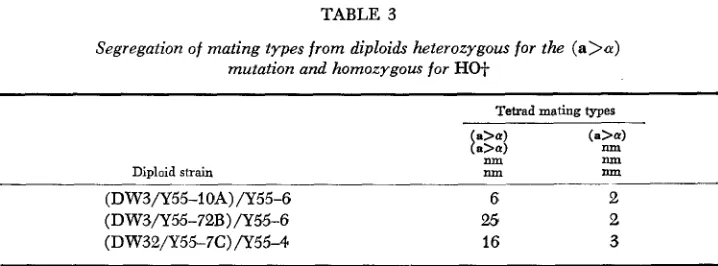
or within MATa and affected only homothallic MATa cells.We then constructed diploids homozygous for HO, so that the mutation could be followed in any segregant. Three (a>cu) segregants were crossed with spores of wild-type ( H O HMa HMa) homothallic strains and then analyzed. Nearly all of the tetrads dissected from these diploids
(47
of 54) contained two non- mating and two (a>,) colonies (Table 3 ) as expected if a single mutation wasTABLE 2
Segregation of mating types from diploid DW3/Y55-2f
Number of tetrads 16 36 9 5
-f Strain DW3 was crossed with spores of homothallic diploid Y55-2 and the resulting diploid
$ Nonmating colonies are designated by nm. Bisexual colonies exhibiting greater a mating type
sporulated and dissected. The diploid genotype is MATa MATa ho/HO.
M A T I N G - T Y P E S W I T C H I N G M U T A N T I N Y E A S T
TABLE 3
Segregation of muting types from diploids heterozygous for the ( a > a ) mutation and homozygous for H0-f
347
Diploid strain
Tetrad mating types
( a h )
nm nm
nm nm
t%l
nm(DW3fl55-10A) /Y55-6 6 2
(DW3/Y56--72B) /Y55-6 25 2
(DW32/Y55-7C) f l 5 5 4 16 3
+
Three (a>a) mating segregants from diploids DW3/Y55-2 and DW32/Y55-6 were crossed with spores of homothallic strains Y55-6 and Y55-4 and the diploids sporulated and dissectedresponsible for the ( a > a ) phenotype. Again, there were no ( & > a ) segregants, although there were seven tetrads in which only one ( a > a ) colony could be seen. These seven tetrads resulted from incomplete penetrance of the mutation, because one of the three nonmaters in each of these tetrads yielded ( a > a ) segregants after they were sporulated and dissected. Thus, the ( a > a ) phenotype appears to be caused by a single mutation.
The mutation affects only MATa: To examine the effect of this mutation on MATa, we took advantage of the fact that some mating-type interconversions do occur in the (a>,) colonies. By mating cells of an ( a > a ) colony with a hetero- thallic MATa strain, we could recover diploids with the mutation linked to MATa. Conversely, by mating cells of the ( a > , ) colony with a heterothallic MATa strain, we could recover the mutation linked to M A T a (Table 4 ) . When the ( a > a ) colony was mated with the heterothallic MATa strain A68,43 of 50 tetrads analyzed contained ( a > a ) segregants (Table 4 ) . On the other hand, when the ( a > a ) colony was mated with M A T a heterothallic strain A87, only one segregant among the 37 tetrads analyzed exhibited an ( a > , ) phenotype. The single ( a > , ) segregant generated from this cross turned out to have resulted
TABLE 4
Analysis of the (a>a) mutation linked to MATa or to MAT&
Cross Genotwe
Tetrad mating types
( a > @ ) ( a > U ) U nm (a>ru) (a>Q) (a>:) a a a (a>m) a
a n m n m n m a a
a n m n m n m U a n m
DW36 MATa-inc HO A68 MATa ho
DW36 MATa HO A87 MATa ho
~ ____- 8 29 7 3 3
1 5 7 2 4
348 D. W. MASCIOLI AR‘D J. E. HABER
from some other, spontaneous mutation that is at or very closely linked to the
HO
gene (see below). These results clearly demonstrate that only when the muta- tion is linked to MATa do homothallic spores give rise to an (a>a) pheontype. Because (a>a) colonies contain haploid cells of both mating types, some MATaIMATa diploids are formed. These diploids should be homozygous for all loci except MAT. Several (a>,) colonies were therefore sporulated and ana- lyzed. Only two of the four segregants gave rise to (a>cr) colonies, while the other two were nonmating (Table 5 ) , providing additional evidence that the mutation only affects mating-type interconversion of MATa spores. There were a few exceptional tetrads among those analyzed. Those containing only one (a>,) segregant and three nonmaters were probably examples of incomplete penetrance where mating type interconversions may have occurred early enough to form a nonmating colony. These tetrads might also arise if meiotic gene con- version produced one MATa and three MATa spores. Similarly, the few tetrads containing three (a>a) colonies and one nonmating colony might also have arisen from a gene conversion.
The mutation lies within the MATa locus: The mutation must lie within the MATa locus, because the mutation can be “healed” after a sequence of mating- type interconversions in which the original
MATa
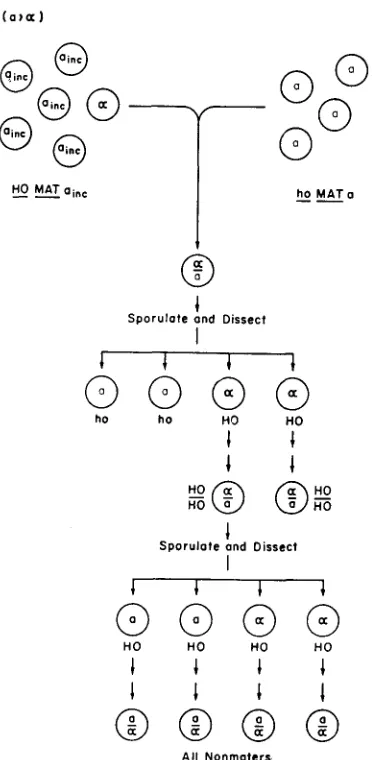
allele switched to MATa and then to a new MATa allele that no longer exhibits the defect. The protocol to demonstrate this healing is shown in Figure 1. An (a>,) colony was crossedwith
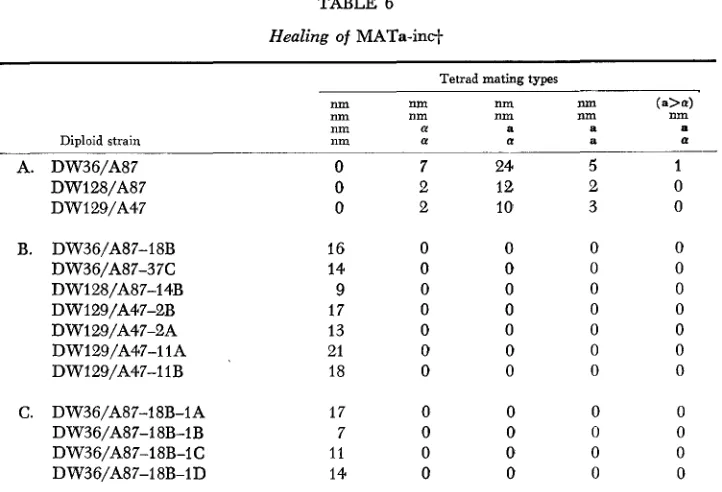
heterothallic MATa strain A87 or A47 to form diploids carrying a normal MATa allele and a MATa allele derived from the original mutant colony. When these diploids were sporulated and dissected, tetrads containing two a-mating and two nonmating segregants were isolated (Table 6A). In such tetrads, the two a-mating colonies are heterothallic segregants containing the MATa allele introduced from strain A87 or A47; the two nonmating colonies have arisen from the normal homothallic mating-type interconversion of the MATa allele to MATa and subsequent diploidization. These nonmating segregants contain the MATa allele derived from the original mutant colony and a new MATa allele resulting from interconversion of the MATa allele. These nonmating segregants were then sporulated and dissected to see if any (a>a) segregants were gener- ated. In 108 tetrads analyzed from seven different such nonmating segregants, no (a>a) colonies were found (Table 6B). Furthermore, the ( a h ) phenotypeTABLE 5
Segregation of mating type from diploid cells derived from an ( a > a ) mating colonrf-
~ ~~
Tetrad mating types
Number of tetrads 34 3 1
MATING-TYPE SWITCHING M U T A N T I N YEAST 349
1
I
Sporulate and Dissect
ho ho HO HO
I
I
I
I
I
I
Sporulate and Dissect
HO HO HO HO
I
1
11
I
I
I
i
ALII Nonmaters
FIGURE 1.-Healing of The MATa-inc mutation. An HO MATa-inc colony with an ( a
>
a ) phenotype was mated with a heterothallic MATa strain to construct a diploid in which the M A T a allele came from the (a>
a) parent. In some of the tetrads dissected from this diploid,HO M A T a segregants were obtained. These cells underwent efficient mating-type switching to produce nonmating diploid cells containing the original M A T a allele and a new M A T a allele. When these new diploids were dissected, it became clear that the new HO MATa alleles switched efficiently to produce nonmating colonies. Thus, the original ( a
>
a ) phenotype asso- ciated with the MATa-inc mutation was lost when MATa-inc was switched, first to MAT& and then to a normal copy of MATa.350 D. W. MASCIOLI A N D J. E. HABER
TABLE 6
Healing of MATa-in4
Tetrad mating types
Diploid strain
nm nm nm m (a>@)
Inn nm nm nm nm
nm ff a a e
nm ff a a a
A. DW36/A87 DW128/A8 7 DW 129/A47
B. DW36/A87-18B DW36/A87-3 7C DW128/A87-14B D W 129/A47-2B D W129/A47-2A DW129/A47-11A ,
DW129/A47-11B
C. DW36/A87-18B-IA DW36/A87-18B-lB D W36/A8 7-1 8B-1 C DW36/A87-18B-lD
0 0 0
16 14 9 17 13 21 18
17 7 11 14
7
2 2
24 12 10
5 2 3
1 0 0
+A. Three ( a > a ) segregants from diploid DW3/Y55-2 were mated with heterothallic MATa strains A87 and A47 and the diploids sporulated and dissected. B. Seven nonmating segregants from tetrads in Step A with two a mating and t w o nonmating segregants were further sporulated and dissected to look for the presence of ( a > a ) mating colonies. C. Finally, all four members of one tetrad, DW36/A87-18B-l, were dissected to look f o r the reappearance of the (a>&)
phenotype.
MATa spores is located within the MATa locus. This mutation was healed in a manner exactly analgous to that for an allele of MATa derived from Saccharo- myces diasticus that was insensitive to homothallic interconversion (TAKANO, KUSUMI and OSHIMA 1973). In accordance with the designation of the MATa allele as MATa-inc, we have designated the mutation described here as MATa-inc.
MATa-inc is a cis-acting mutation: To see if the defect in MATa-inc could be complemented by another, normally switching MATa allele, we constructed MATa-inc/mata* diploids heterozygous for
HO
and followed their ability to undergo mating-type interconversion. W e obtained these HO/ho MATa-im/ mafa* diploids as segregants from a MATa-inc/mata*/mata*/MATa tetraploid (DDWSlO), whose construction is described in MATERIALS AND METHODS. The fate of the MATa-inc allele could be followed by its very close linkage to a cry2MATING-TYPE SWITCHING MUTANT I N YEAST
TABLE 7
Classes of diploid segregants heterozygous for cryl/CRYl obtained from tetraploid DDWSlOj-
35
1Class
Weak a mater Nonmater a mater a mater
I I1 IIIa IIIb
Phenotype sporulates sporulates no sporulation <I % sporulationt a-inc HO a-inc ho a-inc ho a-inc ho rme
a* ho a ho a ho a* ho rme
Assumed genotype
~-
-
--or
a-inc HO a ho
Number of segregants obtained 30 40 41 10
Number expected 41 41 7 41
+
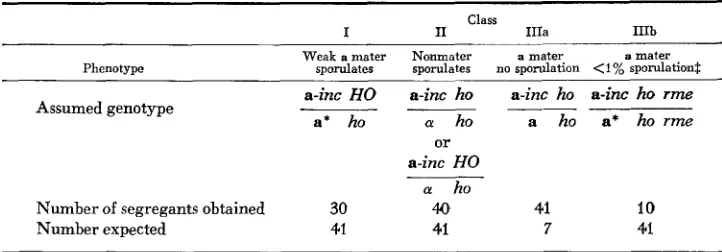
The tetraploid DDW510 (cry1 MATa-inc/CRYl mnta*/CRYl mata*/CRY1 MATa H O / ho/ho/ho +/rme/rme/+) was sporulated and dissected. From 65 tetrads, all diploid segregants heterozygous for cryl/CRYI were examined f o r mating phenotype and ability t o sporulate.$ The mutation rme permits a very low level of sporulation of MATa/mata* diploids (KAssm
and SIMCHEN 1976). Because rme is segregating in this cross, every class will contain a subset of diploids homozygous for rme. Only in the case of class I11 does the presence of rme lead to a new phenotype.
to nonmating diploids and tetraploids, but the colonies still exhibited a very weak a-mating behavior. We used this residual a-mating phenotype to distinguish MATa-inc/mata* HO/ho colonies (Class I ) from completely nonmating, well- sporulating colonies that are, presumably, either MATa-inc/MATa HO/ho or MATa-inc/MATa ho/ho (Class 11).
Two other classes of segregants could also be distinguished. A large number of diploids were a maters, but unable to sporulate (Class IIIa). These were pre- sumed to be MATa-inc/mata* ho/ho strains. Finally, a small number of a maters with very weak ( < 1 % ) sporulation were found (Class IIIb). These colonies were also MATa-inc/mata* ho/ho, but homozygous for the rme mutation (KASSIR and SIMCHEN 1975) also segregating in this cross. This mutation permits a very low level of sporulation in diploids homozygous for one mating type. The genotype of these 10 segregants was confirmed by dissecting tetrads and showing a 2 MATa-inc: 2 mats* segregation. Because rme has no effect on the sporulation o r mating behavior of normal nonmating, well-sporulating diploids, no attempt was made to determine whether rme was homozygous or heterozygous in the other classes of diploids.
We found one additional heterothallic segregant heterozygous for cryl and either mata*/MATa or MATa/MATa, which must have arisen from a crossover or gene conversion event between cryl and MATa-inc.
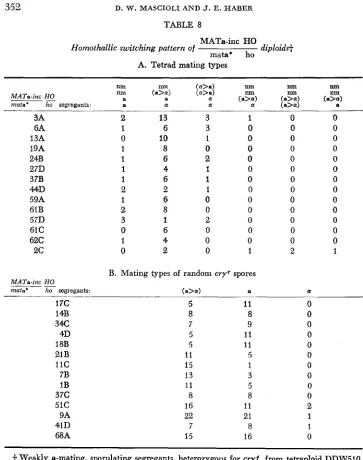
W e centered our attention on the 30 Class I colonies whose genotypes were inferred to be HO/ho MATa-inc/mata*. Since these colonies sporulated and were therefore capable of switching, we examined meiotic progeny to see whether MATa-inc o r mata* had switched.
352 D. W. MASCIOLT A N D J. E. HABER
TABLE 8
MATa-inc HO
mats* ho
Homothallic switching pattern of
~-
diploid4A. Tetrad mating types
3A 6A 13A 19A 24B 27D 37B 44D 59A 61B 57D 61C 62C 2 c
MATa-inc HO
mata* ha segregants:
2 1 0 1 1 I I 2 1 2 3 0 1 0 13 6 10 8 6 4 6 2 6 8 1 6 4 2 3 3 1 0 2 I 1 1 0 0 2 0 0 0 1 0 0 0 0 0 0 0 0 0 0 0 0 1
B. Mating types of random cryr spores
( a > a ) a
17C 14B 34c 4D 18B 21 B 1 IC 7B 1B 37c 51C 9A 41D 68A 5 8 7 5 5 11 15 13 11 8 16 22 7 15 11 8 9 11 11 5 1 3 5 8 11 21 8 16
0 0
0 0
0 0
0 0
0 0
0 0
0 0
0 0
0 0
0 0
0 0
0 0
0 0
2 1
U 0 0 0 0 0 0 0 0 0 0 2 1 1 0
+
Weakly a-mating, sporulating segregants, heterozygous for cryi, from tetraploid DDW510, were sporulated and either dissected (A) or random spores streaked onto agar plates containing crytopleurine (B). Mating type was determined as described in MATERIALS A N D METHODS. Segre- gants from the dissection analysis were also scored for nutritional requirements.MATING-TYPE SWITCHING MUTANT I N YEAST 353
of nutritional markers that is characteristic of tetraploid segregation of
+/+/-/-
markers. These tetrad mating types and nutritional phenotypes are best under- stood by assuming that some cells of the original a-mating diploid switched to a MATa/MATa diploid and that cells of opposite mating type conjugated to form aMATa-inc/mata*/MATa/MATa
HO/HO/hoJho tetraploid. In this case, both MATa-inc and mata* must have been interconverted. Thus, among the 14 initially HO/ho MATa-inc/mata* diploids analyzed by tetrads, only one showed evidence that MATa-inc had switched to MATa, while mata* had switched in all cases.If
interconversion of MATa-inc and mata* were random, seven of these colonies should have shown MATa-inc to MATa switches.The random-spore data (Table 8B) also indicated that MATa-inc remained resistant to homothallic switching, even when another M A T allele was able to switch. In these diploids, the cry1 locus was tightly linked to the MATa-inc allele. Among the cryptopleurine resistant spores from 16 colonies, the MATa-inc allele could always be detected by the presence of homothallic ( a h ) colonies and heterothallic a-mating colonies. Had MATa-inc switched to MATa, at least half of the cry1 spores should have been linked to MATa. In two of the 16 cases, there was a small proportion of cryptopleurine-resistant or-mating cells. These may have resulted from crossing over between my1 and M A T ; however, in these cases, it was clear that the cry1 allele was almost always still closely linked to the MATa-inc allele.
The data from both tetrad and random-spore analysis show that in all 30 cases mata* was switched to MATa; in one case, MATa-inc also must have switched. These results clearly deviate from the expectation that
15
of the 30 cases would show MATa-inc switches to MATa if homothallic switching were random (P<O.Ol). We conclude that MATa-inc is a cis-acting mutation that does not interfere with the switching of mata' and is not complemented by a normally switching mata* allele.In contrast to the switching of MATa-inc/mata* strains, MATa/mata* diploids could convert either allele to MATa. From dissections of the tetraploid DDW511, we obtained ten cry1 MATa/CRYI mata*
H O / h
diploids analogous to ClassI
in Table 7. We dissected tetrads from each of the 10 colonies (Table 9). In two cases, MATa/mata* diploids must have become cry1 MATa/CRYI M A T a diploids, in which the M A T a had switched to M A T a and mata* had switched to MATa. In the remaining eight colonies, all of the cells must have become MATa/mata*/MATa/MATa or MATa/mata*/MATo/mata* tetraploids, which could only have arisen if MATa had switched to MATa. The fact that we could find conversion of a normal MATa allele in all 10 of these MATa/mata* diploids is clearly different from the MATa-inc/mata diploids.354 D. W. MASCIOLI A N D J . E . H A B E R
TABLE 9
Homothallic switching pattern of MATa cryl HO/mata* CRY1 ho diploids+
Segregant 5a 19c Ib 15d IC 3a 14c 13d 15b 17d
Tetrad mating types nm nm
n m nm n m n m n m a
mn n m n m a n m n m a a n m n m a (1
0 0
0 0
4 3
3 1
1 4
7 0
1 1
7 1
5 2
4 3
0 0 0 3 0 3 0 1 0 0 5 5' 1 1 2 1 1 0 0 1 I 1 0 0 0 0 1 0 0 0 nm nm a a _ _ _ _ 2 1 0 0 0 0 0 0 0 0
+Weakly a mating, sporulating segregants, heterozygous for c r y l , from tetraploid DDW511 were sporulated and dissected. The segregation of heterozygous nutritional markers indicated that segregants 5a and 19c were diploid, while the remaining eight were tetraploid. All of the a-mating segregants in the case of both strain 5a and 19c were c r y l . Because the other strain gave diploid offspring, cryl was usually heterozygous and unable to be scored.
therefore be estimated from the ratio of ( a > a ) to nonmating subclones. The analysis of subclones for a number of different (a>,) colonies is presented in Table IO. I n normal HO colonies derived from MATa spores, 100% of the sub- clones are nonmating. With HO MATa-inc colonies, the efficiency of switching is somewhat variable, usually ranging from 0.02 to 0.2. One exception was strain DW36, whose segregants gave rise to ( a > a ) colonies containing a large fraction of nonmaters.
TABLE 10
Mating behavior of subclones (a>,a) colonies*
Strain
Efficiency of
(+a) nm a switching+
DW32/Y55-7C DW80-29 DW79-32 DW79-8 DW90 DW3612B DW364C DW80-1 95 83 81 60 54 4.20 20 9 5 16 18 44) 44 564 80 89 0 1 1 0 2 16 0 2 0.02 0.08 0.W 0.20 0.22 0.14 0.40 0.44
* Subclones of (a>,a) colonies were tested for mating. For strain DW90, IOW random spores from a MATa-inc/MATa homothallic diploid were germinated. In this case, 500 of the spores would be MATa and give rise to nonmating colonies. These have been subtracted in calculating the efficiency of switching of this strain.
MATING-TYPE SWITCHIIVG MUTANT I N YEAST
355
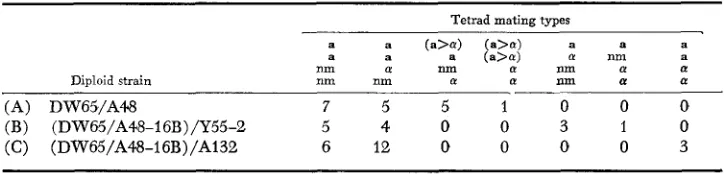
Mata-inc induces or reveats mutations at HMa: In addition to the (a>,) non- mating colonies among the subclones shown in Table 10, there were a number of colonies that were only a maters and appeared completely unable to switch to MATa. This inability to switch is caused by a second mutation not closely linked to MATa-inc. When such an a-mating colony was crossed with an ho MATcY strain, A48, we recovered (a>,) segregants characteristic of MATa-inc (Table 11A). However, the pattern of segregation was similar to one obtained if the diploid were heterozygous for HMa/hma, that is, fewer than t w o non- mating or ( a h a ) colonies were found in some tetrads and there was an excess of a maters over CY maters.
From tetrads of DW65/A48 containing two ( a > a ) and two CY mating segre-
gants, we could recover the “a-only” mutation in an ho MATa segregant. When this strain was crossed with a wild-type HO MATa HMa HMa strain,
YS5-2,
the resulting tetrads again showed a pattern of tetrad mating types expected if the diploid were heterozygous HMa/hma (Table 11B). Furthermore, if the heterothallic MATa segregant containing this mutation was mated with the HO MATa hma
HMa
strain, A132, all of the tetrads contained two a-mating segregants (Table 11 C).
These crosses show that “a-only” mutation is indeed a mutation at HMa.Further characterization of MATa-inc: The MAT locus controls both mating and sporulation in the yeast life cycle. A MATa-inc cell is normal in all of these other functions. In comparison with normal heterothallic MATa haploids, hetero- thallic MATa-inc strains show equivalent mating in standard mating tests with ho MATa strains. When placed near a streak of MATa cells that secrete (Y factor,
the MATa-inc cells cease cell division and “shmooy7, as described by DUNTZE, MACKAY and MANNEY (1970). These MATa-inc strains also exhibit the barrier phenotype, as described by HICKS and
HERSKOWITZ
(1 976a). Finally, MATa-inc cells produce an a factor that arrests the growth of MATa cells, exactly as shown by other MATa strains (MACKAY and NANNEY 1974).TABLE 11
Segregation of mating types from diploids carrying an H M a mutation+
Tetrad mating types
a a (a>a) (a>@) a a a
a a a ( a > a ) a nm a
nm LY nm a nm a LI:
Diploid strain nm nm a a n m LY a
(A) DW65,/A443 7 5 5 1 0 0 0
(B) (DW%/A4%16B) /Y55-2 5 4 0 0 3 1 0
(C) (DW65/A48-16B) /A132 6 12 0 0 0 0 3
356 D. W. MASCIOLI A N D J. E. HABER
A MATa-inc/MATa diploid is nonmating and able to sporulate. This i s in contrast to the only other reported mutations of the MATa locus, mats* and mata', which are defective in their diploid regulatory functions (KASSIR and SIMCHEN 1976; KLAR, FOGEL and %DIN 1979).
A mutation of the
HO
gene: When the (a>a) strain DW36 was crossed withho
MATa strain A87 (Table4),
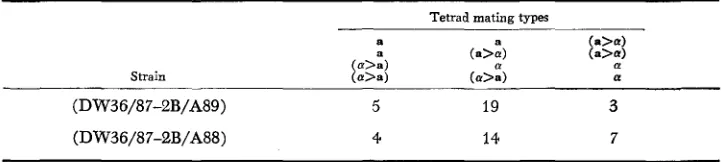
a single (a>a) segregant, DW36/87-2B7 was obtained. When subcloned, the strain gave rise to (a>cw) colonies, nonmating colonies and a few (a>a) colonies. A nonmating colony was sporulated and dissected. Each of 34 tetrads contained two ( a > a ) and two (a>a) segregants. These results immediately distinguished this phenotype from that of MATa-inc. From crosses of DW36/87-2B with MATa and MATa strains A88 and A89, we found that the mutation responsible for this behavior was unlinked to MAT, but strongly linked to HO (Table 12).In
the 52 tetrads examined, there were always two (a>,) or (,>a) colonies and two heterothallic a or a colonies. No nonmatingcolonies characteristic of a wild-type
HO
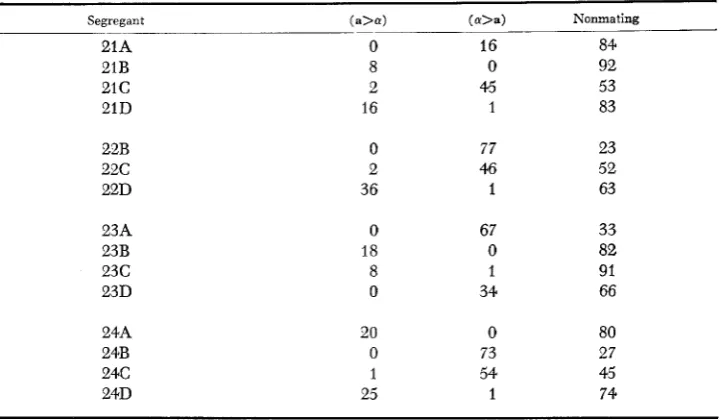
was found. The mutation is, therefore, extremely close (less than 2 cM) t o HO and is most likely an inefficient allele of HO, which we designated HO-I.The HO-I allele reduced mating-type switching to about 30% of normal. When a MATaIMATa diploid homozygous for NO-1 was dissected and the segregants then subcloned (Table 13), we could estimate the efficiency of switch- ing as described before for the switching of MATa-inc. We found a consistent asymmetry in our subcloning studies; namely, that switching from MATa to MATa was more severely inhibited by NO-I than was switching from MATa to MATa.
Interaction between MATa-inc and HO-1: A MATa-inc strain was crossed with a homothallic strain carrying the defective HO-1 allele. Each of these muta- tions by themselves permits some limited switching of MATa to MATa and exhibits an (a>a) phenotype. However, MATa-inc HO-1 recombinants show virtually no switching and appear to behave as if they were heterothallic MATa strains.
TABLE 12
Segregation of a mutation affecting mating-type switching in strain DW36/87-2Bf
Tetrad mating types
Strain
5 19 3
4 14 7
~~ ~
MATING-TYPE SWITCHING M U T A N T IN YEAST
TABLE 13
Muting behavior of subclones of HO-1 segregants from a MATa/MATar HO-l/HO-l diploid
35 7
Segregant
21A 21B 21 C 21D
22B 22C 22D
23 A 23B 23C 23D
24A 24B 24C 24D
0 8 2 16
0 2 36
0 18
a
0
20 0 1 25
77 46 1
67 0 1 34
0 73 54 1
Nonmating
84 92 53 83
23 52 63
33
82
91 66
80 27
45
74
DISCUSSION
We have presented evidence of a cis-acting mutation within M A T a that greatly reduces the conversion of this locus to M A T a . The MATa-inc mutation prevents its own switching even in MATa-inc/mata* diploids in which the mata* allele is readily interconverted to MATcu. Thus, the MATa-inc mutation does not alter a gene coding for a diffusible gene product nor can its defect be complemented by the presence of a normally switching matat allele; we suggest, therefore, that MATa-inc is i n a DNA recognition sequence necessary for the replacement of M A T a by M A T a .
The MATa-inc mutation is apparently equivalent to the MATa-inc allele introduced into S. cereuisiae from S. diasticus (TAKANO, KUSUMI and OSHIMA
1973). Both are cis-acting alleles that are "healed" to normal M A T a o r M A T a alleles by two successive switches of mating-type. The healings of MATa-inc and MATa-inc are analogous to the healing of several recessive mata and mata mutations that must be defects in structural genes of the M A T locus, but which are not impaired in mating-type switching (HICKS and HERSKOWITZ 1977; STRATHERN 1977; KLAR, FOGEL and RADIN 1979). When MATa-inc is replaced by M A T a , the defective allele appears to be lost, as the ( a > , ) phenotype fails to reappear in a subsequent conversion (MATa-inc + MAT,-+ M A T a )
.
358 D. W. MASCIOLI A N D J. E. HABER
3 MATa-inc:l MATa
(TAKANO,
KUSUMI and OSHIMA 1973). In all, these investi- gators found five such conversion events among 330 tetrads. Similarly, we found five of 66 tetrads from the MATa-inc/MATa diploid in Table 2 resulted from gene conversion. Among 256 tetrads pooled from different crosses involving MATa-inc, 12 (or 4.7%) were apparently 3 MATa-inc:l M A T a gene con- versions. In normal homothallic M A T a / M A T a diploids, the frequency of gene conversions is lower. For example, KLAR,FOGEL
andLUSNAK
(1979) report one case of a 3 M A T a : l MATa tetrad in 412 tetrads and two examples of 3 M A T a : l M A T a in 337 tetrads.Possible similarities to another transposable system: The mechanism of switch- ing mating type in yeast exhibits some interesting similarities with excision of bacteriophage h DNA from the
E .
coli host chromosome. The MATa-inc muta- tion seems analogous to att mutants that prevent the normal excision of phage XDNA
from the bacterial chromosome (SHULMAN and GOTTESMAN 1973). Theseat2 mutants are cis-acting and distinguishable from recessive mutants of A, such as xis, that most likely alter a protein necessary for excision (GUARNEROS and ECHOLS 1970). In S. cerevisiae, too, there are mutations in other genes necessary for M A T interconversion. The recessive swil mutation unlinked to M A T , HMa, HMa and HO prevents switching of both M A T a and M A T a
(HABER
and GARVIK 1977).Other homothallism mutations induced b y MATa-inc: One surprising outcome of this study has been the discovery that homothallic strains carrying MATa-inc are likely to become altered in other genes involved in mating-type intercon- version. Whereas the recovery of an altered HO-I allele may have been fortui- tous, the recovery of mutations at HMa at a frequency of about 1% of the subclones of several ( a > a ) colonies is certainly attributable to MATa-inc. These mutations could represent actual switches of HMa to hma (i.e., from a silent copy of a information to a copy of a information). Alternatively, they could
be
changes in HMa itself such that the a mating-type information is either mutated,
deleted or prevented from being transposed.
Recently, we have shown that these mutations were indeed conversions of HMa to a functional copy of a information ( i . e . h m a ) . In fact, the new hma allele carried the a-inc mutation that could be transposed back to M A T (MASCIOLI,
1979; HABER, MASCIOLI and
ROGERS
1980). We have also observed similar conversions in MATa-inc strains, where, f o r example, HMa was converted to a functional hma or hma was switched to HMa. (HABER, MASCIOLI and ROGERS,MATING-TYPE SWITCHING MUTANT I N YEAST
359
necessary to determine if homothallic switching of
H M
genes occurs onlywhen
normal replacement of the
MAT
gene is prevented.W e are extremely grateful for the suggestions and comments of ANITA HOPPER, NANCY PEARSON and ELLEN KRAIG. This work was supported by Public Health Service grant GM20056. During part of this time, D. W. MASCIOLI was supported by Public Health Service Training Grant GM7122-05 in Genetic and Biochemical Mschanisms of Regulation.
LITERATURE CITED
DUNTZE, W.: V. MACKAY and T. R. MANKEY, 1970 Saccharomyces cereuisiae: A diffusable
GRANT, P., L. SANCHEZ and A. JIMENEZ, 1973 Cryptopleurine resistance: Genetic locus for a
GUAANEROS, G. and H. ECHOLS, 1970 New mutants of bacteriophage X with a specific defect
HABER, J. E., 1974 Bisexual mating behavior in a diploid of Saccharomyces cereuisiae: Evi- dence for genetically controlled nonrandom chromosome loss during vegetative growth. Genetics 78: 843-858.
HABER, J. E. and B. GARVIK, 1977 A new gene affecting the efficiency of mating-type inter- conversions i n homothallic strains of Saccharomyces cereuisine. Genetics 87 : 33-50.
HABER, J. E. and J. P. GEORGE, 1979 A mutation that permits the expression of normally silent copies of mating-type information i n Saccharomyces cereuiskze. Genetics 93 : 13-35.
J~ABER, J. E., D. W. MASCIOLI and D. T. ROGERS, 1980 Illegal transpositions of yeast mating type genes. Cell (in press).
HARASHIMA, S., Y. NOGI and Y. OSHIMA, 1974 The genetic system controlling homothallism in Saccharomyces yeasts. Genetics 77: 639-650.
HARASHTMA, S. and Y. OSHIMA, 1976 Mapping of the homothallic genes, HMa and HMa, in Saccharomyces yeasts. Genetics
a:
437-451.HAWTHORNE, D. C., 1963 A deletion in yeast and its bearing on the structure of the mating type locus. Genetics 4.8 : 1727-1 729.
HICKS, J. B. and I. HERSKOWITZ, 1976a Interconversion of yeast mating types. I. Direct obser- vations of the actions of the homothallism ( H O ) gene. Genetics 8 5 : 245-258.
-
, 1976b Evidence for a new diffusable element of mating pheremones in yeast. Nature 260: 246- 248. --, 1977 Interconversion of yeast mating types. 11. Restoration of mating ability to sterile mutants in homothallic and heterothallic strains. Genetics 85: 373-393.The cassette model of mating type inter- conversion. pp. 457-462. In: D N A Insertion Elements, Plasmids and Episomes. Edited by A. I. BUKHARI, J. A. SHAPIRO and S. L. ADHYA. Cold Spring Harbor New York.
KASSIR, Y. and G. SIMCHEN, 1976 Regulation of mating and meiosis by the mating-type region. Genetics 82: 187-206.
KLAR, A. J. S. and S. FOGEL. 1977 The action of homothallism genes i n Saccharomyces diploids during vegetative growth and the equivalence of hma and H n h loci functions. Genetics 8 5 : 407-416.
Gene conversion of the mating-type locus in Saccharomyces cerevisiae. Genetics 92 : 777-782.
MARI-A regulator of the HMa and H M a loci in Saccharomyces cereuisiae. Genetics 93: 37-50.
sex factor. Science 168: 1472-1473.
40s ribosomal component in Saccharomyces cereuisiae. J. Bact. 120: 1308-1314.
in excision from the host chromosome. 5. Mol. Biol. 47: 565-574.
HICKS, J. B., J. STRATHERN and I. HERSKOWITZ, 1977
KLAR, A. J. S., S. FOGEL and K. LUSNAK, 1979
360 D. W. MASCIOLI A N D J. E. HAB E R KLAR, A. J. S., S. FOCEL and D. N. RADIN, 1979
MACKAY, V. and T. MANNEY, 1974
Switching of a mating-type a mutant allele in budding yeast Saccharomyces cereuisiae. Genetics 92 : 759-776.
Mutations affecting sexual conjugation and related pro- cesses in Saccharomyces cerevisiae. I. Isolation and phenotypic characterization of non- mating mutants. Genetics 76: 255-271.
MASCIOLI, D. W. 1979 Transposition of mating type genes in Saccharomyces cereuisiae. Ph.D. Dissertation, Brandeis University, Waltham, Massachusetts.
MORTIMER, R. K. and D. C. HAWTHORNE, 1969 Yeast genetics. pp. 386460. In: T h e Yeasts, Vol. 1. Edited by A. H. ROSE and J. S. HARRISON. Academic Press, New York.
NAUMOV, G. I , V. I. KUNDRATIEVA and I. I. TOLSTORUKOV, 1974 Comparative genetics of yeast.
XV. Determination of the character “delayed diploidizatjon” in the yeast Sgccharomyces bayanus M-180. Genetika 10: 133-138.
NAUMOV, G I. and I. I. TOLSTORUKOV, 1973 Comparative genetics of yeast. X. Re-identification of mutators of mating types in Saccharomyces. Genetika 9: 82-91.
RASSE-MESSENGUY, F. and G. R. FINK, 1973 Temperature-sensitive nonsense suppressors in yeast. Genetics 75: 459-464.
SHERMAN, F., G. R. FINK and H. B. LUKINS. 1970 Methods in Yeast Genetics. Cold Spring Harbor, New York.
SHULMAN, M. and M. GOTTESMAN, 1973 Attachment site mutants of bacteriophage Lambda. J. Mol. Biol. 81: 461-482.
STRATHERN, J. N., 1977 Regulation of cell type in Saccharomyces cereuisiae. Ph.D. disserta- tion, University of Oregon.
TAKANO, I. and K. ARIMA, 1979 Evidence of the insensitipity of the a-inc allele to the function of the homothallic genes in Saccharomyces yeasts. Genetics 91 : 245-254.
T A K ~ N O , I., T. KUSUMI and Y. OSHIMA, 1973 An a mating-type allele insensitive to the muta-
genic action of the homothallic gene system in Saccharomyces cereuisiae. Mol. Gen. Genet. 126: 19-28.
Mutational nature of an allele-specific conversion of the mating type by the homothallic gene HOa in Saccharomyces. Genetics 6 5 : 421-427.
A mutation of yeast mating type altered in sporulation and mating type interconversion. Amer. Soc. of Microbiology Abstracts: 227.
Corresponding editor: R. E. ESPOSITO TAKANO, I. and Y. OSHIMA, 1970