Universally Composable Symbolic Security Analysis
∗
Ran Canetti
†Jonathan Herzog
‡September 12, 2009
Abstract
In light of the growing complexity of cryptographic protocols and applications, it becomes highly desirable to mechanize — and eventually automate — the security analysis of protocols. A natural step towards automation is to allow for symbolic security analysis. However, the complexity of mechanized symbolic analysis is typically exponential in the space and time complexities of the analyzed system. Thus, full automation via direct analysis of the entire given system has so far been impractical even for systems of modest complexity.
We propose an alternative route tofully automatedandefficientsecurity analysis of systems with no a priori bound on the complexity. We concentrate on systems that have an unbounded number of com-ponents, where each component is of small size. The idea is to perform symbolic analysis that guarantees composable security. This allows applying the automated analysis only to individual components, while still guaranteeing security of the overall system.
We exemplify the approach in the case of authentication and key-exchange protocols of a specific for-mat. Specifically, we formulate and mechanically assert symbolic properties that correspond to concrete security properties formulated within the Universally Composable security framework. As an additional contribution, we demonstrate that the traditional symbolic secrecy criterion for key exchange provides an inadequate security guarantee (regardless of the complexity of verification), and propose a new symbolic criterion that guarantees composable concrete security.
Keywords: Cryptographic protocols, security analysis, symbolic analysis, automated analysis, universal composition.
∗This work was first presented at the DIMACS workshop on protocol security analysis, June 2004. An extended abstract
appears in the proceedings of the Theory of Cryptography Conference (TCC), March 2006. Most of the research was done while both authors were at CSAIL, MIT.
Contents
1 Introduction 1
1.1 This work . . . 2
1.2 Related work . . . 4
2 Overview 6 2.1 Background . . . 6
2.2 Simple Protocols . . . 8
2.3 The mapping lemma . . . 9
2.4 Mutual authentication . . . 10
2.5 Key exchange . . . 10
3 The Dolev-Yao model for symbolic encryption 11 3.1 The Message Algebra . . . 11
3.2 Symbolic Protocols . . . 12
3.3 The Symbolic Adversary and Symbolic Executions . . . 13
4 Simple Protocols 15 4.1 The Certified Public-Key Encryption Functionality . . . 16
4.2 The Definition of Simple Protocols . . . 17
4.3 Symbolic semantics of Simple Protocols . . . 19
4.4 Examples . . . 21
4.4.1 The Dolev-Dwork-Naor protocol . . . 21
4.4.2 The Needham-Schroeder-Lowe protocol . . . 22
5 The Mapping Lemma 23 6 Symbolic analysis of UC mutual authentication 28 6.1 The ideal 2-party mutual authentication functionality . . . 28
6.2 Dolev-Yao mutual authentication . . . 28
6.3 Soundness and completeness of the symbolic criterion . . . 29
7 Symbolic analysis of UC key exchange 31 7.1 The ideal key exchange functionality . . . 31
7.2 Dolev-Yao key exchange . . . 32
7.2.1 The traditional symbolic criterion . . . 32
7.2.2 The new symbolic criterion . . . 33
7.3 Soundness and completeness of the symbolic criterion . . . 35
8 Automated Analysis of Needham-Schroeder-Lowe 38 A The UC framework 45 A.1 The basic model . . . 45
A.2 Defining security of protocols . . . 47
A.3 Composition theorems . . . 49
B From simple protocols to fully specified ones. 50 B.1 Realizing multiple instances ofFcpkeusing a single instance . . . 50
1
Introduction
From its very earliest stages, modern cryptography has built mathematical models with which to represent cryptographic protocols and specify their security properties. A very partial list of such properties includes pseudorandomness [15, 16, 69], semantic security [38, 55], unforgeability [41], zero-knowledge [40, 34, 37], non-malleability [29], and general security properties of protocols [70, 36, 39, 56, 9, 19, 64, 20]. Consequently, we now have a variety of mathematical models with which to analyze cryptographic protocols.
These models are complex, however, and analyzing even very simple protocols within them is often painstaking and delicate. In particular, such models are based on complexity theory and have a very ‘computational’ nature. Adversaries are represented by probabilistic Turing machines, and proofs of security reduce a successful attack to some underlying problem. Such proofs show that if this underlying problem is hard, then the adversary’s probability of success is bounded above by some (rapidly diminishing) function of the consumed resources. To show this, however, these proofs use either asymptotic formalisms or highly parameterized notions of security. Furthermore, these analyses often require ‘human ingenuity’, and are thus hard to extend and to mechanize. All in all, full-fledged analysis of even a moderately complex cryptographic system is a daunting task.
Several abstractions of this ‘computational’ model have been proposed, such as the Dolev-Yao model [31] and its many extensions and derivatives (e.g., [33, 68, 26]), the BAN logic [18], and a number of process calculi (e.g. [2, 49, 50, 53]). In these approaches, cryptography is axiomatized. That is, cryptographic primitives are represented as symbolic operations which are defined to guarantee a set of idealized security properties. For example, the BAN logic models encryption as a communication channel which is inaccessible to the adversary [18], while others model it as a symbolic operation which completely hides the message [31]. As a result, these kinds of models are much simpler than the computational ones: protocols are finite and deterministic, security definitions can be stated in absolute terms rather than asymptotic or probabilistic ones, and proof are unconditional (rather than relying on computational hardness assumptions). This greater simplicity makes analysis in these ‘symbolic’ models much more amenable to mechanization and automation, see e.g. [52, 54, 66, 60, 11, 12].
A recent body of work, starting with that of Abadi and Rogaway [4], demonstrates that such symbolic analyses can besoundwith respect to the computational models: that symbolic analyses can also be used to verify security properties of the computational model. In particular, Abadi and Rogaway showed that one can assert indistinguishability of distribution ensembles from a certain class (such as those produced by an encryption scheme) by translating these ensembles to symbolic forms and then verifying a symbolic property. This work has been extended in a number of ways (e.g.[58, 3, 46, 5]). Two particularly important works for our purposes are those of Micciancio and Warinschi [59] and Backes, Pfitzmann and Waidner ([6, 7] and others). Micciancio and Warinschi substantially extend the approach of Abadi and Rogaway to the case of interactive protocols and unauthenticated communication networks with active adversaries. In particular, they provide a general soundness theorem for a class of symbolic properties (which, roughly, correspond to “correctness properties” on the outputs of parties who follow the protocol). They also exemplify their treatment for the task of mutual authentication, as defined in [10]. That is, they show that the security of concrete mutual authentication protocols (of a certain format) can be asserted via the following two-step process: First, translate the concrete protocol into a symbolic one. Then, assert an appropriate symbolic property of the resulting symbolic protocol. Security of the concrete protocol is then guaranteed.
An alternative approach, taken by Backes, Pfitzmann and Waidner (e.g.[6, 7]) and discussed further in Section 1.2, defines idealized abstractions of cryptographic primitives directly in a full-fledged cryptographic model. These abstractions are realizable by actual concrete protocols in a cryptographic setting, but can simultaneously be used as abstract primitives by higher-level protocols. Soundness properties, provided via a general composition theorem, show that protocol executions can be ‘mapped’ from the computational to abstract setting. Therefore, large classes of security properties can be verified by analyzing the abstract primitives. (We note that this approach was developed concurrently to, and initially independently of [4].)
should be analyzed together. In some cases this is not possible at all, since the entire system might not be known at the time of analysis. But even if it is, mechanical analysis might not be computationally feasible or possible. Indeed, the general protocol-security problem — does a given protocol satisfy a given security property when running an unbounded number of sessions — is undecidable [33]. Even when the number of sessions is bounded and specified in the problem statement, the protocol-security problem isNP-hard and in some cases PSPACE-hard [33, 32]. Thus, mechanical and automated analyses justified by the above works do not seem to be feasible for systems of interest.
1.1
This work
We propose a different approach: Use symbolic analysis to prove composable security properties of cryp-tographic protocols. Such properties are defined for (and verified about) individual protocol sessions, but remain valid even when the analyzed session is composed with an unbounded number of other sessions. This allows us to apply automated security analysis only to a single session, and still deduce security properties of the overall system — even when this system consists of an unbounded number of sessions, and is not fully known in advance. More concretely, we propose to modify the two-step approach of [4, 59] as follows:
1. De-compose the system into individual sessions, where each session consists of a single execution of a relatively simple protocol.
2. Translate the resulting protocol into an abstract, symbolic form.
3. Use the automated analysis tools of the symbolic models to show that a single session of the (abstracted) protocol achieves, in isolation, some particular symbolic property.
4. Conclude that, because the symbolic protocol satisfies those particular symbolic properties, the original concrete protocol satisfies a composable security property in the computational model.
5. Conclude that the protocol provides the same security properties in the original, multi-session system.
Step 5 can be asserted once and for all, using a general composition theorem. We do this using the universally composable (UC) security framework of Canetti [20]. Step 4 needs to be asserted only once per model, where a model includes the abstraction method and the task at hand. We do this for a specific abstraction method, and for the tasks of mutual-authentication and key-exchange. In fact, asserting Step 4 is the main technical bulk of this work.
The rest of this section discusses some obstacles in the way of the above plan, and our methods of dealing with them. We postpone full overview to Section 2. We first briefly review the tasks of mutual authentication and key exchange. In both cases, two parties are communicating over an unauthenticated, adversarially controlled network. For mutual authentication, the two parties wish to learn whether the other party exists in the system and agrees to communicate. For key exchange, two parties wish to generate a random key that is known only to the two of them. In both cases, the system of interest consists of multiple ‘runs’ where in each run two parties attempt to mutually authenticate or exchange a key. Because these two kinds of systems de-compose naturally into individual sessions, each of which consists of a relatively simple interaction, they are particularly suited to our approach.
sessions have some amount of “joint state,” and thus the universal composition theorem cannot be directly applied to assert security of the re-composed system.
We solve this problem by using the universal composition with joint state (JUC) theorem of Canetti and Rabin [25]. informally, this theorem states the following: Assume that protocol p has the property that the outputs of the parties from a single instance ofplook like their outputs from multiple independent instances of some other, simpler protocol, f. Then, the behavior of any multi-party system r that uses multiple instances off as subroutines will remain essentially the same even when all the instances off are replaced by asingleinstance ofp.
This somewhat abstract theorem is used as follows. We focus on modeling long-term authentication using public-key encryption. For that purpose, we formulate an ‘ideal certified public key encryption functionality,’ denotedFcpke. This functionality models ideal encryption and decryption services in the presence of a public
key infrastructure. (Fcpkeis a variant of known idealized formulations of public-key encryption, seee.g. [20].)
We then proceed in two steps. First we analyze an overly-idealized protocol, where each single (pairwise) session of the mutual-authentication or key-exchange protocol has access to its own dedicated instance of Fcpke. Here the different protocol sessions have no joint state, and so the UC theorem can be applied.
Next, we demonstrate how multiple instances of Fcpke can be realized by a single instance of a concrete
encryption scheme — so long as all the instances ofFcpkehave the same party as the designated decryptor,
and in addition the concrete scheme is secure against adaptive chosen ciphertext (CCA) attacks as in [65, 29]. By the JUC theorem, therefore, the security of a system where each single session uses its own dedicated instance of Fcpke implies security of that same system where all instances of Fcpke that correspond to the
same decryptor are replaced with a single instance of a CCA secure encryption scheme.
Symbolic forms of concrete protocols. Recall that our approach requires that cryptographic protocols be abstracted from a computational model to a symbolic model. However, an arbitrary protocol in the UC setting may not have a natural or clear symbolic form. In order to enable our approach, therefore, we concentrate on a restricted class of UC protocols which we callsimple protocols. Mirroring Micciancio and Warinschi [59] we require, for simplicity of exposition, that simple protocols use no cryptographic primitives other than public-key encryption (with certified keys). In conjunction with the treatment of joint state, described above, the use of public-key encryption is modeled as interaction with the functionalityFcpke.
In addition, we require that simple protocols can be expressible as a sequence of commands from a restricted set of operations. More precisely, we define simple protocols as programs from a high level ‘pro-gramming language’ that regulates their form and enumerates a specific set of ‘atomic’ operations. While restricted, this format is rich enough to express some ‘benchmark’ protocols such as the Dwork-Dolev-Naor [29] protocol and the Needham-Schroeder-Lowe (NSL) protocol [61, 51, 52].
From symbolic properties to UC security. We first formulate composable, concrete notions of security for mutual authentication and key exchange. Within the UC framework, this is done by way of formulating ideal functionalities that captures the appropriate security properties. For key exchange, we simply use the ’ideal key exchange’ functionality F2ke from [20]. Since there is no existing functionality for mutual
authentication in the literature, we formulate one here (calledF2ma) in a straightforward way.
Our approach now requires us to find criteria for symbolic protocols that imply the two specific notions of security captured byF2ma andF2ke. For mutual-authentication protocols, we use the standard symbolic
mutual authentication criterion from the literature — except that we only need to apply this criterion to a single authentication session. That is, we demonstrate that a concrete symbolic protocol realizesF2ma if and
only if the corresponding symbolic protocol satisfies the standard symbolic mutual authentication criterion, applied to a single session. (This criterion is is also reminiscent of the one used in [59], except that there it is formulated in the more complex terms of multiple sessions).
Nevertheless, this criterion is formulated in a symbolic setting. We then show that this criterion (which is reminiscent of the one used in [12, 57]) suffices to guarantee that a protocol achieves our composable security goals. (i.e., it realizesF2ke). Furthermore, as discussed below, this criterion can be efficiently verified using
the same tools as would be used to verify the traditional symbolic criterion.
A central tool in these two proofs is a ‘mapping lemma’ which provides a close correspondence between executions of the abstracted protocol in the symbolic model and executions of the original protocol in the concrete model. This lemma is similar to the corresponding lemma by Micciancio and Warinschi [59], except that it is framed within our model; in particular, it is formulated in terms of a single execution of a two-party protocol.
Automated analysis. To demonstrate that our approach results in a feasible method for protocol analysis, we used an automated tool to analyze a number of protocols. Specifically, we used ProVerif [13, 11, 12] to analyze three closely-related protocols: the original Needham-Schroeder-Lowe protocol and two variants proposed in this work. The original protocol is a mutual-authentication protocol, while the two variants provide two natural ways to extend this protocol into a key-exchange protocol. As expected, the tool verified that the original protocol satisfied our symbolic criteria for mutual authentication. It was also able to correctly analyze the key-exchange variants: In one case, the tool was able to find an attack and conclude that the protocol fails to realizeF2ke. In the other case, the tool verified that the protocol realizesF2ke.
Again, we emphasize that in our approach, the automatic analysis need only consider a single instance of the protocol running in isolation. Therefore, our ProVerif analyses were limited to this small system and executed quite quickly. For each of the above cases, the tool (running on a 1GHz G4 processor) finished within less than a second.
On the insufficiency of traditional symbolic secrecy of key exchange. The main thrust of this work is to improve the feasibility of security analysis, and so it suffices to show (as we do) that composable security properties are implied by some symbolic criteria. As an additional contribution, however, we also observe that the traditional symbolic secrecy criterion for key exchange provides an inadequate level of security — regardless of how easily it can be verified. Specifically, we present a protocol that satisfies the traditional criterion and an attack against that protocol in a generic computational setting. Interestingly, the attack is completely ‘generic’ in that it treats the underlying encryption in a ‘black-box’ way. (In a nutshell, the issue is that the traditional criterion only requires that no symbolic adversary be able to explicitly output the secret key in any execution of the symbolic protocol [31]. This turns out to be too weak of a requirement.)
1.2
Related work
Pfitzmann and Waidner [64] provide a general definition of integrity properties and prove that such properties are preserved under protocol composition in their framework. Our symbolic mutual authentication criterion can be cast as such an integrity property. In addition, Backes, Pfitzmann and Waidner [7], building on the idealized cryptographic library in [6], demonstrate that several known protocols satisfy a property that is similar to our symbolic mutual authentication criterion. These results differ from ours in two main respects. First, these results do not address the question of whether a given concrete cryptographic protocol realizes an ideal functionality (e.g., the mutual authentication functionality) within a cryptographic model (e.g., their framework.) More importantly, since the idealized library of [6] is formulated in an inherently multi-session way, the analysis of protocols (as in, e.g., [7]) has to be directly applied to the multi-multi-session system. Consequently, analysis based on the idealized library [6] is susceptible to the same complexity limitations which this work circumvents. Furthermore, the formulation [6] does not seem to enable applying a joint-state composition theorem along the lines of [25]. See more discussion on this point in [21].
Concurrently to the first public version of this work, Backes and Pfitzmann [8] propose an abstract secrecy criterion for key-exchange protocols that use their cryptographic library, and demonstrate that this criterion suffices for guaranteeing cryptographically sound secrecy. However, their criterion is still formulated within their full-fledged cryptographic framework, rather than in a simplified symbolic model as done here. Furthermore, it does not carry any secure composability guarantees.
Laud [48] investigates the concrete cryptographic properties guaranteed by certain symbolic secrecy crite-ria for protocols usingsymmetricencryption. He also shows how these symbolic criteria can be automatically verified. However, these criteria are different from the ones discussed here. Specifically, following the tra-ditional symbolic formulation, it is only required that the adversary obtains no information about the key during the course of the protocol, and “real-or-random secrecy” against active adversaries is not considered. Consequently, these criteria do not guarantee secure key exchange, nor are they preserved under composition. Concurrently to this work, Cortier and Warinschi [27] formulate another symbolic secrecy criterion for key exchange protocols, demonstrate how to automatically verify this criterion, and show that this criterion implies a cryptographic secrecy criterion against active adversaries. However, also in that work the symbolic criterion follows the tradition of only requiring that the adversary obtains no information on the secret key. Consequently, their cryptographic criterion falls short of guaranteeing secrecy in a general protocol setting, as exhibited in [23]. In particular, their criterion admits the above-mentioned insecure extension of the NSL protocol to key exchange.
In another concurrent work, Micciancio and Panjwani [57] study computationally sound symbolic analysis of group key agreement protocols with adaptively changing membership. Their symbolic secrecy criterion also has a “real or random” flavor, set in a symbolic setting, much like the one here.
Blanchet [12] provides a symbolic criterion (cast in a variant of the spi-calculus [1]) that captures a secrecy property, called “strong secrecy”, that is similar to our symbolic secrecy criterion for the exchanged key. Essentially, the criterion says that the view of any adversarial environment remains unchanged (modulo renaming of variables) when the symbol representing the secret key is replaced by a fresh symbol that is unrelated to the protocol execution. As opposed to our criterion, however, Blanchet’s directly considers multi-session systems.
Recently, Blanchet has developed a new automated tool called CryptoVerif [14] which directly analyzes computational security of concrete protocols. An interesting direction for future research is to apply this tool to assert composable security properties.
Herzog, Liskov and Micali [45] provide an alternative cryptographic realization of the Dolev-Yao abstrac-tion of public-key encrypabstrac-tion. Their realizaabstrac-tion makes stronger cryptographic requirements from encrypabstrac-tion scheme in use (namely, they require “plaintext aware encryption”), and assumes a model where both the sender and the receiver have public keys. Herzog relaxes this requirement to standard CCA-2 security [44], but that work (lacking any composition theorems) still considers the multi-session case. Furthermore, it only connects executions of protocols in the concrete setting to executions of protocols in the symbolic setting. It does not investigate whether security in the symbolic setting implies or is implied by security in the concrete setting.
Patil [62] extends the present work to handle also mutual authentication and key exchange protocols that use digital signaturesin addition topublic-key encryption.
Organization. We begin with an informal overview of our approach and results (Section 2). Next, we define our version of the Dolev-Yao model for symbolic encryption (Section 3). We then present the class of simple protocolsand the certified public-key encryption functionality,Fcpke(Section 4). Next, we present
2
Overview
This section presents an overview of the rest of this work. Section 2.1 contains a brief review of the UC framework and the traditional symbolic (“Dolev-Yao”) model which we will be using. Section 2.2 sketches and motivates the notion of simple protocols. Section 2.3 informally presents themapping lemma, which is our main tool for relating runs of a concrete (simple) protocol to runs of its “symbolic counterpart.” Finally, Sections 2.4 and 2.5 sketch our treatment of mutual authentication and key exchange, respectively.
2.1
Background
The universal composition framework. The universal composition (UC) framework provides a general way for specifying the security requirements of cryptographic tasks, and asserting whether a given protocol realizes the specification. A salient property of this framework is that it provides strong composability guar-antees: a protocol that realizes the specification in isolation continues to realize the specification regardless of the activity in the rest of the network. That is, the composition of the protocol with the other network activity will not lead to “unexpected side-effects.” We give here a very high level sketch of the framework. A more detailed description appears in Appendix A.
Defining what it means for a protocol p to “securely realize” a certain task is done in three steps, as follows. First, we formulate a model for executing the protocol. This model consists of the parties running the protocol, plus two adversarial entities: theenvironment Z,which generates the inputs for the parties and reads their outputs, and theadversary A, which reads the outgoing messages generated by the parties and delivers incoming messages to the parties. The adversary and the environment can interact freely during the protocol execution.
Next, we formulate an “ideal process” for carrying out the task at hand in a “perfectly secure way”. In the ideal process the protocol participants simply pass their inputs to an imaginary “trusted party,” who locally computes the desired outputs and hands them back to the parties. The program run by the trusted party is called an ideal functionality and is intended to capture the security and correctness specifications of the task. For convenience, the ideal process with ideal functionality F is formulated as the process of running a special protocolIF called theideal protocolforF. In protocolIFthe parties simply pass all inputs to the trusted party, and output whatever information they obtain from the trusted party. Similarly, the adversary does not interact with the parties; instead, it interacts directly with Fin a way specified by F. The communication between the adversary and the environment remains arbitrary.
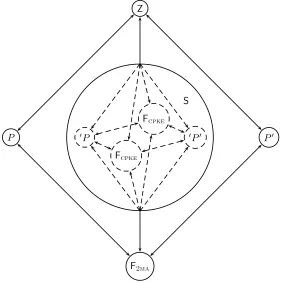
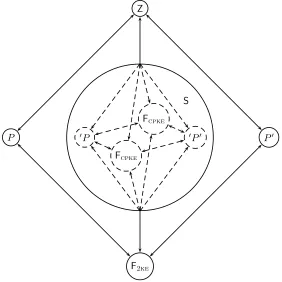
Finally, we say that protocol p UC-emulates protocol f if for any polytime adversary A there exists a polytime adversarySsuch that no polytime environmentZcan tell with non-negligible probability whether it is interacting with an execution ofp and adversaryA, or alternatively with protocolf and adversary S. We say thatp UC-realizesan ideal functionalityFif it UC-emulates the ideal protocolIF. This in particular means that the I/O behavior of the good parties in the protocol execution is essentially the same as that of the ideal functionality; in addition, the information thatZlearns fromAcan be generated (or, “simulated”) byS, who is given only the information that it can learn legally from interacting withF.
The following basic property holds in this framework.
Theorem (Universal Composition, informal). Let p be a protocol that UC-emulates protocol f, and let r be a protocol that has access to (multiple instances of) f. Letrp/f be the “composed protocol” which is identical to rexcept that inputs tof are replaced by inputs top, and outputs from pare treated as outputs from f. Then, protocol rp/f behaves in an indistinguishable way from the originalr.
In particular, ifrUC-realizes some ideal functionalityGthen so doesrp/f.
adversary. That is, say that protocolpUC-realizes an ideal functionalityF with respect to dummy adversaries if there exists an adversaryS such that no environment can tell with non-negligible probability whether it is interacting with an execution ofpand the dummy adversary, or alternatively with the ideal process forF and adversaryS. Then we have thatpUC-realizes Fif and only if pUC-realizes Fwith respect to dummy adversaries.
Another aspect of the UC framework used by our work is the following. To facilitate distinguishing among different protocol instances in a multi-instance system, the framework makes sure that each protocol instance in a system is associated with an identifier, called thesession ID (SID), that is unique to that protocol instance and is known to all participants in that instance. In general, theSIDof an instance is determined by the external system; typically, it will be chosen by the program instance that “initializes” the said protocol instance by invoking the first participant in the said instance. See more details in Appendix A.
Finally, we sketch an additional composition theorem that is necessary for our treatment, namelyuniversal composition with joint state (JUC)[25]. As mentioned in the Introduction, the UC theorem only applies to protocols rp where the honest parties maintain completely disjoint local states for the different instances of p. In contrast, the JUC theorem applies in cases where the different instances of phave some joint state. Specifically, letbp be a protocol that, in one instance, UC-realizes multiple instances of a simpler protocol f. (Formally, letbf be the protocol that exhibits, in a single instance, the behavior of multiple instances of f. Thenbpis a protocol that UC-emulatesbf.) Let rbe an arbitrary protocol that uses multiple instances of f, and letr[bp/f] be the composed protocol where each party runs a single instance of rplus asingleinstance ofbp, and where all the inputs provided byr to all the instances offare forwarded to the single instance of
b
p. Similarly, the outputs of the single instance ofbpare given tor as coming from the various instances off. Then, the JUC theorem states that protocolr[bp/f] UC-emulates the originalr.
The symbolic model. The symbolic model (often dubbed the “Dolev-Yao” model) is an abstract model for representing and analyzing protocols that use cryptographic primitives. In this model, messages are represented as compound elements in some symbolic algebra. That is, each compound element represents a “parse tree,” or a sequence of operations needed to obtain the composite symbol from basic symbols. For instance, the elementEnc(M;K) does not represent a distribution on strings; rather, it is a compound element that results from applying the formal encryption operation to the elements M andK. While the full-fledged Dolev-Yao model includes a variety of primitives such as symmetric encryption and signatures, we focus on a sub-model which includes only asymmetric encryption.
The basic element of the model is asymbolic algebraAthat representsmessagesof a protocol. Theatomic elements of the algebra are used to represent primitive structures such asparty identifiers, public encryption keys, random challenges (“nonces”), and secret keys. (The party identifiers and public keys can be either honest, orcorrupted.) The twooperationsof the algebra represent abstractedpairing(or concatenation) and encryption. Thus, thecompound elements of the algebra (i.e., those messages produced by the operations) represent those messages that pair or encrypt primitive messages (or other, simpler, compound messages). The algebra is free: each message has exactly one representation. Put another way, the algebra admits no equalities other than identity, and a composite element can be associated with a unique “parse-tree.”
Protocols are defined via a state transition table. When a participant receives a message or input, it transitions to a new state and either generates output or sends an outgoing message, as specified in the transition table. Here, messages are elements from the algebra; inputs and outputs are either elements from the algebra or special symbols signaling the beginning and end of an execution.
Thesymbolic adversaryis defined in two parts: itsinitial knowledge(a set of symbolic messages), and the adversary operationsit can use to deduce new messages from the initial messages and the messages generated by parties running the protocol. The adversary operations are extremely limited. Specifically, the adversary can concatenate messages, de-concatenate elements of a message, encrypt a message with a given public key, or decrypt a given symbolic ciphertext if the corresponding public key is corrupted. We remark that this list of adversary operations implicitly postulates “ideal” encryption: the adversary cannot perform any operations to ciphertexts other than the symbolic ones.
• The adversary initializing a participant,
• The adversary delivering a message to a participant,
• A participant sending or outputting a message, or
• The adversary computing some new message from messages it has already computed or intercepted.
Asymbolic traceis sequence of these events, and a trace isvalidfor a protocol if it could have resulted from an execution of that protocol. That is, a trace is valid for a protocol if the messages delivered by the adversary to the participants are consistent with the adversary’s computations, and the messages sent by participants are consistent with the messages received and the protocol in question.
In the symbolic model security propertiesare traditionally formalized as predicates on sets of traces: A protocol satisfies such a security property if the predicate is satisfied by all of that protocol’s valid traces.
2.2
Simple Protocols
Both the Dolev-Yao model and the UC framework allow protocols much flexibility, though in different ways. The Dolev-Yao model strictly regulates the forms of legal messages, restricting messages to the algebra A. However, protocols can consist of any sequence of messages, including sequences that cannot be efficiently computed. (For example, a symbolic protocol might have a participant receive a ciphertext encrypted with another participant’s key but then reply with the plaintext.) The UC framework, on the other hand, requires only that participants run efficiently. So long as it obeys this one restriction, the protocol can consist of any sequence of bit-strings (or distribution on bit-strings). To find a common denominator between these two models, we restrict our attention to a particular set of protocols which are valid for both settings.
This set of protocols, calledsimple protocols, are defined to be programs written in a specificprogramming language. This language enforces that each operation of the program is efficiently computable, but also limits the program to commands that reflect the structure of the Dolev-Yao model. Specifically, the language allows basic operations such as nonce generation, concatenation and separation, encryption, decryption, testing equality, and sending messages. (This set of operations is standard; in particular it is essentially the same as in [59].)
The programming language of simple protocols is presented in an abstract way that is not specific to either the UC model or the Dolev-Yao model. We then provide two different sets of semantic interpretations of the language: one interpretation is formulated in terms of interactive Turing machines in the UC framework, and the other interpretation as a symbolic protocol in the Dolev-Yao model. this gives a natural mapping from the UC interpretation of a simple protocol to the corresponding Dolev-Yao interpretation, and vice versa.
In the UC interpretation of a simple protocol, the encryption and decryption operations are translated to calls to the certified public-key encryption functionality,Fcpke. (This functionality captures, in an idealized
way, the properties of public-key encryption in the case where parties know the public keys of each other in advance.) In the Dolev-Yao interpretation of a simple protocol encryption and decryption are translated to creating new elements of the algebra using the appropriate symbolic operations. The UC and Dolev-Yao interpretations of other instructions in a simple protocol are defined in a similar way.
From simple protocols to fully-specified protocols. Even the UC interpretation of simple protocols are by themselves somewhat abstract, in that they useFcpkerather than some fully-specified public-key
en-cryption. This abstraction is justified as follows. First we show howFcpkecan be realized using functionality
Fpke(which represents the basic properties of public-key encryption schemes) and functionality Freg(which
represents some basic properties of a certification service). Next we recall that Fpke can be realized given
any public-key encryption scheme that is secure against chosen ciphertext attacks [20].
These facts, combined with the UC theorem, provide a way to instantiate simple protocols, while pre-serving security: Replace each instance ofFcpkeby an instance of a CCA-secure encryption scheme, and use
the certification authority to publicize the public keys. However, this results in highly inefficient protocols, where each instance of the instantiated simple protocol uses its own instance of the public-key encryption scheme. Instead, we would like to obtain a protocol where each party uses a single instance of the public-key encryption scheme for multiple instances of the instantiated simple protocol.
One way to do that would be to consider the entire multi-session interaction as a single instance of a more complex protocol. That protocol can now use a single instance ofFcpkeper party. But this approach would
force us to directly analyze the more complex multi-session protocols as a single unit. Instead we would like to be able to specify and analyze simple protocols in terms of a single instance (e.g., a single exchange of a key in the case of key-exchange), while making sure that the instantiated protocol uses only a single instance of Fcpke per party. This can be obtained using the UC with joint state theorem, along with an additional
simple technique from [25]. We sketch this technique.
First we observe that the following protocol realizes multiple instances of Fcpke which has the same
decryptor, using only a single instance ofFcpke: Whenever some party asks to encrypt a messagemfor an
instance ofFcpkewith session identifiersid, the protocol encrypts the pair (m, sid). Whenever some party
asks to decrypt a ciphertextcfor an instancesid, the protocol decryptsc, verifies that the decrypted value is of the form (m, sid) for somem, and returnsm; else an error value is returned. Denote this protocol by es, for “Encrypt the Session ID”. (This protocol and its analysis are analogous to the [25] protocol for realizing multiple instances of an ideal signature functionality using a single instance.)
Now, consider some protocol Pthat involves multiple instances of a simple protocolp. (ProtocolPmay simply describe an adversarially-controlled invocation of multiple instances of p, or alternativelyPmay be geared towards realizing some other ideal functionality, potentially calling other protocols as subroutines.) InP, each party uses a different instance ofFcpkeper instance of p. We can now use the JUC theorem to
assert that the protocolP[es] behaves in the same way asP. Furthermore, inP[es] each party uses a single
instance ofFcpkethroughout the interaction. See more details in Appendix B.
2.3
The mapping lemma
A central tool in our analysis is a mapping lemma that establishes a correspondence between executions of concrete simple protocols and executions of the corresponding symbolic protocols. (This lemma can be regarded as a restatement in our framework of the corresponding lemma in [59].) We proceed as follows. First, we define the trace of an execution of a simple protocol in the presence of an environment and an adversary within the UC framework. The trace provides a global view of the execution, including the views of the environment and the participants. It consists of a sequence of input, outputs, messages, and local variables (represented in bit-strings). It also contains the participants’ calls to Fcpke, thus capturing their
internal cryptographic operations. Similarly, we define the trace of an execution of a symbolic protocol within the symbolic model. Again, the trace represents a global view of the (now symbolic) execution. Here, the trace consists of a sequence of expressions from the underlying symbolic algebra. However, in contrast with concrete traces, the internal cryptographic operations of participants are not represented.
Next, we define a trace mapping, also denotedt, which translates a trace of a concrete simple protocol into a symbolic trace. This mapping is straightforward except that the calls to Fcpke in the concrete trace
protocol that isvalid(meaning: one that could have been produced by the symbolic adversary and symbolic protocol):
Mapping Lemma (informal): Letpbe a simple protocol, and letEnvbe an environment (all in the UC framework). Let tdenote the trace of the execution of pwithZand the dummy adversary, and lettdenote the derived symbolic trace. Letpbe the symbolic protocol derived fromp. Then t is a valid trace ofp, except with negligible probability (over the random choices in t).
In other words, the adversary in the UC setting can do nothing the symbolic adversary cannot also do (except with negligible probability).
We note that the statement of the mapping lemma is unconditional. Furthermore, it applies even to computationally unbounded environments and adversaries. In fact, the only source of error in the mapping is in cases where the environment in the concrete model “guesses” the value of some nonce. Since nonces are chosen at random from a large enough domain, the probability of error is negligible (in fact, it is exponentially small in the length of the nonces).
2.4
Mutual authentication
Having established a general correspondence between concrete traces in the UC framework and the symbolic traces of the Dolev-Yao model, we turn to specific security goals for protocols. Similar to [59] and [7], we demonstrate that the standard symbolic mutual authentication criterion is equivalent to the standard concrete criterion. The symbolic criterion essentially states that if a partyP successfully completes a session with the specified peerP′, thenP′ has initiated a session with the specified peerP.
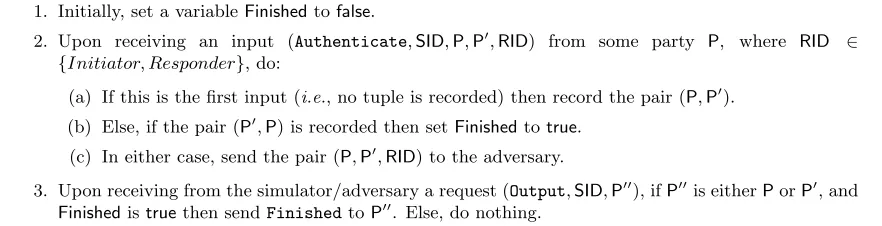
The concrete (UC) criterion is formalized via an ideal functionality F2ma which guarantees the same
property: F2ma waits to receive two session initiation inputs. If the identities in these inputs match (i.e.,
one input is by party P with specified peer P′, and the other is by partyP′ with specified peer P) then, upon request of the adversary,F2magenerates a successful completion output to eitherP orP′. It is stressed
that both the symbolic and the concrete criteria are formulated with respect to a single session of the authentication protocol. We then show:
Theorem (informal): Letpbe a simple concrete protocol. Then pUC-realizes F2ma if and only if
the symbolic protocol psatisfies the symbolic mutual authentication criterion.
The proof is rather straightforward, given the mapping lemma. On the one hand, it is easy to turn any symbolic trace ofpthat violates the symbolic mutual authentication criterion into a strategy for a concrete environment for distinguishing between an execution ofpand the ideal process forF2ma. On the other hand,
given a simple protocol p, we construct a general strategy for a simulator (i.e., an ideal-process adversary) within the UC framework, such that any environment that distinguishes between real and ideal executions can be turned into a symbolic trace ofpthat violates the symbolic mutual authentication criterion. It is in this last part that the mapping lemma is used in a central way.
2.5
Key exchange
The basic security properties for key-exchange areagreementandsecrecyfor the output key. The agreement property states that if two partiesP andP′ obtain keys and associate these keys with each other, then the
two keys are equal. The secrecy requirement states that in this case the joint key should be “unknown” to the adversary. (Note that these requirements neither imply nor are implied by mutual authentication.)
The UC criterion combines agreement and secrecy into a single ideal functionality,F2ke. This functionality
waits to receive requests from two parties to exchange a key with each other, and then hands a secretly chosen random key to the parties. (Each party gets the output key only when the adversary instructs.)
secret key is not in the closure of the messages seen by the adversary. This requirement is different in flavor than standard definitional approach in cryptographic security, where it is typically required that a secret value be indistinguishable from random. It is tempting at first to believe that, since in the symbolic model the security guarantees are “all or nothing” in flavor, the ability to symbolically generate a secret and the ability to distinguish it from random should be equivalent. However, it turns out that this is not the case: we show that the traditional symbolic criterion is insufficient for guaranteeing security of concrete key exchange protocols, under any reasonable definition, even if all the cryptography is “perfect.” Our proof is by counter-example: We show that one of the two Needham-Schroeder-Lowe mentioned earlier satisfies the traditional symbolic definition of secrecy but not a computational one. Thus, the traditional symbolic notion of key secrecy cannot imply the UC notion of security for key-exchange protocols. The key insight of the example is that while the protocol never explicitly leaks the key, it give the adversary an opportunity to verify candidate values for the key.
We formulate a new symbolic secrecy criterion for the shared key. Unlike the traditional symbolic criterion, our new definition is not expressed as a predicate on valid traces. Instead, it translates the real-or-random secrecy criterion from cryptographic definitions of secrecy into the symbolic model. To that end, we formalize two things: the notion of a symbolicadversary strategy, and the observable portionof a trace (usingpublic-key patternsdue originally to Abadi and Rogaway [4].) Our new symbolic definition of secure key-exchange requires that, for all adversary strategies, when a given strategy is applied to the protocol, the observable portion of the resulting trace looks the same when the protocol outputs the shared key as when it outputs a fresh key symbol (representing a fresh random key). The reader is referred to the Introduction for a review of other recent and concurrent works that formulate symbolic secrecy in similar ways.
Having defined this new notion of key-exchange security for the symbolic model, we demonstrate that it is equivalent to the UC criterion. That is, we show:
Theorem (informal): Letpbe a simple concrete protocol. Then pUC-realizes F2ke if and only if
the symbolic protocol psatisfies the symbolic key exchange criterion.
As was the case with mutual authentication, this equivalence holds unconditionally.
The proof proceeds with the same logical structure as before. First, we show how to turn any symbolic trace of p that violates the symbolic key exchange criterion into a strategy of a concrete environment for distinguishing between an execution ofpand the ideal process forF2ke. Next, given a simple protocolp, we
construct a general strategy for a simulator (i.e., an ideal-process adversary) within the UC framework, such that any environment that distinguishes between real and ideal executions can be turned into a symbolic trace ofp that violates the symbolic key exchange criterion. Here, however, the proof is more delicate. In particular, demonstrating the second property with respect to the symbolic secrecy criterion requires some work.
3
The Dolev-Yao model for symbolic encryption
There are several variations on Dolev and Yao’s original symbolic model [31] each of which is tailored to a specific tool or application. In this section, we formulate a variant which is appropriate for our needs. This variant is very close to Paulson’s formalism [63] but with the following changes:
• We consider only public-key encryption (ignoring symmetric encryption, signatures and so on), • We add a few new messages (for garbage terms, errors, and starting/finishing a protocol), • We partition the set of noncesamong the participants and the adversary,
• We add the notion of alocal output, and
• We make explicit the internal states of protocol participants.
3.1
The Message Algebra
Definition 1 (The Message Algebra) The messages of our model are elements of an algebra A. There are enumerably many atomic messages, divided into the following types:
• Identifiers (M) which are denoted byP1, P2. . .
• Random-string (Nonce) symbols (R), which are denoted by R1,R2. . . The set of nonces is partitioned
among the participants: participant Pi is given the set RPi ⊆ R. (The adversary, introduced in
Section 3.3, will also be given its own set of nonces RAdv.)
• Public keys(KP ub), denotedK1,K2. . . • Garbage terms, writtenG,G1,G2. . .
Compound messages are created by two operations:
• encrypt:KP ub× A → A
• pair:A × A → A
Mirroring the standard notation of the symbolic model, write Enc(m;K)for encrypt(K,m) andm1|m2 for
pair(m1,m2).1
The algebra isfree: Every compound message has a unique representation. In other words, each compound message can be equated with the “parse tree” which describes the unique way in which the message was constructed.
Identifiers are used to model the names of protocol participants. Each identifier-symbol is assumed to name a unique entity. (That is, no name is shared by multiple entities, and no entity has multiple names.)
Random-string symbols are used to represent just that: freshly-generated random bit-strings. It is assumed that no two random strings are the same. These symbols have two purposes: First, they can be used as ‘nonces’ to ensure freshness of messages and responses. Second, they can also be used as symmetric keys (i.e., output by key-exchange protocols).
We assume the existence of a function keyof :M → KP ub which maps each identifier to one public key. This function is assumed to be injective but not surjective: a key cannot be associated with more than one identifier, but there is no requirement that every key be associated with a name. This function is used to model a PKI infrastructure, and so every principal is assumed to be able to compute this function.
3.2
Symbolic Protocols
A symbolic protocol P consists of a set LP of roles, each of which describes a program for a protocol
participant. That is, a role describes how a participant should react to an input or an incoming message. The reaction might involve some state transition, and in addition one out of the following three possibilities:2
1. It might generate a new message M to another participant
2. It might generate a local output.
3. It might do neither.
We represent the third case (no observable reaction) by the symbol⊥. We represent the first case (sending a message) by hmessage,Mi. To represent the second case, we need to define the set of local outputs. In addition to messages from the algebraA, local outputs can contain either of two special signals for starting and ending the protocol. However, such outputs can only contain one such signal, and we assume (for simplicity) that such signals are also accompanied by a message from the algebra:
1
When three or more terms are written together, such asm1|m2|m3, we assume they are grouped to the left. That is, m1|m2|m3=pair(pair(m1,m2),m3).
2
Definition 2 (Outputs) Let the set of outputsO be
O=A ∪({Starting,Finished} × A)
To distinguish local outputs from outgoing messages we represent the former ashoutput, Oifor someO∈ O. Although each role defines its own transition table, it will be convenient to combine the transitions-tables of the individual roles into a single transition-table for the protocol as a whole:
Definition 3 A symbolic protocol P is a set of rolesLP, a set of statesS and a mappingfP from the set
of states S, the set LP of roles, an incoming message (either from the algebraA or an empty message ǫ),
and the setMof identities, to a new state and one of:
• ⊥, indicating no visible reaction,
• hmessage,Mi for someM ∈ A, indicating a message-transmission, or
• houtput, Oifor some O∈ O, indicating a local output.
That is,
fP :S × LP×({ǫ} ∪ A)× M →({⊥} ∪({message} × A)∪({output} × O))× S
For convenience, we will write (hmessage, Mi, S) as (message, M, S) and (houtput, Oi, S) as (output, O, S).
Remarks: The definition above does not explicitly determine an initial state or a terminating state.
Termination can be represented as a state which transitions only to itself and outputs only ⊥. We delay discussion of initial states until the definition of protocol-execution in Section 3.3.
Also, note that the formalism does not strictly require that the transition mapping above be written in terms of the participants’ states. It could have been written without them, by mapping directly from the sequence of past inputs and incoming messages to the next message or local output. In fact, most versions of the symbolic model take this approach and define protocols only in terms of observable behaviors such as the transmissions and receptions of messages. (See, for example, [68].) However, we include state as an explicit parameter as it will be useful for translating symbolic protocols to concrete protocols.
Lastly, the definition above does not require that symbolic protocols be efficiently executable. For ex-ample, it is perfectly valid to define a protocol in which a participant can receive the encryption of any message under any public key and output the plaintext as its next action. This generality is characteristic of symbolic approaches. (See, for example, [63] and [68] again.) Although these approaches are often applied only to efficient protocols, efficient execution is not often required by their proof-techniques and is thus not required by their definitions.3 In this work, however, we wish to only consider protocols that have an efficient
implementation in the UC framework, and so we limit our attention to protocols that are derived from some concrete, efficiently implementable protocol (see Section 4).
3.3
The Symbolic Adversary and Symbolic Executions
We start with an informal discussion. An execution of a protocol in the Dolev-Yao model starts by assigning a role and an initial state to each participant involved. Then, each participant reacts to incoming messages and inputs according to its current state and the transition function of the protocol. As in the UC model, the participants can generate outputs and receive inputs. Also like the UC model, the participants cannot communicate directly with each other, but must send messages to (and receive messages from) the adversary only.
As in the UC model, the adversary does not need to follow the protocol, and can send to participants any message that it can compute. However, as opposed to the UC model, the symbolic adversary has only limited power to create new messages. In particular, every message transmitted by the adversary must be derived from the adversary’s initial knowledge and the messages previously received from honest participants. The initial knowledge of the adversary includes:
3
1. All the public keys (KP ub)
2. The identifiers of all the principals (M)
3. The random-string symbols which the adversary itself generates (RAdv ⊆ R). Because the set of nonces
is partitioned among the participants and the adversary, the set RAdv will not overlap with the set
RPi for any honest participant Pi. (The fact that the adversary cannot generate the random-string symbols assigned to uncorrupted parties represents the fact that in a concrete protocol the adversary’s probability of guessing random strings generated by an honest party is negligible.)
4. The decryption keys corresponding to public encryption keys in KAdv. This includes the public keys
for all the parties inMexcept for the legitimate (and honest) participants in the protocol.
To derive new message, the adversary has access only to a small number of re-write rules:
• decryption of messages with known private keys. • encryption with public keys,
• pairing of two known elements, and • separation of a pair into its components.
The trace of a Dolev-Tao execution represents the sequence of adversarial activities in an execution, where each activity is one of the activities mentioned above. More precisely, the trace of a Dolev-Yao execution consists of events of four kinds:
1. Initial-input eventsof the form [“input”,P,oi,P′, S] in which participantP ∈ Mis initialized with role
o∈ L, the identityP′ ∈ Mof the peer with which to interact, and initial stateS∈ S.
2. Input event of the form [“input”,Pi,mi] in which participant P ∈ M receives input mi from the environment,
3. Participant events of the form [Pi,Li,mi], where participant Pi ∈ M either sends mi ∈ O to the adversary or outputs it as a local output, depending on the value ofLi∈ {output,message}.
4. Adversary events (given in the definition below) which represent the atomic (symbolic) computations of the adversary.
The above intuitive discussion is formalized in two steps. First, we define the syntactic structure of a trace, disregarding the question of consistency with a specific protocol. Next, we define what it means for a trace to be consistent with a given symbolic protocol.
Definition 4 (Dolev-Yao Traces) A Dolev-Yao traceis a sequence ofevents
H0 H1 H2 H3 . . . Hn−2 Hn−1 Hn
where Hi is an event of one of the following forms. (Below, mi is an element of the algebraA, Pi and P′
are participant names inM, Li is either output or message, and iandj are natural numbers.)
• An initial-input event of the form [“initialize”,Pi,o,P′, S] which initializes participant Pi with role o,
initial stateS, and with party P′,
• An input event of the form[“input”,Pi,mi], • A participant eventof the form [Pi,Li,mi], or
• An adversary eventof one of the following forms (where j,k < i):
– [“enc”, j, k,mi] (representing the encryption ofmj with the public key ofmk), – [“dec”, j, k,mi](representing the decryption ofmj with the private key ofmk), – [“pair”, j, k,mi] (representing the pairing ofmj with message mk),
– [“random”,R]for some RinR(representing the generation of a new random nonce),
– [“name”,P] for some P ∈ M(representing introduction of some participant’s name),
– [“pubkey”,K]for some K ∈ KP ub (representing the introduction of an encryption key), or – [“privkey”,K] for some K ∈ KAdv (representing the introduction of an encryption key), or
– [“deliver”, j, Pi](representing the delivery of messagemj to participantPi).
To be a valid trace for a protocol, a trace must be consistent with the protocol and the limits on the adversary: the adversary-events must represent valid adversary actions, and each participant-event must be consistent with the protocol’s transition-relation.
Definition 5 (Valid Dolev-Yao Traces) A Dolev-Yao trace
H0 H1 H2 H3 . . . Hn−2 Hn−1 Hn
isvalid for protocolP if for eachHi:
• If Hi = [“enc”, j, k,mi], then j, k < i,mk ∈ KP ub, andmi=Enc(mj;mk), • If Hi = [“dec”, j, k,mi], thenj, k < i,mk∈ KAdv,mj =Enc(mi;mk),
• If Hi = [“pair”, j, k,mi], thenj, k < iandmi=mj|mk
• If Hi = [“extract-l”, j,mi], thenj < i andmj=mi|mk for somemk∈ A, • If Hi = [“extract-r”, j,mi], thenj < iandmj =mk|mi for somemk ∈ A,
• If Hi = [“initialize”,Pi,o,P′, S], then no previous event of the form [“initialize”,Pi,o,P′′, S′] has
occurred in the trace (for any participant P′′ or stateS′).
• If Hi = (Pi,Li,mi)then
1. The event[“initialize”,Pi,o,P′, S]appears previously in the trace (for some o, P′ andS),
2. The previous event in the trace is an adversary trace of the form[“deliver”, k,Pi] (in which case,
letm=mk) or [“input”,Pi,m],
3. Si is the current state of Pi,
4. P(Si,o,m, Pi) = (Li,mi, Si′)for some Li∈ {output,message} andSi′ ∈ S, and
5. Si′ becomes the new state of Pi.
4
Simple Protocols
Inspired by [59], we define a class of protocols, called simple protocols, which use only operations from a small set. In particular, we provide three things: a domain-specific programming language for expressing simple protocols, a semantics for this language in the UC framework, and a mapping from such protocols to their Dolev-Yao counterparts. (Said otherwise, we provide two alternative semantic interpretations of a program written in the devised language: A concrete interpretation in the UC framework, and a symbolic interpretation in the Dolev-Yao model.
The programming language for simple protocols is extremely limited, providing only a small number of commands: randomness generation; encryption and decryption; joining and separation; sending, receiving, and outputting of messages; and equality testing. Despite having relatively few operations, however, this language can represent a number of prevalent mutual-authentication and key-exchange protocols from the literature. We provide examples at the end of this section.
4.1
The Certified Public-Key Encryption Functionality
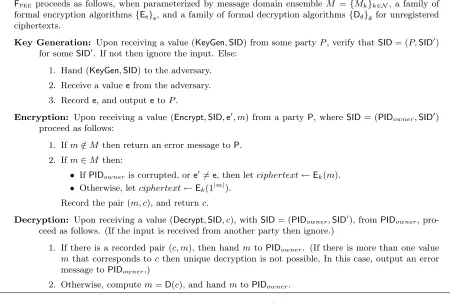
First, we present the certified public-key encryption ideal functionality, Fcpke. This functionality can be
viewed as providing a “bridge” between the cryptographic notion of CCA-security and the Dolev-Yao ab-straction of public-key encryption.
FunctionalityFcpke
Fcpkeproceeds as follows, when parameterized by message domainM, a formal encryption functionEwith
domainM and range{0,1}∗, and a formal decryption functionDof domain{0,1}∗and rangeM∪error. TheSIDis assumed to consist of a pairSID= (PIDowner,SID′), wherePIDowneris the identity of a special party, called theownerof this instance.
Encryption: Upon receiving a value (Encrypt,SID, m) from a party P, where SID = (PIDowner,SID′) proceed as follows:
1. If this is the first encryption request made byP then notify the adversary that P made an encryption request.
2. Ifm /∈M then return an error message toP. 3. Ifm∈M then:
• IfPIDowneris corrupted, then letciphertext←Ek(m).
• Otherwise, letciphertext←Ek(1| m|).
Record the pair (m, c), and returnc.
Decryption: Upon receiving a value (Decrypt,SID, c), withSID= (PIDowner,SID′), fromPIDowner, pro-ceed as follows. (If the input is received from another party then ignore.)
1. If this is the first decryption request made then notify the adversary that a decryption request was made.
2. If there is a recorded pair (c, m), then handmtoPIDowner. (If there is more than one value
mthat corresponds tocthen output an error message toPIDowner.) 3. Otherwise, computem=D(c), and handmtoPIDowner.
Figure 1: The certified public-key encryption functionality,Fcpke
FunctionalityFcpkeis presented in Figure 1. The formalization here is based on past formalizations of the
public-key encryption functionality,Fpke, the closest being the one in [20]. Still, the formulation here differs
from previous ones in a number of respects, outlined below. (We assume familiarity with the formulation of [20] and the motivating discussions for the approach that appear there. Here, we merely highlight and motivate the main differences between the formulations.)
First,Fcpkeis intended to represent an instance of a public-key encryption schemetogether with a “key
registration service” which provides ideal binding between the public-key and the identity of the owner of the corresponding decryption key. InFcpke, therefore, there is no explicit key generation. Instead, the session
identifier (SID) ofFcpkecontains the identity of the legitimate receiver of encrypted messages. That is, if an
instance ofFcpke has session identifier SID, thenSID is of the form
PIDowner,SID′ wherePIDowner is the party identifier (PID) of the legitimate decryptor. Thus, it is guaranteed that only the legitimate receiver can decrypt messages.4
Also,Fcpkenotifies the adversary whenever a party makes the first encryption request. This is intended
to reflect the fact that in the certified public-key setting, the first encryption must be preceded by some process that retrieves the appropriate key from the certificate authority or other repository. Similarly, the
4
The distinction between Fpke and Fcpke is analogous to the distinction between Fsig and Fcert in [22]. There, Fsig
represents a “bare” signature scheme, andFcertrepresents a signature scheme augmented with a trusted registration service
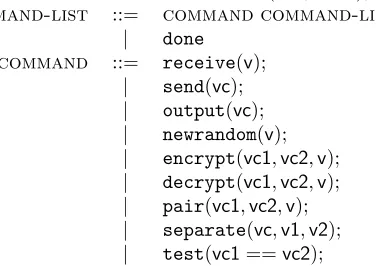
program ::= initialize(self,other);command-list command-list ::= command command-list
| done
command ::= receive(v); | send(vc);
| output(vc);
| newrandom(v);
| encrypt(vc1,vc2,v);
| decrypt(vc1,vc2,v);
| pair(vc1,vc2,v);
| separate(vc,v1,v2);
| test(vc1==vc2);
(Symbolssid,pid,pid2,v, v1,v2and so on represent program variables. Symbols vc,vc1,vc2and so on represent either a variable or constant. The symbolrolerepresents a binary value.
Figure 2: Grammar for Simple Protocols
adversary is notified at the first decryption request to reflect the fact that participants must publicize their public keys to the certificate authority.
Finally, we need to make the following additional requirement, which does not appear in [20]. For the mapping lemma to hold, we need that no string will be too likely to be used as a ciphertext byFcpke. In other
words, we need that the formal encryption algorithmEinduces awell-spreaddistribution on ciphertexts:
Definition 6 A function family {fk}k∈N,fk:M →R, iswell-spread if for any c∈R, Prr←M(fk(r) =c)
is negligible in k.
This requirement is equivalent to requiring that the min-entropy of fk is super-logarithmic in k, or that collisions occur with negligible probability. Also, the requirement thatEbe well-spread only guarantees that a given string is used as a ciphertext with at most negligible probability (rather than, say, exponentially small). Still, the guarantee is unconditional and independent of the adversary.
Recall that a public-key encryption scheme UC-realizes Fpke (with respect to non-adaptive corruptions)
if and only if it is CCA-secure [20, 24]. Using techniques similar to those of [22] we have thatFcpke (with a
well-spread formal encryption function) is realizable given any CCA-secure encryption scheme, plus an ideal “registration service” that allows parties to register their public keys, and obtain in an ideally authenticated way the values registered by other parties. See Appendix B for more details on howFcpkecan be realized.
4.2
The Definition of Simple Protocols
In this section, we provide the programming language for simple protocols. This language contains a small number of operations for inter-process communication and message-manipulation (including public-key en-cryption and deen-cryption). For simplicity we restrict the presentation to two-party protocols, where a partici-pant in a protocol instance has only one peer. First we describe the syntax, or grammar, of simple protocols, and then we provide the semantics.
Definition 7 (Simple protocols: grammar) A simple protocol is a pair of programs (Π0,Π1), each of which is given by the grammar in Figure 2.
This language bears many similarities to other languages in the literature. The Cryptographic Protocol Programming Language (CPPL) [42], for example, also can be used to produce non-looping protocols with cryptographic messages.5 Closer to our purposes, Micciancio and Warinschi [59] also capture a similar notion
5
of simple protocols (though not by that name) via a grammar for cryptographic protocols with Dolev-Yao-style messages and public-key encryption.
Our grammar, however, differs from these two previous examples in one major respect. In both the language of [59] and CPPL, one defines a protocol by specifying only the messages. That is, these languages do not explicitly represent the internal actions of the participants. For our purposes, however, it will be essential that we formalize the internal state and actions of honest participants. In particular, we will need to be able to specifically discuss the points at which a participant encrypts or decrypts a message, and so we make such actions explicit in our grammar.
UC semantics of simple protocols. The semantics of a simple protocol is rather straightforward: It is a protocol in the UC framework in which the participants execute the relevant programs. However, there are a few points worth noting:
• The syntax of Definition 7 defines a simple protocol to be a pair of programs, (Π0,Π1). In keeping with
UC framework, however, the semantics of a simple protocol will be phrased in terms of one Turing machine. This single Turing machine will encode both sides of the protocol, and can be initialized (through its initial input) to execute exactly one of those two sides.
• This initial input of a UC protocol corresponds to the initial statement of every simple protocol:
initialize(sid,pid,role,pid2,v). This will initialize the Turing machine with a session identifier,SID,
a party identifier, PID, a boolean variablerolefor the role, and thePIDof its peerpid2. The machine runs the program Πrole, and will use itsSIDandPIDin the calls toFcpke, as described next.
• All encryption and decryption operations are performed by callingFcpkewith session identifier (SID,PID)
and the appropriate parameters. We note that the use of the session and party identifiers is crucial for the separation among the various instances ofFcpke. It is also crucial for the cryptographic realization
ofFcpke; see Appendix B.
• For convenience, the code will enforce a type-scheme like that of the Dolev-Yao framework. It will do so by “tagging” bit-string values with their type. That is, we let the ITM implementing a simple protocol tag all variables with a string describing their type. Specifically, A PID is tagged as “name,” the SID for an instance of Fcpke is tagged as “pubkey,” a random value is tagged as a “random,” and
the output of aFcpkeinstance is tagged both as an “ciphertext” and with the SID of theFcpkeinstance
that produced it. Furthermore, messages which represent pairs also contain enough information to uniquely determine the two components of the pair.
• To match the UC framework, the semantics will deliberately distinguish between ‘waiting’ (i.e., entering a waiting state and ‘terminating.’ In the UC framework, a Turing machine will enter a waiting state whenever it produces a communication or output. It can then be re-activated to continue computation. When a Turing machine ‘terminates’ however, it has ceased computation. If re-activated, it will simply re-terminate without producing any communication or output.
‘write’ operation.
• Lastly, recall that simple protocols have no loops and their length must be bounded by constant with respect to the security parameter. Furthermore, all of the allowed operations will execute in time polynomial in the security parameter. Consequently, simple protocols run in polynomial time.
More formally:
Definition 8 (Simple protocols: semantics) The UC simple protocol associated with a pair of programs
(Π0,Π1)is an ITMM. The transition function for this machine is defined over statesSM={init} ∪S0∪S1, where init represents the initial state ofMand each state in Si (fori∈ {0,1}) represents three things: