Dynamic SHA
Zijie Xu
E-mail: [email protected]
Abstract.
In this paper I describe the construction of Dynamic SHA family of cryptographic hash functions. They are built with design components from the SHA-2 family, but there is function R in the new hash function. It enabled us to achieve a novel design principle: When message is changed, different rotate right operation maybe done. It makes the system can resistant against all extant attacks.
Key words: Cryptographic hash function, SHA, Dynamic SHA
1 Introduction
The SHA-2 family of hash functions was designed by NSA and adopted by NIST in 2000 as a standard that is intended to replace SHA-1 in 2010 [6]. Since MD5, SHA-0 and SHA-1 was brought out, people have not stopped attacking them, and they succeed. Such as: den Boer and Bosselaers [2,3] in 1991 and 1993, Vaudenay [8] in 1995, Dobbertin [5] in 1996 and 1998, Chabaud and Joux [4] in 1998, Biham and Chen [1] in 2004, and Wang et al. [9–12] in 2005. Most well known cryptographic hash functions such as: MD4, MD5, HAVAL, RIPEMD, SHA-0 and SHA-1, have succumbed to those attacks.
Since the developments in the field of cryptographic hash functions, NIST decided to run a 4 year hash competition for selection of a new cryptographic hash standard [7]. And the new cryptographic hash standard will provide message digests of 224, 256, 384 and 512-bits.
In those attacks, we can find that when different message inputted, the operation in the hash function is no change. If message space is divided many parts, in different part, the calculation is different, the attacker will not know the relationship between message and hash value. The hash function will be secure. To achieve the purpose, I bring in data depend function R to realize the principle.
functions, and by using components from the SHA-2 family, I describe the design of a new family of cryptographic hash functions called Dynamic SHA. The principle is:
1. When message is changed, different rotate right operation maybe done.
The principle combined with the already robust design principles present in SHA-2 enabled us to build a compression function of Dynamic SHA that has the following properties:
1. There is not message expansion part.
2. The iterative part has 48 rounds. Message bits have been mixed three times.
3. The iterative part has two different functions.
2 Preliminaries and notation
In this paper I will use the same notation as that of NIST: FIPS 180-2 description of SHA-2 [6].
The following operations are applied to 32-bit or 64-bit words in Dynamic SHA:
1. Bitwise logical word operations:‘∧’–AND ,‘∨’–OR,‘⊕’–XOR and ‘ ’–Negation. ¬
2. Addition ‘+’ modulo232or modulo264.
3. The shift right operation, , where x is a 32-bit or 64-bit word and n is an integer with 0≤n<32 (resp. 0≤n<64).
) (x SHRn
4.The shift left operation, , where x is a 32-bit or 64-bit word and n is an integer with 0≤n<32 (resp. 0≤n<64).
) (x SHLn
5. The rotate right (circular right shift) operation, , where x is a 32-bit or 64-bit word and n is an integer with 0 ≤ n < 32 (resp. 0 ≤ n < 64).
) (x ROTRn
6. The rotate left (circular left shift) operation, , where x is a 32-bit or 64-bit word and n is an integer with 0 ≤ n < 32 (resp. 0 ≤ n < 64).
Depending on the context I will sometimes refer to the hash function as Dynamic SHA, and sometimes as Dynamic SHA-224/256 or Dynamic SHA-384/512.
2.1 Functions
Dynamic SHA include two functions. The two functions are used in compression function.
2.1.1 Function G(x1,x2, x3,t)
Function G operates on three words x1,x2, x3 and an integer t, produces a word y as output. And function G as follow:
⎪ ⎪ ⎩ ⎪ ⎪ ⎨ ⎧
¬ ∧ ∨ ⊕ ∨ ¬
⊕ ∧ ∨ ∨ ¬
⊕ ∧
⊕ ⊕ = =
) x3 (x1 )) ) 3 2 ( 1 ( (
x3)) x2 ( (x1 )) 3 1 ( (
3 ) 2 1 (
3 2 1
) 3 , 2 , 1 (
x x x
x x
x x x
x x x
x x x G
y t
3 2 1 0
= = = =
t t t t
Table 2.1 function G for Dynamic SHA The truth table for logical functions as table 2.2.
x1 x2 x3 f1 f2 f3 f4 0 0 0 0 0 1 1 0 0 1 1 1 0 0 0 1 0 1 0 1 0 0 1 1 0 1 0 1 1 0 0 1 0 0 1 1 0 1 0 1 1 0 1 1 0 0 1 1 1 1 1 1 1 0 0 0
Table 2.2. truth table for logical functions
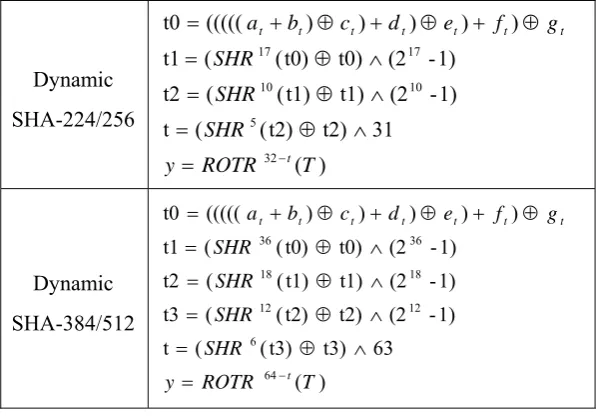
2.1.2 Function R(x1, x2, x3, x4, x5, x6, x7, x8)
Dynamic SHA-224/256
) 8 (
31 t2) t2) ( ( t
1) -(2 t1) t1) ( (
t2
1) -(2 t0) t0) ( (
t1
7 ) 6 ) 5 ) 4 ) 3 ) 2 x1 ((((( t0
5
10 10
17 17
x ROTR y
SHR SHR SHR
x x x x x x
t
=
∧ ⊕ =
∧ ⊕ =
∧ ⊕ =
⊕ + ⊕ + ⊕ + =
Dynamic SHA-384/512
) 8 (
63 t3) t3) ( ( t
1) -(2 t2) t2) ( (
t3
1) -(2 t1) t1) ( (
t2
1) -(2 t0) t0) ( (
t1
7 ) 6 ) 5 ) 4 ) 3 ) 2 x1 ((((( t0
6
12 12
18 18
36 36
x ROTR y
SHR SHR SHR SHR
x x x x x x
t
=
∧ ⊕ =
∧ ⊕ =
∧ ⊕ =
∧ ⊕ =
⊕ + ⊕ + ⊕ + =
Table 2.3. Function R for Dynamic SHA
2.2 Preprocessing
Preprocessing in Dynamic SHA is exactly the same as that of SHA-2. That means that these three steps: padding the message M, parsing the padded message into message blocks, and setting the initial hash value,
0
H are the same as in SHA-2. Thus in the parsing step the message is parsed into N blocks of 512 bits (resp. 1024 bits), and the i-th block of 512 bits (resp. 1024 bits) is a concatenation of sixteen 32-bit (resp. 64-bit) words denoted as . Dynamic SHA may be used to hash a message, M, having a length of bits, where .
) ( 15 )
( 1 ) (
0 , ,...,
i i
i
M M
M
l 0≤l<264
2.2.1 padding
2.2.1.1 Dynamic SHA-224/256
Suppose that the length of the message M is L bits. Append the bit “1” to the end of the message, followed by k zero bits, where k is the smallest, non-negative solution to the equation L+1+k ≡ 448 mod 512. Then append the 64-bit block that is equal to the number L expressed using a binary representation.
2.2.1.2 Dynamic SHA-384/512
non-negative solution to the equation L+1+k ≡ 896 mod 1024. Then append the 128-bit block that is equal to the number L expressed using a binary representation.
2.3 Initial Hash Value
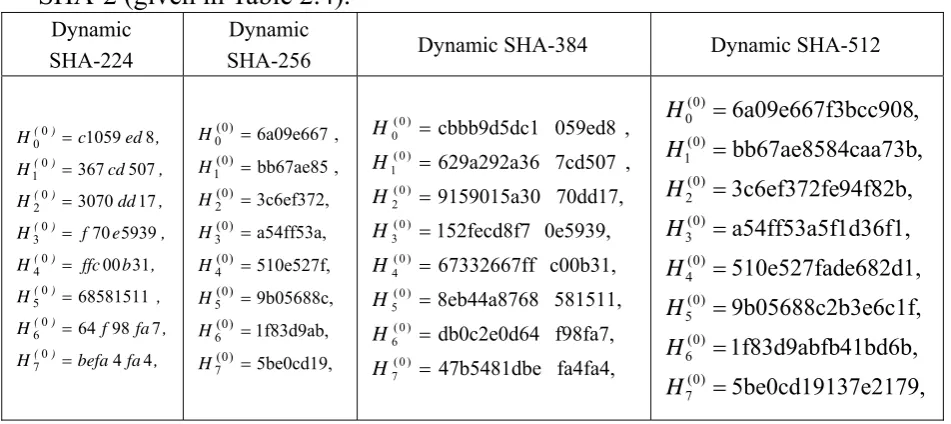
H0 The initial hash value, 0H for Dynamic SHA is the same as that of SHA-2 (given in Table 2.4).
Dynamic SHA-224
Dynamic
SHA-256 Dynamic SHA-384 Dynamic SHA-512
, fa befa H , fa f H , H , b ffc H , e f H , dd H , cd H , ed c H ) ( ) ( ) ( ) ( ) ( ) ( ) ( ) ( 4 4 7 98 64 68581511 31 00 5939 70 17 3070 507 367 8 1059 0 7 0 6 0 5 0 4 0 3 0 2 0 1 0 0 = = = = = = = = 5be0cd19, 1f83d9ab, 9b05688c, 510e527f, a54ff53a, 3c6ef372, , bb67ae85 , 6a09e667 ) 0 ( 7 ) 0 ( 6 ) 0 ( 5 ) 0 ( 4 ) 0 ( 3 ) 0 ( 2 ) 0 ( 1 ) 0 ( 0 = = = = = = = = H H H H H H H H fa4fa4, 47b5481dbe f98fa7, db0c2e0d64 581511, 8eb44a8768 c00b31, 67332667ff 0e5939, 152fecd8f7 70dd17, 9159015a30 , 7cd507 629a292a36 , 059ed8 cbbb9d5dc1 ) 0 ( 7 ) 0 ( 6 ) 0 ( 5 ) 0 ( 4 ) 0 ( 3 ) 0 ( 2 ) 0 ( 1 ) 0 ( 0 = = = = = = = = H H H H H H H H 7e2179, 5be0cd1913 41bd6b, 1f83d9abfb 3e6c1f, 9b05688c2b e682d1, 510e527fad 1d36f1, a54ff53a5f 94f82b, 3c6ef372fe , caa73b bb67ae8584 , bcc908 6a09e667f3 ) 0 ( 7 ) 0 ( 6 ) 0 ( 5 ) 0 ( 4 ) 0 ( 3 ) 0 ( 2 ) 0 ( 1 ) 0 ( 0 = = = = = = = = H H H H H H H H
Table 2.4. The initial hash value, H0 for Dynamic SHA
2.4 Constants
The Dynamic SHA has three constants (given in table 2.5):
Dynamic SHA-224/256 Dynamic SHA-384/512
, 1 8 , 1 9 6 , 827999 5 2 1 0 BBCDC F TT EBA ED TT A TT = = = , 3 703 6 1 8 , 124 4 15 9 6 , 6 28 82799950 5 2 1 0 EF D BBCDC F TT DD C EBA ED TT BE A A TT = = =
Table 2.5. The constants for Dynamic SHA
2.5 Dynamic SHA Hash Computation
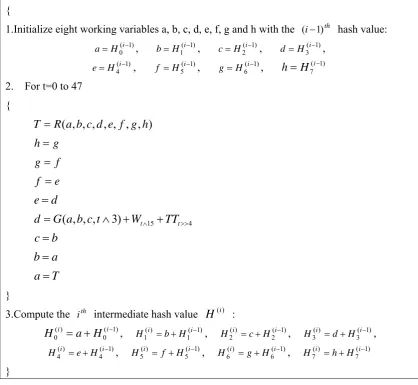
The Dynamic SHA hash computation uses functions and initial values defined in previous subsections. So, after the preprocessing is completed, each message block, , is processed in order, using the steps described algorithmically in Table 2.6.
) ( ) 1 ( ) 0
( , ,..., N
M M
For i = 1 to N: {
1.Initialize eight working variables a, b, c, d, e, f, g and h with the th hash value:
i 1)
( − )
1 ( 0−
= i
H
a , b=H1(i−1), c=H2(i−1), d =H3(i−1),
) 1 ( 4−
= i
H
e , f =H5(i−1), g=H6(i−1), h=H7(i−1)
2. For t=0 to 47 {
) , , , , , , ,
(a b c d e f g h
R
T =
g
h=
f
g =
e f =
d e=
4 15
) 3 , , ,
( ∧ + ∧ + >> =G a b c t Wt TTt d
b c=
a b=
T a= }
3.Compute the th intermediate hash value
i H(i) :
) 1 ( 0 )
( 0
−
+
= i
i
H a
H , 1( 1), , ,
) (
1 = + −
i i
H b
H H2(i) =c+H2(i−1) H3(i) =d+H3(i−1)
) 1 ( 4 )
(
4i =e+H i−
H , H5(i) = f +H5(i−1), H6(i) =g+H6(i−1), H7(i) =h+H7(i−1)
}
Table 2.6. Algorithmic description of Dynamic SHA hash function.
The algorithm uses 1) a message schedule of sixteen 32-bit (resp. 64-bit) words, 2) eight working variables of 32 bits (resp. 64 bits) , and 3) a hash value of eight 32-bit (resp. 64-bit) words. The final result of Dynamic SHA-256 is a 256-bit message digest and of Dynamic SHA-512 is a 512-bit message digest. The final result of Dynamic SHA-224 and Dynamic SHA-384 are also 256 and 512 bits, but the output is then truncated as 224 (resp. 384) bits. The words of the message schedule are labeled . The eight working variables are labeled
and and sometimes they are called “state register”. The words of the hash value are labeled , which will hold the initial hash value,
15 1 0,W,...,W W
g f e d c b
a, , , , , , h
) ( 7 ) ( 1 ) (
0 , ,...,
i i
i
H H
H
) 0 (
H , replaced by each successive intermediate hash value (after each message block is processed), (i)
H , and ending with the final hash value, (N)
and three constants.
3 Security of Dynamic SHA
In this section I will make an initial analysis of how strongly collision resistant, preimage resistant and second preimage resistant Dynamic SHA is. I will start by describing our design rationale, then I will discuss the strength of the function against known attacks for finding different types of collisions.
3.0 Cryptographic Hash Functions
After preprocess message, there are some message blocks that include 512(resp.1024) bits.
Let there exist message blocks M(1),M(2),…,M(n). Let f(h,Mi) is compression function, it is as table 2.6. The operation of the iterated hash function is as follows. First, an b-bit value h(0)=IV is fixed. Then the message blocks are hashed in order. There exist f(h(i-1),M(i))=h(i) i = 1,2,...,n. As table 3.1
f f … f
M1 M2 Mn
IV f F(x)
Mj
…
Table 3.1 The iterated construction of compression function f
3.1 Properties of iterative part
In the iterative part, there are 48 rounds. In one round, there are functions G, R, one message word will be mixed.
3.2 Design rationale
The reasons for the first principle: When message is changed, different rotate right operation maybe done.
From the definition of function R, it is easy to know when the variable is different, the parameter n in will be different, different rotate left operation will be done.
) (x ROTRn
It can guess the parameter n in . Function R is called 48 times in Dynamic SHA, and in first round, the message words is not mixed, so it can just guess the parameter n 48-1=47 times. Then there are
(resp. ) 47-tuple (n(1),…,n(i),…,n(47)), where n(i) is the parameter n of in i-th round.
) (x ROTRn
235 47
2
32 = 47 282
2
64 =
) (x ROTRn
If someone guess the parameter of function R. There are (resp. ) 47-tuple (n(1),…, n(i),…,n(47)). A given 47-tuple define different calculation, so 47-tuple (n(1),…, n(i),…,n(47)) divide the message space into (resp. ) parts. In different part, the calculation is different. When message is changed, the 47-tuple (n(1),…, n(i),…,n(47)) maybe change, different rotate right operation maybe done.
235
2 2282
235
2 2282
Controlling the differentials is hard in Dynamic SHA:
In Dynamic SHA, it is known that when message is changed, the calculation will be different. To analyze Dynamic SHA, it need the unchangeable formulas that represent function R. There are three ways to analyze Dynamic SHA:
1. Guess the parameters of function R. This way is select a part in the message value space. And the message space is divided into (resp. ) parts. In different part, the calculation is different. In a part, the average number of message value is (resp.
). Then the average number of collisions for a hash
value is (resp. , , ), it less than
(resp. , , ). If attacker selects a part, he will
235
2
282
2
277 235
512 2
2 − =
742 282
1024 2
2 − =
53 224
277 2
2 − = 221 2358 2230
288 224
512 2
have a calculation. To a calculation, the average number of collisions for a hash value is 2512−224 =2288
(resp. , , ). If someone develop an algorithm to find collision, then the probability of find the collision is (resp.
, , ).
256
2 2640 2512
235 288
53 2
2 − = −
235
2− 2−282 2−282
2. Someone can use Algebraic Normal Form (ANF) to represent Dynamic SHA, but the ANFs that represent function R has up to
(resp. ) monomials. If constitute the Arithmetic function based on ANF, the degree of the Arithmetic function represents function R is up to 256(resp. 512), and has up to (resp. ) monomials.
256
2 2512
256
2 2512
3. Someone can constitute Arithmetic functions to represent Dynamic SHA as in Appendix 2. But the Arithmetic function that represent function R is complex exponential function with round-off instruction. After 48 rounds, the Arithmetic function that represent function R will be very huge.
3.3 Finding Preimages of Dynamic SHA
To a hash function f(·), it need satisfy:Given hash value H=f(M), it is hard to find message M that meet H=f(M).
There are two ways to find preimages of a hash function:
1,From the definition of Dynamic SHA it follows that from a given hash digest it is possible to perform backward iterative steps by guessing values that represent some relations between working variables of the message words. For that purpose let us use the following notation:
- For every iterative round t = 0,1,...,47, variables that are on the left side of the assignment (equality sign '=') will be denoted by , ,..., while variables that are on the right side of the assignment will be denoted by , ,..., .
t
a bt ht
1
−
t
1. Initialize eight variables a47,b47,...,h47 2.For t=46 to -1
{
1
+
=at
T 1
+
= t
t b
a 1
+
= t
t c
b
) 3 ) 1 ( ), 0
( , ,
( 1− 1− ( 1) 4 + ∧
=G a b d+ C + TT + >> t
ct t t t t t
1
+
= t
t e
d 1
+
= t
t f
e 1
+
= t
t g
f 1
+
= t
t h
g
) , , , , , , , (
1a b c d e f g T
R
ht = t t t t t t t }
Table 3.2. Backward recurrence expressions of Dynamic SHA. Note that the relations for the variables C0t are given in (2)
With that notation we can write the backward recurrence expressions as it is done in Table 3.2. Function R1 as table 3.3:
-The initialization of the variables , , , , , , , , will be denoted as equations (2):
1 0−
= i H
a = 1i−1
H
b c=H2i−1 = 3−1
i H d
1 4
−
= i
H
e = 5−1
i H
f = 6−1
i H
g = 7−1
i H h
) 1 (
0 ... 0 0 ... 0 0 ... 0
15 47
0 32
15 31
0 16
15 15
0 0
⎪ ⎪ ⎪ ⎪ ⎪ ⎪
⎩ ⎪ ⎪ ⎪ ⎪ ⎪ ⎪
⎨ ⎧
= = = = = =
W C
W C
W C
W C
W C
W C
) 2 ( ...
1 7 1
1 0 1
⎪ ⎩ ⎪ ⎨ ⎧
= =
− −
− −
i i
H h
Dynamic SHA-224/256
) (
31 t2) t2) ( ( t
1) -(2 t1) t1) ( (
t2
1) -(2 t0) t0) ( (
t1
) ) ) ) ) (((((
t0
32 5
10 10
17 17
T ROTR y
SHR SHR SHR
g f e d c b a
t
t t t t t t t
−
=
∧ ⊕ =
∧ ⊕ =
∧ ⊕ =
⊕ + ⊕ + ⊕ + =
Dynamic SHA-384/512
) (
63 t3) t3) ( ( t
1) -(2 t2) t2) ( (
t3
1) -(2 t1) t1) ( (
t2
1) -(2 t0) t0) ( (
t1
) ) ) ) ) (((((
t0
64 6
12 12
18 18
36 36
T ROTR y
SHR SHR SHR SHR
g f e d c b a
t
t t t t t t t
−
=
∧ ⊕ =
∧ ⊕ =
∧ ⊕ =
∧ ⊕ =
⊕ + ⊕ + ⊕ + =
Table 3.3. functions R1 for Dynamic SHA
Now, we have the equations (1) as a one system of 48 equations with 16 unknown variables. It is a system over GF(2) or over 232
(resp.
64
2 ).
The size of space is , The size of space is , where w is bit-length of , . The number of the mwssage value that has same hash value is . he probability of there is solution for equation (1) is .
47 0,..., 0
0 C
C 248×w W0,...,W15
w
×
16
2
47 0,..., 0
0 C
C W0,...,W15
w w
w− × ×
× 8 = 8
16 2
2
w w
w− × − ×
× 48 = 40
8 2
2
In first sixteen rounds, all message words are guessed. And there still are 32 words that had not been guessed. Backwarding iterative steps by guessing values is not better than random guessing in Dynamic SHA.
31 0,..., 0
0 C
C
2, The probability of random guess of finding preimages is (resp. , , ).
224
2−
256
2− 2−384 2−512
3.4 Finding Second Preimages of Dynamic SHA
To a hash function f(·), it need satisfy:Given M, it is hard to find M’≠ M s.t. f(M) = f(M’).
There are five ways to find second preimages of a hash function:
2, Given M, and find out the relationship between the difference △M and the difference △H=f(M+△M)-f(M). And find out △M≠0 that make △H=0. To do this, someone will set up some system of equations obtained from the definition of the hash function, then trace forward and backward some initial bit differences that will result in fine tuning and annulling of those differences and finally obtain Second Preimages. It need know the unchangeable formulas that represent hash function f. In Dynamic SHA, when message is changed, the calculation maybe different. To get unchangeable formulas that represent hash function f, it need get ANFs for Dynamic SHA. And the ANFs for function R have up to (resp.
) monomials.
256
2
512
2
3. To get unchangeable formulas that represent hash function f. It can constitute Arithmetic functions to represent Dynamic SHA. And the Arithmetic functions that represent function R is exponential function with round-off instruction. Or someone had to constitute high degree Arithmetic function to represent function R. And the degree of the Arithmetic function is up to 256-degree(resp. 512-degree), and have up to 2256(resp. 2512) monomials.
4. Guess the parameters of function R. This way is select a part in the message value space. And the message space is divided into (resp. ) parts. In different part, the calculation is different. In a part, the average number of message value is (resp.
). Then the average number of collisions for a hash
value is (resp. , , ), it less than
(resp. , , ). If attacker selects a part, he will have a calculation. To a calculation, the average number of collisions for a hash value is
235
2
282
2
277 235
512 2
2 − =
742 282
1024 2
2 − =
53 224
277 2
2 − = 221 2358 2230
288 224
512 2
2 − = 2256 2640 2512
288 224
512 2
2 − = (resp. , , ). If
someone develop an algorithm to find collision, then the probability
of find the second preimages is (resp.
, , ).
256
2 2640 2512
235 288
53 2
2 − = −
235
2− 2−282 2−282
5. The probability of random guess of finding second preimages is (resp. , , ).
224
3.5 Finding Collisions in Dynamic SHA
To a hash function f(·), it need satisfy:It is hard to find different M and M’ s.t. f(M) = f (M’).
There are five ways to find Collisions of a hash function:
1, Fix message M, and find different message M’ that has hash value H=f(M). then the problem become find Second Preimages of the hash function.
2. Find out the relationship between the (M, M’) and the difference
△H=f(M)-f(M’). And find out (M,M’) that make △H=0. To do this, someone will set up some system of equations obtained from the definition of the hash function, then trace forward and backward some initial bit differences that will result in fine tuning and annulling of those differences and finally obtain collisions. It need know the unchangeable formulas that represent hash function f. In Dynamic SHA, when message is changed, the calculation maybe different. To get unchangeable formulas that represent hash function f, it need get ANFs for Dynamic SHA. And the ANFs for function R have up to 2256(resp. 2512) monomials.
3. To get unchangeable formulas that represent hash function f. It can constitute Arithmetic functions to represent Dynamic SHA. And the Arithmetic functions that represent function R is exponential function with round-off instruction. Or someone had to constitute high degree Arithmetic function to represent function R. And the degree of the Arithmetic function is up to 256-degree(resp. 512-degree), and have up to 2256(resp. 2512) monomials.
4. Guess the parameters of function R. This way is select a part in the message value space. And the message space is divided into (resp. ) parts. In different part, the calculation is different. In a part, the average number of message value is (resp.
). Then the average number of collisions for a hash
value is (resp. , , ), it less than
(resp. , , ). If attacker selects a part, he will have a calculation. To a calculation, the average number of
235
2
282
2
277 235
512 2
2 − =
742 282
1024 2
2 − =
53 224
277 2
2 − = 221 2358 2230
288 224
512 2
collisions for a hash value is 2512−224 =2288(resp. , , ). If
someone develop an algorithm to find collision, then the probability of find the collision is
256
2 2640 2512
235 288
53 2
2 − = − (resp. 2−235,2−282,2−282).
5. The attack base on the birthday paradox. the workload for birthday attack is of O(2112) (resp. O(2128) O(2192) O(2256)).
3.6 Finding collisions in the reduced compression function of
Dynamic SHA
If the bits in message are mixed one time, the system will be weak, someone can backward Dynamic SHA as table 3.2 show.
If there are more than 32 rounds, the bits in message are mixed at least twice, if attacker backward Dynamic SHA as table 3.2 show, he will have a system of 32 equation with 16 unknown variables, The probability of there is solution for the system is (resp. ). And the message space is divided into (resp. ) parts, in a part, there are (resp. ) message values. The average number of collisions is (resp. , , ). To a calculation, The average number of collisions is (resp. , , ). If an algorithm is developed to find collision for a calculation, then the probability of find the collision is
(resp. , , ).
512
2− 2−1024
155
2 2186 2357
838
2 2133
101
2 2454 2326
288
2 2256 2640 2512
155
2− 2−155 2−186 2−186
4 Improvements
There are some improvements for Dynamic SHA:
1. To reduce the times that message bits mixed, the message words are mixed three times. To get higher security, it can increase the number of message words mixed times. It will increase the times that message bits are mixed.
2. Function G can be design as data-dependent function. And it will increase system calculation and the number of the parts that message value space had been divided.
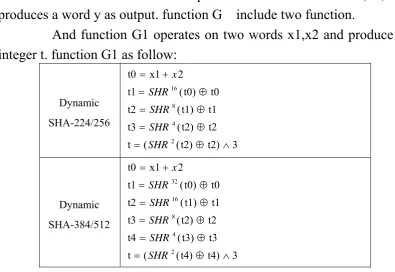
The new function G operates on three words x1,x2, x3, produces a word y as output. function G include two function.
And function G1 operates on two words x1,x2 and produce an integer t. function G1 as follow:
Dynamic SHA-224/256
3 t2) t2) ( ( t
t2 t2) ( t3
t1 t1) ( t2
t0 t0) ( t1
2 x1 t0
2 4 8 16
∧ ⊕ =
⊕ =
⊕ =
⊕ =
+ =
SHR SHR SHR SHR x
Dynamic SHA-384/512
3 t4) t4) ( ( t
t3 t3) ( t4
t2 t2) ( t3
t1 t1) ( t2
t0 t0) ( t1
2 x1 t0
2 4 8 16 32
∧ ⊕ =
⊕ =
⊕ =
⊕ =
⊕ =
+ =
SHR SHR SHR SHR SHR x
Table 4.1. Function G1 for Dynamic SHA
Function G2 operates on three words x1,x2, x3 and an integer t that produced in function G1, function G2 as follow:
⎪ ⎪ ⎩ ⎪ ⎪ ⎨ ⎧
¬ ∧ ∨ ⊕ ∨ ¬
⊕ ∧ ∨ ∨ ¬
⊕ ∧
⊕ ⊕ = =
) x3 (x1 )) ) 3 2 ( 1 ( (
x3)) x2 ( (x1 )) 3 1 ( (
3 ) 2 1 (
3 2 1
) 3 , 2 , 1 (
x x x
x x
x x x
x x x
x x x G
y t
3 2 1 0
= = = =
t t t t
Table 4.2 function G2 for Dynamic SHA
The ANFs and Arithmetic functions that represent message expansion has up to monomials. The degree of Arithmetic functions that represent message expansion is up to 65(resp.129), and has
up to monomials.
) 2 . (
265 129
resp
) 2 . (
265 129
resp
3. In Keyed Hash function, the initial hash value is random variable to attacker. If Dynamic SHA is used in Keyed Hash function, by theorem 3, it is easy know that the probability of hash value is (resp.
).
224
2−
256
2− 2−384 2−512
There are some ways that we can adopt to get random initial hash value, for example: IVi =IVi−1+c, is i-th initial hash value, c is constant and c is odd number. To do this, it need new communication
i
protocol.
4. If some algorithms that based on Arithmetic functions are developed to break Dynamic SHA. The message expansions will increase the degree of the Arithmetic function that represents Dynamic SHA. If the message expansions is data depend function, the degree of the Arithmetic function that represents the message expansions maybe be up to 512(resp.1024). It will increase the ability that resists differential analysis
The message expansion maybe makes some hash values have more probability than other hash value. With improvement 3, all hash value will have same probability.
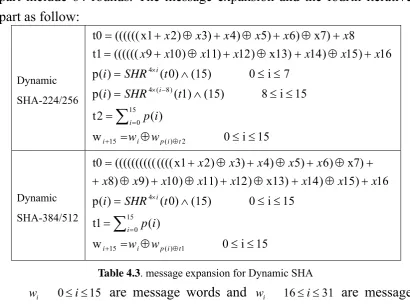
An examlep as follow:
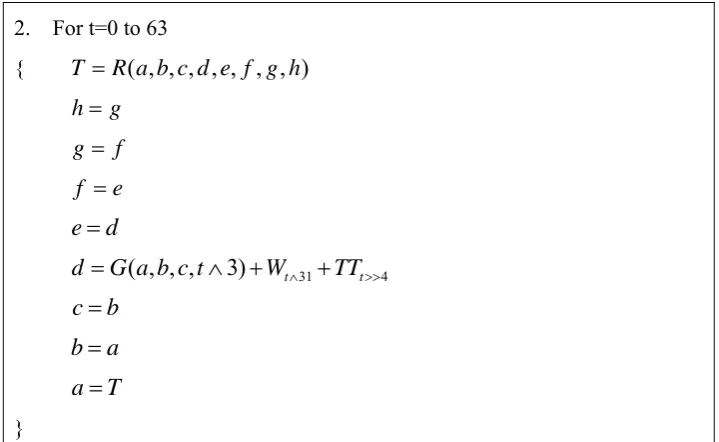
Use a data-depend function as message expansion and the iterative part include 64 rounds. The message expansion and the fourth iterative part as follow:
Dynamic SHA-224/256 15 i 0 w ) ( 2 t 15 i 8 (15) 1) ( ) ( p 7 i 0 (15) 0) ( ) ( p 16 ) 15 ) 14 x13) ) 12 ) 11 ) 10 9 (((((( t1 8 x7) ) 6 ) 5 ) 4 ) 3 ) 2 x1 (((((( t0 2 ) ( 15 15 0 ) 8 ( 4 4 ≤ ≤ ⊕ = = ≤ ≤ ∧ = ≤ ≤ ∧ = + ⊕ + ⊕ + ⊕ + = + ⊕ + ⊕ + ⊕ + = ⊕ + = − × ×
∑
t i p i i i i i w w i p t SHR i t SHR i x x x x x x x x x x x x x Dynamic SHA-384/512 15 i 0 w ) ( 1 t 15 i 0 (15) 0) ( ) ( p 16 ) 15 ) 14 x13) ) 12 ) 11 ) 10 ) 9 ) 8 x7) ) 6 ) 5 ) 4 ) 3 ) 2 x1 (((( (((((((((( t0 1 ) ( 15 15 0 4 ≤ ≤ ⊕ = = ≤ ≤ ∧ = + ⊕ + ⊕ + ⊕ + ⊕ + + ⊕ + ⊕ + ⊕ + = ⊕ + = ×∑
t i p i i i i w w i p t SHR i x x x x x x x x x x x x xTable 4.3. message expansion for Dynamic SHA
15
0≤i≤
wi are message words and wi 16≤i≤31 are message expansion words, and a new constant TT3 =8f1bbcdc (resp.
) will be used, and the iterative part as table 4.4.
9 76 6 7 1 8
3 f bbcdc a d e TT =
The ANFs and Arithmetic functions that represent message expansion has up to monomials. The degree of Arithmetic functions that represent message expansion is up to 512(resp.1024).
) 2 . (
2512 1024
2. For t=0 to 63
{ T =R(a,b,c,d,e, f,g,h)
g h=
f
g=
e
f =
d e=
4 31
) 3 , , ,
( ∧ + ∧ + >> =G a b c t Wt TTt
d b c=
a b=
T a= }
Table 4.4 the iterative part for Dynamic SHA
5 Conclusions
Ronald L Rivest[14] had designed RC5, RC5 include data-depend function, it make it hard to analyse RC5. And William Stallings[15] has mentioned that data-depend function will make cipher system has good nonlinear, and composite function of Boolean functions and Arithmetic functions also make cipher system has good nonlinear. Dynamic SHA carry out the two suggestions. It make Dynamic SHA is more nonlinear than SHA-2.
Data-depend function function R divided the message space into many parts, in different part, the calculation is different.
And based on components from the family SHA-2, I have introduced the principle in the design of Dynamic SHA: When message is changed, different rotate right operation maybe done. And I bring in data depend function R to realize the principle. The principle enabled us to build a compression function of Dynamic SHA that the iterative part has 48 rounds, it is more robust and resistant against generic multi-block collision attacks, and it is resistant against generic length extension attacks.
References
Archive, Report 2004/146, 2004. http://eprint.iacr.org/2004/146
2. B. den Boer, and A. Bosselaers: “An attack on the last two rounds of MD4”, CRYPTO 1991, LNCS, 576, pp. 194-203, 1992.
3. B. den Boer, and A. Bosselaers: “Collisions for the compression function of MD5”, EUROCRYPT 1993, LNCS 765, pp. 293-304, 1994. 4. F. Chabaud and A. Joux, “Differential collisions in SHA-0,” Advances in Cryptology, Crypto98, LNCS, vol.1462, pp.56-71, 1998.
5. H. Dobbertin: “Cryptanalysis of MD4”, J. Cryptology 11, pp. 253-271, 1998.
6. NIST, Secure Hash Signature Standard (SHS) (FIPS PUB 180-2), United States of American, Federal Information Processing Standard (FIPS) 180-2, 2002 August 1.
7. NIST Tentative Timeline for the Development of New Hash Functions, http://csrc.nist.gov/groups/ST/hash/timeline.html
8. S. Vaudenay, “On the need for multipermutations: Cryptanalysis of MD4 and SAFER”, Fast Software Encryption- FSE95, LNCS 1008, pp. 286–297, 1995.
9. X. Wang, X. Lai, D. Feng, H. Chen and X. Yu, “Cryptanalysis of the Hash Functions MD4 and RIPEMD”, EUROCRYPT 2005, LNCS 3494, pp. 1–18, 2005.
10. X. Wang and H. Yu , “How to Break MD5 and Other Hash Functions”, EUROCRYPT 2005, LNCS 3494, pp. 19–35, 2005.
11. X. Wang, H. Yu, Y. L. Yin “Effcient Collision Search Attacks on SHA-0”, CRYPTO 2005, LNCS 3621, pp. 1–16, 2005.
12. X. Wang, Y. L. Yin, H. Yu, “Collision Search Attacks on SHA-1”, CRYPTO 2005, LNCS 3621, pp. 17–36, 2005.
13. Gupta and Sarkar “Computing Walsh Transform from the Algebraic Normal Form of a Boolean Function”
http://citeseer.ist.psu.edu/574240.html
14 Ronald L Rivest “The RC Encryption Algorithm” http://people.csail.mit.edu/rivest/Rivest-rc5.pdf
Appendix 1: Constitute Boolean functions to represent function.
We can use Algebraic Normal Form (ANF) to represent function. Gupta and Sarkar[13] have studied it.Let n≥r≥1 be integers and let be a vector valued Boolean function. The vector valued function can be represented as
an r-tuple of Boolean functions , where
, and the value of equals the value of the s-th component of . The Boolean functions can be expressed in the Algebraic Normal Form (ANF) as polynomials with n variables of kind
r n
F:{0,1} →{0,1}
F
) ,..., ,
( (1) (2) (r)
F F
F F =
) ,..., 2 , 1 }( 1 , 0 { } 1 , 0 { :
) (
r s
F s n → = ( 1, 2,..., )
) (
n s
x x x F ) ,..., ,
(x1 x2 xn
F
) ,..., ,
( 1 2
) (
n s
x x x F
n
x x
x1, 2,..., a0⊕a1x1⊕...⊕anxn⊕
, where
n n
n n n
n x x a x x x
a x
x
a1,2 1 2⊕...⊕ 1, 1 ⊕...⊕ 1,2,..., 1, 2,...,
⊕ − − aλ∈{0,1}. Each ANF has
up to 2n monomials, depending of the values of the coefficients . λ a
Function R
Function R operates on eight words x1, x2, x3, x4, x5, x6, x7 and x8 and produces a word y as output. So we have , It is easy to know that one-bit different in words x1, x2, x3, x4, x5, x6, x7 will make the different rotate right operation be done. So the bit in output maybe changed. And when one-bit different in word x8, the bit in output maybe changed. So the ANFs to represent function R has up to monomials, where w is bit length of the word.
w w
R:{0,1}8× →{0,1}
w
×
8
Appendix 2: Constitute Arithmetic functions to represent
function.
Gupta and Sarkar [13] had studied how to use Algebraic Normal Form (ANF) to represent function. In a similar way, all function will be represented as polynomials.
In appendix 2, the following operations are used: 1.abs(x) is absolute value of x
2. x is round-off instruction on x 3. “+” is arithmetic addition. 4. “-” is arithmetic subtraction. 5. “×” is arithmetic multiplication.
1. Constitute Arithmetic functions to represent Boolean
function
:
In Boolean function, 1 is True, 0 is False.
1. To one bit word. The Boolean function can represented with arithmetic functions as follow:
operand function arithmetic function x,y z=x⊕y z=x+y−2×x×y
x,y z= x∧ y z=x×y
x,y z= x∨ y z=x+y−x×y
x z=¬x z=1−x
Tables B.1 represent Boolean function with arithmetic function
To Boolean polynomial, it can replace every calculation of polynomial base on table B.1.
2. To n-bit word.
If there are three n-bit words x, y, z. if there exist z= f(x,y) where f is
∑
∑
∑
− =
− = − =
× =
× =
× =
1 0 1 0 1 0
2 2 2
n i
i i n i
i i n i
i i
z z
y y
x x
where xi,yi,zi is i-th bit of word x, y, z. There exists zi= f(xi,yi), where
.
1 0≤i≤n−
To Boolean polynomial, it can replace every calculation base on table B.1 for every bit of variables.
3. If function F includes a series functions f0,...,ft−1 as follow:
⎪ ⎩ ⎪ ⎨ ⎧
− = = =
−( , ) 1
...
0 )
, ( ) , , (
1 0
t k y x f
k y x f k y x z
t
Then it can represent as follow:
)) , ( ( ) 2 2
2 2
( )
, ,
( 10
) ( )
(
y x f k
y x
z t i
i
i k abs k
i
abs − × ×
=
∑
=− − −Base on above-mentioned three ways, it can represent Boolean function with arithmetic functions. And there exists:
Theorem 1. If x∈{0,1}, there exists xk =x k>0. Proof.
If x=0, xk =0k =0=x
If x=1, xk =1k =1=x □
2. Constitute Arithmetic functions to represent function with
ANF
Functions can be expressed in the ANF as polynomials with n variables of kind
r n
F:{0,1} →{0,1}
n
x x
x1, 2,..., a0⊕a1x1⊕...⊕anxn⊕a1,2x1x2⊕...⊕an−1,nxn−1xn⊕
, where . If replace every calculation in the ANF base on table B.1 and simplified by theorem 1, it can constitute Arithmetic functions to represent ANF. The Arithmetic functions will be polynomials with n variables n of kind
n nx x a1,2,..., 1...
⊕ aλ∈{,01}
x x
x1, 2,..., b0+b1×x1+...+bn×xn+...+bn−1,n×xn−1×xn+...+b1,2,...,n×x1...×xn,
where are integer. The Arithmetic functions have up to monomials. The degree of Arithmetic functions is up to n. And there
λ
exists =
∑
r=−01 ()( 1, 2,..., )×2 , where f is r-bit word. i i n s x x x F f3. Constitute Arithmetic functions to represent SHR operation
:
The shift right operation SHRk(x) can be represented as follow:) 0 . 2 ( 2 ) ( k k x x SHR
y= =
4. Constitute Arithmetic functions to represent data-depend
function G
:
The function G can be represented as follow:
) 1 . 2 ( )) 3 , 2 , 1 ( ( ) 2 2 2 2 ( ) , 3 , 2 , 1
( 30
) ( ) ( x x x G t x x x y i i i t abs t i
abs − × ×
=
∑
= − −By Theorem 1 and table B.1, function can be represented as follow: ) 3 , 2 , 1
(x x x
Gi ) 2 . 2 ( 3 2 ) 3 2 1 2 3 1 3 2 2 3 2 1 ( 2 2 ) 3 2 1 2 2 1 3 1 2 3 1 1 ( 1 2 ) 3 2 1 2 3 2 1 ( 0 2 ) 3 2 1 4 3 2 2 3 1 2 2 1 2 3 2 1 ( ) 3 , 2 , 1 ( 1 0 1 0 1 0 1 0 ⎪ ⎪ ⎪ ⎪ ⎩ ⎪⎪ ⎪ ⎪ ⎨ ⎧ = × × × × − × + × × + − − = × × × × − × + × × + − − = × × × × − + × = × × × × + × × − × × − × × − + + =
∑
∑
∑
∑
− = − = − = − = t x x x x x x x x x t x x x x x x x x x t x x x x x x t x x x x x x x x x x x x x x x G w i i i i i i i i i i i w i i i i i i i i i i i w i i i i i i i i w i i i i i i i i i i i i i i t i ii x x
x1, 2, 3 is i-th bit of x1, x2, x3. In system (2.2), it is known that are cubic equations, and has 7, 3, 6, 6 monomials. It is easy to know that the equation (2.1) is cubic equation. It is hard to represented equation (2.1) with linear function. And there exists:
i G c x d x d x d y d i i i = ) 3 ( ) 2 ( ) 1 ( ) ( 3
And c is constant.
5. Constitute Arithmetic functions to represent data-depend
function R
:
1. Constitute ANFs that represent function R. And replace the Boolean function base on table B.1. In this way, it will constitute huge Arithmetic function. The ANFs represents function R has up to (resp. ) monomials. By theorem 1 and the input has 261(resp. 518) bits, so the degree of the Arithmetic function represents function R is up to 256(resp. 512), and has up to (resp. ) monomials. There exiset:
256
2 2512
256
2 2512
c x
d x d x d
y d
bn i
bn
=
− )
( ).... ( ).... (
) (
1 0
where c is constant, is i-th input bit of function R, bn is bit number of input, and bn equal 256(resp. 512).
i
x
2. At first, there exist rotate right (circular right shift) operation , where x is n-bit word, and
) (x
ROTRk 0≤k <n . It can represent
as follow:
) (x ROTR y= k
) 1 2 ( 2 2
) 3 . 2 ( 2
) 2 2 ( 2
) (
− × − × =
× × − + =
=
−
−
n k k n
k n k k k
k
x x
x x x
x ROTR y
If function is not data-depend function, the k in equation (2.3) is constant, and equation (2.3) is linear equation. The derivative function of linear equation is constant. This means the difference of function value depend on the difference of input and the difference of function value dose not depend on the input. In SHA-2, the ROTR operation is not data-depend function, it can constitute linear equation to represent the ROTR operation in SHA2.
) (x ROTR y= k
If function is data-depend function, the k in equation (2.3) is variable, and equation (2.3) is exponential function. And equation (2.3) will be exponential function with round-off instruction. It is hard to represent exponential function with linear equation. The derivative function of exponential function is exponential function. This means the difference of function value depend the difference of input and input. When the input changes, the different of function value maybe change. In Dynamic SHA, function R is data-depend function. And if use equation
(2.3) represents function R, the k is function of working variables a,b,c, d, e, f, g, and as table B.2, the equation (2.2) will be complex exponential function. After several rounds, equation (2.3) will be iteration function with equation (2.3), it will be very huge and complex, and there exists no mathematical theory that reduces the size of equation (2.3). It is hard to analyses Dynamic SHA that includes function R.
) , , , , , , ,
(a b c d e f g h
K k=
Dynamic SHA-224/256
31 t2) t2) ( ( k
1) -(2 t1) t1) ( (
t2
1) -(2 t0) t0) ( (
t1
) ) ) ) ) a ((((( t0
5
10 10
17 17
∧ ⊕ =
∧ ⊕ =
∧ ⊕ =
⊕ + ⊕ + ⊕ + =
SHR SHR SHR
g f e d c b
Dynamic SHA-384/512
63 t3) t3) ( ( k
1) -(2 t2) t2) ( (
t3
1) -(2 t1) t1) ( (
t2
1) -(2 t0) t0) ( (
t1
) ) ) ) ) a ((((( t0
6
12 12
18 18
36 36
∧ ⊕ =
∧ ⊕ =
∧ ⊕ =
∧ ⊕ =
⊕ + ⊕ + ⊕ + =
SHR SHR SHR SHR
g f e d c b
Table B.2. function K for Dynamic SHA
Appendix 3: Function G and Function R.
Let p(x) is probability of x.
Function G
Function G operates on three words x1,x2, x3 and an integer t, produces a word y as output. t is constant, x1,x2, x3 are w-bit words and . And function G as follow:
w t< ≤ 0 ⎪ ⎪ ⎩ ⎪ ⎪ ⎨ ⎧ ¬ ∧ ∨ ⊕ ∨ ¬ ⊕ ∧ ∨ ∨ ¬ ⊕ ∧ ⊕ ⊕ = = ) x3 (x1 )) ) 3 2 ( 1 ( ( x3)) x2 ( (x1 )) 3 1 ( ( 3 ) 2 1 ( 3 2 1 ) 3 , 2 , 1 ( x x x x x x x x x x x x x x G y t 3 2 1 0 = = = = t t t t
If x1, x2, x3 are random and uncorrelated. There is:
∑ ∑ ∑
∑ ∑ ∑
− = − = − = − = − = − = × × × = × × × = 1 2 0 1 1 2 0 2 1 2 03 1 2 3
3 2 1 1 2 0 1 1 2 0 2 1 2 0
3 1 2 3 1 2 3
)) 3 , 2 , 1 ( | ( ) 3 ( ) 2 ( ) 1 ( ) ( ) 3 ( ) 2 ( ) 1 ( )) 3 , 2 , 1 ( | ( ) (
w w w
w w w
i i i i i i
i i
i
i i i i i i i i i
x x x y p x p x p x p y p x p x p x p x x x y p y p
To a given y’, there are 22×w 2-tuple (x1,x2), there is relation:
⎪ ⎪ ⎩ ⎪ ⎪ ⎨ ⎧ ¬ ∧ ∨ ⊕ ∨ ¬ ⊕ ∧ ∨ ∨ ¬ ⊕ ∧ ⊕ ⊕ = ) y' (x1 )) ) ' 2 ( 1 ( ( )) y' x2 ( (x1 )) ' 1 ( ( ' ) 2 1 ( ' 2 1 3 y x x y x y x x y x x x 3 2 1 0 = = = = t t t t
it can compute the value for x3. x1, x2, x3 are random and uncorrelated variable, there is
w x p x p x
p( 1)= ( 2)= ( 3)=2− Then there is:
w w w w w
i i i i i i
i i
i
w w w
x x x y p x p x p x p y
p( )= ( 11)× ( 22)× ( 33)×
∑ ∑ ∑
21=−01 22=−01 23=−01 ( |( 11, 22, 33))=2− ×2− ×2− ×22× =2−If x1, x2, x3 are random and uncorrelated, function G will produce random word and w.
y p( )=2−
Function R
There exists:
∑ ∑
∑
∑ ∑
∑
− = − = − = − = − = − = × × × = × × × = 1 2 0 1 1 2 0 2 1 2 07 1 7
7 1 1 2 0 1 1 2 0 2 1 2 0
7 1 7 1 7
)) 7 ,..., 1 ( | 0 ( ... ) 7 ( ... ) 1 ( ) 0 ( ) 7 ( ... ) 1 ( )) 7 ,..., 1 ( | 0 ( ... ) 0 (
w w w
w w w
i i i i i
i i
i i i i i i i
x x t p x p x p t p x p x p x x t p t p
To given value t0’, There is 7-tuple (x1’,x2’,x3’,x4’,x5’,x6’,x7’), There is relation:
w × 7 2 0 ) 6 ) 5 ) 4 ) 3 ) 2 1 (((((
7 x x x x x x t
x = + ⊕ + ⊕ + ⊕ . it can compute
the value for x7. and x1, x2, x3, x4, x5, x6, x7 are random and uncorrelated variable. There exists:
w i i i i i i
i p x p x p x p x p x p x
x
p( 11)= ( 22)= ( 33)= ( 44)= ( 55)= ( 66)= ( 77)=2−
w w i i i i i i
i p x p x p x p x p x p x
x p t
p( 0')= ( 11)× ( 22)× ( 33)× ( 44)× ( 55)× ( 66)× ( 77)×26× =2− .
t0 is w-bit word, let t is -bit word, let: t0=( ) and t=( ), is i-th bit of t0 and t, and there is
w
2
log t00,...,t0w−1
1 log 0,...,t 2w−
t t0i,ti
Dynamic SHA-224/256 ⎪ ⎪ ⎪ ⎩ ⎪⎪ ⎪ ⎨ ⎧ ⊕ ⊕ ⊕ ⊕ ⊕ = ⊕ ⊕ ⊕ ⊕ ⊕ = ⊕ ⊕ ⊕ ⊕ ⊕ = ⊕ ⊕ ⊕ ⊕ ⊕ ⊕ = ⊕ ⊕ ⊕ ⊕ ⊕ ⊕ = 31 26 21 14 9 4 4 30 25 20 13 8 3 3 29 24 19 12 7 2 2 16 28 23 18 11 6 1 1 15 27 22 17 10 5 0 0 0 0 0 0 0 0 0 0 0 0 0 0 0 0 0 0 0 0 0 0 0 0 0 0 0 0 0 0 0 0 0 0 t t t t t t t t t t t t t t t t t t t t t t t t t t t t t t t t t t t t t Dynamic SHA-384/512 ⎪ ⎪ ⎪ ⎪ ⎩ ⎪⎪ ⎪ ⎪ ⎨ ⎧ ⊕ ⊕ ⊕ ⊕ ⊕ ⊕ ⊕ ⊕ ⊕ = ⊕ ⊕ ⊕ ⊕ ⊕ ⊕ ⊕ ⊕ ⊕ = ⊕ ⊕ ⊕ ⊕ ⊕ ⊕ ⊕ ⊕ ⊕ ⊕ = ⊕ ⊕ ⊕ ⊕ ⊕ ⊕ ⊕ ⊕ ⊕ ⊕ = ⊕ ⊕ ⊕ ⊕ ⊕ ⊕ ⊕ ⊕ ⊕ ⊕ = ⊕ ⊕ ⊕ ⊕ ⊕ ⊕ ⊕ ⊕ ⊕ ⊕ = 59 53 47 41 35 29 23 17 11 5 5 58 52 46 40 34 28 22 16 10 4 4 63 57 51 45 39 33 27 21 15 9 3 3 62 56 50 44 38 32 26 20 14 8 2 2 61 55 49 43 37 31 25 19 13 7 1 1 60 54 48 42 36 30 24 18 12 6 0 0 0 0 0 0 0 0 0 0 0 0 0 0 0 0 0 0 0 0 0 0 0 0 0 0 0 0 0 0 0 0 0 0 0 0 0 0 0 0 0 0 0 0 0 0 0 0 0 0 0 0 0 0 0 0 0 0 0 0 0 0 0 0 0 0 t t t t t t t t t t t t t t t t t t t t t t t t t t t t t t t t t t t t t t t t t t t t t t t t t t t t t t t t t t t t t t t t t t t t t t
And there is relation:
To a given t’=( ), there is
. To a given
( ), it can compute the for ( ). And
there is
tuple
logw2 − 0 log 1
2
'
,...,
'
t
w−t
2
w−logw2)
t0
,...,
tuple(t0
)
log
(
2 log w-12w
w
w
−
−
(w−logw2)−tuple1 log ,..., 0'
' 0
2 t w−
t w log tuple
w
2 − t00,...,t0log2w−1
= × =
∑
2=0−1 ( |' 0()) (0) )'
(t iw pt t i pt
p 2w−log2w×p(t0)=2w−logw2×2−w=2−logw2 =w−1.
x1, x2, x3, x4, x5, x6, x7, x8 are random and uncorrelated words, and t is produced from x1, x2, x3, x4, x5, x6, x7. To , there is relation . To a given value y’, there are w value t, to a given t’, it can compute the value for x8. And there is:
) 8 (x ROTR y= t )
(
8 ROTR y
x = w−t
w w w
i i p y ti x i p ti p x i w w
y p
w
− − − −
=
−
= × × = × × =
=
∑ ∑
( |( , 8 )) ( ) ( 8 ) 2 2)
( 1 1
0
1 2
0
8 8 8
If x1, x2, x3, x4, x5, x6, x7, x8 are random and uncorrelated words, function R will produce random word and w.
y p( )=2−
Appendix 4: Some thing about Dynamic SHA
1. Why Dynamic SHA use function G and function R
As mentioned at appendix 3, if the variables are random word, function G and R will produced random word.
Function G operates on three words, produces a word as output. What function G does is produce confusion word.
Function R operates on eight words, produces a word as output. What function R do is confuse the place of bit.
The reason that Dynamic SHA use function G and function R is: 1. To get better property of spreading, Dynamic SHA use function G
and R.
2. With function G, function R makes it hard to find out the relationship between message change and bit place change. If function G is data-depend function, function G and R will make it hard to find out the relationship between message value and what logical function is called and where the bit is placed. And it is hard to analyze data-depend function with differential analysis. It needs construction Arithmetic function to describe function, the degree of the Arithmetic function is up to 256(resp. 512). Or construction exponential function to describe function R. And the ANFs that describe function R has up to (resp. ) monomials.
256
2 2512
2. Why there are 48 rounds in Dynamic SHA
The reason that there are 48 rounds in Dynamic SHA is as follow: 1. It is easy to know mix message words too many times will reduce the randomness of variable of function G and R. So the message bits are mixed no many times in Dynamic SHA.
2. It is easy to backward function R and G, so it must repeatedly mix message words. When someone backward iterative steps by guessing message word, then he will has one system include equations like (1), the system has 48 equations with 16 unknown variables.
Dynamic SHA.
3. Why there is no message expansion part in Dynamic SHA
Mixing message words many times will reduce the randomness of variable of function G and R. and the degree of Arithmetic function that describe function R is up to 256(resp.512), and there are up to (resp.) monomials in the Arithmetic function. It is enough now.
256
2
512
2
4. It is hard to analyses Dynamic SHA
Dynamic SHA include function R. To analyses Dynamic SHA, it need unchangeable representation of function R. As mentioned in Appendix 1 and Appendix 2, the ANFs that describe function R has up to
,(resp. ) monomials, and the Arithmetic functions that describe function R is exponential function with round-off instruction like equation (2.3) or arithmetic function that the degree is up to 256 (resp. 512).
160
2
2
3205. Avalanche of Dynamic SHA
.From the definition of function R, it is enough to known that all bits in working variables a,b,c,d,e,f,g will affect all bits in temporary words T.
Appendix 5: Spreading of Dynamic SHA
Let:1. hv(i)=(a(i), b(i), c(i), d(i),e(i), f(i), g(i), h(i)). Where a(i), b(i), c(i), d(i),e(i), f(i), g(i), h(i) are working variables at i-th round.
2.MW1=(W(0),W(1),W(2),W(3),W(4),W(5),W(6),W(7)),
MW2=(W(8),W(9),W(10),W(11),W(12),W(13),W(14),W(15)) W(j) is the message word.
3.Hi(MW1, MW2) = hv(i) 15 ≤i.
Divide the iterative part into some parts, and a part includes 8 rounds. The iterative part will be as table E.1. hv(-1) is initiation of eight working variables
MW2
MW2 MW2
MW1 MW1
hv(-1) hv(7) hv(15) hv(23)
hv(31) MW1 hv(39) hv(47)
Table E.1. Iterative part of Dynamic SHA
And there is:
hv(47) MW2)
(MW1, H
hv(39) MW2)
(MW1, H
hv(31) MW2)
(MW1, H
hv(23) MW2)
(MW1, H
hv(15) MW2)
(MW1, H
47 39 31 23 15
= = = = =
At first there are two theorems:
Theorem 2. Let:
1. hv(i)=(a(i), b(i), c(i), d(i),e(i), f(i), g(i), h(i)). Where a(i), b(i), c(i), d(i),e(i), f(i), g(i), h(i) are working variables at i-th round. working variables are b-bit word.
2.MW=(W(i),W(i+1),W(i+2),W(i+3),W(i+4),W(i+5),W(i+6), W(i+7)), where W(j) is the word mixed in j-th round. 3. H(hv(i-1),MW)=hv(i+7)
Then there are:
(1),p(hv(i+7))=2−8×b
(2),p(hv(i+7)|MW)=2−8×b
(3),p(hv(i+7)| hv(i-1))=2−8×b
Proof. (1),(2)
Before i-th round, we have (hv(i-1),MW), after 8 rounds, MW is mixed, then we have hv(i+7), so we have b b.
H
:
{
0
,
1
}
16×→
{
0
,
1
}
8×There are MW. To given MW’, there is
and :
b
× 8
2
7) hv(i 1))
-(hv(i
' = +
MW
H
H
MW ':
{
0
,
1
}
8×b→
{
0
,
1
}
8×bTo given hv(i-1)’, there is relation ,
it can compute the value for hv(i+7).
7)
hv(i
)
1)'
-(hv(i
'
=
+
MW
H
To given hv(i+7)’, it is easy to backward iterative steps as table 3.2 show. Then there is relation
H
MW''
(hv(i
+
7))
=
hv(i
-
1)
, it cancompute the value for hv(i).
hv(i), MW are random and uncorrelated, there is
, . So there is:
b
i
hv
p
(
(
−
1
))
=
2
−8× bMW
p
(
)
=
2
−8×b b
b b
i i i
i i i i
i hv p
i MW i
hv i
hv p MW
p i
hv p i
hv p
i MW p i
hv p i
MW i
hv i
hv p i
hv p
b b
b b
× − × × − × −
− =
− = −
= − =
= ×
× =
+
− +
× ×
− =
+
× − ×
− +
= +
∑ ∑
∑ ∑
8 8
8 8
1 2
0 1
1 2
0
2 1
1 2
0 1
1 2
0
2 1 1
2 2
2 2
)) 7 ( (
))) 2 ( , ) 1 ( ( | ) 7 ( ( )
( )) 1 ( ( )) 7 ( (
)) 2 ( ( )) 1 ( ( ))) 2 ( , ) 1 ( ( | ) 7 ( ( ))
7 ( (
b b
i i i
b
i hv p i
hv MW i
hv p MW
i hv
p( ( +7)| )=
∑
21=−01 (( ( +7)| )| ( −1)1)× ( ( −1)1)=2−8× =2−8×(3)
To given hv(i-1)’:
To a given hv(i+7)’, it is easy to backward iterative steps as table 3.2 show. We will have a system of 8 equations with 8 unknown variables. It is easy to compute the value for MW.
To a given MW’, it is easy to compute the value hv(i+7). MW are random, there exist
p
(
MW
)
=
2
−8×bb b
i
b
i MW p i
MW i
hv i
hv p i
hv i
hv p
× − × −
− =
= =
× −
+ =
−
+
∑
8 8
1 2
0 1
2 2
)) 1 ( ( )) 1 ( |
)) 1 ( | ) 7 ( (( ))
1 ( | ) 7 ( (
□
By theorem 2, it is easy to know that:
In 8 round, to a given hv(i-1)’, mix different message words MW, the hv(i+7) will be different.
In 8 round, mix given message words MW’, if the hv(i-1) is different, the hv(i+7) will be different.
The relationship is as Table E.2, hv(i−1)j is j-th value in hv(i-1) space.
is j-th value in hv(i+7) space. is j-th value in MW space.
j i
hv( +7) MWj
) (j klast
MW
) 1 2 ( 8×b−
klast
MW
) 0 (
klast
MW
) 1 2 ( 8×b−
kj
MW
) (j kj
MW
) 0 (
kj
MW
) 1 2 ( 0 8×b−
k
MW
0
) 1 (i− hv
….. …..
….. …..
j i hv( −1)
1 28
) 1
(i− ×b−
hv
0
) 7 (i+ hv
j i hv( +7)
1 28
) 7 (i+ ×b−
hv
) 0 ( 0
k
MW
) ( 0 j k
MW
Table E.2 relationship between hv(i-1), hv(i+7), MW
Theorem 3. In Dynamic SHA, there exist: (1) p(hv(j))=
2
−8×b(2),p(hv(j)|MW1)=
2
−8×b (3),p(hv(j)|MW2)=2
−8×b,... 2 , 1 , 0 8
15+ × =
= k k