ABSTRACT
BOUTON, DEBORAH THIGPEN. Thinking Critically about Critical Thinking in the Community College Classroom: An Examination of the Beliefs of Exemplary Instructors. (Under the direction of Carol E. Kasworm.)
The purpose of this study is to explore how exemplary community college instructors describe their beliefs about critical thinking and how they attempt to foster its development in their students. Situated in both constructivist learning theory and theories of action, the study examines how participants make meaning of critical thinking, and how their beliefs are reflected in their teaching practices. In this multiple case study, the author employs semi-structured interviews, videotaped class observations, and course documents to provide insight into the perceptions and experiences of exemplary instructors. Through a cross-case analysis of data, the author delineates elements of common understanding about teaching for critical thinking.
This research demonstrates that the relationship between an instructor‟s ability to articulate her understanding of critical thinking and her capacity to teach for critical thinking is not as straightforward as some research would suggest. The tacit understandings that these exemplary instructors bring to the classroom provides a valuable framework for their
teaching practice. There are commonalities in how participants conceptualize critical thinking, even though their understandings tend to be a product of personal learning and practice rather than adherence to a particular theoretical perspective. The common elements in how they understand critical thinking include the ability to: 1) see underlying connections in seemingly disparate subjects; 2) value multiple perspectives; 3) exercise prudent
Thinking Critically About Critical Thinking in the Community College Classroom: An Examination of the Beliefs of Exemplary Instructors
by
Deborah Thigpen Bouton
A dissertation submitted to the Graduate Faculty of North Carolina State University
in partial fulfillment of the Requirements for the degree of
Doctor of Education
Higher Education Administration Raleigh, NC
2008
APPROVED BY:
______________________________ ______________________________ Carol E. Kasworm Colleen Aalsburg Wiessner Chair of Advisory Committee
______________________________ ______________________________
ii BIOGRAPHY
Deborah Thigpen Bouton has worked in education her entire career. For the past fifteen years, she has been employed at Central Piedmont Community College where she worked in both student services and instruction. Ms. Bouton coordinated the learning college initiative at CPCC and was instrumental in helping develop the succession management plan for the College. Bouton has also been a part of the strategic planning committee, helping chart the direction of the state‟s largest community college. Most recently, Ms. Bouton has been leading the efforts of the College to identify and assess core competencies for graduates of CPCC.
Ms. Bouton graduated from the University of North Carolina at Chapel Hill, receiving both a BA in psychology and a M.Ed. in Counseling. She is a licensed professional
counselor and a certified career counselor. Ms. Bouton received her Ed.D. in adult and community college education from North Carolina State University. Her research interests focus on faculty beliefs and perceptions in the learning environment of the community
iii ACKNOWLEDGMENTS
Completion of this dissertation would not have been possible without the help of many people. First I would like to thank the seven instructors who opened up their
classrooms and volunteered their time without incentive. They were generous with time and with their experiences. I found that they not only provided invaluable information for my dissertation, but also inspired me by their dedication to helping educate their students. The experience was rich and enlightening, and I am grateful to have had an opportunity to work with these educators.
I am indebted to Dr. Carol Kasworm, my dissertation chair. She was gracious enough to take me on after my initial chair, Dr. George Vaughan retired. The distance between Charlotte and Raleigh seems like a long, long way when you need support and direction. Dr. Kasworm went out of her way to help guide me through this process. I would also like to that the other members of my committee – Dr. Colleen Wiessner, Dr. Gerald Ponder, and Dr. Maxine Atkinson - for their support and encouragement.
The support I have received from my colleagues has been truly amazing. My
iv
made a notebook for me to take to my first course at NCSU. To Caroline, Susan, Cathey, Richard, and Karen, I owe you my thanks for all your many expressions of support and faith.
My father, Dr. Donald Ross Warren, completed his doctorate in adult and community college education at NCSU thirty-five years ago. He was a community college president and an inspiration to me. He and my mother, Barbara Warren, have always believed that I could do whatever I wanted. My husband Hal has been there from the beginning. He even drove me from Charlotte to Raleigh to attend evening classes so that I would not be on the road alone at night. He claims to be even more anxious than I am for this part of my life to reach closure. He thinks I can now jump on the back of his motorcycle and see the sights. Let‟s
not tell him that I recently enrolled in a course on world religions.
v
TABLE OF CONTENTS
LIST OF TABLES ... vii
CHAPTER ONE: INTRODUCTION ... 1
Background ... 4
Conceptual Framework ... 6
Research Purpose ... 10
Research Problem ... 10
Significance ... 11
Summary ... 12
CHAPTER TWO: REVIEW OF THE LITERATURE ... 14
Understanding Teacher Beliefs ... 14
Understanding Critical Thinking ... 26
Community College Faculty... 46
CHAPTER THREE: RESEARCH DESIGN AND METHODOLOGY ... 55
Research Design ... 56
Research Setting ... 57
Selection of Participants ... 59
Data Collection ... 63
Data Analysis ... 70
Quality, Rigor, and Trustworthiness ... 72
CHAPTER FOUR: DISCUSSION OF FINDINGS ... 75
Instructor Understandings of Critical Thinking ... 76
Journey to Teaching for Critical Thinking ... 87
Effective Teaching and Teaching for Critical Thinking ... 102
Teaching for Critical Thinking ... 122
Espoused Beliefs and Teaching Practices ... 137
Chapter Summary ... 142
CHAPTER FIVE: CONCLUSIONS AND IMPLICATIONS ... 146
vi
Contributions to Knowledge... 167
Implications for Future Research ... 168
Implications for Practice... 170
LIST OF REFERENCES ... 173
APPENDICES ... 194
Appendix A Interview Guide ... 195
Appendix B Observation Notes ... 197
Appendix C Contact Summary Form ... 198
Appendix D Initial Letter to Faculty ... 199
Appendix E Faculty Survey of Critical Thinking ... 200
Appendix F Strategies for Teaching Critical Thinking ... 202
Appendix G Researcher Bias Statement ... 203
Appendix H Letter of Invitation to Exemplary Faculty ... 205
Appendix I Follow-up Questions: Third Interview ... 206
vii
LIST OF TABLES
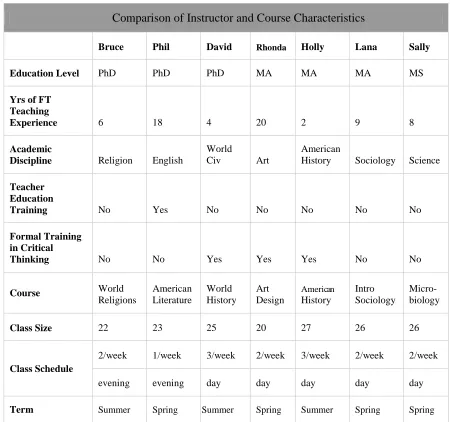
Table 3.1 Comparison of Instructor and Course Characteristics ...63
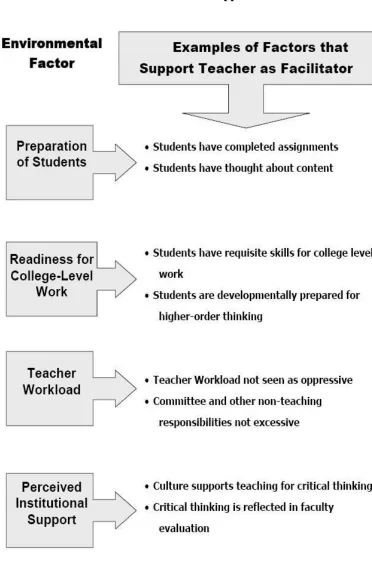
Table 4.1 Environmental Factors that Support Facilitative Role ...112
Table 4.2 Instructional Strategies to Support Developmental Goals ...125
1
CHAPTER ONE: INTRODUCTION
The intellectual roots of critical thinking date back to the time of Socrates, Plato, and Aristotle. These noted thinkers encouraged their students to question the “givens,” the
common understandings that are seldom examined for contemporary relevance and truth. The Socratic Method, the use of probing questioning, continues as a strategy for teachers who wish to encourage students to rationally justify their claims to understanding (Paul, Elder & Bartell, 1997). When teachers help students realize that things are seldom what they seem on the surface, they plant the seeds of critical thought.
2
heavily from other research of noted theorists in the study of critical thinking. Listed below are some of the more salient features of the definition and the rationale for their inclusion:
Reason and emotions convey the importance of both the rational and affective aspects of critical thinking. Emotions are often seen as the antithesis of critical thinking. However, one can recognize and honor the role of emotions without uncritical acceptance or ratification of feelings (Richhart, 2006). Valuing multiple ways of knowing (Belenky, Clinchy, Goldberger & Tarule, 1997; Clinchy, 1989) makes critical thinking a more robust and useful construct.
Reflection, a commonly recognized component of critical thinking, (Brookfield, 1987, 2007; Ennis, 1987) addresses the self-regulatory nature of the concept. Reflection allows the thinker to evaluate her own thoughts, behaviors, and feelings and make adjustments as deemed necessary.
Critical thinking applies to ill-structured problems where “truth” is always tentative and the goal is to construct reasonable and defensible judgments. The skills required for critical thinking are not necessary when dealing with well-structured problems where a clear and verifiable answer exists (Ennis, 1987; King & Kitchener, 1994). Context is included in this definition because it provides the lens through which content is understood (Brookfield, 1997; Ennis, 1987; Nosich, 2005). In this case, context is not limited to McPeck‟s (1990) conception of critical thinking as subject specific, but refers to the potential influences of the broader environment.
3
which thinking is anchored, one has only a partial understanding of how and why beliefs have evolved in the way that they have.
Recognizing the value of multiple perspectives affords the critical thinker the opportunity to see how other thinkers might interpret or approach a problem or situation. (Thayer-Bacon, 1993; Tsui, 1999).
The skills needed to thinking critically remain dormant without the attitude or disposition to use them. Halpern (1995) defines a disposition for critical thinking as valuing “good thinking and the work that is needed to achieve that goal” (p.72). This definition does not address questions about the generalizability of critical
thinking, nor does it specifically answer how critical thinking is to be distinguished from the critical thinker. It does, however, provide a reasonable way to understand critical thinking.
Critical thinking has become a dominant topic of discussion in adult education. Understanding the theoretical positions that inform one‟s practice provides insight into what one believes about the nature of this intellectual process that goes beyond a technical
understanding. Brookfield (2005) offers four different traditions that frame how critical thinking is understood. This researcher‟s understanding of critical thinking invokes two of those traditions of criticality: analytic philosophy and logic, and pragmatist constructivism. Analytic philosophy and logic suggests that for one to be critical, one must be skilled in argument analysis. The pragmatist constructivist perspective emphasizes how individuals “construct and deconstruct their own experiences and meanings” (p.15). Elements of both of
4 Background
An important aspect of the college experience is the exposure to different ways of viewing, thinking, and interacting with one‟s environment (Ignelzi, 2000; Moore, 2003). Through curricular and co-curricular activities, institutions of higher education strive to develop an informed citizenry, i.e., graduates that are critically reflective and that monitor their own thinking about the world and their place in it. At a more practical level, colleges and universities are also expected to prepare graduates to participate effectively in the workplace. The Partnership for 21st Century Skills (2007) has identified skills essential to successful competition in a global economy. Critical thinking is recognized as one of the important learning and thinking skills. Not only will future graduates be expected to be content experts, they will also be expected to be effective problem-solvers and critical thinkers.
This expectation exists regardless of whether the graduate attended a community college, liberal arts college, or research university. Colleges and universities attempt to develop “individuals with the capacity to make independent, reasoned judgments about the complex problems in modern society” (Kronholm, 1996, p.199). However, Brookfield (1995) suggests that although many colleges and universities incorporate values of critical thinking into their mission statements, they often fail to match rhetoric with institutional practice. Such practices are reminiscent of Argyris and Schon‟s (1977) theories in action, where espoused beliefs are sometimes inconsistent with actual behaviors.
5
thinking skills in the college classroom. With over 40% of traditional-age college students entering post-secondary education via the community college, it is particularly important to understand the dynamics of the community college classroom environment in relation to development of critical thinking skills (Outcalt, 2002). Notably, Perry (1970) suggests that the most dramatic changes in the development of critical thinking skills take place not as one approaches graduation, but during the first two years of college, the years that the traditional college transfer student would spend at the community college.
Teachers are the presumptive experts on facilitating the development of critical thinking skills. Effective classroom instructors are expected to “formulate activities so that students create as much of their own learning as possible” (Grubb, 1999, p. 39). They should also help learners “clarify distinctions, construct explanations, and create complex
understandings” (Wlodkowski, 1999, p. 184). One wonders if such lofty expectations are unrealistic for community college instructors who often come to the classroom with little training in the art of teaching, while facing students with broadly varying levels of skill and preparation. Teachers may believe in the value of teaching for critical thinking and intend to incorporate it into their classes. However, their beliefs and intentions are not always visible in the classroom.
6
teaching in higher education. Examining teacher belief systems may provide a glimpse into why teachers do what they do. Belief systems “represent the most stable and least flexible aspect of a person‟s perspective on teaching” (Pratt, 1998, p.21). Therefore, understanding instructors‟ beliefs about critical thinking and its place in the classroom provides important
insights into how they may view the teaching-learning environment and their role as teacher. Given the importance of critical thinking to the mission of educational institutions, it is surprising that there have been few systematic attempts to determine the relationship between teachers‟ beliefs about critical thinking and their teaching practices. Although there is select research on faculty development of critical thinking skills in four-year institutions, there is an unfortunate lack of research at the community college level regarding faculty roles and practices in helping to develop the critical thinking skills of college students. Thus, this study will explore the beliefs of a specific group of individuals, exemplary instructors with expertise and commitment to critical thinking in college students, and the intersection of their beliefs and teaching practices.
Conceptual Framework
The conceptual framework for this study draws upon two schools of thought:
constructivist learning theory (Fosnot, 2005) and theories of action (Argyris & Schon, 1977). While there are different perspectives within constructivism with different associated
7
constructivist and analytic philosophy traditions. This understanding of critical thinking is more consistent with Brookfield‟s earlier writings.
Constructivist learning theory posits knowledge as constructed from the experiences, perceptions, and mental models of the learner. Accordingly, “meaning is made by the individual and is dependent on the individual‟s previous and current knowledge structure” (Merriam & Caffarella, 1999, p.261). In essence, learning is “inherently personal, built sequentially upon a scaffold of experiences, deepening in complexity as people develop and gain new information and understandings” (Carlson, 2001, p.5), and therefore evolving and transitory in nature. Stated more simply, knowledge is not received from without; it is the personal construction of individuals who organize various pieces of information into a unique, unifying whole (Halpern, 1989). This personally constructed understanding is frequently developed through interaction with others. A constructivist epistemology recognizes multiple legitimate ways that knowledge can be formed. However, the test for legitimacy of the personally formed knowledge is “whether it can guide action toward
preservation or enhancement of human well-being” (Henning-Stout, 1994, p.5).
Critical to constructivist practice is deep introspection into how one engages in the learning process. Critical inquiry requires the learner to become actively involved with the material rather than meekly accepting and parroting content as presented (Abdal-Haqq, 1998; Brooks & Brooks, 1993). Yet rote memorization is common in many classrooms. Clinchy (1989) describes this rather passive activity as “received knowing,” one of the least evolved perspectives on knowledge held by learners.
8
environmental factors. Teachers come to the classroom having constructed unique and personal understandings of many important concepts which can then influence their behavior in the classroom. “Like all forms of education, the practice of adult education comes to reflect the beliefs and values of those who participate in it, particularly the teachers” (Dirkx
& Spurgin, 1992, p. 21). Similarly, Brookfield (1995) maintains that all teaching is ideological, that the actions and choices made by teachers reflect the beliefs they hold. However, there is a body of research that indicates that actions do not always reflect stated beliefs (Schon, 1983). This seeming paradox forms the basis for one of the fundamental research questions addressed in this study.
The constructivist teacher functions as a guide who encourages learners to question and challenge unexamined assumptions in order to form opinions that have personal meaning and relevance (Abdal-Haqq, 1998; O‟Banion, 1997). Indeed, for critical thinking to take place, it is sometimes necessary for the teacher to step aside “to allow students to construct their own knowledge and understanding” (Brookfield, 1999, p.199). The job of the teacher is
not to transmit information, but rather to create opportunities for students to build upon their knowledge and experiences. That is, learning is seen as an ongoing process of invention, rather than a mechanical process of factual accumulation (Fosnot, 2005). Constructivist teachers “look not for what students can repeat, but what they can generate, demonstrate, and exhibit” (Brooks & Brooks, 1993, p.16). Indeed Kasworm (2003) in her study of adult
learners in undergraduate classrooms found that students were better able to make meaning of the content when instructors “integrated adult-identified prior knowledge into the
content…” (p. 85).
9
constructing new understandings, the instructor plays a critical role in helping create a learning environment that fosters such understandings. The beliefs and values of the instructor can help set the stage for learning and critical thought. Brookfield (1999) asserts that teachers who value critical thinking and who are themselves critically reflective are more likely to create classrooms that are challenging, engaging, and stimulating. Interestingly, Cranton (1996) suggests that as educators seek to help their students develop cognitively and emotionally, teachers are themselves engaged in the highest forms of reflective learning. In a later work, Cranton (2005) goes further, suggesting that instructors cannot be bystanders in a constructivist classroom. “Teachers‟ beliefs need to be illuminated, discussed, and
challenged” (p.274) if there is to be a shift in how educators understand learning.
Growth through critical reflection is seldom easy or comfortable. At times even the most reflective teacher is blind to inconsistencies in theory and practice. Although teachers may publicly espouse a set of beliefs or theories of educational practice, they do not always translate those beliefs into observable behaviors in the classroom. This inconsistency is more than just a difference between what people say and what they do (Anderson, 1997).
According to Schon (1987), the distinction is between two different theories of action. He describes theories of action as “values, strategies, and underlying assumptions that inform individuals‟ patterns of interpersonal behavior” (p.255).
10
the constructs may be inaccurate representations of the behavior they claim to describe” (Argyris & Schon, 1977, p.7). Theories-in-use are often tacit and unavailable to the actor without deep reflection upon their actual behaviors. People are often unaware that their theories-in-use are inconsistent with their espoused theories (Argyris, 1980).
This represents an interesting dilemma. If individuals are unaware of what values and beliefs drive their behavior, how can they hope to manage that same behavior? “Only by evaluating the compatibilities or incompatibilities which exist within and between these two elements of their theory of action…will teachers be enabled to increase their knowledge of teaching, its contexts and themselves as teachers” (Day, 1999, p.24). Everyday teachers
make numerous judgments about what and how to teach. These judgments, which are often intuitive, must be examined and made transparent if teachers are to understand why they do what they do in the classroom (Cranton, 1996).
Research Purpose
The purpose of this study is to explore how exemplary community college instructors describe their beliefs about critical thinking and how they attempt to foster the development of critical thinking in community college students.
Research Problem
What are the beliefs of exemplary instructors concerning the development of critical thinking skills in the community college classroom? The research study explores the following questions:
11
2. How do instructors describe their roles in helping students develop critical thinking skills?
3. What critical thinking skills do exemplary community college instructors want their students to develop?
4. What teaching practices do exemplary instructors use to help their students develop critical thinking skills?
Significance
There are numerous theories concerning cognitive development and how thinking changes over time or through experiences inside and outside of the classroom (Baxter-Magolda, 1992; Belenky, Clinchy, Goldberger & Tarule, 1997; King & Kitchener, 1994; Merriam & Caffarella, 1999; Perry, 1981). These theorists make assertions about critical thinking that have significant implications for teaching. However, there is scant research examining how faculty beliefs about critical thinking influence classroom practice.
Additionally, much of the available research deals with teaching and learning in university settings. Indeed there is a notable lack of empirical research about teaching in community colleges, America‟s teaching institutions (Grubb, 1999; McClenney & Peterson, 2005). Little has been done to make explicit how community college instructors characterize their role in helping students think more critically.
12
who wish to encourage critical thinking in their courses. Kane, Sandretto, and Heath (2002) argue that in order to understand teaching at the post-secondary level, it is important to consider teachers‟ beliefs about the profession and the relationship between these beliefs and teaching practices. An examination of how instructors view teaching and learning, through a focus on their beliefs and teaching practices, will provide insights into the kinds of
experiences on which professional development programs should be built.
This study will also contribute to the research on critical thinking by demonstrating how teachers‟ beliefs about this complex construct influence how it is incorporated into the curriculum. The research will help make explicit teachers‟ tacit understandings about what it
means to teach for critical thinking. With no universally accepted definition of critical thinking (Tsui, 1999), it becomes even more important to have instructors articulate their understandings of critical thinking, consider the intellectual traditions that inform their practice, and identify the critical thinking skills they hope to nurture in their students. This takes on added importance when one considers the state of critical thinking at many
community colleges as evidenced by students‟ scores on the Measure of Academic Progress (Pierce, 2005). Indeed only 3% of community college sophomores were considered
proficient in critical thinking (Education Testing Service, 2003).
Summary
13
14
CHAPTER TWO: REVIEW OF THE LITERATURE
The purpose of this study was to understand the beliefs of exemplary community college faculty about critical thinking and how those beliefs were perceived to influence teaching practices. The review of literature will include three sections. The first section summarizes the research on teacher beliefs, specifically terminology and the relationship between teacher beliefs and teaching practice. The second section examines the literature on critical thinking as it relates to educational objectives, the evolution of the construct, and implications for infusion into the classroom. Because the study explores the beliefs and practices of exemplary community college faculty, the third section provides additional context by examining the literature on community college faculty. This section focuses on faculty characteristics, preparation, and the teaching emphasis of community college faculty.
Understanding Teacher Beliefs
Much of the early research on teacher beliefs was based on teachers in primary and secondary school settings (Clark & Peterson, 1986; Kagan, 1992; Nespor, 1987; Pedersen, 2003). Fortunately, there has been a recent increase in research articles that examine the beliefs of teachers in higher education (Entwistle & Walker, 2000; Hativa, 2000; Menges & Austin, 2001; Murray & MacDonald, 1997; Quinlan, 1998; Samuelowicz & Bain, 2001; Trigwell & Prosser, 1996). While some aspects of school-based (K-12) research were applicable to this research, there were unique elements to the beliefs of instructors in higher education settings that were best understood within their natural context (Becher, 1989).
15
suggests that many university faculty members identify more with their specific discipline than with the teaching profession in general. Community college instructors, with their emphasis on teaching, find themselves somewhere in the middle, identifying with the discipline but not to the extent of their university colleagues (Outcalt, 2002). Additionally, colleges and universities function differently than primary and secondary schools, with distinct traditions, organizational structures, and value systems. Menges and Austin (2001) also argue for the separation of higher education research from K-12 studies, because higher education institutions enroll learners with a wide variety of ages, personal experiences, and developmental challenges. Community colleges, with the most diverse student population of all post-secondary institutions, represent yet another distinct research opportunity.
However, Entwistle and Walker (2000) assert that, “While teaching in higher education is bound to have distinctive characteristics, it also has elements in common with more general ways of describing teaching. Consequently, we can draw on research on school teaching” (p. 343). Kane, Sandretto, and Heath (2002) also advocate the prudent application
of findings from school-based research to questions dealing with teachers in higher
education. While some relevant findings from school-based research will be included, the majority of the literature cited in this review will be drawn from research in institutions of higher education.
Another issue encountered in the review of literature on teacher beliefs is the
16
different but related constructs or that there is some utility in maintaining such ambiguity. The confusion often revolves around the distinction between beliefs and knowledge. Beliefs often have their genesis in evaluation and judgment, where as knowledge is based on verifiable facts (Pajares, 1992). This distinction between knowledge and beliefs is in some ways artificial. When knowledge is viewed from a constructivist perspective, the line begins to blur. To the constructivist, all knowledge is interpreted based on the beliefs and
experiences of the individual. Debating the finer distinctions between knowledge and belief is less important that consideration of how “teachers‟ beliefs – or what they may take to be knowledge - affect their experience” (Thompson, 1985, p.129). However in the interest of clarity, for this study, beliefs are understood as “personal constructs that are important to a teacher‟s practice; they guide instructional decisions, influence classroom management, and provide a lens for understanding classroom events” (Roehrig & Luft, 2004, p.1510).
The Influence of Teacher Beliefs
Although the thought processes of teachers have been a topic of research for years (Clark & Peterson, 1986), recent studies have broadened in scope to include an examination of their belief systems (Hativa & Goodyear, 2002; Kane, Sandretto, & Heath, 2002). There is general agreement that beliefs greatly influence teaching practices (Clark & Peterson, 1986; Kember & Kwan, 2002; Prawat, 1992; Prosser & Trigwell, 1997; Samuelowicz & Bain, 1992, 2002). Indeed, there is research that suggests that a teacher‟s beliefs take precedence over subject matter knowledge when considering classroom practice (Pajares, 1992).
17
(2002) describes “strong, though not necessarily simple, links between these areas of (a) teacher thinking, beliefs, and knowledge, (b) teachers‟ classroom practices and (c) student learning” (p.1). While there is an instinctive desire to trust the connection between teaching beliefs and teaching practice, the research of Argyris and Schon (1977) raises interesting questions about just how closely espoused beliefs are reflected in day-to-day classroom behaviors.
In his research on teachers‟ beliefs, Pajares (1992) found that the “earlier a belief is incorporated into the belief structure, the more difficult it is to alter, for these beliefs subsequently affect perception and strongly influence the processing of new information”
(p.317). Thompson (1999) takes a quite different position in his research on the beliefs of mathematics teachers. He suggests that belief systems are “dynamic, permeable mental structures, susceptible to change in light of experience” (p.149). Although Thompson‟s study provides promising results for those attempting to influence teacher beliefs, most of the research reported in this review portrays beliefs as enduring and rather static.
18
of determining the task to be performed or defining the problem” (Nespor, 1987, p.321). Much of the research in this area suggests that one must first change educational beliefs in order to make meaningful or lasting changes in instructional practice (Kane, Sandretto & Heath, 2002; McAlpine & Weston, 2000; Quinlan, 1999; Trigwell & Prosser, 1996). “By helping teachers make explicit what was previously implicit, researchers also help teachers become more reflective, rational, and thoughtful in their approach to planning and teaching” (Dirkx & Spurgin, 1992, p.22). Such reflective practices could help surface and examine any inconsistencies between espoused beliefs and actual teaching practices. “College teachers are being asked to be intentional and reflective in their teaching, that is to
examine their basic beliefs and assumptions about the nature of the teaching-learning process, to examine their basic practices as instructors, and to revisit questions of both what and how they teach” (Nunmedal, 1994, p. 290). By having an understanding of their
theories-in-use, teachers are better able to achieve intended consequences (Anderson, 1999). If beliefs affect how teachers interact with students, interpret course content, or determine their level of responsibility for student development, it is logical to assume that teacher beliefs about critical thinking influence how it is infused into the course curriculum. Additional research is needed to explore the potential relationship between teacher beliefs and practices, especially as it relates to critical thinking (Entwistle & Walker, 2000; Kember, 1997).
Teacher Beliefs and Teaching Practices
19
acquired through intensive study and reflection, or they may be unconscious and
unexamined. Regardless of how they are acquired, beliefs are important in their power to influence behavior. This is interesting when one considers that many academics in higher education begin their careers with little or no formal training in how to teach (Cranton, 1996; Grubb, 1999; Kane, Sandretto & Heath, 2002; McShannon & Hynes, 2005). In fact, fewer than 40% of community college instructors have had previous experience as K-12 teachers. This also means that it is unlikely that those instructors completed teacher education training (Outcalt, 2002). Community college instructors are quite likely to enter the classroom steeped in the traditions and canons of their particular discipline, but unschooled in the basic principles of teaching.
Instructors are often left to “teach as they were taught,” drawing on the lecture and knowledge transmission that likely dominated their educational experiences (Haas & Keeley, 1998; King, 1994). In the absence of clearly articulated directions or successful role models, instructors resort to their own, often unexamined and non-evidential belief systems for guidance. In many cases, the pedagogical beliefs of faculty are given life through their design of classroom learning experiences (Simmons et al, 1999). The classroom experiences, in turn impact student learning.
Novice teachers in higher education settings often feel unprepared when they first enter the classroom. They may have little to guide them but their beliefs. The beliefs that novice teachers hold are shaped in part by their own experiences as students, by observations of other teachers, and by trial and error (Calderhead, 1987; Grubb, 1999; Thomas &
20
uncritically acquired, influence the acquisition and interpretation of new information and contribute to emerging pedagogies. In describing a similar phenomenon, Hativa (2002) asserts that during undergraduate and graduate study, individuals experience an
apprenticeship of observation - an idiosyncratic accumulation of expectations and beliefs that can happen without conscious thought. That is, students acquire an unspoken understanding of the rules that govern the classroom. Indeed, Pajares (1992) claims that “…unexplored entering beliefs may be responsible for the perpetuation of antiquated and ineffectual
teaching practices” (p.328). Teachers must bring these tacit beliefs into critical awareness if they hope to extricate themselves from their conceptual ruts (Browne, 2000; Day, 1999).
Kagan (1992) argues, “the need for an elaborate personal belief system among teachers arises out of the many uncertainties endemic to…teaching: In a landscape without bearings, teachers create and internalize their own maps” (p.65). Similarly, Calderhead (1987) describes teachers‟ behavior as often intuitive, responding to situations without the opportunity for reflection or research. The teaching domain is “characterized by an almost total absence of truths, unimpeachable „correct‟ answers to the most important issues” (Kagan, 1992, p.73). Teachers constantly deal with problems that are ill-structured and emotionally-laden, but which require an immediate response. Regardless of the soundness of beliefs, individuals are often guided by them in their attempt to make sense of such a chaotic environment (Nespor, 1987). In other words, when teachers are unsure about how to respond in the classroom, they tend to rely on their personal belief system for guidance and direction.
21
intuitively believed in teaching, his research was based solely on self-reports from teachers. Although the self-report is a widely accepted research technique, it has obvious limitations. Self-reports can be especially problematic in light of Argyris and Schon‟s (1977) research on theories-of-action. Classroom observations would have provided insight into the relationship between teaching intentions and actual teaching practices.
Quinlan (1999), in her study of academic historians‟ educational beliefs, found that teachers of introductory classes had more latitude to select the most important points to include in the discussion. She found that areas of emphasis and approaches to covering the material were strongly influenced by teachers‟ unique beliefs about teaching and the subject
matter. It therefore seems reasonable that teacher beliefs would play a key role in
determining how one might infuse critical thinking into the curriculum as the student learns the concepts of a particular discipline (Elder, 2000).
In their study of polytechnic teachers concerning their conceptions of teaching, Gow and Kember (1994) found two divergent schools of thought. Broadly speaking, teachers saw themselves in one of two roles: learning facilitator or knowledge transmitter. “This study suggests that the methods of teaching adopted, the learning tasks set, the assessment demands made and the workload specified are strongly influenced by the orientation to teaching” (p.31). Trigwell and Prosser (1996) found a similar connection in their study of the
congruence between intention and teaching strategy in a university setting. They discovered a strong relationship between conceptual change intentions and student-focused teaching strategies. Alternately, information transfer intentions were linked to a focus on teachers and instructional strategies. However, findings from a later study suggest that a general
22
et al. (2000) found that context significantly influences the relationship between teachers‟ beliefs, intentions, and teaching practices.
There is a growing body of research that describes a complex linkage between teacher beliefs and teaching practice. The literature review conducted by Kember (1997) categorized teacher beliefs as multidimensional and hierarchical rather than bifurcated. The least
developed conception of teaching falls within the teacher-centered/content-oriented classification, which constitutes a positivist approach to teaching and emphasizes
reproduction of a right answer. The student-centered/learning-oriented approach represents the most highly developed conception of teaching and is consistent with constructivist teaching practices that help develop students‟ higher-order thinking by encouraging them to construct their own understanding (Pithers, 2000).
A recent study of the teaching beliefs of community college faculty found three different conceptions of pedagogy: teacher-centered, student-centered, and student support (Grubb, 1999). Instructors who use a predominantly teacher-centered approach tend to focus on content, coverage, and progressive mastery of a hierarchy of skills. A student-centered or constructivist approach to teaching reflects a belief that for true learning to take place, students must make meaning for themselves. Meaning is built upon what the student already knows or believes. The new ideas and events that they encounter inside and outside the classroom are integrated into this existing framework (Richardson, 1997). Instructors who subscribe to a student support approach believe that students can be successful if given sufficient encouragement and time. The student support approach may resonate with
23
skilled in the art of teaching, the student support approach can sometimes lead to lowered academic standards (Grubb).
In her study of the beliefs of law professors, Hativa (2002) found that teachers‟ beliefs about their students significantly impacted their instructional approach. Teachers tried to match the material and the way it was presented with the learner‟s ability to understand. She discovered several beliefs about students and student learning that “can undermine a positive climate for learning: 1) a view of teaching as knowledge transmission; 2) an expectation that students have sole responsibility for learning; 3) an emphasis on content coverage over depth of understanding; and, 4) an unwillingness to adapt instruction to students‟ needs” (p.247).
Her words of caution are valid, but one must be wary of making assumptions directly linking teacher beliefs and practices. In practice, teachers may display similar classroom behavior but do so for very different reasons. They often find themselves in situations that require them to negotiate between educational beliefs and contextual factors that can affect instructional options (Kagan, 1992; Scott, Schovanec, & Young, 1994). Certainly the priorities of college administration, accrediting bodies, and other key stakeholders can influence what instructors are required to do in the classroom. Context is an important consideration, but espoused beliefs may fail to match the theories-in-use reflected in actual classroom behavior even when intervening influences are not a factor. While this
incongruence might be obvious to the careful observer, it is often unknown to the individual teacher (Schon, 1987).
24
The analysis of the teachers‟ responses have consistently shown gradations from an emphasis on the teacher and the content, and notions of transmitting information from the teacher to the student, through to an emphasis on the student‟s need to construct some sort of representation of the content, and the notion that the teacher‟s role is to
provide support and guidance to the student in that enterprise (p.192).
Although there is ample evidence that teaching practice in higher education is dependent, to some extent, on the beliefs of faculty in the classroom (Quinlan, 1999; Samuelowicz & Bain, 2001; Trigwell & Prosser, 1996), additional research is needed to further examine the complex relationship between teachers‟ beliefs about teaching and actual
teaching practices. There is reason to question the oft-held assumption that the relationship between teacher beliefs, teaching practice, and student achievement is linear and
unidirectional (Clark & Peterson, 1986; Fang, 1996).
25
practice are dynamic and complex and require careful study before drawing any conclusions that might impact classroom teaching.
Summary of Teacher Beliefs
There has been a recent upsurge in the number of research articles concerning the beliefs of teachers in higher education. Although there is some debate about the terminology regarding teacher beliefs, most of the articles reviewed in this study appear to be describing a similar construct. The beliefs teachers hold about teaching and learning form the lens
through which they view their instructional world and provide a significant key to understanding how instructional practice evolves.
26
Understanding Critical Thinking
The second section of the review of literature examines the research on critical thinking as an educational objective. Critical thinking has long been an avowed aim of higher education. “Developing students who are independent enough to think critically about academic subject
matter and real-life problems is an educational objective of paramount importance to our educational system as well as society” (Tsui, 1999, p.185). Indeed Paul (2002), a noted authority on critical thinking, suggests that teaching critical thinking is the primary purpose of public education.
Critical Thinking and Higher Education
Although institutions of higher education claim to produce graduates who can think critically, there is a national concern about the higher-order thinking skills of college graduates. In addition, few educational institutions can verify an enhanced level of critical thinking in their graduates (Bollag, 2005; Burbach, Matkin, & Fritz, 2004; Hyslop-Margison, 2003; Keeley, Shemberg, Cowell, & Zinnbauer, 1998). Even when students learn to think critically in college, there is scant evidence to indicate that those skills can be easily transferred to real-life situations (Brookfield, 1987).
In a complex and rapidly changing society, there is an acute need for college graduates who are prepared to deal with real-world problems. Such problems are often fraught with uncertainty and conclusions are always contingent upon new information. Preparing graduates to deal successfully with such fluid situations can be a daunting task.
27
that critical thinking will develop as a by-product of the college experience. Increasingly there is a tension between the demand for content coverage, content mastery, and the development of the critical thinking skills needed to understand and evaluate that content (Meyers, 1986).
While there are numerous research articles extolling the virtues of the critical classroom, teachers in search of clear direction may find the route poorly articulated. Indeed research indicates that many teachers who profess an interest in helping students think more critically are unclear as to what to do to promote such skills (Meyers, 1986; Paul, Elder, & Bartell, 1997). Professional development programs may offer only limited support, especially in the community college where Grubb (1999) describes the offerings as “formulaic, contrived, and often not focused on teaching” (p.285).
Recent Contributions to our Understanding
During the 20th century, a complex and dynamic understanding of the nature of critical thinking has evolved. Earlier researchers and philosophers described a prescribed set of skills, traits, abilities, that could be subsumed under the construct of critical thinking. More recent conceptions presented a more holistic perspective, a view of critical thinking as greater than the sum total of its component parts. This perspective elevated critical thinking beyond the constraints of disembodied logicism (Walkner & Finney, 1999). Sumner (1940) recognized the shift and wrote eloquently of the importance of critical thinking in faculty:
28
circumstances. Education is good just so far as it produces well-developed critical faculty…a teacher of any subject who insists on accuracy and a rational control of all processes and methods, and who holds everything open to unlimited verification and revision is cultivating that method as a habit in the pupils. Men educated in it…can wait for evidence…and resist appeals to their dearest prejudices (p.632).
More recently, Dewey (1982) defined critical thinking or “reflective thought” as suspended judgment and healthy skepticism such that one gives “active, persistent, and careful consideration of any belief or supposed form of knowledge in light of the grounds that support it…”(p.7). Dewey observed that critical thinking required the evaluation of
possible solutions based on information which is often incomplete and unverifiable. King and Kitchener, (1994) who expanded upon Dewey‟s concept of ill-structured problems,
contended that critical thinking involves the ongoing evaluation of beliefs and assumptions and the ability to consider competing explanations.
Paul et al. (1997) examined the research done by Piaget and noted the “need to develop critical thought which is able to reason within multiple standpoints and to be raised to the level of conscious realization” (p.10). While Piaget (1950) did not use the term critical in his explanation of mental operations, there are similarities between his description of formal thought and what might be considered a generic description of critical thinking, “the ability to formulate generalizations, entertain new possibilities, and suspend judgment” (Meyers, 1986).
29
environments and how they view their world. He charted their development from dualistic thinkers who view the world as either right or wrong, to multiplistic thinkers who
acknowledge multiple answers, to relativistic thinkers who see knowledge as contextual. He was also credited with being the first to understand the importance of the underlying
assumptions about knowledge that students make and the resulting influence on their reasoning (King & Kitchener, 1994).
Perry‟s (1970) scheme provided educators with a useful framework to guide
educational practice. However, Perry‟s original research was based solely on interviews with male undergraduates. Belenky, et al. (1997) expanded upon his research to explore women‟s experiences as learners and knowers. They developed five major epistemological categories: silence, received knowledge, subjective knowledge, procedural knowledge, and constructed knowledge that suggested different ways that women might view reality and understand knowledge.
Paul (1990), a contemporary philosopher in the critical thinking movement, suggested a “new literacy” that recognizes the “centrality of independent critical thought to all
substantial learning” (p.41). Those subscribing to the new literacy recognized the importance of the affective dimension of critical thinking, as well as the cognitive dimension (Clinchy, 1989; Halpern, 1992; Paul, 1990). Simply possessing the cognitive skills needed for critical thought was not enough. Clearly there are individuals who possess the skills needed to critically assess their own thinking, but who may not be disposed to use them (Jones, 1993). Without the attitude or disposition to use critical thinking, the skill can lie fallow.
30
sufficient condition of a rational, democratic society. Facione contributed greatly to the understanding of critical thinking through his Delphi Method research project. The project included 46 national experts who arrived at a consensus of opinion about the skills and dispositions of critical thinking. Although his definition represented a consensus of opinion from these national experts, subsequent research on critical thinking continued to reflect a variety of theoretical perspectives. (The challenges of defining critical thinking will be discussed in more detail in the following section.)
Perspectives on a Complex Construct
As suggested in the preceding section, there is still vigorous debate about the definition of critical thinking and its relationship to other skills such as problem solving, decision making, rational thinking, and reasoning. Early definitions provided a list of skills or abilities that, taken together, enabled one to think in more cognitively complex ways. Such cognitive complexity was thought to prepare the individual to participate effectively in a pluralistic society. This traditional view of critical thinking venerates rationality,
universality, objectivity, and abstraction while often ignoring dispositional and constructivist aspects (Walters, 1994).
Research has emphasized the affective aspects of critical thinking (Brookfield, 1987; Clinchy, 1989; Halpern, 1998; Paul, 1995; Thayer-Bacon, 1993), the importance of reflection (Brookfield, 1987, 2007; Ennis, 1993; McPeck, 1990), the contextual nature of critical
31
critical thinking. With input from experts in different disciplines, he published a consensus statement describing the nature of critical thinking:
We understand critical thinking to be purposeful, self-regulatory judgment which results in interpretation, analysis, evaluation, and inference, as well as explanation of the evidential, conceptual, methodological, criteriological, or contextual considerations upon which that judgment is based (p.14).
Although the definition is initially appealing, the absence of any language to address the affective aspects of critical thinking proposed by theorists (Clinchy, 1989; Halpern, 1998) limits its applicability. Rather, Facione chooses to use dispositions to describe the critical thinker, rather than the act of thinking critically. Facione‟s choice of the term “self-regulatory” is also surprising. It is unclear from the definition if criticism or input from external sources is considered important in formulating judgment about one‟s thinking. Because much of Facione‟s previous work included the social aspects of critical thinking, his omission of a specific reference to an interpersonal component in the definition is an
interesting omission.
Balin et al. (1999) suggest that critical thought includes three fundamental features: it helps the individual decide what to do or believe; the critical thinker maintains adequate standards and pursues accurate information; and, to think critically, one must meet or exceed some threshold level. This concept is sufficiently broad as to allow a variety of
32
Paul (2001) proposes four interrelated components as the essential elements of critical thinking. In his work with Elder and Bartell (1997), they describe critical thinkers as able to engage in reasoned discourse, reason within intellectual standards, make appropriate
inferences, and demonstrate intellectual integrity. This understanding of the construct represents a departure from Paul‟s earlier definition: “critical thinking is disciplined, self-directed thinking which exemplifies the perfection of thinking appropriate to a particular mode or domain of thinking” (1989, p. 214). This latest iteration may reflect Paul‟s growing acknowledgment of a social aspect of critical thought.
According to Clinchy (1989, 1994), more emphasis should be placed on the collaborative aspects of critical thinking, what she calls “connected knowing.” This is similar to Paul‟s (2001) “intellectual empathy,” the value of being able to reconstruct the viewpoints of others. Clinchy goes on to suggest that the traditional view of critical thinking-as a detached and adversarial form of discourse-puts women at a disadvantage by devaluing a more cooperative approach to evaluation and judgment. Her concerns are understandable, given that the term critical often connotes contentious negativity. One might raise the same objection to McPeck‟s (1981) use of “reflective skepticism” to describe critical thinking (p.42). The use of the term critical can also represent “a reflection of the character of reasoning in a scientific/academic context, where falsification is… believed to be the only rigorous approach to establishing reliable truths” (Walkner & Finney, 1999, p.141). While the term may have negative connotations in common parlance, most theorists understand it as a means to reflect upon the adequacy of one‟s thinking (Tsui, 1999).
33
thinking, and the conception of rationality that underlies them, are culturally biased in favor of a particular masculine or Western mode of thinking, one that implicitly devalues other „ways of knowing‟” (Burbules & Berk, 1999, p.4). Additionally, Thayer-Bacon (1993) and Martin (1992) suggest that the emotional aspects of thinking are downplayed in favor of rationality. There is disagreement as to whether this lack on emphasis on emotions represents a bias or simply a deficiency in how critical thinking is defined (Balin, 1995; Ennis, 1998; Norris, 1995). Clinchy sees a role for both rationality and emotions in how one comes to understand their environment. Connected knowing, to use Clinchy‟s term,
validates the social and emotional. Separate knowing honors the rational and objective. Even with this expanded conception of critical thinking, there are many ways of knowing that have been neglected or dismissed.
Halpern (1989) also emphasizes the importance of a critical thinking attitude and makes little distinction between critical thinking and the critical thinker. “Good thinkers are motivated and willing to exert the conscious effort needed to work in a planful manner, to check for accuracy, to gather information, and to persist when the solution isn‟t obvious and/or requires several steps” (p.29). As stated earlier, it matters little if one learns to think critically but fails to put forth the energy and effort required to exercise those skills.
Attitudes are more than what animates the skills of critical thinking (Siegel, 1988, 1999). When individuals use the skills of critical thinking to examine the assumptions that guide life choices, they have what Siegel describes as a “critical spirit” (1999, p.210) and what Paul (1995) calls “strong-sense” (p.550) critical thinking.
34
on deciding what to believe or do” (p. 10). However, he offers little to explain if simply deciding what to believe or do is sufficient for critical thought, or if some sort of action is required that follows upon one‟s reasonable reflective thinking (Johnson, 1992). Ennis places much more emphasis on the outcomes of critical thought rather than the essential characteristics required for critical thinking.
Although some would find such diversity of definitions problematic, Paul (1990) argues the advantages of having different conceptions of critical thinking. He suggests that such plurality helps maintain openness to different perspectives and prevents the rigidity that comes with definitions that are stagnant and static. This same plurality, however, makes interpretation and application of research findings more difficult and complicated (Williams & Worth, 2001). How is the teacher to infuse critical thinking into the classroom when there is little agreement as to what it is? Certainly how one interprets this elusive construct
“determines in large measure the type of instruction one designs to promote it” (McPeck, 1990, p.3).
35
Much of the previous discussion in this chapter related to the technical aspects of critical thinking, with different theorists proposing various dispositions, traits, abilities, or skills. However, beyond the technical aspects, Brookfield (2005b, 2007) suggests that how one understands critical thinking is also informed by certain intellectual traditions. He describes four traditions which provide the lens through which one interprets and conceptualizes criticality. Those traditions include analytic and linguistic philosophy,
psychoanalysis, pragmatist constructivism, and ideology critique. Briefly, in the analytic and linguistic philosophy tradition, learning to be critical means becoming skilled at argument analysis; the psychoanalytically inclined tradition represents identification and examination of inhibitions acquired in childhood; the pragmatist constructivist tradition focuses on the individualized way people interpret their experiences; and, in learning, ideology critique focuses on hegemonic assumptions and practices.
These intellectual traditions frame how teachers understand and practice critical thinking. For instance, if a teacher views critical thinking through the lens of ideology critique, then she is more likely to see critical thinking as an inherently political process. Therefore, if one‟s teaching is informed by ideology critique, then one is more likely to teach with social and political goals in mind. Certainly one‟s understanding of critical thinking can draw from multiple traditions. However, Brookfield would argue that it is helpful to examine how one operationalizes the technical aspects of critical thinking within the context of the tradition that “frames how one understands and practices critical thinking” (2007, p.3).
Critical Thinking in the Classroom
36
Century Skills, 2007). Indeed the critical thinking movement promotes the development of reasoning skills, specifically critical thinking, as the purpose of education (Barbules & Berk, 1999). Although there has been general agreement about the need for critical thinking, any agreement about how to teach critical thinking persists “only so long as theorists remain at
the level of abstract discussion and permit their use of the term to remain vague. As soon as they interpret the term to provide a clear conception, agreement evaporates” (Balin, Case, Coombs, & Daniels, 1999, p.287).
The approaches to teaching critical thinking are as varied as the beliefs and interpretations of the term. One major area of debate concerns the question of whether critical thinking should be taught within a specific knowledge domain or as an independent subject (Bers, 2005; Plath, English, Connors, & Beveridge, 1999). Some theorists consider critical thinking to be a general reasoning ability that is independent of context and can be taught as a singular skill. Once learned, the skill could be deployed as needed regardless of the situation or context. This approach, championed by Ennis (1989), is diametrically opposed to McPeck‟s (1990) position that the “requirements for critical thought vary according to the nature of the problem, and the various forms of rational discourse” (p. 42), further describing critical thinking as “parasitic upon the disciplines” (p.43). Indeed, there is significant research supporting the teaching of critical thinking through the content of the discipline (Brookfield, 2007; Cromwell, 1986; Paul & Elder, 2001; Willingham, 2007).
37
and thus frame how one is expected to think. For example, an important aspect of thinking critically in a history course is questioning the source of documents studied to consider who wrote them, when they were written, and the motive of the author in writing the document. Questioning the source of documents may be less important in some other disciplines. The debate over whether to teach critical thinking within disciplinary boundaries or as an independent skill takes on added importance in the community college setting where technical programs have limited space for courses that are not explicitly related to the discipline.
While Brookfield (2007) argues convincingly that critical thinking “can only be learned and practiced from within domain knowledge” (p.1), which most interpret as discipline content, he also suggests that such domain knowledge might represent the events and experiences of one‟s life. In that regard, he views the text as comprising the assumptions one makes about how the world works, and what is considered appropriate action. That is, the provisional understandings that guide one‟s beliefs and actions become the content about
which one learns to think critically. Although Brookfield does not discount the value of teaching critical thinking within disciplinary frameworks, he does assert that critical thinking can be taught successfully outside the confines of traditional academic courses.
38
Willingham, 2007). However, Brookfield (2007) believes in the efficacy of such a course as long as the course is taught “within the context of the subject‟s own life” (p.1). The infusion approach is framed within the content of an academic discipline and the principles of critical thinking are explicitly taught. There is widespread support for this approach to teaching critical thinking (Brookfield, 2007; Cromwell, 1986; McPeck, 1990; Paul & Elder, 2001; Willingham, 2007). The immersion approach is also framed within the content of a
discipline but the principles of critical thinking are not made explicit. The mixed approach uses a combination of either the immersion or infusion and general approaches. Much less has been written about the efficacy of the immersion and mixed approaches.
The transferability of critical thinking skills is at the heart of the debate over how best to help students develop as critical thinkers. However, even those teachers who consider critical thinking an important objective seldom teach students the necessary skills of critical thought as they delve into the course content (Bok, 2005; Reed, 2001). It is easier to focus on the acquisition of course content rather than critically examining that same content.
According to the work done by VanGelder (2004) and Hass and Keeley (1998), there are many instructors who expect students to develop critical thinking skills by a process of intellectual osmosis, a gradual assimilation through curricular and co-curricular activities, of the skills required for critical thought. However, research indicates that the development of critical thinking skills is “not likely to be realized spontaneously or as an incidental
39
Browne (2000) asserts that the classroom that supports critical thinking usually allows for frequent questions, engagement in active learning, developmental tensions that challenge students to think beyond their comfort zones, and an acknowledgement of the contingency of conclusions. Teachers must challenge students‟ assumptions and help them consider
alternative ways of thinking and acting if they hope to encourage critical thinking
(Brookfield, 2007). These strategies require both students and teachers to take intellectual risks that can often be awkward and uncomfortable and require instructors to move beyond lecture as the default instructional strategy.
Fortunately, instructors now have resources and models for the teaching of critical thinking that can help guide their efforts (Paul, 1999). Halpern (1999) proposes an
interesting model of instruction that includes teaching the skills and dispositions of critical thinking, structure training, and metacognitive monitoring. Structure training refers to a technique designed to assist students in recognizing when to use a particular thinking skill. They learn to create retrieval cues based on the underlying structure of the problem. Consequently, they are better able to transfer this thinking skill to different contexts. The final component of the model, metacognitive monitoring, describes students‟ ability to monitor the progress and quality of their thinking. Instructors can make the process explicit by modeling “their own thinking process, so that the usually private activity of thinking is made visible and open to scrutiny” (Halpern, 1999, p.73). The metacognitive monitoring
recommended by Halpern is consistent with Paul‟s (1999) admonition to critical thinkers to think about their thinking in order to improve the quality of their thinking.
40
intellectual growth. Similarly Pascarella and Terenzini (2004), in a review of studies
examining interventions designed to increase cognitive growth in college students, concluded that purposeful instruction in critical thinking skills can improve students‟ abilities in this respect. They did, however, advise against over-interpretation of their findings due to inconsistencies in how the studies characterized instruction in critical thinking.
For those educators who believe critical thinking to be inextricably tied to content, the subject matter becomes the vehicle through which they engage students in critical thinking (Elder, 2000; McPeck, 1981). Students learn to think critically “within the context of academic disciplines rather than apart from them” (Cromwell, 1986, p.2). Questioning then
becomes a tool with which to challenge assumptions and explore justifications that are considered foundational aspects of the discipline. Students new to higher education may be unaccustomed to being asked to examine or justify their thinking. They may initially interpret questions as criticism rather than an attempt to encourage consideration of other explanations. It is therefore incumbent upon the instructor to provide the rationale and support for this more intrusive approach to teaching for critical thinking.
King (1994) suggests that the questioning process must be structured, strategic, and supportive if it is to help students think more critically.
41
King‟s comments assume that these questions require more than a simple recitation of factual information. When teachers encourage thoughtful, disciplined questions and responses from students, they help them move from a focus on facts to an attitude of reflection, reason, evaluation, and construction of personal understandings (Elder, 2000; Riordan, 1986). Unfortunately, Grubb‟s (1999) research indicates that most community college instructors pose questions that might be described as fill in the blank, requiring production of a single correct answer. Instructors are unlikely to get thoughtful and in-depth responses from students without first providing challenging and thought provoking questions.
Not only do instructors need to think about the questions they pose to students, they also need to help students learn to craft questions that drive thinking forward. Elder (2000) asserts that it is impossible to be a good critical thinker and a poor questioner. The quality of the question often determines the quality, relevance, and utility of the answer. Clearly “critical questions provide a stimulus and direction for critical thinking” (Browne & Keeley, 2004, p. 2).
The Community College Faculty Survey of Student Engagement (CCFSSE) raises another interesting issue concerning the quality of questioning in the college classroom. According to the report, 83% of instructors believe that students in their classes regularly ask questions that contribute to class discussion. It is noteworthy that only 65% of students expressed similar beliefs (Community College Survey of Student Engagement, 2005). Without reliable data on student perceptions, instructors tend to rely on their own, often biased interpretation of student classroom behaviors (McClenney & Peterson, 2006).