Key points
Older adults are at particular risk of harm from overscreening. This problem includes the use of screening tests at an age
older than recommended or at a greater frequency (shorter interval) than recommended. Overscreening also occurs when asymptomatic persons are tested in the absence of high-quality evidence to support screening with a specific test.
Any benefits from screening occur far into the future, while harms typically occur shortly after screening. Estimates of potential
benefits and harms should be provided to older adults either as absolute risks or natural frequencies. Patient decision aids should be used to facilitate discussion of harms and benefits.
Physicians should be prepared for shared decision making with older adults about screening. These discussions need to
consider individual patient life expectancy, as well as values and preferences. An estimate of individual patient life expectancy beyond 10 years is usually required for benefit from screening.
In framing discussions about stopping screening, physicians should consider patient communication preferences. Phrases
indicating “your other health issues should take priority” or “the test is not recommended for you by medical guidelines” are most preferred, while phrases indicating “you will not live long enough to benefit from the screening test” or no discussion with the physician are least preferred.
Age to stop?
Appropriate screening in older patients
Roland Grad MD CM MSc CCFP FCFP Guylène Thériault MD CCFP Harminder Singh MD MPH FRCPC James A. Dickinson MB BS PhD CCFP FRACGP Olga Szafran MHSA Neil R. Bell MD SM CCFP FCFP
I focus particularly on the issue of patient preference, because many of my elderly patients would be insulted if I recommended not getting a screening mammogram. After a woman reaches 75 years of age I address mam-mography screening only if the patient initiates the topic.1
H
ow does the above strategy resonate with yourpractice style? In this article, we address a simple question: When should we stop screening our patients for disease? The simple answer might be when the estimated risk of 10-year mortality is greater than the sum of the expected benefit of screening for disease. This solution reminds us of a quotation attributed to H.L. Mencken: “There is always a well-known solution to every human problem—neat, plausible, and wrong.”2
Many physicians want to do better than simply omit-ting any discussion about cancer screening in older adults who are beyond the upper age limit of screen-ing recommendations. Healthy and active older patients might benefit from continued screening, while others have health problems that override the potential to ben-efit. Given the possible development of frailty and the certainty of death, delivering preventive health care to the elderly, therefore, requires careful thought.3,4 More than 10 years ago, Mangin and colleagues asked us to rethink the concept of preventive health care for the elderly: “We need a way to assess prevention and treat-ment of risk factors in the elderly that takes a wider perspective when balancing potential harms against putative benefits.”5 What then are the issues that we
should consider in decision making about screening in older patients, and how should we discuss screening with older patients?
Case description
Rachel, a 75-year-old woman, is checking in for a routine visit. Sitting outside the office door is Rachel’s 78-year-old husband, whom you last saw a few months ago. Jacques is a sedentary man who has never smoked. He has a history of gout, hypertension, and is “slowing down,” but generally feels well. At his last visit,
Jacques had a blood pressure check and you renewed his medication. You recall a brief exchange about the negative results of his fecal immunochemical test (FIT) done 2 years earlier. You did not request another test.
As you are wrapping up her visit, Rachel challenges your omission of another FIT test for Jacques. After all, her husband was screened for colorectal cancer in the past. Was it now because he was “too old”? That put you on the spot—is there a simple way to explain the cascade of interventions that follow positive screening test results? What about cancer overdiagnosis? Not to mention competing risks of mortality .…
Deciding if an older patient
would benefit from screening
of life expectancies for older patients of a given age, the potential for harms from screening and uncertain bene-fits, and individual patient preferences and values.
Overscreening
Overscreening refers to the use of a screening test at ages younger or older than recommended or at a greater fre-quency than recommended (shorter rescreening interval). Overscreening also occurs when asymptomatic persons are tested in the absence of high-quality evidence to sup-port the idea that such interventions improve health.11 Overscreening in older patients is a problem, given that, past a certain age, patients could be more likely to expe-rience harm from screening, while it usually takes many years for any mortality benefit from screening to accrue.12,13
To avoid overscreening in the elderly, one consideration rises to the top: life expectancy. Two other considerations— namely patient values and preferences and downstream thinking about the possible outcomes of screening—are equally important but apply to people of all ages.
Life expectancy
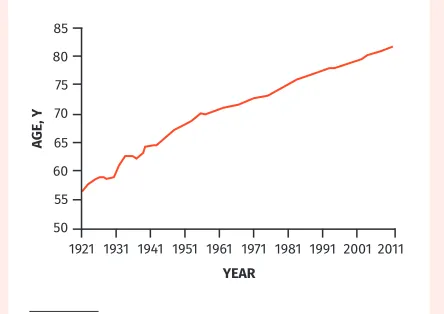
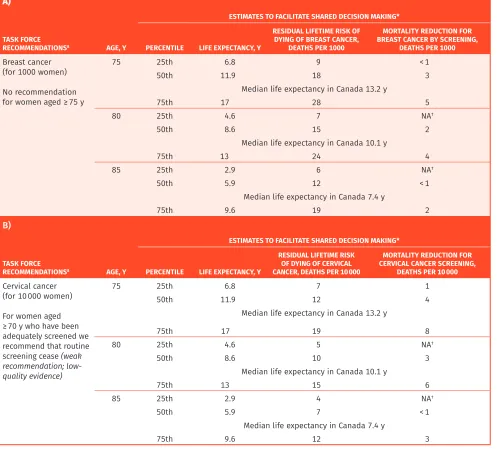
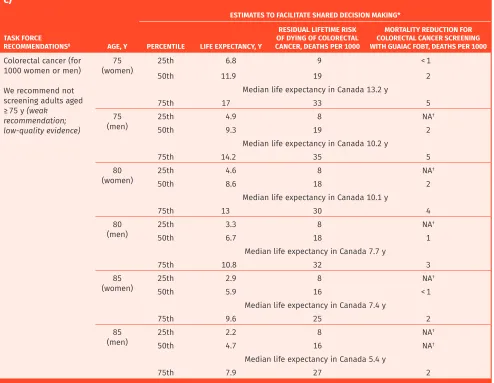
For decades, the life expectancy of Canadians has been slowly increasing (Figure 1).14 According to Statistics Canada,9 the average Canadian man at age 75 has 10 years of life expectancy; however, this typically includes some years of life in failing health. Table 2 provides esti-mates of median life expectancy at 75, 80, and 85 years, as well as a range of life expectancies influenced by the severity of comorbid conditions.7-9 Using this information can help to roughly estimate the life expectancy of your patient. The absolute risk of dying of breast, cervical, and colorectal cancer, and estimates of mortality reduction from screening over the remaining lifetime of persons with a life expectancy like your patient, is also provided. You could use these estimates to give you an order of magnitude of a possible benefit from screening. For some ages no reduction in cancer mortality can be expected from screening. For example, women at age 80 in the lowest quartile of life expectancy should expect no reduc-tion in mortality from screening for cancer. Models to
Table 1. Steps for consideration and discussion when deciding if your older patient would benefit from screening
STEPS ISSUES FOR CONSIDERATION
Determining whether to discuss screening with older patients
• Requests for continued screening will come from patients or relatives • Omitting discussion about cancer screening is not preferred by older patients1
• Family physicians should be prepared to discuss screening decisions with older patients • Older patients might be confused about the difference between screening and
monitoring of existing health conditions
Clinical practice guidelines often recommend against screening in older patients based on a specific age or life expectancy
Clinical trials on screening used to develop practice guidelines do not typically include people aged > 75 y Determining if older patients might benefit from screening
• Patient life expectancy is an important consideration in deciding on the potential benefits and harms of screening
• Family physicians should estimate individual life expectancy based on unique patient circumstances to aid in decision making on screening
• Older patients will have a range of life expectancies depending on comorbidity.6 Each age
group will include patients who might or might not benefit from screening (Table 2)7-9
• Other issues that should be considered include health status, frailty,4 and individual
patient values and preferences
Benefits from screening occur
downstream while harms typically occur immediately after screening
Patients with life expectancy > 5-10 y have the potential to benefit from some screening interventions
Discussing screening
• Some older patients might not consider life expectancy an important issue and might prefer not to have a discussion on screening framed by their life expectancy— although all of us older than 50 are aware that no one gets out of here alive! • Use of health status is a preferred approach to framing discussions about screening in
older patients
Appropriate framing of discussions is important in developing individualized screening decisions (Box 1)10
Identifying patients who would probably not benefit from screening
• The most preferred explanation is a priority shift to other health care issues. Consider this script: “Your other health issues should take priority. This test is unlikely to help you live longer or better”
• Confidence in their physician is an important factor in patients’ acceptance of recommendations to stop screening
Identifying patients who have the potential to benefit from screening
• Patients should be aware of the lack of evidence to support the benefits of screening into advanced age
• Discussions should include both the potential harms and benefits of any screening intervention
• Patients should be informed about the implications of positive test results, such as further tests or interventions that could cause harm
estimate life expectancy have been developed in Canada, the United States, and the United Kingdom, and in testing some have been found to be fairly accurate.15,16 Such cal-culations can also be used to guide clinicians and might be of greater relevance to them than to their patients.
Downstream thinking about the
possible outcomes of screening
As Muir Gray has pointed out, “The harm from a screen-ing programme starts immediately; the good takes lon-ger to appear.”17 If the screening test results were positive, would your patient be willing to go down the path of diag-nostic confirmation leading to treatment? In screening for colorectal cancer, a positive FIT result will raise the need for colonoscopy with biopsy, and a positive biopsy result will raise the issue of fitness to thrive following hemicolectomy. Regardless of comorbidities, any person so diagnosed is now a “cancer patient” with all this can imply. While the concept of watchful waiting (or active surveillance) is gain-ing traction for some types of cancer (eg, prostate), it is not possible to know whether a specific patient was overdiag-nosed with a slow-growing tumour that was never des-tined to cause harm to him or her. Cancer overdiagnosis is understandably a cause of much uncertainty.18
In our case, it seems reasonable to ask Jacques what he would like his doctor to do. Would he have a colo-noscopy in the event of a positive FIT result? In an asymptomatic patient, the purpose of screening is to treat any disease uncovered. If further testing, biopsy, or treatment would be declined, then no screening should be done in the first place (primum non nocere).
Shared decision making and
patient values and preferences
When should one stop cancer screening? To the best of our knowledge, there is no systematic review examining
the values and preferences of older patients around this question. That said, the concern expressed by Rachel and Jacques is not trivial given the rising incidence of cancer in older people. The big question is whether screening Jacques would add life to his years or years to his life.3 Treatment could certainly lower his qual-ity of life; and many patients underestimate the harms of medical intervention,19 which might be greater with advancing age. Although Jacques could live to age 88, he could be told the Canadian Task Force on Preventive Health Care made a recommendation against screening for colon cancer after age 7520; however, this is based on low-quality evidence and is a conditional (or weak) rec-ommendation, which implies a need to consider individ-ual patient situations including values and preferences.
One way to approach this case is through shared decision making with the patient or family members. Shared decision making is a structured process to incor-porate values and preferences into screening and treat-ment decisions.21 Shared decision making is especially important for implementation of conditional or weak recommendations.22 When bringing up the idea that cancer screening might no longer be beneficial given a patient’s life expectancy, using direct language, such as “You might not live long enough to benefit from this test,” can be perceived as overly harsh. Instead, a state-ment such as the following might be better received: “This test is unlikely to help you live longer. Your other health issues should take priority.” Jacques should be informed that, in screening with a fecal occult blood test, the lag time to benefit has been estimated to be 10.3 years for an absolute reduction of 1 death
pre-vented for 1000 persons screened.12
In screening for colorectal cancer after age 75, guide-lines from the United Kingdom and the United States recommend that the decision to screen be an individual one.13 For some cancers, there is international agree-ment among guideline committees on the age to stop (eg, age 75 for breast cancer).23 This guidance, as with the age to stop screening for colon cancer, is based on the absence of direct trial evidence to quantify the benefits and harms for women who outlive the recommended age for screening. In the absence of trial evidence, it is not easy to quantify the net benefit of preventive activities.
For patients who express a willingness to continue screening into advanced age, a values clarification exer-cise should be considered, once patients are informed of the uncertainty of benefit and possible harms. By values clarification we mean having a conversation about what matters most to our patients and their families in terms of health outcomes. This conversation can be helped by making time to work through a decision aid, such as the one on screening for breast cancer for women aged 75 to 84.24 Research suggests the greatest potential for improve-ment in practice is in having such a conversation.25
Figure 1. Change in life expectancy at birth in Canada since 1921
Reproduced from Statistics Canada with permission.14
85 80 75 70 65 60 55 50
1921 1931 1941 1951 1961 1971
YEAR
AGE, Y
Table 2. Estimates of life expectancy and mortality reduction from cancer screening at ages 75, 80, and 85 y: A) Breast, B) cervical, and C) colorectal cancer.
A)
ESTIMATES TO FACILITATE SHARED DECISION MAKING*
TASK FORCE
RECOMMENDATIONS8 AGE, Y PERCENTILE LIFE EXPECTANCY, Y
RESIDUAL LIFETIME RISK OF DYING OF BREAST CANCER,
DEATHS PER 1000
MORTALITY REDUCTION FOR BREAST CANCER BY SCREENING,
DEATHS PER 1000 Breast cancer
(for 1000 women)
No recommendation for women aged ≥ 75 y
75 25th 6.8 9 < 1
50th 11.9 18 3
Median life expectancy in Canada 13.2 y
75th 17 28 5
80 25th 4.6 7 NA†
50th 8.6 15 2
Median life expectancy in Canada 10.1 y
75th 13 24 4
85 25th 2.9 6 NA†
50th 5.9 12 < 1
Median life expectancy in Canada 7.4 y
75th 9.6 19 2
B)
ESTIMATES TO FACILITATE SHARED DECISION MAKING*
TASK FORCE
RECOMMENDATIONS8 AGE, Y PERCENTILE LIFE EXPECTANCY, Y
RESIDUAL LIFETIME RISK OF DYING OF CERVICAL CANCER, DEATHS PER 10 000
MORTALITY REDUCTION FOR CERVICAL CANCER SCREENING,
DEATHS PER 10 000 Cervical cancer
(for 10 000 women)
For women aged ≥ 70 y who have been adequately screened we recommend that routine screening cease (weak recommendation; low-quality evidence)
75 25th 6.8 7 1
50th 11.9 12 4
Median life expectancy in Canada 13.2 y
75th 17 19 8
80 25th 4.6 5 NA†
50th 8.6 10 3
Median life expectancy in Canada 10.1 y
75th 13 15 6
85 25th 2.9 4 NA†
50th 5.9 7 < 1
Median life expectancy in Canada 7.4 y
75th 9.6 12 3
Framing the discussion on
screening in older patients
Older adults might not consider life expectancy impor-tant in screening and might not welcome a discussion of their life expectancy when discussing screening.6 In our discussions with older adults, we should use phrases that are generally preferred by patients to explain cessation of routine cancer screening. Box 1 provides the phrases that were most and least preferred by older American adults.10
Physicians can provide their patients with decision aids as tools to supplement the discussion in the office.26 Implementing patient decision aids during the clinical encounter can be challenging, as many people have diffi-culty understanding the concept of risk.27-29 As we discussed
in a recent article on organizing a practice for screening, there are compelling reasons to involve different members of the primary care team in screening activities.30 For exam-ple, we could further develop the role of nursing.
And in the end …
Rachel and Jacques wonder about his continuing to be screened for colorectal cancer. Using Table 2,7-9 you estimate Jacques to be at the 50th percentile for men about 80 years of age, giving him a good chance for more than 5 years of remaining life. You decide to invite Jacques for further discussion about the harms and benefits of continuing to be screened with the FIT. Further screening with the fecal occult blood test
can minimally reduce the risk of death from colorec-tal cancer from about 18 to 17 per 1000 men at his age. He now understands the magnitude of a pos-sible benefit from screening to be very small, with a 10-year lag time to benefit exceeding his estimated life expectancy. On the other hand, it is difficult to estimate the frequency of harms he might experi-ence from screening. These harms include risks of dehydration from bowel preparation for colonoscopy, conscious sedation, bleeding or perforation from polyp removal, and the anesthesia of surgery. Based on this discussion, Jacques and Rachel decide to decline further screening.
There comes a time when many patients will have the good fortune to exceed the recommended age range for screening. For these people, we should consider an individualized shared decision making approach around the harms and benefits of screening.
C)
ESTIMATES TO FACILITATE SHARED DECISION MAKING*
TASK FORCE
RECOMMENDATIONS8 AGE, Y PERCENTILE LIFE EXPECTANCY, Y
RESIDUAL LIFETIME RISK OF DYING OF COLORECTAL CANCER, DEATHS PER 1000
MORTALITY REDUCTION FOR COLORECTAL CANCER SCREENING WITH GUAIAC FOBT, DEATHS PER 1000 Colorectal cancer (for
1000 women or men)
We recommend not screening adults aged ≥ 75 y (weak
recommendation; low-quality evidence)
75
(women) 25th 50th 11.96.8 199 < 12
Median life expectancy in Canada 13.2 y
75th 17 33 5
75
(men) 25th 4.9 8 NA
†
50th 9.3 19 2
Median life expectancy in Canada 10.2 y
75th 14.2 35 5
80
(women) 25th 4.6 8 NA
†
50th 8.6 18 2
Median life expectancy in Canada 10.1 y
75th 13 30 4
80
(men) 25th 3.3 8 NA
†
50th 6.7 18 1
Median life expectancy in Canada 7.7 y
75th 10.8 32 3
85
(women) 25th 2.9 8 NA
†
50th 5.9 16 < 1
Median life expectancy in Canada 7.4 y
75th 9.6 25 2
85
(men) 25th 2.2 8 NA
†
50th 4.7 16 NA†
Median life expectancy in Canada 5.4 y
75th 7.9 27 2
FOBT—fecal occult blood test, NA—not applicable. *Adapted from Statistics Canada9 and Walter and Covinsky.7 †No mortality reduction is expected.
Box 1. Phrases to explain stopping cancer screening
Most preferred by patients
1. Your other health issues should take priority 2. This test is not recommended for you by medical
guidelines
3. You are unlikely to benefit from this test 4. We usually stop doing this test at your age 5. You are at high risk of harm from this test
6. We should focus on quality of life instead of looking for cancer
Least preferred by patients
1. The doctor does not give an explanation 2. The doctor does not mention this test
3. You might not live long enough to benefit from this test 4. This test can be very inconvenient to complete 5. This test can be very uncomfortable
Adapted from Schoenborn et al.10
Dr Grad is Associate Professor in the Department of Family Medicine at McGill University in Montreal, Que. Dr Thériault is Associate Vice Dean of Distributed Medical Education and Academic Lead for the Physicianship Component at Outaouais Medical Campus in the Faculty of Medicine at McGill University. Dr Singh is Associate Professor in the Department of Internal Medicine and the Department of Community Health Sciences at the University of Manitoba in Winnipeg and in the Department of Hematology and Oncology of CancerCare Manitoba. Dr Dickinson is Professor in the Department of Family Medicine and the Department of Community Health Sciences at the University of Calgary in Alberta. Ms Szafran is Associate Director of Research in the Department of Family Medicine at the University of Alberta in Edmonton. Dr Bell is Professor in the Department of Family Medicine at the University of Alberta.
Competing interests
All authors have completed the International Committee of Medical Journal Editors’ Unified Competing Interest form (available on request from the corresponding author).
Dr Singh reports grants from Merck Canada, personal fees from Pendopharm, and personal fees from Ferring Canada, outside the submitted work. The other authors declare that they have no competing interests.
Correspondence
Dr Roland Grad; e-mail [email protected] References
1. Parnes BL, Smith PC, Conry CM, Domke H. Clinical inquiries. When should we stop mammography screening for breast cancer in elderly women? J Fam Pract 2001;50(2):110-1.
2. Wikiquote [website]. H. L. Mencken. Los Angeles, CA: Wikimedia Foundation Ltd; 2019. Available from: https://en.wikiquote.org/wiki/H._L._Mencken. Accessed 2019 May 22. 3. Clarfield AM. Screening in frail older people: an ounce of prevention or a pound of
trouble? J Am Geriatr Soc 2010;58(10):2016-21. Epub 2010 Oct 1.
4. Abbasi M, Rolfson D, Khera AS, Dabravolskaj J, Dent E, Xia L. Identification and man-agement of frailty in the primary care setting. CMAJ 2018;190(38):e1134-40. Erratum in: CMAJ 2019;191(2):E54.
5. Mangin D, Sweeney K, Heath I. Preventive health care in elderly people needs rethinking. BMJ 2007;335(7614):285-7.
6. Schoenborn NL, Lee K, Pollack CE, Armacost K, Dy SM, Bridges JFP, et al. Older adults’ views and communication preferences about cancer screening cessation. JAMA Intern Med 2017;177(8):1121-8.
7. Walter LC, Covinsky KE. Cancer screening in elderly patients: a framework for indi-vidualized decision making. JAMA 2001;285(21):2750-56.
8. Canadian Task Force on Preventive Health Care [website]. Published guidelines. Canadian Task Force on Preventive Health Care; 2019. Available from: https:// canadiantaskforce.ca/guidelines/published-guidelines. Accessed 2019 May 22. 9. Statistics Canada. Life expectancy at various ages, by population group and sex,
Canada. Ottawa, ON: Statistics Canada; 2019. Available from: https://www150. statcan.gc.ca/t1/tbl1/en/tv.action?pid=1310013401. Accessed 2019 May 22. 10. Schoenborn NL, Janssen EM, Boyd CM, Bridges JFP, Wolff AC, Pollack CE. Preferred
clinician communication about stopping cancer screening among older US adults: results from a national survey. JAMA Oncol 2018;4(8):1126-28.
11. Ebell M, Herzstein J. Improving quality by doing less: overscreening. Am Fam Physician 2015;91(1):22-4.
12. Lee SJ, Leipzig RM, Walter LC. “When will it help?” Incorporating lag time to benefit into prevention decisions for older adults. JAMA 2013;310(24):2609-10.
13. US Preventive Services Task Force; Grossman DC, Curry SJ, Owens DK, Bibbins- Domingo K, Caughey AB, et al. Screening for colorectal cancer: US Preventive Services Task Force recommendation statement. JAMA 2016;315(23):2564-75. Errata in: JAMA 2016;316(5):545, JAMA 2017;317(21):2239.
14. Decady Y, Greenberg L. Health at a glance. Ninety years of change in life expectancy. Cata-logue no. 82-624-X. Ottawa, ON: Statistics Canada; 2014. Available from: https://www150. statcan.gc.ca/n1/pub/82-624-x/2014001/article/14009-eng.htm. Accessed 2019 May 22. 15. Cruz M, Covinsky K, Widera EW, Stijacic-Cenzer I, Lee SJ. Predicting 10-year mortality
for older adults. JAMA 2013;309(9):874-6.
16. Kobayashi LC, Jackson SE, Lee SJ, Wardle J, Steptoe A. The development and valida-tion of an index to predict 10-year mortality risk in a longitudinal cohort of older English adults. Age Ageing 2017;46(3):427-32.
17. Muir Gray JA. Evidence-based healthcare and public health: how to make deci-sions about health services and public health. 3rd ed. Edinburgh, Scot: Churchill Livingstone, Elsevier; 2009.
18. Mahal BA, Butler S, Franco I, Spratt DE, Rebbeck TR, D’Amico AV, et al. Use of active surveillance or watchful waiting for low-risk prostate cancer and management trends across risk groups in the United States, 2010-2015. JAMA 2019;321(7):704-6. 19. Hoffmann TC, Del Mar C. Patients’ expectations of the benefits and harms of
treat-ments, screening, and tests: a systematic review. JAMA Intern Med 2015;175(2):274-86. 20. Canadian Task Force on Preventive Health Care. Recommendations on screening for
colorectal cancer in primary care. CMAJ 2016;188(5):340-8. Epub 2016 Feb 22. 21. Grad R, Légaré F, Bell NR, Dickinson JA, Singh H, Moore AE, et al. Shared decision
making in preventive health care. What it is; what it is not. Can Fam Physician 2017;63:682-4 (Eng), e377-80 (Fr).
22. Thombs BD, Straus SE, Moore AE; Canadian Task Force for Preventive Health Care. Up-date on task force terminology and outreach activities. Advancing guideline usability for the Canadian primary care context. Can Fam Physician 2019;65:12-3 (Eng), e5-7 (Fr). 23. Ebell MH, Thai TN, Royalty KJ. Cancer screening recommendations: an international
comparison of high income countries. Public Health Rev 2018;39:7.
24. The Ottawa Hospital Research Institute [website]. Patient decision aids. Decision aid summary. Ottawa, ON: The Ottawa Hospital Research Institute; 2017. Available from:
https://decisionaid.ohri.ca/AZsumm.php?ID=1908. Accessed 2019 May 22. 25. Diendéré G, Dansokho SC, Rocque R, Julien AS, Légaré F, Côté L, et al. How often do
both core competencies of shared decision making occur in family medicine teach-ing clinics? Can Fam Physician 2019;65:e64-75. Available from: www.cfp.ca/content/ cfp/65/2/e64.full.pdf. Accessed 2019 Jun 12.
26. Moore AE, Straus SE, Kasperavicius D, Bell NR, Dickinson JA, Grad R, et al. Knowledge transla-tion tools in preventive health care. Can Fam Physician 2017;63:853-8 (Eng), e466-72 (Fr). 27. Scalia P, Durand MA, Berkowitz JL, Ramesh NP, Faber MJ, Kremer JAM, et al. The impact
and utility of encounter patient decision aids: systematic review, meta-analysis and narrative synthesis. Patient Educ Couns 2019;102(5):817-41. Epub 2018 Dec 21. 28. Lang E, Bell NR, Dickinson JA, Grad R, Kasperavicius D, Moore AE, et al. Eliciting
patient values and preferences to inform shared decision making in preventive screening. Can Fam Physician 2018;64:28-31 (Eng), e13-6 (Fr).
29. Bell NR, Dickinson JA, Grad R, Singh H, Kasperavicius D, Thombs BD. Understanding and communicating risk. Measures of outcome and the magnitude of benefits and harms. Can Fam Physician 2018;64:181-5 (Eng), 186-91 (Fr).
30. Wilson BJ, Bell NR, Grad R, Thériault G, Dickinson JA, Singh H, et al. Practice organi-zation for preventive screening. Can Fam Physician 2018;64:816-20 (Eng), e477-82 (Fr).
This article is eligible for Mainpro+ certified Self-Learning credits. To earn credits, go to www.cfp.ca and click on the Mainpro+ link.