APPENDIX
A
UNIT INTELLIGENCE
TRAINING
CHECKLIST
This checklist will help a newly assigned brigade or battalion S2 maintain technical and tactical intelligence proficiency. Its building-block approach is systematic. The phases are supported by tasks to be completed for certification during the time specified. Some tasks may not apply to a particular echelon of staff.
I PHASE I - ORIENTATION PHASE
This phase covers basic orientation to the division and the unit's mission. This phase should be completed within the first 30 days. The goal is to quickly acquaint the S2 with an understanding of the battalion, brigade, and division roles within corps, possible missions, and deployment areas.
In it i ai/Date Task
Coordinate with and receive briefing from outgoing S2. Review unit's intelligence library of publications listed in Appendix J.
Read unit METL and latest training brief to determine overall unit missions and status.
Receive unit COR in-brief.
Talk with unit COR; ask what are his desires for intelligence and intelligence products. Tailor intelligence to the needs of the COR.
Visit and receive briefing from ACofS G2, Deputy G2, G2 Operations Chief, G2 Plans Chief, G2 Training Chief. Meet with subordinate S2's and gain an understanding
.
Personneland equipmentstatus.
.
Trainingproficienciesand deficiencies.
.
Areaswhere they needyour echelon's help.
Visit MI battalion or DS MI Co commander for unit and equipment briefings, display, and demonstrations. Study division, brigade, and battalion OPLANs.Review and evaluate intelligence annex to unit SOPs. (Use FM 34-1, FM 101-5, your SOP, and intelligence annex to the division SOP.) Provide CDR an updated evaluation of the unit intelligence annexes. Develop an SOP if one is missing or outdated.
Receive an organizational and functional briefing from the next higher G2/S2.
Study the CDR's current PIR and IR as developed. Meet and discuss intelligence missions, products, and
training with
the-. Scout platoon leader. . GSR platoon leader. . Local division CI team.
. ACT.
. ACE Chief, IPS Chief, and CM Chief.
. EWO.
. Terrain detachment team.
Determine all organic or assigned division intelligence collection assets that may support collection efforts. (See Appendix G.)
Learn the connectivity, reporting, and requesting procedures. Meet with next higher echelon G2/S2 to discuss the CM process.
Review unit's collection plan.
Become knowledgeable of the unit's and division's FSOP, RSOP, and deployment procedures.
Read unit and division history.
Obtain SI access through the SSO and review SCI billets for unit.
Review unit's arms room security SOP. Inventory all sensitive items in one company. Review key control program SOP.
Review physical security and crime prevention SOP. Receive a crime prevention and physical security program briefing from the MP and Directorate of Security.
Become familiar with the S2 section vehicles and generators, as necessary.
Become familiar with the TOC SOP, setup, and multisystem, multiechelon connectivity.
Visit G2 training for intelligence training products. Test an arms room's J-SIIDS.
Develop and implement a detailed internal security
inspection program that covers intelligence areas within the unit.
Develop working relationship with higher echelon G2/S2. Review mission and section METL and battle tasks. Have section members give their assessment of current training level.
I
PHASE II - FUNDAMENTAL PHASE
This is the most critical phase for the newly assigned S2. The knowledge, insight, and assessments of I&S will establish the foundation for future development. This phase focuses on the IPB process, intelligence production and dissemination, collection operations, and security. This phase should be completed within 90 days.
In it i ai/Date Task
Present to unit personnel an officer professional development class on the threat.
Update unit's collection plan as needed; submit revisions to the CDR and forward a copy to higher HQ G2/S2.
Brief the CDR on division and corps IEW assets. Brief next lower units on division and corps IEW assets. Inspect unit map program. Identify basic map load and training requirements.
Inspect and evaluate unit training for intelligence tasks, including awareness of AR 381-10.
Begin country studies.
Understand additional duty responsibilities as required:
. Security manager. . Physical security officer. . Personnel security officer. . Crime prevention officer. . Key custodian.
. Top secret document custodian. . Information systems security officer.
Receive briefing and training from unit SIGO on
communications procedures and communications equipment PMCS.
Become familiar with capabilities, limitations, and vulnerabilities of unit's equipment (tanks, Bradleys, other assigned, attached, DS systems, or OPCON BOS operating in the unit's battlespace; particularly the TA and information dissemination capabilities).
Update, as needed, the
unit's-. Arms room SOP. . Physical security SOP. . Key control SOP.
. Crime prevention program.
Conduct random unannounced security spot checks. Report the results and any recommendations to the CDR.
Brief CDR on the unit's intelligence estimate.
Brief CDR on the intelligence collection and reporting system from platoon through corps.
Be knowledgeable on CTC threat vehicles, E-O devices, doctrine, and tactics. Teach a class on this subject at least once in this phase.
Visit nearest battle simulation center and become familiar with computer operations.
Visit and observe training of primary weapon systems in the division.
Understand current division policy on CONUS and OCONUS transportation of classified material.
Work with commanders. Ask what intelligence they want during FTXs and OPORD briefings.
Know how to read a TACFIRE direction system message. Let FSO know you want to receive these during FTXs and deployments.
Work with FSO to develop and review unit targeting and BDA procedures.
Know unit air LNO. Request BDA and in-flight reports that will bolster reporting.
Obtain recent CTC and applicable CALL. Develop plan to correct any deficiencies.
Obtain inspector general checklist and CIP checklists; conduct internal inspection on all S2 functional areas. Brief CDR on inspection results and solutions.
Review language proficiency requirements; assist S3 in coordinating training. Retain list of unit's capabilities; include unpaid abilities.
Constantly review clearance requirements, applications, and updates.
I
PHASE 111-DEVELOPMENTAL PHASE
This phase will build and expand on the knowledge gained during Phase II. It will cover the same basic intelligence functions but in greater detail. Th is phase should be completed within 180 days.
In it i ai/Date Task
Fully understand the functions of the S2 at the unit's TOC and how S2 functions drive other TOC functions.
Submit REDTRAIN requests through applicable higher S2 to G2 training, as required.
Review threat OB holdings and files. Order update material as required.
Determine available intelligence databases and actually "work the system" to obtain data in support of a CONPLAN. Brief CDR on the results.
Identify gaps of information in battle books, OB holdings and files, and intelligence annexes. Submit Rlls to satisfy intelligence requirements.
Identify S2 and intelligence weaknesses from the last EXEVAL and present a correction plan to the CDR. Evaluate intelligence training classes and provide written results to the CDR.
Evaluate unit soldier's knowledge of intelligence training tasks and provide a written report to the CDR.
Demonstrate a thorough understanding of the intelligence reporting system during FTXs.
Act as threat CDR during the wargaming process and TF rehearsals.
Develop an internal S2 section intelligence cross-training program. Have section soldiers teach the classes. Determine unit's security posture during FTXs and recommend corrective actions to the CDR.
Become familiar with and teach a class on doctrine, tactics, and current vehicles of a CON PLAN threat.
I PHASE IV - ADVANCE PHASE
This phase will take the S2 who has mastered the intelligence fundamentals through the first year, during which the unit will have participated in the full annual training program.
In it i ai/Date Task
Successfully complete an EXEVAL.
Successfully deploy section and perform S2 operations during a CTC rotation.
Successfully deploy section and perform S2 operations during a BCTP Warfighter Exercise.
Qualify or familiarize yourself on all unit weapon systems. Update unit's intelligence annex as required.
Accurately predict threat actions during FTXs using IPB and all intelligence assets.
APPENDIX
B
INTELLIGENCE
PREPARATION
OF THE BATTLEFIELD
PRODUCTS
This following examples of various overlays, templates, and matrices are constructed and used during the IPB process to enhance the battlespace visualization of the commander and staff. These samplings are not all-inclusive. Your products will be dictated by your mission statement, resources available to you, and the time allowed.
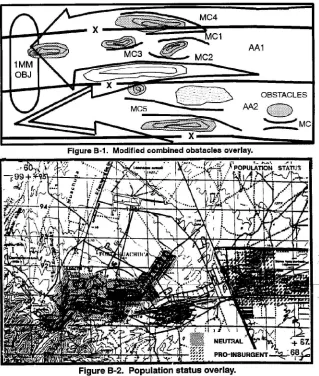
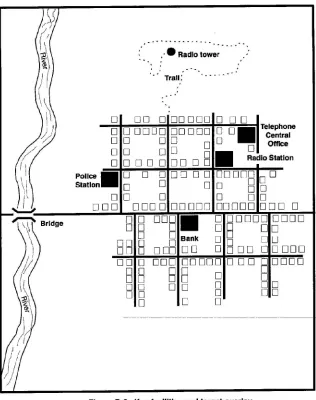
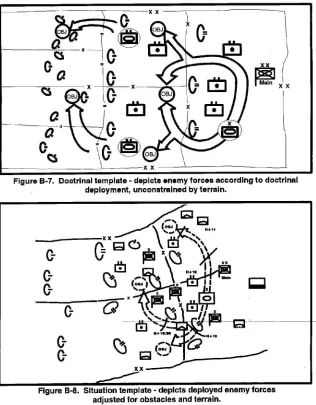
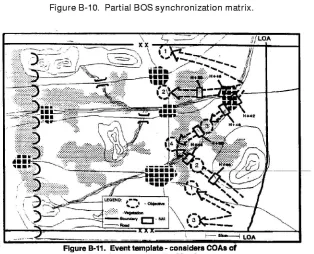
Figures B-1 through B-6 are terrain overlays. Figures B-7 through B-13 are templates and associated matrices. Figure B-14 is a sample of an ADA-tailored IPB.
The MCOO
includes-. MCs and AAs stated in terms of concealment and cover, size and deployment type of formation that can move along them (armored battalion in company wedge), speed the formation can reasonably achieve; dismounted, mounted, and aerial routes; trails and passes that will allow column movement if unopposed.
. Obstacles in terms of what they are an obstacle to.
. Key terrai n .
. Restricted terrain in terms of what size force can deploy there and what mobility work could be done to "unrestrict" it.
. Severely restricted terrain in terms of what will allow a dismounted force to traverse it and at what speed.
. IVLs. Without a 1- or 5-meter resolution terrain product, IVLs will have to be determined by historical knowledge or ground reconnaissance.
AA1
(ici~'...0
OBSTACLES
MC5
~AA2
~
~~
~MCX
Figure B-2.
NElJT::IAL + S1.
PRD-INSURGENT
~.9~
~. ~. . . - - - . - . .
.
..
.
Radiolowe;
. . -.
.:.
.
. .
I'.. Trail:' ""'" -..'
.-" '.
0 00 000000000
0 0 DODO 00000 0 0
II
Telephone0 0 0 0 0 Central
0 0 0 Office
00 0 0
11
0 0 0 0 0 DO 0 0 Radio Station Police
II
0
0
ODD
0 0 DO ono
0
0
Station
0
0
0 0
B 0
DO
0
0
DO
0 0 0
0 DO 0 DO ODD DO ODD 0 0 0 0
0 0
ODD
II
0 00000
DODD
DO
D
D
B
DO
0
D
0
ROO
Bank
0
0
0 U
0
0
0 DO 00
0 ODD
00000
DO 0
ODD 00000
ODD
0 DODD
BB
88
0
8
DO
00
0
DO
DO
0
DO
0
C
0
- ---
",""j AT' -" -'-1HuW>u.o,
~ f!.-;,...,::: ;---;-'r)1 ,," ~1
~(,
.
~ ;)
60
.;"::"-','1
' \
~99+', ", "I
,
\
,,' ,. oJ .~
:./ ., ~:' ~j') '"'j---;
, ,,'59 ,c
.Y ("
~
' , /.'62'"
('", I I . \ (I
.
vt
e'."- , / ,.-1 "'.'",-f "'. -' - I~,
. J.,~'i~
,
,",,' ~,,; " &;'{ I "" "
.
'.
I
;'relj,
L
/Yr.I "~<
$
: CONCEALMENT and COV,
ER ::. .
. ,.' '-' J"'.',,,
'
j
' "-'1 ':',f fr
i
-"'I
...,"
"~.
/'-b.'l(As,. 66,/ ,J ,'e7 '!, 68
IL, , .' I
.~ r -'.; - ' )
I
/ ~\.
'c' .' -; J ')
L/~;
R',"~':
It,
I . ort5U ,-'..T !
~--:'-99+ '
1-)
-/ ~
59
L'
f-
-<,"L
- ROAD
---n
-UNPAVEDROAD
-m -TRAIL
\f
.
""
,
'~--.
---j~~,---.
.~
fR
.
~~;'l"
It
\.1',-
l' .~'+
87~I
', ,I ~,
~.-.:.w.! ,~,
68
.~~"
~
11--10
Go
10
~
BJ .xyx
=I:!J
0
\0
~
OBJ\
Xx-Figure B-7. Doctrinal template - depicts enemy forces according to doctrinal deployment, unconstrained by terrain.
l
xx)
~t
0
-a"
G
~
c-~
...,
~
e
\
~~.I..ft.. H+"xx
~-"'"
G
e 0
x x' '\\/~
Ii!I
\~
H+1'l'
xx ... ..., If!
\
-~
t~..,
i&I~
I;;J
--x
~F\"
~
0
--~''1:.\j
~
~x~II
pi1L-au~---"+10:" /. M+10
~
...,
~~
to'"
uer
e
'''' . xxc-
In the offense: In the defense:
8 Objectives & LOA. 8 BPs & direct fire range fans.
8 AAs & MCs. 8 Reserve & hide positions.
8 Recon routes, OP & IEW sites. 8 CATK routes & firing lines.
8 Firing lines & direct fire range fans. 8 Counter-SOPs & counterrecon
8 Formations & deployment lines. forces.
8 Artillery targets & range fans. 8 Recon routes, OP & IEW sites.
8 Artillery & ADA position areas. 8 Ambush sites.
8 ADA coverage. 8 Artillery targets & range fans.
8 Attack helicopter routes, BPs & range 8 Artillery & ADA position areas.
fans. 8 ADA coverage.
8 LZs. 8 Attack helicopter routes, BPs &
8 CAS routes. range fans.
8 Situational obstacles. 8 Tactical & protective obstacles.
8 Chemical agent targets. 8 CAS routes.
8 Smoke targets 8 Situational obstacles.
8 Chemical agent targets.
8 Smoke targets.
The situation template should include the following for mechanized armor-based offense and defense.
---+
..
DP No. 1 2
Decision Insurgent Camp is in NAI1 or 3. Insurgent Camp is in NAI 2.
Criteria
Maneuver A Co receives 3/B, occupy TAA A Co occupies TAA BEAUTY,
BEAUTY, % movement to % occupy BPs 1, 2, and 3.
CATK along AXIS KEN.
FS Priority: A, B, C. Priority: C, B, A.
M-CM-S 1/A/13th Engr to A. 1/A/13th Engr to C.
Figure B-10. Partial BOS synchronization matrix.
\ L, ~.!
-
xx.
<..~.- ~.'
", --"''[::==:::>
\ ,1
--
.
..::::', .~. ~-, I \
=
J)\.."-
.'-~<~,~~<"'~
..
.
..
wm:
~~'~~Q::~:o~~~~/--.
=~Oi=I""~1
Ro8d\
{';\;4,..1'\r--- '::." I I-- .'---" LOA Figure B-11. Event template - considers COAsofreinforcing or counterattacking forces.
\
C ":~:=>//
IJ
IlOA~-; ~ xx ---' 1/
I(f~
I
,~~
/'
,
If
!~~i~~1i~rjj
...':0...
.,~
r/L.
w
~
\
:.~:-.i:~~~~'~'::::~:::::::~~:~~;:;:~;'~::::'."'::'"
~ _.;;~:t{-/
.-~;~
'flu
"~-
.
~_w~~
J
i~ ...~..~~)\
'\ \
LEB~~.D
)
-.
.:=:/ .~
\:::'::::
Q
,
"--//
,' '
-.Road .MAl
3-/ X X X
f--
..m---1
LOAEST INDICATORS THAT WOULD HELP CONFIRM
NAI TIME COA1 COA2 COA3 OTHER
1 H-15 AASL T
Forces
2 H-15 AASL T
Forces
3 H-15 AASL T ASSL T Forces
Forces
4 H-15 Infil of LT Inf
5 H-4 LT Inf ATK
NAI5
6 H-4 LT Inf LT Inf ATK
ATK NAI 7 NAI6
7 H-4 LT Inf LT Inf ATK
ATK NAI 8 NAI7
8 H-4 - Poised LT Inf ATK
to ATK NAI8
9 H-4 - Poised - Poisedto TO ATKs
to ATK ATK
10 H-4 - Poised to - Poisedto TO ATKs
ATK ATK
Abreast
11 H-6 -Shifts N
12 H-18 1 or 2 Bdes
ATKN
13 H-18 1 or 2 Bdes
ATKS
- Indicates ECOAs.
WIND- PRECIPI- TEMPER-
ILLUMI-SPEED & TATION ATURE & NATION
DIREC- HUMIDITY2
TION'
For airborne Severe weather Temp>100and Little air-operations within 3 miles of humidity<80% to-air or
speed must target will hinder will degrade point CAS
be <13 knots accuisition. payload capability
Freezing rain capability at night
greatly limits lift except
capability newest
F/W
For airmobile Same Same No CAS
operations without
speed must
illumina-be <13 knots tion
except newest R/W
1. DEFINE THE BATTLEFIELD.
CONSIDERATIONS FOR AIR IPB
.
AI for air IPB is significantly larger than ground IPB.- Includes airfields which can range supported unit AO to include those within aerial refueling radius.
- AAAs which lead into supported unit's AO. - Three types of air avenues:
* F/W Attack = Normally follows ground forces.
* F/W Transport = Bombers and R/W lift uses terrain to mask ingress and egress routes.
* R/W Attack = Normally follows ground forces.
2. DESCRIBE THE BATTLEFIELD'S EFFECTS. See the following example of
weather effects on aviation operations.
TYPE AIR-CRAFT MINIMUM VIS Fixed
Wing 2.5 nmi vis
2.5nmi AGL ceiling in hilly terrain
1.0nmi AGL in flat terrain
Rotary Wing
1.0 nmi vis
300 ft AGL
1 Strong winds perpendicular to AAA increase difficulty in hitting target.
2 Amount of degradation differs with type of aircraft.
---.
Terrain Analysis.- Determine impact of geographic factors on the ability of the aircraft to approach, acquire, and engage a target.
- Predict how an aircraft would most likely approach target or area to deliver ordnance.
- Locate positions that rotary wing could use for stand-off and/or pop-up attacks. - Determine locations of possible LZs, DZs, and the AAAs to these areas. - AAAs do not stop at FLOT or FEBA and they do not enter your AO
solely from the FLOT or FEBA; watch your flanks and rear.
- The closer an aircraft is to a target the greater an influence terrain will have on the aircraft and how it is employed.
- The best method for formulating AAAs is based on fixed factors: * Locations of enemy airbase or staging area (known or suspected). * Position of friendly targets.
* Most aircraft will fly a straight-in approach from the airbase to the vicinity of the target.
Reason: Shorter overall mission time, less fuel needed, more payload or ordnance.
Exceptions which cause deviation from this rule: * Heavy concentrations of air defense.
* Major terrain features that can mask the approach of aircraft at low altitudes. * Terrain that may force unnecessary exposure.
* Terrain exceeding the operating ceiling of rotary-wing aircraft. - What happens in the vicinity of the target?
* Most attacking aircraft will drop lower to use terrain masking and minimize early warning and exposure times to associated air defenses.
* How will the enemy aircraft approach the target (Hi-Hi-Lo, Lo-Hi-Lo, or Lo-Lo-Hi, etc)?
* To engage the target the pilot must be able to see it (visual, radar, sensor). * The pilot must approach his target so he can see it at far enough distance to
allow lock-on and engagement by his weapon system.
* The pilot will maximize his standoff range to increase survivability. - How to determine the direction of attack:
* Know the enemy HPT; what friendly asset he must destroy. * Know the location of these assets.
* Know the location of known or suspected enemy airbases and FARP.
---* Determine AAA which could be used by fixed- or rotary-wing aircraft making
the attack.
* Determine locations from which stand-off and pop-up rotary-wing attacks are most likely.
* These locations will provide terrain masking for the aircraft to hide behind. * The location must also provide observation and fields of fire into the target area
when the aircraft pops-up.
* This type of location + a masked ingress and egress route = a stand-off or pop-up position.
* Within the vicinity of the target, consider the following:
- LOS acquisition of the target.
- Weapon stand-off capability. - Pilot reaction time. - Aircraft survivability. - Standard tactics.
3. EVALUATE THE THREAT.
.
Should address the following:- AOB-How many and what type aircraft. (Include different models such as Mi-24 E or F because they all have varying payloads, optics, and weapon systems.) - Capabilities of the aircraft in the enemy inventory.
- Types of ordnance available to the enemy.
* Guns.
* Rockets.
* Tactical ASMs, CBUs, PGM, AAM, NBC, and mines. - Capabilities:
* Range.
* Guidance (aerial, ground). * Release altitude. - Doctrine:
* Raid sizes and composition.
* Ingress and egress altitude and speed. * Delivery profiles.
* Use of EP and SEAD.
-C2:
* Most non-Western aircraft operate under strict ground control. They are vectored toward a target rather than being sent to an area to seek
---targets on their own. The vector is from ground emplaced beacons which normally operate in HF range.
- Work to template high value C2targets:
* GCI nodes. * FAC. * RNP. * Beacons.
- Maintenance and Sortie Generation Capability:
* OR rates determine the percentage of aircraft able to fly. OR rate x number of aircraft = the maximum aircraft that can fly at anyone time.
* The average sortie generation rate for most modern air forces is 2.5 to 3 for first 24-hour period. Second and succeeding day's planning factor is 5% of available number of aircraft.
* To get sortie generation rate: number of aircraft x sortie generation rate = number of sorties in a 24-hour period.
* To estimate number of sorties in your AO, consider ground situation, enemy main effort, enemy doctrine.
4. DETERMINE THREAT COURSES OF ACTION.
.
Enemy air operations are conducted in support of their groundoperations. The most important part of determining enemy air COAs is to understand the ground situation and enemy ground COAs.
.
With the information and analysis you've done in the first three steps, determine how the enemy will employ his air assets..
Consider enemy doctrine, AAAs, terrain in the target area, and current weather conditions..
You must answer the following questions: - When will the enemy commit his air assets?- Where will the enemy commit his air assets (target area)? - What air assets will the enemy commit (number of aircraft)?
- How will the aircraft attack in the target area (AAA or delivery profile)?
REQUIREMENT EFFECTS
Coordinate with higher, flank, Better guidance from higher & integration with
forward units. adjacent units; less redundancy & gaps in
coverage.
Identify R&S requirements; Success of unit mission.
rehearse R&S plan.
Supervise & coordinate the Better use of survl systems (GSR/REMBASS
command's aerial & ground employment), LRRPs, and tasking UA Vs or other
reconnaissance (include LRRPs). aerial assets to answer COR's PIR.
Brief GSR, REM BASS, and patrol Effectiveness of R&S assets which, in turn, affects team leaders (pit leaders of every success of R&S effort.
BOS in AO to collect) (e.g., LLVI, LRSO, scouts).
Prepare R&S WARNO and Start the reconnaissance effort ASAP.
OPORO early-on.
Update R&S OPORO as info is Effectiveness of R&S effort and unit mission. received.
Provide R&S plan to higher, R&S effectiveness and other unit actions;
lower, and adjacent units. prevention of negative effects.
APPENDIX
C
RECONNAISSANCE
AND SURVEILLANCE
PLANNING
R&S planning is continuous. You must understand the commander's intent for each mission. After mission analysis, the commander should tell you the key information needed before and during the mission. This key information is the commander's PIR and IR. The PIR and IR provide the initial focus to R&S planning. Plan to conduct R&S throughout the depth of the battle in space and time. (See FM 34-2-1.)
G2/S2 R&S RESPONSIBILITIES (Table C-1)
EXAMPLE: The primary R&S planning objective is to task subordinate units (all possible assets; e.g., MI, MP, FA, Signal, Engr, FSB) to cover NAls important to brigade mission or directed by higher HQ. Subordinate units plan the use of available R&S assets to satisfy taskings from the brigade and their own requirements. They strive to complete their plans quickly (using the 1/3,2/3 rule) so R&S assets have time to prepare and execute the plan. As soon as they are complete, the subordinate unit plans are consolidated at brigade to form the brigade R&S plan. You now have a draft plan that shows when and in what areas to begin R&S planning.
I R&S PLANNING PROCESS (Figure C-1)
I. PLANNING PROCESS.
A. Initial Requirements:
1. Did higher HQ provide tasking requirements?
2. Was the commander's PIR and IR stated and included? 3. Did commander provide R&S intent?
4. Did S2 brief the staff on enemy collection capabilities? 5. Were other staff tasks performed?
B. SIR Developed (IPB Driven):
1. Did S2 identify air or ground AA?
2. Did situation and event templates reflect probable or prioritized ECOAs?
3. Was NAI developed in detail? (What is expected? When?
Where?)
4. Were collectible indicators at NAls developed? 5. Were SIR developed from NAls and indicators?
6. Were reporting requirements developed for priority collection missions to allow the commander time to change plans?
C. Possible Collectors Analyzed:
1. Did S2 coordinate with staff, S2, and G2 to identify all available collection assets?
2. Did S2 analyze asset capabilities to develop collection requirements based on range to target, time available, target characteristics, terrain, weather, enemy (obscurant use), and communication?
3. Did S2 analyze collection redundancy (is it necessary)?
---4. Did staff identify support requirements (communication nets,
retransmission, FS, NBC reconnaissance support, logistic support, special equipment support)?
5. Did S2 identify gaps in collection?
6. Did S2 back brief S3 or the commander on R&S concept?
7. Were WARNOs sent to appropriate assets?
8. What were timelines?
a. When was mission received?
b. What is NL T time for execution?
c. When was templating done?
d. When was tentative plan made? Back briefed?
f. When was initial reporting needed? g. Who was in charge of R&D planning?
h. Who was in charge of counterreconnaissance planning? i. What is LTIOV.
II. PREPARATION FOR R&S OPERATIONS.
A. Specific Collection Instructions:
1. What assets could be available? a. Scouts.
b. Patrols.
c. Forward Observers. d. Armor.
e. Aviation. f. Infantry.
g. EW.
h. REM BASS.
i. Chemical.
j. UAV.
k. Medical. I. CI teams.
Used? (See Figure C-4.) m. GSR.
n. OPs and LPs.
o. Signal. p. Antitank. q. Engineer. r. Cavalry. s. MP. t. ADA. u. SOF.
v. Support units.
w. GRCS.
x. Interrogation teams.
2. Did the S2 provide detailed instructions to tasked assets? Did the instructions
include-a. Who is tasked? b. What to look for? c. Why to look?
d. When to look?
e. Where to look?
f. What you could expect to see? g. How to get there?
h. Who to coordinate with?
---i. Passage of lines and recognition signals?
j. Reporting requirements? k. Friendly assets in AO? I. Resupply?
m. Obstacles? n. MEDEVAC? o. NBC hazards?
3. Was the collection location appropriate (concealment, collectable)? 4. Were there sufficient control measures included to control assets during
mission?
5. Did the 82 request assistance from higher HQ for identified collection gaps?
6. Did the R&8 plan cover all collection requirements? 7. Were assets overtasked?
8. Was redundancy appropriate for this mission?
B. Coordination:
1. What is format of plan (collection plan, overlay, matrix)?
2. Were direct or indirect fires or jamming coordinated between staff and 82? 3. Was a CI vulnerability assessment made?
4. Was additional equipment (special) planned for?
5. Were communication nets established to meet reporting needs? 6. Were commanders and staff briefed on plan before execution? 7. Did commander or 83 approve final plan?
8. Did assets know specific requirements (PIR and IR)? 9. Was plan disseminated to all involved or with a need to know
(FRAGO, overlay)?
10. Was plan sent to higher HQ?
C. Asset Internal Coordination:
1. Was equipment checked?
2. Were internal procedures clarified? 3. Did coordination between assets occur? 4. Was mission rehearsed?
5. Was plan developed far enough in advance for assets to prepare or rehearse?
6. Was plan developed in time for higher HQ to review?
III. EXECUTION.
A. Continuity of R&8 and counterreconnaissance operations:
---1. Did unit plan provide for operations when scout or other R&S assets are
inoperable?
2. Did unit SOP provide for operations during briefings, debriefings, or rehearsals?
3. Are unit and leaders cross-trained to facilitate substitutions or replacement of scouts?
B. Asset and Unit Response:
1. Did assets depart and set up on time?
2. Did assets use concealment, cover, and camouflage? 3. Were assets able to observe enemy undetected? 4. Was low-level deception used?
5. What were meteorological report requirements? 6. Were enemy locations pinpointed?
7. Was objective reconnoitered?
8. Were obstacles identified and marked?
9. Were routes marked?
10. Did assets submit route/obstacle overlay?
11. Was enemy reconnaissance located?
12. Were counterreconniassance missions performed?
13. Did assets help with C2 during attack? 14. Did assets help direct or control fires?
15. Was terrain reconnoitered (trafficability reported)?
C. Reporting:
1. Were reports timely, accurate, and concise? 2. Were assets debriefed?
D. Results:
1. Did S2 plot asset reports (track results of plan)?
2. Did S2 identify inadequately tasked or unproductive assets and change tasking (with approval of commander and S3)? 3. Did reports or analysis answer PIR and IR?
4. Was R&S plan updated and recoordinated? 5. Were templates updated?
E. Dissemination:
1. Was commander briefed on answer to PIR?
2. Has commander updated PIR?
3. Did units get intelligence based on priority? 4. Did higher HQ get answers to taskings? 5. Did assets receive feedback on level of success?
OTHER R&S PLANNING CONSIDERATIONS (Figure C-2)
1. General.
a. Combat information is knowledge of the enemy, weather, and terrain. b. R&S collection should answer the commander's PIR and IR. c. Every soldier is an important HUMINT collection asset.
2. Analysis of information collected on PIR and IR is an objective process.
3. Determine requirements:
a. Set priorities. Develop SIR and SOR. Do not let the R&S
elements decide what answers the commander's PIR.
b. Terrain and weather.
c. Tactical situation (deep, close, rear). d. Focus the R&S mission.
4. Develop R&S plan based on the principles of reconnaissance: a. Timely information.
b. Aggressive reconnaissance. c. Continuous reconnaissance.
d. Focus combat power.
e. Relevant information (focused on PIR and CCIR).
f. Reconnaissance OPSEC. Coordinate with G3/S3 to establish control measures which deconflict and help protect R&S assets on the battlefield. g. Accurate information.
h. Complementary with operations.
i. Consideration of threat counterreconnaissance threat. j. Destruction of threat reconnaissance elements when detected. k. Plan for CasEvac, resupply, and reconstitution for teams in the field.
5.
6.
Identify METT-T.
Develop communications plan and reporting schedule.
7.
8.
Issue WARNO to R&S asset leaders.
Coordinate R&S plan
with-a. Commander and commanders of areas in which teams will operate. b. Adjacent and higher G2/S2.
---c. Unit 81/83/84.
d. F8O.
e. 8IGO.
f. Engineer LNO.
g. ADA LNO. h. Chemical Officer.
i. G3/83 to tie R&8 plan into the maneuver plan.
9. Brief R&8 team leaders and all other R&8 assets.
10. Advise higher and lower 82 of R&8 plan.
11. Request support from higher headquarters.
12. Write R&8 tasks into paragraph 3 of the OPORD.
13. Evaluate reports, review requirements, and identify intelligence gaps.
14. Analyze reports to deny or confirm your templates; then update templates.
15. Ensure combat information is passed immediately to those elements that can react to it.
16. Update the R&8 plan based on known intelligence.
17. Plan for future operations.
18. Maximize use of all available assets.
Figure C-2. R&S planning considerations (continued). You can now begin adding some detail to the R&S plan. Integrate any
requirements from higher HQ. Translate the initial PIR and IR into indicators on which R&S assets can collect. Use the indicators to develop the SIR and SOR. The SIR and SOR ensure assets are collecting specific information that answers the PIR and IR.
I TOOLS TO TRACK DEPLOYED R&S ASSETS
Three methods are used to track deployed R&S assets: . Reconnaissance base OPORD (Figure C-3).
. R&S overlay (Figure C-4).
. R&S tasking matrix (Figure C-5).
Select any method as long as the assets receive clear, specific instructions. Some S2s use all three methods by attaching the R&S overlay and R&S tasking matrix to the reconnaissance order prior to dissemination. When possible, using all three is best because each asset then has a graphic, a matrix, and a written set of instructions.
RECONNAISSANCE ORDER:
The reconnaissance order is the narrative instructions for deployed assets. Figure C-3 is an example of a brigade reconnaissance order.
RECONNAISSANCE ORDER 1. SITUATION.
a. Enemy forces. b. Friendly forces.
c. Attachments and detachments. d. Assumptions (OPLAN only).
2. MISSION. Expressed as task and purpose derived from planning process. Clearly stated reconnaissance objectives.
3. EXECUTION. Commander's intent, derived during planning process: a. Concept of Operation. State how reconnaissance assets are operating in relation to the parent organization. This scheme must identify if the reconnaissance force is infiltrating or penetrating the enemy's security forces (or both) and how this will occur.
---(1) Manuever.
(2) FS. (Refer to FS annex if required.)
(a) Scheme of fires that specifies what fires are available and how to get them.
(b) Engagement criteria.
(c) Scheduled fires in support of insertions and extractions. (3) Mobility and survivability.
(4) Air defense. (5) C2W.
b. Tasks to maneuver units. [List all units from task organization into subparagraphs, and only unique items for those units; all other tasks go into d below.] For each of the elements in the reconnaissance force, state the following:
(1) How to get there.
(2) Where to look (NAI for static targets). (3) What to look for.
(4) When to look for it.
(5) Plan to maintain contact with moving target. (6) What equipment to bring.
(7) How (what communications systems, how often) to report. (8) To whom to report:
(a) Brigade reconnaissance teams. (b) Task forces.
(c) MI company (EW, UAV, other). (d) ADA battery.
(e) Engineer battalion. (f) FA battalion. (g) Chemical company. (h) MP platoon. (i) Signal company. (j) FSB.
c. Tasks to combat support units (if applicable). (1) Fires (or refer to FS annex).
(a) Air support. (b) Chemical support. (c) FA support.
(2) Mobility and survivability. (Refer to mobility and survivability annex if required.)
---d. (3)
(4) Air defense.C2W. (Refer to C2W annex if required; address applicable(Refer to air defense annex if required.) subcomponents of C}W: deception, EW, psychological warfare, UAVs.)
Coordinating instructions.
(1) Time or condition when OPORD or OPlAN becomes effective. (2) EEFI.
(a) PIR. (b) EEFI. (c) FFIR.
Risk reduction control measures. Environmental considerations.
Any additional coordinating instructions. (a) lD or defend Nl T
- .
(b) MOPP level.
(c) Rally points, alternate positions. (d) Rehearsal time, type, location. (e) Extraction plan.
(f) PZ and lZ.
(g) Fratricide avoidance measures. (h) ROE and actions on contact. (i) IHl.
(3) (4) (5)
SERVICE SUPPORT. State the concept of logistic support. a. Support concept.
b. Material and services (resupply location or time and days of supply, emergency resupply, vehicle evacuation).
c. Medical evacuation (CasEvac plan). d. Personnel (reconstitution plan). e. Civil-military cooperation. NA. f. Miscellaneous.
4.
5. COMMAND AND SIGNAL.
a. Command (C2 structure, report plan).
b. Signal (nets used, retransmission or relay plan).
R&S OVERLAY:
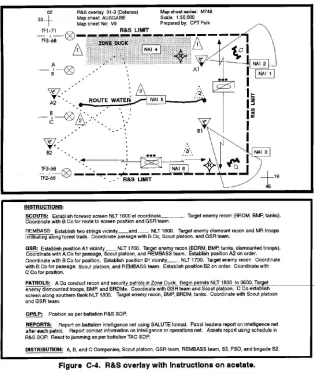
The R&S overlay is the R&S plan in graphic format. Its purpose is to show exactly where and when R&S assets are operating. Use FM 101-5-1 for overlay graphics and symbols. Due to various R&S operational techniques and the unique nature of some SASO missions, you will need to construct some new graphics and explain them in your legend (Figure C-4). The R&S overlay has two parts: (1) The graphic display of deployed or planned deployment of R&S assets, and (2) The marginal data consisting of the legend, administrative data, specific instructions to each asset, and the distribution list. The latter part consists of standard wording found on all overlays. (See top of Figure C-4.)
With digitized systems coming online, the location, heading, range to target, system health, and logistical data will be available NRT in digital,
02 R&S overlay 91-3 (Defense) Map sheet seri9S: M74B
3°
+
Map sheetMap sheet No: VIIAUSGABE Scale: 1:50,000Prepared by: CPT Polk /\
TFI.71 R&S LIMIT
:
f~
- ;1
-@
-::~':I'~':'~'?~~~'::~:!'m:~::"'}"/~~':~\~::!r
- -
--TF3-68 ""'iimif"ou"j(""""""""""""
~
\
A
&~~,;\[~l\I~~I~[r~,~
s~
\
-~-0 ...' ", Al 1 [NA111
,
':
D
.
T
~.
1
I:' ..'
'0
.i
1
W..
' ROUTEWATEV'NAiSl :.':';' .~
A2 ".-" ~ I'"B--0 ". ..' '.'
f::
-
~
/JS:"'"
.~:
~
a:
..' '..': BI
~
1 W7-..':r
1
~"'- :.-}t
NAI3 -".;
000 .~
~
TF3.68
~I
~
-,-@
f_J)
+
TF2.68 - - . .' R&SLIMIT
\~
/
-46,.
INSTRUC110NS:
SCOUTS:Establish forward screenNLT 1600 at coordinate_. Target enemy reean (BADM,BMP, tanks).
Coordinate with B Co for route to screen position and GSR team.
REMBASS: Establish two strin!Js vicinity_and- NLT 1800. Target enemy dismount reeon and MR troops mfl"ratmg along forest trails. Coordinatepassaae withB Co, Scout platoon, and GSR team.
~SR: Establish position A 1 vicinity
- NLT 1700. Target enemy recen (BDAM, BMP, tanks, dismounted troops). Coordinate with A Co for passage, Scout platoon, andREMBASS team. Establish position A2. on order. Coordinate w~hB Co for position. Establish position B1 vicinity- NLT 17DD. Target enemy reeon, Coordinate with B Co for passage, Scout platoon, and AEMBASS team. Establish position B2 on order. Coordinate with C Co for position.
PATROLS: A Co conduct recon and securi1Y_p~tr_C)1~jI1.ZoneJ2!1_cK__!3~l!lP.ilJ~.N!:'I_1~QJQ._Q§_9P~I~~~-enemy dismounted troops, BMP, and BRDMs, Coordinate withGSR teamand Seout platoon. C Co establish screen along southern flank NLT1800. Target enemy reeon, BMP, BRDM, tanks, Coordinate with Scout platoon andGSR team.
OMP: Position as per battalion R&SSOP.
REPORTS: Report on battalion intelligence net using SALUTE format. Patrol leaders report on intelligence net after each patrol. Report combat information on inteJligAnr.A or operations net. Assets report using schedule in R&S SOP. React to jamming as per battalion TAC SOP.
DISTRIBUTION: A, B, and C Companies, Scout platoon, GSR team, REMBASS team, S3, FSO, andbriQade 52.
The key portion of the administrative data contains the written instructions to each R&S asset. The instructions should focus
on-. The required operational timeframes. Give each asset a start and a finish time for each observation or action.
. The target. To answer the PIR, look for specific indicators. Each asset should be told exactly what to look for. Never give broad-based generic mission statements. Specific guidance will promote specific answers.
. Coordinating instructions. All assets at one time or another will move through or near another unit's AO. To keep units from shooting (directly or indirectly) friendly R&S assets, assets and units must coordinate with each other. FSO should restrict fires around R&S assets.
. Reporting requirements. All assets should know when, how often, and what format to use when reporting. Provide frequencies, alternate frequencies, and reactions during jamming, as well as the LTIOV for specific information to be reported.
Initially, the locations for assets are areas in which you recommend that they deploy. After the assets have deployed to the NAI, they report to the S2 or the S3 the actual coordinates from which they can best accomplish their mission. The S2 or the S3 then updates the R&S overlay graphics to show actual locations. Include the following control measures on your R&S overlay:
. Friendly boundaries, R&S limit of responsibility, NAls, SPs, RPs, and checkpoints.
. Graphics depicting route, area, and zone reconnaissance.
. Primary, alternate, and supplementary positions.
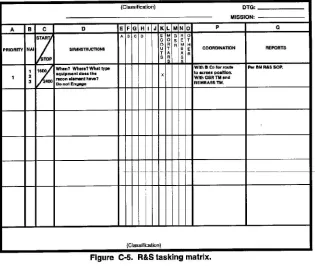
R&S TASKING MATRIX:
Another less preferred method of disseminating R&S guidance is the matrix method (Figure C-5).
. Priority. The priority number of each mission, which should correspond with the PIR number.
. NAI. The NAI number and grid coordinate.
. START/STOP. The times for this mission.
. SIR INSTRUCTIONS. Explains to the assets exactly what they are looking for (target).
. TASKINGS. Lists the actual assets tasked to conduct each mission. An "X" placed under each asset identifies the tasking.
. COORDINATION. Tells the assets which units to coordinate with for this mission.
(Classification) DTG: MISSION:
A B C D E F G HI J KL MIN0 P Q
Z
A D C D 5i M
11:
0 c 0 sET 0 R R M H
PRIORITY HAl SlMNSTRUCTION8 U T 'B E COORDINATION FtEPORTS T A A R
S R 5
1
:i
When? Where? Whit type With 8 CDfor routa Per BN US SOP., 2 8qulpment doe. th. X to KRell p08/1lon.
I'8con Iltm8I'It hive? With GSR TM end
3
Do not Engege REMBASS TU.
---.- --
--I
(ClassifKAition)
I BRIEFING OPORDs
The following OPORDs are additions to the base reconnaissance OPORD (see Figure C-3). GSR, REMBASS, and patrol employment OPORDs would be issued to the teams by the respective platoon leaders.
GSR EMPLOYMENT:
. Give GSR teams adequate time to prepare and deploy. . Deploy GSRs for best area coverage.
. Deploy GSRs, with a security force, so they scan an area and provide early warning.
. Plan logistical support. . Lim itations:
- Limited to LOS acquisition and gives off detectable signal.
- Visibility hindered by heavy precipitation, thick vegetation, and broken terrain.
- Limited range and ability to identify except by personnel and wheeled or tracked vehicles.
1. SITUATION.
a. Enemy. Intelligence estimate format. b. Friendly.
(1) Current unit locations. (2) Scheme of maneuver. (3) Boundaries.
(4) Objectives.
2. MISSION. Who, what, where, when, and why for this R&S mission. Surveillance of threat antiaircraft from location and time.
3. EXECUTION.
a. Concept of operation.
(1) Primary and alternate routes to sites (SPs, PPs, checkpoints, RPs). (2) Primary, alternate, and supplementary sites.
(3) Sectors of scan. (4) Operating times. b. Coordinating instructions.
(1) Battalion and brigade R&S plan: patrols, scout routes, times, sizes, LP and OP locations, ground and air cavalry screens, REMBASS,
asset replacement plan, NAI redundancy coverage backup plan, etc. (2) Link-up plan with security forces.
(3) Obtain target list from FSO (recommend additional targets). (4) Coordinate fire control measures with FSO and plan NFA for
team locations.
(5) Obtain obstacle plan from TF engineer and check routes for obstacles.
(6) Coordinate with supported commander to tie the R&S site into unit defensive plan or scheme of maneuver.
(7) Review engagement and disengagement criteria. (8) Review actions upon mission completion.
---4. SERVICE SUPPORT. Coordinate with S4, battalion maintenance officer, SIGO
for-a. b. c. d.
Class I (Food). Class III (Fuel).
Class IV (Barrier materials) (during prepared defense). Class V (Ammunition).
Class IX (Repair parts). Organizational maintenance. e.
f.
5. COMMAND AND SIGNAL. a. Signal.
(1) Issue SOl extract.
(2) Review reporting requirements and communications connectivity.
(3) Identify multiple reporting paths and methods. (4) Review communications check requirements. (5) Execute COMMEX prior to employment. (6) Review actions upon EA.
6.
b. Command.
(1) Review chain of command. (2) Review leaders' locations. SAFETY.
IREMBASS EMPLOYMENT:
Brief team leader using the reconnaissance OPORD format (see Figure C-3) with the changes shown in Figure C-7.
1. SITUATION.
2. MISSION. Who, what, where, when, and why for this R&S mission. Monitor NAls, DPs, routes.
3. EXECUTION.
a. Concept of operation. (1) SIR required.
(2) Team leader recommends sensor mix, emplacement sites, and relay sites.
(3) Primary and alternate routes and transportation to emplacement sites, PPs, and checkpoints.
(4) Emplacement method.
b. Coordinating instructions.
(1) Battalion and brigade R&S plan: patrols, scout routes, times, sizes, LP and OP locations, ground and air cavalry screens, IREMBASS.
(2) Link-up plan with security forces.
(3) Obtain target list from FSO (recommend additional targets). (4) Coordinate fire control measures with FSO.
(5) Obtain obstacle plan from TF engineer and check routes for obstacles.
(6) Review engagement and disengagement criteria. (7) Actions upon mission completion.
1. SITUATION.
2. MISSION.
3. EXECUTION.
PATROL EMPLOYMENT:
Brief patrol leader using reconnaissance OPORD format (see Figure C-3) with the changes shown in Figure C-8.
a. Concept of operation. (1) Maneuver. (2) Fire support.
b. Subunit tasks.
c. Coordinating instructions. (1) Actions at the objective. (2) Time of departure and return.
(3) Movement techniques and order of movement. (4) Routes.
(5) PPs.
(6) RPs and actions at RPs. (7) Actions upon enemy contact. (8) Actions at danger areas. (9) Actions at halts.
(10) Locations of friendly obstacles, mine fields. (11) Rehearsals and inspections.
(12) Debriefings. (13) SIR.
DEBRIEFING Debrief patrols using the sample debriefing format below.
1. Size and composition of team. Team leader, assistant team leader, radio operator, and observers.
2. Mission. 3. SIR.
4. Reporting requirements.
5. Time of departure, method of infiltration, and point of departure. 6. Enemy observed enroute.
a. Ground activity. b. Air activity.
c. Miscellaneous activity.
7. Routes. a. Dismounted. b. Vehicle. c. Air.
8. Terrain. a. Key terrain. b. Significant terrain. c. Decisive terrain. d. Terrain compartment. e. Terrain corridor. f. Map corrections.
9. Enemy forces and installations. 10. Miscellaneous information.
a. Lack of animals or strange animal behavior. Did animal reaction to patrol's presence generate alarm? If so, when, where, type of animal, activity that caused the alarm, and nature of alarm.
---b. Mutilated plants.
c. Strange, uncommon insects.
d. Abandoned military equipment, number and type. (1) Out of fuel.
(2) Unserviceable; estimate reason. (3) Destroyed or damaged; how. (4) Operational equipment left intact. e. Abandoned towns or villages.
11. Results of encounters with enemy forces and local populace. 12. Condition of team including disposition of dead and wounded.
13. All of team's maps or any other identifiable material returned with team. For missing items, describe item and approximate location lost.
14. Conclusions and recommendations.
15. Process CEE, CEM, photographs, and videos taken by teams. 16. Time of exfiltration, method of exfiltration, exfiltration point. 17. Routes of retu rn.
a. Dismounted. b. Flight. 18. Time of return. 19. Point of return.
20. Enemy observed on return route.
21. What pre-mission intelligence support was provided and not needed? What intelligence support was not provided but needed? What intelligence was provided but turned out to be misleading or erroneous?
R&S TEN KEYS TO SUCCESS:
1. Know that thecommander's intent or CCIR drives R&S. 2. Support R&S early with integrated staff products.
3. Be adept at abbreviated IPB forquick or combat decision making process.
4. Focus on the event template to capture the moving enemy.
5. Provide situation template depicting enemy in the engagement area. 6. Use automation tools like AS AS to enhance products.
7. Deploy organic R&S assets early and request support from higher HQ. Issue S3 FRAGO with S2 graphic overlay.
8. Provide continuous coverage throughout the depth of the battlefield. 9. Use all possible assets from national levels to scouts.
APPENDIX
D
PRIORITY INTELLIGENCE
REQUIREMENTS,
INFORMATION
REQUIREMENTS,
AND INDICATORS
PIR are intelligence requirements associated with a decision that will affect the overall success of the command's mission. PIR may change in order or be replaced entirely.
IR are requirements for intelligence to fill a gap in the command's knowledge and understanding of the battlefield or threat forces. They target specific COAs. Indicators are positive or negative evidence of threat activity or any AO
characteristic which points toward threat vulnerabilities or adoption or rejection by the threat of a particular capability, or which may influence the commander's selection of a COA.
During wargaming, the S2 develops a set of PIR for each friendly COA. Each is linked to a specific enemy action that requires a friendly response (DPs). PIR are those IR critical to accomplishing the mission. Wargaming will dictate which IR will become PIR as the mission runs its course.
The S2 should nominate PIR for approval ONLY FROM THE LIST OF ALREADY PLANNED AND COORDINATED IR.
EXAMPLE OF A POOR PIR:
"Will the enemy attack? If so, how, when, where, and in what strength?" . The PIR contains five significantly different questions. Which one is the
priority? Unless the S2 gives more guidance, the individual collector must determine which part of this PIR to work.
. Even for issues that the S2 does not know, the enemy can only select from a limited range of COAs due, for example, to terrain, weather, policies. If the PIR consider IPB, the S2, through more specific tasking, will minimize the chance that collection assets will look for the enemy where they are not likely to be.
. When the staff wargames, it may find some aspects of this question to be irrelevant to the present situation. For example, the defense may be fully capable of defeating an enemy attack regardless of when they actually attack. Why waste collection assets on a question that does not need to be
answered?
EXAMPLE OF A GOOD PIR:
There is no "set" of PIR we can present that will be useful for all tactical situations any more than there is a set of maneuver paragraphs that the S3 can plug into any OPORD. Below are examples of types of PIR the S2 presents to the commander for approval. Because intelligence needs change over time, most PIR will be important only during certain times.
Referring to PIR as "timephased" is redundant. They are dynamic just as the battle will be dynamic. Just as there are no standard situation templates or friendly COAs that will serve in all situations, there is no standard set of PIR. Good PIR, however, have some things in common:
. They ask only one question.
. They focus on a specific fact, event, or activity.
. They provide intelligence required to support a single decision. . They are tied to key decisions that the commander has to make. . They give an LTIOV.
Examples:
. "Will the enemy defend OBJ JAMES using a forward slope defense?" . What size force is defending OBJ NACO?"
. Which bridges over the San Pedro River are intact?"
Not all PIR are appropriate as questions, particularly those associated with moving targets or formations. PIR are requirements and should be stated as such when appropriate. In addition, PIR for moving targets must include the requirement to continue to maintain contact with the target. Simply locating the target once will not prevent it from surprising the commander later.