Volume 8, No. 5, May-June 2017
International Journal of Advanced Research in Computer Science
RESEARCH PAPER
Available Online at www.ijarcs.info
ISSN No. 0976-5697
Analysis of the Medicinal Leaves by using Image Processing Techniques and ANN
Mr. K.Nithiyanandhan
Department of Master of Computer& Applications Brindavan College, Bangalore, Karnataka, India
and Research Scholar, Rayalaseema University Kurnool, Andhra Pradesh, India.
Prof.T. Bhaskara Reddy
Department of Computer Science & Technology S. K. University, Anantapuram 515003. AP, India
Abstract: Neural Network has emerged over the years and has made remarkable contribution to the advancement of various fields of endeavor. The purpose of this work is to examine neural networks and their emerging applications in the field of engineering, focusing more on controls. An Artificial Neural Network (ANN) is an information processing paradigm that is inspired by the way biological nervous systems, such as the token, process information. It is composed of a large number of highly interconnected processing elements (neurons) working in unison to solve specific problems. ANNs, like people, learn by example. An ANN is configured for a specific application, such as pattern recognition or data classification, through a learning process. Learning in biological systems involves adjustments to the synaptic connections that exist between the neurons. This is true for ANNs as well. Neural networks perform a variety tasks, such as prediction and function approximation, pattern classification, they are also capable of complex data and signal classification task and many other using.
Keywords: Neural Network, Peepal Leaf Betel Leaf, Hibiscus Leaf medicinal, Digital Image.
I. INTRODUCTION
Image processing is an emerging research area now days. There exist various applications for the image processing in various domains like medical field, signal processing, forensics and many others.
Image processing is becoming all pervasive in nature. with the recent advancement in imaging technology and algorithms, one can think of using image processing to solve most of the real world problem where vision is involved. The analysis of plant leaf growth for physiological coordinates has been of botanical for a long time[9],[10]. A botanical interpretation needs the data to be in a form that allows comparison between different leaves. Therefore the results of the growth analysis have to be transformed into a coordinate system affixed to the leaf. Assessing the appearance of leaves is an important botanical skill. Any token of visual appearance is a potential character. These token on leaves can be extracted to specify tree species [11]. In forest variety registration , a recognition system can use leaf appearance to deal with many leaf species; at the same time this system should be easily extended to include an increasing set of varieties. Traditionally, tokens in leaf appearance can be assess by measurement and subjective scoring. The former can be used for the measurements of simple size and shape, such as more subtle differences which are more difficult to measure [12].
The study on recognition system mainly focused on two aspects: one concentrates on seeking efficient methods to detect the leaf image and then identifying specific leaf image tokens; the other focuses on transferring the leaf image shape into a neural network. For this purpose, leaf recognition approach can be established by mach vision applied in the recognition field [13]. These tokens will be the basis of the calculations of neural network and make it possible by recognizing an unknown leaf image to specify tree species.
In this paper, the leaves recognition approach is presented by using a neural network, which is based on the java application/applet to recognize images of leaves according to the previously trained the BP(Back –Propagation) network. A back-propagation network is a special form of a feed-forward neural network. It optimizes the learning process by propagating the weights of an actual neural back to its previous matrix. An important feature of this approach is that it could be applied directly by a java enabled internet browser.
Introduction to Medicine plants
All plants live and grow by photosynthesis. The only exceptions to this are extreme parasites such as dodder (which have lost their chlorophyll) and saprophytes such as the ghost orchid, most fungi and bacteria. The saprophytes feed off dead and decaying vegetation, whilst the parasites feed off living plants and so both are dependent on green plants and chlorophyll, even though they do not possess it. Green plants are the primary producers as a result of their wonderful greenness! Many animals -including humans -eat plants. Some animals eat other animals, but if you follow the food chain back you will find that green plants are always at the base. Animals and plants die and decay, releasing minerals into the soil and Co2
In [1] the authors proposed and discussed the implementation on forest variety registration visual traits of the plants, where the appearance are widely used to discern into the air for green plants to use for photosynthesis. Thus the cycle continues, and we all (except a few bacteria) need green plants. If green plants were to suddenly disappear, then so would virtually all life on the earth including Homo Sapiens.
Green leaves are thus the powerhouses -the great driving force for Life on Earth. Photosynthesis is the life generating chemical process. Chlorophyll is thus the Molecule of Life.
different tree species. The new recognition system of leaf image strategy which is based on neural network established to administrate a hierarchical list of leaf images. Some sorts edge detection can be performed to identify the individual tokens of every image and the frame of the leaf can be got to differentiate the tree species. An approach based on back-propagation neuronal network is proposed and the programming language for the implementation is also given by using java. The numerical simulation results have shown that the proposed leaf strategy is effective and feasible In [2] a review article discussed on image thinning plays an important role in image processing, It is also equally important to propose an efficient image thinning algorithm with an objective, to minimize the amount of information to be processed by preserving the important information required to preserve the topological and geometrical properties of the thinned image, thereby enhancing the later processing procedure. This can be achieved by an efficient image independent thinning algorithm. This algorithm process the image in two-passes, in first pass of this algorithm, the entire image is thinned to two pixels thick and in second pass; the two pixel width image is further thinned to one pixel thick without any discontinuities in the resultant image.
In [3] which is a review article discusses the skeletonization problem using parallel thinning techniques and proposes a new one-pass parallel asymmetric thinning algorithm (OPATA8).Wu and
Tsai presented a one-pass parallel asymmetric thinning algorithm (OPATA4) that implemented 4-distance, or city block distance, skeletonization. However, city block distance is not a good approximation of Euclidean distance. By applying 8-distance, or chessboard distance, this new algorithm improves not only the quality of the resulting skeletons but also the efficiency of the computation. This algorithm uses 18 patterns. The algorithm has been implemented, and has been compared to both algorithm OPATA4 and Zhang and Suen’s two-pass parallel thinning algorithm. The results show that the proposedOPATA8 has good noise resistance, perfectly 8-connected skeleton output, and a faster speed without serious erosion.
In [4] the authors discusses how betel leaves have their dominant place in Indian commercial market. This is because of its high medicinal values as per the history of Ayurvedic medicinal system, also habit of people chewing betel leaves with areca nut. In Karnataka state of India, there are two species of betel leaves which are commercially recognized by local names Mysore betel leaf and Ambadi betel leaf. These leaves are separated and packed manually. In this context, here is a new approach using machine vision and machine intelligence blend; for classification of these two species of betel leaves leading to less human effort. This paper uses image processing for machine vision where the leaf features such as width, gray histogram and color histogram is extracted. Machine intelligence part uses Neural Networks with back propagation algorithm.
In [5] the authors have discussed how agriculture plays a vital role in the development of human civilization. But plant leaf diseases can damage the crops and there may be economic losses in crops. Without knowing about the diseases affected in the plant, the farmers are using excessive pesticides for the plant disease treatment. To overcome this, the detected spot diseases in leaves are
classified based on the diseased leaf types using various neural network algorithms. By this approach one can detect the diseased leaf variety and thus can take necessary steps in time to minimize the loss of production. The proposed methodology uses to classify the diseased plant leaves using Feed Forward Neural Network (FFNN), Learning Vector Quantization (LVQ) and Radial Basis Function Networks (RBF) by processing the set of shape and texture features from the affected leaf image. The simulation results show the effectiveness of the proposed scheme. With the help of this work, a machine learning based system can be formed for the improvement of the crop quality in the Indian Economy.
In [6] the protocol outlines how to obtain the traits used to quantify structure and to relate to the functions of leaf venation architecture. Leaf venation architecture has common functions across plant species, serving for mechanical support, sugar and hormone transport in the phloem, and, via the xylem, the replacement of water lost to transpiration during photosynthesis.
In [7] the authors remark that Getting to know the details of plants growing around us is of great importance medicinally and economically. Conventionally, plants are categorized mainly by taxonomists through investigation of various parts of the plant. However, most of the plants can be classified based on the leaf shape and associated features. This article describes how Artificial Neural Network is used to identify plant by inputting leaf image. Compared to earlier approaches, new input features and image processing approach that matter in efficient classification in Artificial Neural Network have been introduced. Image processing techniques are used to extract leaf shape features such as aspect ratio, width ratio, apex angle, apex ratio, base angle, centroid deviation ratio, moment ratio and circularity. These extracted features are used as inputs to neural network for classifying the plants. Under the current research, 534 leaves of 20 kinds of plants were collected. Out of these, 400 leaves were trained. The 134 testing samples were recognized with 92% accuracy; even without considering types of leaf margins, vein and removal of the petiole. Software has also been developed to identify leaf automatically except two mouse clicks by the user. Some of the other works include ([8] to [13]).
III. PROBLEM SPECIFICATION
The main objective of the present study is to make a detailed analysis of the number of tokens in Indian Medicinal leaves. In particular, Peepal Leaf, Betel Leaf, Hibiscus Leaf etc. by using the techniques of image processing methodologies and Neural Network. Different samples are taken and the experiments are conducted.
IV. METHODOLOGY
For the study the medicinal leaf in Peepal Leaf, Betel Leaf, Hibiscus Leaf and also to predict the other character tics like token, and recognition of the leaves using by Java Applet program, the experiments are conducted.
Image edge detection
basis of the neuronal network calculations. Assuming that the image is a full 2D scan of a single leaf like in the examples below, we considered to use the well-known Prewitt Edge detection algorithm
Prewitt edge detection produces an image where higher grey-level values indicate the presence of an edge between two objects. The Prewitt Edge Detection filter computes the root mean square of two 3x3 templates. It is one of the most popular 3x3 edge detection filters. The Prewitt edge detection filter uses these two 3x3 templates to calculate the gradient value:
-1 0 1 1 1 1 -1 0 1 0 0 0 -1 0 1 -1 -1 -1
X Y
Now consider the following 3x3 image window: +---+
| a1 a2 a3 | | a4 a5 a6 | | a7 a8 a9 | +---+
Where:
a1 .. a9 - are the grey levels of each pixel in the filter window
X = -1*a1 + 1*a3 - 1*a4 + 1*a6 - 1*a7 + 1*a9 Y = 1*a1 + 1*a2 + 1*a3 - 1*a7 - 1*a8 - 1*a9 Prewitt gradient = SQRT(X*X + Y*Y)
All the pixels are filtered. In order to filter pixels located near the edge of an image, edge pixels values are replicated to give sufficient data.
Thinning
The idea of identifying a specific leaf image`s species here is that the outer frame of a leaf is enough to specify the species it belongs to. To accomplish that, it is necessary to identify this outer frame exactly. The previously applied Prewitt Edge detection normally just identify the edges with a preconfigured threshold and after this edge detection we have to perform a thinning algorithm to minimize this threshold-based edge to a one-line frame where we then can apply a sort of token recognition as discussed later. The used thinning algorithm here processed the image recursively and minimizes the found lines to a one-pixel wide one by comparing the actual pixel situation with specific patterns and then minimizes it.
Leaf image token
The central part of this application is the tokens of each leaf image that are found after the image processing is through with it. What exactly stands behind the idea of this tokens and how we defined this tokens should be explained here in detail.
The idea behind the transfer of the leaf image shape into a neuronal network usable form is, that the cosines and sinus angles of the shape represents the criteria’s of a recognition pattern.
The right hand image shows a part of a leaf image that was already processed through the above mentioned edge detection and thinning algorithms.
The following are the important observations:
• Green line: The shape of the leaf image after successful edge detection & thinning.
• Red Square: This square represents a point on the shape of the leaf image from which we are going to draw a line to the next square.
• Blue line: The compound of the center of two squares from which we are going to calculate the cosines and sinus angle. Such a blue line is a representation of a leaf token.
If you now take a deeper view on the small triangle zoom on this image you should recognize that it shows a right-angled triangle. This and the summary of all triangles of a leaf image are the representation of the tokens of a leaf from which we can start the neuronal network calculations.
Back propagation Neural Network
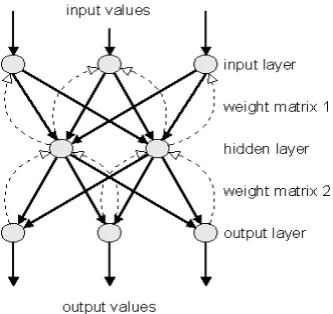
Another main part of this work is the integration of a feed-forward back propagation neuronal network. As described earlier the inputs for this neuronal network are the individual tokens of a leaf image, and as a token normally consists of a cosinus and sinus angle, the amount of input layers for this network are the amount of tokens multiplied by two.
The image on the right side should give you an idea of the neuronal network that takes place in the Leaves Recognition application.
We have chosen a feed-forward back propagation network because it was part of the task to show that just a back propagation network and the shape of a leaf image is enough to specify the species of a leaf. The implemented network also just have one input, hidden and output layer to simplify and speed-up the calculations on that java implementation.
To fill the input neurons of the network, we use the previous calculated leaf tokens like discussed in section 2.3. The number of output neurons is normally specified by the amount of different species because we use a encoded form to specify the outputs. All other behavior of the network is specified by the normal mathematical principals of a back propagation network. If you want to get an idea of how such a back propagation network works, please refer to deeper explanations about the back propagation algorithm
Network Layers
The commonest type of artificial neural network consists of the three groups, or layers, of units : a layers of “Input” units is connected to a layer of “Hidden” units , which is connected to a layer of “output” units.
Input Units: The activity of the inputs units represents the raw information that is feed into the network.
Hidden Units: The activity of the each hidden unit is determined by the activities of the input units and the wrights on the connections between the input and the hidden units.
Training a Neural Network:
For the most part, a network is trained by changing the weights of the connections between nodes. These weights can be randomly chosen or individually chosen. Usually a computer program randomly generates values for connection weights, Then the network is given an input , and it is allowed to process the information through its nodes to produce an output
V.EXPERIMENTS AND RESULTS
The experiments are conducted on the data, and three steps are performed by using Java Applet Program The results are presented and figure 1 to 3.
[image:4.595.76.243.168.325.2]Figure 1
Table 1 .Network Operations parameter Number of specie :5
Number of Leaf : 10
Sl. No
Description Bilva Leaf Castrol oil Leaf
1 Input 10 10
2 Output 2 2
3 Hidden 5 5
4 Token 49 64
5 Error 0.990 0.800
6 Momentum 1.0 1.0
7 Learning Rate 0.3 0.3 8 Maximum
Number of Token
189 523
9 Number of steps
100 100
10 Recognition 90.584% 83.084
Figure 2
1. If the error rate drops below 0.01 then normally should enter the problem in recognizing different leaf images.
[image:4.595.37.258.406.554.2]2. The amount of input neurons for the network is normally twice the amount of tokens because of th sinus andncosinus value for one token.
Figure 3
Here you can see which of the species that are in the trained network are most similar to the loaded leaf image.
The error rate for Bilava leaf 0.990 and Castroil 0.800 while recognition of Bilva leaf is 90.584% and Castroil leaf is 83.084.
VI. CONCLUSION
The new recognition system of leaf images strategy which is based on the back-propagation neural network was established to administrate a hierarchical list of leaf images by detecting some sort of leaf tokens which can be performed to identify the tree species in forest variety registration. The training set contains minimum five species for each type of leaf in each data file. Using more number of species in training set and number of output nodes can enhance the recognition ability. Thus it is possible for us to extract the leaf shapes from edge detection.
Certainly more training characteristics could provide a conclusive confirmation to further patter recognition.
VII. ACKNOWLEDGEMENTS
One of the authors Mr. K.Nithiyanandhan acknowledges Brindavan College Department of Master of Computer Applications, Bangalore, Karnataka and Rayalaseema University, Kurnool, India for providing the facilities for carrying out the research work.
[image:4.595.47.265.612.782.2]1. Wang Dal-lin, Zhang Xiu-mei and Liu Ya-qiu “ Recognition system of leaf images based on neuronal network” Journal of Forestry Research, 17(3):243-246(2006).
2. Jagna “An Efficient Image Independent Thinning Algorithm”, International Journal of Advanced Research in Computer and Communication Engineering” ISSN (Online) : 2278-1021 ISSN (Print) : 2319-5940 Volume. 3, Issue 10, October 2014.
3. Weian Deng, and S. Sitharama Iyengar and Nathan E. Brener “A fast parallel thinning algorithm for the binary image skeletonization”, International Journal of High Performance Computing Applications Volume 14, No. 1, Spring 2000, PP. 65-81.
4. Sandeep Kumar.E ” a novel neural network based Approach for the classification of betel leaves” International Journal of Emerging Trends & Technology in Computer Science (IJETTCS) ISSN 2278-6856 Volume 1 , Issue 2, July – August 2012.
5. K. Muthukannan, P. Latha, R. Pon Selvi and P. Nisha “ Classification of diseased plant leaves using neural Network algorithms “ARPN Journal of Engineering and Applied Sciences ISSN 1819-6608 Volume. 10, No. 4, March 2015 6. S. R. Deokar, P. H. Zope and S. R. Suralkar
“Leaf Recognition Using Feature Point Extraction and Artificial Neural Network”
International Journal of Engineering Research & Technology (IJERT) ISSN: 2278-0181 Volume 2 Issue 1, January- 2013.
7. Shayan Hati and Sajeevan G “Plant Recognition from Leaf Image through Artificial Neural Network” International Journal of Computer Applications (0975 – 8887) , Volume 62– No.17, January 2013
8. Ashwini S. Karnea and S. S. Navalgund “
Implementation of an Image Thinning Algorithm using Verilog and MATLAB”
International Journal of Current Engineering and Technology ISSN 2277 – 4106 |Proceedings of National Conference on ‘Women in Science & Engineering’ (NCWSE 2013), DMCET Dharwad.
9. Maksymowych “Analysis of leaf development[M]” Cambridge Cambridge University Press 1973.
10. Spies H. Scharr.H and Schurt U 2001 Root growth analysis in physiological co ordinates[C], In ICIAP01, Palermo, Italy 11. Schurr.U, Heckenberger.U, Herdel.K Walter ,A and Fell ,R
2000. Leaf development in Rucinus communis during drought stress-dynamics of growth processes, of cellular structure and of sink sourc-transition[J] Journal of Experimental Botany ,51(350) 1515-1529.
12. Camlin .M.S and McMichael.A.C ”New methodology for the measurement of leaf color in ryeguss(Loliumspp[J]”, Plant Varieties and Seeds , 1994 ,7,37-49.