pISSN 2320-1770 | eISSN 2320-1789
Original Research Article
Mifepristone: an alternate to dinoprostone in induction of labour
Sailatha R.
1*, Famida A. M.
2, Vinoth Gnana Chellaiyan D.
1, Vijayalakshmi K.
1,
Sathiya S.
1, Renuka S.
1Dr. Sindhura. M
INTRODUCTION
ThehistoryoflabourinductiondatesbacktoHippocrates original description of mammary stimulation and mechanicaldilatationofcervicalcanal.Theavailabilityof neweroxytocicsandinductiontechniqueswhicharenow effective as well as more predictable have significantly modified our traditionally conservative attitude towards induction of labour, which was once regarded as “meddlesomemidwifery”.1Neverthelesseventodaynone ofthemethodsofinductionare bothabsolutelysafeand certain.
Karimetalwerethefirsttoreportuseofprostaglandins for labour induction.2 Dinoprostone is a naturally occurring prostaglandin (PGE2) and is commonly used for induction of labour. The role of mifepristone (RU-486),aprogesteroneantagonist,inlaborinductionisnot aswellestablishedasitisfortherapeuticabortions. Asa fall in level of progesterone is considered one of the importantevents inthe onsetofspontaneous labour,the anti-progesteronemifepristonewasusedinseveraltrials to induce labour at term. Mifepristone (RU-486) is a 19non steroid that binds strongly to progesterone receptors and inhibits the activity of progesterone at cellular level. It has minimal effects on uterine ABSTRACT
Background: To assess and compare the efficacy, safety and fetomaternal outcome of mifepristone versus dinoprostone in priming the cervix and in inducing labour in pregnant women at term.
Methods: This is a prospective comparative study done in Chettinad health and research institute, over a period of one year from October 2015 to October 2016. 50 pregnant women (Group 1) in 3rd trimester with unfavorable cervix were given 200mcg of mifepristone orally. If labour did not start or if the Bishop score remained poor at the end of 24hrs, induction was continued with 0.5mg of dinoprostone gel at a maximum of 3 gels at 6th hourly interval. Another 50 pregnant women (Group2) in 3rd trimester underwent induction according to the routine dinoprostone gel regimen of maximum 3 gels at intervals of 6hrs.
Results: Improvement in Bishop score was significant with mifepristone by the end of 24hrs.But, in comparison, there was statistically significant improvement in Bishop score in favour of dinoprostone (Mean 4.7) than mifepristone (Mean 4.0). Also, the induction delivery interval was significantly less (Mean 11.5 hrs) with dinoprostone than mifepristone (Mean 20.3 hrs). Number of cases undergoing LSCS for failed induction was less in mifepristone group (4%). The rate of vaginal delivery, Caesarean sections, instrumental delivery and overall fetal outcome was comparable in both groups.
Conclusions: Mifepristone is a safe, effective and suitable alternate agent for cervical ripening and initiation of labour when given 24 h before onset of labour.
Keywords: Bishop score, Dinoprostone, Induction of labour, Mifepristone
1Department of Obstetrics and Gynecology, 2Department of Community Medicine, Chettinad Hospital and Research
Institute, Chennai, Tamilnadu, India
Received: 16 January 2017 Accepted: 24 March 2017
*Correspondence: Dr.Sailatha R.,
E-mail: [email protected]
Copyright: © the author(s), publisher and licensee Medip Academy. This is an open-access article distributed under the terms of the Creative Commons Attribution Non-Commercial License, which permits unrestricted non-commercial use, distribution, and reproduction in any medium, provided the original work is properly cited.
contractilityasitripensthecervix,makingitanoptionfor use in induction and enhance the rates of spontaneous labour. However, in late pregnancy, the uterus is sensitizedbymifepristonetoprostaglandinsandpromotes cervical dilatation which induces labour. Hence the sequentialuseofmifepristone followedby dinoprostone ismoreeffectiveininductionoflabourwithlesschances offailedinductionandtherebydecreasingtheCaesarean rates. There are no apparent maternal or neonatal side effects.3 The pharmacokinetics of mifepristone is characterizedbyrapid absorption andalonghalf-life of 25-30h.4
Varioustrialsemploying200mgofmifepristoneresulted inshorterintervaltotheonsetoflabourandlessoxytocin wasrequired for those achieving vaginaldelivery.More recently Elliot and colleagues compared the effects of 50mg and 200mg of oral mifepristone with placebo on cervical ripening and labour induction at term in primigravid women with unfavourable cervices.5 At a dose of 200mg, mifepristone resulted in a favourable cervixorspontaneouslabourmoreoftenthandidplacebo.
METHODS
Objectives
1. TocomparativelystudytheefficacyofMifepristone andDinoprostoneasacervicalripeningandpriming agentforinductionoflabour.
2. Tostudysafetyandfetomaternaloutcomesafterthe useofmifepristoneversusdinoprostone.
ThisisaprospectivecomparativestudydoneinChettinad HealthandResearch Institute, atertiary carehospital in Chennai for a period of 1 year from October 2015 to October2016.Atotalof100pregnantwomen,50women inmifepristonegroupand50inthe dinoprostone group, scheduled for inductionof labour were selected for the studybyconsecutivesamplingmethod.
Inclusion criteria
1. Singletonpregnancywithcephalicpresentationand intactmembranes iflabour induction wasindicated anddeliverycouldbepostponedfor24hrs.
2. Womenwith unfavorablecervix (Bishop scoreless than5).
3. Antenatalpatientsinthirdtrimester(28-41wks). 4. PatientswithreactiveNST.
5. Pregnancyinducedhypertension. 6. GestationalDiabetesMellitus. 7. Postdatedpregnancy. 8. Intrauterinefetaldeath.
9. Mild IUGR, mild oligohydramnios,
polyhydramnios, fetalcongenitalmalformations.
Exclusion criteria
1. Parity more than 4.
2. Previous Caesarean section.
3. Major cephalopelvic disproportion, macrosomia. 4. Malpresentation.
5. Known hypersensitivity to prostaglandins or mifepristone.
6. Medical problems like impaired renal, hepatic or adrenal function.
7. Antenatal hemorrhage.
8. Premature rupture of membrane.
Outcome variables
Labour progression (Bishop score, induction delivery interval, number of dinoprostone gels required, syntocinon augmentation), maternal outcome (mode of delivery, indications for Caesarean section, number of failed inductions, incidence of hyper stimulation), fetal outcome (healthy baby, fetal distress, APGAR scores, NICUadmission,perinataldeath).
After detailed history, examination, conformation of diagnosis, investigations and after informed consent, women were allocated into two groups by consecutive sampling method. The participant who received mifepristone was assigned to study group 1(n=50) and who received dinoprostone gel was assigned to study group2(n=50).1tabletof200mgmifepristonewasgiven orally for those in group1 and were assessed after 24 hours orwithonset oflabour, whichever wasearlier. If Bishop score was ≥8, patient was transferred to labour roomandsyntocinonstarted.Evenafter 24hrs,ifBishop score was ≤8, dinoprostone gel was administered vaginallyevery 6th hourly toa maximumof 3 doses. If after 3 doses of dinoprostone gel Bishop score was not changed,theinductionattemptwascategorizedasfailed.
In Group 2, women were induced with intracervical dinoprostone gel, which isrepeated at 6thhrly intervals, uptomaximumof3 gelstillBishopscorebecame≥8.If Bishopscoreis≥8, oxytocinwasstartedafter6hrsoflast dose of dinoprostone gel. If cervix remains unfavorable even after 6hrs of 3rd attempt with gel, induction was categorizedasfailed.
Ifatany time,ineitherofthegroups,progressoflabour was unsatisfactory or variable fetal heart pattern was observed, the participants underwent Caesarean section. Theefficacyofmifepristonewasassessedonthebasisof improvement in Bishop’s score, induction to delivery interval, necessity of augmentation of labour with oxytocin,mode ofdelivery,numberofcaseswithfailed induction,maternalandfetaloutcome.
Statistical analysis
RESULTS
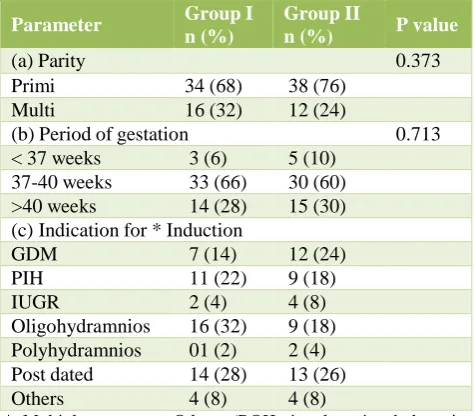
[image:3.595.49.287.175.383.2]Baseline characteristics like parity, period of gestation, indicationforinductionwerecomparable inbothgroups (Table1).
Table 1: Baseline characteristics of study population (n=100).
Parameter GroupI
n (%)
GroupII
n (%) Pvalue
(a)Parity 0.373
Primi 34(68) 38(76)
Multi 16(32) 12(24)
(b)Periodofgestation 0.713
<37weeks 3(6) 5(10) 37-40weeks 33(66) 30(60) >40weeks 14(28) 15(30) (c) Indicationfor* Induction
GDM 7(14) 12(24)
PIH 11(22) 9(18)
IUGR 2(4) 4(8)
Oligohydramnios 16(32) 9(18) Polyhydramnios 01(2) 2(4) Postdated 14(28) 13(26)
Others 4(8) 4(8)
* Multiple response, Others (BOH, intrahepatic cholestasis, congenitalanomalies)
Table2showslabouroutcomebasedontheimprovement in Bishop score and induction delivery interval. The improvementinBishopscorewasbetterindinoprostone group[mean4.7(±1.49)] whencomparedtomifepristone group [mean 4.0(±1.48)] which was statistically significant (p value 0.042). It hasto be noted that, this resultcould not beachieved indinoprostone group with onegelalone. 20 womenneeded2dinoprostonegelsand 11 women needed 3 gels to improve the Bishop score. Whereas in mifepristone group, Bishop score was assessedafteronedoseofmifepristone(200mg).
Table 2: Efficacy of mifepristone and dinoprostone among the study population (n=100).
Parameters Mean
(SD)
Mean difference
95% CI
t value
p value
Bishop’sscoreimprovement
GroupI 4.0
(±1.48) 0.707
0.09-1.40 2.020 0.042
GroupII 4.7 (±1.49)
InductionDeliveryInterval(hrs)
GroupI 20.3
(±15) 8.72
3.843
-13.6 3.546 0.001
GroupII 11.5 (±8.7)
Independentttestapplied,P<0.05significant
Meaninductiondeliveryintervalwasmore[20.3h(±15)] inmifepristonegroupwhileitwaslesser[11.5h(±8.7)]in
[image:3.595.310.544.183.345.2]dinoprostone group, which was again statistically significant(pvalue0.001).4 casesinmifepristonegroup and6 casesindinoprostone groupdeliveredwithin6hrs ofinduction. 2 participants developed hyper stimulation in both the groups of which 1 neonate in dinoprostone groupneededNICUadmissionforfetaldistress.
Table 3: Maternal outcomes among the study population (n=100).
Parameter GroupIn
(%)
Group
IIn (%)
P value
ModeofDelivery:
VaginalDelivery 38(76) 38(76) -
LSCS 12(24) 12(24) -
IndicationforLSCS(n=12):
FailedInduction 2(16.67) 5(41.67) 0.251 Fetaldistress 9(75) 5(41.67) CephaloPelvic
Disproportion 1(8.33) 2(16.67) Syntoaugmentation:
Notrequired 38(76) 31(62) 0.130
Required 12(24) 19(38)
Table3showsparametersofmaternaloutcomeamongthe study population. Number of women who had vaginal deliveryandCaesareansectionswerethesameinboththe group 5 (41.67%) women in group 11 had to undergo Caesarean section for failed induction whereas only 2 (16.67%)ingroup1underwentCaesareansectionforthe sameindication.Thusshowingthatchancesoffailureof inductionwaslesserwithmifepristonethandinoprostone. 9 (75%) out of 12 cases of Caesarean section in mifepristone group was done for fetal distress (Non-reactive NST). But none of these neonates had poor APGARscorenordidtheyneedNICUadmission.5(41.67 %) in dinoprostone group underwent Caesarean section for fetal distress and 2 neonates out of these 5 needed NICU admission. Thus showing that mifepristone does not increase the incidence of fetal distress. The requirement of syntocinon augmentation was less with mifepristone (24%) when compared to dinoprostone (38%).Differencewasnotstatisticallysignificant.
Table 4 and 5 shows parameters offetal outcome. The groupshad comparable fetaloutcomes. Though1 and5 minuteAPGARscoreswerebetteringroup 1,therewas nostatisticallysignificantdifference.
Table 4: Fetal outcome among study population (n=100).
Parameter Group I n (%) Group II n (%)
Perinatal death 0 0
[image:3.595.43.294.582.724.2]Table 5: Differences in APGAR Scores of study population (n=100).
Parameter Mean
(SD)
Mean difference
95%
CI t value
p value APGAR 1
Group I 7.87
(±0.71) 0.600
0.078-1.278 1.757 0.082 Group II 7.84
(±0.84) APGAR 5
Group I 9.04
(±0.41) 0.440
0.193-1.073 1.379 0.171 Group II 8.9
(±0.42)
Independent t test applied, p <0.05 is significant
DISCUSSION
StudiesbyFrydmanetalwere theearliest ontheuse of mifepristonefor inductionoflabour.6Manystudieshave reported that mifepristone is better than a placebo in ripening the cervix and in reducing the incidence of Caesarean section rates. This study was to see if mifepristone was as safe or better than dinoprostone in achieving the same result. The age, parity, period of gestation was comparable in both groups of our study. Oligohydramnios was the commonest indication for Caesarean section in mifepristone group, whereas postdatismwasthecommonestindicationindinoprostone group.
ImprovementinmeanBishop’sscorewassignificantwith mifepristonebytheendof24hours.Wingetal,Athawale etal,FathimaetalalsonotedsignificantchangeinBishop score with use of oral mifepristone.7-9 Hapangama and Neilson reported that there is insufficient evidence to supportaparticulardose,butasingledoseof200mgof mifepristoneappears tobe the lowest effective dose for cervical ripening(RR 2.13, 95% CI 1.15-3.97).10Inour studytheimprovementinBishopscorewassignificantly better with dinoprostone when compared with mifepristone.ThiswascontrarytothestudybyGaikwad et al.11This is probably because in our study we used morethanonegelin31casestoachieveimprovementin Bishopscoreingrouptwo,whereasGaikwardetalused onlyonedinoprostone gel,toassesstheimprovement in Bishopscore.
The mean induction delivery interval in mifepristone groupwas20.3hrsandindinoprostonegroupitwas11.5 hrs. The difference was statistically significant (p value 0.001)infavorofdinoprostone. But therewasnotmuch differenceinthe timefrom prostaglandinadministration tovaginaldeliverybetweenthesubgroupofwomenwho required dinoprostone gel following priming with mifepristone, and dinoprostone group. The induction deliveryintervalingroup1ismore,asittakesabout24-48 hrs for the drug to have priming effect on the cervix. Hapangama and Neilson reported that mifepristone treatedwomenweremorelikelytobeinlabourortohave
a favourable cervix at 48 hrs (RR 2.41, 95% CI, 1.70-3.42) andthis effectpersistsat 96hrs(RR3.40, 95%CI 1.96-5.92).10
Mainadvantageofmifepristoneisthatitcanbegivenon outpatient basis and the patient is asked to report after 24hrs or with onset of labour whichever is earlier. Whereas withdinoprostone,patientmust behospitalized oninductionwithfirstgelofdinoprostoneitself.Thusthe total duration of hospital stay in mifepristone group is muchlesserthanindinoprostone group. Hapangamaand Neilson reported that mifepristone treated women were morelikelytobeinlabourortohaveafavourablecervix at 48 hrs (RR 2.41, 95% CI, 1.70-3.42) and this effect persistsat96hrs (RR3.40,95%CI1.96-5.92).10
In the present study, 20 (40%) women in mifepristone group went into labour anddelivered vaginally without need of dinoprostone. Of which 15 (30%) women deliveredwithin24 hrs.InYellikar etalstudy, 8 (16%) women in study group went into labour and delivered vaginallywithoutanyneedofprostaglandinswithin24hr ofingestionofmifepristone.12Frydmanetalreported3% ofwomengoingintolabourwithin24hrsofingestionof mifepristone.6
Totally30 womeningroup1 needed dinoprostonegel in additiontomifepristonetoprimethecervix ofwhich21 womenneeded1gel,6needed2gelsand3needed3gels toimprovetheBishopscore.Thenumberofgelsneeded followingmifepristone,whenmifepristonealonewasnot sufficient for cervical priming was significantly lesser (42)thanthetotalnumberofgelsneededindinoprostone group(92).
The need for augmentation withsyntocinon was less in mifepristone group than dinoprostone group, though it wasnotstatistically significant.Hapangama andNeilson also reported that there was less likely need for augmentation with oxytocin (RR0.80,95% CI 0.66 to 0.97).10 The number of Caesarean sections, vaginal delivery and perinatal outcome was comparable in both groups.2womenneededtoundergoCaesareansectionfor failedinductionoflaborinmifepristonegroupwhereas5 hadtoundergoCaesareansectionforthesameindication in dinoprostone group. This was comparable to Hapangama and Neilson study who reported that mifepristonetreated women were less likelyto undergo Caesareansectionas aresultoffailureofinduction(RR 1.43,95%CI0.20-0.80).10Thusshowingthat chancesof failureofinductionoflabourwaslesswithmifepristone.
CONCLUSION
Mifepristone is a safe and effective induction agent for cervicalripening andinitiation oflabour, when givenat least24hrspriorinthirdtrimesterpregnancieswhenever inductionoflabourisindicated.Eventhoughmifepristone isexpensive,asitcanbeadministeredonoutpatientbasis, theremightbeoverallsavingsinthisgroup.Mifepristone andcerviprimearecomparableinfeto-maternaloutcome. Thus,mifepristonecanbeasafealternatetodinoprostone ininductionoflabour,especiallywhenprostaglandinsare contraindicated.
Funding: No funding sources Conflict of interest: None declared
Ethical approval: The study was approved by the Institutional Ethics Committee
REFERENCES
1. Misra R. Ian Donald’s Practical Obstetric Problem’s, 7th Edition, New Delhi, Wolters Kluwer India Pvt Ltd, chapter 25. Induced labor; 2014:488.
2. Karim SMM, Trussele RR, Patel RC, Hillier K. Response of pregnant human uterus to PGF2 α in induction of labor. BMJ. 1968;IV:621-3.
3. Newhall EP, Winikof B. Abortion with mifepristone and misoprostol:regimens, efficacy, acceptability and future directions. Am J Obstet Gynecol. 2000,;183:S44-53.
4. Heikinheimo O, Kekkonen R, La hteenma ki P. The pharmacokinetics of mifepristone in humans reveal insights into differential mechanisms of antiprogestin action. Contraception. 2003;68(6):421-6.
5. Elliot CL, Brennand JE, Calder AA. The effect of mifepristone on cervical ripening and labor induction in primigravidae. Obstet Gynecol. 1998;92:804-9. 6. Frydman R, Lelaidier C, Baton-Saint-Mleux C.
Labor induction in women at term with mifepristone (RU 486): A doubleblind, randomized, placebo-controlled study. Obstet Gynecol. 1992;80:972-5. 7. Wing DA, Fassett Michael J, Mishell Daniel R.
Mifepristone for preinduction cervical ripening beyond 41 weeks gestation: a randomized controlled trial. Obstet Gynecol. 2009;96:543-8.
8. Athawale R, Acharya N, Samal S. Effect of mifepristone in cervical ripening for induction of labor.Int J Reprod Contracept Obstet Gynecol. 2013;2(1):35-8.
9. Fathima S, Nayak SR, Rao B. Mifepristone in induction of labor at term. Int J of Pharm Biomed Res. 2013;4(3):164-6.
10. Hapangama D, Nielson JP. Cochrane Database Syst Rev. 2009;(3):CD002865.
11. Gaikwad V, Mittal B, Puri M. Comparative analysis of safety, efficacy and fetomaternal outcome of Induction of labor with mifepristone versus intracervical dinoprostone gel. RJPBCS. 2014;5(2):68.
12. Yellikar K, Deshpande S, Deshpande R, Lone D. Safety and efficacy of oral mefipristone in preinduction cervical ripening and induction of labor in prolonged pregnancy. J Obstet Gynaecol India. 2015;65(4):221-5.