Volume 7, No. 2, March-April 2016
International Journal of Advanced Research in Computer Science
RESEARCH PAPER
Available Online at www.ijarcs.info
GCP Constraint Based SAT Clause Generation in Polynomial Time
Nidhi Dahale FCA Department
Acropolis Institute of Technology and Research Indore (M.P), India
N.S. Chaudhari Director and Professor VNIT Nagpur and IIT Indore
Indore (M.P), India
Maya Ingle
Professor and Sr. System Analyst SCSIT DAVV
Indore (M.P), India
Abstract: Graph Colorability Problem (GCP) belongs to a subset of the large family of NP–Hard combinatorial problems. Till now there exist very less deterministic methods to find the solutions to k- Color problem. Constraint analysis of the k-Color problem and formulating the constraints to the SAT clauses provides another way to find the solution to this typical problem. The recent advancement in the development of SAT solvers has really provided an easy approach to find the truth values for a SAT formula. Thus, we have performed the formulations of the constraints of GCP into ALOC, AMOC and DCOL clauses. With our formulations, we are able to generate the SAT clauses in polynomial time. The total SAT clauses that are being generated with our formulations are | V | + | V |* k*(k-1) / 2 + (m*E).
Keywords: SAT, Graph Coloring, Encodings, Clauses, Polynomial Time
I. INTRODUCTION
A proper graph coloring emphasizes on coloring the vertices of the graph G (V, E) in such a way that two vertices (u, v) of a graph which share an edge must have different colors. The minimum number of colors required to color the vertices is known as Chromatic Number for that graph and is denoted by ᵡ(G). In the proper k coloring environment, graph G (V, E) is termed to be colored with available k colors if its neighboring vertices have different colors. Deciding the k-Colorability of a graph is an NP Complete problem [1] [2].
There exist a few deterministic methods that can solve the k-Colorability of a graph in polynomial time. Satisfiability (SAT) has been a major concern to solve the k-Colorability of the graph in many ways. It has been observed that an encoding exists on the vertices and edges of the graph with 3-color that generates a Disjunctive Normal Form (DNF) clauses in SAT. This DNF expression may be enhanced to a k-CNF formulaby using recursive method. Further, these k-CNF clauses with the use of some non- recursive methods are converted into the 3-CNF expression. It is observed that total clauses generated in 3-CNF formula for 3- colorable graphs are ((27*|V|) + (256*|E|)) [3]. Using some generalizations and input of this method are utilized to generates a total (kk (k-2)*|V|) + (22k+2 *|E|)) 3CNFSAT clauses and is also applied to solve the Channel Assignment problem in cellular networks [4].
The encodings provide a very important framework of converting one problem instance to the other. In this paper, we have introduced a new encoding from k-Color graphs to SAT formula in polynomial time. This encoding results in the generation of SAT clauses on the basis of GCP constraints. We have also presented, algorithm COLSAT to formulate our encoding. We discuss the background details of k-Color problem and SAT in Section II. In Section III, our encoding
methodology, formulations along with COLSAT algorithm is discussed. DIMACS provides a set of challenging datasets for the k-Color problem [5] [6]. We cover the results of our encodings on DIMACS benchmarks graphs in Section IV. Finally, we conclude with conclusions in Section V.
II. BACKGROUND
We now discuss the background details of k-Color and SAT problem in this section as follows:
2.1 k - Color Problem
Graph Coloring Problem (GCP) is a very important problem in the category of graph based NP-Hard Combinatorial problems. Formally, a GCP is denoted by {< G, k >} where G represents a graph and k denotes the minimum colors required to color the vertices V. In other words, GCP emphasizes the assignment of k colors to the vertices of the graph such that adjacent vertices receive different colors. Mathematically, a k-Coloring problem is defined on the basis of a coloring function Ck.The coloring function Ck need to assign k color values to the vertices of the graph. This assignment is stated as Ck: V → {1, 2, … , k} [7].
The most widespread utility of GCP is as an optimization problem. GCP as an optimization problem for a graph G (V, E) is defined as follows: Let there be V- set of graph vertices denoted by |V| = n, E- set of connected edges denoted by |E| = m and a minimum positive integer k such as k
≤ n. Specifically, GCP is to find the minimum positive integer
k and a coloring function Ck : V → {1, 2, … , k} such
Many other variants of optimized GCP exist in literature such as Equitable Coloring, Sum Coloring, Contrast Coloring, Harmonious Coloring, Circular Coloring, Consecutive Coloring, List Coloring etc. In optimization version of the basic problem called GCP, a conflict–free coloring with minimum number of colors is searched [9]. Intensive research conducted in this area resulted in a large number of exact and approximate algorithms, heuristics and metaheuristics. However, the reported results are often difficult to compare due to specific assumptions, different algorithms and their implementation details, tuning of parameters, computing platforms, test data sets etc. [10, 11, 12, 13, 14].
Thus, graph Coloring and its generalizations are useful tools in modeling a variety of scheduling and assignment problems. There are several interesting practical problems that can be modeled by graph coloring. Aircraft Scheduling, Bioprocesses Tasks and Frequency Assignment are also not untouched with k-Color magic [15].
2.2 SAT Problem
Let there be a function f: {0, 1} → {0, 1}, i.e. f(x1, … , xm) ϵ {0,1}. There is an assignment 0’s and1’s, a1,
… , am, to the variables x1, … , xm such that f(a1, … , am) = 1.
If there is such an assignment then f is satisfiable and a1, … ,
am is called as satisfying assignment. If no such assignment
then f is unsatisfiable. Any function f: {0, 1} n → {0, 1} can be
expressed in Conjunctive Normal Form (CNF) as F = C0˄C1˄… ˄ Cm-1. A clause is a disjunction of literals as
(Ci = li0˅…˅ li (s-1)). A literal is either a variable or a negated
variable lij = vij or ⌐vij.
There exists mainly four versions of SAT namely; Max-SAT, K-Max-SAT, 2-SAT and 3-SAT. The SAT problem converts to an optimization problem by maximizing the number of clauses that one assignment can satisfy. Such a SAT problem leads to Maximum Satisfiability Problem (MAX-SAT). K-SAT has all clauses in CNF with k literal per clause. 2-K-SAT is the problem which is solvable in polynomial time, with each clause is restricted to two literals only. 3SAT is the first problem to be NP-Complete, with every clause has only three literals [16].
Vivid range of other naturally occurring decision and optimization problems can be transformed into SAT instances. This is possible due to revolutionary advances in the range of SAT solvers available for solving huge SAT instances. A class of algorithms called SAT solvers can efficiently solve a large enough subset of SAT instances. The advancement of the SAT solvers is one of the reasons for rise in the number of practical applications of SAT. Many practical applications of SAT occur in model checking, Automatic Test Pattern Generation, Combinatorial Equivalence, Planning in AI, Automated Theorem Proving, Software Verification, Haplotype Inference etc. [17].
III. PROPOSED WORK
Let there be a graph G (V, E) and a positive integer k as available colors to color the vertices of the graph. Where, V is a set of n vertices V{v1,v2, … , vn} and E is the set of m edges
E{e1,e2, … , em}. An encoding is performed on a graph to
obtain SAT formula. To perform the encoding constraint analysis of GCP and its formalization to obtain SAT clauses is executed.
3.1 Analysis of the Constraints of GCP Problem
The constraints are analyzed into three crucial variants as: At Least One Color (ALOC), At Most One Color (AMOC) and Different Color (DCOL). The constraint ALOC is use to color each vertex of the graph. In other words, no vertex should be left uncolored. AMOC is used to avoid the redundant color assignments to any vertex of the graph, as there exists a possibility of a vertex assigned with the multiple colors. DCOL is use to assign different colors to the adjacent or neighboring vertices of a graph. In order to perform encoding and obtain SAT clauses we initialize a Boolean variable xij, where 1 ≤ i ≤ |V| and 1 ≤ j ≤ k is true if the node vi
is assigned a color j. This assignment generates k |V| variables for SAT formula. We formalize the constraints ALOC, AMOC and DCOL to obtain SAT clauses as follows:
3.2. Categorize and Formalize the Constraints for SAT Clause Generation:
(I). At Least One Color (ALOC)
The intention is to have at least one color for each vertex. Out of all the variables available from the initialization at least one should be true. This generates one clause for each vertex, resulting a total of |V| clauses for the graph. The generalize representation of a clause for the vertex vi is as follows:
˄ ( xi,1˅xi,2˅ … ˅xi,k ) (eq.1)
(II). At Most One Color (AMOC)
There exists a possibility that SAT checker might come up with the assignment of more than two colors for a single vertex. To avoid such assignments, clauses are generated emphasizing the fact that vertex vi is assigned at most one
color. It is asserted definitely, that if a vertex vi is assigned a
color m, then it is not be assigned a color n i.e. c( m) ≠ c(n). This particular constraint gives rise to generation of simple two literal clauses of the form: (xi,m→ ⌐ xi,n) ≡ (⌐xi,m˅⌐xi,n).
For k available colors, total ( k * (k-1)/2 ) SAT clauses are generated. For V vertices of a graph, |V| *( k * (k-1)/2) clauses is the contribution of AMOC constraint. The generalize representation for a SAT clause for the vertex vi is
as follows:
˄ ˄ (⌐xi,m˅⌐xi,n) (eq.2)
1≤ m ≤ k m+1≤n≤k
(III). Different Color (DCOL)
This is the most important constraint for the k-Color problem. Basically, DCOL is based upon the most important aspect of k-color problem. It is based on condition that two vertex of a graph connected by an edge have different colors. If the vertex ( vi, vj ) are connected with an edge e, then vi and
vj should not be colored with m. Thus for every edge (vi, vj) ϵ
E, if vi is colored with m then the vj should not be colored with
the color m. This constraint generates a two literal clause as (xi,m→ ⌐xj,m) ≡ (⌐xi,m ˅ ⌐xj,m). Further, when this constraint is
placed for each color m, generates total (m * E) clauses for all edges of the graph. All the SAT clauses for the edge (vi,vj) are
as follows:
˄ (⌐xi,m˅⌐xi,m) (eq.3)
1≤c≤k
clauses as |V|, |V| *(k *(k-1)/2) and (m*E) respectively. Thus, the Total SAT clauses (TSC) generated with these formulations are as follows:
TSC = | V | + | V |*( k*(k-1) / 2) + (m*E) (eq.4)
On the basis of the above defined constraints formulations an algorithm COLSAT is proposed. The algorithm takes an input graph G (V, E) and available colors k. COLSAT generates ALOC, AMOC and DCOL clauses in polynomial time as output.
3.3 Algorithm: COLSAT
/* Input graph dataset G; use its vertices and edges, number of colors available k and a Boolean variable xij*/
Step 1: for i = 1 to V do for j = 1 to k do input( xij )
/* Initialize clauses */
ALOC Clause ( ) = NULL; AMOC Clause ( ) = NULL; DCOL Clause ( ) = NULL; Total Clause ( ) = NULL;
/* Generate ALOC Clause and their Count */
Step 2: for j = 1 to k do begin
ALOC Clause = NULL; for i = 1 to V do begin
ALOC Clause = ˄ ( xi,1˅xi,2˅ … ˅xi,k )
end;
ALOC Clause = ALOC Clause + 1; end;
/* Generate ALOC Clause and their Count */
Step 3: for j = 1 to k do begin
AMOC Clause = NULL; for i = 1 to V do begin
AMOC Clause = ˄ (⌐xi,m˅⌐xi,n)
end;
AMOC Clause = AMOC Clause + 1; end;
/* Generate DCOL Clause and their Count */
Step 4: for j = 1 to k do begin
DCOL Clause = NULL; for i = 1 to V do begin
DCOL Clause = ˄ (⌐xi,m˅⌐xi,m)
end;
DCOL Clause = DCOL Clause + 1; end;
/* Generate Total Clause and their Count*/ Step 5:
begin
Total Clause = (ALOC Clause + AMOC Clause + DCOL Clause);
end;
Example SCG: SAT Clause Generation
In this example COLSAT is applied on a G (V, E) that consists of 11 vertices and 20 edges connections. The value of k i.e. the available colors to color vertices of the graph is k = 3. The small scale Dimacs dataset to elaborate this case is as follows:
(e1, e2), (e2, e3), (e3, e4), (e4, e5), (e5, e6), (e6, e7), (e7, e8), (e8, e9), (e1, e9), (e2, e10), (e3, e10), (e4, e10), (e5, e10), (e6, e10), (e6, e11), (e8, e11), (e9, e11), (e1, e11) (e10, e11), (e1, e10).
On the basis of the constraint based formulations for the k color problem, the ALOC, AMOC and DCOL constraints are generated as follows:
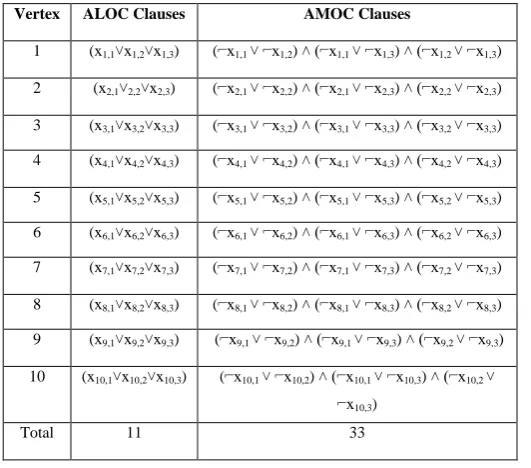
The ALOC clauses are generated using the eq.1 for every vertex. With the formulations, the total ALOC clauses contribution is equal to 11. The ALOC clause generation for the Dimacs dataset is depicted in Table 1. Similarly, |V|*( k*(k-1)/2) total AMOC clauses for the given dataset expending eq.2 are generated. The generation of AMOC clauses is presented in Table 1. Subsequently, to generate DCOL clauses with our formulations eq. 3 is utilized. Noticeable feature behind the generation of DCOL clauses is the basis of edge connections among the number of vertices. The obvious result of the increase in the number of DCOL clauses is the dependency on the total number of edge
connections. The DCOL clause generation is depicted in Table 2.
IV. RESULTS
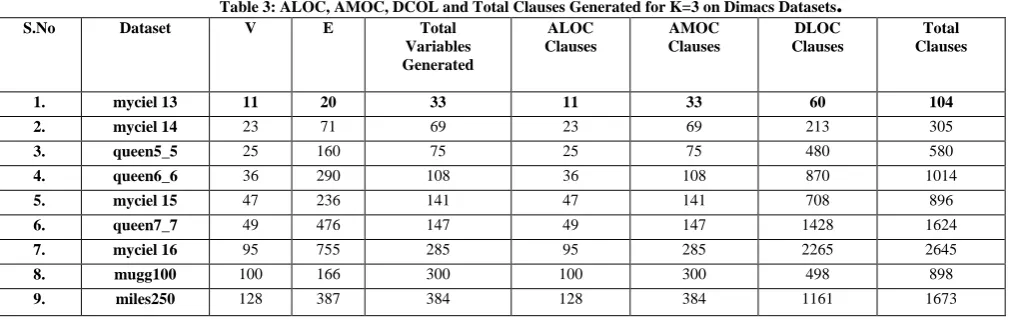
The implementation of our formulations are depicted on the datasets from Dimacs benchmark problems for k-Color graphs in Table 3. It must be observed that, Dimacs maintains a huge range of challenging datasets for k-Color graphs. Our results depict the generation of SAT clauses in polynomial time for k = 3 on nine different datasets. The generation of clauses for one of the data set containing 11 vertices and 20 edges has been elaborated in the example. Besides the total clauses generated, the results also state the number of variables required to generate the SAT clauses. Our results generate the ALOC, AMOC, DCOL clauses in polynomial time, providing it a novel structure. Thus, analyzing and formalizing the GCP constraints leads a polynomial time generation of SAT clauses.
V. CONCLUSION
Table 1: ALOC and AMOC Clauses for Example SCG
Vertex ALOC Clauses AMOC Clauses
1 (x1,1˅x1,2˅x1,3) (⌐x1,1 ˅ ⌐x1,2) ˄ (⌐x1,1 ˅ ⌐x1,3) ˄ (⌐x1,2 ˅ ⌐x1,3)
2 (x2,1˅2,2˅x2,3) (⌐x2,1 ˅ ⌐x2,2) ˄ (⌐x2,1 ˅ ⌐x2,3) ˄ (⌐x2,2 ˅ ⌐x2,3)
3 (x3,1˅x3,2˅x3,3) (⌐x3,1 ˅⌐x3,2) ˄ (⌐x3,1 ˅⌐x3,3) ˄ (⌐x3,2 ˅⌐x3,3)
4 (x4,1˅x4,2˅x4,3) (⌐x4,1 ˅ ⌐x4,2) ˄ (⌐x4,1 ˅ ⌐x4,3) ˄ (⌐x4,2 ˅ ⌐x4,3)
5 (x5,1˅x5,2˅x5,3) (⌐x5,1 ˅ ⌐x5,2) ˄ (⌐x5,1 ˅ ⌐x5,3) ˄ (⌐x5,2 ˅ ⌐x5,3)
6 (x6,1˅x6,2˅x6,3) (⌐x6,1 ˅ ⌐x6,2) ˄ (⌐x6,1 ˅ ⌐x6,3) ˄ (⌐x6,2 ˅ ⌐x6,3)
7 (x7,1˅x7,2˅x7,3) (⌐x7,1 ˅ ⌐x7,2) ˄ (⌐x7,1 ˅ ⌐x7,3) ˄ (⌐x7,2 ˅ ⌐x7,3)
8 (x8,1˅x8,2˅x8,3) (⌐x8,1 ˅ ⌐x8,2) ˄ (⌐x8,1 ˅ ⌐x8,3) ˄ (⌐x8,2 ˅ ⌐x8,3)
9 (x9,1˅x9,2˅x9,3) (⌐x9,1 ˅ ⌐x9,2) ˄ (⌐x9,1 ˅ ⌐x9,3) ˄ (⌐x9,2 ˅ ⌐x9,3)
10 (x10,1˅x10,2˅x10,3) (⌐x10,1 ˅ ⌐x10,2) ˄ (⌐x10,1 ˅ ⌐x10,3) ˄ (⌐x10,2 ˅
⌐x10,3)
Total 11 33
VI. REFERENCES
[1] Garey, R. Johnson D. S. “Computers and Intractability - A Guide to the Theory of NP Completeness”, Freeman, 1979.
[2] Karp R. M. “Reducibility Among Combinatorial Problems”, In: Miller R. E. and Thatcher J. W. (Eds.), Complexity of Computer Computations, Plenum Press, 1972, pp. 85–103.
[3] Alexander Tsiatas, “Phase Transitions in Boolean Satisfiability and Graph Coloring”, May 2008, Department of Computer Science, Cornell University.
[4] Prakash C. Sharma and Narendra S. Chaudhari, “A Graph Coloring Approach for Channel Assignment in Cellular Network via Propositional Satisfiability”, International Conference on Emerging Trends in Networks and Computer Communications (ETNCC) at Udaipur, 22-24 April 2011, pp. 23-26.
[5] DIMACS Implementation Challenges, http://dimacs.rutgers .edu/Challenges/.
[6] Graph Coloring Instances, http://mat.gsia.cmu.edu/ COLOR/instances.html.
[7] M. Anathanarayanan, S.Lavanya, “Fuzzy Graph Coloring Using α Cuts”, International Journal of Engineering and Applied Sciences, March , 2014,Vol.4,No.90.
[8] Jensen, T. R.—Toft, B., “Graph coloring problems”, Wiley Interscience, 1995.
[9] Kubale, M. (Ed.), “Graph Colorings, American Mathematical Society, 2004. DOI: 10.1090/conm/352
[10] Croitoriu, C.—Luchian, H.—Gheorghies, O.—Apetrei A, “A new Genetic Graph Coloring Heuristic”, Computational Symposium on Graph Coloring and Generalizations COLOR’02.In: Constraint Programming, Proceedings of the International Conference, P’02, 2002.
[11] Filho, G. R.,—Lorena, L. A. N.,“Constructive Genetic Algorithm and Column Generation: An Application to Graph Coloring”, Proc. Asia Pacific Operations Research Symposium, APORS’2000, 2000.
[12] Fleurent, C.—Ferland, J. A., “Genetic and Hybrid Algorithms for Graph Coloring”, Annals of Operations Research Vol. 63, 1996, pp. 437–461.DOI: 10.1007/BF02125407.
[13] Khuri, S.Walters, T.Sugono, “Grouping Genetic Algorithm for Coloring Edges of Graph”, Proc. 2000 ACM Symposium on Applied Computing, 2000, pp. 422–427. DOI: 10.1145/335603.335880.
[14] Kubale M, “Introduction to Computational Complexity and Algorithmic Graph Coloring”, GTN, Gda´nsk, 1998.
[15] Daniel Marx, “Graph Colouring Problems and their Applications in Scheduling”, Periodica Polytechnica Ser El. Eng Vol.48, No.1, pp. 11-16 (2004).
[16] E´en, N., S¨orensson N., “An extensible SAT-solver” In: Giunchiglia, E., Tacchella, A. (eds.) SAT 2003, LNCS, vol. 2919, pp. 502–518. Springer, Heidelberg (2004).
[17] A. Slater, Investigations into Satisfiability Search”, PhD thesis, NICTA, Australian National University, Acton, Australia, 2003.
[18] N.Een and A. Biere, “Effective Preprocessing in SAT through Variable and Clause Elimination”, In Proceedings of the Eighth International Conference on Theory and Applications of Satisfiability Testing (SAT'05).
Table 2: DCOL Clause Generation for Example SCG
Edge DCOL Edge DCOL
(e1, e2) (⌐x1,1 ˅ ⌐x2,1) ˄ (⌐x1,2 ˅ ⌐x2,2) ˄ (⌐x1,3 ˄ ⌐x2,3) (e3, e10) (⌐x3,1 ˅ ⌐x10,1) ˄ (⌐x3,2 ˅ ⌐x10,2) ˄ (⌐x3,3 ˄ ⌐x10,3)
(e2, e3) (⌐x2,1 ˅⌐x3,1) ˄ (⌐x2,2 ˅⌐x3,2) ˄ (⌐x2,3 ˄⌐x3,3). (e4, e10) (⌐x4,1 ˅⌐x10,1) ˄ (⌐x4,2 ˅⌐x10,2) ˄ (⌐x4,3 ˄⌐x10,3)
(e3, e4) (⌐x3,1 ˅ ⌐x4,1) ˄ (⌐x3,2 ˅ ⌐x4,2) ˄ (⌐x3,3 ˄ ⌐x4,3) (e5, e10) (⌐x5,1 ˅ ⌐x10,1) ˄ (⌐x5,2 ˅ ⌐x10,2) ˄ (⌐x5,3 ˄ ⌐x10,3)
(e4, e5) (⌐x4,1 ˅ ⌐x5,1) ˄ (⌐x4,2 ˅ ⌐x5,2) ˄ (⌐x4,3 ˄ ⌐x5,3) (e6, e10) (⌐x6,1 ˅ ⌐x10,1) ˄ (⌐x6,2 ˅ ⌐x10,2) ˄ (⌐x6,3 ˄ ⌐x10,3)
(e5, e6) (⌐x5,1 ˅ ⌐x6,1) ˄ (⌐x5,2 ˅ ⌐x6,2) ˄ (⌐x5,3 ˄ ⌐x6,3). (e6,e11) (⌐x6,1 ˅ ⌐x11,1) ˄ (⌐x6,2 ˅ ⌐x11,2) ˄ (⌐x6,3 ˄ ⌐x11,3).
(e6, e7) (⌐x6,1 ˅⌐x7,1) ˄ (⌐x6,2 ˅⌐x7,2) ˄ (⌐x6,3 ˄⌐x7,3) (e8,e11) (⌐x8,1 ˅⌐x11,1) ˄ (⌐x8,2 ˅⌐x11,2) ˄ (⌐x8,3 ˄⌐x11,3)
(e7, e8) (⌐x7,1 ˅ ⌐x8,1) ˄ (⌐x7,2 ˅ ⌐x8,2) ˄ (⌐x7,3 ˄ ⌐x8,3) (e9,e11) (⌐x9,1 ˅ ⌐x11,1) ˄ (⌐x9,2 ˅ ⌐x11,2) ˄ (⌐x9,3 ˄ ⌐x11,3)
(e8, e9) (⌐x8,1 ˅ ⌐x9,1) ˄ (⌐x8,2 ˅ ⌐x9,2) ˄ (⌐x8,3 ˄ ⌐x9,3) (e1,e11) (⌐x1,1 ˅ ⌐x11,1) ˄ (⌐x1,2 ˅ ⌐x11,2) ˄ (⌐x1,3 ˄ ⌐x11,3)
(e1, e9) (⌐x1,1 ˅ ⌐x9,1) ˄ (⌐x1,2 ˅ ⌐x9,2) ˄ (⌐x1,3 ˄ ⌐x9,3) (e10,e11) (⌐x10,1 ˅ ⌐x11,1) ˄ (⌐x10,2 ˅ ⌐x11,2) ˄ (⌐x10,3 ˄ ⌐x11,3)
[image:4.595.28.475.604.775.2]Table 3: ALOC, AMOC, DCOL and Total Clauses Generated for K=3 on Dimacs Datasets
.
S.No Dataset V E Total
Variables Generated
ALOC Clauses
AMOC Clauses
DLOC Clauses
Total Clauses
1. myciel 13 11 20 33 11 33 60 104
2. myciel 14 23 71 69 23 69 213 305
3. queen5_5 25 160 75 25 75 480 580
4. queen6_6 36 290 108 36 108 870 1014
5. myciel 15 47 236 141 47 141 708 896
6. queen7_7 49 476 147 49 147 1428 1624
7. myciel 16 95 755 285 95 285 2265 2645
8. mugg100 100 166 300 100 300 498 898