Active Learning for Part-of-Speech Tagging:
Accelerating Corpus Annotation
Eric Ringger*, Peter McClanahan*, Robbie Haertel*, George Busby*, Marc Carmen**,
James Carroll*, Kevin Seppi*, Deryle Lonsdale**
*Computer Science Department; **Linguistics Department
Brigham Young University
Provo, Utah, USA 84602
Abstract
In the construction of a part-of-speech an-notated corpus, we are constrained by a fixed budget. A fully annotated corpus is required, but we can afford to label only a subset. We train a Maximum Entropy Mar-kov Model tagger from a labeled subset and automatically tag the remainder. This paper addresses the question of where to focus our manual tagging efforts in order to deliver an annotation of highest quality. In this context, we find that active learning is always helpful. We focus on Query by Un-certainty (QBU) and Query by Committee (QBC) and report on experiments with sev-eral baselines and new variations of QBC and QBU, inspired by weaknesses particu-lar to their use in this application. Experi-ments on English prose and poetry test these approaches and evaluate their robust-ness. The results allow us to make recom-mendations for both types of text and raise questions that will lead to further inquiry.
1
Introduction
We are operating (as many do) on a fixed budget and need annotated text in the context of a larger project. We need a fully annotated corpus but can afford to annotate only a subset. To address our budgetary constraint, we train a model from a ma-nually annotated subset of the corpus and automat-ically annotate the remainder. At issue is where to focus manual annotation efforts in order to produce a complete annotation of highest possible quality. A follow-up question is whether these techniques work equally well on different types of text.
In particular, we require part-of-speech (POS) annotations. In this paper we employ a state-of-the-art tagger on both prose and poetry, and we ex-amine multiple known and novel active learning (or sampling) techniques in order to determine which work best in this context. We show that the results obtained by a state-of-the-art tagger trained on a small portion of the data selected through ac-tive learning can approach the accuracy attained by human annotators and are on par with results from exhaustively trained automatic taggers.
In a study based on English language data pre-sented here, we identify several active learning techniques and make several recommendations that we hope will be portable for application to other text types and to other languages. In section 2 we briefly review the state of the art approach to POS tagging. In section 3, we survey the approaches to active learning employed in this study, including variations on commonly known techniques. Sec-tion 4 introduces the experimental regime and presents results and their implications. Section 5 draws conclusions and identifies opportunities for follow-up research.
2
Part of Speech Tagging
Labeling natural language data with part-of-speech tags can be a complicated task, requiring much effort and expense, even for trained annotators. Several efforts, notably the Alembic workbench (Day et al., 1997) and similar tools, have provided interfaces to aid annotators in the process.
Maxi-mum entropy conditional Markov models (MaxEnt CMMs, or MEMMs for short) (Ratnaparkhi, 1996; Toutanova & Manning, 2000; Toutanova et al., 2003). Part of the success of MEMMs can be attri-buted to the absence of independence assumptions among predictive features and the resulting ease of feature engineering. To the best of our knowledge, the present work is the first to present results using MEMMs in an active learning framework.
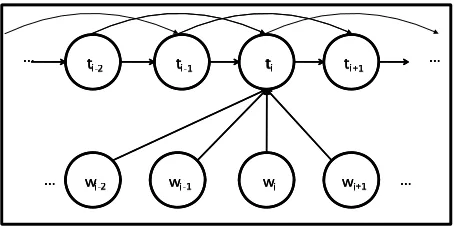
An MEMM is a probabilistic model for se-quence labeling. It is a Conditional Markov Model (CMM as illustrated in Figure 1) in which a Max-imum Entropy (MaxEnt) classifier is employed to estimate the probability distribution
1.. 1 1 2
( | ,i i ) ME( |i i, i, i , i )
p t w t − ≈ p t w f t− t− over possible labels
t
i for each element in the se-quence—in our case, for each wordw
i in a sen-tence w. The MaxEnt model is trained from la-beled data and has access to any predefined attributes (represented here by the collection fi) of the entire word sequence and to the labels of pre-vious words (t
1.. 1i− ). Our implementation employs an order-two Markov assumption so the classifier has access only to the two previous tagst
i−1,
t
i−2.We refer to the features (w f ti, i, i−1,ti−2) from which the classifier predicts the distribution over tags as “the local trigram context”.
A Viterbi decoder is a dynamic programming algorithm that applies the MaxEnt classifier to score multiple competing tag-sequence hypotheses efficiently and to produce the best tag sequence, according to the model. We approximate Viterbi very closely using a fast beam search. Essentially, the decoding process involves sequential classifi-cation, conditioned on the (uncertain) decisions of the previous local trigram context classifications. The chosen tag sequence
t
ˆ
is the tag sequence maximizing the following quantity:1 2 1..
ˆ arg max ( | )
arg max ( | , , , )
t
t ME i i i i i
i n
t P t w
p t w f t− t−
=
=
=
∏
The features used in this work are reasonably typical for modern MEMM feature-based POS tagging and consist of a combination of lexical, orthographic, contextual, and frequency-based in-formation. In particular, for each word the follow-ing features are defined: the textual form of the word itself, the POS tags of the preceding two words, and the textual form of the following word. Following Toutanova and Manning (2000) approx-imately, more information is defined for words that are considered rare (which we define here as words
[image:2.612.314.541.107.220.2]that occur fewer than fifteen times). We consider the tagger to be near-state-of-the-art in terms of tagging accuracy.
Figure 1. Simple Markov order 2 CMM, with focus on the i-th hidden label (or tag).
3
Active Learning
The objective of this research is to produce more high quality annotated data with less human anno-tator time and effort. Active learning is an ap-proach to machine learning in which a model is trained with the selective help of an oracle. The oracle provides labels on a sufficient number of “tough” cases, as identified by the model. Easy cases are assumed to be understood by the model and to require no additional annotation by the oracle. Many variations have been proposed in the broader active learning and decision theory litera-ture under many names, including “active sam-pling” and “optimal sampling.”
In active learning for POS tagging, as in other applications, the oracle can be a human. For expe-rimental purposes, a human oracle is simulated using pre-labeled data, where the labels are hidden until queried. To begin, the active learning process requires some small amount of training data to seed the model. The process proceeds by identify-ing the data in the given corpus that should be tagged first for maximal impact.
3.1 Active Learning in the Language Context
meaning of the whole. Consequently, we thought it unreasonable to choose the word as the granularity for active learning. Instead, we begin with the as-sumption that a human will usually require much of the sentence or at least local context from the sentence in order to label a single word with its POS label. While focusing on a single word, the human may as well label the entire sentence or at least correct the labels assigned by the tagger for the sentence. Consequently, the sentence is the granularity of annotation for this work. (Future work will question this assumption and investigate tagging a word or a subsequence of words at a time.) This distinguishes our work from active learning for classification since labels are not drawn from a fixed set of labels. Rather, every sen-tence of length n can be labeled with a tag se-quence drawn from a set of size
T
n, where T is the size of the per-word tag set. Granted, many of the options have very low probability.To underscore our choice of annotating at the granularity of a sentence, we also note that a max-imum entropy classifier for isolated word tagging that leverages attributes of neighboring words— but is blind to all tags—will underperform an MEMM that includes the tags of neighboring words (usually on the left) among its features. Pre-vious experiments demonstrate the usefulness of tags in context on the standard Wall Street Journal data from the Penn Treebank (Marcus et al., 1999). A MaxEnt isolated word tagger achieves 93.7% on words observed in the training set and 82.6% on words unseen in the training set. Toutanova and Manning (2000) achieves 96.9% (on seen) and 86.9% (on unseen) with an MEMM. They sur-passed their earlier work in 2003 with a “cyclic dependency network tagger”, achieving 97.2%/89.05% (seen/unseen) (Toutanova et al., 2003). The generally agreed upon upper bound is around 98%, due to label inconsistencies in the Treebank. The main point is that effective use of contextual features is necessary to achieve state of the art performance in POS tagging.
In active learning, we employ several sets of data that we refer to by the following names:
Initial Training: the small set of data used to train the original model before active learning starts
Training: data that has already been la-beled by the oracle as of step i in the learn-ing cycle
Unannotated: data not yet labeled by the oracle as of step i
Test (specifically Development Test): la-beled data used to measure the accuracy of the model at each stage of the active learn-ing process. Labels on this set are held in reserve for comparison with the labels chosen by the model. It is the accuracy on this set that we report in our experimental results in Section 4.
Note that the Training set grows at the expense of the Unannotated set as active learning progresses.
Active Learning for POS Tagging consists of the following steps:
1. Train a model with Initial Training data 2. Apply model to Unannotated data
3. Compute potential informativeness of each sentence
4. Remove top n sentences with most po-tential informativeness from Unanno-tated data and give to oracle
5. Add n sentences annotated (or corrected) by the oracle to Training data
6. Retrain model with Training data 7. Return to step 2 until stopping condition
is met.
There are several possible stopping conditions, including reaching a quality bar based on accuracy on the Test set, the rate of oracle error corrections in the given cycle, or even the cumulative number of oracle error corrections. In practice, the exhaus-tion of resources, such as time or money, may completely dominate all other desirable stopping conditions.
Several methods are available for determining which sentences will provide the most information. Expected Value of Sample Information (EVSI) (Raiffa & Schlaiffer, 1967) would be the optimal approach from a decision theoretic point of view, but it is computationally prohibitive and is not con-sidered here. We also do not consider the related notion of query-by-model-improvement or other methods (Anderson & Moore, 2005; Roy & McCallum, 2001a, 2001b). While worth exploring, they do not fit in the context of this current work and should be considered in future work. We focus here on the more widely used Query by Committee (QBC) and Query by Uncertainty (QBU), includ-ing our new adaptations of these.
of QBC) from scratch on the training data during every round of the active learning loop would pro-long our experiments unnecessarily. Instead we start each optimization search with a parameter set consisting of the model parameters from the pre-vious iteration of active learning (we call this “Fast MaxEnt”). In practice, this converges quickly and produces equivalent results.
3.2 Query by Committee
Query by Committee (QBC) was introduced by Seung, Opper, and Sompolinsky (1992). Freund, Seung, Shamir, and Tishby (1997) provided a care-ful analysis of the approach. Engelson and Dagan (1996) experimented with QBC using HMMs for POS tagging and found that selective sampling of sentences can significantly reduce the number of samples required to achieve desirable tag accura-cies. Unlike the present work, Engelson & Dagan were restricted by computational resources to se-lection from small windows of the Unannotated set, not from the entire Unannotated set. Related work includes learning ensembles of POS taggers, as in the work of Brill and Wu (1998), where an ensem-ble consisting of a unigram model, an N-gram model, a transformation-based model, and an MEMM for POS tagging achieves substantial re-sults beyond the individual taggers. Their conclu-sion relevant to this paper is that different taggers commit complementary errors, a useful fact to ex-ploit in active learning. QBC employs a committee of N models, in which each model votes on the correct tagging of a sentence. The potential infor-mativeness of a sentence is measured by the total number of tag sequence disagreements (compared pair-wise) among the committee members. Possi-ble variants of QBC involve the number of com-mittee members, how the training data is split among the committee members, and whether the training data is sampled with or without replace-ment.
A potential problem with QBC in this applica-tion is that words occur with different frequencies in the corpus. Because of the potential for greater impact across the corpus, querying for the tag of a more frequent word may be more desirable than querying for the tag of a word that occurs less fre-quently, even if there is greater disagreement on the tags for the less frequent word. We attempted to compensate for this by weighting the number of disagreements by the corpus frequency of the word
in the full data set (Training and Unannotated). Unfortunately, this resulted in worse performance; solving this problem is an interesting avenue for future work.
3.3 Query by Uncertainty
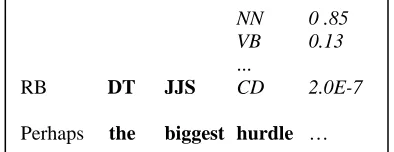
The idea behind active sampling based on uncer-tainty appears to originate with Thrun and Moeller (1992). QBU has received significant attention in general. Early experiments involving QBU were conducted by Lewis and Gale (1994) on text classi-fication, where they demonstrated significant bene-fits of the approach. Lewis and Catlett (1994) ex-amined its application for non-probabilistic learn-ers in conjunction with other probabilistic learnlearn-ers under the name “uncertainty sampling.” Brigham Anderson (2005) explored QBU using HMMs and concluded that it is sometimes advantageous. We are not aware of any published work on the appli-cation of QBU to POS tagging. In our implementa-tion, QBU employs a single MEMM tagger. The MaxEnt model comprising the tagger can assess the probability distribution over tags for any word
[image:4.612.322.519.356.432.2]in its local trigram context, as illustrated in the ex-ample in Figure 2.
Figure 2. Distribution over tags for the word “hurdle” in italics. The local trigram context is in boldface.
In Query by Uncertainty (QBU), the informa-tiveness of a sample is assumed to be the uncer-tainty in the predicted distribution over tags for that sample, that is the entropy of
1 2
( | , , , )
ME i i i i i
p t w f t− t− . To determine the poten-tial informativeness of a word, we can measure the entropy in that distribution. Since we are selecting sentences, we must extend our measure of uncer-tainty beyond the word.
3.4 Adaptations of QBU
There are several problems with the use of QBU in this context:
• Some words are more important; i.e., they contain more information perhaps because they occur more frequently.
NN 0 .85
VB 0.13
...
RB DT JJS CD 2.0E-7
• MaxEnt estimates per-word distributions over tags, not per-sentence distributions over tag sequences.
• Entropy computations are relatively costly. We address the first issue in a new version of QBU which we call “Weighted Query by Uncertainty” (WQBU). In WQBU, per-word uncertainty is weighted by the word's corpus frequency.
To address the issue of estimating per-sentence uncertainty from distributions over tag sequences, we have considered several different approaches. The per-word (conditional) entropy is defined as follows:
where
T
i is the random variable for the tagt
i on wordw
i, and the features of the context in whichi
w
occurs are denoted, as before, by the collection if and the prior tags
t
i−1,
t
i−2. It is straightforward to calculate this entropy for each word in a sen-tence from the Unannotated set, if we assume that previous tagst
i−1,
t
i−2 are from the Viterbi (best) tag sequence (for the entire sentence) according to the model.For an entire sentence, we estimate the tag-sequence entropy by summing over all possible tag sequences. However, computing this estimate ex-actly on a 25-word sentence, where each word can be labeled with one of 35 tags, would require 3525 = 3.99*1038 steps. Instead, we approximate the per-sentence tag sequence distribution entropy by summing per-word entropy:
This is the approach we refer to as QBU in the experimental results section. We have experi-mented with a second approach that estimates the per-sentence entropy of the tag-sequence distribu-tion by Monte Carlo decoding. Unfortunately, cur-rent active learning results involving this MC POS tagging decoder are negative on small Training set sizes, so we do not present them here. Another al-ternative approximation worth pursuing is compu-ting the per-sentence entropy using the n-best POS tag sequences. Very recent work by Mann and McCallum (2007) proposes an approach in which exact sequence entropy can be calculated
efficient-ly. Further experimentation is required to compare our approximation to these alternatives.
An alternative approach that eliminates the overhead of entropy computations entirely is to estimate per-sentence uncertainty with
1
−
P t
( )
ˆ
, where tˆis the Viterbi (best) tag sequence. We call this scheme QBUV. In essence, it selects a sample consisting of the sentences having the highest probability that the Viterbi sequence is wrong. To our knowledge, this is a novel approach to active learning.4
Experimental Results
In this section, we examine the experimental setup, the prose and poetry data sets, and the results from using the various active learning algorithms on these corpora.
4.1 Setup
The experiments focus on the annotation scenario posed earlier, in which budgetary constraints af-ford only some number x of sentences to be anno-tated. The x-axis in each graph captures the num-ber of sentences. For most of the experiments, the graphs present accuracies on the (Development) Test set. Later in this section, we present results for an alternate metric, namely number of words cor-rected by the oracle.
In order to ascertain the usefulness of the active learning approaches explored here, the results are presented against a baseline in which sentences are selected randomly from the Unannotated set. We consider this baseline to represent the use of a state-of-the-art tagger trained on the same amount of data as the active learner. Due to randomization, the random baseline is actually distinct from expe-riment to expeexpe-riment without any surprising devia-tions. Also, each result curve in each graph represents the average of three distinct runs.
Worth noting is that most of the graphs include active learning curves that are run to completion; namely, the rightmost extent of all curves represents the exhaustion of the Unannotated data. At this extreme point, active learning and random sample selection all have the same Training set. In the scenarios we are targeting, this far right side is not of interest. Points representing smaller amounts of annotated data are our primary interest.
In the experiments that follow, we address sev-eral natural questions that arise in the course of applying active learning. We also compare the
va-1 2
1 2
1 2
( |
, ,
,
)
( |
,
,
,
)
log
( |
, ,
,
)
i
i i i i i
ME i i i i i t Tagset
ME i i i i i
H T w f t
t
p
t w f t
t
p
t w f t
t
− −
− − ∈
− −
= −
⋅
∑
1 2
ˆ ( | )
( |
, ,
,
)
i
i i i i i w w
H T w
H T w f t
−t
−riants of QBU and QBC. For QBC, committee members divide the training set (at each stage of the active learning process) evenly. All committee members and final models are MEMMs. Likewise, all variants of QBU employ MEMMs.
4.2 Data Sets
The experiments involve two data sets in search of conclusions that generalize over two very dif-ferent kinds of English text. The first data set con-sists of English prose from the POS-tagged one-million-word Wall Street Journal text in the Penn Treebank (PTB) version 3. We use a random sam-ple of the corpus constituting 25% of the tradition-al training set (sections 2–21). Inititradition-al Training data consists of 1% of this set. We employ section 24 as the Development Test set. Average sentence length is approximately 25 words.
Our second experimental set consists of English poetry from the British National Corpus (BNC) (Godbert & Ramsay, 1991; Hughes, 1982; Raine, 1984). The text is also fully tagged with 91 parts of speech from a different tag set than the one used for the PTB. The BNC XML data was taken from the files B1C.xml, CBO.xml, and H8R.xml. This results in a set of 60,056 words and 8,917 sen-tences.
4.3 General Results
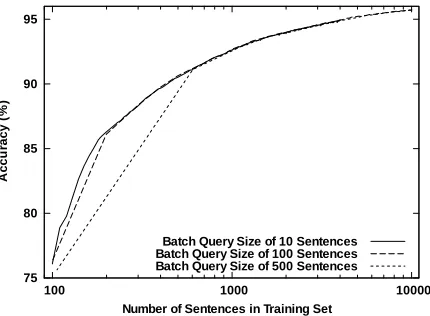
To begin, each step in the active learning process adds a batch of 100 sentences from the Unanno-tated set at a time. Figure 3 demonstrates (using QBU) that the size of a query batch is not signifi-cant in these experiments.
The primary question to address is whether ac-tive learning helps or not. Figure 4 demonstrates that QBU, QBUV, and QBC all outperform the random baseline in terms of total, per-word accu-racy on the Test set, given the same amount of Training data. Figure 5 is a close-up version of Figure 4, placing emphasis on points up to 1000 annotated sentences. In these figures, QBU and QBUV vie for the best performing active learning algorithm. These results appear to give some useful advice captured in Table 1. The first column in the table contains the starting conditions. The remain-ing columns indicate that for between 800-1600 sentences of annotation, QBUV takes over from QBU as the best selection algorithm.
The next question to address is how much initial training data should be used; i.e., when should we
[image:6.612.318.533.125.283.2]start using active learning? The experiment in Fig-ure 6 demonstrates (using QBU) that one should use as little data as possible for Initial Training Data. There is always a significant advantage to starting early. In the experiment documented in
[image:6.612.319.531.319.476.2]Figure 3. Varying the size of the query batch in active learning yields identical results after the first query batch.
Figure 4. The best representatives of each type of active learner beat the baseline. QBU and QBUV trade off the
[image:6.612.317.535.524.677.2]top position over QBC and the Baseline.
Figure 5. Close-up of the low end of the graph from Figure 4. QBUV and QBU are nearly tied for best performance.
75 80 85 90 95
100 1000 10000
Ac
c
u
ra
c
y
(
%
)
Number of Sentences in Training Set Batch Query Size of 10 Sentences Batch Query Size of 100 Sentences Batch Query Size of 500 Sentences
75 80 85 90 95
100 1000 10000
Accuracy (%)
Number of Sentences in Training Set QBUV
QBU QBC Baseline
76 78 80 82 84 86 88 90 92
100 1000
A
ccu
racy (
%
)
Number of Sentences in Training Set QBUV
this figure, a batch query size of one was employed in order to make the point as clearly as possible. Larger batch query sizes produce a graph with sim-ilar trends as do experiments involving larger Un-annotated sets and other active learners.
100 200 400 800 1600 3200 6400
QBU 76.26 86.11 90.63 92.27 93.67 94.65 95.42
QBUV 76.65 85.09 89.75 92.24 93.72 94.96 95.60
QBC 76.19 85.77 89.37 91.78 93.49 94.62 95.36
[image:7.612.70.300.131.248.2]Base 76.57 82.13 86.68 90.12 92.49 94.02 95.19
Table 1. The best models (on PTB WSJ data) with various amounts of annotation (columns).
Figure 6. Start active learning as early as possible for a head start.
4.4 QBC Results
An important question to address for QBC is what number of committee members produces the best results? There was no significant difference in results from the QBC experiments when using be-tween 3 and 7 committee members. For brevity we omit the graph.
4.5 QBU Results
For Query by Uncertainty, the experiment in Fig-ure 7 demonstrates that QBU is superior to QBUV for low counts, but that QBUV slightly overtakes QBU beyond approximately 300 sentences. In fact, all QBU variants, including the weighted version, surpassed the baseline. WQBU has been omitted from the graph, as it was inferior to straight-forward QBU.
4.6 Results on the BNC
[image:7.612.72.300.254.440.2]Next we introduce results on poetry from the Brit-ish National Corpus. Recall that the feature set employed by the MEMM tagger was optimized for performance on the Wall Street Journal. For the experiment presented in Figure 8, all data in the Training and Unannotated sets is from the BNC, but we employ the same feature set from the WSJ experiments. This result on the BNC data shows first of all that tagging poetry with this tagger leaves a final shortfall of approximately 8% from the WSJ results. Nonetheless and more importantly, the active learning trends observed on the WSJ still hold. QBC is better than the baseline, and QBU and QBUV trade off for first place. Furthermore, for low numbers of sentences, it is overwhelmingly to one’s advantage to employ active learning for annotation.
Figure 7. QBUV is superior to QBU overall, but QBU is better for very low counts. Both are superior to the
[image:7.612.316.533.308.466.2]ran-dom baseline and the Longest Sentence (LS) baseline.
Figure 8. Active learning results on the BNC poetry data. Accuracy of QBUV, QBU, and QBC against the random baseline. QBU and QBUV are nearly indistinguishable.
0 10 20 30 40 50 60 70 80 90
10 100
A
ccu
ra
c
y
(
%
)
Number of Sentences in Training Set 1% 5% 10% 25%
75 80 85 90 95
100 1000 10000
A
ccu
ra
c
y
(
%
)
Number of Sentences in Training Set QBU QBUV LS Baseline
40 45 50 55 60 65 70 75 80 85 90
100 1000 10000
A
ccu
ra
cy (
%
)
[image:7.612.318.538.514.671.2]4.7 Another Perspective
Next, briefly consider a different metric on the ver-tical axis. In Figure 9, the metric is the total num-ber of words changed (corrected) by the oracle. This quantity reflects the cumulative number of differences between the tagger’s hypothesis on a sentence (at the point in time when the oracle is queried) and the oracle’s answer (over the training set). It corresponds roughly to the amount of time that would be required for a human annotator to correct the tags suggested by the model. This fig-ure reveals that QBUV makes significantly more changes than QBU, QBC, or LS (the Longest Sen-tence baseline). Hence, the superiority of QBU over QBUV, as measured by this metric, appears to outweigh the small wins provided by QBUV when measured by accuracy alone. That said, the random baseline makes the fewest changes of all. If this metric (and not some combination with accuracy) were our only consideration, then active learning would appear not to serve our needs.
[image:8.612.74.295.384.541.2]This metric is also a measure of how well a par-ticular query algorithm selects sentences that espe-cially require assistance from the oracle. In this sense, QBUV appears most effective.
Figure 9. Cumulative number of corrections made by the oracle for several competitive active learning algorithms.
QBU requires fewer corrections than QBUV.
5
Conclusions
Active learning is a viable way to accelerate the efficiency of a human annotator and is most effec-tive when done as early as possible. We have pre-sented state-of-the-art tagging results using a frac-tion of the labeled data. QBUV is a cheap approach to performing active learning, only to be surpassed by QBU when labeling small numbers of sentences.
We are in the midst of conducting a user study to assess the true costs of annotating a sentence at a time or a word at a time. We plan to incorporate these specific costs into a model of cost measured in time (or money) that will supplant the metrics reported here, namely accuracy and number of words corrected. As noted earlier, future work will also evaluate active learning at the granularity of a word or a subsequence of words, to be evaluated by the cost metric.
References
Anderson, B., and Moore, A. (2005). “Active Learning for HMM: Objective Functions and Algorithms.” ICML, Germany. Brants, T., (2000). “TnT -- a statistical part-of-speech tagger.” ANLP,
Seattle, WA.
Brill, E., and Wu, J. (1998). “Classifier combination for improved lexical disambiguation.” Coling/ACL, Montreal, Quebec, Canada. Pp. 191-195.
Day, D., et al. (1997). “Mixed-Initiative Development of Language Processing Systems.” ANLP, Washington, D.C.
Engelson, S. and Dagan, I. (1996). “Minimizing manual annotation cost in supervised training from corpora.” ACL, Santa Cruz, Cali-fornia. Pp. 319-326.
Freund, Y., Seung, H., Shamir, E., and Tishby, N. (1997). “Selective sampling using the query by committee algorithm.” Machine Learning, 28(2-3):133-168.
Godbert, G. and Ramsay, J. (1991). “For now.” In the British National Corpus file B1C.xml. London: The Diamond Press (pp. 1-108). Hughes, T. (1982). “Selected Poems.” In the British National Corpus
file H8R.xml. London: Faber & Faber Ltd. (pp. 35-235). Kupiec, J. (1992). “Robust part-of-speech tagging using a hidden
Markov model.” Computer Speech and Language 6, pp. 225-242. Lewis, D., and Catlett, J. (1994). “Heterogeneous uncertainty
sam-pling for supervised learning.” ICML.
Lewis, D., and Gale, W. (1995). “A sequential algorithm for training text classifiers: Corrigendum and additional data.” SIGIR Forum, 29 (2), 13--19.
Mann, G., and McCallum, A. (2007). "Efficient Computation of En-tropy Gradient for Semi-Supervised Conditional Random Fields". NAACL-HLT.
Marcus, M. et al. (1999). “Treebank-3.” Linguistic Data Consortium, Philadelphia, PA.
Raiffa, H. and Schlaiffer, R. (1967). Applied Statistical Decision
Theory. New York: Wiley Interscience.
Raine, C. (1984). “Rich.” In the British National Corpus file CB0.xml. London: Faber & Faber Ltd. (pp. 13-101).
Ratnaparkhi, A. (1996). “A Maximum Entropy Model for Part-Of-Speech Tagging.” EMNLP.
Roy, N., and McCallum, A. (2001a). “Toward optimal active learning through sampling estimation of error reduction.” ICML. Roy, N. and McCallum, A. (2001b). “Toward Optimal Active
Learn-ing through Monte Carlo Estimation of Error Reduction.” ICML, Williamstown.
Seung, H., Opper, M., and Sompolinsky, H. (1992). “Query by com-mittee”. COLT. Pp. 287-294.
Thrun S., and Moeller, K. (1992). “Active exploration in dynamic environments.” NIPS.
Toutanova, K., Klein, D., Manning, C., and Singer, Y. (2003). “Fea-ture-Rich Part-of-Speech Tagging with a Cyclic Dependency Net-work.” HLT-NAACL. Pp. 252-259.
Toutanova, K. and Manning, C. (2000). “Enriching the Knowledge Sources Used in a Maximum Entropy Part-of-Speech Tagger.” EMNLP, Hong Kong. Pp. 63-70.
0 1000 2000 3000 4000 5000 6000 7000 8000 9000 10000
100 1000 10000
N
u
m
b
er
o
f C
h
an
g
e
d
W
o
rd
s