Automatic Indexing of Specialized Documents:
Using Generic vs. Domain-Specific Document Representations
Aurélie Névéol
James G. Mork
{neveola,mork,alan}@nlm.nih.gov
National Library of Medicine
8600 Rockville Pike
Bethesda, MD 20894
USA
Alan R. Aronson
Abstract
The shift from paper to electronic docu-ments has caused the curation of informa-tion sources in large electronic databases to become more generalized. In the bio-medical domain, continuing efforts aim at refining indexing tools to assist with the update and maintenance of databases such as MEDLINE®. In this paper, we evaluate two statistical methods of producing MeSH® indexing recommendations for the genetics literature, including recom-mendations involving subheadings, which is a novel application for the methods. We show that a generic representation of the documents yields both better precision and recall. We also find that a domain-specific representation of the documents can contribute to enhancing recall.
1
Introduction
There are two major approaches for the automatic indexing of text documents: statistical approaches that rely on various word counting techniques [su-ch as vector space models (Salton, 1989), Latent Semantic Indexing (Deerwester et al., 1990) or probabilistic models (Sparck-Jones et al., 2000)] and linguistic approaches that involve syntactical and lexical analysis [see for example term extrac-tion and term variaextrac-tion recogniextrac-tion in systems such as MetaMap (Aronson, 2001), FASTR (Jacquemin and Tzoukermann, 1999) or IndDoc (Nazarenko and Ait El Mekki, 2005)]. In many cases, the com-bination of these approaches has been shown to improve the performance of a single approach both
for controlled indexing (Aronson et al., 2004) and free text indexing (Byrne and Klein, 2003).
Recently, Névéol et al. (2007) presented lin-guistic approaches for the indexing of documents in the field of genetics. In this paper, we explore a statistical approach of indexing for text documents also in the field of genetics. This approach was previously used successfully to produce Medical Subject Headings (MeSH) main heading recom-mendations. Our goal in this experiment is two-fold: first, extending an existing method to the pro-duction of recommendations involving subhead-ings and second, assessing the possible benefit of using a domain-specific variant of the method.
2
A k-Nearest-Neighbors approach for
indexing
2.1
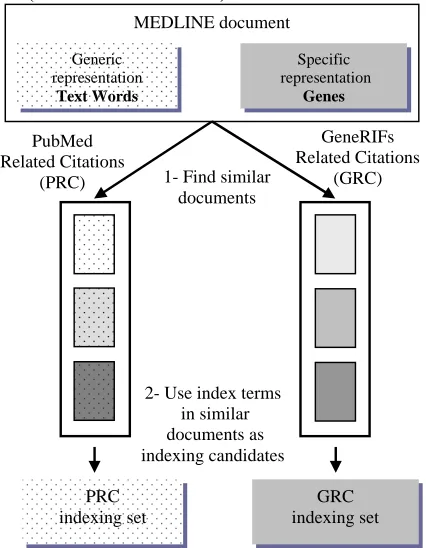
PrincipleThe k-Nearest-Neighbors (k-NN) approach views indexing as a multi-class classification problem where a document may be assigned several “classes” in the form of indexing terms. It requires a large set of labeled data composed of previously indexed documents. k-NN relies on the assumption that similar documents should be classified in a similar way. The algorithm consists of two steps: 1/documents that are most “similar” to the query document must be retrieved from the set of labeled documents. They are considered as “neighbors” for the query document; 2/an indexing set must be produced from these and assigned to the query document.
Finding similar documents
may be ranked according to their similarity to the query document using usual similarity measures such as cosine or Dice. The challenge in this step is to define an appropriate representation space for the documents and to select optimal features for each document. Another issue is the number (k) of neighbors that should be selected to use in the next step.
Producing an indexing set
When applied to a single-class classification prob-lem, the class that is the most frequent among the k neighbors is usually assigned to the query docu-ment. Indexing is a multi-class problem for which the number of classes a document should be as-signed is not known, as it may vary from one document to another. Therefore, indexing terms from the neighbor documents are all taken into account and ranked according to the number of neighbors that were labeled with them. The more neighbors labeled with a given indexing term, the higher the confidence that it will be a relevant in-dexing term for the query document. This resulting indexing set may then be filtered to select only the terms that were obtained from a defined minimum number of neighbors.
2.2
Document representationGeneric representation
A generic representation of documents is obtained from the text formed by the title and abstract. This text is processed so that punctuation is removed, stop-words from a pre-defined list (of 310 words) are removed, remaining words are switched to lower case and a minimal amount of stemming is applied. As described by Salton (1989) words should be weighted according to the number of times they occur in the query document and the number of times they occur in the whole collection (here, MEDLINE). Moreover, words from the title are given an additional weight compared to words from the abstract. Further adjustments relative to document length and local weighting according to the Poisson distribution are detailed in (Aronson et al, 2000; Kim et al., 2001) where the PubMed Re-lated Citations (PRC) algorithm is discussed. Fur-ther experiments showed that the best results were obtained by using the ten nearest neighbors.
Domain-specific representation
In specialized domains, documents from the litera-ture may be represented with concepts or objects commonly used or studied in the field. For exam-ple, (Rhodes et al., 2007) meet specific chemistry oriented search needs by representing US patents and patent applications with molecular information in the form of chemical terms and structures. A similar representation is used for PubChem (http://pubchem.ncbi.nlm.nih.gov/) records. In the genetics domain, genes are among the most com-monly discussed or manipulated concepts. There-fore, genes should provide a relevant domain-specific description of documents from the genet-ics literature.
The second indexing algorithm that we describe in this paper, know as the Gene Reference Into Function (GeneRIF) Related Citations (GRC) algo-rithm, uses “GeneRIF” links (defined in the para-graph below) to retrieve neighbors for a query document.
To form a specific representation of the docu-ment, gene names are retrieved by ABGene1 (Ta-nabe and Wilbur, 2002) and mapped to Entrez Gene2 unique identifiers. The mapping was per-formed with a version of SemRep (Rindflesch and Fiszman, 2003) restricted to human genes. It con-sists in normalizing the gene name (switch to lower case, remove spaces and hyphens) and matching the resulting string to one of the gene names or aliases listed in Entrez Gene.
For each gene, the GeneRIF links supply a sub-set of MEDLINE citations manually selected by NLM indexers for describing the functions associ-ated with the gene. These sets were used in two ways:
To complete the document representation. If a citation was included in the GeneRIF of a given gene, the gene was given an additional weight in the document representation. To limit the set of possible neighbors. In the
generic representation, all MEDLINE cita-tions contain the representation features, words. Therefore, they all have to be con-sidered as potential neighbors. However,
1 Software downloaded January 17, 2007, from
http://www.ncbi.nlm.nih.gov/staff/lsmith/MedPost.html
2 Retrieved January 17, 2007, from:
only a subset of citations actually contains genes. Therefore, only those citations need to be considered as potential neighbors. This observation enables us to limit the specific processing to relevant citations. Possible neighbors for a query document consist of the union of the GeneRIF citations corre-sponding to each gene in the document rep-resentation.
Table 1: Gene description of a sample MEDLINE document and its two nearest neighbors
PubMed IDs ABGene Entrez Gene IDs
15645653 abcc6 shows the description of a sample MEDLINE cita-tion and its two nearest neighbors.
Based on experiments with the PubMed Related Citations algorithm, ten neighbors were retained to form a candidate set of indexing terms.
3
Experiment
3.1
Application to MeSH indexingIn the MEDLINE database, publications of the bio-medical domain are indexed with Medical Subject Headings, or MeSH descriptors. MeSH contains about 24,000 main headings denoting medical con-cepts such as foot, bone neoplasm or appendec-tomy. MeSH also contains 83 subheadings such as
genetics, metabolism or surgery that can be associ-ated with the main headings in order to refer to a specific aspect of the concept. Moreover, each de-scriptor (a main heading alone or associated with one or more subheadings) is assigned a “minor” or “major” weight depending on how substantially the
concept it denotes is discussed in the article. “Ma-jor” descriptors are marked with a star.
In order to form a candidate indexing set to be assigned to a query document, the descriptors as-signed to each of the neighbors were broken down into a set of main headings and pairs (i.e. a main pairs Myocardium/cytology and Myocar-dium/metabolism.
3.2
Test Corpuspreci-sion and recall - F1=2*PR/(P+R) and giving a higher weight to recall - F3=10*PR/(9P+R).
Four different categories of descriptors were considered in the evaluation:
MH: MeSH main headings (regardless of whether subheadings were attached in the reference indexing)
SH: stand-alone subheadings (regardless of the main heading(s) they were attached to in the reference indexing)
MH/SH: main heading/subheading pairs
DESC: MeSH descriptors, i.e. main headings and main heading/subheading pairs
Similarly, four different candidate indexing sets were considered: the indexing set resulting from PRC, the indexing set resulting from GRC, the in-dexing set resulting from the pooling of PRC and GRC sets and finally the indexing set resulting from the intersection of PRC and GRC indexing sets (common index terms).
Figure 1: Producing candidate indexing sets with generic and domain-specific representations.
4
Results
Appendix B shows the indexing sets obtained from the GRC and PRC algorithms for a sample citation from the test corpus. Table 2 presents the results of our experiments. For each category of descriptors, the best performance was bolded. It can be ob-served that in general, the best precision and F1 scores are obtained with the common indexing set, the best recall is obtained with the pooling of in-dexing sets and the best F3 score is obtained with PRC algorithm, the pooling of indexing sets being a close second.
5
Discussion
5.1
Performance of the methodsAs can be seen from the bolded figures in table 2, the best performance is obtained either from the PRC algorithm, or from a combination of PRC and GRC. When indexing methods are combined, it is usually expected that statistical methods will pro-vide the best recall whereas linguistic methods will provide the best precision. Combining complemen-tary methods is then expected to provide the best overall performance. In this context, it seems that the option of pooling the indexing sets should be retained for further experiments. The most signifi-cant result of this study is that the pooling of meth-ods achieves a recall of 92% for stand-alone subheading retrieval. While the precision is only 19%, the selection of stand-alone subheadings of-fered by our methods is nearly exhaustive and it reduces by 70% the size of the list of allowable subheadings that could potentially be used. NLM indexers have declared this could prove very useful to enhance their indexing practice.
In order to qualify the added value of the spe-cific description, we looked at the descriptors that were correctly recommended by GRC and not rec-ommended by PRC. Check Tags (descriptors used to denote the species, age and gender of the sub-jects discussed in an article) seemed prominent, but only Human was significantly recommended cor-rectly more often than it was recommended incor-rectly (~2.2 times more correct than incorrect recommendations – 2,712 correct vs. 1,250 incor-rect). No other descriptor could be identified as being consistently recommended either correctly or incorrectly.
Generic representation
Text Words
Specific representation
Genes
1- Find similar documents MEDLINE document
PubMed Related Citations
(PRC)
GeneRIFs Related Citations
(GRC)
2- Use index terms in similar documents as indexing candidates
PRC indexing set
For both methods, filtering the indexing sets according to the number of neighbors that lead to include the indexing terms results in an increase of precision and a loss of recall. The best trade-off (measured by F1) is obtained when indexing terms come from at least three neighbors (data not shown).
5.2
A scale of indexing performanceThe problem with evaluating indexing is that, although inter-indexer variability is reduced when a controlled vocabulary is used, indexing is an open cognitive task for which there is no unique “right” solution.
Table 2: performance of the indexing methods on the four categories of descriptors
SH MH SH/MH DESC
P R F1 F3 P R F1 F3 P R F1 F3 P R F1 F3
GRC 21 72 32 58 8 49 14 32 3 23 6 14 6 38 10 25
PRC 27 88 41 72 13 61 22 45 8 56 15 36 11 59 18 41 Pool 19 92 32 67 9 82 16 44 5 62 9 29 7 74 13 38
Common 36 68 47 62 22 27 24 27 18 17 17 17 21 23 22 23
In practice, this means that there is no ideal unique set of descriptors to use for the indexing of a particular document. Therefore, when com-paring an indexing set obtained automatically (e.g. here with the PRC or GRC methods) to a “gold standard” indexing set produced by a trained indexer (e.g. here, NLM indexers) the difference observed can be due to erroneous de-scriptors produced by the automatic methods. But it is also likely that the automatic methods will produce terms that are semantically close to what the human indexer selected or even rele-vant terms that the human indexer considered or forgot to select. While evaluation methods to assess the semantic similarity between indexing sets are investigated (Névéol et al. 2006), a con-sistency study by Funk et al. (1983) can shade some light on inter-indexer consistency in MEDLINE and what range of performance may be expected from automatic systems. In this study, Hooper’s consistency (the average pro-portion of terms in agreement between two in-dexers) for stand-alone subheadings (SH) was 48.7%. It was 33.8% for pairs (MH/SH) and 48.2% for main headings (MH). In light of these figures, although no direct comparison with the results of our experiment is possible, the preci-sion obtained from the common recommenda-tions (especially for stand-alone subheadings, 36%) seems reasonably useful. Further more, when informally presenting the indexers sample recommendations obtained with these methods, they expressed their interest in the high recall as reviewing a larger selection of potentially useful
terms might help them track important descrip-tors they may not have thought of using other-wise.
In comparison with other research, the results are also encouraging: the recall resulting from either PRC or pooling the indexing sets is sig-nificantly better than that obtained by Névéol et al. (2007) on a larger set of MEDLINE 2005 citations – 20% at best for main head-ing/subheading pairs with a dictionary-based method which consisted in extracting main head-ing and subheadhead-ing separately from the citations (using MTI and string matching dictionary en-tries) before forming all the allowable pairs as recommendations.
5.3
Limitations of the experimentIn the specific description, the mapping between gene names and Entrez Gene IDs only takes hu-man genes into account, which potentially limits the scope of the method, since many more or-ganisms and their genes may be discussed in the literature. In some cases, this limitation can lead to confusion with other organisms. For example, the gene EPO “erythropoietin” is listed in Entrez Gene for 11 organisms including Homo Sapiens. With our current algorithm, this gene will be assumed to be a human gene. In the case of PMID 15213094 in our test corpus, the organism discussed in the paper was in fact Mus Musculus
correct indexing terms could still be retrieved due to the fact that both the human and mouse gene share common functions.
Another limitation is the size of the test cor-pus, which was limited to less than 4,000 docu-ments.
5.4
Mining the biomedical literature for gene-concept linksOther approaches to gene-keyword mapping ex-ploit the links between genes and diseases or proteins as they are described either in the re-cords of databases such as OMIM or more for-mally expressed as in the GeneRIF. Substantial work has addressed linking DNA microarray data to keywords in controlled vocabulary such as MeSH (Masys et al. 2001) or characterizing gene clusters with text words from the literature (Liu et al. 2004). However, no normalized “se-mantic fingerprinting” has been yet produced between controlled sets such as Entrez Gene and MeSH terms.
6
Conclusion and future work
In this paper, we applied a statistical method for indexing documents from the genetics literature. We presented two different document represen-tations, one generic and one specific to the ge-netics domain. The results bear out our expectations that such statistical methods can also be used successfully to produce recommen-dations involving subheadings. Furthermore, they yield higher recall than other more linguis-tic-based methods. In terms of recall, the best results are obtained when the indexing sets from both the specific and generic representations are pooled.
In future work, we plan to refine the algorithm based on the specific method by expending its scope to other organisms than Homo Sapiens
and to take the gene frequency in the title and abstract of documents into account for the repre-sentation. Then, we shall conduct further evalua-tions in order to observe the impact of these changes, and to verify that similar results can be obtained on a larger corpus.
Acknowledgments
This research was supported in part by an ap-pointment of A. Névéol to the Lister Hill Center
Fellows Program sponsored by the National Li-brary of Medicine and administered by the Oak Ridge Institute for Science and Education. The authors would like to thank Halil Kilicoglu for his help with obtaining Entrez Gene IDs from the ABgene output. We also thank Susanne Humphrey and Sonya Shooshan for their in-sightful comments on the preparation and edit-ing of this manuscript.
References
Alan R. Aronson, Olivier Bodenreider, H. Florence Chang, Susanne M. Humphrey, James G. Mork, Stuart J. Nelson, Thomas C. Rindflesch and W. John Wilbur. 2000. The NLM Indexing Initiative.
Proceedings of the Annual American Medical In-formatics Association Symposium. (AMIA 2000): 17-21.
Alan R. Aronson. 2001. Effective mapping of bio-medical text to the UMLS Metathesaurus: the MetaMap program. Proceedings of the Annual AMIA Symposium. (AMIA 2001):17-21.
Alan R. Aronson, James G. Mork, Cliff W. Gay, Su-sanne M. Humphrey and William J. Rogers. 2004. The NLM Indexing Initiative's Medical Text In-dexer. Proceedings of Medinfo 2004: 268-72. Kate Byrne and Ewan Klein. 2003. Image Retrieval
using Natural Language and Content-Based tech-niques. In Arjen P. de Vries, ed. Proceedings of the 4th Dutch-Belgian Information Retrieval Workshop (DIR 2003):57-62.
Scott Deerwester, Susan Dumais, Georges Furnas, Thomas Landauer and Richard Harshman. 1990. Indexing by latent semantic analysis. Journal of American Society for Information Science, 6 (41):391-407.
Mark E. Funk, Carolyn A. Reid and Leon S. McGoogan. 1983. Indexing consistency in MEDLINE. Bull. Med. Libr. Assoc. 71(2):176-183.
Susanne M. Humphrey. 1999. Automatic indexing of documents from journal descriptors: a preliminary investigation. J Am Soc Inf Sci Technol. 50(8):661-674
Won Kim, Alan R. Aronson and W. John Wilbur. 2001. Automatic MeSH term assignment and qual-ity assessment. Proceedings of the Annual AMIA Symposium: 319-23.
Ying Liu, Martin Brandon, Shamkant Navathe, Ray Dingledine and Brian J. Ciliax. 2004. Text mining functional keywords associated with genes. Pro-ceedings of MEDINFO 2004: 292-296
Daniel R. Masys, John B. Welsh, J. Lynn Fink, Mi-chael Gribskov, Igor Klacansky and Jacques Cor-beil. 2001. Use of keyword hierarchies to interpret gene expression patterns. In: Bioinformatics
17(4):319-326
Adeline Nazarenko and Touria Ait El Mekki 2005. Building back-of-the-book indexes. In: Terminol-ogy 11(1):199–224
Aurélie Névéol, Kelly Zeng, Olivier Bodenreider. 2006. Besides precision & recall: Exploring alter-native approaches to evaluating an automatic in-dexing tool for MEDLINE. Proceedings of the Annual AMIA Symposium: 589-93.
Aurélie Névéol, Sonya E. Shooshan, Susanne M. Humphrey, Thomas C. Rindflesch and Alan R Aronson. 2007. Multiple approaches to fine-grained indexing of the biomedical literature.
Pro-ceedings of the 12th Pacific Symposium on Bio-computing. 12:292-303
James Rhodes, Stephen Boyer, Jeffrey Kreulen, Ying Chen, Patricia Ordonez. 2007. Mining Patents Us-ing Molecular Similarity Search. Proceedings of the 12th Pacific Symposium on Biocomputing. 12:304-315
Thomas C. Rindflesch and Marcelo Fiszman. 2003. The interaction of domain knowledge and linguis-tic structure in natural language processing: inter-preting hypernymic propositions in biomedical text. J Biomed Inform. 36(6), 462-77
Gerald Salton. 1989. Automatic text processing : The transformation, analysis, and retrieval of informa-tion by computer. Reading, MA : Addison-Wesley. Karen Sparck-Jones, Steve Walker and Stephen E.
Robertson. 2000. A probalistic model of informa-tion retrieval: development and comparative ex-periments (part 1). Information Processing and Management, 36(3):779-808.
Lorraine Tanabe and W. John Wilbur. 2002. Tagging gene and protein names in biomedical text. Bioin-formatics. 2002 Aug;18(8):1124-32.
Appendix A: Title, abstract and reference indexing set for a sample citation
PubMed ID 15645653
Title Identification of two novel missense mutations (p.R1221C and p.R1357W) in the ABCC6 (MRP6) gene in a Japanese patient with pseudoxanthoma elasticum (PXE).
Abstract Pseudoxanthoma elasticum (PXE) is a rare, inherited, systemic disease of elastic tissue that in par-ticular affects the skin, eyes, and cardiovascular system. Recently, the ABCC6 (MRP6) gene was found to cause PXE. A defective type of ABCC6 gene (16pl3.1) was determined in two Japanese patients with PXE. In order to determine whether these patients have a defect in ABCC6 gene, we examined each of 31 exons and flanking intron sequences by PCR methods (SSCP screening and direct sequencing). We found two novel missense variants in exon 26 and 29 in a compound het-erozygous state in the first patient. One is a missense mutation (c.3661C>T; p.R1221C) in exon 26 and the other is a missense mutation (c.4069C>T; p.R1357W) in exon 29. These mutations have not been detected in our control panel of 200 alleles. To our knowledge, this is the first report of mutation identification in the ABCC6 gene in Japanese PXE patients. The second patient was ho-mozygous for 2542_2543delG in ABCC6 gene and heterozygous for 6 kb deletion of LDL-R gene. This case is the first report of a genetically confirmed case of double mutations both in PXE and FH loci.
MeSH reference indexing set
Adult Aged Female Humans Japan
Multidrug Resistance-Associated Proteins/*genetics *Mutation, Missense
Pedigree
Appendix B: Sample indexing sets obtained from the GRC and PRC algorithms for
a sample citation
PubMed ID 15645653
GRC indexing
set* (top 15 terms)
Humans (10)
Multidrug Resistance-Associated Proteins (9) Mutation (8)
Male (7) Female (7)
Multidrug Resistance-Associated Proteins/genetics (7) Pseudoxanthoma Elasticum (6)
Pseudoxanthoma Elasticum/genetics (6) Pedigree (5)
Exons (4)
DNA Mutational Analysis (4) Mutation/genetics (4) Adult (4)
Introns (3)
Aged(3)
PRC indexing
set* (top 15 terms)
Multidrug Resistance-Associated Proteins (10)
Multidrug Resistance-Associated Proteins /genetics (10) Pseudoxanthoma Elasticum (10)
Pseudoxanthoma Elasticum/genetics (10) Mutation (7)
DNA Mutational Analysis (6) Pedigree (5)
Genotype (4)
Polymorphism, Genetic (4) Alleles (4)
Mutation/genetics (3) Haplotypes (3) Models, Genetic (3) Gene Deletion (3) Exons (3)
*Terms appearing in the reference set are underlined; the number of neighbors – out of the 10 nearest neighbors –