Improving Context Vector Models by Feature Clustering for
Auto-matic Thesaurus Construction
Jia-Ming You
Institute of Information Science
Academia Sinica
[email protected]
Keh-Jiann Chen
Institute of Information Science
Academia Sinica
[email protected]
Abstract
Thesauruses are useful resources for NLP; however, manual construction of thesau-rus is time consuming and suffers low coverage. Automatic thesaurus construc-tion is developed to solve the problem. Conventional way to automatically con-struct thesaurus is by finding similar words based on context vector models and then organizing similar words into thesaurus structure. But the context vec-tor methods suffer from the problems of vast feature dimensions and data sparse-ness. Latent Semantic Index (LSI) was commonly used to overcome the prob-lems. In this paper, we propose a feature clustering method to overcome the same problems. The experimental results show that it performs better than the LSI mod-els and do enhance contextual informa-tion for infrequent words.
1
Introduction
Thesaurus is one of the most useful linguistic resources. It provides information more than just synonyms. For example, in WordNet (Fellbaum, 1998), it also builds up relations between syno-nym sets, such as hyposyno-nym, hypersyno-nym. There are two Chinese thesauruses Cilin(1983) and Hownet1. Cilin provides synonym sets with sim-ple hierarchical structure. Hownet uses some primitive senses to describe word meanings. The common primitive senses provide additional re-lations between words implicitly. However, many words occurred in contemporary news cor-pora are not covered by Chinese thesauruses.
1
http://www.HowNet.com(Dong Zhendong, Dong Qiang:HowNet)
Therefore, we intend to create a thesaurus based on contemporary news corpora. The com-mon steps to automatically construct a thesaurus include a) contextual information extraction, b) finding synonym words and c) organizing syno-nym words into a thesaurus. The approach is based upon the fact that word meaning layson its contextual behavior. If words act similarly in context, they may share the same meaning. However, the method can only handle frequent words rather than infrequent ones. In fact most of vocabularies occur infrequently, one has to dis-cover extend information to overcome the data sparseness problem. We will introduce the con-ventional approaches for automatic thesaurus construction in section 2. Follow a discussion about the problems and solutions of context vec-tor models in section 3. In section 4, we use two performance evaluation metrics, i.e. discrimina-tion and nonlinear interpolated precision, to evaluate our proposed method.
2
Conventional approaches for
auto-matic thesaurus construction
The conventional approaches for automatic the-saurus construction include three steps: (1) Ac-quire contextual behaviors of words from cor-pora. (2) Calculate the similarity between words. (3) Finding similar words and then organizing into a thesaurus structure.
2.1 Acquire word sense knowledge
One can model word meanings by their co-occurrence context. The common ways to extract co-occurrence contextual words include simple window based and syntactic dependent based (You, 2004). Obviously, syntactic dependent relations carry more accurate information than window based. Also, it can bring additional in-formation, such as POS (part of speech) and se-mantic roles etc. To extract the syntactic
;
pended relation, a raw text has to be segmented, POS tagged, and parsed. Then the relation ex-tractor identifies the head-modifier relations and/or head-argument relations. Each relation could be defined as a triple (w, r, c), where w is the thesaurus term, c is the co-occurred context word and r is the relation between w and c.
Then context vector of a word is represented differently by different models, such as: tf, weight-tf, Latent Semantic Indexing (LSI) (Deerwester, S.,et al., 1990) and Probabilistic LSI (Hofmann, 1999). The context vectors of word x can be express by:
a) tf model: word x ={tf1x,tf2x,...,tfnx},where tfixis the term frequency of the ith context word when given word x. PLSI to reduce the dimension of the matrix.
2.2 Similarity between words
The common similarity functions include a) Adopting simple frequency feature, such as cosine, which computes the angle between two context vectors;
b) Represent words by the probabilistic distribu-tion among contexts, such as Kull-Leiber diver-gence (Cover and Thomas, 1991).
The first step is to convert the co-occurrence
Then calculate the distance between probabil-istic vectors by sums up the all probabilprobabil-istic dif-ference among each context word so called cross entropy.
Due to the original KL distance is asymmetric and is not defined when zero frequency occurs. Some enhanced KL models were developed to prevent these problems such as Jensen-Shannon (Jianhua, 1991), which introducing a probabilis-tic variable m, or α -Skew Divergence (Lee, 1999), by adopting adjustable variable α. Re-search shows that Skew Divergence achieves better performance than other measures. (Lee, 2001)
2.3 Organize similar words into thesaurus
There are several clustering methods can be used to cluster similar words. For example, by select-ing N target words as the entries of a thesaurus, then extract top-n similar words for each entry; adopting HAC(Hierarchical agglomerative clus-tering, E.M. Voorhees,1986) method to cluster the most similar word pairs in each clustering loop. Eventually, these similar words will be formed into synonyms sets.
3
Difficulties and Solutions
There are two difficulties of using context vector models. One is the enormous dimensions of
textual words, and the other is data sparseness problem. Conventionally LSI or PLSI methods are used to reduce feature dimensions by map-ping literal words into latent semantic classes. The researches show that it’s a promising method (April Kontostathis, 2003). However the latent semantic classes also smooth the informa-tion content of feature vectors. Here we proposed a different approach to cope with the feature re-duction and data sparseness problems.
3.1 Feature Clustering
Reduced feature dimensions and data sparseness cause the problem of inaccurate contextual in-formation. In general, one has to reduce the fea-ture dimensions for computational feasibility and also to extend the contextual word information to overcome the problem of insufficient context information.
In our experiments, we took the clustered-feature approaches instead of LSI to cope with these two problems and showed better perform-ances. The idea of clustered-feature approaches is by adopting the classes of clustering result of the frequent words as the new set of features which has less feature dimensions and context words are naturally extend to their class mem-bers. We followed the steps described in section 2 to develop the synonyms sets. First, the syntac-tic dependent relations were extracted to create the context vectors for each word. We adopted the skew divergence as the similarity function, which is reported to be the suitable similarity function (Masato, 2005), to measure the distance between words.
We used HAC algorithm to develop the syno-nyms classes, which is a greedy method, simply to cluster the most similar word pairs at each clustering iteration.
The HAC clustering process:
While the similarity of the most similar word pair (wordx, wordy) is greater than a threshold ε
then cluster wordx, wordy together and replace it with the centroid between wordx and wordy
Recalculate the similarity between other words and the centroid
3.2 Clustered-Feature Vectors
We obtain the synonyms sets S from above HAC method. Let the extracted synonyms sets S = { S1,
The feature extension processing transforms the coordination from literal words to synonyms sets. Assume there are N contextual words {C1,C2,…CN}, and the first step is to transform
the context vector of of Ci to the distribution
vec-tor among S. Then the new feature vecvec-tor is the summation of the distribution vectors among S of its all contextual words.
The new feature vector of wordj =
tf Distribution_Vector_among_S(Ci)
,where j
Due to the transformed coordination no longer stands for either frequency or probability, we use simple cosine function to measure the similarity between these transformed clustered-feature vec-tors.
4
Evaluation
To evaluate the performance of the feature clus-tering method, we had prepared two sets of test-ing data with high and low frequency words re-spectively. We want to see the effects of feature reduction and feature extension for both frequent and infrequent words.
4.1 Discrimination Rates
The discrimination rate is used to examine the capability of distinguishing the correlation be-tween words. Given a word pair (wordi,wordj), one has to decide whether the word pair is simi-lar or not. Therefore, we will arrange two differ-ent word pair sets, related and unrelated, to esti-mate the discrimination. By given the formula below
,where Na and Nb are respectively the numbers of synonym word pairs and unrelated word pairs. As well as, na and nb are the numbers of correct labeled pairs in synonyms and unrelated words.
4.2 Nonlinear interpolated precision
The Nap evaluation is used to measure the per-formance of restoring words to taxonomy, a similar task of restoring words in WordNet (Dominic Widdows, 2003).
The way we adopted Nap evaluation is to re-construct a partial Chinese synonym set, and measure the structure resemblance between original synonyms and the reconstructed one. By doing so, one has to prepare certain number of synonyms sets from Chinese taxonomy, and try to reclassify these words.
Assume there are n testing words distributed in R synonyms sets. Let
R
1istands for therepre-sented word of the ith synonyms set. Then we will compute the similarity ranking between each represented word and the rest n-1 testing words. By given formula synonyms can be identified. The maximum value of NAP is 1, means the extracted similar words are exactly match to the synonyms.
5
Experiments
The context vectors were derived from a 10 year news corpus from The Central News Agency. It contains nearly 33 million sentences, 234 million word tokens, and we extracted 186 million syntactic relations from this corpus. Due to the low reliability of infrequent data, only the relation triples (w, r, c), which occurs more than 3 times and POS of w and c must be noun or verb, are used. It results that nearly 30,000 high frequent nouns and verbs are used as the contex-tual features. And with feature clustering2, the contextual dimensions were reduced from 30,988 literal words to 12,032 semantic classes.
In selecting testing data, we consider the words that occur more than 200 times as high frequent words and the frequencies range from 40 to 200 as low frequent words.
Discrimination
For the discrimination experiments, we randomly extract high frequent word pairs which include 500 synonym pairs and 500 unrelated word pairs from Cilin (Mei et. al, 1983). At the mean time, we also prepare equivalent low frequency data.
We use a mathematical technique Singular Value Decomposition (SVD) to derive principal components and to implement LSI models with respect to different feature dimensions from 100 to 1000. We compare the performances of differ-ent models. The results are shown in the follow-ing figures.
Figure1. Discrimination for high frequent words
The result shows that for the high frequent
tween related recalls and unrelated recalls are clearly shown. Another observation is that no matter of using LSI or literal word features (tf or weight_tf), the performances are comparable. Therefore, we could simply use any method to handle the high frequent words.
Figure2 Discrimination for low frequent word
For the infrequent words experiments, neither LSI nor weighted-tf performs well due to insuffi-cient contextual information. But by introducing feature clustering method, one can gain more 6% accuracy for the related data. It shows feature clustering method could help gather more infor-mation for the infrequent words.
Nonlinear interpolated precision
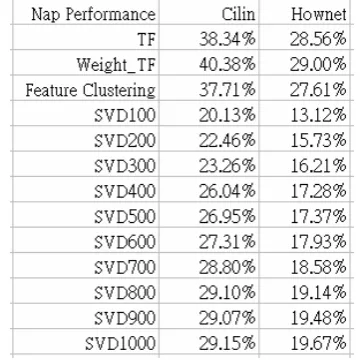
For the Nap evaluation, we prepared two testing data from Cilin and Hownet. In the high frequent words experiments, we extract 11331111 wwoorrddss w
wiitthhiinn 335522 synonyms sets from Cilin and 2981 s words within 570 synonyms sets from Hownet.
Figure 3. Nap performance for high frequent words
In high frequent experiments, the results show that the models retaining literal form perform better than dimension reduction methods. It
means in the task of measuring similarity of high frequent words using literal contextual feature vectors is more precise than using dimension reduction feature vectors.
In the infrequent words experiments, we can only extract 202 words distributed in 62 syno-nyms sets from Cilin and 1089 words within 222 synonyms sets. Due to fewer testing words, LSI was not applied in this experiment.
Figure 4. Nap performance for low frequent words
It shows with insufficient contextual informa-tion, the feature clustering method could not help in recalling synonyms because of dimensional reduction.
6. Error Analysis and Conclusion
Using context vector models to construct thesau-rus suffers from the problems of large feature dimensions and data sparseness. We propose a feature clustering method to overcome the prob-lems. The experimental results show that it per-forms better than the LSI models in distinguish-ing related/unrelated pairs for the infrequent data, and also achieve relevant scores on other evalua-tions.
Feature clustering method could raise the abil-ity of discrimination, but not robust enough to improve the performance in extracting synonyms. It also reveals the truth that it’s easy to distin-guish whether a pair is related or unrelated once the word pair shares the same sense in their senses. However, it’s not the case when seeking synonyms. One has to discriminate each sense for each word first and then compute the similar-ity between these senses to achieve synonyms. Because feature clustering method lacks the abil-ity of senses discrimination of a word, the method can handle the task of distinguishing cor-relation pairs rather than synonyms identification.
a) Some senses of synonyms in testing data are not their dominant senses.
Take guang1hua2 (光華) for example, it has a sense of “splendid” which is similar to the sense of guang1mang2 (光 芒). Guang1hua2 and guang1mang2 are certainly mutually changeable in a certain degree, guang1hua2jin4shi4 (光華盡
失) and guang1mang2jin4shi4 (光芒盡失), or
xi2ri4guang1hua2 ( 昔 日 光 華 ) and xi2ri4guang1mang2 (昔日光芒). However, the dominated contextual sense of guang1hua2 is more likely to be a place name, like guang1hua2shi4chang3( 光 華 市 場 ) or hua1lian2guang1hua2 (花蓮光華) etc3
.
b) Some synonyms are different in usages for pragmatic reasons.
Synonyms with different contextual vectors could be result from different perspective views. For example, we may view wai4jie4 (外界) as a container image with viewer inside, but on the other hand, yi3wai4 (以外) is an omnipotence perspective. This similar meaning but different perspective makes distinct grammatical usage and different collocations.
Similarly, zhong1shen1 (終身) and sheng1ping2 ( 生 平 ) both refer to “life-long time”. zhong1shen1 explicates things after a time point, which differs from sheng1ping2, showing mat-ters before a time point.
c) Domain specific usages.
For example, in medical domain news ,wa1wa1 (娃娃) occurs frequently with bo1li2 (玻璃) refer
3 This may due to different genres. In newspapers the
proper noun usage of guang1hua2 is more common than in a literature text.
to kind of illness. Then the corpus reinterpret wa1wa1 (娃娃) as a sick people, due to it occurs with medical term. But the synonym of wa1wa1 (娃 娃), xiao3peng2you3(小 朋 友) stands for money in some finance news. Therefore, the meanings of words change from time to time. It’s hard to decide whether meaning is the right an-swer when finding synonyms.
With above observations, our future researches will be how to distinguish different word senses from its context features. Once we could distin-guish the corresponding features for different senses, it will help us to extract more accurate synonyms for both frequent and infrequent words.
References
April Kontostathis, William M. Pottenger 2003. , A Framework for Understanding LSI Performance, In the Proceedings of the ACM SIGIR Workshop on Mathematical/Formal Methods in Information Re-trieval, Annual International SIGIR Conference, 2003.
Christiance Fellbaum, editor 1998,WordNet: An alec-tronic lwxical database. MIT press, Cambrige MA.
Deerwester, S.,et al. 1990 Indexing by Latent Seman-tic Analysis. Jorunal of the American Society for In-formation Science, 41(6):391-407
Dominic Widdows. 2003. Unsupervised methods for developing taxonomies by combining syntactic and statistical information. In Proceeding of HLT-NAACL 2003 Main papers, pp, 197-204.
E.M. Voorhees, “Implement agglomerative hierarchi-cal clustering algorithm for use in document re-trieval”, Information Processing & Management. , no. 22 pp.46-476,1986
Hofmann, T.1999. Probabilistic Latent Semantic Indexing. Proc.of the 22nd International conference on Research and Development in Information Retrieval (SIGIR’99),50-57
James R.Curran and Marc Moens. 2002. I mprove-ments in Automatic Thesaurus Extraction. Proceed-ings of the Workshop of the ACL Special Interest Group on the Lexicon (SIGLEX), pp. 59-66
Jia-Ming You and Keh-Jiann Chen, 2004 Automatic Semantic Role Assignment for a Tree Structure, Pro-Wai4jie4
外界
Yi3wai4以外
Omnipotence viewer
•
Zhong1shen1 終身
•
ceedings of 3rd ACL SIGHAN Workshop
Jiahua Lin. 1991. Divergence measures based on the Shannon Entropy. IEEE transactions on Information Theory, 37(1): 145-151
Lillian Lee. 2001. On the effectiveness of the skew divergence for statistical language analysis. In Artifi-cial Intelligence and Statistics 2001, page 65-72.
Lillian Lee. 1999. Measure of distributional similarity. In Proceeding of the 37th Annual Meeting of the As-sociation for Computational Linguistics (ACL-1999), page 23-32.
Masato Hagiwara, Yasuhiro Ogawa, and Katsuhiko Toyama. 2005. PLSI Utilization for Automatic The-saurus Construction. IJCNLP 2005, LNAI 651, pp. 334-345.
Mei,Jiaju,Yiming Lan, Yunqi Gao, Yongxian Ying (1983) 同 義 詞 詞 林 [ A Dictionary of Syno-nyms],Shanghai Cishu Chubanshe.
Mochihashi, D., Matsumoto, Y.2002. Probabilistic Representation of Meanings. IPSJ SIG Notes Natural Language, 2002-NL-147:77-84.
Appendix:
Some feature clustering results
一下一陣子
一千多四百多一百多二百多
一切災難性
一月份二月份類型
一生畢生一輩子生平
一年級國一大學部
一成三成兩成二成
一百多萬三百多萬一千多萬
一段大半較多多一點 空檔美東間隔 尖峰睡眠
美西需要
一家人家人親人
一席之地優勢
一氧化碳沼氣食物河豚粉塵
一級黨務行庫原由二級
一般性計畫型
一號機二號機
一銀二銀五金
一審原審陪審團審法院
一樓大會堂中庭
一舉一動動向事項言行舉止
一體中西文
乙級技術士廚師中餐
丁等甲等乙等丙等中醫師優等
七人九人六人九人決策
七夕西洋
七月號月刊八月號雜誌消息報週報二月號
七成六成八成五成四成九成
七股鰲鼓
七美東引
九孔 草蝦 鰻魚 石斑魚 虱目魚 文蛤 吳郭魚 牡蠣
甲魚箱網蝦子魚蝦蚵仔黑鯛魚群蝸牛
九份草嶺國姓鄉瑞芳鎮竹北市
二仁溪大漢溪淡水河漢江新店溪游泳池泳池鴨
綠江朴子溪後龍溪農漁局
二月十二月九月十一月十月七月元月
二年制四年制
二年級五年級大二
二次大戰第二次世界大戰大戰韓戰
二兵上士准將新聞官
二者兩者三者
二金三金一金
二段三段
二胡琵琶古箏吉他
二重疏洪道
二氧化碳 廢氣污染物廢水二氧化硫氣體柴油車
氧化物臭氣污染源
二專四技二專學校院校院
二組三組五組八組標準組組別梯隊
二號三號四號五號一號太原風雲型號
二路三路
二線三線四線
二壘三壘隊友
二讀會三讀會讀會提案
人人舉世舉國兩性
人力物力頻寬
人口 人數人口數 救濟金 大軍週數戶數家數 次
數隊數保險金頻率斷面
人才人材師資運動選手增長點搖籃英才專才
人文美學藝能科展
人文組數理組
人犯罪犯煙毒犯
人生寶島山城
人生觀價值觀觀念
人次車次
人行道騎樓
人身信仰言論性行為
人事費醫療費用利息保費保險費
人協黨代表會員懇親股東社員締約國
人命性命生命