Syllable-Based Speech Recognition for Amharic
Solomon Teferra Abate
[email protected]
[email protected]
Wolfgang Menzel
Uniformity of Hamburg, Department of Informatik Natural Language Systems Groups
Vogt-Kölln-Strasse. 30, D-22527 Hamburg, Germany
Abstract
Amharic is the Semitic language that has the second large number of speakers after Arabic (Hayward and Richard 1999). Its writing system is syllabic with Consonant-Vowel (CV) syllable structure. Amharic orthography has more or less a one to one correspondence with syllabic sounds. We have used this feature of Amharic to develop a CV syllable-based speech recognizer, using Hid-den Markov Modeling (HMM), and achieved 90.43% word recognition accuracy.
1
Introduction
Most of the Semitic languages are technologically unfavored. Amharic is one of these languages that are looking for technological considerations of re-searchers and developers in the area of natural lan-guage processing (NLP). Automatic Speech Re-cognition (ASR) is one of the major areas of NLP that is understudied in Amharic. Only few attempts (Solomon, 2001; Kinfe, 2002; Zegaye, 2003; Martha, 2003; Hussien and Gambäck, 2005; Solomon et al., 2005; Solomon, 2006) have been made.
We have developed an ASR for the language using CV syllables as recognition units. In this paper we present the development and the recognition performance of the recognizer following a brief description of the Amharic language and speech recognition technology.
2
The Amharic Language
Amharic, which belongs to the Semitic language family, is the official language of Ethiopia. In this family, Amharic stands second in its number of speakers after Arabic (Hayward and Richard 1999). Amharic has five dialectical variations (Ad-dis Ababa, Gojjam, Gonder, Wollo, and Menz) spoken in different regions of the country (Cowley,
et.al. 1976). The speech of Addis Ababa has emerged as the standard dialect and has wide cur-rency across all Amharic-speaking communities (Hayward and Richard 1999).
As with all of the other languages, Amharic has its own characterizing phonetic, phonological and morphological properties. For example, it has a set of speech sounds that is not found in other lan-guages. For example the following sounds are not found in English: [p`], [tЅ`], [s`], [t`], and [q].
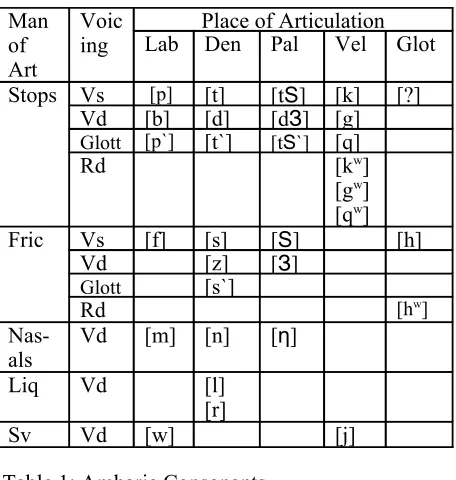
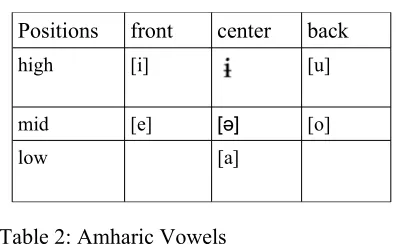
Amharic also has its own inventory of speech sounds. It has thirty one consonants and seven vowels. The consonants are generally classified as stops, fricatives, nasals, liquids, and semi-vowels (Leslau 2000). Tables 1 and 2 show the classifica-tion of Amharic consonants and vowels1.
Man of Art
Voic
ing Lab Den Pal Place of ArticulationVel Glot
Stops Vs [p] [t] [tЅ] [k] [?]
Vd [b] [d] [dЗ] [g]
Glott [p`] [t`] [tЅ`] [q]
Rd [kw]
[gw]
[qw]
Fric Vs [f] [s] [Ѕ] [h]
Vd [z] [З]
Glott [s`]
Rd [hw]
Nas-als Vd [m] [n] [η]
Liq Vd [l]
[r]
Sv Vd [w] [j]
Table 1: Amharic Consonants
Key: Lab = Labials; Den = Dentals; Pal = Palat-als; Vel = Velars; Glot = Glottal; Vs = Voiceless;
1International Phonetic Association's (IPA) standard has
Vd = Voiced; Rd = Rounded; Fric = Fricatives; Liq = Liquids; Sv = Semi-Vowels.
Positions front center back high [i] [u]
mid [e] [ə] [o]
low [a]
Table 2: Amharic Vowels
Amharic is one of the languages that have their own writing system, which is used across all haric dialects. Getachew (1967) stated that the Am-haric writing system is phonetic. It allows any one to write Amharic texts if s/he can speak Amharic and has knowledge of the Amharic alphabet. Un-like most known languages, no one needs to learn how to spell Amharic words. In support of the above point, Leslaw (1995) noted that no real problems exist in Amharic orthography, as there is more or less, a one-to-one correspondence between the sounds and the graphic symbols, except for the gemination of consonants and some redundant symbols.
Many (Bender 1976; Cowley 1976; Baye 1986) have claimed the Amharic orthography as a syllab-ary for a relatively long period of time. Recently, however, Taddesse (1994) and Baye (1997), who apparently modified his view, have argued it is not. Both of these arguments are based on the special feature of the orthography; the possibility of rep-resenting speech using either isolated phoneme symbols or concatenated symbols.
In the concatenated feature, commonly known to most of the population, each orthographic symbol represents a consonant and a vowel, except for the sixth order2, which is sometimes realized as a
sonant without a vowel and at other times a con-sonant with a vowel. This representation of concat-enated speech sounds by a single symbol has been the basis for the claim made of the writing system, as syllabary.
Amharic orthography does not indicate gemination, but since there are relatively few
2An order in Amharic writing system is a combination of a
consonant with a vowel represented by a symbol. A consonant has therefore, 7 orders or different symbols that represent its combination with 7 Amharic vowels.
minimal pairs of geminations, Amharic readers do not find this to be a problem. This property of the writing system is analogous to the vowels of Arabic and Hebrew, which are not normally indicated in writing.
The Amharic orthography, as represented in the Amharic Character set - also called [fidəlI] con-sists of 276 distinct symbols. In addition, there are twenty numerals and eight punctuation marks. A sample of the orthographic symbols is given in Table 3.
ə u i a e o
h ሀ ሁ ሂ ሃ ሄ ህ ሆ
l ለ ሉ ሊ ላ ሌ ል ሎ
m መ ሙ ሚ ማ ሜ ም ሞ
r ረ ሩ ሪ ራ ሬ ር ሮ
Table 3: Some Orthographic Symbols of Amharic However, research in speech recognition should only consider distinct sounds instead of all the or-thographic symbols, unless there is a need to de-velop a dictation machine that includes all of the orthographic symbols. Therefore, redundant ortho-graphic symbols that represent the same syllabic sounds can be eliminated. Thus, by eliminating re-dundant graphemes, we are left with a total of 233 distinct CV syllable characters. In our work, an HMM model has been developed for each of these CV syllables.
3
HMM-Based Speech Recognition
The most well known and well performing ap-proach for speech recognition are Hidden Markov Models (HMM). An HMM can be classified on the basis of the type of its observation distributions, the structure in its transition matrix and the number of states.
The observation distributions of HMMs can be either discrete, or continuous. In discrete HMMs, distributions are defined on finite spaces while in continuous HMMs, distributions are defined as probability densities on continuous observation spaces, usually as a mixture of several Gaussian distributions.
because the speech signal varies in time from left to right (Deller, Proakis and Hansen 1993).
An HMM is flexible in its size, type, or architec-ture to model words as well as any sub-word unit.
3.1
Sub-word Units of Speech Recognition
Large Vocabulary Automatic Speech Recognition Systems (LVASRSs) require modeling of speech in smaller units than words because the acoustic samples of most words will never be seen during training, and therefore, can not be trained. Moreover, in LVASRSs there are thousands of words and most of them occur very rarely, con-sequently training of models for whole words is generally impractical. That is why LVASRSs re-quire a segmentation of each word in the vocabu-lary into sub-word units that occur more frequently and can be trained more robustly than words. Us-ing sub-word based models enables us to deal with words which have not been seen during training since they can just be decomposed into the word units. As a word can be decomposed in sub-word units of different granularities, there is a need to choose the most suitable sub-word unit that fits the purpose of the system.
Lee et al. (1992) pointed out that there are two alternatives for choosing the fundamental sub-word units, namely acoustically-based and linguist-ically-based units . The acoustic units are the labels assigned to acoustic segment models, which are defined on the basis of procuring a set of segment models that spans the acoustic space determined by the given, unlabeled training data. The linguistic-ally-based units include the linguistic units, e.g. phones, demi-syllables, syllables and morphemes.
It should be clear that there is no ideal (perfect) set of sub-word units. Although phones are very small in number and relatively easy to train, they are much more sensitive to contextual influences than larger units. The use of triphones, which mod-el both the right and left context of a phone, has become the dominant solution to the problem of the context sensitivity of phones.
Triphones are also relatively inefficient sub-word units due to their large number. Moreover, since a triphone unit spans a short time-interval, it is not suitable for the integration of spectral and temporal dependencies.
An other alternative is the syllable. Syllables are longer and less context sensitive than phones and capable of exploiting both the spectral and
tempor-al characteristics of continuous speech (Ganapathiraju et al. 1997). Moreover, the syllable has a close connection to articulation, integrates some co-articulation phenomena, and has the po-tential for a relatively compact representation of conversational speech.
Therefore, different attempts have been made to use syllables as a unit of recognition for the devel-opment of ASR. To mention a few: Ganapathiraju et al. (1997) have explored techniques to accentu-ate the strengths of syllable-based modeling with a primary interest of integrating finite-duration mod-eling and monosyllabic word modmod-eling. Wu et al. (1998) tried to extract the features of speech over the syllabic duration (250ms), considering syllable-length interval to be 100-250ms. Hu et al. (1996) used a pronunciation dictionary of syllable-like units that are created from sequences of phones for which the boundary is difficult to detect. Kanok-phara (2003) used syllable-structure-based tri-phones as speech recognition units for Thai.
However, syllables are too many in a number of languages, such as English, to be trained properly. Thus ASR researchers in languages like English are led to choose phones where as for Amharic it seems promising to consider syllables as an altern-ative, because Amharic has only 233 distinct CV syllables.
4
Syllable-Based Speech Recognition for
Amharic
In the development of syllable-based LVASRSs for Amharic we need to deal with a language mod-el, pronunciation dictionary, initialization and training of the HMM models, and identification of the proper HMM topologies that can be properly trained with the available data. This section presents the development and the performance of syllable based speech recognizers.
4.1 The Language Model
4.2 The Pronunciation Dictionary
The development of a large vocabulary speaker in-dependent recognition system requires the availab-ility of an appropriate pronunciation dictionary. It specifies the finite set of words that may be output by the speech recognizer and gives, at least, one pronunciation for each. A pronunciation dictionary can be classified as a canonical or alternative on the basis of the pronunciations it includes.
A canonical pronunciation dictionary includes only the standard phone (or other sub-word) se-quence assumed to be pronounced in read speech. It does not consider pronunciation variations such as speaker variability, dialect, or co-articulation in conversational speech. On the other hand, an al-ternative pronunciation dictionary uses the actual phone (or other sub-word) sequences pronounced in speech. In an alternative pronunciation diction-ary, various pronunciation variations can be in-cluded (Fukada et al. 1999).
We have used the pronunciation dictionary that has been developed by Solomon et al. (2005). They have developed a canonical and an alternative pro-nunciation dictionaries. Their canonical dictionary transcribes 50,000 words and the alternative one transcribes 25,000 words in terms of CV syllables.
Both these pronunciation dictionaries do not handle the difference between geminated and non-geminated consonants; the variation of the pronun-ciation of the sixth order grapheme, with or without vowel; and the absence or presence of the glottal stop consonant. Gemination of Amharic consonants range from a slight lengthening to much more than doubling. In the dictionary, however, they are represented with the same tran-scription symbols.
The sixth order grapheme may be realized with or without vowel but the pronunciation dictionaries do not indicate this difference. For example, the dictionaries used the same symbol for the syllable [rI] in the word [dЗəmərInI] 'we started', whose vowel part may not be realized, and in the word [bərIzo] 'he diluted with water' that is always real-ized with its vowel sound. That forces a syllable model to capture two different sounds: a sound of a consonant followed by a vowel, and a sound of the consonant only. A similar problem occurs with the glottal stop consonant [?] which may be uttered or not.
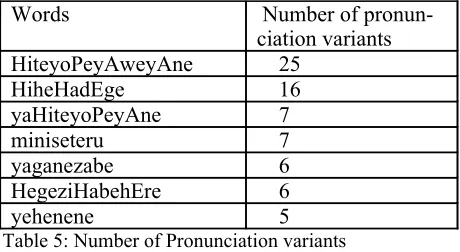
A sample of pronunciations in the canonical and alternative pronunciation dictionaries is given in Table 43. The alternative pronunciation dictionary
contains up to 25 pronunciation variants per word form. Table 5 illustrates some cases of the vari-ation.
Words
Canonical Pro-nunciation
Alternative Pronun-ciation
CAmA
CA mA sp CA mA sp Ca mA sp
Hitey-oPeyA
Hi te yo Pe yA
sp Hi te yo Pe yA sp Hi te yo Pi yA sp Hi to Pe yA sp te yo Pe yA sp to Pe yA sp Table 4: Canonical and Alternative Pronunciation
Words Number of
pronun-ciation variants HiteyoPeyAweyAne 25
HiheHadEge 16
yaHiteyoPeyAne 7
miniseteru 7
yaganezabe 6
HegeziHabehEre 6
yehenene 5
Table 5: Number of Pronunciation variants
Although it does not handle gemination and pro-nunciation variabilities, the canonical pronunci-ation dictionary contains all 233 distinct CV syl-lables of Amharic, which is 100% syllable cover-age.
Pronunciation dictionaries of development and evaluation test sets have been extracted from the canonical pronunciation dictionary. These test dic-tionaries have 5,000 and 20,000 words each.
4.3 The Acoustic Model
For training and evaluation of our recognizers, we have used the Amharic read speech corpus that has been developed by Solomon et al. (2005).
The speech corpus consists of a training set, a speaker adaptation set, development test sets (for 5,000 and 20,000 vocabularies), and evaluation test sets (for 5,000 and 20,000 vocabularies). It is a medium size speech corpus of 20 hours of training speech that has been read by 100 training speakers who read a total of 10850 different sentences. Eighty of the training speakers are from the Addis
Ababa dialect while the other twenty are from the other four dialects.
Test and speaker adaptation sets were read by twenty other speakers of the Addis Ababa dialect and four speakers of the other four dialects. Each speaker read 18 different sentences for the 5,000 vocabulary (development and evaluation sets each) and 20 different sentences for the 20,000 vocabu-lary (development and evaluation sets each) test sets. For the adaptation set all of these readers read 53 adaptation sentences that consist of all Amharic CV syllables.
Initialization: Training HMM models starts with initialization. Initialization of the model for a set of sub-word HMMs prior to re-estimation can be achieved in two different ways: bootstrapping and flat start. The latter implies that during the first cycle of embedded re-estimation, each training ut-terance will be uniformly segmented. The hope of using such a procedure is that in the second and subsequent iterations, the models align as intended.
We have initialized HMMs with both methods and trained them in the same way. The HMMs that have been initialized with the flat start method per-formed better (40% word recognition accuracy) on development test set of 5,000 words.
The problem with the bootstrapping approach is that any error of the labeler strongly affects the performance of the resulting model because con-secutive training steps are influenced by the initial value of the model. As a result, we did not benefit from the use of the segmented speech, which has been transcribed with a speech recognizer that has low word recognition accuracy, and edited by non-linguist listeners. We have, therefore, continued our subsequent experiments with the flat start ini-tialization method.
Training: We have used the Baum-Welch re-es-timation procedure for the training. In training sub-word HMMs that are initialized using the flat-start procedure, this re-estimation procedure uses the parameters of continuously spoken utterances as an input source. A transcription, in terms of sub-word units, is also needed for each input utterance. Us-ing the speech parameters and their transcription, the complete set of sub-word HMMs are re-estim-ated simultaneously. Then all of the sub-word HMMs corresponding to the sub-word list are joined together to make a single composite HMM. It is important to emphasize that in this process the transcriptions are only needed to identify the
se-quence of sub-word units in each utterance. No boundary information is required (Young et al. 2002).
The major problem with HMM training is that it requires a great amount of speech data. To over-come the problem of training with insufficient speech data, a variety of sharing mechanisms can be implemented. For example, HMM parameters are tied together so that the training data is pooled and more robust estimates result. It is also possible to restrict the model to a variance vector for the de-scription of output probabilities, instead of a full covariance matrix. Rabiner and Juang(1993) poin-ted out that for the continuous HMM models, it is preferable to use diagonal covariance matrices with several mixtures, rather than fewer mixtures with full covariance matrices to perform reliable re-es-timation of the components of the model from lim-ited training data. The diagonal covariance matrices have been used in our work.
HMM Topologies: To our knowledge, there is no topology of HMM model that can be taken as a rule of thumb for modeling syllable HMMs, espe-cially, for Amharic CV syllables. To have a good HMM model for Amharic CV syllables, one needs to conduct experiments to select the optimal model topology. Designing an HMM topology has to be done with proper consideration of the size of the unit of recognition and the amount of the training speech data. This is because as the size of the re-cognition unit increases and the size of the model (in terms of the number of parameters to be re-es-timated) grows, the model requires more training data.
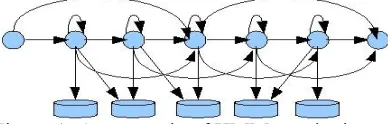
We, therefore, carried out a series of experi-ments using a left-to-right HMM with and without jumps and skips, with a different number of emit-ting states (3, 5, 6, 7, 8, 9, 10 and 11) and different number of Gaussian mixtures (from 2 to 98). By jump we mean skips from the first non-emitting state to the middle state and/or from the middle state to the last non-emitting state. Figure 1 shows a left-to-right HMM of 5 emitting states with jumps and skips.
We have assumed that the problem of gemina-tion may be compensated by the looping state transitions of the HMM. Accordingly, CV syllables containing geminated consonants should have a higher loop probability than those with the non-geminated consonants.
To develop a solution for the problem of the ir-regularities in the realization of the sixth order vowel [I] and the glottal stop consonant [?], HMM topologies with jumps have been used.
We conducted an experiment using HMMs with a jump from the middle state to the last (non-emit-ting) state for all of the CV syllables with the sixth order vowel, and a jump from the first emitting state to the middle state for all of the CV syllables with the glottal stop consonant. The CV syllable with the glottal stop consonant and the 6th order
vowel have both jumps. These topologies have been chosen so that the models recognize the ab-sence of the vowel and the glottal stop consonant of CV syllables. This assumption was confirmed by the observation that the trained models favor such a jump. A model, which has 5 emitting states, of the glottal stop consonant with the sixth order vowel tends to start emitting with the 3rd emitting
state with a probability of 0.72. The model also has accumulated a considerable probability (0.38) to jump from the 3rd emitting state to the last
(non-emitting) state.
A similar model of this consonant with the other vowels (our example is the 5th order vowel) tend to
start emitting with the 3rd emitting state with a
probability of 0.68. This is two times the probabil-ity (0.32) of its transition from the starting (non-emitting state) to the 1st emitting state.
The models of the other consonants with the sixth order vowel, which are exemplified by the model of the syllable [jI], tend to jump from the 3rd
emitting state to the last (non-emitting) state with a probability of 0.39, which is considerably greater than that of continuing with the next state (0.09).
Since the amount of available training speech is not enough to train transition probabilities for skip-ping two or more states, the number of states to be skipped have been limited to one.
To determine the optimal number of Gaussian mixtures for the syllable models, we have conduc-ted a series of experiments by adding two Gaussian mixtures for all the models until the performance of the model starts to degrade. Considering the dif-ference in the frequency of the CV syllables, a
hy-brid number of Gaussian mixtures has been tried. By hybrid, we mean that Gaussian mixtures are as-signed to different syllables based on their fre-quency. For example: the frequent syllables, like [nI], are assigned up to fifty-eight while rare syl-lables, like [p`i], are assigned not more than two Gaussian mixtures.
4.4 Performance of the Recognizers
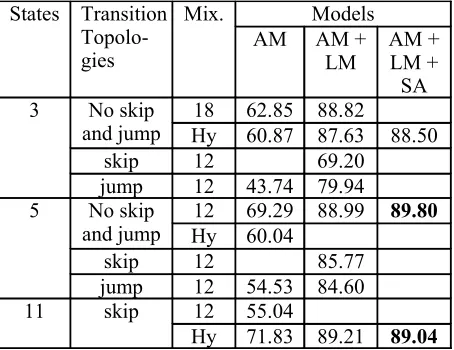
We present recognition results of only those recog-nizers which have competitive performance to the best performing models. For example: the perform-ance of the model with 11 emitting states with skips and hybrid Gaussian mixtures is more com-petitive than those with 7, 8, 9, and 10 emitting states. We have also systematically left out test res-ults which are worse than those presented in Table 6. Table 64 shows evaluation results made on the
5k development test set.
States Transition Topolo-gies
Mix. Models AM AM +
LM
AM + LM +
SA 3 No skip
and jump Hy18 62.8560.87 88.8287.63 88.50
skip 12 69.20
jump 12 43.74 79.94 5 No skip
and jump Hy12 69.2960.04 88.99 89.80
skip 12 85.77
jump 12 54.53 84.60 11 skip 12 55.04
Hy 71.83 89.21 89.04
Table 6: Recognition Performance on 5k Develop-ment test set
From Table 6, we can see that the models with five emitting states, with twelve Gaussian mix-tures, without skips and jumps has the best (89.80%) word recognition accuracy. It has 87.69% word recognition accuracy on the 20k de-velopment test set.
Since the most commonly used number of HMM states for phone-based speech recognizers is three emitting states, one may expect a model of six emitting states to be the best for an HMM of
4In tables 6 and 7, States refers to the number of emitting
concatenated consonant and vowel. But the result of our experiment shows that a CV syllable-based recognizer with only five emitting states performed better than all the other recognizers.
As we can see from Table 6, models with three emitting states do have a competitive performance with 18 and hybrid Gaussian mixtures. They have the least number of states of all our models. Never-theless, they require more storage space (33MB with 18 Gaussian mixtures and 34MB with hybrid Gaussian mixtures) than the best performing mod-els (32MB). Modmod-els with three emitting states also have larger number of total Gaussian mixtures5
(30,401 with 18 Gaussian mixtures and 31,384 with hybrid Gaussian mixtures) than the best per-forming models (13,626 Gaussian mixtures).
The other model topology that is competitive in word recognition performance is the model with eleven emitting states, with skip and hybrid Gaus-sian mixtures, which has a word recognition accur-acy of 89.21%. It requires the biggest memory space (40MB) and uses the largest number of total Gaussian mixtures (36,619) of all the models we have developed.
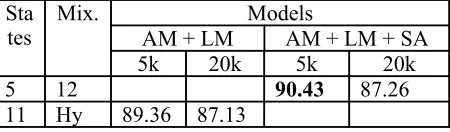
We have evaluated the top two models with re-gard to their word recognition accuracy on the evaluation test sets. Their performance is presented in Table 7. As it can be seen from the table, the models with the better performance on the devel-opment test sets also showed better results with the evaluation test sets. We can, therefore, say that the model with five emitting states without skips and twelve Gaussian mixtures is preferable not only with regard to its word recognition accuracy, but also with regard to its memory requirements.
Sta tes
Mix. Models
AM + LM AM + LM + SA
5k 20k 5k 20k
5 12 90.43 87.26
11 Hy 89.36 87.13
Table 7: Recognition Performance on 5k and 20k Evaluation test sets
For a comparison purpose, we have developed a baseline word-internal triphone-based recognizer using the same corpus. The models of 3 emitting states, 12 Gaussian mixtures, with skips have the
5We counted the Gaussian mixtures that are physically
saved, instead of what should actually be.
best word recognition accuracy (91.31%) of all the other triphone-based recognizers that we have de-veloped. This recognizer also has better word re-cognition accuracy than that of our syllable-based recognizer (90.43%). But tying is applied only for the triphone-based recognizers.
However the triphone-based recognizer requires much more storage space (38MB) than the syl-lable-based recognizer that requires only 15MB space. With regard to their speed of processing, the syllable-based model was 37% faster than tri-phone-based one.
These are encouraging results as compared to the performance reported by Afify et al. (2005) for Arabic speech recognition (14.2% word error rate). They have used a trigram language model with a lexicon of 60k vocabulary.
4.5 Conclusions and Research Areas in the Future
We conclude that the use of CV syllables is a promising alternative in the development of ASRSs for Amharic. Although there are still pos-sibilities of performance improvement, we have got an encouraging word recognition accuracy (90.43%). Some of the possibilities of performance improvement are:
•The pronunciation dictionary that we have used does not handle the problem of gemination of consonants and the irregular realization of the sixth order vowel and the glottal stop consonant, which has a direct effect on the quality of the sub-word transcriptions. Proper editing (use of phonetic transcription) of the pronunciation dic-tionaries which, however, requires a consider-able amount of work, certainly will result in a higher quality of sub-word transcription and consequently in the improvement of the recog-nizers' performance. By switching from the grapheme-based recognizer to phonetic-based recognizer in Arabic, Afif et al. (2005) gained relative word error rate reduction of 10% to 14%.
5
References
Afif, Mohamed, Long Nguyen, Bing Xiang, Sherif Ab-dou, and John Makhoul. 2005. Recent progress in Ar-abic broadcast news transcription at BBN. In INTER SPEECH2005, 1637-1640
Baye Yimam and TEAM 503 students. 1997. "ፊደል እንደገና" Ethiopian Journal of Languages and Literat-ure 7(1997): 1-32.
Baye Yimam. 1986. "የአማርኛ ሰዋሰው". Addis Ababa. ት.መ.ማ.ማ.ድ.
Bender, L.M. and Ferguson C. 1976. The Ethiopian Writing System. In Language in Ethiopia. Edited by M.L. Bender, J.D. Bowen, R.L. Cooper, and C.A. Ferguson. London: Oxford University press.
Cowley, Roger, Marvin L. Bender and Charles A. Fer-gusone. 1976. The Amharic Language-Description. In Language in Ethiopia. Edited by M.L. Bender, J.D. Bowen, R.L. Cooper, and C.A. Ferguson. Lon-don: Oxford University press.
Deller, J.R. Jr., Hansen, J.H.L. and Proakis, J.G., Dis-crete-time Processing of Speech Signals. Macmillan Publishing Company, New York, 2000.
Fukada, Toshiaki, Takayoshi Yoshimura and Yoshinori Sagisa. 1999. Automatic generation of multiple pro-nunciations based on neural networks. Speech
Com-munication 27:63—73
http://citeseer.ist.psu.edu/fukada99automatic.html. Ganapathiraju, Aravind; Jonathan Hamaker; Mark
Or-dowski; and George R. Doddington. 1997. Joseph Pi-cone. Syllable-based Large Vocabulary Continuous Speech Recognition.
Getachew Haile. 1967. The Problems of the Amharic Writing System. A paper presented in advance for the interdisciplinary seminar of the Faculty of Arts and Education. HSIU.
Hayward, Katrina and Richard J. Hayward. 1999. Am-haric. In Handbook of the International Phonetic As-sociation: A guide to the use of the International Phonetic Alphabet. Cambridge: the University Press. Hu, Zhihong; Johan Schalkwyk; Etienne Barnard; and
Ronald Cole. 1996. Speech recognition using syllable like units. Proc. Int'l Conf. on Spoken Language Pro-cessing (ICSLP), 2:426-429.
Kanokphara, Supphanat; Virongrong Tesprasit and Rachod Thongprasirt. 2003. Pronunciation Variation Speech Recognition Without Dictionary Modifica-tion on Sparse Database, IEEE InternaModifica-tional Confer-ence on Acoustics, Speech, and Signal Processing (ICASSP 2003, Hong Kong).
Kinfe Tadesse. 2002. Sub-word Based Amharic Word Recognition: An Experiment Using Hidden Markov Model (HMM), M.Sc Thesis. Addis Ababa Uni-versity Faculty of Informatics. Addis Ababa.
Lee, C-H., Gauvain, J-L., Pieraccini, R. and Rabiner, L. R.. 1992. Large vocabulary speech recognition using subword units. Proc. ICSST-92, Brisbane, Australia, pp. 342-353.
Leslau, W. 2000. Introductory Grammar of Amharic, Wiesbaden: Harrassowitz.
Martha Yifiru. 2003. Application of Amharic speech re-cognition system to command and control computer: An experiment with Microsoft Word, M.Sc Thesis. Addis Ababa University Faculty of Informatics. Ad-dis Ababa.
Rabiner, L. and Juang, B. 1993. Fundamentals of speech recognition. Englewood Cliffs, NJ.
Hussien Seid and Björn. Gambäck 2005. A Speaker In-dependent Continuous Speech Recognizer for Am-haric. In: INTERSPEECH 2005, 9th European Con-ference on Speech Communication and Technology. Lisbon, September 4-9.
Solomon Birihanu. 2001. Isolated Amharic Consonant-Vowel (CV) Syllable Recognition, M.Sc Thesis. Ad-dis Ababa University Faculty of Informatics. AdAd-dis Ababa.
Solomon Teferra Abate. 2006. Automatic Speech Re-cognition for Amharic. Ph.D. Thesis. University of Hamburg. Hamburg.
Solomon Teferra Abate, Wolfgang Menzel and Bairu Tafla. 2005. An Amharic Speech Corpus for Large Vocabulary Continuous Speech Recognition. In: IN-TERSPEECH 2005, 9th European Conference on Speech Communication and Technology. Lisbon, September 4-9.
Tadesse Beyene. 1994. The Ethiopian Writing System. Paper presented at the 12th International Conference of Ethiopian Studies, Michigan State University. Wu, Su-Lin. 1998. Incorporating Information from
Syl-lable-length Time Scales into Automatic Speech Re-cognition. PhD thesis, University of California, Berkeley, CA.
Young, Steve; Dan Kershaw; Julian Odell and Dave Ol-lason. 2002. The HTK Book.
Zegaye Seyifu. 2003. Large vocabulary, speaker inde-pendent, continuous Amharic speech recognition, M.Sc Thesis. Addis Ababa University Faculty of