
Volume 3, No. 7, Nov-Dec 2012
International Journal of Advanced Research in Computer Science
RESEARCH PAPER
Available Online at www.ijarcs.info
ISSN No. 0976-5697
English Character Recognition using Quadrant Feature Extraction Method and Artificial
Neural Nework
Manas Sen*
B.Tech 4th Year Student
Department of Computer Science & Engineering Murshidabad College of Engineering & Technology
Murshidabad, West Bengal, India [email protected]
Bithi Biswas
B.Tech 4th Year Student
Department of Computer Science & Engineering Murshidabad College of Engineering & Technology
Murshidabad, West Bengal, India [email protected]
Mithun Biswas
Assistant Professor
Department of Computer Science & Engineering Murshidabad College of Engineering & Technology
Murshidabad, West Bengal, India [email protected]
Abstract: This paper proposes a scheme for recognition of English characters based on features derived from partitioning the character image into quadrant cells. Pixel counted from each quadrant in anticlockwise direction; contribute towards generation of the feature vector. A total of 51 quadrants lead to the generation of a 51-element feature vector. A neural network (multi-layered perception) is used for classifying the 26 alphabets of the English language. Accuracies obtained are demonstrated to have been improved upon with respect to contemporary works.
Keywords: quadrant feature; neural network; multilayered perception; feature vector
I. INTRODUCTION
English Character Recognition is a pattern recognition process .Even human too sometimes makes mistakes during pattern recognition .When it comes to the computer it will be more difficult. Many algorithms have been proposed by researchers to efficiently recognize printed characters primarily using their shapes, styles, sizes, orientations etc. however because of the difference in writing styles and variety of fonts available today, it still remains a challenging task to do so in a completely error free manner. This paper proposes a technique for recognizing English alphabets based on a 51-element feature vector derived by using a quadrant method. According to experiments, we conclude that this method has advantages in other similar methods for pattern recognition.
II. PREVIOUSWORK
A number of researches have been proposed over the years for character recognition. In [1] the authors have divided each character into a number of predetermined rectangular zones and extracted a 13-element vector comprising of the pixel values in those zones. A neural network classifier has been used to recognize the 26 alphabets of English language. In [2] the authors have proposed twelve directional features based upon gradients of pixels and employed neural networks for classification of handwritten characters. In [3] the authors are concerned with recognizing composite characters in Bengali language formed by joining two or more basic characters, by resizing the characters in a 16 × 16 grid and utilizing a 256
element vector extracted from them by reading the pixel values. Curvelet transforms along with SVM classifiers have been used in [4] to recognize Bangla handwritten characters. In [5] the authors have decomposed characters into a set of structural shape units and used s dynamic time warping based classifiers to identify component shapes in a character. In [6] the authors have used a 392-element feature vector derived from Modified Quadratic Discriminant Function obtained from the gradient image, to identify Bangla compound characters. Fuzzy rule descriptors have been used in [7] to identify handwritten numerals. In [8] a 110-element direction code representing structural shape units have been utilized for recognition of handwritten characters. Wavelet Energy Density Features derived from the DB4 wavelet have been used in [9] to identify numerals 0 to 9 using a 252-element vector.
for letter detection. Hidden Markov Models (HMM) and Dynamic Bayesian Network (DBN) classifiers have been employed in [14] to recognize handwritten Arabic words. In [15] the authors have proposed a novel method to identify script lines in handwritten whiteboard notes by assigning the sample points of the script trajectory using Viterbi Algorithm. A “critical region analysis” technique based on the outputs of the Fishe’s Discriminant, have been used to identify handwritten Chinese characters. In [16] the authors have used convex hull & water reservoir principle to recognize multi-sized and multi-oriented characters of Bangla and Devnagari script, along with Support Vector Machine (SVM) classifiers. Structural units called strokes have been used in [5] to identify handwritten Bengali characters using a Hidden Markov Model classifier.
III. PROPOSEDMETHOD
In this section, we will accomplish the following tasks. Image acquisition, preprocessing and feature extraction with Quadrant feature extraction method.
A. Image Acquisition:
Data characters are collected from different fonts. The image of different data characters is shown in Fig.1 below:
Figure 1. The image of the data character.
B. Gray the image
In this process the image is converted from three dimensional images to two dimensional images. Though the matrix containing single character have changed from 48x48x3 to 48x48.
[image:2.612.394.506.62.110.2]
Figure 2. The image after gray.
C. Binarization of Image:
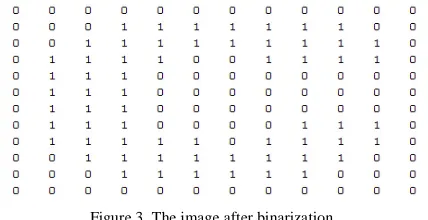
[image:2.612.337.567.192.717.2]The matrix is complicated because the elements in the matrix cover from 0 to 255. Therefore, we make a processing of binarization on the image. The elements originally from ‘0’ to ‘255’ are replaced by ‘0’ or ‘1’.The image after binarization is shown in Fig.3.
Figure 3. The image after binarization.
D. Shrink the Character matrix of image:
In this process the matrix is shrink to smaller one that can be easily calculated and contain all useful information. After shrinking, the image is shown in Fig. 4.
Figure 4. The image after shrinking.
E. Qudrant feature extraction method:
In this section, we will introduce the Quadrant feature extraction method. The proposed approach is summarized as follows:
a. The whole rectangle image is divided into 4 quadrants and each quadrant is divided into 4 sub quadrants.
b. The top right corner sub quadrant is divided into three different size windows and all pixel values of the image within the boundaries of the windows are summed up.
c. The process is repeated for all the sub quadrants of 1st quadrant in anticlockwise direction and the sum of pixel values at 1st quadrant gives rise to a 12-element vector V12.
d. The whole process is repeated for 2nd, 3rd and 4th quadrant in anticlockwise direction. Element vector V12 is obtained for all the three quadrants.
e. The whole rectangle image is taken as 5th quadrant. Similarly the process is repeated again. The sum of pixel values at 5thquadrant gives rise to a 3-element vector V3.
f. All these values are subsequently concatenated to generate a 51-element vector which is used as the feature vector for character recognition i.e. V51 = V12 + V12 + V12 + V12 + V3.
[image:2.612.340.559.440.722.2] [image:2.612.55.269.561.671.2]Classification of the characters is done by a collection of features obtained from 30 different instances of the character obtained during a training phase. The features are then fed to a neural network classifier using feed-forward back-propagation architecture (MLP: multi-layer perceptron) to compute class probability of 10 instances of test images for each character. The procedure is repeated for all the 26 characters of the English alphabet and the overall accuracy of the recognition system is determined.
IV. EXPERIMENTATIONANDRESULTS
A. Data Set:
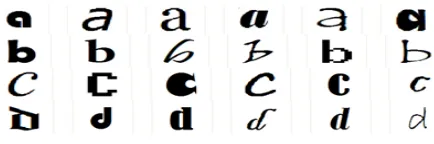
[image:3.612.326.567.54.294.2]The dataset consists of 1040 images of lower-case English alphabets of various appearances divided into training and testing sets. The training set consists of 30 different instances of each of the 26 English alphabets, a total of 780 images. The training set is indicated by legends AT, BT, CT, …, ZT. The testing set consists of 10 different instances of each of the 26 alphabets, a total of 260 images. The testing set is indicated by legends AS, BS, CS, …, ZS. Samples of the characters used are shown below.
Figure 6. Samples of characters in the dataset.
B. Training phase:
[image:3.612.40.257.321.393.2]The training phase consists of computing the 51-element feature vectors from each of the 780 images of the training set, using the quadrant method. The feature plots for the training set, is shown below. The legend ‘T’ denotes the Training set. Fig. 7 indicates the variation of the mean values of the first 17 elements of the feature vector over all the 51 instances of each character, shown for the first 12 characters, here x-axis refers zones and y-axis refers corresponding zone values
Figure 7. Mean values of elements 1 – 17 of feature vector of training set.
[image:3.612.326.568.380.727.2] [image:3.612.39.287.535.736.2]Figure 8. Mean values of elements 18 – 34 of feature vector of training set.
[image:4.612.324.567.165.670.2]Fig. 9 indicates the variation in mean values of the next 17 elements of the feature vector (i.e. elements 35-51) over all the 51 instances of each character, shown for the first 12 characters, here x-axis refers zones and y-axis refers corresponding zone values
Figure 9. Mean values of elements 35 – 51 of feature vector of training set.
C. Testing Set:
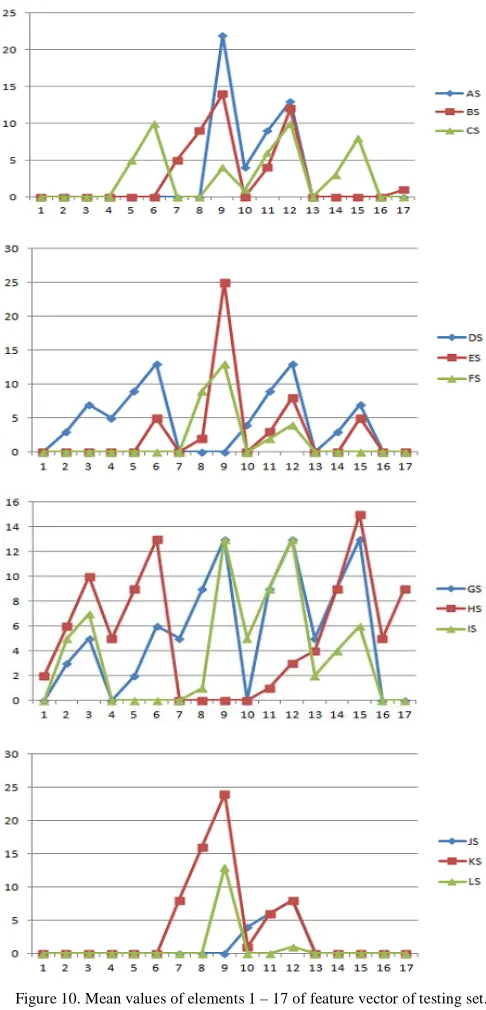
The testing phase consists of computing the 51-element feature vectors from each of the 260 images of the testing set, using the quadrant algorithm. The feature plots for the testing set, is shown below. The legend ‘S’ denotes the Testing set. Fig. 10 indicates the variation of the mean values of the first 17 elements of the feature vector over all the 10 instances of each character, shown for the first 12 characters, here x-axis refers zones and y-axis refers corresponding zone values
Figure 10. Mean values of elements 1 – 17 of feature vector of testing set.
[image:4.612.38.283.255.719.2]Figure 11. Mean values of elements 18 – 34 of feature vector of testing set.
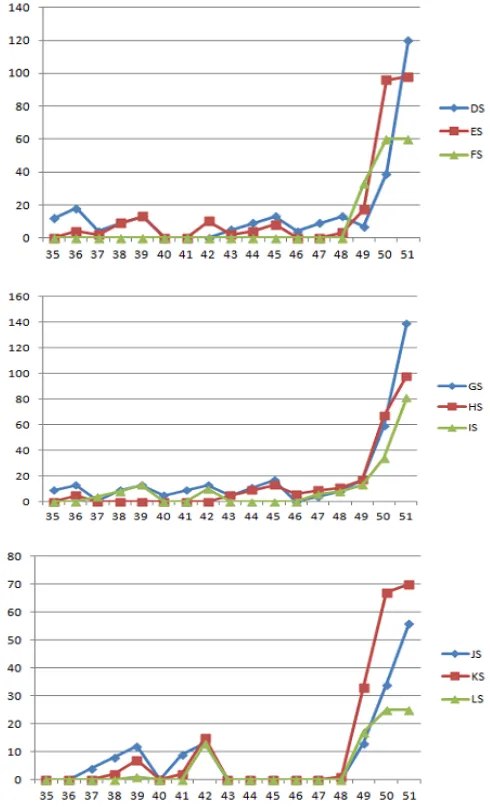
[image:5.612.330.575.594.694.2]Fig. 12 indicates the variation in mean values of the next 17 elements of the feature vector (i.e. elements 35-51) over all the 10 instances of each character, shown for the first 12 characters, here x-axis refers zones and y-axis refers corresponding zone values
Figure 12. Mean values of elements 35 – 51 of feature vector of testing set.
D. Classification:
Classification is done using a neural network (NN) (MLP: multi-layer perceptron). The MLP consists of 51 inputs for feeding in the 51-element feature vector for each character, and 26 outputs for discriminating between the characters. The activation transfer functions are of log-sigmoid type. The best overall accuracy of 88.46% was achieved with 270 units in the hidden layer. Table 1 below reports accuracy rates obtained.
Table 1. Percentage Recognition Accuracies
[image:5.612.39.278.621.734.2]
Figure 13. NN convergence plot.
E. Analysis:
One of objectives and contributions of this work is to improve upon the accuracy obtained using the 13-element vector reported in [1]. The feature plots corresponding to the work in [1] applied to the first 12 characters of the current dataset is shown below. Fig. 13 shows the mean values of the 13-element feature vector applied to the current training set, where x-axis refers zones and y-axis refers corresponding zone values
[image:6.612.40.285.50.228.2]
Fig. 15 shows the mean values of the 13-element feature vector applied to the current testing set. The training and testing vectors are fed to a 13-260-26 neural net in groups of 30 instances for training and in groups of 10 instances for testing and the best accuracy obtained was 56.15%. The accuracy rates for individual characters are depicted in Table 2. Here x-axis refers zones and y-axis refers corresponding zone values
[image:7.612.87.572.55.727.2]Figure 15. Mean values of elements 1 – 13 of feature vector of article [1] applied to current testing set.
Table 2. Percentage Recognition Accuracies using 13-element feature vector of article [1]
The learning rate is .01, learn for 100000 epochs. The NN convergence plot is shown in Fig. 11.
[image:7.612.51.371.139.743.2] [image:7.612.319.577.463.721.2]V. CONCLUSIONANDFURTURESCOPE
This paper proposes a 51-point feature of quadrant method to increase the accuracy of English character recognition. The accuracies are acceptable as compared to contemporary works. One of the main objectives of this work is to improve upon the results reported in [1] using a 13-element feature vector. The 51-element feature vector used here has been able to substantially improve upon the overall accuracy from 56% using the methodology in [1] to 88% for the current approach, when experimented using the same dataset. Other papers have reported higher accuracies on their respective datasets, however for a meaningful comparison between the techniques all of them need to be tested using the same dataset. Such comparison work is currently in progress. Efforts are also being made to improve upon the current accuracies obtained. Although, a lot of efforts have been made to complete a great deal of work but still it has tremendous scope for further improvement enhancement. In future, efforts can be made to improve the recognition accuracy of the network for special characters by using more training samples and by making advancements in 51-point feature quadrant method.
VI. REFERENCES
[1]. C. Zhong, Y. Ding, J. Fu., “Handwritten Character Recognition Based on 13-point feature of Skeleton and Self-Organizing Competition Network”, In Proceedings of 10th International Conference on Intelligent Computation Technology and Automation (ICICTA), pp. 414-417, 2010.
[2]. D. Singh, S. K. Singh, M. Dutta , “Handwritten Character Recognition using Twelve Directional Feature Input and Neural Network”. International Journal of Computer Application, 2010, pp. 82 – 85.
[3]. A. R. Md. Forkan, S. Saha, Md. M. Rahman, Md. A. Sattar, “Recognition of Conjuctive Bangla Characters by Artificial Neural Network”, In Proceedings of International Conference on Information and Communication Technology (ICICT), 2007, pp. 96-99.
[4]. B.B. Chaudhuri and A. Majumdar, “Curvelet–based Multi SVM Recognizer for Offline Handwritten Bangla: A Major Indian Script”, In Proceedings of Ninth International Conference on Document Analysis and Recognition (ICDAR), 2007.
[5]. A. Bandyopadhyay, B. Chakraborty, “Development of Online Handwriting Recognition System: A Case Study with Handwritten Bangla Character”, In Proceedings of World Congress on Nature & Biologically Inspired Computing (NaBIC), 2009, pp.514-519.
[6]. U. Pal, T. Wakabayashi and F. Kimura, “Handwritten Bangla Compound Character Recognition using Gradient Feature”,
In Proceedings of 10th International Conference on Information Technology (ICIT), 2007, pp.208-213.
[7]. Md. M. Hoque, Md. M. Islam, Md. M. Ali, “An Efficient Fuzzy Method for Bangla Handwritten Numerals Recognition”, In Proceedings of 4th International Conference on Electrical and Computer Engineering (ICECE), 2006,pp.197-200.
[8]. U. Bhattacharya, B. K. Gupta and S. K. Parui, “Direction Code Based Features for Recognition of Online Handwritten Characters of Bangla”, In Proceedings of Ninth International Conference on Document Analysis and Recognition (ICDAR), 2007.
[9]. M. Li, C. Wang, R. Dai, “Unconstrained Handwritten Character Recognition Based on WEDF and Multilayer Neural Network”, In Proceedings of the 7th World Congress on Intelligent Control and Automation, 2008, pp. 1143-1148.
[10]. U. Pal, T. Wakabayashi, N. Sharma and F. Kimura, “Handwritten Numeral Recognition of Six Popular Indian Scripts”, In Proceedings of 9th International Conference on Document Analysis and Recognition (ICDAR),2007,pp. 749 -753.
[11]. G. Vamvakas, B. Gatos, S. J. Perantonis, “Handwritten character recognition through two-stage foreground sub-sampling”, Pattern Recognition, 2010, pp. 2807-2816.
[12]. A. A. Desai, “Gujarati handwritten numeral optical character reorganization through neural network”, Pattern Recognition, 2010, pp. 2582–2589.
[13]. K. Saeed, M. Albakoor, “Region growing based segmentation algorithm for typewritten and handwritten text recognition”, Applied Soft Computing, 2009, pp. 608 – 617.
[14]. J. H. Al Khateeb, O. Pauplin, J. Ren, J. Jiang, “Performance of hidden Markov model and dynamic Bayesian network classifiers on handwritten Arabic word recognition” Knowledge-Based Systems, 2011, pp. 680 – 688.
[15]. J. Schenk, J. Lenz, G. Rigoll, “Novel script line identification method for script normalization and feature extraction in on-line handwritten whiteboard note recognition”, Pattern Recognition, 2009,pp. 3383-3393.
[16]. U. Pal, P. P. Roy, N. Tripathy, J. Llados , “Multi-oriented Bangla and Devnagari text recognition”, Pattern Recognition, 2010, pp. 4124–4136.
![Figure 14. Mean values of elements 1 – 13 of feature vector of article [1] applied to current training set](https://thumb-us.123doks.com/thumbv2/123dok_us/701191.1078007/6.612.324.575.50.712/figure-values-elements-feature-article-applied-current-training.webp)
![Figure 15. Mean values of elements 1 – 13 of feature vector of article [1] applied to current testing set](https://thumb-us.123doks.com/thumbv2/123dok_us/701191.1078007/7.612.51.371.139.743/figure-values-elements-feature-article-applied-current-testing.webp)
