Volume 3, No. 4, July- August 2012
International Journal of Advanced Research in Computer Science
RESEARCH PAPER
Available Online at www.ijarcs.info
ISSN No. 0976-5697
Semantic Stability: A Missing Link between Cognition and Behavior
Md. Rokunuzzaman Dept. of Mechanical Engineering,
Rajshahi University of Engineering & Technology (RUET) Rajshahi-6204 , Bangladesh.
[email protected] Mahmudul Hasan*
Dept. of Mechanical Engineering,
Rajshahi University of Engineering & Technology (RUET) Rajshahi-6204, Bangladesh.
Asma-Ul-Husna Dept. of Mechanical Engineering,
Rajshahi University of Engineering & Technology (RUET) Rajshahi-6204, Bangladesh.
[email protected] Barun Kumar Das
Dept. of Mechanical Engineering,
Rajshahi University of Engineering & Technology (RUET) Rajshahi-6204,Bangladesh.
Md. Abdul Kader Dept. of Mechanical Engineering,
Rajshahi University of Engineering & Technology (RUET) Rajshahi-6204,Bangladesh.
Abstract:This paper explains the concept of semantic stability as a missing link between cognition and behavior for multi-robot cooperation with distributed sensing. In cooperation perspective when the cognition of robots is different, there need to interpret the situation by selecting a common Region of Interest. Interpretation of situation by observing visual information is still challenging for the artificial agents. The reason behind this difficulty is to find the cognitive boundary by which the situation can be described efficiently. Since this boundary is a part of cognition, therefore this research relates this boundary with region of interest (ROI) to visualize this concept. In this regard, this boundary contains semantic relevant objects which build a connection between visual objects and their semantic interpretation by semantic labelling. This paper addresses various related technical issues to emphasize the emergence of this concept. A formal expression for the semantic stability concept has been proposed in the current work and applies it to determine the cognitive boundary by selecting the best ROI from the visual scenes. However, selecting of best ROI is meaningless, since the cognition of individual robot is different. Therefore, for co-operation, best ROI needs to be shared between robots. In this research, ROI sharing gives various behaviors which are guided by semantic stability concept. In this respect, semantic stability acts as a missing link between cognition and behavior by selecting meaningful ROI for Cognition and decision making to perform actions which stands as Behavior in a cooperation task. Several complex scenes are tested to illustrate the applicability of the proposed algorithm at the end of the paper.
Keywords:Semantic Stability, Region of Interest (ROI) sharing, Cognition, Multi-robot Co-operation
I. INTRODUCTION
The great difficulty to engage the artificial agents or robots in everyday life is the lack of situation understanding. Typically most of the information received by agents is visual. Interpretation of situation by observing visual information is still challenging for the artificial agents. The reason behind this difficulty is: visual information can be interpreted in different ways due to its notion of subjectivity. Moreover, every interpretation is not meaningful for efficient situation understanding. In the quest of meaningful interpretation, universality in description and expression is realized by Alan Turing who introduced universal Turing machine [1]. Later on Chomsky [2] explains how human brains learn language from interaction by the concept of universal grammar. In connection with language, Paul Grice proposed four conversational maxims that arise from the pragmatics of natural language. The Gricean Maxims [3] are a way to explain the link between utterances and what is understood from them. All these theories stated above are based on low level primitives and exhaustive logical in nature which are impractical to realize. Therefore we would like to develop more profound concept which is based on
cognitive principles, quantifiable and practical to implement in real systems. In our approach, we assume that effective communication can be done between artificial agents if they can share their cognition. However, sharing cognition is not as easy as it seems to be. If we consider an image as a source of information, then every agent have their own observation space which is based on their individual interest.
method based [7], semantic based [8] or interest based [9]. The underlying principles of ROI selection is based on gestalt theory of cognitive psychology [10] and related with various interdisciplinary fields of neuro-science [11], semantics [12], linguistics [13].
In some of the aforementioned studies and literatures, cognition is studied in relation with ROI selection. However, in these researches behavior is not studied. In other words, how behavior is affected in the selection of ROI is not investigated experimentally. Therefore, this research is intended to develop a formal method of semantic stability which links cognition and behavior of an artificial agent based on ROI selection and realized through multi-robot cooperation.
II. FORMALEXPRESSIONOFSEMANTIC STABILITY
A. Definition:
The term “Semantic stability” is used in order to evaluate a stable communication [14], [15] between agents, to establish a link between language and perception [16] or to retrieve knowledge [17]. However, there is no formal method for image understanding.
The notion of “stability” comes from the concept of stability of control theory. Usually information in an image is enormous. According to the exploration of image with ROI, information increases exponentially. Conversely, the complexity decreases as the like. If we plot the image in terms of complexity and information with respect to contexts, then we can obtain some concave curves as depicted in Fig. 1. The lower part of these curves indicates the local minima. These individual curves are very similar to the potential field concept of control theory. In the context of information, these curves are the trade-offs between information and complexity. These trade-offs are called semantic stability. In these regions, the understanding of context becomes stable.
Figure.1 Concept of Semantic stability with illustration
The main goal of ROI selection is to understand the event or scene. Interest also depends on our understanding. Usually our interest decreases when we understand the object or context completely. Since ROI contains objects, therefore selection of different objects and their relations affect our understanding. To quantify the understanding we need to develop some functions. Using such functions, Robot can evaluate their understandings by ROI Selection. Based on the above concept, let’s define the semantic stability as:
ContextKB Information Abstractness Semantic Stability Interest = (1) In order to quantify the information abstractness, we consider semantic relatedness as it is appropriate to object-object relations in ROI. Interest develops from information gap between object’s semantic information. Meaning is context specific; therefore we evaluate semantic stability with respect to Context Knowledge Base, ContextKB.
B. Assumptions:
Semantic stability is a high level concept; therefore its computation depends on structured knowledge or ontology. Ontology also requires object labels which can be found after identification of objects. Based on the requirements, we assume 4 assumptions which are needed to be considered for computation of semantic stability. First, the Context ontology is used as previous knowledge, second, Marker detection gives object recognition; third, Semantic Information gap and semantic stability ≠0 and fourth, different ways of representation of context gives different values of semantic stability.
C. Formulation of Semantic Stability :
a. Evaluation of Semantic information:
To compute semantic stability, we need to evaluate semantic information of object. Based on information theoretic approach, information content of WordNet concept [18] can be expressed as:
( ) 1 log
max log( ( ) 1)
( ) 1
log(max ) 1 log max WN WN WN WN hypo c hypo c IC c + + = = − (2)
Where hypo = number of hyponyms of given concept, maximum number of concepts. This number expresses the maximum entropy in the context of information and acts as a normalizing factor for the taxonomy.
b. Semantic relatedness measure:
Semantic relatedness is the extent to which the concepts share information. Based on Resnik’s [19] measure, the semantic relatedness between two concepts, c1 and c2
1 2 1 2
( , )c c ICWN( ( , ))c c
ϒ = Λ
(3)
Where, r and Λ represents relatedness and intersection
(AND) between two concepts.
c. Semantic Information gap measure:
We define the semantic information gap, Γ as the absolute difference in semantic information content of individual objects. It can be expressed by:
1 2 1 2
( , )c c ICWN( )c ICWN( )c
Γ = − (4)
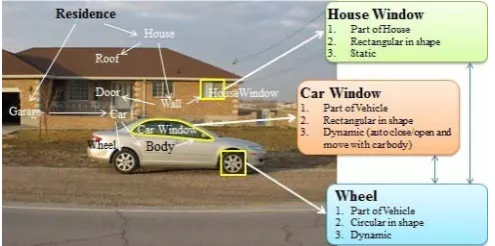
Suppose, we have 3 objects and each object contains some semantic information as shown in Fig.2. Now if we consider information gap between Wheel and Car window, we can see that there are more similarity in information, therefore the information gap is small. Conversely due to information dissimilarity between Wheel and House window
information gap is higher.
1 2 3 4 5 6 7 8
9 10
Context1: Food Corner
Context2: Library Context3: Office Desk
C omp le x ity Information Context4: Laboratory office
Figure 2: Illustration of Semantic Information Gap
Now using these two parameters, we can formally express the semantic stability as:
1 2 1 2
1 2 ( ( , )) ( , )
( ) ( )
WN
WN WN ContextKB
IC c c
c c
IC c IC c
ψ = Λ
−
(5)
The meaning of this equation is: it evaluates the understanding of a context for a particular interest level derived from semantic information gap.
It might be helpful if we can present one sample calculation of semantic stability of ROIs. Let’s consider the example that has been presented previously.
[image:3.595.36.284.69.192.2]Let’s consider Wheel and Car Window as depicted in Fig.3. These 2 concepts are sharing Car as their common node. Therefore, semantic relatedness is the information content of the car.
Figure.3 Illustration for computation of Semantic stability
Using eq. 3 we have
log(3 / 11) ( , ) ( ) 0.54
log(1/ 11)
WN
CarWindow Wheel IC Car
ϒ = = = (6)
For semantic information gap, these two concepts have 2 similar properties. This property is used as hyponyms in equation 4. Therefore, semantic information gap can be computed as:
log((2 1) / 11) ( , ) 0.54
log(1/ 11)
CarWindow Wheel
Γ = + = (7)
With similar calculations,
( , ) ( ) log(3 / 11)
0.54 log(1/ 11)
WN
HouseWindow Wheel IC Residence
ϒ =
= = (8)
log((1 1) / 11) ( , ) 0.71
log(1/ 11)
HouseWindow Wheel
Γ = + = (9)
Therefore, the semantic stabilities are:
0.54
( , ) 1.0 0.54 Residence
CarWindow Wheel
ψ = =
(10)
0.54
( , ) 0.76 0.71 Residence
HouseWindow Wheel
ψ = =
(11)
From these calculations, we can find that ROI composed
of Car Window and Wheel is more stable than
ROIcomposed of House Window and Wheel.
III. MULTI-ROBOTCOOPERATIONBASEDON SEMANTICSTABILITY
Figure 4 shows the basic mechanism of establishing a link between cognition and behavior by semantic stability. In this research two robots are observing different region of the scene, therefore the observation is distributed. This type of observation gives different meaning which leads to different cognition for the robots. However, co-operation is possible only when robots have similar cognition by selecting a common ROI [20]. In order to have a common ROI, information should be invariant. ‘Invariance’ is the property which eliminates ambiguity in selecting right object in a cooperation perspective. To clarify the idea, let’s have an example. Suppose two robots are observing objects of a room. One robot is observing a Cup on the table, where as another robot is observing another Cup on the floor. If robots want to share the concept “Cup”, the information ‘Cup’ is not enough to eliminate ambiguity. Therefore robots need to select some relations which help to find common ROI or unique region of observation.To select useful relations, nearby objects of the target object need to be selected intelligibly. These nearby objects are called LandMark.
There can be many LandMarks in the observation area. Therefore, it can be possible to have many ROIs which include Target object and LandMark. However, only meaningful ROI can provide stable cognition. Therefore, Best ROI selection is necessary. Semantic stability plays a key role in this selection by quantifying the relations based on meaningfulness of the ROI. Since Best ROI for individual robot is different, therefore it is meaningless for the co-operation between robots. Co-co-operation is possible only when robots share their cognition as well as do some actions. In order to realize this, Best ROI is shared between robots. Best ROI sharing gives decision for the behaviors of the robots for useful co-operation. In Best ROI sharing which behavior needs to be shown is also determined by semantic stability. Therefore, semantic stability is the criterion which acts as a links between cognition and behavior in multi-robot co-operation.
(a) Selected ROIs (b) Context ontology
Behavior Cognition
Semantic stability
Multi-robot Co-operation Distributed Observation
Invariance Selection
Selection of Useful LandMark
Best ROI selection
Sharing of Best ROI Residence
House Garage
Roof Wall Car
Door House Window
Wheel Body
Car Window
1 similar property
[image:3.595.35.291.393.526.2]Figure.4 Semantic stability as a link between Cognition and Behavior
IV. APPROACH
[image:4.595.41.283.181.259.2]The approach of multi-robot cooperation is shown in Fig.5. The process of Semantic stability determination is discussed in section 2.3. We have proposed a Best ROI selection algorithm which is discussed in our previous work [4]. Here we would like to emphasize the robot behavior through ROI sharing and co-operation governed by its semantic stability in cognition.
Figure.5 Approach of Multi-robot Cooperation based on Semantic stability
Experimental Scenario:
[image:4.595.310.565.230.527.2]Fig. 6 shows the experimental scenario for multi-robot cooperation with distributed sensing. Here we have two robots A and B. Robot A has camera equipped with it and Robot B is equipped with Camera and Arm. The observation area is different for both robots. Now Robot A wants to pick up the bottle (Target) and put into Goal. Since it does not have the arm, it asks the Robot B to make cooperation for solving this problem.
Figure. 6: Experimental Scenario for Multi-robot Cooperation
Since the observation area of each robot is different, therefore the cognition of each robot is also different. The target is similar at both observations. In order to distinguish each target, each robot need to select some landmark.
V. RESULTS
In order to solve this problem, individual robots need to select ROI. The results of individual robot’s cognition and behavior are shown as follows:
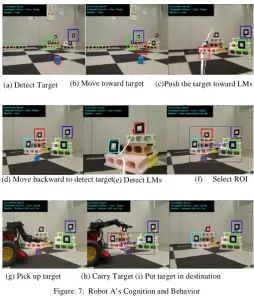
Fig. 7 shows Robot A’s Cognition and Behavior in multi-robot cooperation.
At first Robot A detects Target (bottle) based on color and shape and Landmarks using ARToolkit. However, the LandMarks are not clearly visible to Robot A. Therefore, Robot A moves forward and pushes the target toward LandMarks. The LandMark objects are Apple, Book, CAN
and Cup. The semantic stability values are 0.22, 0.1, 1.0 and
1.0 respectively. The distance from all the Landmarks to target (bottle) is nearly the same. Therefore, robot assumes that the bottle can be related to all the landmarks. For this reason, the relation is described as Target (bottle) is “Near
Apple, Book, Cup, and CAN”. However, the information is not precise and ambiguous. Therefore, robot uses semantic stability to choose the best landmark. Immediately after some frames, robot finds that CAN and Cup has greater semantic stability than Apple and Book. Since the semantic stability for the CAN and Cup is same (1.0), therefore Robot A chooses both landmarks to locate the bottle. Moreover, it changes the relation information as Target is “Between CAN
and Cup”. By the aid of semantic stability Robot A’s search space is narrowed down, which reduces ambiguity and enriches the ROI with sufficient semantic relations.
(g) Pick up target (h) Carry Target (i) Put target in destination
Figure. 7: Robot A’s Cognition and Behavior
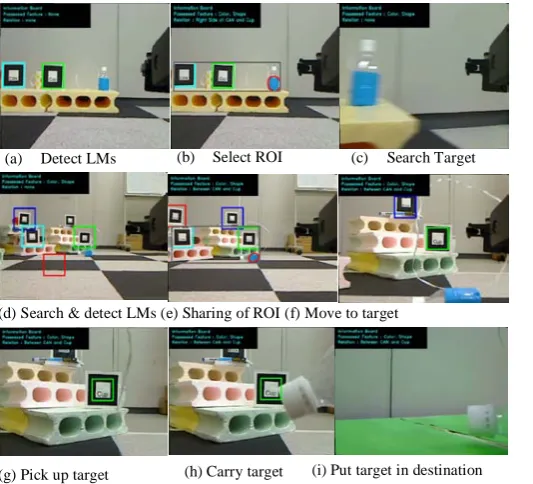
Fig. 8 shows Robot B’s Cognition and Behavior in multi-robot cooperation. As like Robot A, Robot B detects Land Marks and then select ROI using color and shape and relation information. Since the relation for target object in Fig. 8(b) is “Right side of CAN and Cup”, is different from the Robot A’s relation information, therefore robot tries to search the right target by moving its body and arm. The robot moves toward the search area and again detects LandMarks. Using semantic stability the robot B selects ROI and shares with ROI selected by Robot A. The robot B then move toward the target, pick up, carry and put the target in destination.
In this experiment, semantic stability plays a key role to select the meaningful and sufficient information from number of possible ROIs. This selection facilitates the useful cognition for the robots for co-operation. On the other hand, semantic stability decides about the sharing of the ROI so that the cognition is shared. Sharing cognition helps the robot to select the right action, such as move, search, pickup, carry etc. for the task to be performed for cooperation. In this way, semantic stability guides the behavior of the robot.
(a) Detect Target (b) Move toward target (c)Push the target toward LMs
(d) Move backward to detect target (e) Detect LMs (f) Select ROI Video stream
from camera selection ROI
Semantic stability determination
Best ROI selection Best
ROI Multi-robot
Cooperation
[image:4.595.36.281.407.561.2](d) Search & detect LMs (e) Sharing of ROI (f) Move to target
[image:5.595.37.304.63.305.2](g) Pick up target
Figure. 8: Robot B’s Cognition and Behavior
VI. CONCLUSION
In this research, we formalize the concept of semantic stability for multi-robot cooperation with distributed sensing. With this concept, it is possible to get a stable understanding of the situation by selection of ROI. Moreover, with semantic stability, the artificial agents are able to make decision about meaningful relations which is very similar to human cognitive ability. Furthermore, agents can select useful invariance (information) for the best combination of Target and LandMark. The biggest advantage of semantic stability is: it helps to make a consensus between robots without any communication which saves time for decision making. Analyzing all these results and discussion, we can conclude that the proposed formulation of semantic stability is practically applicable to the real systems which make useful contribution to both in the field of cognition and behavior for distributed autonomous robotics.
VII. REFERENCES
[1] A.M. Turing, “On Computable Numbers, With an Application to the Entscheidungsproblem: A correction” Proc. of the London Mathematical Society, Vol. 43, No. 2, pp. 544–546 ,1937.
[2] N. Chomsky, “Aspects of the Theory of Syntax”, MIT Press, 1965, pp. 3-60
[3] Paul Grice, “Studies in the way of words”, Chapter 2: logic and conversation, Harvard University Press, Cambridge, Massachusetts, London, England, 1991, pp. 22-40.
[4] M. Rokunuzzaman, K. Sekiyama and T. Fukuda, “Cognitive Boundary Detection using Semantic Stability Concept”, Joint 5th Int. Conf. on Soft Computing and Intelligent Systems and 11th Int. Sympo. on Advanced Intelligent Systems, pp.384-389, 2010 (Best Paper Award)
[5] T. Sevilmis, M. Bastan, “Automatic detection of salient objects and spatial relations in videos for a video database system,” Int. J. of Image and Vision Computing, vol. 26, pp. 1384–1396, 2008
[6] M. Rokunuzzaman, K. Sekiyama and T. Fukuda, “Automatic ROI Detection and Evaluation in Video Sequences Based on Human Interest”, J. of Robotics and Mechatronics, vol.22, no. 1, pp. 65-75, February, 2010
[7] G. Kim, A. Torralba, “Unsupervised Detection of Regions of Interest Using Iterative Link Analysis”, Neural Information Processing Systems, 2009
[8] M. Rokunuzzaman, K. Sekiyama and T. Fukuda, “Semantic Evaluation of Region of Interest for Intelligent Robot”, Proc. IEEE/RSJ Int. Conf. on Intelligent Robots and Systems (IROS), Taiwan, pp. 3519-3524, 2010
[9] M. Rokunuzzaman, K. Sekiyama and T. Fukuda, “Multiple Region of Interest Evaluation for Ubiquitous Robots”, 7th Int. Conf. on Ubiquitous Robots and Ambient Intelligence, pp. 429-432, 2010
[10] S.E. Palmer, Common Region: A new principle of perceptual grouping, Cognitive Psychology, vol.9, no. 3, pp. 441-474, 1992.
[11] V. Wyart, “Neural Dissociation between Visual Awareness and Spatial Attention”, Neuroscience, vol.28, no.10, pp. 2667-2679, 2008
[12] T. Liu, K. Muramatsu, M. Daigo, “Region-based Image Retrieval Using Semantic Mining”, World Wide Business Review, Vol. 10, No. 2, pp. 97-104, 2009
[13] K. Church, et al, “Word association norms, Mutual information and Lexicography,”Computational Linguistics, vol.16, no. 1, pp.22-29, Mar. 1990
[14] L. Anolli, R. Ciceri and G. Riva (Eds.), “Say not to Say: New perspectives on miscommunication,” IOS Press, 2001, ch-3, pp. 4-39
[15] Y. Visetti, P. Cadiot, “Instability and theory of semantic forms: starting from the case of prepositions”, Prepositions in their Syntactic, Semantic and Pragmatic Context, pp. 9-39, John Benjamin’s Publishing Company, 2002
[16] E. Khatchatourian, “Analysis of Discourse Markers: between the Semantic Stability and the Contextual Variability”, Workshop on Formal and Computational Approaches to Discourse and Other Particles, 2005
[17] C. Thomas and A. Sheth, “Semantic Convergence of Wikipedia Articles,” Proc. of the IEEE/WIC/ACM International Conference on Web Intelligence, pp. 600-606, 2007
[18] N. Seco, T. Veale and J. Hayes, “An intrinsic information content metric for semantic similarity in WordNet,” in Proc. ECAI-04, 2004, pp. 1089-1090
[19] P. Resnik, “Using information content to evaluate semantic similarity in a taxonomy”, In Proc. of IJCAI-95, Vol. 1, pp. 448–453, 1995
(a) Detect LMs (b) Select ROI (c) Search Target
[20] M. Rokunuzzaman, K. Sekiyama and T. Fukuda, “Sharing Region of Interest for Common Concern between Autonomous Agents with Different