Volume 4, No. 3, March 2013 (Special Issue)
International Journal of Advanced Research in Computer Science
RESEARCH PAPER
Available Online at www.ijarcs.info
Simulation and Comparison of Ad-Hoc Routing Protocols in Multiple
Source-Destination Pairs Using NS2
Meena Kushwaha
M.Tech Scholar
Rajasthan College of Engineering for Women, Bhankrota Jaipur, Rajasthan
Siddlingappagouda C Biradar
Phd Scholar
Dayananda Sagar of Engineering College Banglore [email protected]
Tejpal
Assistant Professor
Rajasthan College of Engineering for Women, Bhankrota Jaipur, Rajasthan
Abstract: MANET, a mobile ad hoc network is a collection of wireless mobile nodes dynamically forming a temporary network without any infrastructure and centralized administration. There are various routing protocols available for MANETs. The most popular ones are DSR, AODV and DSDV. The vision of this paper is to evaluate above mentioned protocols for multiple source-destination pair which use single intermediate node. An attempt has been made to compare the performance and hence forms selection criteria for best routing protocol in particular scenarios. The comparison has been done under TCP protocol.
Simulation results for different aspects are also depicted. These simulations are carried out rely on the Rice Monarch Project that has made substantial extensions to the NS2 network simulator to run ad hoc simulations. The tools used for the simulation are NS2 (ver 2.29) which is the main simulator, NAM (Network Animator), NS2-VisualTraceAnalyzer-0.2.72 and Tracegraph which is used for preparing the graphs from the trace files. The analysis is significant because we considered all the information as suggested by RFC 2501. An RFC has been drafted regarding Routing in MANET, RFC 2501.
Keywords: MANET; AODV; DSR; DSDV; NS2; NAM; TCP; NS2-VisualTraceAnalyzer-0.2.72; tracegraph; RFC 2501
I. INTRODUCTION
Mobile ad-hoc networks are formed dynamically by an autonomous system of mobile nodes that are connected via wireless links without using an existing network infrastructure or centralized administration. The nodes are free to move randomly and organize themselves arbitrarily; thus, the networks wireless topology may change rapidly and unpredictably. Each node participating in the network acts both as host and a router and must therefore is willing to forward packets for other nodes to make sure that the packets are delivered from source to destination. Routes between nodes in an ad hoc network may include multiple hops and, hence, it is appropriate to call such networks “multihop wireless ad hoc networks” [1].
Various dedicated routing protocols have been proposed to the Internet Engineering Task Force (IETF) MANET Working Group [2]. Many different protocols have been proposed to solve the multihop routing problem in ad hoc networks, each based on different assumptions and intuitions.
Three routing protocols are studied in this work, namely Ad-hoc on Demand Distance Vector (AODV), Dynamic Source Routing (DSR), and Destination Sequenced
Distance Vector (DSDV). AODV and DSR were selected because they show the best performance in ad-hoc networks, but should be compared and evaluated further using additional metrics and typical scenarios. As opposed to DSR and AODV, DSDV is a proactive protocol and was included to illustrate the differences between reactive and proactive protocols. This paper is to provide a realistic, quantitative analysis comparing the performance of a variety of multi-hop wireless ad hoc network routing protocols. We present results of detailed simulations showing the relative performance of three major ad hoc routing protocols: DSDV [3], DSR [4, 5, 6], and AODV [7].
© 2010, IJARCS All Rights Reserved CONFERENCE PAPER II International Conference on 279
II. OVERVIEWOFROUTINGPROTOCOLS
In this section, we briefly describe the key features of the DSDV, DSR, and AODV protocols studied in our simulations.
A. Destination-Sequenced Distance Vector
(DSDV):
DSDV [18] is a hop-by-hop distance vector routing protocol requiring each node to periodically broadcast routing updates. The key advantage of DSDV over traditional distance vector protocols is that it guarantees loop-freedom [8].
a. Basic Mechanisms:
Each DSDV node maintains a routing table listing the “next hop” for each reachable destination. DSDV tags each route with a sequence number and considers a route R more favorable than R’ if R has a greater sequence number, or if the two routes have equal sequence numbers but R has a lower metric. Each node in the network advertises a monotonically increasing even sequence number for itself.
When a node B decides that its route to a destination D has broken, it advertises the route to D with an infinite metric and a sequence number one greater than its sequence number for the route that has broken (making an odd sequence number). This causes any node A routing packets through B to incorporate the infinite-metric route into its routing table until node A hears a route to D with a higher sequence number [8].
B. Dynamic Source Routing (DSR):
DSR [9, 10, 2] uses source routing rather than hop-by-hop routing, with each packet to be routed carrying in its header the complete, ordered list of nodes through which the packet must pass. The key advantage of source routing is that intermediate nodes do not need to maintain up-to-date routing information in order to route the packets they forward, since the packets themselves already contain all the routing decisions. This fact, coupled with the on-demand nature of the protocol, eliminates the need for the periodic route advertisement and neighbor detection packets present in other protocols.
a. Basic Mechanisms:
The DSR protocol consists of two mechanisms: Route Discovery and Route Maintenance. Route Discovery is the mechanism by which a node S wishing to send a packet to a destination D obtains a source route to D. To perform a Route Discovery, the source node S broadcasts a ROUTE REQUEST packet that is flooded through the network in a controlled manner and is answered by a ROUTE REPLY packet from either the destination node or another node that knows a route to the destination. To reduce the cost of Route Discovery, each node maintains a cache of source routes it has learned or overheard, which it aggressively uses to limit the frequency and propagation of ROUTE REQUESTs.
Route Maintenance is the mechanism by which a packet’s sender S detects if the network topology has changed such that it can no longer use its route to the destination D because two nodes listed in the route have moved out of range of each other. When Route Maintenance indicates a source route is broken, S is notified with a ROUTE ERROR packet. The sender S can then attempt to use any other route to D already in its cache or can invoke Route Discovery again to find a new route [8].
C. Ad Hoc On-Demand Distance Vector (AODV):
AODV [17] is essentially a combination of both DSR and DSDV. It borrows the basic on-demand mechanism of Route Discovery and Route Maintenance from DSR, plus the use of hop-by-hop routing, sequence numbers, and periodic beacons from DSDV.
a. Basic Mechanisms:
When a node S needs a route to some destination D, it broad-casts a ROUTE REQUEST message to its neighbors, including the last known sequence number for that destination. The ROUTE REQUEST is flooded in a controlled manner through the network until it reaches a node that has a route to the destination. Each node that forwards the ROUTE REQUEST creates a reverse route for itself back to node S. When the ROUTE REQUEST reaches a node with a route to D, that node generates a ROUTE REPLY that contains the number of hops necessary to reach D and the sequence number for D most recently seen by the node generating the REPLY. Each node that participates in forwarding this REPLY back toward the originator of the ROUTE REQUEST (node S), creates a forward route to D. The state created in each node along the path from S to D is hop-by-hop state; that is, each node remembers only the next hop and not the entire route, as would be done in source routing [8]. In order to maintain routes, AODV normally requires that each node periodically transmit a HELLO message, with a default rate of once per second. Failure to receive three consecutive HELLO messages from a neighbor is taken as an indication that the link to the neighbor in question is down. Alternatively, the AODV specification briefly suggests that a node may use physical layer or link layer methods to detect link breakages to nodes that it considers neighbors [17]. When a link goes down, any upstream node that has recently forwarded packets to a destination using that link is notified via an UNSOLICITED ROUTE REPLY containing an infinite metric for that destination. Upon receipt of such a ROUTE REPLY, a node must acquire a new route to the destination using Route Discovery as described above [8].
III. SIMULATIONENVIRONMENT
[10]. A realistic physical layer that includes a radio propagation model, radio network interfaces and the IEEE 802.11 Medium Access Control (MAC) protocol using the Distributed Coordination Function (DCF).The radio network interface card (NIC) model is based on the WaveLaninterface from Lucent [11]. The model includes collisions, propagation delay and signal attenuation with a 2Mbps data rate and a radio range of 250 meters.
The ns-2 environment includes full implementation of the
following MANET routing protocols: DSR, AODV and DSDV. These protocols are still under improvement and the different research groups periodically offer new improved versions that can be inserted automatically into
the ns-2 simulation environment [8].
IV. SCENARIOCONSIDERATION
Our protocol evaluations are based on the simulation of 3, 5 and 7 wireless nodes forming an ad hoc network, over a rectangular (500m X 400m) flat space for 150 seconds of simulated time.
[image:3.612.330.542.242.520.2]The physical radio characteristics of each mobile node’s network interface, such as the antenna gain, transmit power, and receiver sensitivity, were chosen to approximate the Lucent WaveLAN [11] direct sequence spread spectrum radio. In order to enable direct, fair comparisons between the protocols, we assume the protocols with identical loads and environmental conditions. Each run of the simulator accepts as input a scenario file that describes the exact sequence of packets originated by each node, together with the exact time at which each packet origination is to occur. Since each protocol was challenged in an identical fashion, we can directly compare the performance results of the three protocols.
Table 1: Simulation Parameters
Method Value
Channel type Channel/Wireless channel
Radio-propagation model Propagation/Two ray round
Network interface type Phy /wirelessphy
MAC type Mac/802.11
Interface queue type Queue/Drop Tail
Link Layer Type LL
Maximum packet in ifq 50
Number of Nodes 3 / 5 / 7
Area (mxm) 500X400
Simulation time 150 second
Routing Protocol AODV / DSDV / DSR
Simulator ns2.29
The protocols were carefully implemented according to their specifications published as of April 1998 and based on clarifications of some issues from the designers of each protocol and on our own experimentation with them.
V. PROBLEMSTATEMENT
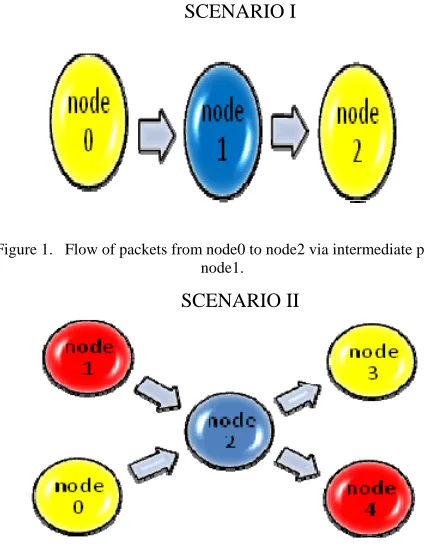
We create three scenarios shown in fig 1, 2 and 3 of different nodes. An intermediate point in each and every scenario works as bottleneck of the route of each source-destination pair. We chose that intermediate point to analyze the performance matrices of all three protocols, focusing on (a) Number of dropped packets at all nodes (b) Cumulative sum of dropped packets at Intermediate Point (c) Average packet Delay in seconds and (d) Number of lost packets (e) Throughput.
SCENARIO I
Figure 1. Flow of packets from node0 to node2 via intermediate point node1.
[image:3.612.52.300.467.706.2]SCENARIO II
Figure 2. Flow of packet from node0 to node3 and node1 to node4 via intermediate point node2.
SCENARIO III
[image:3.612.339.548.560.693.2]© 2010, IJARCS All Rights Reserved CONFERENCE PAPER II International Conference on 281
VI. SIMULATIONANDRESULTS
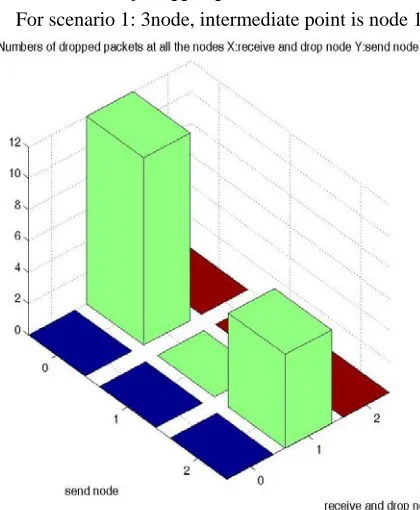
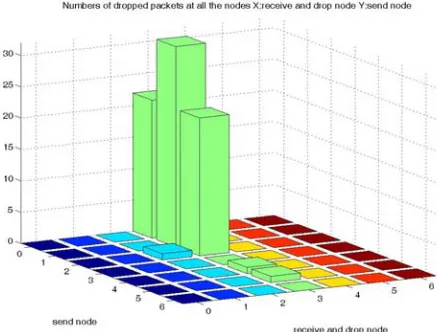
The results corresponding to above depicted scenarios in following matrices (a) Number of dropped packets at all nodes (b) Cumulative sum of dropped packets at Intermediate Point (c) Average packet Delay in seconds and (d) Number of lost packets are shown in Figure 4.(a b c), Figure 5. (a,b,c), Figure 6.(a,b,c). Figure 7.(a,b,c), Figure 8.(a,b,c), Figure 9.(a,b,c), Figure 10 and Figure 11 respectively.
And also throughput of all three protocols in all three scenarios considered. The results are depicted in table, Table II, Table III and Table IV.
A. Number of dropped packets at all the nodes:
[image:4.612.334.551.64.271.2](i) For scenario 1: 3node, intermediate point is node 1.
[image:4.612.64.274.214.469.2]Figure 4.a Drop of packets at all 3nodes using AODV Protocol
Figure 4.b Drop of packets at all 3nodes using DSDV Protocol
Figure 4.c Drop of packets at all 3nodes using DSR Protocol
[image:4.612.342.543.308.490.2](ii) For scenario 2: 5node, intermediate point is node2.
Figure 5.a Drop of packets at all 5nodes using AODV Protocol
[image:4.612.70.281.507.709.2] [image:4.612.346.536.523.706.2]
Figure 5.c Drop of packets at all 5nodes using DSR Protocol
[image:5.612.68.282.62.236.2](iii) For scenario 3: 7node, node 3 is intermediate point.
Figure 6.a Drop of packets at all 7nodes using AODV Protocol
Figure 6.b Drop of packets at all 7nodes using DSDV Protocol
Figure 6.c Drop of packets at all 7nodes using DSRProtocol
As shown in Figure 4.(a,b,c), Figure 5.(a,b,c) and Figure 6.(a,b,c) number of dropped packet is high in DSDV.
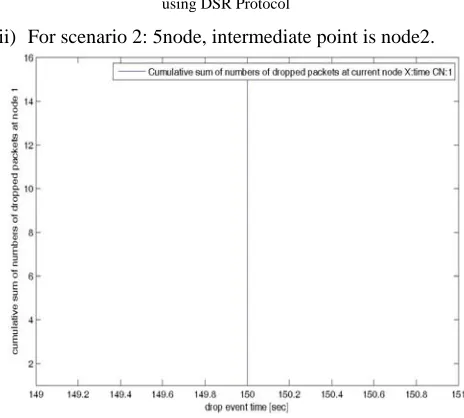
B. Cumulative sum of dropped packets at
Intermediate Point:
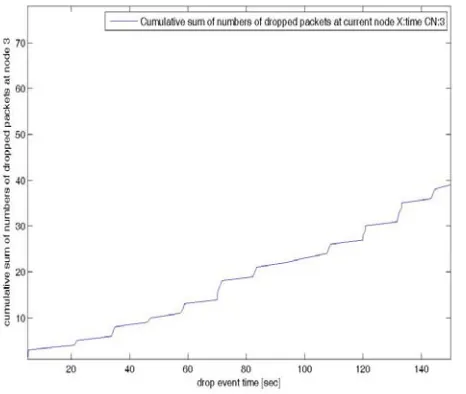
In this metrics, we can observe the drop of packets at intermediate point only. The drops of packets at particular time of event in AODV, DSDV and DSR protocols can be analysed using below graphs.
[image:5.612.68.276.294.480.2](i) For scenario 1: 3node, intermediate point is node 1.
Figure 7.a Cumulative sum of dropped pkt V/s drop event time (sec) using AODV Protocol
[image:5.612.330.560.349.537.2] [image:5.612.72.275.512.701.2]© 2010, IJARCS All Rights Reserved CONFERENCE PAPER II International Conference on 283 Figure 7.c Cumulative sum of dropped pkt V/s drop event time (sec)
using DSR Protocol
[image:6.612.65.560.51.700.2](ii) For scenario 2: 5node, intermediate point is node2.
[image:6.612.63.282.52.239.2]Figure 8.a Cumulative sum of dropped pkt V/s drop event time (sec) using AODVProtocol
Figure 8.b Cumulative sum of dropped pkt V/s drop event time (sec)
[image:6.612.327.560.52.235.2]using DSDV Protocol
Figure 8.c Cumulative sum of dropped pkt V/s drop event time (sec) using DSR Protocol
[image:6.612.58.290.259.468.2](iii) For scenario 3: 7node, node 3 is intermediate point.
Figure 9.a Cumulative sum of dropped pkt V/s drop event time (sec) using AODV Protocol
[image:6.612.326.558.270.480.2]Figure 9.c Cumulative sum of dropped pkt V/s drop event time (sec) using DSR Protocol
We notice that cumulative drop of packets in AODV and DSR are increases as increase in number of node in this particular scenario, whereas it shows less increment in DSDV.
C. Average packet Delay in seconds:
A specific packet is transmitting from source to destination and calculates the difference between send times and received times. Delays due to route discovery, queuing, propagation and transfer time are included in the delay metric. Delay can be defined as:
Packet Delay = packets receive time - packet send time
Figure 10. Comparison of average packet delay in seconds
We notice in the above graph that for 3 nodes and 5 nodes all three protocols we considered behave similar but as we move to 7 nodes AODV gives best results, whereas DSDV is slightly better than DSR.
D. Number of lost packets:
Total number of lost packets is defined as:
[image:7.612.62.295.54.251.2]Number of Packets Lost=Number of packets Sent - Number of packet Received.
Figure 11. Comparison of protocols in terms of lost packets.
As we can notice from the above graph that number of lost packets are least in DSDV and highest in AODV.
E. Throughput:
Throughput is the measurement of number of packets passing through the network in a unit of time. This metric shows the total number of packets that have been successfully transferred to the destination nodes.
Throughput can be defined as the ratio of transferred data to generated data.
Table 2
Throughput for 3nodes
Generated Tranfered
AODV 42 KB/s 41 KB/s
DSDV 32 KB/s 41 KB/s
DSR 42 KB/s 41 KB/s
Table 3
Throughput for 5nodes
Generated Tranfered
AODV 41 KB/s 41 KB/s
DSDV 39 KB/s 33 KB/s
[image:7.612.53.295.423.601.2]DSR 42 KB/s 41 KB/s
Table 4
Throughput for 7nodes
Generated Tranfered
AODV 42 KB/s 41 KB/s
DSDV 39 KB/s 41 KB/s
DSR 39 KB/s 41 KB/s
© 2010, IJARCS All Rights Reserved CONFERENCE PAPER II International Conference on 285 VII. CONCLUSION
This paper addressed three particular scenarios corresponding that we compare three routing protocols. We presented the results of comparing Ad-hoc On Demand Distance Vector (AODV), Direct Source Routing (DSR) and Destination-Sequenced Distance- Vector Routing (DSDV). We selected the most representative parameters for a MANET, we then defined and simulated a basic scenario and finally the results obtained from the simulations allow us to conclude that generally pure on-demand protocols such as DSR and AODV perform better than DSDV, but in this particular scenario AODV performs best, and at some metrices DSDV is better than DSR.
VIII. REFERENCES
[1] Stefano Basagni, Marco Conti, Silvia Giordano, Ivan Stojmenovic. “MOBILE AD HOC NETWORKING”, John Wiley & Sons, Inc., 2010. [2] Internet Engineering Task Force MANET Working
Group Charter, http://www.ietf.org/html.charters/manet-
charter,html.
[3] Charles E. Perkins and Pravin Bhagwat. Highly dynamic Destination Sequenced Distance-Vector routing (DSDV) for mobile computers. In Proceedings of the SIGCOMM ’94 Conference on Communications architectures, Protocols and Applications, pages 234–244, August 1994. A revised version of the paper is available from http://www.cs.umd.edu/projects/mcml/papers/Sigc omm94.ps
[4] David B. Johnson. Routing in ad hoc networks of mobile hosts. In Proceedings of the IEEE Workshop on Mobile Computing Systems and Applications, pages 158–163, December 1994. [5] David B. Johnson and David A. Maltz. Dynamic
source routing in ad hoc wireless networks. In Mobile Computing, edited by Tomasz Imielinski and Hank Korth, chapter 5, pages 153–181. Kluwer Academic Publishers, 1996.
[6] Josh Broch, David B. Johnson, and David A. Maltz. The Dynamic Source Routing Protocol for Mobile Ad Hoc Networks. Internet-Draft, draft-ietf-manet-dsr-00.txt, March 1998.
[7] Charles Perkins. Ad Hoc On Demand Distance Vector (AODV) routing. Internet-Draft, draft-ietf-manet-aodv-00.txt, November 1997.
[8] A Performance Comparison of Multi-Hop Wireless Ad Hoc Network Routing Protocols. By Josh Broch, David A. Maltz, David B. Johnson, Yih-Chun Hu and Jorjeta Jetcheva. Computer Science Department, Carnegie Mellon University
Pittsburgh, PA 15213 http://www.monarch.cs.cmu.edu
[9] K: Fall and K. Varadhan, (Eds.) “ns Notes and Documents”, The VINT Project. UC Berkeley, LBL, USC/ISI, and Xerox PARC, February 25, 2000. Available from http://www.isi.edu/-salehi/ns doc/
[10] Kevin Fall and Kannan Varadhan, editors. ns notes and documentation. The VINT Project, UC Berkeley, LBL, USC/ISI, and Xerox PARC, November 1997. Available from http://www-mash.cs.berkeley.edu/ns/
[11] Bruce Tuch. Development of WaveLAN, an ISM band wireless LAN. AT&T Technical Journal, 72(4):27–33, July/August 1993.
[12] Runcai Huang, Yiwen Zhuang and Qiying Cao. Simulation and Analysis of Protocols in Ad Hoc Network. IEEE Conference Publication Year: 2009, Page(s): 169-173.
[13] Per Johansson, Tony Larsson, Nicklas Hedman, Bartosz Mielczarek and Mikael Degermark.
SCENARIO-BASED PERFORMANCE ANALYSIS OF ROUTING PROTOCOLS FOR
MOBILE AD-HOC NETWORKS. Published in MobiCom ’99 Proceedings of the 5th annual ACM/IEEE Inc., Mobile computing and networking, pages 195-206.
[14] Taksande, V.K. A Simulation Comparison Among AODV, DSDV, DSR Protocol with IEEE 802.11 MAC for Grid Topology in MANET. Computational Intelligence and Communication Networks (CICN), 2011, pages 63-67.
[15] Bagwari,A., Jee R., Joshi P., Bisht S. Performance of AODV Routing Protocol with Increasing the MANET Nodes and Its Effects on QoS of Mobile Ad Hoc Networks. Conference Publications in
Communication Systems and Network Technologies (CSNT), 2012, pages 320-324.