Volume 2, No. 6, Nov-Dec 2011
International Journal of Advanced Research in Computer Science
RESEARCH PAPER
Available Online at www.ijarcs.info
© 2010, IJARCS All Rights Reserved 508
ISSN No. 0976-5697
CONFERENCE PAPER
International Conference on Issues & Challenges in Networking, Intelligence & Computing Technologies
Organized by Krishna Institute of Engineering and Technology (KIET) Ghaziabad, India
Preserving Security in Routing in Mobile Ad- hoc Environment through Non-Linear
Dimension Reduction Techniques
Lokesh Jain*
Department of Computer Science Krishna Engineering College, Ghaziabad-India
Pramod Kumar Yadav, Sanjeev Kumar Yadav
Department of Computer Science, Krishna Institute of Engineering and Technology, Ghaziabad-India
Abstract -A mobile Ad-Hoc Network (MANET) is a collection of wireless nodes that communicate with each other without any infrastructure. Present day mobile ad hoc networks grow in size and the associated complexity warrant the need to explore the suitability of the various simulation parameters during their execution. One of the major issues related to the MANET is security of data that has been transferred via wireless communication medium. In this paper we conclude that dimension reduction is one of the factors through we can achieve the security and maintain the integrity of dataset. We highlight various Non-Linear dimension reduction techniques which applied on common MANET parameters.
Keywords: MANET routing, Dimension reduction techniques, Security
I. INTRODUCTION
Mobile ad hoc networks (MANETs) is a self-configuring network of mobile routers (and associated hosts) connected by wireless links (Fig. 1). Communication must be set up and maintained on the fly over mostly by wireless links. Each node of a network can both route and forward data [1]. The exploding demand for computing and communication on the move has led to reliance for ad hoc networks. Although substantial attempts have been made on research towards design and development of ad hoc network parameters, there is relatively little understanding of their behavior in terms of the performance by comparing execution times as the system is scaled up [2] & [8].
Figure.1 MANET structure
As in a wired network, application flows in a MANET have different characteristics (e.g. type and volume of information exchanged, lifetime of the interaction, packet interarrival time, with or without burst) and also different Quality of Service (QoS) requirements (e.g. delay, throughput, high priority processing). Hence, a uniform packet processing is not adequate and a QoS support taking into account various QoS requirements is needed [1][2]. The overall routing protocol types responsible for transmission of packets between different mobile hosts in ad-hoc network falls into three broad categories (as shown in Fig. 2)
Figure.2 MANET Routing Categories and Protocols
One of the challenges in MANET is security of data during routing. Although security preservation in data publishing has been studied extensively and several important models such as k-anonymity and l-diversity as well as many efficient algorithms have been proposed, most of the existing studies can deal with relational data only. Those methods cannot be applied to MANET data straightforwardly. Security may be break if a MANET is released improperly to public. In practice, we need a systematic method to anonymize MANET data before it is released.
© 2010, IJARCS All Rights Reserved CONFERENCE PAPER 509
International Conference on Issues & Challenges in Networking, Intelligence & Computing Technologies
Organized by Krishna Institute of Engineering and Technology (KIET) Ghaziabad, India
II. ADHOCROUTINGPROTOCOLS
We can use any of the routing category for implementing our approach; so at this stage we will briefly discuss DSR.
A. DSR (Dynamic Source Routing):
DSR is a reactive protocol i.e. it doesn’t use periodic advertisements. It computes the routes when necessary and then maintains them (Fig. 3). Source routing is a routing technique in which the sender of a packet determines the complete sequence of nodes through which the packet has to pass; the sender explicitly lists this route in the packet’s header, identifying each forwarding “hop” by the address of the next node to which to transmit the packet on its way to the destination host. There are two significant stages in working of DSR: Route Discovery and Route Maintenance.
[image:2.595.319.554.392.588.2]A host initiating a route discovery broadcasts a route request packet which may be received by those hosts within wireless transmission range of it. The route request packet identifies the host, referred to as the target of the route discovery, for which the route is requested. If the route discovery is successful the initiating host receives a route reply packet listing a sequence of network hops through which it may reach the target. In addition to the address of the original initiator of the request and the target of the request, each route request packet contains a route record, in which is accumulated a record of the sequence of hops taken by the route request packet as it is propagated through the network during this route discovery. DSR uses no periodic routing advertisement messages, thereby reducing network bandwidth overhead, particularly during periods when little or no significant host movement is taking place. DSR has a unique advantage by virtue of source routing. As the route is part of the packet itself, routing loops, either short-lived or long-lived, cannot be formed as they can be immediately detected and eliminated.
Figure. 3 DSR structure
III. REASONFORCHOOSINGNON-LINEAR DIMENSIONREDUCTIONTECHNIQUE
In case of MANET, the size of the data set is large and data set has various dimensions. Due to severity of MANET data, it is very difficult to secure the data. Consider a dataset represented as a matrix (or a database table), such that each row represents a set of attributes (or features or dimensions) that describe a particular instance of something. If the number of attributes is large, then the space of unique possible rows is exponentially large. Thus, the larger the dimensionality, the more difficult it becomes to sample the space. This causes many problems. Algorithms that operate on high dimensional data tend to have a very high time
complexity. Many machine learning algorithms, for example, struggle with high-dimensional data. This has become known as the curse of dimensionality. Reducing data into fewer dimensions often makes analysis algorithms more efficient, and can help machine learning algorithms make more accurate predictions.
By reducing the dimension of dataset, we can also achieve the security because dimension reduction only represents the abstract feature of a particular data set. Data abstraction shows only those features that are essential to represent the data and hide the remaining details. Hence data hiding is a one way to achieve the security. In this paper we analyze that non-linear dimension reduction a more efficient way as compared to linear Dimension reduction techniques. These techniques not only use for feature selection and extraction but can also be used for security purposes.
IV. DIMENSIONREDUCTION
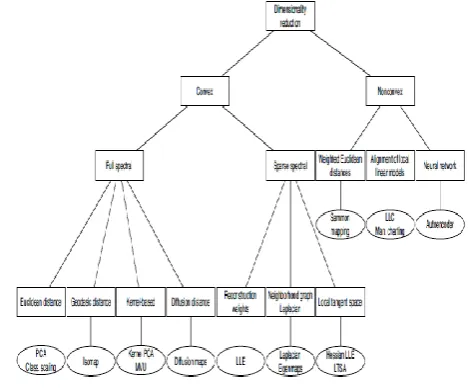
The dimension of the data is the number of variables that are measured on each observation. We subdivide techniques for dimensionality reduction into convex and non-convex techniques (Fig. 4). Convex techniques optimize an objective function that does not contain any local optima, whereas non-convex techniques optimize objective functions that do contain local optima. The further subdivisions in the taxonomy are discussed in the review in the following two sections:
Figure. 4: Structure of dimension Reduction Techniques
A. Convex Techniques for Dimensionality
Reduction:
Convex techniques for dimensionality reduction optimize an objective function that does not contain any local optima, i.e., the solution space is convex. Most of the selected dimensionality reduction techniques fall in the class of convex techniques. In these techniques, the objective function usually has the form of a (generalized) Rayleigh quotient: the objective function is of the form Ø(Y)=YTAY/YTBY It is well known that a function of this form can be optimized by solving a generalized eigenproblem.
[image:2.595.61.267.469.596.2]© 2010, IJARCS All Rights Reserved CONFERENCE PAPER 510
International Conference on Issues & Challenges in Networking, Intelligence & Computing Technologies
Organized by Krishna Institute of Engineering and Technology (KIET) Ghaziabad, India
Full spectral techniques for dimensionality reduction perform an eigendecomposition of a full matrix that captures the covariances between dimensions or the pairwise similarities between datapoints (possibly in a feature space that is constructed by means of a kernel function). In this subsection, we have five such techniques: (1) PCA / classical scaling, (2) Isomap, (3) Kernel PCA, (4) Maximum Variance Unfolding, and (5) diffusion maps.
b. Sparse Spectral Techniques :
In the previous subsection, we discussed five techniques that construct a low-dimensional representation of the high-dimensional data by performing an eigendecomposition of a full matrix. In contrast, the four techniques discussed in this subsection solve a sparse (generalized) eigenproblem. All presented sparse spectral techniques only focus on retaining local structure of the data. We discuss the sparse spectral dimensionality reduction techniques (1) LLE, (2) Laplacian Eigenmaps, (3) Hessian LLE, and (4) LTSA
B. Non-convex Techniques for Dimensionality
Reduction:
We have a non-convex techniques for multidimensional scaling that forms an alternative to classical scaling called Sammon mapping, a technique based on training multilayer neural networks ,and two techniques that construct a mixture of local linear models and perform a global alignment of these linear models. So we have following non-convex techniques (1) Sammon Mapping, (2) Multilayer Autoencoder, (3) Locally Linear Coordination (LLC) and (4) Manifold Charting.
V. EXPERIMENTALSETUP
The research is carried out using discrete event simulation software known as OPNET (Optimized Network Engineering Tool) Modeler version 14.5. It is one of the most widely used commercial simulators based on Microsoft Windows platform and incorporates more MANET routing parameter as compared to other commercial simulator available. It not only supports MANET routing but also provides a parallel kernel to support the increase in stability and mobility in the network. OPNET’s intensive analysing feature provides best environment for comparing and coordinating the output obtained.
[image:3.595.348.526.90.270.2]The simulation focused on the performance of routing protocols with increased in security. Therefore, simulation scenarios consisting of 50,120 nodes initially considered. The nodes were randomly placed within certain gap from each other in 1000 x 1000 m campus environment. The constant File Transfer Protocol (FTP) and video conferencing traffic was generated in the network explicitly i.e. user defined via Application and Profile Configuration. The transmitters and receivers parameter were configured with defining RXGroup in the network. Every node in the network was configured to execute AODV and DSR respectively. The simulation time was set to 300s and used Karn’s Algorithm to calculate the Transmission Control Protocol (TCP) parameters in the network. In addition to that all the nodes were configured with defined path trajectories for mobility in space within certain time interval.The simulation parameter configured in this research work is shown in table 1.
Table 1: Parameters of simulation
Parameters Values
Simulation time 300s Simulation area 1000*1000m
No of nodes 50,120 Application Traffic FTP Server
File size 430,957 bytes
Data rate (bps) 11mbps Mobility algorithm Random waypoint
Routing protocols AODV, DSR
Performance parameter Throughput, delay, drop
VI. DESIGNAPPROACH
For achieve security in MANET, we proposed a model to achieve security. In this model first we collect the information regarding the MANET data and after that reduce the dimension of the data set using various dimension reduction technique. After reducing the data, we covert the data into digitized form and to encrypt the data we use the MD5 (Message Digest 5) technique. Generally, instead of MD5, we can also use any other encryption techniques, such as DSA, AES and so on, to decrypt the message. After encrypt the key we transfer data through MANET and at the other end, another node decrypt the data in the reverse order. Hence, in this paper we proposed a secure and authenticate technique for MANET which is more secure as compared to earlier techniques.
VII. EXPERIMENTALRESULT
In our experiments on MANET datasets, we apply the ten techniques for dimensionality reduction on the high-dimensional representation of the data. Subsequently, we assess the quality of the resulting low-dimensional data representations by evaluating to what extent the local structure of the data is retained. The evaluation is performed by measuring the generalization errors of 1-nearest neighbor classifiers that are trained on the low-dimensional data representation.
Once we create a model for MANET and retrieve a structure like a graph which contains following information about the nodes (Table 2):
Table 2: MANET Data set Structure
Nodes 3214
Edges 10901
Nodes in largest WCC 3455 (0.878) Edges in largest WCC 89889(0.912)
Nodes in largest SCC 1200 (0.129) Edges in largest SCC 23431 (0.243) Average clustering coefficient 0.2281
© 2010, IJARCS All Rights Reserved CONFERENCE PAPER 511
International Conference on Issues & Challenges in Networking, Intelligence & Computing Technologies
Organized by Krishna Institute of Engineering and Technology (KIET) Ghaziabad, India
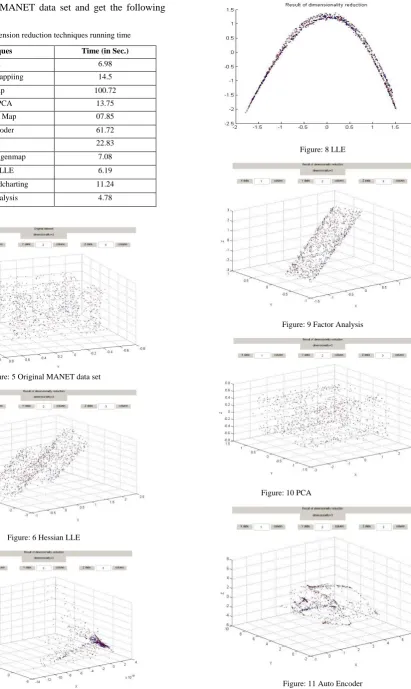
[image:4.595.114.526.64.754.2]We perform the Non-linear dimension reduction techniques on the MANET data set and get the following result (Table 3):
Table 3: Dimension reduction techniques running time
Techniques Time (in Sec.)
PCA 6.98
Sammon Mappiing 14.5
Isomap 100.72
Kernal PCA 13.75 Diffusion Map 07.85 AutoEncoder 61.72
LLE 22.83
Laplacian Eigenmap 7.08 Hessian LLE 6.19 LLCManifoldcharting 11.24
Factor Analysis 4.78
[image:4.595.337.537.65.588.2]Figure: 5 Original MANET data set
Figure: 6 Hessian LLE
Figure: 7 LLC ManifoldCharting
Figure: 8 LLE
Figure: 9 Factor Analysis
Figure: 10 PCA
[image:4.595.52.281.81.764.2]© 2010, IJARCS All Rights Reserved CONFERENCE PAPER 512
International Conference on Issues & Challenges in Networking, Intelligence & Computing Technologies
Organized by Krishna Institute of Engineering and Technology (KIET) Ghaziabad, India
Figure: 12 Isomap
Figure: 13 Sammon Mapping
Figure: 14 Diffusion Map
Figure: 15 Kernal PCA
Figure: 16 Diffusion Map
In the above diagrams we represent the graphical representation of the dimension reduction of various Non-Linear techniques. After reduce the dimension of data, we convert the reduce data into digitized form by sampling technique and encrypt the data using MD5 technique. Hence, we can find a way to achieve security in MANET.
VIII. CONCLUSIONANDFUTUREWORK
In the present paper we present new techniques to secure the data on MANET by dimension reduction techniques. The common measures for measuring the QoS are delay, throughput and packet drop that are used to secure the data by reducing the dimension of MANET dataset. Generally there are also many other parameters that in MANET that can be used for security purpose.
We can also use many other non linear dimension reduction techniques for securing the data such as SNE, MDS and so on. So in future we can implement proposed model with Quantum Key Distribution for distribute the key and use more efficient non-linear dimension reduction technique whose complexity and running time is lesser than the presented techniques. This technique can also introduce a more secure and authenticate communication channel for community and other MANET routing protocol.
IX. REFERENCES
[1] A.M. Posadas, F. Vidal, F. de Miguel, G. Alguacil, J. Pena, J.M. Ibanez, and J. Morales. Spatial-temporal analysis of a seismic series using the principal components method. Journal of Geophysical Research, 98(B2):1923–1932, 1993.
[2] Anon. An Introduction to Role-Based Access Control. NIST ITL Bulletins, National Institute of Standards and Technology, December 1995.
[3] Bar-Hillel, T. Hertz, N. Shental, and D. Weinshall. Learning a Mahalanobis metric from equivalence constraints. Journal of machine Learning Research, 6(1):937–965, 2006
[4] Data Integrity, from Wikipedia, the free encyclopedia, http://en.wikipedia.org/wiki/Data_integrity.
[5] H. Hoffmann. Kernel PCA for novelty detection. Pattern Recognition, 40(3):863–874, 2007.
[6] Haas, Z. and Tabrizi, S. On Some Challenges and Design Choices in Ad Hoc Communications. 1998. Lee, S.-J. et al. On-Demand Multicast Routing Protocol (ODMRP). IETF draft, January 2000.
© 2010, IJARCS All Rights Reserved CONFERENCE PAPER 513
International Conference on Issues & Challenges in Networking, Intelligence & Computing Technologies
Organized by Krishna Institute of Engineering and Technology (KIET) Ghaziabad, India
[8] J.A. Lee and M. Verleysen. Nonlinear dimensionality reduction of data manifolds with essential loops.Neurocomputing, 67:29–53, 2005.
[9] Jim Parker, Anand Patwardhan, and Anupam Joshi, Detecting Wireless Misbehavior through Cross-layer Analysis, in Proceedings of the IEEE Consumer Communications andNetworking Conference Special sessions (CCNC’2006), Las Vegas, Nevada, 2006.
[10] N. Gisin et al, “Quantum cryptography,” Rev. Mod. Phys., Vol. 74, No. 1, January 2002.
[11] P. Papadimitratos and Z. J. Hass, Secure Routing for Mobile Ad Hoc Networks, in Proceedings of SCS Communication
Networks and Distributed Systems Modeling and Simulation Conference (CNDS), San Antonio, TX, January 2002. [12] Sergio Marti, T. J. Giuli, Kevin Lai and Mary Baker,
Mitigating routingmisbehavior in mobile ad hoc networks, in Proceedings of the 6th annual international conference on Mobile computing and networking (MobiCom’00), pages 255–265, Boston, MA, July 2000.
[13] W.E. Arnoldi. The principle of minimized iteration in the solution of the matrix eigenvalue problem. Quarterly of Applied Mathematics, 9:17–25, January 1951.