Volume 3, No. 3, May-June 2012
International Journal of Advanced Research in Computer Science
RESEARCH PAPER
Available Online at www.ijarcs.info
ISSN No. 0976-5697
Agent Oriented E-learning System for Visually Impaired Students using JADE Agent
Technology
Shiladitya Pujari*
Department of Information Technology UIT, Burdwan University Burdwan, West Bengal, India [email protected]
Sripati Mukhopadhyay
Department of Computer Science Burdwan University Burdwan, West Bengal, India
Abstract: Students with visual impairment face too much problems in continuing their education in the existing education system. A software agent oriented e-learning system can be a better solution for the students who are visually impaired. The proposed e-learning system is a multi-agent system based scheme. Agents within the system work on the basis of centralized as well as distributed multi-agent planning for inter-agent communication, collaboration and negotiation. Java Agent Development Environment (JADE) is used to create these agents because JADE agents are autonomous and the entire system becomes platform independent.
Keywords: Agent, assistive, disables e-learning, multi-agent, visual impairment.
I. INTRODUCTION
The scope of having quality education for disabled students, especially the students with visual impairment is really in poor condition. In our country, we can hardly find out any proper institute or education system only for them [1]. Students with visual impairment cannot cope up with the normal students within the existing education systems, such as conventional black-board based classrooms. Visually Impaired students need some kind of special attention and special assistance. Existing education or learning systems do not empowered with this kind of aids or tools. Beside this, education system in India for disabled students facing some basic problems as follows:
a.Huge scarcity of trained teachers/tutors for visually impaired students in institutions.
b.Limitation of available and suitable seats in respect of total potential students.
c. Limited number of Institutes, Universities for blind students which do not meet the actual need.
d.Course fees for professional courses, in most of the cases, are huge.
e. Lack of proper communication as well as geographical barrier.
f. Lack of proper education and learning environment for handicapped.
g.Socio-economic barrier and indulgence in people towards education of blind students.
II. IMPAIRMENT,DISABILITYANDHANDICAP
It is important to define disability of a person properly and to identify the kind of disability also. World Health Organization (WHO in 1976) drew a clear three-fold distinction between impairment, disability and handicap. a. Impairment is any loss or abnormality of psychological,
physiological or anatomical structure or function.
b. Disability is defined as any restriction or lack (resulting from an impairment) of ability to perform an activity in the manner or within the range considered normal for a human being.
c. Whereas, handicap is a disadvantage, for a given individual, resulting from impairment or a disability, which prevents the fulfillment of a role that is considered normal for that individual.
WHO reaffirmed this classification in 1980. In 2001, WHO issued the International Classification of Functionality, Disability and Health (ICF). The ICF distinguishes between body functions (either psychological or physiological, such as vision) and body structures (anatomical parts such as eyes) in 2002. The ICF enlisted 9 broad domains of functioning which can be affected mostly. These domains are:
a) Learning and applying knowledge b) General tasks and demands c) Communication
d) Mobility e) Self-care f) Domestic life
g) Interpersonal interactions and relationships h) Major life areas
i) Community, social and civic life
The ICF was endorsed officially by all 191 WHO Member States in the 54th Health Assembly on 22 May 2001.
III. DEFINITIONANDTYPESOFDISABILITY
a. As per the Princeton University Press, disability is defined as the condition of being unable to perform as a consequence of physical or mental unfitness;"reading disability";"hearing impairment" etc.
body and features of the society in which he or she lives”.
c. A disability is a condition or function judged to be significantly impaired relative to the usual standard of an individual or group, defined by an organization named disabled-world.
Disabilities can be classified into some types and sub-types. The classification is as follows:
a) Mobility and Physical Impairments
i. Upper limb(s) disability ii. Lower limb(s) disability iii. Manual dexterity
iv. Disability in co-ordination with different organs of the body
b) Spinal Cord Disability
c) Head Injuries - Brain Disability
i. Acquired Brain Injury (ABI) ii. Traumatic Brain Injury (TBI)
d) Vision Disability
e) Hearing Disability
f) Cognitive or Learning Disabilities
g) Psychological Disorders
IV. PREVALENCEOFDISABILITYININDIA
There are different kinds of prevalence rates of disability available in India. According to Census 2001, there are almost 2.19 thousand people with significant disabilities in India, constituting 2.13% of the total population of the country. Out of the 21, 906, 769 people with disabilities, 12, 605, 635 are males and 9, 301, 134 are females including persons with hearing, speech, visual, locomotors and mental disabilities.
No disabilities,
97.87 Disabled
person, 2.1 3
Chart I: Ratio of disabled persons in India (Census 2001)
In contrary, in 2002, the National Sample Survey Organization (NSSO) estimated that only 1.8% (40-90 million) of the Indian population is disabled. Almost 75% of persons with disabilities live in rural areas, 49% of the disabled population is literate, and only 34% are actually
employed. NSSO also included the persons with visual, hearing, speech, locomotors and mental disabilities.
49%
34% 17%
According to NSSO 2002
Literate Employed Rest
Chart II: Scenario of disabled persons in India (NSSO 2002)
While the estimation varies, it is evident that people with disabilities comprise between 4 to 8 percent of the Indian population (almost 40-90 million). And like any other group, education is critical to expanding the life of people with disabilities. Additionally, the socialization of children with disabilities through education assumes an unusually important role in societies like India, where social exclusion of persons with disabilities is much significant. Despite its importance, reality says that educational outcomes for children as well as adults with disabilities remain very poor. Illiteracy rates for all persons with disabilities and school-age disabled children remain much higher than the general population [2].
35%
38% 27%
According to NSSO 2002
Visual Hearing Speech
According to the Census 2001, nearly 50 percent of persons with disability are visually disabled, compared to 15.3 percent in the NSS. For visual disability, the Census includes persons who have blurred vision and have had no occasion to test their vision. It thus includes persons who may be able to see with spectacles. In contrast, the NSS does not consider whether or not a person’s vision has been tested and focuses on the ability to perform tasks requiring visual acuity [2].
V. NECESSITYOFAMULTI-AGENTBASED SYSTEM
This is the scenario about education of visually impaired students in India. To provide quality education to them, and due to the remarkable advent of computer as well as Internet technologies, a distributed, automated and intelligent education system is one of the best alternatives at this situation. This type of education system (virtual classroom environment, intelligent tutor etc.) may help to wipe out the current situation and may increase the education outcomes for disabled students, because these systems do not contain the limitations and problems of the conventional education systems in India stated earlier. Education or learning systems, for example, a school, or a University, is a complex system, where different sections/departments have their own tasks/ responsibilities and they are located at different sites. Those different agencies/departments have to communicate between themselves to accomplish a specific task, such as conducting regular classes, examinations, publication of results etc [3][4]. This kind of complex, distributed system, where collaboration, negotiation and communication between separate and independent sections/departments is necessary to accomplish a desired task can be designed best with the help of multi-agent system (MAS).
If we look to the most emerging software paradigm of this century, the agent based system or the multi-agent system (MAS), we shall find out that automated and computerized education system can be implemented using the concept of multi-agent system (MAS). In this research paper, a scheme of the computerized automated intelligent education system using the Multi-agent system (MAS) is presented.
VI. DEFINITIONOFAGENTANDMULTI_AGENT SYSTEM
According to Michael Wooldridge, An agent is a software entity that applies Artificial Intelligence techniques for choosing the best set of actions to perform in order to reach a goal specified by the user. It should react in a flexible, proactive, dynamic, autonomous and intelligent way to the changes produced in its environment.
A multi-agent system can be defined as a collection of autonomous agents that communicate between them to coordinate their activities in order to be able to solve collectively a problem that could not be tackled by any agent individually.
Multi-agent systems may be considered as the latest software engineering paradigm in the recent era. This kind
of systems may be used in those domains which consist of the following features:
a. Knowledge is distributed in different locations.
b. Several entities, while keeping their autonomous behavior, have to join their problem-solving abilities to be able to solve a complex problem.
The problems in the domain may be decomposed in different sub-problems, even if they have some kind of inter-dependencies [4].
A. Basic Agent Properties:
Intelligent and autonomous agents consist of some basic properties. These properties are:
a) Reactivity: awareness of the environment.
b) Autonomy: control over its own actions.
c) Proactive: anticipation to user’s requests.
d) Reasoning/planning (AI): basis of intelligent
behaviour.
e) Learning: improvement of its performance.
f) Communication: exchange of information with other
agents; implies standardization of languages and protocols; allows cooperation, negotiation etc.
VII. JADEAGENTTECHNOLOGY
To design the e-learning system for visually impaired students, the JADE technology is used. According to Wooldridge and Jennings (1995), JADE is a software platform that provides basic middleware-layer functionalities which are independent of the specific application and which simplify the realization of distributed applications that exploit the software agent abstraction. The framework facilitates the development of complete agent-based applications by means of a run time environment implementing the life-cycle support features required by agents, the core logic of agents themselves, and a rich suite of graphical tools. A significant merit of JADE is that it implements this abstraction over a well-known object-oriented language, Java, providing a simple and friendly API. The following simple design choices were influenced by the agent abstraction. JADE was initially developed by the Research & Development department of Telecom Italia s.p.a. The JADE agent has the following advantages:
a. JADE Agent is Autonomous and Proactive: the JADE
agent is Autonomous, the each of the agent have own thread of execution, they can control own life-cycle and decide autonomous when to perform which actions. JADE agent is also proactive in nature.
b. Agents have no Dependency and they are Loosely
Coupled: There is no temporal dependency between the
sender and receivers: a receiver might not be available when the sender issues the message. There is also no need to obtain the object reference of receiver agents but just name identities that the message transport system is able to resolve into proper transport addresses.
c. The System is Peer-to-Peer: each agent can be
discover other agents through both white-page and yellow-page services.
d. Is Fully Distributed System: the each of the agent
running as a separate thread, they can running in different machines, and also can communication between them.
e. Full Compliance with the FIPA Specifications: The
platform successfully participated in all FIPA interoperability events and was used as the middleware for many platforms in the Agentcities network.
f. A Library of Interaction Protocols: they already give some of the protocol option in the JADE library, when need just using the function implementation.
g. Support for J2SE, J2EE, J2ME platform and wireless
environment.
h. Platform Independent: It can be used in any operating
system.
Using the JADE agent technology, the proposed e-learning system has the following characteristics:
a. Autonomy: The system has the autonomous transaction
facility. It reduces the user intervention during purchasing activity.
b. User adaptability: The user preference changes all the
time. The system reflects the user’s up to date preferences in an adaption mechanism.
c. Scalability: Using JADE technology, the system can
easily scale up to 1500 agents and 300000 ACL messages.
VIII. DESCRIPTIONOFTHEE-LEARNING SYSTEM
The multi-agent based scheme of e-learning system presented here may be a better place for disabled students, both children as well as adult, of India to start and continue their education without attending any kind of conventional e-learning centre, such as school, college, university etc. This e-learning system will not entirely wipe out the conventional learning methods the disabled students can opt. This system may work properly and may give the maximum outcome if implemented or installed along with the conventional systems.
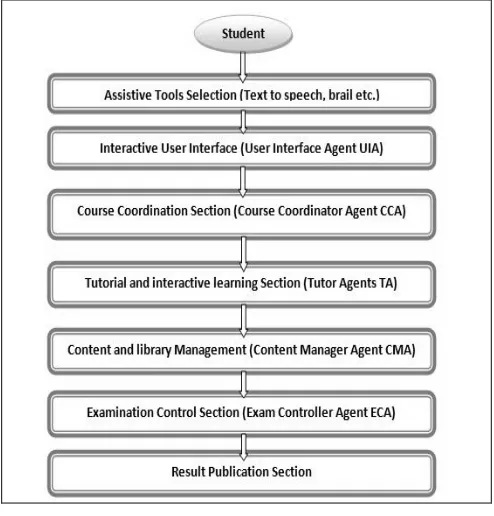
The e-learning system is divided into some modules. Some modules are independent, whereas some modules have inter-dependencies and has specific goal to accomplish. But, modules can communicate between themselves for the purpose of achieving some common goal when necessary. Every module are driven or coordinated by some autonomous agents. Some of those modules are composed of two or more agents, while some modules has single agent. Here is the schematic diagram of the assistive e-learning system.
Figure 1: Modules and agents of e-learning system
It is clearly mentioned in Figure I that the e-learning system is divided into several modules or sections. That means knowledge (whether it is specific for a module or the knowledge is global for the entire system) is distributed in different locations, and different entities or modules has to communicate between themselves to solve a complex problem [5][6]. An important aspect of this agent based e-learning system must be mentioned here. This system is not totally devoid of explicit human intervention, because subjective knowledge and expertise of experts is necessary. In the consecutive text, each module of the system has been described briefly.
This multi-agent based e-learning system has seven modules. Before describing the modules, a schematic diagram of multi-agent based approach will be more helpful to understand the e-learning system. The following picture is showing the role of agents and coordination, communication and negotiation between them [7].
Here, in Figure II, is the complete schematic diagram of the e-learning system for visually impaired students. From this diagram, we can see that, a student first selects an assistive tool or a set of assistive tools required for him/her to carry out the learning process. Students use an interactive user interface to perform the entire necessary task relevant to the learning process. The user interface is coordinated by the User Interface Agent (UIA). The responsibilities and roles of every modules as well as agents have been described in the following sections of this paper.
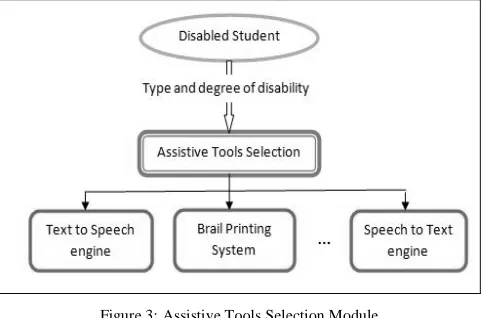
The first module is the Assistive Tools Selection module. This module is for selection of appropriate assistive tools for disabled student. Assistive tools will be selected as per the nature and degree of disability of individual student. For blind students, voice recognition system, text to speech engine, brail printing system and other aids will be selected. This is a onetime selection and fixation process, i.e. once this set of assistive tools is selected for a particular student, the set of tools will be fixed for that student for the entire course.
Figure 3: Assistive Tools Selection Module
After selection and fixation of appropriate assistive tool (or set of tools), an interactive user interface will help the student to start and carry out the interactive learning process. Here, an intelligent software agent is entirely responsible for these kinds of interactivities and coordination. This agent is named as User Interface Agent (UIA). This UIA serves the users (students) with the help of the global knowledge base and global data base of the system. UIA receives input from user, does some analytical operation to make the input into knowledge, and then communicate with agents of other modules such as Course Coordinator Agent (CCA), Content Manager Agent (CMA) or Exam Controller Agent (ECA) etc as per requisite.
UIA actually communicates with Tutor Agents (TA) for different subjects, Exam Controller Agent (ECA) and Content Manager Agent (CMA) directly, but in some goal specific situation, it communicates through Course Coordinator Agent (CCA). UIA eventually works on the basis of distributed multi-agent planning, because UIA has to achieve different goals at different time, by communicating and negotiating with other agents (such as CCA, ECA, CMA and also various Tutor Agents or TAs).
As we stated earlier that, agents of this e-learning system work on the basis of both centralized as well as distributed
multi-agent planning for communication, cooperation and negotiation between them [8][9]. The Course Coordinator Agent (CCA) acts as the major part of centralized multi-agent planning, CCA communicate with multi-agents of every modules of the e-learning system. It communicates with User Interface Agent (UIA), Exam Controller Agent (ECA), Content Manger Agent (CMA), and all the expert agents of the tutorial and learning section. Actually, each agent communicates and negotiates with other agents in the system through the CCA. That means CCA acts as the central coordinator. CCA rectifies communications between agents if there are any flaws. Every agent is associated with their respective local database and knowledgebase, and they can also access the global database and global knowledgebase, through the CCA, if required. CCA directly accesses the global database and global knowledgebase of the system. CCA also keep track of all the subject wise expert agents (Tutor Agent or TA) and their activities. In figure V, the role of CCA and communication between other agents within the system is clearly depicted.
Among the agents, CMA is also associated with the digital library databases, local (library of the e-learning system and maintained within the system) as well as global library through Internet and other networks. Human intervention is necessary here to develop the local library of the system, because contents, tutorials, questionnaires, books, research papers, articles etc. must be stored and into library to enrich and upgrade it. This content development needs direct human intervention. Communication between CMA and TAs is very important to conduct a course. TAs must have access to the digital library. CMA also communicates with UIA during the learning process and accessing of library by a student through user interface.
Figure 4: Role of Course Coordinator Agent (CCA)
CCA during evaluation, tabulation and publication of result [9].
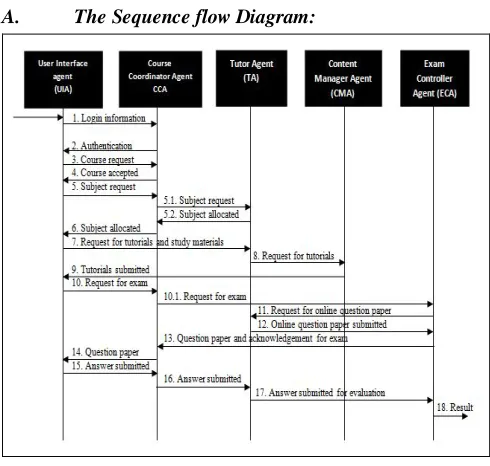
In Figure II, we can see that individual agents are there to conduct regular classes and tutorial classes of specific subjects during the entire course. These agents are named as Tutor Agents (TA). These TAs maintain their respective local database and local knowledgebase. They have access to the global database and global knowledgebase through the CCA. TAs can also access digital library through CMA. Local database and local knowledgebase of TAs are to store and maintain tutorials, contents, books etc. for the specific subject the TA is assigned for. TAs and UIA communicate through CCA during the class hour and tutorial session. Human intervention is required so that experts from different disciplines may enrich the local database and local knowledgebase of each subject specific TA by submitting books, articles, tutorials, etc. A sequence flow diagram can depict the message passing between the agents and communication, cooperation and negotiation between them.
A. The Sequence flow Diagram:
Figure 5: The sequence flow diagramfor transactions
We can realize the interactions and communications between the agents of different modules within the system from this sequence flow diagram depicted in Figure VI. The diagram showing that minimum of eighteen steps is necessary to carry out a complete learning process for a student, starting from login process up to the publication of result.
IX. CONCLUSION
Here is the brief description of the proposed scheme. In this scheme, human intervention is obvious at many situations because without human intervention, many aspects of the system, where knowledge is required, may not
give its proper outcome, such as content development, tutorial selection, question paper preparation, evaluation of examination copies etc. This assistive e-learning system is a multi-agent based system, and this system can be no doubt a better alternative for the visually impaired students to continue their studies. This system can be accessed from home through the Internet. That means, a student with disability does not have to go to any institution for his/her study. This aspect may hopefully increase the ratio of literate disabled students in India.
X. REFERENCES
[1] NCPEDP audit report “Status of Mainstream Education of Disabled Students in India A Research Study”, 2005.
[2] “People with disabilities in India: From commitments to outcomes”,Human Development Unit, South Asia Region, The World Bank, 2007.
[3] Syed Asif Ali, S. M Aqi/ Burney, “Conversion of Heterogeneous Education System (HeES) into Homogeneous Education System (HoES) for Ease of Disabled Persons using Information Technology”, International Conference On Computer Design And Appliations (ICCDA 2010), ISBN: 978-1-4244-7 164-5, 2010 IEEE.
[4] Michael Wooldridge, ”An Introduction to Multi agent Systems”,Department of Computer Science, University of Liverpool, Uk,JOHN WILEY & SONS, LTD.
[5] Yin Bing, Lin Zhuying, Du Li, “The Applications of Multi-Agent Technology in Distance Education System”, International Conference on Networking and Digital Society, ISBN: 978-1-4244-5161-6/10 ©2010 IEEE.
[6] WANG Dong-sheng, PAN Wei-wei, “The Design of Distance Learning System based on Multi-Agent”, Second International Workshop on Education Technology and Computer Science (ETCS), ISBN: 978-0-7695-3987-4/10 © 2010 IEEE.
[7] S. Pujari, S. Gupta, S. Mukherjee “Patient Scheduling and Diagnosis Scheme for Rural Health Care System in India: A Multi-Agent System (MAS) based Approach”. ISBN 93-80813-01-5, 2010.
[8] S. Gupta, S.Pujari” A multi agent system (MAS) based scheme for health care and medical diagnosis system”, IAMA conference proceeding, IEEE Catalog Number: CFP0953H,ISBN: 978-1-4244-4711-4,2009.