Volume 3, No. 3, May-June 2012
International Journal of Advanced Research in Computer Science
RESEARCH PAPER
Available Online at www.ijarcs.info
ISSN No. 0976-5697
Security Issues Related to E-Assessment: A UML based Approach
Nikhilesh Barik
Research Scholar, Department of Computer Science, Burdwan University, West Bengal
Burdwan, India [email protected]
Abstract: Although E-Learning system is one of the most effective applications of Information and Communication Technology (ICT) and gradually becoming popular among the educational Institute, but the backbone of the system E-Assessment is not secure enough in most of the cases. As an effect most of the participants are still very much reluctant to get full fledged support via E-learning. In this paper we outline the security measurement related to E-assessment where assessment can be similar to paper based system. I have used Digital Signature to protect E-assessment documents like Question Papers, Answer sheets etc. and keep on monitoring (e-monitoring) via ICT with VPN, Video conference, etc. Also I will discuss UML based sample Class description, use case diagram and Sequence Diagram to show E-assessment security so that all the participants, Management of the E-learning organization (Institutions / Managers),Authors (Books, Content of subjects),Teachers (Professor etc) and Learners (students) can build trust in their minds for E-Learning system.
Keywords: E-Learning, E-Assessment, E-Learning Security, E-monitoring, Digital Signature, E-Assessment Security.
I. INTRODUCTION
In any educational system assessment is a major issue among all other issues. With out assessment student learning will not be completed. In case of e-learning system, assessment is called e-assessment. Secure e-assessments by ICT in e-learning environments create opportunities for lifelong learning,
automatic marking and immediate feedback. Online
assessments are designed to improve students’ learning and give information about their progress [1]. E-assessments are categorized as high-ended examinations which count towards a degree. In higher education, e-assessments can be divided into two ways; one e-assessment in supervised environments and another in non-supervised environments [2]. Our discussion tends towards supervised environment i.e. the learners must come to a centre for their exam where group of persons will be responsible for supervising all the assets and monitor all examines related to examination. As total system is based on electronic media, one form answer must be soft copy, where as a hardcopy may be maintain for better security.
The second section explains common assets used in case of assessment, Section three elaborate different features of e-assessments. Various Phases of e-assessment is discussed in the fourth section .UML approach of E-assessment is discussed in fifth section and the last section offers a brief conclusion.
II. E-ASSESSMENT ASSETS
Instead of hardware and software used by different e-learning users, there are valuable assets existing related to e-assessment [10]. Some of these are User Profile , Announcement from the authority like Examination Schedule, new seminar Presentation date and time, List of registration number course and year wise ,generated e-admit / e-registration certificate, question paper, correct answers sheet, answer script, Grades, Grades related documents, Students’ Assignment etc.
III. FEATURES Of E-ASSESSMENT
Assessment is a continuous process and it provides information for improving learning and teaching. This information is anonymous and not graded. Where as evaluation is the judgement of a student’s performance and it focuses on grades [9]. In case of E-assessment system the following four features must be considered [10].
A. Authenticity:
Authenticity is the main part of any assessment system [6]. We need to authenticate the examinee, examiner, System Manager and invigilators at every step in the assessment because it is difficult to identify everybody “facto-face” continuously in e-learning environments except for some video monitoring.
a. Passwords:
Unfortunately less ambitious students can share their password to other students which leads to difficulty of the e-learning system. There must be a system to edit the profile /change the password after receiving high security password via short message services (SMS). Also there must be time limit after that user must have to change their password.
b. Biometric:
Most scientific authentication by biometric solution such as fingerprint and face reorganization method. These are continuous authentication methods. Multimodal biometrics is new e-authentication approach which is clearly discussed by Apampa [2]. Also it is possible to use biometric solution by pupil matching methods.
c. Video Monitoring:
d. Answer to Challenge Questions:
User has to face different challenges related to the data provided by them during the examination. Though it may disturb a little the examinee but will increase more trust on E-assessment system.
e. E-token:
Organization will send some code via SMS / E-mail to authenticate students, invigilators and centre head together so that three inputs together allow to continue examination.
f. E-Admit Card:
Similar to e-token, e-admit cards authenticate students and invigilator together.
B. Integrity:
Question paper and answers sheet should both be checked for their integrity, to detect unauthorized changes [6]. Only one submission of the answer sheet should be allowed, and the submission of answers after the examination is ended should be prohibited [7]. The unauthorized deletion or the modification of the materials related to the exam should be impossible, or at least detectable. The following technologies can be applied to maintain the integrity of the e-assessment.
a. Encryption
b. Digital Signature c. Digital Certificate
C. Privacy:
Access control needs to guarantee the enforcement of the privacy requirements. There are two principal problems that needed to be considered -one is the definition of privacy preserving access control policies; which requires considering, expressing, and combining protection requirements taking in to account both direct and indirect release of information. Another is that information may not be under the control of a single authority; where privacy policies related to information must take in to consideration not only the privacy requirements of the owner, but also the privacy requirements of the collector and relevant privacy laws.
Concept of privacy is always changeable as the participants are not fixed. It is important that privacy requirements be associated with the data during their movement among different participant in e-assessment system. So all the users who receive the information follow the privacy rules when accessing or accepting the documents. These multiple authorities' scenario should be supported from the administration point of view by providing solutions for modular, large-scale, scalable policy composition and interaction.
D. Reliability and Validity:
Reliability and validity both refer to the degree accuracy of the system. Wipple suggests clearly that availability is the system’s readiness to perform the service while reliability refers on delivering the accurate service according to the system specification and efficiency of participants [8]. Maria discussed reliability of examination by two examiners [1]. Here we can apply reliability by comparing of first examiners’ score by checking the hard copies and the score by Result Management System (RMS) / Content Management System (CMS) from the correct answer sheet. If there is any ambiguity then another evaluation can be done by third persons to increase reliability.
Maria states that validity of E-assessment depends on proper judgement of the students or the success of the purpose of the evaluation[1]. Valid e-assessment requires an actual reflection of the students’ knowledge.
IV. PHASES OF E-ASSESSMENTS
As Weippl suggested clearly few steps relevant to the examination are examined in his dependability in E-Assessment, we are presenting three more steps related to e-assessment. These seven steps are as follows[8].
A. Setting up Examination Centre:
As already we have discussed supervised environment for e-assessment , so it is important to look after the setting up of the examination centre with all kind of infrastructure (software and hardware ) as required. It will be better idea to run total program with some dummy examinees. So all the e-assessment assets like exam questions, user profile, smart card, e-admit card, e-registration card, Answer sheet, Grade card must be kept with lock (encryption ) and key will be verified. Integrity of the question and blank answer sheet must be of highest priority at the time of setting up examination centre.
B. Check List Just Before Examination:
Firstly all exam questions and other documents must be delivered to the examination room to maintain secrecy and integrity. Then each user and invigilator must be identified and authenticated physically, logically or technologically. If there is any concept of storing answer sheet at local server then one scheduler must be set with time gap to back up the data. Take a demo video recording to check whether system is running smoothly or not.
C. Verification of Examinee and Invigilator:
When everything is ready to start the examination, there will be a dual coded verification required to authenticate both examinee and invigilator together. After the verification examinees can open the browser or Learning Management System. Digital Signature or Digital Certificate will take a vital role for authentication examinees and invigilator as well as their documents [4].
D. Conducting the Examination:
All invigilators must be aware of cheating at the time of holding of the examination It can be exchange of information among students, students can used book or other material, they can use internet or mobile as and when they think these malpractices are not harmful. Some times desperate students may attack the server room to damage each and every information so that no evaluation is possible or waiting for the repeation the event.
E. Monitoring the Examination:
to find out the advantages as they can. In case of very difficult question /out of syllabus questions, teachers must follow the guidelines at the time of evaluation.
F. Submitting the Answer Sheet and Storing Documents:
As the problem sets and answer sheet should be available to the examinees, so the time of leaving from examination room, be sure that they have submitted the information filled answer sheets. Then the answer sheets should be kept securely before grading. There is also possibilities of cheating during submission if students know that they may fail, they can damage the server and other hardware (like router, switch etc) or can delete all soft records. Efficient Digital Signature scheme can be applied at the time of submission of answer sheets also[4].
G. Grading the Examination:
It is important to give the feedback to all the students via grading. First of all correct answer sample must be distributed to all users. Next distribution of the answer sheet is another risk in e-assessment. Before distribution all copies must the coded and remove the details of students record so that to evaluator can not identify the examinee and no question of any partiality should arise.
If each copy has to be published in the internet for the students maintaining proper privacy so that except the candidate no body else can view this copies. Also make sure that every exam is really graded – even if students forget to logout from the system[8].
As Barik discuss access control using firewall can be apply in each part of grading the examination to maintain non-repudiation & archiving [3]. Non-non-repudiation of the Marking Process can be done by changing the original roll no by some code. Last minute announcement from the authorized committee makes the system unbiased
V. UML (UNIFIED MODELLING LANGUAGE ) APPROACH OF E-ASSESSMENT
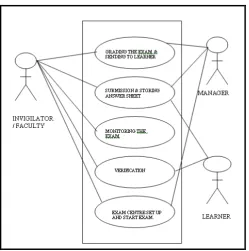
E-assessment system is mainly dealt by three users namely Learner, Manager and Invigilator. The following class diagram, use-case and sequence diagram shows details of users interaction and different views of e-assessment system respectively.
A. Class Description:
A class is a group of objects who share common properties and relationships. In an OOM the overall system is framed via classes .Though there will be different sub classes derived from main classes, we are here giving description of those three main classes [11].
a. Learner:
[image:3.595.348.501.56.206.2]Learner means students of e-learning system .i.e group of students who have enrolled in different e-learning courses. As everything here is via ICT so learner may have to log in different time with their user code and also run different methods sending query & receive solution via get_code method.
Figure 1. Sample LEARNER class
b. Manager:
[image:3.595.341.506.321.479.2]Manager represents an office administrator or system administrator or any body who is responsible to look after management part of e-learning as well as e-assessment system. They are responsible to set the access code to the learner or other manager /invigilator at the time of examination, make digital signature to the documents and to send reply according to the questions received by get_query() methods
Figure 2. Sample MANAGER class
c. Invigilator :
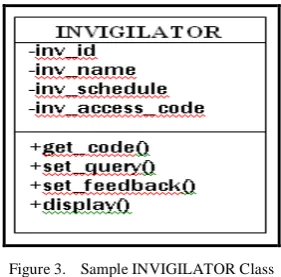
Invigilators are only responsible to conduct the exam during examination time and collect the answer sheets or help the learners to submit online copy. To maintain the integrity there will be code for invigilator also. They can send the feedback via set_feedback() method and see the instruction from manager via display() method.
Figure 3. Sample INVIGILATOR Class
B. Use Case Diagram Of E-Assessment System:
[image:3.595.362.503.595.733.2]Modeling Language) design. User view version can be described clearly by the following Use Case diagram.
Figure 4. Use Case Diagram of the proposed in E-Assessment System
C. The Advantages of this Modelling in E-Assessment System [12]:
a. Systematic and well-defined e-Assessment learning
process that is easy to track and monitor.
b. Clear understanding of evaluation objectives and
learner satisfaction.
c. Flexible system that is easy to manage and maintain d. Effortless transfer and exchange of data between the
learner and managers
e. Standardized guidelines for the entire e-assessment system.
f. Interoperability among multiple methods of
e-assessment system.
D. Sequence Diagram:
[image:4.595.39.289.80.332.2]The following sequence diagram display how message transmits among Manager, Learner and Invigilator in e-assessment system[11].
Figure 5. Sequence Diagram with Manager ,Learner & Invigilator.
VI. CONCLUSIONS
As it is easier to apply malpractice in an online examination compared to traditional examination , there exists an increased risk of academic fraud in online assessments over the traditional assessments. Though many software companies are conducting their recruitment with preliminary online test. All students (online users) will be monitored by their Training Placement Officer/Officers .This year in India Syntel India Ltd. & Tata Consultancy Service(TCS) have organised an online test of this methodology where there was not any security measure whether someone else is taking the examination instead of the candidate. In this paper, we have proposed a systematic approach to each phase of e-assessments. Also we have investigated the different security features in e-assessment in reference to all the e-assessment assets. As a result more online users will be attracted towards e-learning system also have trust on e-assessment. In future, the concept of m-learning will be essential, in case of secured e-assessment. Objective of the paper is to describe some initial efforts and experiments in internet-based e-assessment. By which a secured e-assessment system can be designed and developed. We have given trace to overcome possible shortcomings in seven different phases of e-assessment system to ensure that its e-e-assessment strategy and operations are robust and develop confidence in the E-Assessment process for users.
VII. REFERENCES
[1] Apampa, K. M., Gary Wills, David Argles “User Security
Issues in Summative E-Assessment Security” International Journal of Digital Society (IJDS), Volume 1, Issue 2, June 2010.
[2] Apampa K M ,Gary Wills, David Argles “Towards a
Blob-based Presence Verification System in Summative International Journal of e-Assessment Vol-1,No-1,2011
[3] Barik Nikhilesh and Karforma Sunil “Risks And Remedies In E-Learning System “ “International Journal of Network Security & Its Applications (IJNSA), Vol.4, No.1, January 2012 ,ISSN -0974-9330(OL),0975-2307(P), PP 51-59
[4] Barik Nikhilesh and Karforma Sunil “A Study On Efficient
Digital Signature Scheme for E-Governance Security” “ “Global Journal of Computer Science and Technology”(GJCST) Online ISSN :0975-4172 & Print ISSN :0975-4350 ,Vol-XII ,ISSUE –II ,Version –I, PP 7-11
[5] Camille F. Rogers et al “Faculty Perceptions about
E-Cheating during online Testing” JCSC 22, 2 (December 2006) PP 206-212.
[6] Marais, Emil, Argles, David and von Solms, Basie (2006)
Conference on www Applications, Bloemfontein, 08 - 06 Sep 2006.
[7] Naresh ,CH.Deepthi, T.P.Shekhar “A Novel Approach to
Enhance Security for Online Exams “IJCST Vol. 2, Issue 3, September 2011
[8] Weippl Edgar R “ IT Security Context in E-Learning.,”
September 10,2008
[9] Weippl Edgar R. “Security in E-Learning” , Springer
[10] Z. F. Zamzury ,M Manaf, A Ahmad, Y Yunus “Computer Security Threats Towards the E-Learning System Assets” 2011, Volume 180, Part 3, 335-345.
[11]Karforma Sunil and Ghosh Basudeb ,: On Designing an e_learning Sytem Model;An Object based approach “NACCS 2010 ,Burdwan University ,Jan 2010.