DOI: http://dx.doi.org/10.26483/ijarcs.v8i7.4289
Volume 8, No. 7, July – August 2017
International Journal of Advanced Research in Computer Science
RESEARCH PAPER
Available Online at www.ijarcs.info
ISSN No. 0976-5697
DIFFSERV BASED QOS PERFORMANCE STUDY OF VIDEO CONFERENCING
APPLICATION USING TRADITIONAL IP AND MPLS-TE NETWORKS OVER
IPV4 AND IPV6
Asma Mushtaq
Department of Electronics and Communication Punjabi University
Patiala, India
Dr. Manjeet Singh Patterh
Professor, Department of Electronics and Communication Punjabi University
Patiala, India
Abstract: With the constant evolution in the communication industry and development in the network technology, demand for more sophisticated and quality assured multimedia applications has increased. Although Differentiated Services (DiffServ) model can be deployed over the traditional Internet Protocol (IP) based networks to ensure QoS, it is unable to provide a guaranteed end-to-end QoS to the network. Multiprotocol Label Switching (MPLS) is one of the recent technologies that is being used as a backbone network to provide QoS on account of its Traffic Engineering (TE) capabilities. Use of DiffServ as the dedicated QoS model over MPLS-TE networks can lead to a significant improvement in the quality of the services provided by the network. IPv4 is the basic network layer protocol currently in use over the Internet. With technological advances and increase in number of users and their requirements, IPv4 is proving to be insufficient. IPv6 is the latest version of the Internet Protocol that can potentially takeover as the basic network layer protocol. In this paper, an attempt has been made to study and improve the QoS performance of the video conferencing application by using DiffServ-aware MPLS-TE network. Comparison of delay, jitter, packet loss and throughput as QoS parameters has been done over the network using IPv4 and IPv6. It has been seen that MPLS-TE networks show an improved performance as compared to traditional IP networks, with a further upgrade in performance over IPv6.
Keywords: DiffServ, IPv4, IPv6, MPLS, QoS, Traffic Engineering
I. INTRODUCTION
Internet is constantly evolving from a simple network that provides best-effort service to the pure text based traffic to a network that supports multiple services over which a number of real-time multimedia applications like email, video conferencing, Voice over IP (VoIP), web browsing, etc. are serviced according to their requirements. The presence of various kinds of applications over the Internet, each having a unique Quality of Service (QoS) requirement, has led to the need for providing individual QoStothem over a single unified network.
Traditional IP networks are prone to congestion over the optimal lowest cost links because of the use of Open Shortest Path First (OSPF) as the basic routing protocol [1]. Traffic Engineering (TE) is used as a solution to this problem and is defined as a technique used to optimize the resource utilization while simultaneously avoiding congestion over a network [2]. The present day multimedia applications not only require dedicated bandwidth, but also other QoS assurances, e.g. low values of delay, jitter and packet loss. These requirements are fulfilled by the TE mechanism [3]. The TE mechanism also reduces the impact of link or node failure in the network on its performance and resource utilization. It has been observed over time that the IP based TE is not an efficient method to optimize the network according to present day application requirements [4]. For efficient Traffic Engineering implementation, Internet Engineering Task Force (IETF) introduced Multiprotocol Label Switching (MPLS) with TE capabilities [5]. Although, MPLS is a simple technology, it introduces sophisticated control capabilities through explicit label-switched paths that help in the advancement of TE capabilities in the IP networks [6].
Over the years, several QoS models such as Integrated Services (IntServ), Differentiated Services (DiffServ) and Resource Reservation Protocol (RSVP) have been developed to provide QoS [7], with DiffServ proving to be most suitable for large scale networks such as Internet.This is attributed to the fact that the complexity of DiffServ architecture is limited to the edge of the network, making packet handling and forwarding easy and fast over the core network.Among the underlying network technologies, such as, ATM, Frame Relay, MPLS etc., MPLS has been found to be with more suitable results in terms of QoS parameters. The traffic within the MPLS network is transmitted on the basis of the short labels in the MPLS header, keeping the destination IP address complexity limited to the edge of MPLS domain. These, along with the TE capabilities have been the prime reasons that motivated the use of MPLS-TE technology to improve QoS parameters. The use of DiffServ as the QoS model for MPLS-TE networks enables the achievement of bandwidth assurance models [3].
particular flow between a source-destination pair. Thus, with this any time critical or real-time data can be given a special service over the default service provided by the network when needed [10]. Since IPv4 is gradually paving a way towards IPv6, there is a subsequent need to switch the network carrying IPv6 over MPLS backbone as well. Consequently the performance analysis of QoS parameters over IPv6 based network is needed in order to have a better understanding of the effect of changing the basic IP version (IPv4) with the next generation IP version (IPv6). The performance of various multimedia applications needs to be studied as well. The objectives of this paper is to evaluate and compare the QoS performance of video conferencing application for traditional IP and DiffServ-aware MPLS-TE networks, and also compare the effect of change in IPv4 and IPv6 on the QoS performance for the same.
II. QUALITY OF SERVICE (QOS)
Quality of Service (QoS) is the capability of a network to provide better services to selected network traffic based on their preference.ITU-T formally defines QoS as: “The collective effect of service performance which determines the degree of satisfaction of a user of the service” [7]. QoS is used to evaluate the traffic oriented performance of the network, with the preferences based on the type of application and the user demands. The traffic oriented QoS performance parameters include (i) delay, (ii) jitter, (iii) packet loss and (iv) throughput. The Internet community has developed a number of QoS models to overcome the limitations of the “best-effort” services provided by traditional IP networks, as the best-effort services are not suitable for the present day real-time multimedia applications.In order to overcome the shortcomings of QoS in IP networks, IETF has provided us with series of mechanisms, known as the QoS models [11]. The most commonly studied and applied models being the Integrated Services (IntServ) and the Differentiated Services (DiffServ).
The concept of IntServ was developed by the IETF in the early 1990s after a large-scale video-conferencing experiment over Internet, prior to the introduction of World Wide Web [12]. The IntServ architecture is based on ‘per-flow resource reservation’ so as to ensure bandwidth and delay to the applications. It is based on the idea of allocating resources to meet the user and application requirements [13]. RSVP is used as the signaling protocol in IntServ model to signal the application’s requirements to the network and for reserving resources along the path. Although, IntServ is an effective model for providing guaranteed services, it is not suitable for present day Internet. The lack of scalability is the main reason for its failure over the Internet.IntServ is more suitable for small networks and not large networks like the Internet.
IETF designed DiffServ model as a more scalable QoS service model [14], as IntServturned out to be a non-scalable solution for implementing QoS in the IP networks. Unlike the IntServ model, an application using differentiated service does not explicitly signal the router before sending the data. DiffServ provides a traffic class based preferential treatment with some traffic classes given a preference of resources and quality of service over the others, making it suitable for use over the Internet.
III. MULTIPROTOCOLLABELSWITCHING(MPLS)
[image:2.595.308.558.400.448.2]MPLS is a packet forwarding scheme in which every packet is assigned one or more 32 bits long label, based on which forwarding decisions are taken at the routers, instead of the IP destination address contained in the IP header. Special routers i.e. the Label Edge Routers (LERs) and Label Switched Routers (LSRs)are employed for the label switching in the MPLS domain. All the routing decisions are taken at the ingress LER of the MPLS network [7]. This is contrary to the traditional IP networks where each router takes a routing decision based on the router’s individual routing table. This makes MPLS a fast forwarding scheme as. MPLS also provides with the traffic classification of its own. Packets belonging to same class are assigned to a single Forwarding Equivalence Class (FEC) and follow the same path, known as the Label Switched Path (LSP). The MPLS label headers are inserted between the layer 2 header and layer 3 IP data packet. All the traditional IP routing protocols like OSPF, RIP and BGP can also be used for MPLS networks.MPLS-TE allows for a TE scheme in which the traffic is distributed over the links using the link state protocols like OSPF in the same manner as in IP networks. However, at the time of high loads the traffic can be distributed and rerouted over paths that may not be shortest. This way, both congestion and underutilization can be avoided, thus optimizing the resource utilization by making traffic to take paths that are non-shortest as well. This leads to lesser delay, lesser jitter, lower packet loss and more throughput for the given traffic conditions. An illustration of MPLS header format is given in Fig. 1.
Fig. 1 MPLS Header Format
IV. QOSOVERMPLS
IETF, in the recent years, has given a series of MPLS based QoS solutions for the improvement of the network performance. The integration of DiffServ with MPLS-TE proved to be the most effective [14]. MPLS based TE reroutes the traffic flows over the non-shortest path in case there is a chance of congestion the preferred shortest path. Thus, it is a mechanism of congestion avoidance [15]. However, if congestion occurs, the data packets are dropped in a random order. DiffServ classifies the data packets according to a set precedence and at the time of congestion, the packets can be dropped based on this precedence. Therefore, it is a mechanism of congestion control.Using MPLS-TE and DiffServ in unison reduces the chances of congestion. But if congestion occurs, with the help of DiffServ, packets would be dropped according to the set priority and not at random. This helps preventing the loss of more valuable data packets over the less critical ones.
V. INTERNETPTOTOCOLVERSION6(IPV6)
security [16]. IPv6 has a simplified header format as compared to IPv4 header. For implementation of QoS, IPv4 has 1 byte Type of Service (ToS) field in its header. In IPv6, two fields are dedicated to the use of QoS: Traffic Class Field and Flow Label Field. The traffic class field works in a similar sense as the ToS field of IPv4. The Flow Label field is a 20 bit field that is used to label packets from a source that request a special handling by IPv6 routers, such as non–default QoS or real-time service [8].
VI. SIMULATION
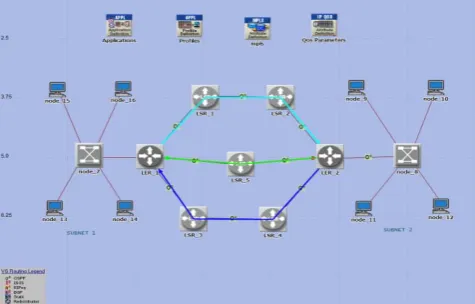
To perform the evaluation and comparison, OPNET (Optimized Network Engineering Tools) Modeler Version 17.5 has been used as a tool of choice. The aim is to design and simulate the network and obtain the performance parameters. OPNET is a versatile simulator with a good graphical user interface and capability to configure networks. A typical network as given in Fig. 2 has been created to meet the objective.
Fig. 2 Network Topology
The network consists of two subnets having a duplex communication, connected to each other through a network with routers connected over three distinct paths. 10Base-T (10 Mbps) links are used to connect the subnets to switches, 100Base-T (100 Mbps) links to connect switches and the routers and point-to-point (PPP) links i.e. PPP DS-1 (1.544 Mbps) to connect the routers to each other.Application that has been deployed to monitor the QoS performance is Video Conferencing under two conditions of high quality (heavy) and low quality videos (light). Some other basic applications like web browsing are also deployed to create background traffic for the network. Communication is made to take place between the nodes of the two subnets having random traffic profiles, over the intermediate IP and MPLS network routers as shown.
Three distinct scenarios have been created. In the first scenario, traditional IP supporting network is deployed with OSPF as the routing protocol and IPv4 as the networking protocol. In the second scenario MPLS-TE network with DiffServ model for implementing QoS is created with OSPF as the routing protocol and IPv4 as the network layer protocol. In the third scenario, the same MPLS-TE based network is deployed with a difference of using IPv6 in place of IPv4 and the related routing and addressing specifications. Same application specifications are used in all the cases. DiffServ in this simulation uses weighted fair queuing (WFQ) scheme as it provides the preferential treatment to some traffic without
overlooking the less critical traffic completely. The traffic conditions include video conferencing between nodes 15 and 11, 16 and 10, 12 and 15, with some background traffic as well. The simulation is run for 20 minutes for each scenario. Following QoS parameters case have been determined in each case: (a) Delay, (b) Jitter, (c) Packet Loss and (d) Throughput. The results are given below.
VII. RESULTS
A. Delay:It is the time taken by the packet to travel through the network while moving from the source to the destination. The End-to-End Delay is the time between the departure of data packet from the source to arrival at the destination. For efficient communication, the delay for a video conferencing application should be less than 130ms. The Delay comparison over various network configurations is given in Table I.
Table I: Delay Comparison
Parameter Traditional IP
MPLS-TE over IPv4
MPLS-TE over IPv6
DELAY 1sec (max)
20ms 24ms
[image:3.595.36.274.296.448.2]B. Jitter: Different packets in IP networks take different routes while moving from source to destination, thus arriving at the destination at different times and out of order. Jitter is defined as the variation in delay experienced by various data packets of the same traffic class. It is also known as delay variation in video conferencing. The value for jitter should be less than 30ms. Table II shows the jitter comparison over the networks.
Table II: Jitter Comparison
Parameter Traditional IP
MPLS-TE over IPv4
MPLS-TE over IPv6
JITTER (max.)
4.9 sec 20µs 0.02µs
C. Packet Loss:While moving from source to destination, the data packets may get dropped, lost or corrupted over the network. This is known as packet loss. This performance parameter determines the rate at which packet loss occurs in the network. It is an important performance parameter as it determines the efficiency and reliability of the network. The acceptable packet loss should be less than 1% for video conferencing. The comparison for packet loss is given in Table III.
Table III: Packet Loss Comparison
Parameter Traditional IP
MPLS-TE over IPv4
MPLS-TE over IPv6
PACKET LOSS
75 packets/sec
30 packets/sec
No Packet Loss
Table IV: Throughput Comparison
Parameter Traditional IP
MPLS-TE over IPv4
MPLS-TE over IPv6
THROUGHPUT 45 packets/sec
90 packets/sec
120 packets/sec (Max.)
VIII.SUMMARY
To summarize the results, the graphs depicting comparison of QoS parameters corresponding to video conferencing application considered comparing the impact of change in the network technology i.e. traditional IP and MPLS-TE and the network layer protocol i.e. IPv4 and IPv6 has been given in this section.
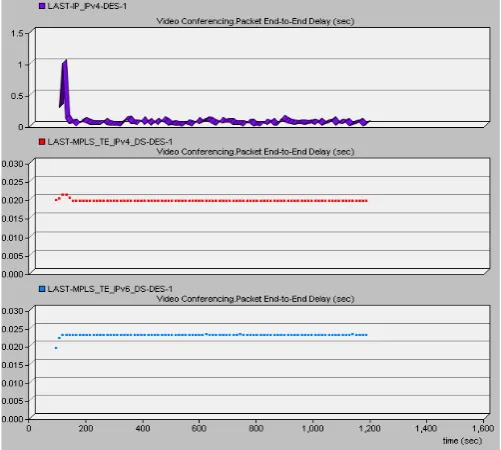
As shown in Fig. 3, the maximum end-to-end delay for the video conferencing application can be seen over the pure IP based network. The maximum variation in delay, with respect to time, is also seen. On an average, there is a 70% improvement in performance over the MPLS-TE (IPv4) network as compared to the pure IP network. However, the delay over MPLS-TE (IPv6) has increased as compared to MPLS-TE (IPv4) by about 16%.
The packet delay variation (Jitter) for video conferencing has been reduced from a maximum of 4.9 sec over the traditional IP network, to about 20µs over IPv4 based MPLS-TE network, as shown in Fig. 4. This accounts for about 99.99% improvement in performance. Further, the jitter value is decreased from 20µs over IPv4 based MPLS-TE network to as low as 0.01µs over IPv6 based MPLS-TE network. This shows a further 99% performance improvement.
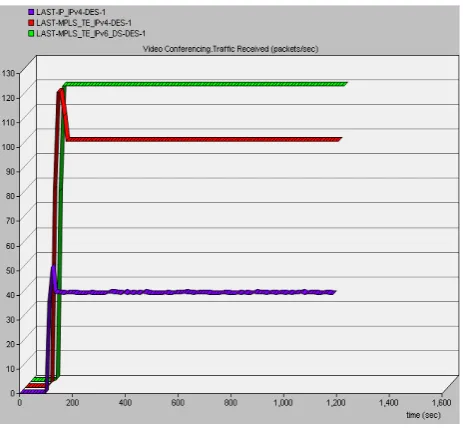
From the simulation results shown in Fig. 5, it can be seen that out of 120 packets sent per second over each of the networks, only 40 packets are received in pure IP networks, 100 packets are received in IPv4 based MPLS-TE networks and all the 120 packets are received in IPv6 based MPLS-TE networks. This accounts for 66% packet loss in pure IP and a 16% packet loss in IPv4 based MPLS-TE networks. The IPv6 based MPLS-TE shows no packet loss.
It can be seen from Fig. 6, that the throughput over IPv4 based MPLS-TE network has increased by 60% as compared to that over the pure IP networks. Also, the throughput has further increased by over 16% in the IPv6 based MPLS-TE network as compared to IPv4 based MPLS-TE network.
Fig. 3: End-to-End Delay comparison (sec).
[image:4.595.305.540.312.521.2]Fig. 4: Packet Delay variation comparison (sec).
Fig. 6 Throughput comparison (packets/sec)
IX. CONCLUSION
To eliminate the QoS limitations of the traditional IP networks, Multiprotocol Label switching technology is being considered as one of the most preferred solution. In this paper an attempt has been made to use TE over MPLS network, coupled with DiffServ as the QoS model for QoS improvement. Further, the MPLS-TE network QoS performance is evaluated over both the in use IP versions i.e. IPv4 and IPv6, and comparisons made. As IPv6 is predicted to completely replace IPv4 as the basic network layer protocol, a complete understanding of its effect on the network performance needs to be studied. The application under consideration is Video Conferencing, as it is the one of the mostly used real-time multimedia application at present. The QoS parameters considered for determining the impact are:delay, jitter, packet loss and throughput. Simulations have been conducted using OPNET modeler. From the simulation results it has been concluded that there is a substantial improvement in the performance of the video conferencing application over the DiffServ-aware MPLS-TE network in comparison to the traditional IP network. The maximum improvement of over 99% can be seen for end-to-end delay and jitter, which are the parameters of concern for the video conferencing application. Also, with the use of IPv6 over the MPLS-TE network, the QoS performance shows a further improvement in jitter, essentially reducing it to zero. No packet loss has been witnessed over IPv6 based MPLS-TE, showing an 8% improvement over IPv4 based MPLS-TE network. There is a slight degradation in the delay parameter, but the delay values are still way low than the acceptable limits. Thus, the overall QoS performance has improved over MPLS-TE network, with a further upgrade when the network is used with IPv6 as the basic network layer protocol.
X. REFERENCES
[1] Fortz, Bernard, Jennifer Rexford, and MikkelThorup. "Traffic engineering with traditional IP routing protocols." IEEE communications Magazine 40.10 (2002): 118-124.
[2] Mishra, Aditya Kumar, and AnirudhaSahoo. "S-OSPF: A traffic engineering solution for OSPF based best effort networks." Global Telecommunications Conference, 2007. GLOBECOM'07. IEEE. IEEE, 2007.
[3] Tanvir, Muhammad, and AbasMd Said. "Decreasing packet loss
for QoS sensitive IP traffic in DiffServ enabled network using MPLS TE." Information Technology (ITSim), 2010 International Symposium in. Vol. 2. IEEE, 2010.
[4] Dasgupta, Sukrit, Jaudelice C. de Oliveira, and Jean-Philippe
Vasseur. "A performance study of ip and mpls traffic engineering techniques under traffic variations." Global Telecommunications Conference, 2007. GLOBECOM'07. IEEE, 2007.
[5] Rosen, Eric, ArunViswanathan, and Ross Callon. Multiprotocol label switching architecture. No. RFC 3031. 2000.
[6] B. Jamoussi et al., “Constraint-based LSP Setup Using LDP” IETF Internet Draft, work in progress, Feb 1999.
[7] Baraković, Sabina, and JasminaBaraković. "Traffic performances improvement using DiffServ and MPLS networks." Information, Communication and Automation Technologies, 2009. ICAT 2009. XXII International Symposium on. IEEE, 2009.
[8] Stallings, William. "IPv6: the new Internet protocol." IEEE
Communications Magazine 34.7 (1996): 96-108.
[9] Loshin, Peter. IPv6: Theory, protocol, and practice. Morgan Kaufmann, 2004.
[10]Glenn Davies, “Why IPv6 Matters to Your Station”, 2011. [11]Shenker, Scott. "Specification of guaranteed quality of service."
(1997).
[12]Wang, Zheng. Internet QoS: architectures and mechanisms for quality of service. Morgan Kaufmann, 2001.
[13]Baraković, Sabina, and JasminaBaraković. "Traffic performances improvement using DiffServ and MPLS networks." Information, Communication and Automation Technologies, 2009. ICAT 2009. XXII International Symposium on. IEEE, 2009.
[14]Xiaoling Sun, “Research on QoS of Next Generation Network Based on MPLS”, IEEE International Conference on Information Science and Technology, 2012.
[15]Saika, A., et al. "QoS in the MPLS-DiffServ network." Sciences of Electronics, Technologies of Information and Telecommunications (SETIT), 2012 6th International Conference on. IEEE, 2012.