Human Judgements in Parallel Treebank Alignment
Martin Volk and Torsten Marek
University of Zurich
Institute of Computational Linguistics 8050 Zurich, Switzerland
Yvonne Samuelsson
Stockholm University Department of Linguistics 106 91 Stockholm, Sweden
Abstract
We have built a parallel treebank that includes word and phrase alignment. The alignment information was manually checked using a graphical tool that al-lows the annotator to view a pair of trees from parallel sentences. We found the compilation of clear alignment guidelines to be a difficult task. However, experi-ments with a group of students have shown that we are on the right track with up to 89% overlap between the student annota-tion and our own. At the same time these experiments have helped us to pin-point the weaknesses in the guidelines, many of which concerned unclear rules related to differences in grammatical forms between the languages.
1 Introduction
Establishing translation correspondences is a dif-ficult task. This task is traditionally called align-ment and is usually performed on the paragraph level, sentence level and word level. Alignment answers the question: Which part of a text in lan-guage L1 corresponds in meaning to which part of a text in language L2 (under the assumption that the two texts represent the same meaning in differ-ent languages). This may mean that one text is the translation of the other or that both are translations derived from a third text.
There is considerable interest in automating the alignment process. Automatic sentence alignment
c
°2008. Licensed under the Creative Commons
Attribution-Noncommercial-Share Alike 3.0 Unported
li-cense (http://creativecommons.org/licenses/by-nc-sa/3.0/). Some rights reserved.
of legacy translations helps to fill translation mem-ories. Automatic word alignment is a crucial step in training statistical machine translation systems. Both sentence and word alignment have to deal with 1:many alignments, i.e. sometimes a sentence in one language is translated as two or three sen-tences in the other language.
In other respects sentence alignment and word alignment are fundamentally different. It is rela-tively safe to assume the same sentence order in both languages when computing sentence align-ment. But such a monotonicity assumption is not possible for word alignment which needs to allow for word order differences and thus for crossing alignments. And while algorithms for sentence alignment usually focus on length comparisons (in terms of numbers of characters), word alignment algorithms use cross-language cooccurrence fre-quencies as a key feature.
Our work focuses on word alignment and on an intermediate alignment level which we call phrase alignment. Phrase alignment encompasses the alignment from simple noun phrases and preposi-tional phrases all the way to complex clauses. For example, on the word alignment level we want to establish the correspondence of the German “verb form plus separated prefix” fing an with the Eng-lish verb form began. While in phrase alignment we mark the correspondence of the verb phrases
ihn in den Briefkasten gesteckt and dropped it in the mail box.
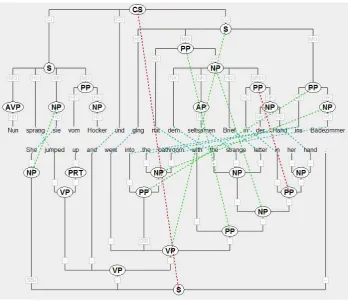
We regard phrase alignment as alignment be-tween linguistically motivated phrases, in con-trast to some work in statistical machine trans-lation where phrase alignment is defined as the alignment between arbitrary word sequences. Our phrase alignment is alignment between nodes in constituent structure trees. See figure 1 for an
ample of a tree pair with word and phrase align-ment.
We believe that such linguistically motivated phrase alignment provides useful phrase pairs for example-based machine translation, and provides interesting insights for translation science and cross-language comparisons. Phrase alignments are particularly useful for annotating correspon-dences of idiomatic or metaphoric language use.
2 The Parallel Treebank
We have built a trilingual parallel treebank in Eng-lish, German and Swedish. The treebank consists of around 500 trees from the novel Sophie’s World and 500 trees from economy texts (an annual re-port from a bank, a quarterly rere-port from an inter-national engineering company, and the banana cer-tification program of the Rainforest Alliance). The sentences in Sophie’s World are relatively short (14.8 tokens on average in the English version), while the sentences in the economy texts are much longer (24.3 tokens on average; 5 sentences in the English version have more than 100 tokens).
The treebanks in English and German consist of constituent structure trees that follow the guide-lines of existing treebanks, the NEGRA/TIGER guidelines for German and the Penn treebank guidelines for English. There were no guidelines for Swedish constituent structure trees. We have therefore adapted the German treebank guidelines for Swedish. Both German trees and Swedish trees are annotated with flat structures but subsequently automatically deepened to result in richer and lin-guistically more plausible tree structures.
When the monolingual treebanks were finished, we started with the word and phrase alignment. For this purpose we have developed a special tool called the Stockholm TreeAligner (Lundborg et al., 2007) which displays two trees and allows the user to draw alignment lines by clicking on nodes and words. This tool is similar to word alignment tools like ILink (Ahrenberg et al., 2003) or Cairo (Smith and Jahr, 2000). As far as we know our tool is unique in that it allows the alignments of lin-guistically motivated phrases via node alignments in parallel constituent structure trees (cf. (Samuels-son and Volk, 2007)).
After having solved the technical issues, the challenge was to compile precise and comprehen-sive guidelines to ensure smooth and consistent alignment decisions. In (Samuelsson and Volk,
2006) we have reported on a first experiment to evaluate inter-annotator agreement from our align-ment tasks.
In this paper we report on another recently con-ducted experiment in which we tried to identify the weaknesses in our alignment guidelines. We asked 12 students to alignment 20 tree pairs (Eng-lish and German) taken from our parallel treebank. By comparing their alignments to our Gold Stan-dard and to each other we gained valuable insights into the difficulty of the alignment task and the quality of our guidelines.
3 Related Research
Our research on word and phrase alignment is re-lated to previous work on word alignment as e.g. in the Blinker project (Melamed, 1998) or in the UPLUG project (Ahrenberg et al., 2003). Align-ment work on parallel treebanks is rare. Most notably there is the Prague Czech-English tree-bank (Kruijff-Korbayov´a et al., 2006) and the Link¨oping Swedish-English treebank (Ahrenberg, 2007). There has not been much work on the align-ment of linguistically motivated phrases. Tinsley et al. (2007) and Groves et al. (2004) report on semi-automatic phrase alignment as part of their research on example-based machine translation.
Considering the fact that the alignment task is essentially a semantic annotation task, we may also compare our results to other tasks in seman-tic corpus annotation. For example, we may sider the methods for resolving annotation con-flicts and the figures for inter-annotator agreement in frame-semantic annotation as found in the Ger-man SALSA project (cf. (Burchardt et al., 2006)).
4 Our Alignment Guidelines
We have compiled alignment guidelines for word and phrase alignment between annotated syntax trees. The guidelines consist of general principles, concrete rules and guiding principles.
The most important general principles are:
1. Align items that can be re-used as units in a machine translation system.
2. Align as many items (i.e. words and phrases) as possible.
3. Align as close as possible to the tokens.
Figure 1: Tree pair German-English with word and phrase alignments.
We do not want to know which part of a sentence has possibly given rise to which part of the cor-respondence sentence. Instead our perspective is on whether a phrase pair is general enough to be re-used as translation unit in a machine translation system. For example, we do not want to align die
Verwunderung ¨uber das Leben with their astonish-ment at the world although these two phrases were
certainly triggered by the same phrase in the orig-inal and both have a similar function in the two corresponding sentences. These two phrases seen in isolation are too far apart in meaning to license their re-use. We are looking for correspondences like was f¨ur eine seltsame Welt and what an
ex-traordinary world which would make for a good
translation in many other contexts.
Some special rules follow from this principle. For example, we have decided that a pronoun in one language shall never be aligned with a full noun in the other, since such a pair is not directly useful in a machine translation system.
Principles 2 and 3 are more technical. Princi-ple 2 tells our annotators that alignment should be exhaustive. We want to re-use as much as pos-sible from the treebank, so we have to look for as many alignments as possible. And principle 3
says that in case of doubt the alignment should go to the node that is closest to the terminals. For example, our German treebank guidelines require a multi-word proper noun to first be grouped in a PN phrase which is a daughter node of a noun phrase[[Sofie Amundsen]PN ]NPwhereas the English guidelines only require the NP node
[Sophie Amundsen]NP. When we align the two names, principle 3 tells us to draw the align-ment line between the German PN node and the English NP node since the PN node is closer to the tokens than the German NP node.
Often we are confronted with phrases that are not exact translation correspondences but approx-imate translation correspondences. Consider the phrases mehr als eine Maschine and more than a
piece of hardware. This pair does not represent the
distinguish between different alignment strengths sounded very attractive at the start but it turned out to be the source for some headaches later. Where and how can we draw the line between exact and fuzzy translation correspondences?
We have formulated some clear-cut rules:
1. If an acronym is to be aligned with a spelled-out term, it is always an approximate align-ment. For example, in our economy reports the English acronym PT stands for Power
Technology and is aligned to the German En-ergietechnik as a fuzzy correspondence.
2. Proper names shall be aligned as exact align-ments (even if they are spelled differently across languages; e.g. Sofie vs. Sophie).
But many open questions persist. Is einer der
ersten Tage im Mai an exact or rather a fuzzy
trans-lation correspondence of early May? We decided that it is not an exact correspondence. How shall we handle zu dieser Jahreszeit vs. at this time of
the year where a literal translation would be in this season? We decided that the former is still an exact
correspondence. These examples illustrate the dif-ficulties that make us wonder how useful the dis-tinction between exact and approximate translation correspondence really is.
Automatically ensuring the overall consistency of the alignment decisions is a difficult task. But we have used a tool to ensure the consis-tency within the exact and approximate alignment classes. The tool computes the token span for each alignment and checks if the same tokens pairs have always received the same alignment type. For ex-ample, if the phrase pair mit einer blitzschnellen
Bewegung and with a lightning movement is once
annotated as exact alignment, then it should always be annotated as exact alignment. Figure 1 shows approximate alignments between the PPs in der
Hand and in her hand. It was classified as
approxi-mate rather than exact alignment since the German PP lacks the possessive determiner.
Currently our alignment guidelines are 6 pages long with examples for English-German and English-Swedish alignments.
5 Experiments with Student Annotators
In order to check the inter-annotator agreement for the alignment task we performed the following ex-periment. We gave 20 tree pairs in German and
English to 12 advanced undergraduate students in a class on ”Machine Translation and Parallel Cor-pora”. Half of the tree pairs were taken from our Sophie’s World treebank and the other half from our Economy treebank. We made sure that there was one 1:2 sentence alignment in the sample. The students did not have access to the Gold Standard alignment.
In class we demonstrated the alignment tool to the students and we introduced the general align-ment principles to them. Then the students were given a copy of the alignment guidelines. We asked them to do the alignments independently of each other and to the best of their knowledge ac-cording to the guidelines.
In our own annotation of the 20 tree pairs (= the Gold Standard alignment) we have the following numbers of alignments:
type exact fuzzy total
Sophie part word 75 3 78
phrase 46 12 58
Economy part word 159 19 178
phrase 62 9 71
In the Sophie part of the experiment treebank we have 78 word-to-word alignments and 58 phrase-to-phrase alignments. Note that some phrases con-sist only of one word and thus the same alignment information is represented twice. We have deliber-ately kept this redundancy.
The alignments in the Sophie part consist of 125 times 1:1 alignments, 4 times 1:2 alignments and one 1:3 alignment (w¨are vs. would have been) when viewed from the German side. There are 3 times 1:2 alignments (e.g. introducing vs. stellte
vor) and no other 1:many alignment when viewed
from the English side.
In the Economy part the picture is similar. The vast majority are 1:1 alignments. There are 207 times 1:1 alignments and 21 times 1:2 alignments (many of which are German compound nouns) when viewed from German. And there are 235 times 1:1 alignments, plus 4 times 1:2 alignments, plus 2 times 1:3 alignments when viewed from English (e.g. the Americas was aligned to the three tokens Nord- und S¨udamerika).
On closer inspection we found that the student with the lowest numbers works as a translator and chose to use a very strict criterion of transla-tion equivalence rather than translatransla-tion correspon-dence. Three other students at the end of the list are not native speakers of either German and English. We therefore decided to exclude these 4 students from the following comparison.
The student alignments allow for the investiga-tion of a number of interesting quesinvestiga-tions:
1. How did the students’ alignments differ from the Gold Standard?
2. Which were the alignments done by all stu-dents?
3. Which were the alignments done by single students only?
4. Which alignments varied most between exact and fuzzy alignment?
When we compared each student’s alignments to the Gold Standard alignments, we computed three figures:
1. How often did the student alignment and the Gold Standard alignment overlap?
2. How many Gold Standard alignments did the student miss?
3. How many student alignments were not in the Gold Standard?
The remaining 8 students reached between 81% and 48% overlap with the Gold Standard on the Sophie part, and between 89% and 66% overlap with the Gold Standard on the Economy texts. This can be regarded as their recall values if we assume that the Gold Standard represents the correct align-ments. These same 8 students additionally had between 2 and 22 own alignments in the Sophie part and between 12 and 55 own alignments in the Economy part.
So the interesting question is: What kind of alignments have they missed, and which were the additional own alignments that they suggested (alignments that are not in the gold standard)? We first checked the students with the highest numbers of own alignments. We found that some of these alignments were due to the fact that students had ignored the rule to align as close to the tokens as possible (principle 3 above).
Another reason was that students sometimes aligned a word (or some words) with a node. For example, one student had aligned the word
nat¨urlich to the phrase of course instead of to the
word sequence of course. Our alignment tool al-lows that, but the alignment guidelines discour-age such alignments. There might be exceptional cases where a word-to-phrase alignment is neces-sary in order to keep valuable information, but in general we try to stick to word-to-word and phrase-to-phrase alignments.
Another discrepancy occurred when the stu-dents aligned a German verb group with a single verb form in English (e.g. ist zur¨uckzuf¨uhren vs.
reflecting). We have decided to only align the full
verb to the full verb (independent of the inflection). This means that we align only zur¨uckzuf¨uhren to
reflecting in this example.
The uncertainties on how to deal with different grammatical forms led to the most discrepancies. Shall we align the definite NP die Ums¨atze with the indefinite NP revenues since it is much more common to drop the article in an English plural NP than in German? Shall we align a German genitive NP with an of-PP in English (der beiden
Divisio-nen vs. of the two divisions)? We have decided to
give priority to form over function and thus to align the NP der beiden Divisionen with the NP the two
divisions. But of course this choice is debatable.
When we compute the intersection of the align-ments done by all students (ignoring the difference between exact and fuzzy alignments), we find that about 50% of the alignments done by the student with the smallest number of alignments is shared by all other students. All of the alignments in the intersection are in our Gold Standard file. This in-dicates that there is a core of alignments that are obvious and uncontroversial. Most of them are word alignments.
When we compute the union of the alignments done by all students (again ignoring the difference between exact and fuzzy alignments), we find that the number of alignments in the union is 40% to 50% higher than the number of alignments done by the student with the highest number of alignments. It is also about 40% to 50% higher than the number of alignments in the Gold Standard. This means that there is considerable deviation from the Gold Standard.
weak-nesses of the guidelines. For example, one align-ment in the Gold Standard that was missed by all students concerns the alignment of a German pro-noun (wenn sie die Hand ausstreckte) to an empty token in English (herself shaking hands). Our
guidelines recommend to align such cases as fuzzy alignments, but of course it is difficult to determine that the empty token really corresponds to the Ger-man word.
Other discrepancies concern cases of differing grammatical forms, e.g. a German definite singu-lar noun phrase (die Hand) that was aligned to an English plural noun phrase (Hands) in the Gold Standard but missed by all students. Finally there are a few cases where obvious noun phrase cor-respondences were simply overlooked by all stu-dents (sich - herself ) although the tokens them-selves were aligned. Such cases should be handled by an automated process in the alignment tool that projects from aligned tokens to their mother nodes (in particular in cases of single token phrases).
We also investigated how many exact align-ments and how many fuzzy alignalign-ments the stu-dents had used. The following table gives the fig-ures.
exact fuzzy overlap total
Sophie part 152 106 69 189
Economy part 296 188 119 366
The alignments done by all students resulted in a union set of 189 alignments for the Sophie part and 366 alignments for the Economy part. The align-ments in the Sophie part consisted of 152 exact alignments and 106 fuzzy alignments. This means that 69 alignments were marked as both exact and fuzzy. In other words, in 69 cases at least one stu-dent has marked an alignment as fuzzy while at least one other student has marked the same align-ment as good. So there is still considerable con-fusion amongst the annotators on how to decide between exact and fuzzy alignments. And in case of doubt many students have decided in favor of fuzzy alignments.
6 Conclusions
We have shown the difficulties in creating cross-language word and phrase alignments. Experi-ments with a group of students have helped to iden-tify the weaknesses in our alignment guidelines and in our Gold Standard alignment. We have re-alized that the guidelines need to contain a host
of fine-grained alignment rules and examples that will clarify critical cases.
In order to evaluate a set of alignment experi-ments with groups of annotators it is important to have good visualization tools to present the results. We have worked with Perl scripts for the compar-ison and with our own TreeAligner tool for the vi-sualization. For example we have used two colors to visualize a student’s alignment overlap with the Gold Standard in one color and his own alignments (that are not in the Gold Standard) in another color. In order to visualize the agreements of the whole group it would be desirable to have the option to in-crease the alignment line width in proportion to the number of annotators that have chosen a particular alignment link. This would give an intuitive im-pression of strong alignment links and weak align-ment links.
Another option for future extension of this work is an even more elaborate classification of the alignment links. (Hansen-Schirra et al., 2006) have demonstrated how a fine-grained distinction be-tween different alignment types could look like. Annotating such a corpus will be labor-intensive but provide for a wealth of cross-language obser-vations.
References
Ahrenberg, Lars, Magnus Merkel, and Michael Petter-stedt. 2003. Interactive word alignment for language engineering. In Proc. of EACL-2003, Budapest.
Ahrenberg, Lars. 2007. LinES: An English-Swedish parallel treebank. In Proc. of Nodalida, Tartu.
Burchardt, A., K. Erk, A. Frank, A. Kowalski, S. Pad´o, and M. Pinkal. 2006. The SALSA corpus: A Ger-man corpus resource for lexical seGer-mantics. In
Pro-ceedings of LREC 2006, pages 969–974, Genoa.
Groves, Declan, Mary Hearne, and Andy Way. 2004. Robust sub-sentential alignment of phrase-structure trees. In Proceedings of Coling 2004, pages 1072– 1078, Geneva, Switzerland, Aug 23–Aug 27. COL-ING.
Hansen-Schirra, Silvia, Stella Neumann, and Mihaela Vela. 2006. Multi-dimensional annotation and alignment in an English-German translation corpus. In Proceedings of the EACL Workshop on
Multidi-mensional Markup in Natural Language Processing (NLPXML-2006), pages 35– 42, Trento.
Kruijff-Korbayov´a, Ivana, Kl´ara Chv´atalov´a, and Oana Postolache. 2006. Annotation guidelines for the Czech-English word alignment. In Proceedings of
Lundborg, Joakim, Torsten Marek, Ma¨el Mettler, and Martin Volk. 2007. Using the Stockholm TreeAligner. In Proc. of The 6th Workshop on
Tree-banks and Linguistic Theories, Bergen, December.
Melamed, Dan. 1998. Manual annotation of transla-tional equivalence: The blinker project. Technical Report 98-06, IRCS, Philadelphia PA.
Samuelsson, Yvonne and Martin Volk. 2006. Phrase alignment in parallel treebanks. In Hajic, Jan and Joakim Nivre, editors, Proc. of the Fifth Workshop on
Treebanks and Linguistic Theories, pages 91–102,
Prague, December.
Samuelsson, Yvonne and Martin Volk. 2007. Align-ment tools for parallel treebanks. In Proceedings of
GLDV Fr¨uhjahrstagung 2007.
Smith, Noah A. and Michael E. Jahr. 2000. Cairo: An alignment visualization tool. In Proc. of
LREC-2000, Athens.
Tinsley, John, Ventsislav Zhechev, Mary Hearne, and Andy Way. 2007. Robust language pair-independent sub-tree alignment. In Machine Translation Summit