Compositional Semantics of Coordination using Synchronous Tree
Adjoining Grammar
Chung-hye Han
Department of Linguistics
Simon Fraser University
David Potter
Department of Linguistics
Simon Fraser University
Dennis R. Storoshenko
Department of Linguistics
Simon Fraser University
Abstract
In this paper, we propose a compositional semantics for DP/VP coordination, us-ing Synchronous Tree Adjoinus-ing Grammar (STAG). We first present a new STAG ap-proach to quantification and scope ambi-guity, using Generalized Quantifiers (GQ). The proposed GQ analysis is then used in our account of DP/VP coordination.
1
Introduction
In this paper, we propose a compositional se-mantics for DP coordination and VP coordina-tion, using Synchronous Tree Adjoining Grammar (STAG). We take advantage of STAG’s capacity to provide an isomorphic derivation of semantic trees in parallel to syntactic ones, using substitu-tion and adjoining in both syntax and semantics. In addition, we use unreducedλ-expressions in se-mantic elementary trees, as in Han (2007). This allows us to build the logical forms by applying λ-conversion and other operations defined on λ -expressions to the semantic derived tree.
DP meanings cannot be directly conjoined in an STAG approach that does not make use of unreduced λ-expressions in semantic trees, as in Shieber (1990) and Nesson and Shieber (2006; 2007). In this approach, a quantified DP introduces an argument variable and a formula consisting of a quantifier, restriction and scope. The argument variables cannot be conjoined as conjunction is de-fined on formulas. Although the formula compo-nents can be conjoined in principle, it is not clear how the conjoined formulas can compose with the meaning coming from the rest of the sentence.
In our analysis, we redefine the semantics of DPs as Generalized Quantifiers (GQ) (Barwise and Cooper, 1981), enabling the DP meanings to be directly conjoined. GQs can be conjoined through the application of the Generalized Con-junction Rule, and the conjoined GQs can
com-pose with the meaning coming from the rest of the sentence throughλ-conversion.
Our approach is in contrast to previous works on DP coordination (Babko-Malaya, 2004) and VP coordination (Banik, 2004) that use feature-unification-based TAG semantics (Kallmeyer and Romero, 2008). While the two accounts handle DP and VP coordination separately, they cannot together account for sentences with both DP and VP coordination, such as Every boy and every girl
jumped and played, without adding new features.
Furthermore, due to the recursive nature of co-ordination, an indefinite number of such features would potentially need to be added.
We first present a new STAG approach to quan-tification and scope ambiguity in section 2, using GQs. We then extend the proposed GQ analysis to DP coordination in section 3 and VP coordination in section 4. It will also be shown how sentences with both DP and VP coordination can be handled under the proposed analysis.
2
Quantification and scope ambiguity
A sentence such as (1) is ambiguous between two readings: for every course there is a student that likes it (1a), and there is a student that likes every course (1b).
(1) A student likes every course. (∀>∃,∃>∀)
a. ∀x[course(x)][∃x[student(x)][likes(x, x)]] b. ∃x[student(x)][∀x[course(x)][likes(x, x)]]
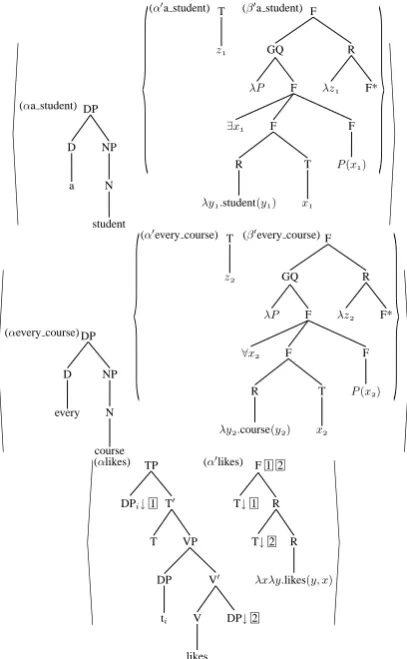
Figure 1 contains the elementary trees to derive (1). For the DP a student, we pro-pose that (αa student) on the syntax side
is paired with the multi-component set
(CETM), as a noun can form an extended projec-tion with a DP, in line with the DP Hypothesis. (α′a student) provides an argument variable, and (β′a student) provides the existential quantifier with the restriction and scope in the form of a GQ. We define the syntax and semantics of the DP
every course in a similar way. In the <(αlikes), (α′likes)>pair, the boxed numerals indicate links between the syntactic and semantic tree pairs and ensure synchronous derivation between the syntax and semantics: an operation carried out at one such node in the syntax side must be matched with a corresponding operation on the linked node(s) in the semantics side. The symbols 1 and 2 at the F node in (α′likes) indicate that two elementary trees will adjoin at this node using Multiple Adjunction, as defined in Schabes and Shieber (1994). In the derivation of (1), (β′a student) and (β′every course) will multiply-adjoin to it. Figure 2 depicts the isomorphic syntactic and semantic derivation structures for (1).
(αa student) DP
D
a NP
N
student
(α′ a student) Tz
(β′ a student) F
GQ
λP F
∃x F
R
λy.student(y)
T
x
F
P(x)
R
λz F*
(αevery course) DP
D
every NP
N
course
(α′every course) T
z
(β′
every course) F
GQ
λP F
∀x F
R
λy.course(y)
T
x
F
P(x)
R
λz F*
(αlikes) TP DPi↓1 T′T VP
DP
ti
V′
V
likes DP↓2 (α′likes)
F 1 2
T↓1 R
T↓2 R
λxλy.likes(y, x)
[image:2.595.325.523.72.109.2]Figure 1: Elementary trees for A student likes every
course
(δ1) (αlikes)(αa student) DPi
(αevery course) DP
(δ′1) (α′likes)
{(β′a student), (α′a student)} {
(β′every course), (α′every course)}
Figure 2: Derivation structures for A student likes
every course
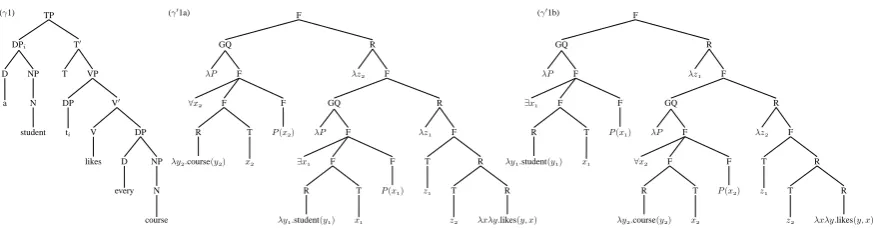
Note that while the derivation in the syntax pro-duces a single derived tree (γ1) in Figure 3, the derivation in semantics produces two semantic de-rived trees in Figure 3: (γ′1a) for the ∀ > ∃
reading, and (γ′1b) for the ∃ > ∀ reading. This is because the semantic derivation structure pro-vides an underspecified representation for scope ambiguity, as the order in which (β′a student) and (β′every course) adjoin to the F node in (α′likes) is unspecified. The application ofλ-conversion to the semantic derived trees yields the formulas in (1a) and (1b).
3
DP coordination
We now extend our GQ analysis to DP coordina-tion. Our analysis captures two generalizations of scope in DP coordination, as discussed in Babko-Malaya (2004). First, coordinated quantified DPs must scope under the coordinator (2). Second, scope interaction is possible between a coordi-nated DP and other quantifiers in a sentence (3).
(2) Every boy and every girl jumped. (∧>∀)
a. ∀x[boy(x)][jumped(x)]∧
∀x[girl(x)][jumped(x)]
(3) Every boy and every girl solved a puzzle. (∧>∀>∃,∃>∧>∀)
a. ∀x[boy(x)][∃x[puzzle(x)][solved(x, x)]]∧
∀x[girl(x)][∃x[puzzle(x)][solved(x, x)]]
b. ∃x[puzzle(x)][∀x[boy(x)][solved(x, x)]∧
∀x[girl(x)][solved(x, x)]]
[image:2.595.95.299.362.692.2](γ1) TP
DPi
D
a NP
N
student T′
T VP
DP
ti
V′
V
likes DP
D
every NP
N
course
(γ′1a) F
GQ
λP F
∀x F
R
λy.course(y)
T
x
F
P(x)
R
λz F
GQ
λP F
∃x F
R
λy.student(y)
T
x
F
P(x)
R
λz F
T
z
R
T
z
R
λxλy.likes(y, x)
(γ′1b) F
GQ
λP F
∃x F
R
λy.student(y)
T
x
F
P(x)
R
λz F
GQ
λP F
∀x F
R
λy.course(y)
T
x
F
P(x)
R
λz F
T
z
R
T
z
R
[image:3.595.69.506.71.185.2]λxλy.likes(y, x)
Figure 3: Derived trees for A student likes every course
This specification ensures that the coordinator scopes over the conjoined quantified DPs. Further, (β′and every girl) does not include an argument component for every girl. Instead, the argument variable will be provided when (β′and every girl) adjoins to (β′every boy).
(αevery boy) DP 1
D
every NP
N
boy
(α′ every boy) Tz
(β′ every boy)F
GQ 1
λP F
∀x F
R
λy.boy(y)
T
x
F
P(x)
R
λz F*
(βand every girl)DPDP* Conj
and DP
D
every NP
N
girl (β′
and every girl) GQ
GQ* ∧ GQ
λP F
∀x F
R
λy.girl(y)
T
x
F
P(x)
(αjumped) TP DPi↓1 T′T VP
DP
ti
V
jumped (α′jumped)
F 1
T↓1 R
[image:3.595.74.279.309.618.2]λx.jumped(x)
Figure 4: Elementary trees for Every boy and every
girl jumped
The isomorphic syntactic and semantic deriva-tion structures of (2) are in Figure 5, and the syn-tactic and semantic derived trees are in Figure 6.
As we are coordinating GQs, we can use the Generalized Conjunction (GC) rule of Barwise and Cooper (1981) to compose them. The GC rule
takes two coordinated GQs and λ-abstracts over them, as in (4). Application of the GC rule andλ -conversion to (γ′2) yields the formula in (2a).
(4) Generalized Conjunction (GC) Rule: [GQ1∧GQ2] =λZ[GQ1(Z)∧GQ2(Z)]
(δ2) (αjumped)(αevery boy) DPi
(βand every girl) DP
(δ′2)
(α′jumped)
{(β′every boy), (α′every boy)}
(β′and every girl)
[image:3.595.299.506.398.629.2]Figure 5: Derivation structures for Every boy and
every girl jumped
(γ2) TP
DPi
DP
D
every NP
N
boy Conj
and DP
D
every NP
N
girl T′
T VP
DP
ti
V′
V
jumped (γ′2)
F
GQ
GQ
λP F
∀x F
R
λy.boy(y)
T
x
F
P(x)
∧ GQ
λP F
∀x F
R
λy.girl(y)
T
x
F
P(x)
R
λz F
T
z
R
λx.jumped(x)
Figure 6: Derived trees for Every boy and every
girl jumped
and thus two separate semantic derived trees, pre-dicting scope ambiguity.
(αa puzzle) DP
D
a NP
N
puzzle
(α′ a puzzle) Tz
(β′a puzzle) F
GQ
λP F
∃x F
R
λy.puzzle(y)
T
x
F
P(x)
R
λz F*
(αsolved) TP DPi↓1 T′T VP
DP
ti
V′
V
solved DP↓2 (α′solved)
F 1 2
T↓1 R
T↓2 R
λxλy.solved(y, x)
[image:4.595.315.532.72.299.2]Figure 7: Elementary trees for Every boy and every
girl solved a puzzle
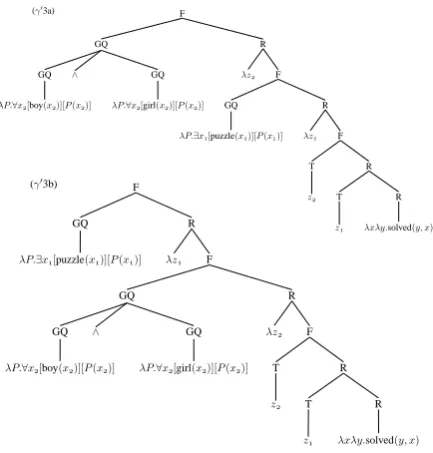
The derivation structures and semantic derived trees for (3) are in Figures 8 and 9. To save space, we have reduced all the GQ nodes in the seman-tic derived trees and omitted the syntacseman-tic derived tree. The semantic derivation is accomplished with no additional assumptions and proceeds in the same manner as the derivation for (2) with the ex-ception that the scope components, (β′every boy) and (β′a puzzle), may adjoin to (α′solved) in two orders in the derived tree: the reading in (3a) is derived if (β′every boy) is adjoined higher than (β′a puzzle), as in (γ′3a). The opposite ordering as in (γ′3b) derives the reading in (3b).
Our analysis also handles coordination of proper names as in (5a), if they are treated as GQs.
(5) a. John and Mary jumped. b. jumped(john)∧jumped(mary)
The new elementary trees needed for (5a) are given in Figure 10. In syntax, (αJohn) substitutes into
(δ3) (αsolved)(αevery boy) DPi
(βand every girl) DP
(αa puzzle) DP
(δ′3) (α′solved)
{(β′every boy), (α′every boy)} (β′and every girl)
{(β′a puzzle), (α′a puzzle)}
[image:4.595.100.297.111.330.2]Figure 8: Derivation structures for Every boy and
every girl solved a puzzle
(γ′3a) F
GQ
GQ
λP.∀x[boy(x)][P(x)]
∧ GQ
λP.∀x[girl(x)][P(x)]
R
λz F
GQ
λP.∃x[puzzle(x)][P(x)]
R
λz F
T
z
R
T
z
R
λxλy.solved(y, x) (γ′3b)
F
GQ
λP.∃x[puzzle(x)][P(x)]
R
λz F
GQ
GQ
λP.∀x[boy(x)][P(x)]
∧ GQ
λP.∀x[girl(x)][P(x)]
R
λz F
T
z
R
T
z
R
[image:4.595.334.509.453.582.2]λxλy.solved(y, x)
Figure 9: Semantic derived trees for Every boy and
every girl solved a puzzle
DPi in (αjumped) in Figure 4, and (βand Mary)
adjoins to DP in (αJohn). In semantics, (β′John) adjoins to F in (α′jumped), (α′John) substitutes into T in (α′jumped), and (β′and Mary) adjoins to GQ in (β′John). The application of λ-conversion and GC rule to the resulting semantic derived tree yields the formula in (5b).
(αJohn) DP 1
D
John
(α′ John) Tz
(β′John) F
GQ 1
λP.P(john)
R
λz F*
(βand Mary) DPDP* Conj
and DP
D
Mary (β′and Mary)
GQ
GQ* ∧ GQ
λP.P(mary)
Figure 10: Elementary trees for John and Mary
jumped
4
VP coordination
[image:4.595.98.297.656.704.2](6) A student read every paper and summarized every book. (∃>∧>∀)
a. ∃x[student(x)][∀x[paper(x)][read(x, x)]∧
∀x[book(x)][summarized(x, x)]]
(7) A student takes and a professor teaches every course. (∀>∧>∃)
a. ∀x[course(x)][∃x[student(x)][takes(x, x)]∧
∃x[professor(x)][teaches(x, x)]]
(8) A student likes and takes every course. (∃>∀>∧,∀>∃>∧)
a. ∃x[student(x)][∀x[course(x)][likes(x, x)∧ takes(x, x)]]
b. ∀x[course(x)][∃x[student(x)][likes(x, x)∧ takes(x, x)]]
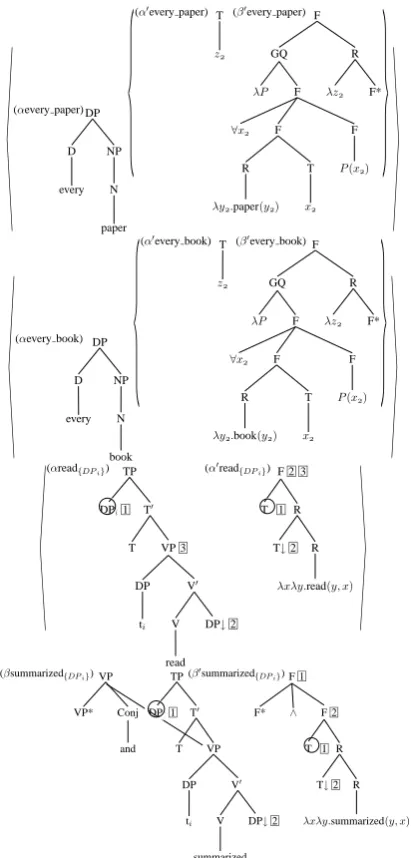
Figure 11 illustrates the elementary trees nec-essary to derive (6). We follow Sarkar and Joshi (1996) for the syntax of VP coordina-tion: we utilize elementary trees with contrac-tion sets and assume that their Conjoin Oper-ation creates coordinating auxiliary trees such as (βsummarized{DPi}). In (αread{DPi}), the subject DPi node is in the contraction set,
marked in the tree with a circle, and repre-sents a shared argument. (βsummarized{DPi}), also with the subject DPi node in the
contrac-tion set, contains the coordinator. Elementary trees such as (βsummarized{DPi}) are in ac-cordance with CETM, as coordinators are func-tional heads. When (βsummarized{DPi}) adjoins to (αread{DPi}), the two trees will share the node in the contraction set. As for the seman-tics, we propose that (αread{DPi}) is paired with (α′read{DPi}), and (βsummarized{DPi}) is paired with (β′summarized{DPi}). In (α
′read
{DPi}), the T node linked to the contracted DPi node is
marked as contracted with a circle. Crucially, the link for the scope component of the DPi is
ab-sent on F. Instead, the scope information will be provided by the shared argument coming from the coordinating auxiliary tree. This specification will prove to be crucial for deriving proper scope rela-tions. As usual, the non-contracted node, the ob-ject DP, has a link for the argument component on T and a link for the scope component on F. In the coordinating auxiliary tree (β′summarized{DPi}), the contracted node DPi has a link for the
argu-ment component on T, which is marked as a con-tracted node, and a link for the scope component
on the highest F. This ensures that the shared ar-gument scopes over the coordinator. Moreover, the link for the scope component of the non-contracted object DP node is placed on the lower F, ensuring that it scopes below the coordinator.
(αevery paper) DP
D
every NP
N
paper
(α′every paper) T
z
(β′
every paper) F
GQ
λP F
∀x F
R
λy.paper(y)
T
x
F
P(x)
R
λz F*
(αevery book) DP
D
every NP
N
book
(α′every book) T
z
(β′
every book) F
GQ
λP F
∀x F
R
λy.book(y)
T
x
F
P(x)
R
λz F*
(αread{DPi}) TP DPi1 T′T VP 3
DP
ti
V′
V
read DP↓2 (α′read{
DPi}) F 2 3
T 1 R
T↓2 R
λxλy.read(y, x)
(βsummarized{DPi}) VPVP* Conj
and TP
DPi1 T′
T VP
DP
ti
V′
V
summarized DP↓2 (β′summarized{DPi}) F 1
F* ∧ F 2
T 1 R
T↓2 R
λxλy.summarized(y, x)
[image:5.595.299.505.153.583.2]Figure 11: Elementary trees for A student read
ev-ery paper and summarized evev-ery book
tree pairs, (α′a student) substitutes into a T node in (α′read{DPi}) and (β
′summarized
{DPi}) simul-taneously, and (β′a student) adjoins to the root F node in (β′summarized{DPi}). This produces the semantic derived tree in (γ′6) in Figure 13. We de-fine functional application for shared arguments as in (9). Application of λ-conversion to (γ′6) thus yields the formula in (6a).1
(δ6) (αread{DPi}) (αa student)DPi
(βsummarized{DPi}) VP
(αevery book) DP
(αevery paper) DP
(δ′6) (α′read {DPi})
{(α′a student), (β′a student)}
(β′summarized{DPi})
{(α′every book),
(β′every book)}
{(α′every paper), (β′every paper)}
[image:6.595.322.523.110.340.2]Figure 12: Derivation structures for A student read
every paper and summarized every book
(9) Functional application for shared arguments: Ifα andβ are branching nodes sharing one daughterγ, andαdominatesδ andβ domi-natesχ, andγis in the domain of bothδand χ,α=δ(γ)andβ=χ(γ).
α
γ δ
β
χ
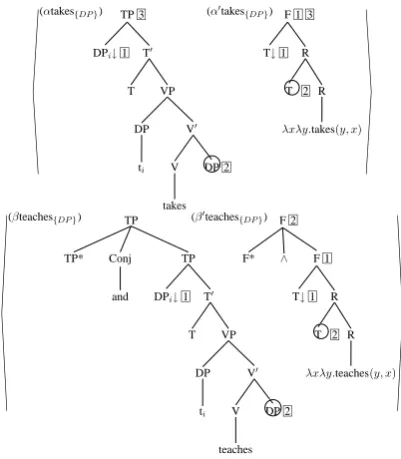
(7) is derived similarly, with the exception that the elementary trees for (7) has the object DP node in the contraction sets. These elementary trees are in Figure 14: in (αtakes{DP}), the object DP node
is contracted, and thus in (α′takes{DP}), the link
for the scope component of the DP is absent on F; in (β′teaches{DP}), the scope component of the
DP is placed on the root F node. In addition to these trees, a pair of elementary trees for the DP
a professor is required, which is exactly the same
as the elementary trees for a student in Figure 1. The derivation structures for (7) are in Figure 15.
1
A second semantic derived tree is available for (6), where (β′every paper) adjoins higher than (β′summarized), as they
are multiply adjoined to the F node of (α′read). We thank
an anonymous reviewer for pointing this out. We do not cur-rently have a way to block this second derived tree. How-ever, the formula in (i) that results from the application of
λ-conversion and the GC rule to the second derived tree has the same meaning as the one in (6a) reduced from the first derived tree in (γ′6) in Figure 13. Similarly, (7) has available
a second derived tree that yields the formula in (ii) which is equivalent to (7a) above.
(i) ∃x[student(x)][∀x[paper(x)]
[read(x, x)∧ ∀x[book(x)][summarized(x, x)]]] (ii) ∀x[course(x)][∃x[student(x)]
[takes(x, x)∧ ∃x[professor(x)][teaches(x, x)]]]
The application ofλ-conversion to (γ′7) yields the formula in (7a).
(αtakes{DP}) TP 3 DPi↓1 T′T VP
DP
ti
V′
V
takes DP 2 (α′takes{
DP}) F 1 3
T↓1 R
T 2 R
λxλy.takes(y, x)
(βteaches{DP}) TPTP* Conj
and TP
DPi↓1 T′
T VP
DP
ti
V′
V
teaches DP 2 (β′teaches{
DP}) F 2
F* ∧ F 1
T↓1 R
T 2 R
λxλy.teaches(y, x)
Figure 14: Elementary trees for A student takes
and a professor teaches every course
(δ7) (αtakes{DP}) (αa student)
DPi
(βteaches{DP}) TP
(αa professor)
DPi
(αevery course)
DP
(δ′7) (α′takes{DP})
{(α′a student),
(β′a student)}
(β′teaches {DP})
{(α′a professor),
(β′a professor)}
{(α′every course),
[image:6.595.92.306.189.242.2](β′every course)}
Figure 15: Derivation structures for A student takes
and a professor teaches every course
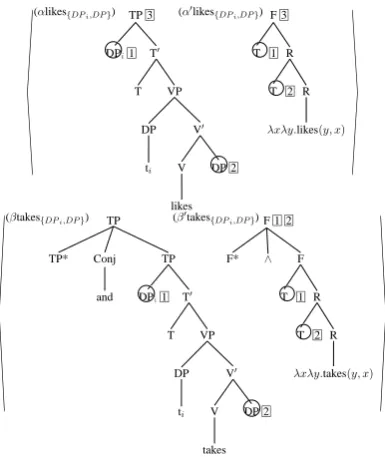
The derivation of (8) requires elementary trees with two contracted nodes, as both subject and ob-ject are shared. These elementary trees are in Fig-ure 16. Since both the subject DPiand the object
DP are contracted, the links for the scope compo-nents of both are absent in F in (α′likes{DPi,DP}), and placed on the root F in (β′takes{DPi,DP}). This means that the two scope components will multiply-adjoin to the F node, and as the order in which the two components adjoin is not specified, scope ambiguity is predicted. The derivation struc-tures and the derived trees are in Figures 17 and 18. The application ofλ-conversion to (γ′8a) and (γ′8b) yields the formulas in (8a) and (8b) respec-tively.
The derivation of sentences with both DP and VP coordination, such as Every boy and
ev-ery girl jumped and played, follows from our
[image:6.595.319.529.392.442.2](γ6) TP
DPi
D
a NP
N
student T′
T VP
DP
ti
V′
V
read DP
D
every NP
N
paper VP
Conj
and TP
T′
T VP
DP
ti
V′
V
summarized DP
D
every NP
N
book (γ′6)
F
GQ
λP.∃x[student(x)][P(x)]
R
λz F
F
GQ
λP.∀x[paper(x)][P(x)]
R
λz F
T
z
R
T
z
R
λxλy.read(y, x)
∧ F
GQ
λP.∀x[book(x)][P(x)]
R
λz F
R
T
z
R
[image:7.595.73.498.71.224.2]λxλy.summarized(y, x)
Figure 13: Derived trees for A student read every paper and summarized every book
(γ8) TP
TP
DPi
D
a NP
N
student T′
T VP
DP
ti
V′
V
likes Conj
and TP
T′
T VP
DP
ti
V′
V
takes DP
D
every NP
N
course (γ′8a)
F
GQ
λP.∃x[student(x)][P(x)]
R
λz F
GQ
λP.∀x[course(x)][P(x)]
R
λz F
F
T
z
R
T
z
R
λxλy.likes(y, x)
∧ F
R
R
λxλy.takes(y, x)
(γ′8b) F
GQ
λP.∀x[course(x)][P(x)]
R
λz F
GQ
λP.∃x[student(x)][P(x)]
R
λz F
F
T
z
R
T
z
R
λxλy.likes(y, x)
∧ F
R
R
[image:7.595.73.504.251.411.2]λxλy.takes(y, x)
Figure 18: Derived trees for A student likes and takes every course
(αlikes{DPi,DP}) TP 3 DPi1 T′T VP
DP
ti
V′
V
likes DP 2 (α′likes{
DPi,DP}) F 3
T 1 R
T 2 R
λxλy.likes(y, x)
(βtakes{DPi,DP}) TPTP* Conj
and TP
DPi1 T′
T VP
DP
ti
V′
V
takes DP 2 (β′takes{
DPi,DP}) F 1 2
F* ∧ F
T 1 R
T 2 R
λxλy.takes(y, x)
[image:7.595.293.509.443.485.2]Figure 16: Elementary trees for A student likes and
takes every course
(δ8) (αlikes{DPi,DP}) (αa student)DPi
(βtakes{DPi,DP}) TP
(αevery course) DP
(δ′8) (α′likes {DPi,DP})
{(α′a student),
(β′a student)}
(β′takes
{DPi,DP}) {(α′every course),
(β′every course)}
Figure 17: Derivation structures for A student likes
and takes every course
in Figure 4, (αjumped{DPi}), (α
′jumped {DPi}), (βplayed{DPi}), and (β
′played
{DPi}), which are intransitive variants of the verb elementary trees in Figure 11, are necessary. In syntax, (βand every girl) adjoins to DP in (αevery boy), (βplayed{DPi}) adjoins to VP in (αjumped{DPi}), and (αevery boy) substitutes simultaneously into (αjumped{DPi}) and (βplayed{DPi}) at DPi. In semantics, (β′and every girl) adjoins to GQ in (β′every boy), which adjoins to the root F in (β′played{DPi}), and (α
′every boy) substitutes
[image:7.595.78.271.460.689.2](10) ∀x[boy(x)][jumped(x)∧played(x)]∧
∀x[girl(x)][jumped(x)∧played(x)]
5
Conclusion and future work
We have shown that our STAG analysis of DP/VP coordination accounts for the scope interaction be-tween the coordinator and quantified DPs. Our analysis utilizes GQs, appropriate placement of links between the syntactic and semantic elemen-tary tree pairs, and parallel syntactic and seman-tic derivations, using substitution and adjoining in both syntax and semantics.
Potential counterexamples to our analysis of VP coordination are those where the coordinator has scope over the shared argument, as in (11). How-ever, world knowledge or discourse context is nec-essary to achieve such a reading, and we therefore suspect that an additional operation such as ellipsis may be required to properly account for them.
(11) A woman discovered radium but [a man in-vented the electric light bulb and developed the theory of relativity]. (Winter, 2000)
Our analysis of DP/VP coordination does not ac-count for all the scope possibilities of phrasal
ei-ther...or, as a reviewer points out: the∨> ∀> ∃
reading in (12a), and the∨ > ∀reading in (12b). One possible analysis is that either is interpretable from a displaced position in the beginning of the sentence. If so, then we can adopt the ellipsis analysis of Schwarz (1999) that a displaced either marks the left boundary of an ellipsis site.
(12) a. Every boy met either a baseball player or a soccer player.
b. Every boy will either go to a baseball game or stay at home.
Further, our analysis does not handle the non-distributive reading associated with coordinated DPs as in (13a), as pointed out by a reviewer.
(13) a. Every boy and every girl met/gathered. b. The boys met/gathered.
Non-distributivity however is not restricted to co-ordinated DPs, but occurs with plural DPs in gen-eral, as in (13b). We thus speculate that and in a non-distributive DP should be defined as a func-tion that turns the coordinated DP to a plural ob-ject. All these issues are left for future research.
Acknowledgment
We thank the three anonymous reviewers of TAG+9 for their insightful comments. All remain-ing errors are ours. This work was supported by NSERC RGPIN/341442 to Han.
References
Babko-Malaya, Olga. 2004. LTAG semantics of fo-cus. In Proceedings of TAG+7, pages 1–8, Vancou-ver, Canada.
Banik, Eva. 2004. Semantics of VP coordination in LTAG. In Proceedings of TAG+7, pages 118–125, Vancouver, Canada.
Barwise, Jon and Robin Cooper. 1981. Generalized quantifiers and natural language. L&P, 4:159–219. Frank, Robert. 2002. Phrase Structure
Composi-tion and Syntactic Dependencies. MIT Press,
Cam-bridge, MA.
Han, Chung-hye. 2007. Pied-piping in relative clauses: Syntax and compositional semantics using Synchronous Tree Adjoining Grammar. Research
on Language and Computation, 5(4):457–479.
Kallmeyer, Laura and Maribel Romero. 2008. Scope and situation binding in LTAG using semantic uni-fication. Research on Language and Computation, 6(1):3–52.
Nesson, Rebecca and Stuart M. Shieber. 2006. Simpler TAG Semantics through Synchronization. In
Pro-ceedings of the 11th Conference on Formal Gram-mar, Malaga, Spain. CSLI.
Nesson, Rebecca and Stuart Shieber. 2007. Extraction phenomena in Synchronous TAG syntax and seman-tics. In Wu, Dekai and David Chiang, editors,
Pro-ceedings of the Workshop on Syntax and Structure in Statistical Translation, Rochester, New York.
Sarkar, Anoop and Aravind Joshi. 1996. Coordination in Tree Adjoining Grammars: formalization and im-plementation. In Proceedings of COLING’96, pages 610–615, Copenhagen.
Schabes, Yves and Stuart M. Shieber. 1994. An Al-ternative Conception of Tree-Adjoining Derivation.
Computational Linguistics, pages 167–176.
Schwarz, Bernhard. 1999. On the syntax of either...or.
NLLT, 17(2):339–370.
Shieber, Stuart and Yves Schabes. 1990. Synchronous Tree Adjoining Grammars. In Proceedings of
COL-ING’90, Helsinki, Finland.
Winter, Yoad. 2000. On some scopal asymmetries of coordination. In Bennis et al, editors, Proceedings