Creating an Annotated Corpus for Generating Walking Directions
Stephanie Schuldes† Michael Roth‡
†EML Research gGmbH Heidelberg, Germany
http://www.eml-research.de/nlp
Anette Frank‡ Michael Strube†
‡Department of Computational Linguistics University of Heidelberg, Germany
http://www.cl.uni-heidelberg.de
Abstract
This work describes first steps towards building a system that synchronously gen-erates multimodal (textual and visual) route directions for pedestrians. We pur-sue a corpus-based approach for building a generation model that produces natural in-structions in multiple languages. We con-ducted an empirical study to collect ver-bal route directions, and annotated the ac-quired texts on different levels. Here we describe the experimental setting and an analysis of the collected data.
1 Introduction
Route directions guide a person unfamiliar with the environment to their designated goal. We plan to generate route instructions that are similar to those given by humans by referring to landmarks and by structuring the route in a way that it is easy to memorize (Denis, 1997).
We develop a system for synchronously gen-erating natural language route directions and 3D scenes of a route. The core of the architecture is a unified representation providing information for both verbal and graphical output. The direct correspondence between linguistic references and shown objects facilitates the identification of the visual scene in the real world and the choice of the correct action while following the route. To cre-ate a reusable system that is adaptable to different navigational domains and languages, we use ma-chine learning techniques to build a statistical gen-eration model from annotated corpora. We report on an empirical study to collect human-produced walking directions to be used for statistical gener-ation from underlying semantic structures. While our scenario is ultimately multilingual, here we give an analysis of the German dataset.
2 Related Work
The task of analyzing and generating cognitively adequate route instructions has been addressed by a number of authors (Taylor & Tversky, 1996; Tappe, 2000; Habel, 2003; Richter, 2008; Vi-ethen & Dale, 2008; Kelleher & Costello, 2009). Marciniak & Strube (2005) showed that a system for generating route directions can be successfully trained on a small set of 75 route direction texts (8418 tokens). In their approach directions are represented in a graph, which encodes informa-tion on various conceptual levels. While their ap-proach is restricted to reproducing directions for the learned graphs, we will generate directions for a wide range of possible routes. Dale et al. (2005) developed a system that takes GIS data as input and uses a pipeline architecture to generate verbal route directions. In contrast to their approach, our approach will be based on an integrated architec-ture allowing for more interaction between the dif-ferent stages of generation. The idea of combining verbal directions with scenes from a virtual 3D en-vironment has recently lead to a new framework for evaluating NLG systems: The Challenge on Generating Instructions in Virtual Environments (GIVE) (Byron et al., 2009) is planned to become a regular event for the NLG community.
3 Corpus Acquisition
For collecting naturally produced route instruc-tions, we conducted a study with 29 native speak-ers of German (66% female and 33% male). The participants in our study were students from var-ious fields aged between 20 and 34 years. We
designed two different settings: one on-site
set-ting, in which participants walked around in a real
world situation (specifically our university
cam-pus), and one desk-based setting, in which they
interacted with a web application. The former was further divided into indoor and outdoor routes,
3 2
1
7
6
4
5
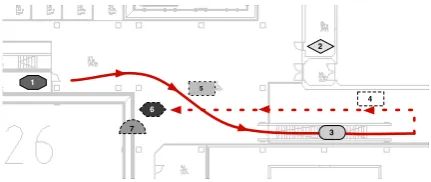
Figure 1: Example route from the indoor setting (first task), leading from a room with photocopiers (1) across an open space and downstairs (3) to a students’ union room (6), passing an information board (4) and a coffee machine (5). A lecture room (2) and a glass wall (7) are visible from the route.
while the latter was restricted to an outdoor sce-nario. This design enables us to study possible differences and commonalities between linguistic realizations obtained for different environments as well as different presentation modes.
For both scenarios, the task was to give written directions to a person unfamiliar with the area as to how to get to the destination the participants just reached, taking the same route. First, participants were led along a route to a given destination point (on-site). Each participant was asked to give di-rections for two routes inside buildings of the uni-versity campus (e.g. from an office to a seminar room, cf. Figure 1), and one outside route (e.g. from the building entrance to a bus stop).
Second, participants were shown a web appli-cation that guided them along a route by means of a 2D animation (desk-based). Subjects were al-lowed to use all information displayed by the web application: named places, buildings, street and bridge names, etc. (cf. Figure 2).
Setting GM CI CO Total
physical routes 9 6 3 18
directions 59 58 28 145
tokens 5353 4119 2674 12146
tokens/dir. (∅) 91 71 96
Table 1: Number of routes, directions, and tokens for the different settings. GM = Google Maps, CI = Campus Indoor, CO = Campus Outdoor.
4 Corpus Annotation
The acquired texts were processed in several steps. To ensure that all route directions consist of syn-tactically and semantically correct sentences, we
Figure 2: Web application used in the second task. Landmarks were introduced successively via pop-ups as the animated walker encountered them.
manually corrected spelling mistakes, omissions resulting in grammatical errors, and removed el-liptical and unclear directions.
The preprocessed texts were annotated on the following three levels:
pos lemma – part-of-speech and lemma
syn dep – dependency relations
sem frame – frames and semantic roles
For thepos lemmaandsyn deplevels, we used
TreeTagger (Schmid, 1997) and XLE (Maxwell
& Kaplan, 1993). The corpus was parsed
with the German ParGram LFG grammar (Forst, 2007). The outputs were corrected manually
by two annotators. On the sem frame level
an-notation was carried out using the anan-notation tool SALTO (Burchardt et al., 2006) and fol-lowing the definiton of the FrameNet frames SELF MOTION, PERCEPTION, BEING LOCATED
and LOCATIVE RELATION(Baker et al., 1998). In
terms of accuracy for unlabeled/labeled relations, the annotation agreement was 78.88%/65.17% on thesyn dep level and 79.27%/68.39% for frames and semantic roles.
5 Data Analysis
5.1 Corpus Statistics
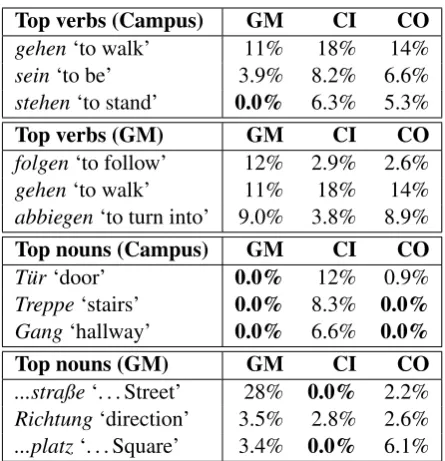
We examined word frequencies with respect to the experimental settings in order to determine simi-larities and dissimisimi-larities in lexical choice. Table 2 shows the three most frequent verbs and nouns found in each corpus part.
Top verbs (Campus) GM CI CO
gehen‘to walk’ 11% 18% 14%
sein‘to be’ 3.9% 8.2% 6.6%
stehen‘to stand’ 0.0% 6.3% 5.3%
Top verbs (GM) GM CI CO
folgen‘to follow’ 12% 2.9% 2.6%
gehen‘to walk’ 11% 18% 14%
abbiegen‘to turn into’ 9.0% 3.8% 8.9%
Top nouns (Campus) GM CI CO
T¨ur‘door’ 0.0% 12% 0.9%
Treppe‘stairs’ 0.0% 8.3% 0.0%
Gang‘hallway’ 0.0% 6.6% 0.0%
Top nouns (GM) GM CI CO
...straße‘. . . Street’ 28% 0.0% 2.2%
Richtung‘direction’ 3.5% 2.8% 2.6%
...platz‘. . . Square’ 3.4% 0.0% 6.1%
Table 2: Relative frequency of the three most com-mon verbs and nouns in both studies
scenario-specific. In many cases, the occurrence or absence of a verb can be attributed to a verb’s selectional restrictions. For example, some of the verbs describing movements along streets (e.g.
folgen‘to follow’,abbiegen‘to turn into’) do not occur within the indoor corpus whereas verbs
de-scribing “3D movements” (e.g. durchqueren ‘to
walk through’,hinuntergehen‘to walk down’) are
not mentioned with the Google Maps setting. The most frequent nouns significantly differ be-tween the indoor and outdoor settings. This corre-lation does not come as a surprise, as most of the mentioned objects cannot be found in all scenar-ios. On the other hand, nouns that are common to both indoor and outdoor scenarios can be di-vided into two categories: Nouns denoting (1)
ob-jects that appear in both scenarios (e.g. Geb¨aude
‘building’) and (2) abstract concepts typical for
route directions in general, e.g. Richtung
‘direc-tion’, Nummer ‘number’, Ziel ‘goal’, and
Start-punkt‘starting point’.
5.2 Landmark Alignment
Landmark alignment serves the purpose of de-tecting objects that are most frequently men-tioned across directions, and how the same ob-ject is referred to differently. We created a graph-based representation of the landmarks mentioned
in each route instruction (single route
representa-tion, SRR) for use in two types of alignment.
Fig-ure 3 shows an example from the indoor study. First, we created a combined graph for each phys-ical route by merging the respective SRRs, taking into account several criteria:
String matching of landmark names;
Semantic similarity usingGermaNet(Lemnitzer
& Kunze, 2002), a lexical-semantic network for German similar to WordNet;
Frequency of references across all directions;
Spatio-temporal proximity of references to the
same object;
Number of landmarks mentioned in a single
di-rection (i.e. length of the SRR).
The combined graphs show that there are strong correspondences between the directions for the same route. We also found that, in the campus settings, there was a small number of frequently used general objects and a large number of less frequently used specific objects. This facilitates merging and shows the importance of the objects for people’s orientation, and at the same time sup-ports our claim that other modalities are needed to disambiguate references during navigation. For generating informative referential expressions, the combined graph needs to be refined so that object properties are represented (Krahmer et al., 2003).
Second, we aligned the SRRs with the physical route graph. Comparing the landmarks mentioned in the campus settings revealed that, in 97.8% of the cases, people adhere to the sequence in which objects are encountered. Reversed order was only found in special cases like distant objects.
5.3 Discourse Phenomena
We analyzed the use of anaphora, the temporal or-der of instructions, and occurrences of prototypi-cal event chains in the collected texts in order to identify coherence-inducing elements.
Spatio-temporal adverbials: Most anaphors
mention intermediate goals on the route in order to refer to the starting point of a new action (e.g.
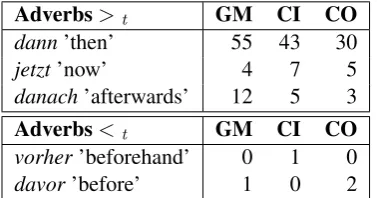
da/hier ‘here’, dort ‘there’). This finding goes hand in hand with the observation that the col-lected route directions are typically structured in a linear temporal order (cf. Table 3) as for
ex-ample indicated by the use of adverbs
indicat-ing temporal succession (e.g. jetzt ‘now’, dann
‘then’ anddanach‘afterwards’) and conjunctions
(e.g. bis‘until’,wenn‘when’). Interestingly, a
Rücken Raum Kopierer Treppe Treppe Brett Getränkeautomat Treppe Hörsaal Treppe Kaffeeautomat Tür Fachschaft
Kopierer Treppe Hörsaal Brett Säule Glastür Getränkeautomat Tür Fachschafts-raum
Druckerraum Theoretikum 180-Grad-Kurve Fachschaftstafel Glaswand Glaswand Kopf Fachschaft
Medizin-Kopierzentrum Rücken Treppe Treppe Richtung Glasfenster Glasfront Eingang Fachschaft
3 2
1 4 5 6 7
Figure 3: Each line shows one SRR for the route in Figure 1. Correspondences are indicated by identical node shapes, black dots substitute non-matched tokens. The bottom graph shows the physical route seen as sequence of landmarks. Node size reflects the importance of the referred object as conveyed by SRRs.
Adverbs>t GM CI CO
dann’then’ 55 43 30
jetzt’now’ 4 7 5
danach’afterwards’ 12 5 3
Adverbs<t GM CI CO
vorher’beforehand’ 0 1 0
davor’before’ 1 0 2
Table 3: Frequencies of temporal adverbs indicat-ing linear (>t) and reversed linear order (<t)
the following action or situation is not supposed
to take place (e.g. Gehen Sie vorher rechts
‘be-forehand turn right’).
Backward-looking event anaphors and
refer-ences to result states: We also found explicit
references to past events (e.g. Nach dem
Durch-queren ‘after traversing’) and result states of
events, e.g. the adverbial phrase unten
angekom-men(here: ‘downstairs’) was frequently used
fol-lowing an instruction to ‘walk downstairs’.
6 Conclusions and Future Work
The lexical corpus analysis confirms our hypoth-esis that there are strong commonalities in lexi-cal choice for directions that persist across sce-narios and presentation modes, with a small num-ber of focused differences, and obvious domain-dependent lexical differences regarding the nature of objects in the respective scenarios. While our current corpus data is rather broad, environment-specific data can be extended quickly by setting up web studies using 2D and 3D environments.
The alignment of the physical routes and ver-bal instructions shows a clear tendency that linear route structure is observed in verbal realization, with only few exceptions. Since temporal order is observed by default, temporal annotation can be restricted to capture exceptional orderings, which are recoverable from linguistic cues. The study of discourse coherence effects yielded a number of elements that will be given special attention in the surface generation model. We observed a variety of coherence-inducing elements that are generic in nature and thus seem well-suited for a corpus-based generation model. As other languages are known to exhibit differences in verbal realization of directions (von Stutterheim et al., 2002), we have to extend our data collection in order to gen-erate systematic linguistic variations from a single underlying semantic structure for all languages.
The linguistic annotation levels of frames and roles, syntactic dependencies, and basic word cat-egories have been tested successfully with a sim-ilar corpus (Roth & Frank, 2009). The next steps will consist in the alignment of physical routes and landmarks with semantic representations in an in-tegrated generation architecture.
Acknowledgements: This work is supported by
References
Baker, Collin F., Charles J. Fillmore & John B. Lowe (1998). The Berkeley FrameNet Project. InProceedings of the 17th International Conference on Computational Linguis-tics and 36th Annual Meeting of the Association for Com-putational Linguistics,Montr´eal, Qu´ebec, Canada, 10–14 August 1998, pp. 86–90.
Burchardt, Aljoscha, Katrin Erk, Anette Frank, Andrea Kowalski & Sebastian Pado (2006). SALTO: A versatile multi-level annotation tool. InProceedings of the 5th In-ternational Conference on Language Resources and Eval-uation,Genoa, Italy, 22–28 May 2006, pp. 517–520. Byron, Donna, Alexander Koller, Kristina Striegnitz, Justine
Cassell, Robert Dale, Johanna Moore & Jon Oberlander (2009). Report on the First NLG Challenge on Generating Instructions in Virtual Environments (GIVE). In Proceed-ings of the 12th European Workshop on Natural Language Generation (ENLG 2009),Athens, Greece, 30-31 March 2009, pp. 165–173.
Dale, Robert, Sabine Geldof & Jean-Philippe Prost (2005). Using natural language generation in automatic route de-scription.Journal of Research and Practice in Information Technology, 37(1):89–106.
Denis, Michel (1997). The description of routes: A cognitive approach to the production of spatial discourse. Current Psychology of Cognition, 16:409–458.
Forst, Martin (2007). Filling statistics with linguistics – Property design for the disambiguation of German LFG parses. In Proceedings of the ACL 2007 Workshop on Deep Linguistic Processing,Prague, Czech Republic, 28 June 2007, pp. 17–24.
Habel, Christopher (2003). Incremental generation of mul-timodal route instructions. In Reva Freedman & Charles Callaway (Eds.),Working Papers of the 2003 AAAI Spring Symposium on Natural Language Generation in Spoken and Written Dialogue, pp. 44–51. Menlo Park, California: AAAI Press.
Kelleher, John D. & Fintan J. Costello (2009). Applying com-putational models of spatial prepositions to visually situ-ated dialog.Computational Linguistics, 35(2):271–306. Krahmer, Emiel, Sebastiaan van Erk & Andr´e Verleg (2003).
Graph-based generation of referring expressions. Compu-tational Linguistics, 29(1):53–72.
Lemnitzer, Lothar & Claudia Kunze (2002). GermaNet – rep-resentation, visualization, application. InProceedings of the 3rd International Conference on Language Resources and Evaluation,Las Palmas, Canary Islands, Spain, 29–31 May 2002, pp. 1485–1491.
Marciniak, Tomacz & Michael Strube (2005). Beyond the pipeline: Discrete optimization in NLP. InProceedings of the 9th Conference on Computational Natural Language Learning,Ann Arbor, Mich., USA, 29–30 June 2005, pp. 136–145.
Maxwell, John T. & Ronald M. Kaplan (1993). The inter-face between phrasal and functional constraints. Compu-tational Linguistics, 19(4):571–590.
Richter, Kai-Florian (2008). Context-Specific Route Direc-tions – Generation of Cognitively Motivated Wayfinding Instructions. Amsterdam: IOS Press.
Roth, Michael & Anette Frank (2009). A NLG-based appli-cation for walking directions. InCompanion Volume to the Proceedings of the 47th Annual Meeting of the Associ-ation for ComputAssoci-ational Linguistics and the 4th Interna-tional Joint Conference on Natural Language Processing of the Asian Federation of Natural Language Processing,
Singapore, 2-7 August 2009. To appear.
Schmid, Helmut (1997). Probabilistic Part-of-Speech tagging using decision trees. In Daniel Jones & Harold Somers (Eds.),New Methods in Language Processing, pp. 154–
164. London, U.K.: UCL Press.
Tappe, Heike (2000). Perspektivenwahl in Beschreibun-gen dynamischer und statischer Wegeskizzen. [Choice of perspective in descriptions of dynamic and static sketch-maps]. In Christopher Habel & Christiane v. Stutterheim (Eds.), R¨aumliche Konzepte und sprachliche Strukturen, pp. 69–97. T¨ubingen: Niemeyer.
Taylor, Holly & Barbara Tversky (1996). Perspective in spatial descriptions. Journal of Memory and Language, 35:371–391.
Viethen, Jette & Robert Dale (2008). The use of spatial re-lations in referring expression generation. InProceedings of the Fifth International Natural Language Generation Conference, Salt Fork OH, USA, 12–14 June 2008, pp. 59–67.