Bolette Sandford Pedersen University of Copenhagen
Denmark
Anna Braasch University of Copenhagen
Denmark
Abstract
The first version of the Danish WordNet, DanNet, was released in March 2009 under an open source license similar to the Princeton Licence (cf. www.wordnet.dk). In order to present and discuss the set of encoded seman-tic information in a focused form and with some empirical data, we dive into a specific ontological type in the WordNet, namely hu-mans. We present and discuss the information types in the lexical semantic resource for this ontological type, and we focus on the infor-mation types where DanNet constitutes an ex-tension of the general WordNet framework, namely regarding taxonomical status of a hy-ponym, qualia structure and connotative in-formation.
1 Introduction
Which kinds of semantic information should be in focus when compiling lexical semantic resources for computational means? And more specifically, if we look into each ontological type, which are the particular ontological characteristics, relations and features that would provide us with the most basic and prototypical dimensions of lexical meaning? In order to answer these questions regarding ap-propriateness of description from an empirical viewpoint, we dive into a particular ontological type of entities, namely humans. The choice has fallen on this ontological type for two reasons: (i) Words referring to humans are very frequent in language: Thus, in the modern Danish dictionary, Den Danske Ordbog (DDO), the word person
(‘person’) is by far the word with most hyponyms pointing to it: 4246 words refer to it as its closest hyperonym. For comparison, the closest competing word is del (‘part’) with only 764 hyponyms refer-ring directly to it. And (ii) humans are concrete entities and thereby belong to a group whose man-ner of description is relatively well-documented in lexicographical, terminological and NLP literature (in contrast to e.g. abstract entities). At the same time, they are rather complex types in the sense that they encompass a series of semantic properties and connotations. Thus, they constitute a proto-typical, but still sufficiently interesting ontological type as to shed light on the appropriate complexity of a lexical semantic resource.
cover 70,000 of DDO's approx. 100,000 word senses.
The paper is composed as follows: In Section 2 we relate to previous work in the field of lexical se-mantic resources and briefly discuss the particular, monolingual approach adopted in DanNet, whereas we look in Section 3 into the basic structure and description of humans: Which are the taxonomical principles used and which properties are central to encoding of the specific synsets. How can qualia structure (Pustejovsky 1995) help us organize rela-tions and features in the wordnet, and how can we minimize the so-called ISA-overload problem. In Section 4 we move on to another aspect of the se-mantic encoding which goes beyond the primary, literary meaning of a synonym set (synset), namely that of connotation. By investigating the DanNet material, we examine the differences in connota-tional values for men and women, respectively. In Section 5, we exemplify how encodings of seman-tic relations and features as well as the inheritance mechanism is performed in DanNet, and finally, in Section 6 we conclude by summing up the points where DanNet differs from the standard WordNet framework.
2 Related work
Being a part of the ‘WordNet family’ (cf.
www.wordnet.org), DanNet generally conforms to the framework given in the WordNet Specifica-tions as accounted for in Fellbaum (1998) and Vossen (ed.) (1999). Thus, in DanNet we basically operate with synsets as well as with a fixed set of semantic relations between synsets, the has_hyperonym relation being the central one. However, as already mentioned, two former Dan-ish resources have been reused in the compilation of DanNet, encompassing thereby several aspects of the more lexically driven and far more complex SIMPLE resources as accounted for in Lenci et al. (2000), as well as the linguistic specifications of DDO (Lorentzen 2004). This has resulted in the fact that DanNet includes some information types that are not generally given in WordNets, such as some more specific ontological types, information on taxonomical status of a hyponym minimizing thereby the ISA-overload, qualia structure on nouns, connotative values etc.
The approach of reusing monolingual resources for the building of a WordNet is contrasted by the ap-proaches used in several other recently compiled WordNets of other languages such as the Spanish Wordnet (Fernández-Montraveta et al. 2008), the Arabic WordNet (Rodríguez et al. 2008), and the Hungarian WordNet (Márton et al. 2008). To our knowledge, only one other WordNet, namely the Polish WordNet (Derwojedowa et al. 2008), ap-plies a monolingual approach similar to ours.
Our arguments for applying a monolingual ap-proach to the Danish WordNet (and not an expand approach where translations are performed from Princeton WordNet) are partly linguistic, partly pragmatic, namely that we believe that a WordNet should ideally reflect the inherent characteristics of the general vocabulary of the language described, and that SIMPLE and in particular DDO constitute excellent sources for our approach since they are corpus-based, i.e. they reflect contemporary Dan-ish language use. For further accounts of the reuse perspectives in the compilation of DanNet as well as on the general framework of the lexical re-source, cf. Asmussen et al. (2007), Pedersen et al. (2008) and Pedersen & Sørensen (2006).
3 Taxonomical Structure and Semantic
Properties
A basic assumption in DanNet is that a core part of the vocabulary can and should be organised in terms of strict taxonomical structures. Thus, con-forming to the taxonomical principles referred to by Cruse (2002), humans are a kind of concrete entities parallel their co-taxonyms such as animals and things. It is further assumed that co-taxonyms areincompatible; thus an entity cannot be a human and an animal at the same time. This is the case in a majority of the synsets established in DanNet, which conforms to what Cruse (2002) refers to as
natural or functional kinds. Natural kinds are found in natural taxonomies: A dahlia is a kind of flower and is incompatible with for instance a rose. Likewise, a needle represents a functional kind which is a type of instrument and which is incom-patible with for instance a scalpel1.
1
In this respect, humans constitute a rather special ontological type. If we look into the internal taxo-nomical structure of humans, it becomes clear that they hardly conform to such principles. For illus-tration, the following set of hyponyms of person
may very well have the same referent: fodgænger
(‘pedestrian’), alkoholiker (‘alcoholic’), lærer
(‘teacher’), idiot (idiot) and skønhed (‘beauty’) all at the same time. In other words, these hyponyms of persons are not incompatible since they do not refer to different individuals but rather to specific dimensions of these. Such terms are labelled nomi-nal kinds by Cruse (2002). In contrast to natural and functional kinds, nominal kinds cannot be de-scribed as a kind of or a type of. They therefore typically constitute a taxonomical problem which is often referred to as the ISA-overload problem (Guarino 1998, Huang et al. 2008). As a further characteristic, the relation between nominal kinds and their hyperonyms can typically be captured in terms of a single differentiating feature; thus a pe-destrian is a person who walks, a teacher a person who teaches, and an alcoholic a person who drinks, etc. This is in clear contrast to the aforementioned natural and functional kinds which require listing of prototypical features and use in order to be de-fined, i.e. “a needle is a very fine and slender piece of polished metal with a point at one end and a hole or eye for thread in the other, used in sewing” (NODE). To be more precise, nominal kinds call for a classification rather into semantic properties than into taxonomical types. One proposal for such a classification is given in the SIMPLE framework (Lenci et al. 2000a:197-211), where the following dimensions are suggested (Figure 1):
Human (example: person) People (example: American) Role (example: member)
Ideo (example: communist) Kinship (example: mother) Social Status (example: lord)
Agent of temporary activity (example: student)
Agent of persistent activity (example: violinist)
Profession (example: teacher)
Figure 1: Semantic dimensions of humans encoded in SIMPLE
Note that two of these dimensions, namely People and Professions, however, do expose
incompatibil-ity between their own co-hyponyms to a certain degree: Prototypically, an American is not at the same time a French, and a nurse is normally not a doctor at the same time, although specific contexts may permit compatibility.
Agents of temporary activities, on the other hand, are unique in the sense that they do not refer to individuals but rather to events performed by these. If you count monthly customers in a restaurant or passengers on a certain transport route, you are typically not counting individuals but rather the
number of times that individuals visit the restaurant or take a given train. Several linguistic tests sup-port this ontological distinction, for instance you can add a time specification and say a frequent customer, but not *a frequent American or *a fre-quent mother.
In DanNet we have adopted a somewhat simplified way of viewing different semantic properties of persons than the one given in SIMPLE. We apply Pustejovskys four-dimensional qualia structure (Pustejovsky 1995) as a frame also for describing the different properties of persons. The four qualia roles include:
• the formal role encompassing the dimen-sion of seeing something as a kind, • the constitutive role encompassing the
di-mension of seeing something as a whole consisting of parts (in SIMPLE a large number of semantic features and relations typically concerning the internal structure of the concept is expressed via this role2), • the telic role encompassing the dimension
of seeing something as having a certain function, and finally
• the agentive role encompassing the di-mension of seeing something from the point of view of its origin.
Excluding here the formal role since it is already described via the hyperonym, the three other qualia roles are interpreted as follows:
• The constitutive role encompasses proper-ties on gender, intellect, appearance or connotation, as expressed implicitly in
2
son nouns such as mandsperson (‘man’),
idiot (‘idiot’), geni (‘genius’), skønhed
(beauty), and dværg (‘dwarf’).
• The telic role encompasses typical func-tions as expressed implicitly in nouns such as lærer (‘teacher’, role of agent: to teach) and chef (‘leader’, role of agent: to lead). • The agentive role focuses on properties
that define the following nouns: fodgænger
(‘pedestrian’, defining act: to walk), cyklist
(‘cyclist’, defining act: to cycle), alkoho-liker (’alcoholic’, defining act: to drink), kunde (’customer’, defining act: to buy).
On this approach, some of the fine-grained distinc-tions made in the SIMPLE specificadistinc-tions are ex-cluded, for instance the distinction between properties regarding temporary and persistent ac-tivities (which could, however, be added by means of a feature). On the other hand, the qualia struc-ture represents a more basic and generally applica-ble structure which is resemapplica-bled all through the DanNet database in the sense that all concrete enti-ties are described within this structure (cf. Peder-sen & SørenPeder-sen 2006, PederPeder-sen et al. 2008).
4 Connotations
Nominal kinds (to which, as we have seen, most of our human synsets belong) are characterized by the fact that they often include some kind of judgment or connotation. Within the framework of DanNet, connotation is understood as the set of associations implied by a word or lexical item in addition to its primary, literal meaning. The primary meaning of a word is its denotation or its referential meaning3, e.g. pige (‘girl’) denoting a young female person. Lyons (1977:176) refers to the non-philosophical use of the term “connotation of a word “in seman-tics […] as an emotive or affective component ad-ditional to its central meaning.”
In some cases, a group of lexical items share cen-tral (primary) meaning, e.g. young female person. These items can only be distinguished by a differ-ence in their connotations such as the positive
3
In philosophy and logic the term extension is used to refer to the relationship between a lexical item and the class of entities it is ap-plied to. Intension, opposed to extension, includes only the defining properties of lexical items (Lyons 1977:159).
‘sild’ (‘bird’, ‘chick’), and the negative tøjte
(‘tart’), whereas the noun pige is emotionally neu-tral. In DanNet, these words are not considered synonyms, even if they refer to the same entity; they appear in different synsets. In contrast, Cruse (1986:287) discusses a similar case as a sub-type of synonymy from the lexical semantics viewpoint and states that “subordinate [semantic] traits (…) have a role within the meaning of a word analo-gous to that of a modifier in a syntactic construc-tion”.
The connotation associated with a word may ex-press e.g. a value judgment, personal feelings or emotional responses to the entity concerned. Obvi-ously, person nouns frequently imply a connotation because humans judge each other by various re-markable features and traits e.g. in a social context.
Connotation may be of personal or general charac-ter. The first depends on the listener/reader’s atti-tude, whereas the last mentioned is common to the language user community and therefore relevant information to be encoded. Further, whether the connotation of a word is activated at all depends on the context in which the word is used. For instance, in somewhat older texts with neutral or objective point of view, the word tøs denotes a (very) young, female person (‘girl’). In contemporary texts, on the other hand, tøs is mainly used derogatively in the sense of ‘tart’ or ‘wench’: immorality and a contemptible behavior are associated with the per-son denoted. In this case the negative connotation is activated. This type of difference gives rise to encoding of separate meanings belonging to two distinct synsets.
The connotative information is based on DDO; it formalizes explicit usage information (e.g. the
explicit polarity values: positive and negative, ex-pressing a subjective attitude to the denoted per-son, topic, etc. Word senses with neutral attitude have a default, unmarked value.
Currently, 415 person nouns (approximately 10% of the total) are provided with a connotation value, hereof 58 specified by their nearest hyperonym as female and 47 male persons, resp.). The majority of person nouns, such as names of occupations, nationalities, family members, etc. are unmarked. This can be illustrated by the following two syn-sets: {børsmægler, børshandler} (‘stock broker’, ‘stock dealer’) denotes an occupation without con-notation, whereas {børsbaron, børshaj, børsspeku-lant} (‘stock-exchange magnate’, ‘stock jobber’, ‘stock speculator’) denotes a person risking losses for the possibility of quick, considerable gains in a reprehensible way, which usually evokes a nega-tive connotation.
Since connotations are very often emotional or evaluative in nature, it is interesting to look into the question of which personal characteristics evoke positive and negative associations, respec-tively. In the following, we present selected exam-ples that are hyponyms of the ontological type
person (‘person’), with the focus on hyponyms of
kvinde, pige (‘woman’, ‘girl’) mand, dreng (‘man’ and ‘boy’). We investigate whether there is any difference between the prevalent features and con-notation values associated with noun synsets that denote male and female persons, respectively, and we also look briefly into the group of nouns that have both male and female referents.
The features listed in the Tables 1 and 2 may apply also in combination, like appearance and shape, though this fact is ignored in the schematic presen-tation below. Other traits like manners, temper and mind appear frequently together in dictionary defi-nitions; therefore they are not separated in this presentation either. The order and selection of prevalent features are slightly different in the ta-bles 1 and 2 because of the observation that prior-ity and weight of characterising or striking features seem to differ in case of nouns denoting male and/or female persons.
Feature evoking the connotation
Percentages in the encoded material
sexual behavior (neg:10; pos:6 =16) 27.5% temper/mind/manners (neg:15; pos:0 =15 26% appearance (neg:4; pos:8 =12) 20% general (neg:5; pos:2 = 7) 12% shape/stature (neg:3; pos: 2 = 5) 8.5% intellect/ability (neg:1; pos:2 = 3) 5% TOTAL (neg:38 ; pos:20 = 58) 100%
Table 1: Features of female persons (Hyperonyms:
kvinde ‘woman’, pige ‘girl’)
Feature evoking the connotation
Percentages in the encoded material
manners/ mind (neg:14; pos:3 =17) 36% sexual behavior (neg: 10; pos:1 = 11) 23.5 % appearance (neg: 5; pos:2 =7) 15 % general (neg: 4; pos:1 =5) 10.5 % intellect/ability (neg: 3; pos:1 =4) 8.5% physical power (neg: 1; pos: 2 =3) 6.5 % TOTAL (neg:37; pos:10 =47) 100% Table 2: Features of male persons (Hyperonyms: mand
‘man’, dreng ‘boy’)
The figures and percentages indicate the following distribution tendencies: female persons have more connotations associated to them than male persons, and in general, the connotations are predominantly negative, namely 65% for females and 81% for males.
The most striking traits for both genders seem to concern sexual and social behaviour, but at a more detailed level the figures differ. Female persons are almost equally judged by their sexual behaviour and temper/mind/manners, the latter including a particular way of communication e.g. rap-penskralde ‘battleaxe’ (being bad-tempered and cheeky). In case of male persons, their man-ners/mind is by far the most frequently judged property, e.g. rod ‘tough, yob’ (being ill-mannered and impudent). A large number (319) of person nouns with connotation can denote both male and female persons, e.g. brokkehoved (‘moaner/ a grouchy person’), though a part of them has a pri-ority of implied gender, e.g. bulderbasse
(‘busterer’). The distribution of connotation polar-ity in the gender-neutral group shows the same tendency as in the tables, namely 253 nouns with
(21%) have a positive connotation. On the other hand, as regards the feature evoking the connota-tion, the distribution seems to be broader and more scattered, e.g. attitude, position, rank, experience, age, birth, etc.
If we compare the strategy for assigning connota-tion values in DanNet with other projects, e.g. Sen-tiWordNet (Esuli & Sebastiani, 2006), there are a number of differences. Firstly, DanNet is hand-coded, and connotation is currently provided for a subset of nouns only and without grades of polarity as is the case of SentiWordNet. Secondly, Senti-WordNet does not include information parallel to
the concerns relation in DanNet, information
which we believe provide highly relevant lexical semantic information to the word sense.
5 Encodings in DanNet
DanNet currently contains 7057 synsets referring to humans and out of these, 3748 belong to the on-tological type Human+Object, 1192 to the type Human+Object+Group, 1944 to the type Hu-man+Occupation+Object, and 183 to the ontologi-cal type Human+Object+Part (typiontologi-cally members of something). Each ontological type evokes a spe-cific template with a particular set of relations. For instance, for the ontological type Human+Part, the
has_holo_member relation is obligatory, i.e.
par-timedlem (party member) has_holo_member parti
(party).4
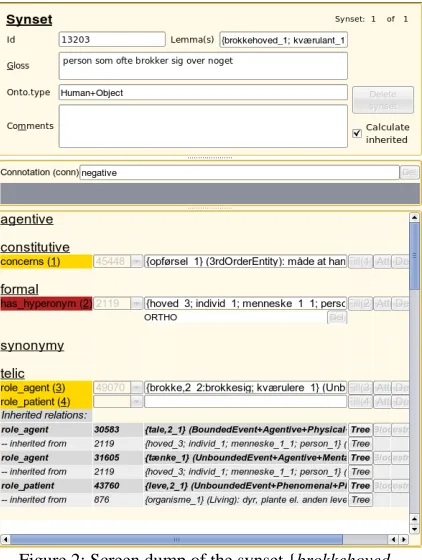
Figure 2 gives an example of the actual encoding of these in the DanNet database. The screen dump regards the encoding of the previously mentioned synset {brokkehoved, kværulant} (moaner, grouchy person). The top part of the screen shows the synset identifier, the lemmas of the synset, the gloss taken over from DDO, and the ontological type, in this case Human+Object. The second part regards the semantic features and relations. The connotative value is negative since {brokkehoved, kværulant}is conceived as derogative. For the ac-tual synset the constitutive, formal, and telic roles are filled; the constitutive role is filled with the relation concerns {opførsel} (behavior). The for-mal role is filled with the has_hyperonym {
4
These templates are comparable to Moerdijk’s semagrams, as pre-sented in Moerdijk 2008.
son, individ, menneske..} (person, individual, hu-man being..); this relation is typically automati-cally inherited from DDO. The has_hyperonym
relation is further specified by the feature ‘ortho’ which indicates that {brokkehoved, kværulant} is conceived as orthogonal to the taxonomy, i.e. the synset does not form the basic taxonomy because of its being a nominal kind in Cruse’s terms (cf. Section 3 on taxonomical structure). The telic role is filled with the relation role_agent {brokke_sig, kværulere} (moan, make a fuss).
Figure 2: Screen dump of the synset {brokkehoved, kværulant} (moaner, grouchy person)
In addition, two relations are inherited from the top synset {person, individ, menneske..}, namely
role_agent {tænke} and role_agent {tale}(‘think,
talk’). In some (few) cases semantic relations are blocked for inheritance. This facility is applied in cases of non-prototypical behavior, such as for in-stance a mute who cannot talk.
6 Conclusions
ap-pear in the DanNet resource, and we have ex-tracted some data from the database in order to examine the actual distribution of various connota-tive features on humans.
By describing the encodings of humans in DanNet, we have also accounted for four aspects which dis-tinguish this resource from the general WordNet framework:
• The resource is made from a monolingual basis, not by expanding from Princeton WordNet.
• Nominal terms are treated as
non-taxonomical (orthogonal to the taxonomy) whereby the ISA-overload is reduced. • Relations and features are systematically
organized along the dimensions of an ex-tended qualia structure.
• Connotative information is provided when relevant in terms of a constitutive feature regarding positive or negative connotation.
The question is to which extent these additions improve the utility of the lexical resource, in this particular case, of the ontological type humans. At the most basic level, the possibility of simply dis-tinguishing humans uniquely from other entities in running text is a much required piece of informa-tion asked for repeatedly by DanNet’s advisory panel (cf. www.wordnet.dk), an information type provided, however, generally in WordNets. An-other question regards whether the subdivision in DanNet of hyponymic relations into taxonomical and non-taxonomical ones will actually ease inte-gration of the lexical resource into formal ontolo-gies or other formal systems where advanced inference mechanisms require a strictly logical structure. Anyhow, the apparently messy structure (from an ontological point of view) of the proto-typical WordNet has been eagerly discussed at several Ontolex workshops and in other fora where lexicographers and formal ontologists meet. The organisation of DanNet into taxonomical and non-taxonomical structures is a first attempt to address this problem (see also Huang 2008 for a similar attempt in the Chinese WordNet).
Regarding the description of qualia structure, Pustejovsky (1995) argues that it defines the core elements of meaning of a lexical item, and that these core elements are a prerequisite for resolving
several grammatical and semantic hurdles in lan-guage analysis such as type shifting, type coercion, and ambiguity. If we, for instance, refer to en hur-tig bilist (a fast car driver), qualia structure helps disambiguate the often subtle meaning of the ad-jective (via selective binding), namely that the fastness regards the driving and not anything else.
Finally, the encoding of connotative information can be seen as a way of supplementing the lexical resource with information that goes beyond the pure denotation of words; a feature which in fact has also being investigated in relation to several other WordNets but mostly at an experimental lev-el (Flev-ellbaum & Miller 2006, Veale 2008)). Gener-ally, such information supports the identification of the associations implied beyond the denotative tex-tual level and helps clarify the attitude or bias of a text. In our particular case, we have focused on person nouns with positive or negative connotation and thereby only just shed light on a small corner of this immense semantic field.
The final proof of the pudding is in the eating: In other words, time will show in which kinds of ap-plications the resource can be really useful, and which particular information types are most appli-cable. Hopefully, experiments will take place in time as to actually give feedback to the second de-velopment phase of DanNet running until the end of 2010.
Acknowledgments
Thanks to Nicolai H. Sørensen for providing the statistics on the encoding of synsets referring to humans in DanNet.
References
Asmussen, J. Pedersen, B.S. & Trap-Jensen, L. 2007. DanNet: From Dictionary to WordNet. Kunze, C., Lemnitzer, L. & Osswald, R. (eds.)
GLDV-2007 Workshop on Lexical-Semantic and Ontological Resources: 1-11. Universität Tübingen, Germany.
Cruse, D.A. 1986. Lexical Semantics. Cambridge University Press.
Semantics of Relationships: An Interdisciplinary Perspective, Information Science and Knowl-edge Management: 2–21. Springer Verlag.
Derwojedowa, M. M. Piasecki, S. Szpakowicz, M. Zawislawska & B. Broda. 2008. Words, Concepts and Relations in the Construction of the Polish WordNet. Global WordNet Conference 2008: 162–177. Szeged, Hungary.
Esuli, A. & F. Sebastiani. 2006. SentiWordNet: A Publicly Available Lexical Resource for Opinion Mining. Proceedings of LREC 2006: 417-422. Genua, Italy
Fellbaum, C. (ed). 1998. WordNet – An Electronic Lexical Database. The MIT Press, Cambridge, Massachusetts, London, England.
Fellbaum, C. & G. Miller (2006) Wither WordNet?
Zampolli Prize Talk at LREC 2006. Available at
http://www.lrec-conf.org/lrec2006/IMG/pdf/AZPrize.Christiane %20Fellbaum%20Presentation.LREC06.pdf
Fernández-Montraveta, A, G. Vázquez & C. Fellbaum. 2008. The Spanish Version of Word-Net 3.0. In: Text resources and Lexical Knowl-edge: 175–182. Text, Translation, Computational Processing. Mouton de Gruyter, Berlin & New York.
Guarino, N. (1998) Some Ontological Principles for Designing Upper Level Lexical Resources. Proceedings from the First International Confer-ence on Language Resources and Evaluation pp: 527–534, Granada.
Huang, C., Hsiao, P., Su, I., Ke, X. (2008). Para-nymy: Enriching Ontological Knowledge in WordNets. Proceedings of the Fourth Global WordNet Conference: 221–228, Szeged, Hun-gary.
Lenci, A., Bel, N., Busa, F., Calzolari, N., Gola, E., Monachini, M., Ogonowski, A., Peters, I. Peters, W., Ruimy, N., Villegas, M. & Zampolli, A. 2000. SIMPLE – A General Framework for the Development of Multilingual Lexicons. T. Fon-tenelle (ed) International Journal of Lexicogra-phy, Vol 13: 249–263. Oxford University Press.
Lenci, A. F. Busa, N. Ruimy, E. Gola, M. Monachini, N. Calzolari, A. Zampolli. 2000.
SIMPLE. Linguistics Specifications. Technical Report. Pisa.
Lorentzen, H. 2004. The Danish Dictionary at large: Presentation, Problems and Perspectives. G. Williams and S. Vessier (eds): Proceedings of the Eleventh EURALEX International Con-gress: 285–294. Lorient, France.
Lyons, J. 1997. Semantics. Cambridge University Press.
Márton, M., C. Hatvani, J. Kuti, G. Szarvas, J. Csi-rik, G. Prószéky, T. Váradi. 2008. Methods and Results of the Hungarian WordNet Project.
Global WordNet Conference 2008: 311–320. Szeged, Hungary.
Moerdijk, F. 2008. Frames and Semagrams. Mean-ing Description in the General Dutch Dictionary.
EURALEX 2008. Barcelona, Spain.
NODE. 1998. The New Oxford Dictionary of Eng-lish. Oxford.
Pedersen, B.S., S. Nimb, L. Trap-Jensen (2008) DanNet: udvikling og anvendelse af det danske wordnet. Nordiske Studier i Leksikografi, Rap-port fra konference om leksikografi i Norden, Akureyri, Iceland.
Pedersen, B.S. & N. Sørensen. 2006. Towards sounder taxonomies in WordNets. In: Alessandro Oltramari, Chu-Ren Huang, Alessandro Lenci, Paul Buitelaar, Christiane Fellbaum (eds.): Ontolex 2006: 9-16. Genova, Italy.
Pustejovsky, J. 1995. The Generative Lexicon. The MIT Press, Cambridge, Massachusetts.
Rodríguez, H. D. Farwell, J. Farreres, M. Bertran, M. Alkhalifa, M. A. Martí, W. Black, S. El-kateb, J. Kirk, A. Pease, P. Vossen, & C. Fell-baum (2008). Arabic WordNet: Current State and Future Extension. Global WordNet Con-ference 2008: 387–405. Szeged, Hungary.
Veale, T. 2008. Enriching WordNet with Folk Knowledge and Stereotypes. Global WordNet Conference 2008: 453–461. Szeged, Hungary.